Quarks and leptons are the fundamental particles that constitute all normal matter in the universe. Quarks come in six flavors (up, down, charm, strange, top, bottom) with charges of +2/3 or -1/3, and combine to form hadrons: baryons like protons (two up, one down quarks) and neutrons (two down, one up quark), and mesons consisting of quark-antiquark pairs. Leptons include electrons, muons, taus, and their corresponding neutrinos, existing as weak doublets. Each particle has an antiparticle counterpart, and when matter and antimatter particles collide, they annihilate, releasing energy as photons or converting into other particles.
Quarks and Leptons Explained for Beginners | Fizzics
Added:Deep Dive
Basic atomic structure, including the classical model of the atom with protons, neutrons, and electrons.

إلكترونيات أشباه الموصلات ( EE429 ) : المحاضرة 1
906
The instructor describes the classical model of atomic structure: atoms consist of a nucleus containing protons (positively charged) and neutrons (neutral), with electrons orbiting around the nucleus. The instructor explains that protons and neutrons are held together in the nucleus by the strong nuclear force, which overcomes the electrostatic repulsion between positively charged protons. This classical model was the accepted understanding before quantum mechanics revolutionized our understanding of atomic structure.
Click to watch →

Particles in an Atom protons, neutrons, electrons
241
An atom consists of a central nucleus containing protons and neutrons, with electrons orbiting outside the nucleus in rings. The atom is mostly empty space. This is the basic model of atomic structure that most people are familiar with.
Click to watch →
Class 7 | Atomic Structure and Transformation of Matter 02 | Pearson IIT Foundation Chemistry
8.7K
Three fundamental subatomic particles constitute atoms: electrons (negative charge, relative mass 1/1837, discovered by Thomson), protons (positive charge, relative mass 1, discovered by Goldstein), and neutrons (neutral, relative mass 1, discovered by Chadwick). The classical atomic model describes a dense central nucleus containing protons and neutrons, surrounded by electrons orbiting in circular energy levels (K, L, M shells). This structure explains atomic stability through electrostatic attraction between positive nucleus and negative electrons.
Click to watch →

•3• El átomo. Modelos atómicos (Dalton, Thompson, Rutherford y Bohr) •3•
39.8K
The basic atomic structure consists of negatively charged electrons orbiting in various energy levels around a central positively charged nucleus. The nucleus contains protons (positively charged) and neutrons (no charge). The entire atom is electrically neutral when undisturbed. The atomic nucleus size ranges from one-hundredth to one-thousandth of the total atom size. The number of protons and electrons in each atom is equal, called the atomic number (Z). The total number of protons and neutrons is the mass number (A).
Click to watch →

20 Question GCSE Physics Quiz - LIVE
415
The basic atomic model consists of a nucleus at the center containing protons (positively charged particles) and neutrons (neutral particles), with electrons orbiting around the nucleus. Almost all of an atom's mass is contained in the nucleus. A common misconception is that neutrons are positively charged, but they are actually neutral.
Click to watch →
Deep Dive
The concept of electric charge, specifically the idea of positive and negative integer charges.

شرح لدرس الأعداد الصحيحة والقيمة المطلقة للصف اول متوسط
816
Electric charges can be represented with integers: (1) Positive charges are represented with positive integers (e.g., +17 or 17), (2) Negative charges are represented with negative integers (e.g., -25). The sign indicates the type of charge, with positive and negative charges having opposite signs.
Click to watch →

01 CONCEPT OF CHARGE AND COULOMB'S LAWW
240
Charge is the fundamental quantity in electrostatics, denoted by Q or q. The smallest positive charge is on a proton (+1.6 × 10^-19 C), and the smallest negative charge is on an electron (-1.6 × 10^-19 C). Electric charge is quantized, meaning it exists only in integral multiples of the elementary charge (e). You will never find fractional charges like 1.2e or 2.9e. Positive charges will be +e, +2e, +3e, and negative charges will be -e, -2e, -3e. This quantization is a fundamental property of electric charge.
Click to watch →

Electric Charge & Its Properties | 12th Physics Hindi Medium
309
In the formula q = ±ne, the value of n must always be an integer (whole number). It can never be a fraction or decimal. This is a fundamental property of electric charge - it always comes in discrete packets equal to integer multiples of the elementary charge.
Click to watch →

L03||12th||Crash Course|| Conservation of Charge and methods of Charging
4.4K
Electric charge is a fundamental property of matter with two types: positive and negative. Positive charge is denoted by '+' and negative by '-'. A body becomes positively charged when it loses electrons and negatively charged when it gains electrons. Charge is a scalar quantity with no direction and has an additive nature where total charge equals the algebraic sum of individual charges. Like charges repel while unlike charges attract. Charge is quantized, meaning it exists only in discrete packets of elementary charge (e = 1.6 × 10^-19 C). The total charge is always an integer multiple of e, expressed as q = ±ne. This quantization allows calculation of electron count from any given charge using n = q/e.
Click to watch →

LEC-01) Electrostatic | Charge | Conservation of charge | for class 12th |
3.4K
There are two types of electric charge: positive charge and negative charge. Positive charge is represented by a plus sign (+) and negative charge is represented by a minus sign (-). These terms were chosen to simplify calculations and follow the algebra of positive and negative numbers.
Click to watch →
Deep Dive
An introductory understanding of the four fundamental forces of nature, with an emphasis on the electromagnetic and strong nuclear forces.

Intro to Physics - Forces I
209
The four fundamental forces of nature are: (1) Gravitational force - affects everyday life and is fundamental; (2) Electromagnetic force - includes electricity and magnetism as two parts of the same force; (3) Strong nuclear force - plays important role inside atoms and particles; (4) Weak nuclear force - also plays important role inside atoms and particles. The first two are most relevant in first-year physics.
Click to watch →

Fundamental Forces of Nature | Physics
4K
The four fundamental forces in nature are: (1) Strong nuclear force - holds protons and neutrons together in the atomic nucleus, the strongest force; (2) Electromagnetic force - binds electrons to the nucleus and enables attraction between atoms to form molecules, including cohesion (same molecules) and adhesion (different molecules); (3) Weak nuclear force - governs radioactive decay and nuclear changes, stronger than gravity but weaker than strong and electromagnetic forces; (4) Gravitational force - the weakest force, causes objects to fall toward Earth. Electricity and magnetism are closely related phenomena, as demonstrated by electromagnets attracting metal objects.
Click to watch →

Física Geral III - Aula 1 - Carga Elétrica - Parte 2
288.8K
The four fundamental forces are: (1) Gravitational force - weakest (~10⁻³⁸ relative strength), acts on all matter; (2) Electromagnetic force - ~10⁻² relative strength, acts on charged particles; (3) Strong nuclear force - strongest (~1), acts on quarks and nucleons within ~10⁻¹⁵ m; (4) Weak nuclear force - ~10⁻⁷ relative strength, responsible for radioactive decay. The strong force overcomes Coulomb repulsion between protons, stabilizing atomic nuclei.
Click to watch →

AP Physics 2: Modern Physics 27: 4 Fundamental Forces of Nature
2.2K
The four fundamental forces of nature are gravitational, electromagnetic, strong nuclear, and weak nuclear forces. Gravitational and electromagnetic forces are long-ranged inverse-square law forces, with gravity being the weakest but acting on all mass, while electromagnetism is much stronger and manifests as contact forces like tension and normal force. The strong nuclear force is even stronger than electromagnetism but extremely short-ranged (~10^-15 m), holding atomic nuclei together by overcoming proton-proton repulsion. The weak nuclear force is shorter-ranged than the strong force and is involved in radioactive decay processes.
Click to watch →

12.08 Modern Physics - The Four Fundamental Forces (Regents Physics, High School Physics)
163
The four fundamental forces of nature, ranked from strongest to weakest, are: (1) Strong nuclear force - strongest, holds atomic nuclei together; (2) Electromagnetic force - second strongest, causes attraction/repulsion between charged particles; (3) Weak force - third strongest, responsible for radioactive decay; (4) Gravitational force - weakest, attracts all masses. The strong nuclear force acts between quarks, holding them together in protons and neutrons, and holding protons and neutrons together in atomic nuclei. Its strength is approximately 20 times that of the electromagnetic force, with an extremely tiny range (10⁻¹⁵ m) and carrier particles called gluons (zero mass). Interestingly, the strong nuclear force gets stronger as quarks move further apart. The electromagnetic force acts between charged particles, causing opposite charges to attract and like charges to repel. Its strength is set as the reference value of 1, with infinite range and carrier particles called photons (zero mass).
Click to watch →
Deep Dive
The distinction between elementary (fundamental) particles and composite (made of other particles) structures.

"An Easy Way to Ace CSIR NET Particle Classification? | IFAS
5.5K
Fundamental particles (elementary particles) are point particles with no internal structure, like electrons and quarks. Composite particles (like protons and neutrons) have internal structure made of fundamental particles. A key criterion to distinguish fundamental particles is their g-factor (gyromagnetic ratio): fundamental particles have g-factor = 2, while composite particles have g-factor values different from 2 (like 5/3 for protons and neutrons).
Click to watch →
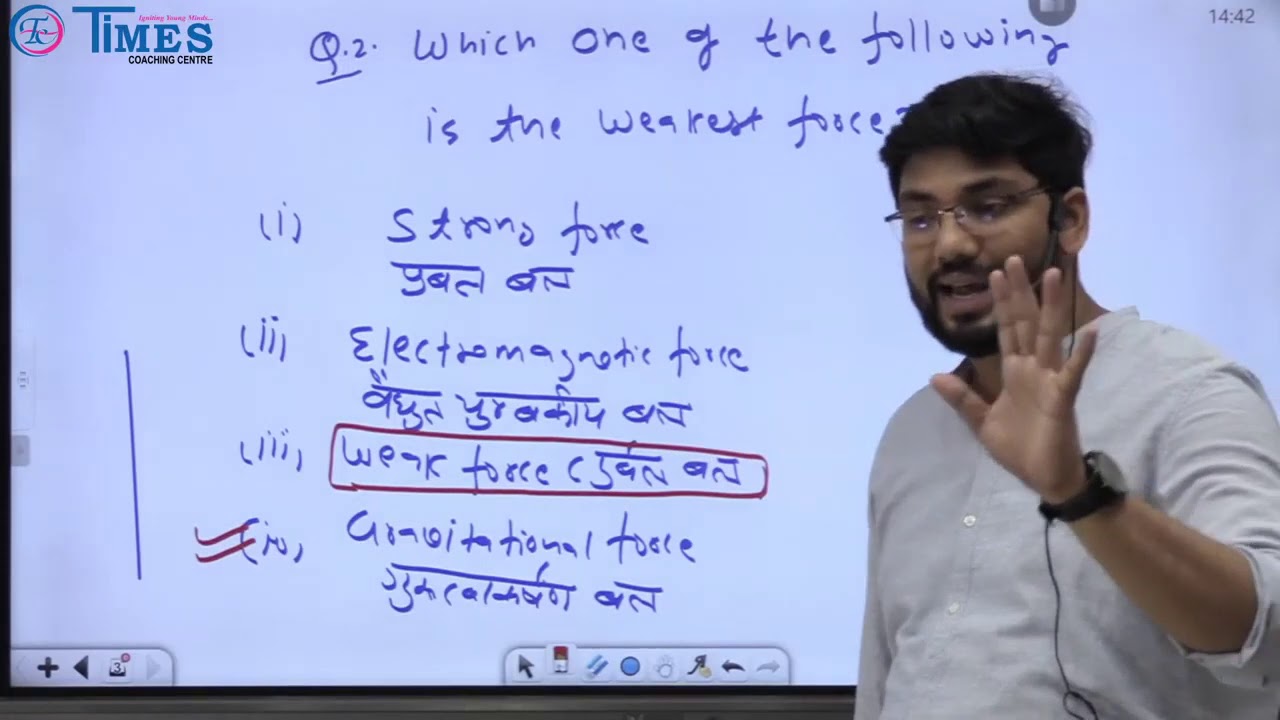
Modern physics class 1 ssc/nda/cds/pcs/airforce/pcs
11.7K
Fundamental particles (elementary particles) cannot be broken down further, while composite particles are made up of fundamental particles. Electrons are fundamental particles belonging to the lepton family, but protons and neutrons are composite particles made of quarks. This distinction is important for understanding the structure of matter.
Click to watch →

Fundamental vs. Composite Particles and the Standard Model - IB Physics
13.8K
A composite particle is a particle made of other smaller particles. A fundamental or elementary particle is a particle that is not made of other smaller particles and cannot be broken up into smaller pieces.
Click to watch →

Particle Physics (Part-II) Interview Questions
1.5K
Fundamental particles are particles that are not composed of any other particles. In the Standard Model, fundamental particles include: 6 quarks (up, down, charm, strange, top, bottom) and 6 leptons (electron, muon, tau, and their corresponding neutrinos). Composite particles are made up of fundamental particles. For example, protons and neutrons are composite particles made of quarks. Hadrons (baryons and mesons) are composite particles made of quarks. Leptons are fundamental particles that do not participate in the strong interaction. Understanding the distinction between fundamental and composite particles is essential for understanding particle physics.
Click to watch →
Physics| Nuclear and Particle Physics| Basics of Elementary Particles| CSIR NET/JRF,IIT JAM, CUET PG
19.4K
Fundamental particles cannot be broken down further and include electrons and quarks. Composite particles are made up of other particles, such as protons and neutrons which are composed of quarks. This distinction is fundamental to understanding the structure of matter in the universe.
Click to watch →
Prerequisite Knowledge
- Concept 01Basic atomic structure, including the classical model of the atom with protons, neutrons, and electrons.
- Concept 02The concept of electric charge, specifically the idea of positive and negative integer charges.
- Concept 03An introductory understanding of the four fundamental forces of nature, with an emphasis on the electromagnetic and strong nuclear forces.
- Concept 04The distinction between elementary (fundamental) particles and composite (made of other particles) structures.
Subsequent Learning
- Step 01The Standard Model of Particle Physics, integrating quarks and leptons with gauge bosons (force carriers) and the Higgs boson.
- Step 02Quantum Chromodynamics (QCD), including the concept of 'color charge' and how gluons bind quarks together.
- Step 03The phenomenon of quark confinement and why quarks cannot exist as isolated free particles in nature.
- Step 04Weak interactions and particle decay, specifically how quarks change flavors during processes like beta decay.
- Step 05The role of high-energy particle accelerators, such as the Large Hadron Collider (LHC), in discovering and studying these subatomic particles.
Quark Basics
Leptons & More
Quark Basics
0:00Playing Section
- 1
Explains six quark flavors and their fractional charges.
- 2
Details proton and neutron quark compositions.
- 3
Notes existence of antiquarks, totaling twelve.
Preon Theory: Are Quarks and Leptons Truly Fundamental?
While the Standard Model of particle physics treats quarks and leptons as indivisible, point-like, fundamental particles, an alternative hypothesis known as Preon Theory suggests they may actually be composite structures. Proposed in the late 20th century, Preon Theory posits the existence of even smaller, more fundamental sub-constituents called "preons." Proponents of this theory argue that a composite model could explain the repetitive generations of quarks and leptons and why they possess specific fractional electric charges, much like how the discovery of quarks simplified the complex "particle zoo" of hadrons. Although there is currently no experimental evidence supporting preons, and modern particle colliders have constrained their potential size to extremely small scales, Preon Theory remains a key conceptual counterpoint. It challenges students to question whether we have truly reached the fundamental building blocks of nature, or if quarks and leptons are merely another layer in an ongoing nested structure of matter.
Deep Dive
The Standard Model of Particle Physics, integrating quarks and leptons with gauge bosons (force carriers) and the Higgs boson.
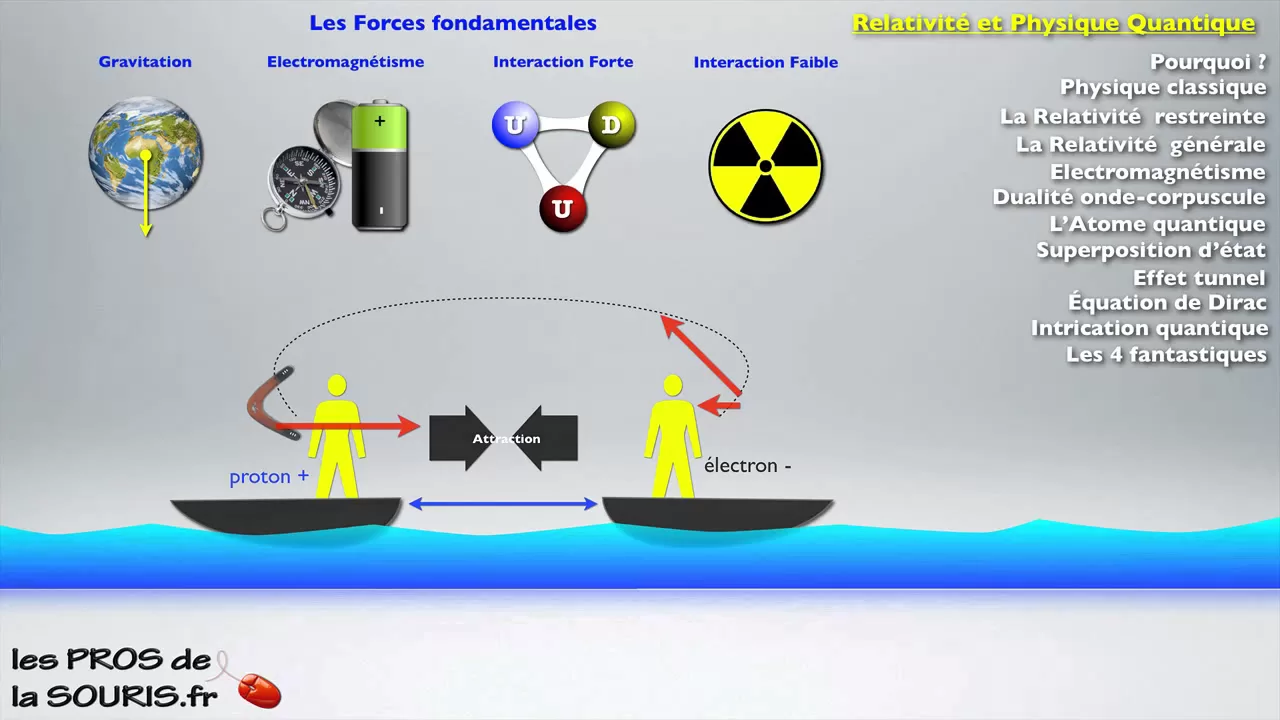
Einstein entre relativité et mécanique quantique ! partie 3
41.1K
The Standard Model is the current best theory describing all known particles and forces (except gravity). It includes fermions (matter particles) - quarks and leptons, with three generations of increasing mass; gauge bosons (force carriers) - photons (electromagnetism), W and Z bosons (weak force), gluons (strong force); and the Higgs boson, which gives particles their mass. The model has been remarkably successful in predicting experimental results. However, it does not include gravity or explain dark matter/energy. The Higgs mechanism explains how particles acquire mass through interaction with the Higgs field - particles that interact strongly are heavy, while those that don't interact (like photons) have zero mass.
Click to watch →
Sean Carroll on Radical Simplicity in Physics and Spacetime
590.1K
The standard model combines quantum field theory with the known particles and forces. It has been remarkably successful, matching all experimental data to date. It includes six quarks, six leptons arranged in three families, and force carriers (photons, gluons, W/Z bosons). The Higgs boson was discovered in 2012, completing the predicted particle list. However, dark matter and other phenomena suggest the model is incomplete.
Click to watch →

1a: Introdução
5.3K
Each fundamental interaction has specific gauge bosons (force carriers): electromagnetic interaction is mediated by photons (massless, travel at light speed); strong interaction by gluons (massless, carry color charge); weak interaction by W+, W-, and Z bosons (massive, have spin). The Standard Model combines all known fundamental particles and interactions, including matter particles (fermions - quarks and leptons), force carriers (gauge bosons), and the Higgs boson (responsible for mass). The graviton is a hypothetical particle that would mediate gravitational interaction, but in Einstein's general relativity, gravity is spacetime curvature rather than a force.
Click to watch →

Champ magnétique, champ de Higgs…, qu’est-ce qu’un champ ?
25.5K
The Standard Model classifies fundamental particles into quarks (participating in strong interaction), leptons (including neutrinos and charged leptons), and gauge bosons (photon, W±, Z, gluons). The Higgs mechanism gives mass to particles coupled to the Higgs field while leaving others massless. This framework successfully describes all known fundamental interactions except gravity.
Click to watch →

Standard Model I - Lecture 1 - 16.11.2021
190
The Standard Model describes fundamental particles and their interactions. Quarks (up, down) interact through all four forces and get mass from the Higgs. Leptons (electrons, neutrinos) interact through electromagnetic and weak forces. Gauge bosons (photon, W, Z, gluons) mediate forces, with the Higgs being fundamentally different as it is not a gauge boson. A major limitation is that the Standard Model predicts massless neutrinos, but experiments show they have small masses and oscillate between flavors.
Click to watch →
Deep Dive
Quantum Chromodynamics (QCD), including the concept of 'color charge' and how gluons bind quarks together.

The Cosmological Particle Zoo: The Stuff of the Universe!
2.2K
Quantum chromodynamics (QCD) explains how quarks bind together through color charge—a property with three values: red, green, blue. Gluons carry color-anticolor combinations. Baryons require all three colors to achieve color neutrality (white). This explains why quarks never appear isolated but always form color-neutral combinations. The theory resolves the 'quark confinement' problem and provides the fundamental mechanism for nuclear binding.
Click to watch →

The Strong Force: Unseen Glue of Matter
180
QCD describes the fundamental strong force between quarks using color charge—a quantum property analogous to electric charge but with three types (red, green, blue) plus three anti-colors. Each quark carries one color charge, and antiquarks carry anti-color. The force carriers are gluons (eight types), unlike photons which carry no charge. Crucially, gluons themselves carry color charge and interact with each other, making QCD mathematically far more complex than electromagnetism. This self-interaction leads to confinement: quarks are never found alone because the force doesn't weaken with distance—it stays constant or increases, acting like an unbreakable rubber band. When energy is poured in to separate quarks, new quark-antiquark pairs form instead, keeping quarks confined within color-neutral particles.
Click to watch →

Beyond Nanotech to Femtotech | Hugo de Garis | Humanity+ Hong Kong Summit 2011
253
Quantum Chromodynamics (QCD) is the branch of physics that studies quarks and gluons. Quarks have a property called 'color charge,' which comes in three types (red, blue, green) plus their antiparticles (anti-red, anti-blue, anti-green). Gluons, which bind quarks together, carry two color charges simultaneously (e.g., red-anti-blue). This color charge conservation is fundamental to how quarks interact.
Click to watch →

PHYS 4C - Lecture 30 - The Standard Model
226
The strong interaction is mediated by gluons (force carriers with 'G' designation). Gluons carry color charge and are responsible for binding quarks together in hadrons. The name 'gluon' comes from 'glue' because it binds quarks together. Color charge is a quantum number in the strong interaction with three types: red, green, and blue (and their antiparticles). Unlike electromagnetism which has only one type of charge, the strong interaction has three color charges. This three-fold symmetry is the basis for the color charge concept in QCD.
Click to watch →
PP(2) QCD(CHROMODYNAMICS),Asymptotic Freedom,Quark Confinement,Glueballs,Yukawa Pion Exchange Model.
501
Quantum Chromodynamics (QCD) is the theory describing the strong nuclear force that binds quarks together. Unlike electromagnetism where photons mediate forces without carrying charge, gluons in QCD carry color charge themselves. Quarks possess both electric charge (fractional values like +2/3e and -1/3e) and color charge (red, green, blue). Color conservation laws govern interactions, requiring that total color charge remains constant. During strong interactions, quarks can exchange gluons and change their color, but the overall system maintains color neutrality. This framework explains how quarks combine to form protons, neutrons, and other hadrons while remaining confined within them.
Click to watch →
Deep Dive
The phenomenon of quark confinement and why quarks cannot exist as isolated free particles in nature.

Atomun Ötesinde: Maddenin Kalbine, Sonsuz Küçüklüğe Doğru İNANILMAZ Bir Dalış
242K
Quark confinement is the phenomenon that quarks are never found in isolation but always combine to form hadrons. This is because the strong nuclear force becomes stronger as quarks are separated, making it impossible to isolate a single quark. The energy required to separate quarks would create new quark-antiquark pairs, resulting in new hadrons rather than isolated quarks. This is why we never observe free quarks in nature.
Click to watch →

Parçacıklar Nasıl Kütle Kazanır? | Atom Altı Parçacıklar ve Standart Model | PDF
140.2K
Quarks cannot exist freely in isolation due to a property called color confinement. They must always be bound together in groups (either three quarks for baryons or quark-antiquark pairs for mesons). This is why we never observe isolated quarks in nature - they are always confined within hadrons.
Click to watch →

Elementary Particles - A Level Physics
196.7K
Quarks cannot exist in isolation; they are always found within composite particles like protons, neutrons, or mesons. This phenomenon is called confinement. If you attempt to separate a quark from a proton by providing enormous energy, pair production occurs instead—creating a quark-antiquark pair from the energy. The original quark combines with the new antiquark to reform the original particle, while the new quark combines with another antiquark to form a meson. Thus, you never obtain a free quark, only new particle combinations.
Click to watch →
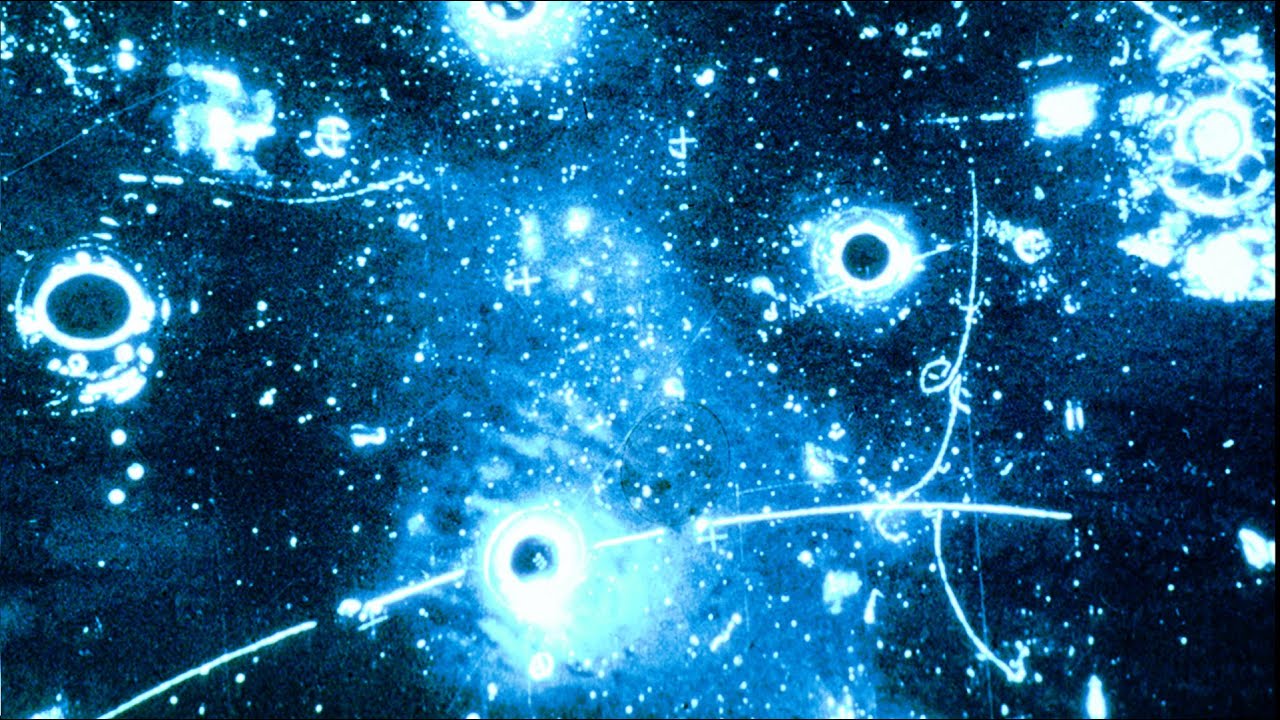
Fizyka cząstek elementarnych – przekraczanie granic poznania, Paweł Malecki
450.8K
A key property of quarks is that they cannot exist as free, isolated particles. When attempts are made to separate quarks from each other (such as trying to pull apart a proton), the energy required increases dramatically. Instead of producing free quarks, this energy creates new particle-antiparticle pairs (such as quark-antiquark pairs), preventing quarks from ever being observed individually. This phenomenon is called 'quark confinement' and is a fundamental aspect of the strong nuclear force.
Click to watch →

¿Conoces los campos de Yang-Mills?
39.7K
This section explores the phenomenon of confinement, explaining why quarks cannot exist in isolation. Unlike electromagnetic interactions where separating charges weakens the force, the strong interaction behaves oppositely—separating color-charged particles actually strengthens the interaction. Gluons act like springs connecting quarks; the more you try to separate them, the more energy you must add to the system. Nature follows the principle of minimizing energy expenditure, so when attempting to separate quarks, it becomes energetically favorable for the vacuum to spontaneously produce a quark-antiquark pair rather than continuing to separate the original quarks. This results in quarks only appearing in bound states called hadrons (such as protons and neutrons), which have overall color-neutral charge. The video concludes with a comparison table highlighting key differences: photons lack charge and don't self-interact, while gluons have color charge and do self-interact; electromagnetic interactions weaken at long distances allowing free particles, while strong interactions strengthen with distance causing confinement.
Click to watch →
Deep Dive
Weak interactions and particle decay, specifically how quarks change flavors during processes like beta decay.
PHYS 4C - Lecture 30 - The Standard Model
226
The weak interaction has elementary vertices where particles change flavor. For leptons: an electron and antineutrino can annihilate to form a W⁻ boson. For quarks: a down quark and anti-up quark can annihilate to form a W⁻ boson. The weak interaction is the only fundamental interaction that can change quark flavor. For example, a down quark (charge -1/3 e) can turn into an up quark (charge +2/3 e) by emitting a W⁻ boson. This flavor-changing property is essential for processes like beta decay.
Click to watch →
The Four Horsemen of Physics
37.6K
The weak interaction enables quarks to change flavor (type), which is essential for beta decay. In neutron decay, a down quark converts to an up quark via the weak force, transforming a neutron into a proton while emitting an electron and anti-neutrino. Similarly, protons can convert to neutrons by emitting a positron and neutrino. This force is unique in breaking CP symmetry, meaning matter and antimatter decay differently, which helps explain why our universe contains more matter than antimatter.
Click to watch →
Elementary Particles - A Level Physics
196.7K
The weak interaction is one of the four fundamental forces and is responsible for changing the flavor of quarks. It converts up quarks to down quarks and vice versa. In beta decay, a neutron decays into a proton, electron, and anti-electron neutrino. The neutron (udd) transforms into a proton (uud), requiring a down quark to change to an up quark. Similarly, in the Sun's core, protons convert to neutrons via the weak interaction, producing positrons and electron neutrinos. This quark-flavor transformation is mediated by W bosons.
Click to watch →
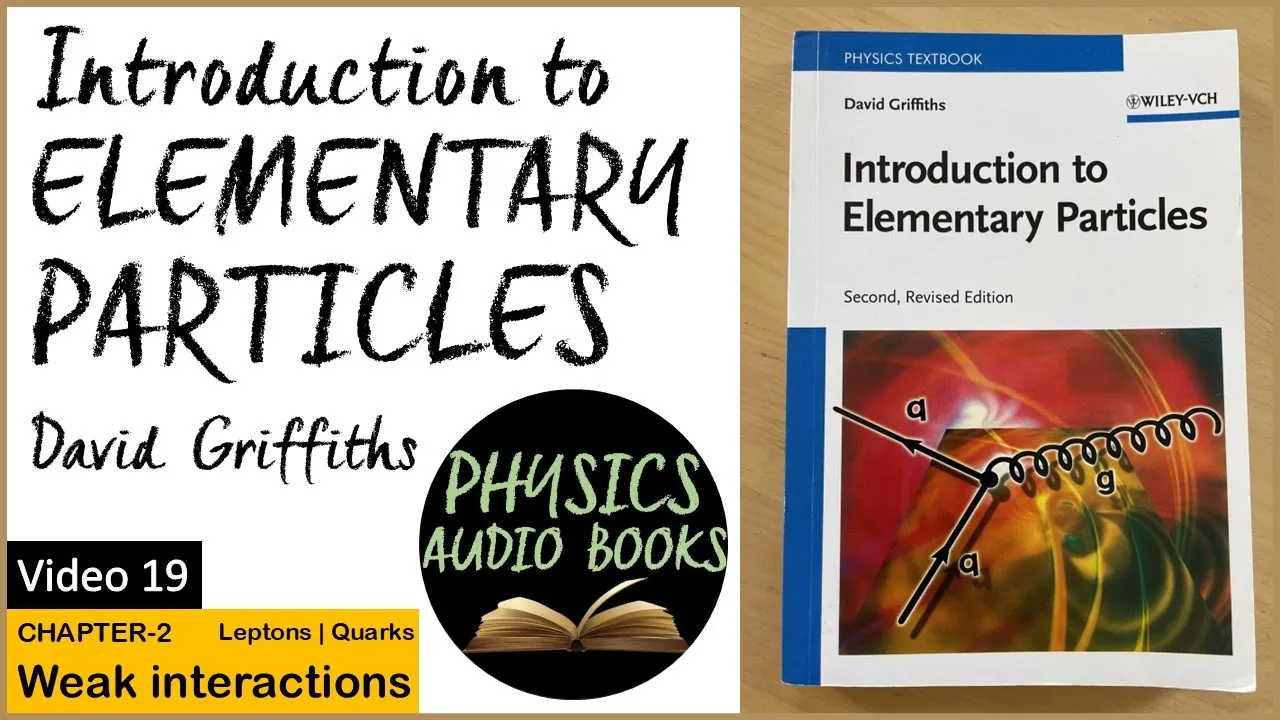
Introduction to elementary particles | David Griffiths | Chapter 2 | Weak interactions | Quarks
435
Weak interactions are mediated by W and Z bosons, with all quarks and leptons carrying weak charge; unlike electromagnetic or strong forces, weak interactions violate flavor conservation, allowing quarks to change flavor (e.g., strange to up) through the Cabibbo-Kobayashi-Maskawa mechanism, which explains processes like neutron beta decay and strange particle decays through a 3x3 mixing matrix that permits cross-generational transitions.
Click to watch →
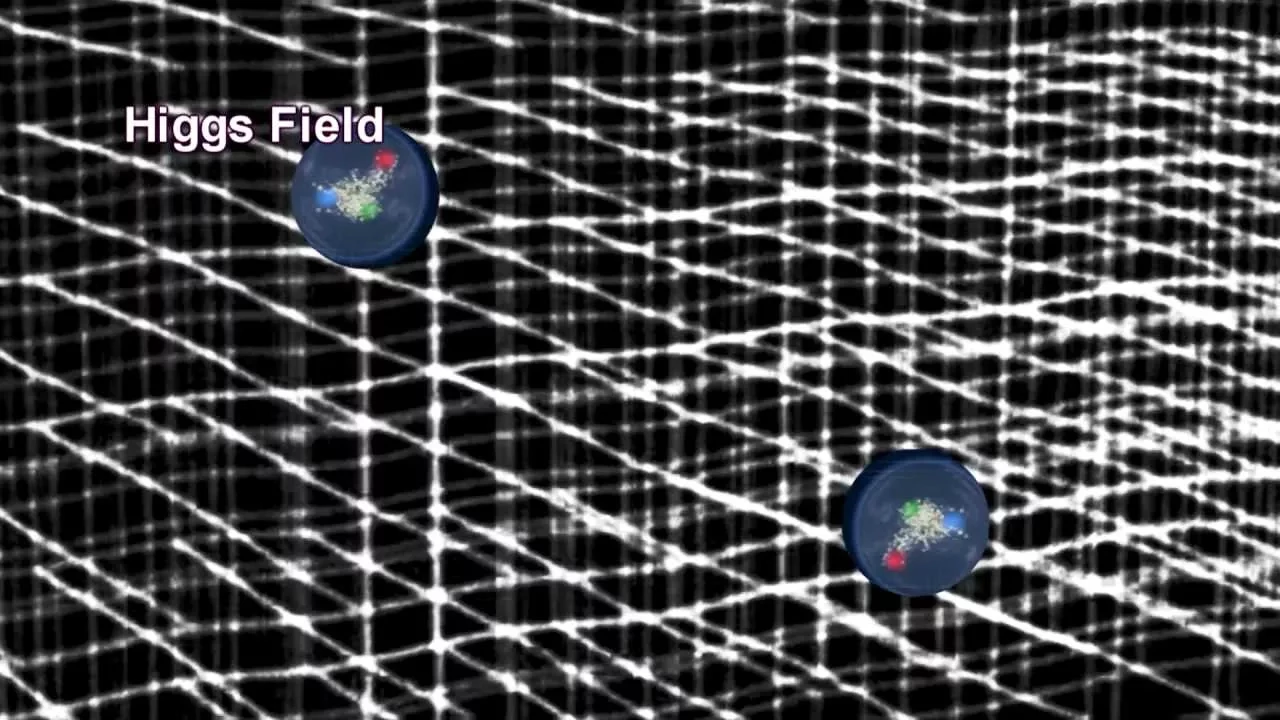
The Higgs Boson - GOTO 4K 2021 EDITION - https://youtu.be/znbfrubQ2F8
982.2K
Beta decay illustrates how the weak force works. The process has two phases: First, a down quark drops to a lower energy up quark and emits a W boson. However, because the W boson is so massive, there isn't enough energy in the quark transition to create a full independent W boson—only a virtual W boson is created. In the second phase, because there is enough energy in the virtual W boson, it decays into an electron and a neutrino. This is possible because both the electron and neutrino carry weak hypercharge. The weak force can change one flavor of quark into another, which is why a neutron (containing a down quark) can transform into a proton (containing an up quark).
Click to watch →
Deep Dive
The role of high-energy particle accelerators, such as the Large Hadron Collider (LHC), in discovering and studying these subatomic particles.
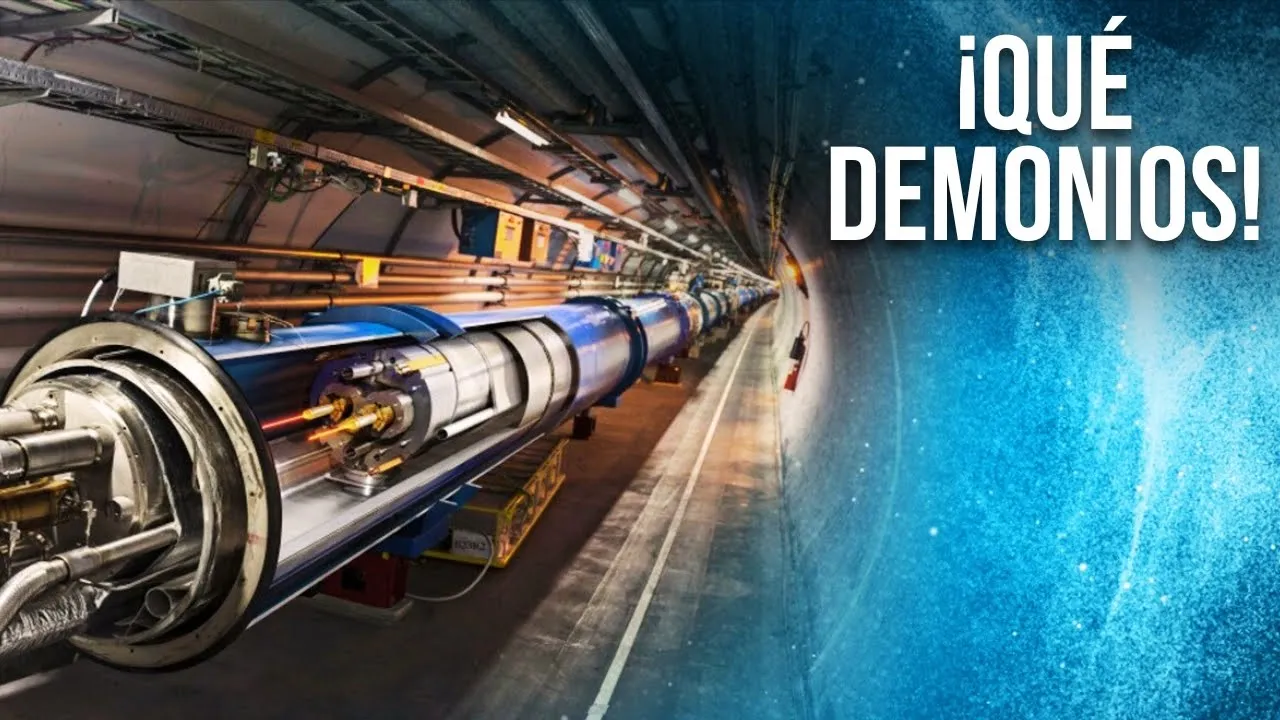
¡Los científicos anuncian un nuevo descubrimiento del gran colisionador de hadrones!
197.4K
The Large Hadron Collider (LHC) at CERN in Geneva, Switzerland, is the world's largest and fastest particle accelerator. It uses superconducting magnets and proton beams to accelerate particles to extreme speeds, enabling scientists to study subatomic particles that are too small to be seen directly. Since particles cannot be observed with even the most powerful microscopes, scientists must detect their interactions to understand their properties. The LHC has been closed since 2016 and recently resumed operations with new experiments, including the AWAKE experiment testing plasma wakefield acceleration technology. Scientists are also conducting climate experiments using the installation's shielded environment to study global warming, though critics question whether underground experiments could affect the planet's atmosphere.
Click to watch →
Accélérateurs de Particules #08 Science
450.3K
Particle accelerators are built to probe the fundamental nature of matter and understand the origins of the universe. The Large Hadron Collider (LHC), located on the Franco-Swiss border near Geneva, represents humanity's most ambitious attempt to answer what the universe is made of. In 1889, humanity knew of zero particles from the modern Standard Model. J.J. Thomson's 1897 cathode ray tube experiment discovered the electron, a negatively charged particle with mass 1,800 times less than hydrogen atoms. This revolutionized physics by revealing atoms have internal structure. The Crookes tube used to discover the electron is technically the world's first particle accelerator. In 1909, Ernest Rutherford bombarded gold foil with alpha particles from radon gas (a natural accelerator with 5 MeV energy), discovering that atoms contain a tiny, dense, positively charged nucleus occupying only about 1/10,000th of the atom's volume. In 1919, Rutherford achieved the first controlled nuclear reaction by bombarding nitrogen with alpha particles, transforming nitrogen into oxygen while emitting protons.
Click to watch →

What No One Realizes About CERN
2.3K
Inside the LHC, two high-energy particle beams travel at practically the speed of light inside ultra-high vacuum tubes, mimicking space conditions. Superconducting electromagnets chilled to temperatures colder than space steer and concentrate beams at designated impact centers. When beams smash into particles with tremendous energy, they produce an assortment of subatomic particles, some incredibly unstable and existing only for fractions of a second. The LHC is equipped with enormous detectors (ATLAS, CMS, ALICE, LHCb) that capture data about particles including mass, charge, and energy. This data helps physicists test assumptions for particle physics theories including the Standard Model. Key discoveries include the Higgs boson (2012), which confirmed how particles acquire mass, and the discovery of pentaquarks and tetraquarks—particles made of four and five quarks respectively. These discoveries broaden our understanding of hadronic matter and the strong force that holds atomic nuclei intact.
Click to watch →

The three new Exotic sub-atomic particles discovered by LHC- IN FOCUS | Drishti IAS
33K
The Large Hadron Collider (LHC) is the world's largest particle accelerator, a 27-kilometer tunnel on the Switzerland-France border operated by CERN since 2008. It accelerates protons to near light speed using 25,000 kilometers of superconducting magnets cooled to -271.93°C with liquid helium. The LHC smashes particles to study fundamental physics, discovering the Higgs boson in 2012. Matter consists of hadrons (protons, neutrons made of quarks) and leptons (electrons). Quarks come in six types: up, down, charm, strange, top, and bottom. This research reveals the universe's composition: 4% ordinary matter, 71.5% dark energy, and 23% dark matter.
Click to watch →

Pescando partículas en el LHC del CERN - por la Dra. Isabel Pedraza
179
The Large Hadron Collider (LHC) enables scientists to study fundamental particles that compose matter. Cosmic rays are high-energy particles from space that collide in the atmosphere, creating particle showers at approximately 100,000 per hour. Matter is composed of fundamental particles called quarks, which combine to form protons and neutrons. To observe these particles, scientists must use very high energy. Einstein's equation E=mc² establishes that energy and matter are interchangeable. The Standard Model describes four fundamental forces: the strong force (mediated by gluons) holds atomic nuclei together; the electromagnetic force governs everyday experiences; the weak force (mediated by W and Z bosons) controls nuclear reactions; and gravity remains unexplained. In the 1960s, scientists discovered that particles have different masses but the theory did not explain how they acquired mass. In 1964, François Englert, Robert Brout, and Peter Higgs proposed a theory of symmetry breaking that explains mass acquisition. The Higgs field permeates all space, and particles interact with it differently: photons travel without resistance, while electrons interact more and move slower. Particles with greater interaction have more mass. The LHC is a 27-kilometer circular accelerator on the France-Switzerland border with four interaction points. CMS and ATLAS are general-purpose experiments (4-5 story buildings), while LHCb studies matter-antimatter asymmetry and ALICE studies the universe's initial conditions. The accelerator uses superconductors requiring near-zero temperatures and must maintain extreme vacuum. Proton bunches collide at 400 million times per second, with only 1% recorded. The energy (13.6 TeV) is equivalent to a 400-ton train but concentrated at a mosquito's tip, sufficient to melt 500 grams of copper. In the LHC, entire bunches of protons collide rather than individual protons. The CMS detector is 15 meters tall and 25 meters long, with specialized layers: silicon trackers with hair-fine resolution, electromagnetic calorimeters with crystals for electrons and photons, hadronic calorimeters for protons and neutrons, a superconducting solenoid for magnetic fields, and muon chambers with iron plates. Charged particles curve in magnetic fields based on energy, with lower energy particles curving more. Scientists reconstruct particle trajectories by connecting detector points, identifying collision vertices where the most energy is exchanged. The Higgs boson was discovered in 2012 by combining CMS and ATLAS data. The 'golden channel' was decay into two photons, appearing as energy deposits in electromagnetic calorimeters. Scientists calculated invariant mass of photon pairs and looked for a peak at 125 GeV. The discovery required 5 sigma statistical significance (probability of random fluctuation less than 1 in 3.5 million).
Click to watch →
Quark Basics
Leptons & More
Quark Basics
0:00- 1
Explains six quark flavors and their fractional charges.
- 2
Details proton and neutron quark compositions.
- 3
Notes existence of antiquarks, totaling twelve.
Preon Theory: Are Quarks and Leptons Truly Fundamental?
While the Standard Model of particle physics treats quarks and leptons as indivisible, point-like, fundamental particles, an alternative hypothesis known as Preon Theory suggests they may actually be composite structures. Proposed in the late 20th century, Preon Theory posits the existence of even smaller, more fundamental sub-constituents called "preons." Proponents of this theory argue that a composite model could explain the repetitive generations of quarks and leptons and why they possess specific fractional electric charges, much like how the discovery of quarks simplified the complex "particle zoo" of hadrons. Although there is currently no experimental evidence supporting preons, and modern particle colliders have constrained their potential size to extremely small scales, Preon Theory remains a key conceptual counterpoint. It challenges students to question whether we have truly reached the fundamental building blocks of nature, or if quarks and leptons are merely another layer in an ongoing nested structure of matter.
Basic atomic structure, including the classical model of the atom with protons, neutrons, and electrons.
The concept of electric charge, specifically the idea of positive and negative integer charges.
An introductory understanding of the four fundamental forces of nature, with an emphasis on the electromagnetic and strong nuclear forces.
The distinction between elementary (fundamental) particles and composite (made of other particles) structures.
The Standard Model of Particle Physics, integrating quarks and leptons with gauge bosons (force carriers) and the Higgs boson.
Quantum Chromodynamics (QCD), including the concept of 'color charge' and how gluons bind quarks together.
The phenomenon of quark confinement and why quarks cannot exist as isolated free particles in nature.
Weak interactions and particle decay, specifically how quarks change flavors during processes like beta decay.
The role of high-energy particle accelerators, such as the Large Hadron Collider (LHC), in discovering and studying these subatomic particles.
226.8K views2.4Klikes4:02@fizzicsorgOriginal Release: 2014-03-28
[Music] [Music] The idea that nucleons that is protons and neutrons could be split into smaller particles was developed in the 1960s.
These smaller particles were called quarks. The theory developed to identify six types or flavors of quarks. These were rather weirdly but memorably named as up and down, charm and strange top and bottom. Three of these up, charm and top have a charge of plus 2/3 whereas down, strange and bottom have a charge of minus 1/3. Only two of the quarks are stable and they make up all normal matter that is protons and neutrons.
Hydrons are particles which are made up from quarks. Of these barrians comprise three quarks and mezison two. The group of particles called barons of which protons and neutrons are the most significant members are composed of three quarks.
The proton one down and two up quarks and the neutron two down and one up quark. The charges on these quarks comprise the total charge on each of the nucleons. For instance, a proton is made from two up quarks charged 2/3 and one down quark charged minus a3. The total charge is therefore one. A neutron is two down and one up quark. And those charges cancel out to zero. That is 2/3 - a3 - a3. I started by saying there are six quarks, but in fact there are 12 because each quark has an antiparticle, an anti-up, an anti- down, and so on. Therefore, there are 12 in total. None of the anti-quarks are stable. Mezins are unstable particles consisting of a quark and an anti-quark.
An example of this is the pyzin or pion which has an up quark and a down anti-quark. The strange quark was so cool because the mezzones that included it had a strangely long life, only about a nancond, but longer still than the other mezons. For the last of our examples, this particle, the negative kon, consists of a strange quark and an anti-up quark. So far as we're concerned, the most important lepton is the electron.
But there are two of us, the mule and the toao. Or if we count the associated neutrinos, there are six leptons. The electron-like particles and the neutrinos exist as a weak dlet. The pairing is sometimes likened to a dog with a flea. And like fleas, neutrinos can exist separately. The electron with its neutrino is part of all normal matter in our universe. And these are stable particles, although in fact all of the neutrinos are stable. Whereas the charged mu and towel are not. We said there were six leptons or perhaps three but in fact we can count 12 because every particle has its antiparticle. The antimatter electron is called the posetron and it is also stable unless of course it collides with its counterpart the electron. If a particle collides with its corresponding antimatter particle then they will annihilate. The resulting pulse of energy may be emitted as photons or converted into other particles. Notes supporting this video are available on the website. Thank you for watching. For free notes to support this video and to view many other videos with supporting notes, please go to the website at www.physics.org.
[Music]
Up Next
59:44
Beyond the Higgs: What's Next for the LHC? - with Harry Cliff
@TheRoyalInstitution
3.2M views•2018-01-17

12:53
21cm Hyperfine Transition in Neutral Hydrogen: Radio Astronomy Basics
@AaronRobertParsons
12.4K views•2011-10-13

32:32
NMR Spin Physics I: Zeeman Effect, Resonance Condition & Larmor Frequency
@nptel-indianinstituteofsci8064
2.3K views•2024-01-17

27:14
Entropy and the Second Law of Thermodynamics Explained
@veritasium
27.5M views•2023-07-01
Related Study Plans & Knowledge Roadmaps
Structured learning paths in Physics
physics
Nuclear Physics (Decay, Fission & Reactors)
01Atomic Structure and the Binding Force
02Radioactive Decay and Half-Life
03Nuclear Fission Mechanics and Chain Reactions
+ 2 more learning modules
12h5 modules
Explore Roadmap
physics
Soft Matter (Polymers, Colloids & Rheology)
01Foundations of Soft Matter & Thermal Forces
02Polymer Physics and Macromolecules
03Colloids, Surfactants, and Self-Assembly
+ 2 more learning modules
38h5 modules
Explore Roadmap
physics
Analytical Mechanics: Lagrangian & Hamiltonian
01Mathematical Foundations: Calculus of Variations
02From Newtonian Mechanics to Constraint Dynamics
03The Principle of Least Action & Lagrangian Mechanics
+ 3 more learning modules
28h6 modules
Explore Roadmap
physics
General Relativity (Spacetime & Cosmology)
01Foundations of Relativity: Special Relativity
02The Geometry of Spacetime: Equivalence Principle & Curvature
03Einstein's Field Equations: The Mathematics of Gravity
+ 2 more learning modules
55h5 modules
Explore Roadmap