






















![SACANI RESPONDE [URANO E NETUNO] - Ciência Sem Fim #137](https://i.ytimg.com/vi/oz8eHgI3gSI/maxresdefault.jpg)
Uranus is the most catastrophically altered planet in our solar system, having been struck by a body 1-3 times Earth's mass early in the solar system's history, which knocked it onto its side with a 97.8° axial tilt. This impact also created stable internal stratification that trapped heat, making Uranus colder than Neptune despite being closer to the Sun. The collision explains Uranus's unique features: its sideways rotation, extreme 21-year polar seasons, diamond rain in its interior, and the tilted, off-center magnetic field generated by convection in its electrically conducting icy mantle. This single event demonstrates how early solar system collisions shaped planetary characteristics and provides insights into ice giant formation and migration.
Uranus: The Extreme Physics of a Tilted Ice Giant
Added:Tonight, we're going to look at the planet in our solar system that broke every rule anyone thought they understood about how worlds are supposed to work. Uranus. It spins on its side.
Its moons orbit at a right angle to everything else in the solar system.
It's colder than Neptune. Even though Neptune is almost a billion miles farther from the sun, it has a magnetic field so strange that even the scientists who study it describe it as formerly chaotic. It may be raining diamond in its interior right now. And for decades, it was the planet nobody prioritized.
But here's what they missed. Uranus is the most catastrophically altered planet in the solar system. A world that was struck so hard so [snorts] early in its history that it was knocked nearly onto its side and has been rolling through space that way ever since. By the end of tonight, you're going to understand why Uranus is the most physically extreme planet we have. What happened to it that made it that way? And why the answers to those questions matter for understanding not just one strange planet, but the entire history of how our solar system formed. Before we get started, if you love exploring the depths of space as much as we do, take a second to like the video or subscribe.
It's a simple action, but it helps this channel reach more curious minds like yours. Now, let's begin. Every planet in the solar system formed from the same cloud of gas and dust roughly 4 and a half billion years ago. The sun coalesed at the center of that cloud, igniting under its own gravity, while the leftover material spread into a flat rotating disc around it. Over millions of years, dust particles stuck to each other, clumped into pebbles, pebbles into boulders, boulders into bodies large enough for their own gravity to pull in more material.
Planets grew from that process. They assembled themselves out of whatever was available in their region of the disc.
And because all of that material was rotating together in the same direction, in the same flat plane, all the planets inherited that shared geometry. They orbit the sun in the same direction, counterclockwise, when viewed from above the sun's north pole. They rotate in roughly that same direction and their axes of rotation stand more or less perpendicular to the plane of the solar system.
The technical term for this axial orientation is oblquity.
A planet with zero oblquity would have its rotation axis pointing straight up perpendicular to its orbital plane. Its poles would never tilt toward or away from the sun.
It would have no seasons.
Every location on the surface would receive roughly the same amount of sunlight throughout the year. None of the planets are quite at zero oblquity, and that's expected. Collisions during formation, gravitational tugs from neighboring bodies, the complex dynamics of planetary accretion, all introduce small deviations.
Earth tilts at about 23 and 12°.
Mars tilts at about 25°.
Saturn leans at about 27°.
Even Venus, which rotates in the opposite direction to most planets, is only tilted about 177°, which is essentially upside down. But at least still in the general orientation of the solar system plane. Jupiter sits at only 3° nearly perfectly upright.
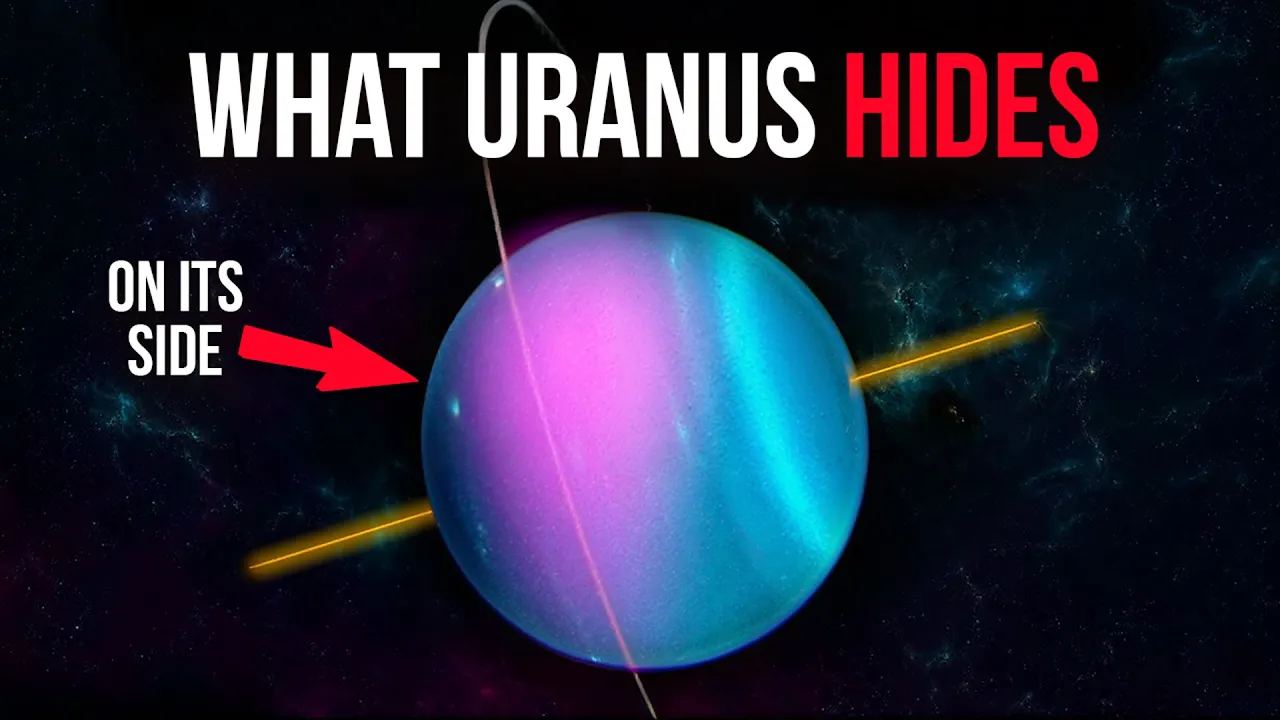
Mercury tilts less than one degree. Then there's Uranus. Uranus has an oblquity of 97.8°.
That means its axis of rotation isn't pointing up. It isn't pointing down.
It's pointing sideways, almost perfectly parallel to the plane of the solar system. Uranus doesn't spin upright. It rolls like a ball knocked over on a table, never set back up. That single number, 97.8°, makes Uranus unlike anything else in the solar system. And once you understand what that tilt actually means for the planet's experienced reality, the strangeness stops being a curiosity and starts being something genuinely extreme.
A planet tilted on its side doesn't experience seasons the way Earth does.
On Earth, our 23 12° tilt means the northern hemisphere leans toward the sun in June and away from it in December.
The difference is modest.
Neither pole points directly at the sun.
The extra sunlight each hemisphere receives during summer is significant but not overwhelming. We get warmer summers and colder winters with the transitional months of spring and autumn in between. Uranus gets something incomparably more extreme. for roughly 21 years at a time. One pole of Uranus points almost directly at the sun.
During those 21 years, that pole sits in continuous daylight, not morning and evening, not a day that cycles into night, continuous uninterrupted sunlight for two full decades, while the opposite pole sits in total darkness. also for two full decades.
Then Uranus continues along its orbit.
Its orientation relative to the sun slowly shifts. The pole that was in darkness begins to receive light. The pole that was lit begins moving into the long night. And in between, during brief transitional periods, the equatorial regions finally see something resembling the familiar alternation of day and night. Uranus takes 84 Earth years to complete one orbit. Those extreme polar seasons each last about 21 years.
one quarter of a uranian year in permanent daylight, one quarter in permanent darkness with two transitional stretches in between. The word season barely captures what this actually means for the planet's atmosphere and weather.
On Earth, the difference in sunlight between summer and winter drives weather systems. Temperature gradients between sunlit and shadowed regions drive winds.
The cycling of seasons keeps the atmosphere dynamic. On Uranus, the atmospheric driver isn't a gentle 6-month alternation. It's a 21-year sunbathing of one hemisphere followed by 21 years of darkness. The winds and weather patterns that result from this kind of forcing are unlike anything in our experience. When Voyager 2 flew past Uranus in January of 1986, that encounter happened to coincide with the South Pole, pointing almost directly toward the sun. Every piece of data Voyager 2 collected about Uranus came from a moment when the planet was at one of its most extreme seasonal configurations.
One hemisphere had been in continuous sunlight for years. The other had been in darkness for years. The atmosphere was not in anything close to its average state. Voyager 2's portrait of Uranus was like photographing Earth from space during the middle of an ice age and concluding you documented the normal climate. It was real data, but it was data from an extreme moment. And for three decades, that snapshot was essentially the entire spacecraft data set we had. Before we go deeper into what Uranus does, let's establish what it's actually made of. Because Uranus is not what most people picture when they imagine a planet. It doesn't have a solid surface you could stand on. If you descended into the atmosphere of Uranus, you would never arrive at a boundary you could call ground. What you'd encounter is a progression of increasingly hostile environments, each one fading into the next without a sharp dividing line. The outermost layers are hydrogen and helium, the two most abundant elements in the universe.
This is true of all four giant planets, but the proportions are different from Jupiter and Saturn. In Jupiter and Saturn, hydrogen and helium make up the vast majority of the planet's total mass. In Uranus, they're present as an outer envelope. But the planet's bulk composition tells a different story.
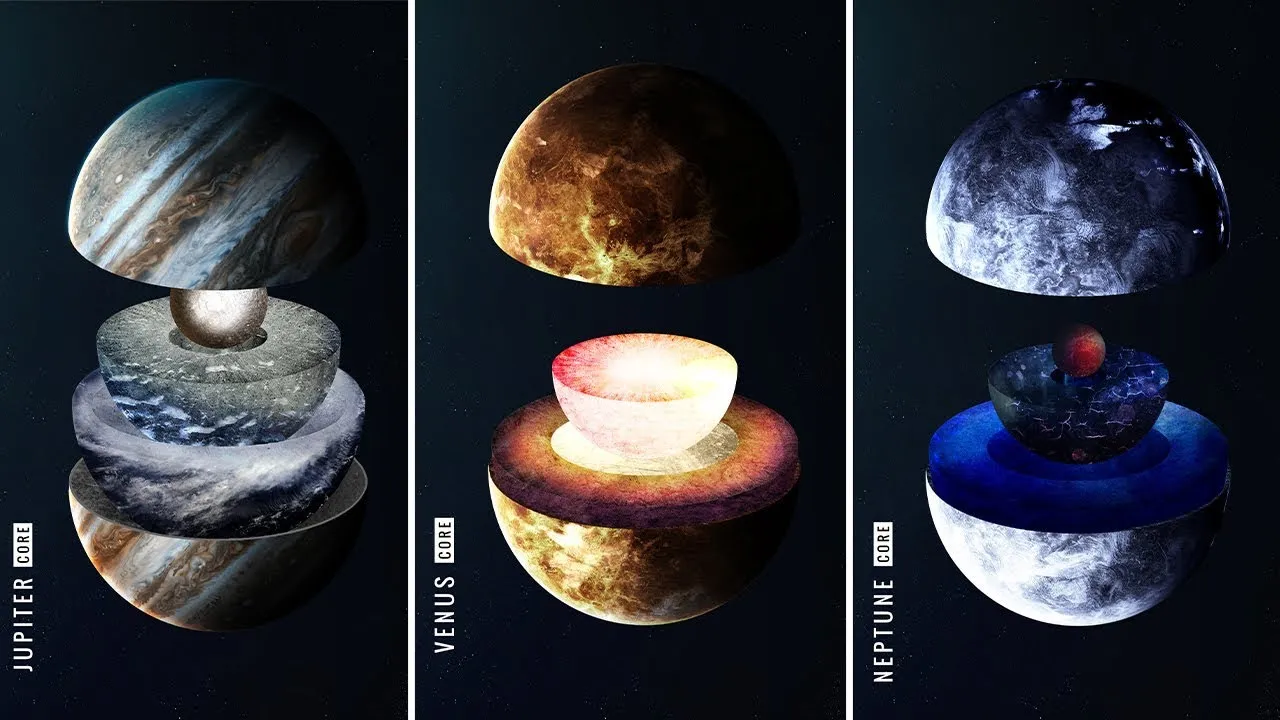
Below the hydrogen and helium outer atmosphere, you enter something different. A deep layer of hot pressurized fluid made primarily of water, methane, and ammonia. Scientists call this [music] the icy mantle, though the word icy is genuinely misleading.
Nothing about it is cold. Under the pressure that exists at those depths, reaching many millions of atmospheres, these compounds are compressed into a hot, dense state unlike anything that exists on Earth's surface. The temperature in this layer climbs from a few thousand° near the upper boundary to potentially tens of thousands of degrees deeper in. Under those conditions, these simple molecules don't behave like anything you'd recognize from everyday chemistry. They're partially ionized, meaning electrons have been stripped from some atoms.
They conduct electricity. They behave more like liquid metal than like the water or methane you'd buy in a store.
This is the layer where Uranus's magnetic field is generated, not in a metallic iron core the way Earth's field is. In this electrically conducting icy fluid, below that, at the very center, there may be a rocky core of heavier elements, iron, silicon, magnesium.
Though at the temperatures and pressures involved, even rock behaves in ways that have no parallel in ordinary experience.
Whether the core is truly solid or in some other exotic high pressure phase is genuinely uncertain. We don't have direct measurements.
Now, within that icy mantle, something remarkable happens that gets discussed far less often than it deserves. Carbon is present in this layer, carried in from methane molecules.
Under intense pressure, carbon atoms can be stripped free from those methane molecules.
And once free, under the extreme pressure conditions that exist inside an ice giant, carbon doesn't remain in a simple molecular arrangement.
It crystallizes into diamond.
Solid diamond precipitating out of the hot fluid interior and sinking slowly toward the core. Diamond rain. The phrase sounds invented, but the physics behind it is not. Laboratory experiments on Earth have used laser pulses and shockwave generators to compress methane to conditions analogous to the interiors of Uranus and Neptune and have directly observed diamond formation occurring.
Published research in the journal Nature Physics and other high-profile scientific journals has confirmed that the process works at the relevant pressures.
What we cannot say with certainty is how pervasive this process is inside Uranus.
Whether the diamonds remain as loose crystals or accumulate into more continuous structures, or how thick a layer of diamond sediment might have built up around the core over billions of years. The model suggests the process could be producing substantial quantities of diamond material per year, multiplied across billions of years.
A layer of diamond may have accumulated at the base of Uranus's icy mantle.
While the outside of the planet sits in blue green calm, the interior may be doing something that on any human scale of value is almost incomprehensible.
The blue green color of Uranus is real and comes from methane.
Methane in Uranus's upper atmosphere absorbs red wavelengths of sunlight and reflects blue and green wavelengths back into space.
When sunlight enters the upper atmosphere, the red portion is captured and scattered while blue and green wavelengths escape back towards space.
What you see when you look at Uranus is the light that got away.
Neptune has the same methane in its atmosphere and is also blue, but Neptune's blue is richer and deeper. The exact reason for the color difference between the two planets isn't fully understood.
One leading explanation involves an aerosol haze layer in Uranus's upper atmosphere that Neptune lacks in the same form. This haze would dilute the color, mixing blue with white and producing the paler, more washed out appearance.
The haze is likely chemically complex.
Ultraviolet sunlight drives reactions between methane and other atmospheric molecules, building up longer chain hydrocarbon compounds, which settle out as fine aerosol particles at high altitudes.
Precisely identifying what's in that haze requires an atmospheric probe that can sample it directly.
But the immediate consequence of the pale blue green calm is that it made Uranus look inactive.
When you compare Uranus to Jupiter with its banded cloud structure and storms and churning jet streams [music] and enormous persistent vortices, Uranus looks empty, featureless.
When Voyager 2 flew past in 1986, the images showed exactly that, a smooth, pale disc with no obvious features.
The planetary science community at the time did not treat Uranus as the scientific priority it deserved.
The instrument packages on Voyager 2 weren't as comprehensive as scientists would have chosen had Uranus been the primary target.
The mission was designed primarily to study Jupiter and Saturn. Uranus was a bonus stop on the Grand Tour trajectory and our data set has reflected that ever since. We have orbiters studying Mars.
We have sent orbiters to Jupiter and Saturn. We descended probes into Jupiter's atmosphere.
We've landed on the moon, on Venus, on Mars, on asteroids, on a comet. Uranus has had one visitor for a few hours 40 years ago with instruments not optimized for it. The boring reputation started to crack in the decades after Voyager 2's departure. As telescopes improved and observing techniques became more sophisticated, particularly with the development of adaptive optics systems that correct for atmospheric blurring in real time.
Groundbased observatories began seeing Uranus in ways Voyager 2 never could.
Not because they were closer, because they could watch over time. In 2006, astronomers detected a dark spot in Uranus's atmosphere.
A large organized storm system structurally comparable to Neptune's great dark spot, which Voyager 2 had photographed in 1989.
Dark spots in ice giant atmospheres are regions where you're looking down into the clearer. Deeper atmosphere through gaps in the cloud layers above and they mark large-scale vortex systems.
Something was clearly driving atmospheric dynamics on Uranus.
The planet wasn't as passive as the Voyager 2 snapshot had suggested.
In 2007, Uranus reached its equinox, the moment in its orbit when neither pole was aimed at the sun. The planet was transitioning between its extreme seasonal configurations and the atmosphere responded.
Activity increased visibly.
New cloud features appeared.
The storm activity that had been suppressed during the long polar summer began picking up. In 2014, a series of enormous storms erupted in Uranus's northern hemisphere.
Bright cloud systems formed that were so optically intense they were visible to amateur astronomers with mid-range backyard telescopes.
Professional observatories tracked them carefully.
These were some of the brightest atmospheric features ever recorded on Uranus and they persisted for months before dissipating.
Uranus has weather, real dynamic planet spanning weather. It just operates on time scales driven by seasons lasting 21 years and we happen to visit during a quiet period.
The featureless disc Voyager two photographed was Uranus at rest during an extreme seasonal configuration.
Uranus at its equinox is something different.
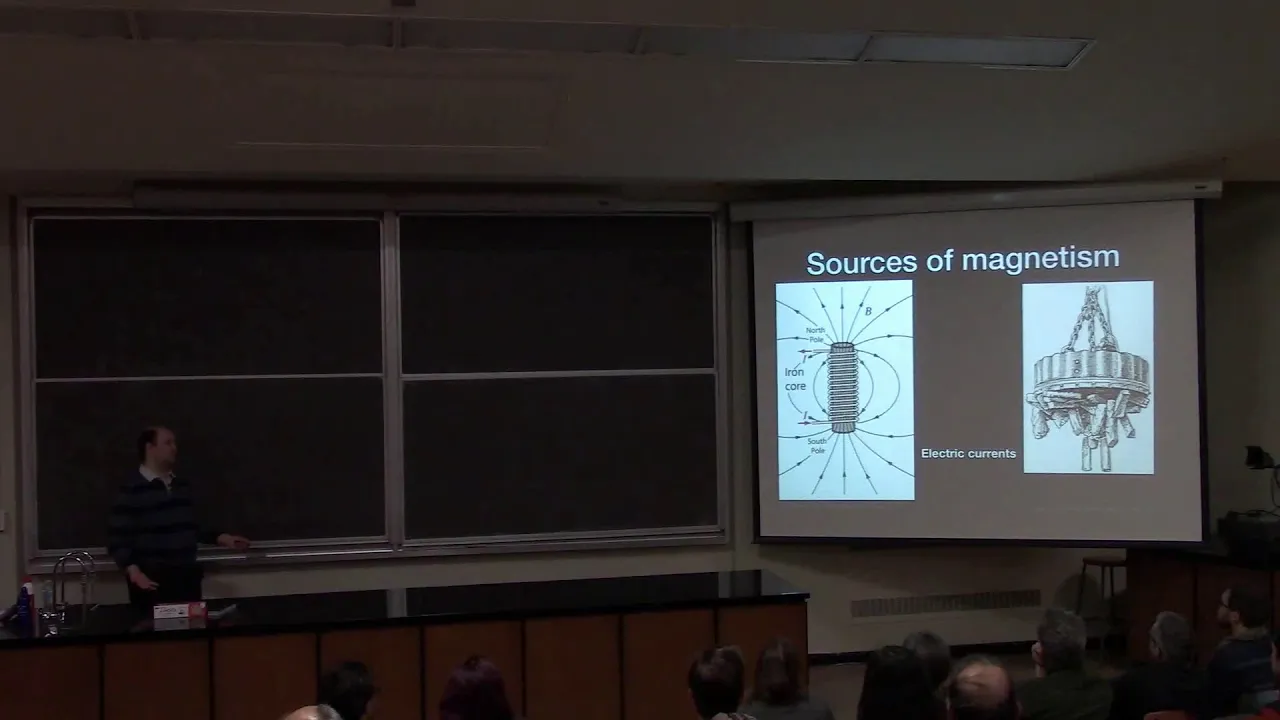
And Uranus's weather is something we've barely begun to understand. The magnetic field of Uranus is where things become genuinely disorienting, even for planetary scientists [music] who work with unusual magnetic environments every day. Understanding why Uranus's field is so strange, requires first understanding what normal planetary magnetic fields look like. Earth generates its magnetic field in its outer core. A layer of liquid iron about 1,400 miles thick sitting between the solid inner core and the rocky mantle above. Heat flowing from the inner core drives convection in this liquid iron.
Convection currents move electrically conducting material.
Moving conducting material in a rotating body generates a magnetic field.
This is the geod dynamo and it produces a roughly dipolar field meaning it has one magnetic north pole, one magnetic south pole and an axis connecting them that runs close to earth's rotational axis.
The offset is only about 11° close enough to the rotational axis that the field points towards something we can usefully call magnetic north.
Jupiter's field is generated in its vast interior of metallic hydrogen where the pressure is high enough to make hydrogen conduct electricity like a metal. The result is also a roughly dipolar field though tilted a bit more than Earth's.
Saturn's field is even more aligned with its rotational axis than Earth's. One of the cleanest natural dipoles we've found. The pattern is clear.
Planetary magnetic fields should be roughly dipolar with poles near the geographic poles and the field axis passing through the center of the planet. Uranus violates all three of these expectations.
The magnetic field of Uranus is tilted 59° away from its rotational axis, not 11°.
59.
The magnetic poles of Uranus are not near the geographic poles.
They're somewhere out in the middle latitudes of the planet. A compass on Uranus were such a thing to exist would be profoundly misleading. It would point toward a magnetic pole that's nowhere near where you'd want it to point. But then the strangeness goes further.
The magnetic field axis doesn't pass through the center of the planet.
On Earth, the dipole axis connects two opposite poles across the middle, passing through a point close to the center. On Uranus, the axis is offset from the center by about 1/3 of the planet's total radius.
The field doesn't connect poles that are on opposite sides of the globe. It connects them through a geometry that's distinctly offc center.
The consequence of this is a field that is wildly asymmetric.
One side of Uranus sits under a powerful magnetic field.
The other side sits under a field that can be more than 100 times weaker.
The two hemispheres of Uranus are in completely different magnetic environments.
No other planet in the solar system has a magnetic field this lopsided with one partial exception, Neptune.
Neptune's magnetic field is also tilted roughly 47° from its rotational axis.
It's also offc center displaced by about 1/3 of Neptune's radius. It's also asymmetric.
The similarity between Neptune's magnetic field and Uranus's is one of the most informative patterns in outer solar system science. It strongly implies that both planets generate their fields through the same mechanism. Not in a deep bulk of metallic material the way Earth and Jupiter do in the electrically conducting icy fluid layer that both worlds share. The hot pressurized water, methane and ammonia under millions of atmospheres of pressure becomes electrically conducting and convection in that layer drives a dynamo. But convection in a thin shell of conducting fluid produces different results than convection in a deep bulk.
Instead of an organized dipole, you get something messier. Multiple magnetic poles contributing to the field.
the field strongly tilted relative to the rotation axis. The field center displaced from the planet's center. This is called a thin shell dynamo model and it represents one of the key theoretical frameworks for understanding ice giant magnetic fields.
If it's correct, it should also apply to the many ice giant planets that astronomers have found orbiting other stars.
Understanding why Uranus's field looks the way it does has implications far beyond our solar system.
What the tilted off-center magnetic field does to the space around Uranus is unlike anything else in the solar system. Every planet with a significant magnetic field has a magnetosphere, a bubble of space dominated by the planet's field rather than by the sun's.
The solar wind runs into every magnetosphere.
At Earth, the interaction is relatively organized.
The solar wind compresses the sunward side of the magnetosphere and stretches the night side into a long magneto tail.
Charged particles are funneled along magnetic field lines toward the poles where they collide with atmospheric molecules and produce auroras.
predictable, periodic.
At Jupiter, the interaction is more violent.
The vast Jovian magnetosphere creates the most intense radiation environment in the solar system outside the sun itself. But even that can be modeled, predicted, understood.
At Uranus, the interaction is something that doesn't really have a comparison elsewhere.
Because the magnetic field axis is tilted 59° from the rotational axis, the field tumbles dramatically as Uranus rotates every 17 hours. With each rotation, the orientation of the magnetic field relative to the incoming solar wind changes completely.
During one part of the rotation, the field might be oriented in a way that channels solar wind particles efficiently toward one hemisphere.
12 hours later, the entire field geometry has shifted. The regions where particles are captured and accelerated have moved.
The shape of the magnetosphere has changed. And because Uranus's rotational axis itself is pointed roughly toward the sun during the extreme polar summer, there are periods in Uranus's orbit when the tumbling magnetic field sweeps through orientations unlike anything the other planets experience.
Computer models of Uranus's magnetosphere produce solutions that exhibit formally chaotic behavior.
In mathematics, chaos means the system is so sensitive to initial conditions that small changes in the starting state produce wildly different outcomes over time. Long range prediction becomes essentially impossible.
The path of a charged particle entering Uranus's magnetosphere on one rotation of the planet might be completely different from the path of an identical particle entering from the same direction on the company next rotation because the field geometry has changed so dramatically in the intervening 17 hours.
The practical implication is that the radiation environment around Uranus is deeply variable and extremely difficult to characterize from a single flyby.
The scientists who study planetary magnetospheres describe the existing data set for Uranus's field and magnetosphere as inadequate, not difficult to analyze, not limited in some normal sense, inadequate.
A fundamentally insufficient sample of a formally chaotic system.
One trajectory, one direction, one moment.
Years of orbital monitoring would transform that picture completely.
It would provide the continuous sampling across complete rotation cycles and across seasons that would allow a real understanding of what Uranus's magnetic environment actually does.
Uranus has 28 known moons, all named after characters from the works of William Shakespeare and Alexander Pope.
This is unusual in the solar system.
Most planetary moon systems draw their names from classical mythology.
Jupiter's moons honor figures associated with the myths of Zeus.
Saturn's moons come primarily from Greco Roman mythological traditions with Inuit and GIC names for some of the smaller outer moons.
Uranus's moon system inhabits a different literary world entirely.
Titania, Oberon, Miranda, Ariel, Umbreel, from A Midsummer Night's Dream, from The Tempest, from other plays, and from Alexander Popes, The Rape of the Lock. The naming convention was set early in the history of Uranian moon discovery and has been maintained as new moons were found. There's something that feels almost right about it. A planet that operates by different physical rules, also orbited by moons with different mythological roots.
But the names are the least interesting thing about this satellite system. The most interesting thing is the geometry.
Because Uranus is tilted on its side, its equatorial plane is nearly perpendicular to the plane of the solar system.
Moons form from material in a disc around a planet's equator.
Standard planetary formation.
But Uranus's equatorial plane is tilted nearly 90° from the solar system plane.
So the moons that formed from that disc now orbit at that same extreme angle.
They orbit Uranus's equator.
But Uranus's equator is nearly vertical relative to the solar system plane. So the moon's orbit nearly vertically.
When Voyager 2 approached in January of 1986 with the south pole of Uranus aimed almost directly toward the spacecraft.
The moons appeared to orbit in concentric circles around a central point like a bullseye, like rings on a target. Not the flattened tilted disc that makes Saturn's moon system so visually dramatic. A set of nested circles, each moon tracing its orbit around the pole that was facing the approaching spacecraft.
It was geometrically unlike anything that had been seen before. The five major moons, all discovered by Earth-based observers before the space age, each have distinct surface characteristics.
Titania is the largest at roughly 980 mi in diameter, roughly the size of the distance from the east coast to the west coast of the United States, but squashed into a sphere. Its surface bears long fault systems, canyons hundreds of miles in length that record a past expansion event. When water freezes, it expands.
If Titania's interior contained water ice that froze at some point, that expansion would crack the surface from below. The fault systems appear to record exactly this kind of process. The surface is old and cratered, but the faults cut through it, recording a later event. Ariel has the youngest looking and brightest surface of the five major moons.
Smooth planes of relatively fresh material sit adjacent to heavily cratered ancient terrain.
The transition between them is sometimes sharp, suggesting that fresh material flooded old terrain rather than gradually resurfacing it. On a world as cold as aerial, this kind of resurfacing involves cryovcanism, not the silicate magma of Earth's volcanoes.
Water ice, likely mixed with ammonia, which acts as antifreeze and lowers the melting point enough for the mixture to remain fluid at temperatures far below water's normal freezing point.
A slushy, extremely cold, but flowing material that could erupt through surface vents and spread across the terrain. What drove this process on aerial is [music] debated.
Tidal heating from orbital resonances in the past is one candidate. Radiogenic heating from radioactive elements in the interior is another perhaps a combination.
Umbreel is darker and more heavily cratered than the other moons. Its surface looks uniformly ancient, less processed, less modified.
One notable feature is a bright annular deposit visible in one large impact crater near its equator. Thought to be exposed ice or fresh material within the crater that hasn't yet been darkened by radiation. Oberon is similar to Umbreel in its ancient heavily cratered appearance, but with some craters showing dark floor deposits that may be cryovcanic material that welled up after the impacts.
And then there's Miranda.
Miranda is the smallest of the five major moons at about 290 mi across.
By every expectation, it should be geologically simple. Small bodies lose heat quickly and efficiently. Their interiors cool and solidify on time scales far shorter than the age of the solar system. Once solidified, geological activity ends.
Nothing drives it. You're left with an ancient, heavily cratered surface, unchanged for billions of years.
Miranda's surface is the opposite of simple.
It is one of the most geologically perplexing surfaces we have ever photographed anywhere in the solar system.
The terrain is contradictory in ways that resist straightforward explanation.
Ancient, heavily cratered planes, the kind of surface you'd expect on a completely dead world, sit immediately adjacent to dramatically different terrain. Regions called Coroni. Large, roughly rectangular or oval-shaped features with concentric patterns of ridges and valleys inside them. regions that looked like they belong to an entirely different geological history, sitting right next to regions that look billions of years old. The transitions between these terrain types are sometimes sharp, sometimes near vertical. The overall impression is of a world whose surface was assembled from mismatched pieces.
The most extraordinary feature on Miranda is the Verona ropes, a cliff.
Its height is estimated at somewhere between 3 and 12 mi. The uncertainty reflects the [music] fact that we've only seen it from one direction at limited resolution.
Even the most conservative estimate, 12 mi, makes it the tallest known cliff in the solar system. The cliff is near vertical. You stand at the top and look down essentially straight. Miranda's surface gravity is about 100th of Earth's. At that gravity, stepping off the edge of Verona Rupz means falling for roughly 12 minutes before reaching the bottom. The physics of this fall produces an impact velocity of something around 130 mph.
Survivable in principle with the right protective equipment, which is not the sort of thing you usually have to calculate about a cliff.
The existence of this cliff on a world 290 mi across requires explanation.
The early hypothesis proposed that Miranda had been completely shattered by a large impact, broken into fragments, and then those fragments slowly reassembled under Miranda's gravity.
When they came back together, they may have done so in disordered fashion, mixing deep interior material with surface material, creating the jumbled geology we see.
This explanation has become less favored as modeling has improved.
Current thinking leans toward localized upwellings driven by tidal heating. If Miranda's orbit was more elliptical in the past, the gravitational flexing from Uranus would have generated heat in its interior.
That heat could have driven pockets of warm material to rise through the interior in discrete locations, creating the coroni and the dramatic terrain contrasts without requiring the moon to be shattered and reassembled.
But neither model fully accounts for all the features.
Miranda's geological story is not yet told. It requires better images and more comprehensive mapping. We've only seen its southern hemisphere.
Everything we know about Miranda's bizarre surface comes from one hemisphere photographed at one moment 40 years ago. The northern hemisphere is essentially unmapped. A returning mission would need to orbit Miranda, photograph both hemispheres, and ideally use radar to probe below the surface.
That mission doesn't exist yet. The rings of Uranus were discovered in 1977 by an astronomer named James Elliot observing from aboard the Kyper Airborne Observatory.
a converted highaltitude aircraft equipped with a telescope designed to operate above most of Earth's interfering atmosphere.
The observation was planned to study Uranus's atmosphere by watching the planet pass in front of a distant star.
As Uranus approached the star, the stars light should have dimmed gradually as the planet's atmosphere came between them. What Elliot and his team observed was different. Before Uranus reached the star, the starlight winked out briefly, multiple times in quick succession, then came back.
Then Uranus passed across the star. Then on the other side, the starlight winked out again multiple times in a symmetric pattern mirroring what had happened on the approach side.
symmetric blinks on both sides of the planet. If it were an atmospheric irregularity or an instrumental artifact, you wouldn't get symmetry. You wouldn't get the same pattern repeated in mirror image.
Symmetric dimming could only mean one thing.
Something was circling Uranus in a series of distinct bands.
something that blocked starlight as it passed between the star and the observers.
Rings.
Five rings were identified from that initial observation with four more confirmed through subsequent earth-based occultations over the following year.
Voyager 2's close approach brought the total to 13 with a few additional faint rings found by Hubble and KEK telescope observations in subsequent years.
These rings are fundamentally different from Saturn's in almost every measurable way. They're narrow.
The main rings range from a few miles to a few tens of miles wide. The widest, the epsilon ring, reaches only about 60 m across at its broadest.
They're dark. The ring material reflects only 2 to 3% of the light that hits it.
This is darker than the black rubber of a car tire. Darker than the darkest natural rock. The material has been processed by radiation into this extreme darkness.
High energy particles from the solar wind and from Uranus's own magnetic environment continuously bombard the ring material.
These particles break chemical bonds, build complex organic molecules, and darken whatever they repeatedly strike over geological time. What may have started as relatively bright water ice has been transformed across millions or billions of years into carbonri radiation processed material that barely reflects light at all. Because they're narrow and dark, these rings are essentially invisible through ordinary telescopes.
You can't casually spot them the way Saturn's rings leap out at even modest magnification.
Voyager 2's close pass photographed them directly and revealed the sharp edges that puzzle scientists.
Rings should spread over time. Particle collisions transfer energy and spread the distribution of orbital parameters.
A ring should gradually diffuse, broaden, thin out. But Uranus's main rings, especially the epsilon ring, have edges that look almost as if someone drew them with a compass. The explanation is shepherd moons.
small moons whose gravity corrals ring material, preventing it from spreading.
If a ring particle drifts outward, the outer shepherd's gravity tugs it back.
If it drifts inward, the inner shepherd pushes it out. The ring is gravitationally confined. Two small moons, Cordelia and Ailia, orbit on either side of the epsilon ring and appear to serve exactly this function.
But shephering doesn't last forever. The shepherd moons extract energy from the ring over time. The ring gradually loses material.
Some models suggest the Uranian ring system is geologically young, perhaps only a few hundred million years old, born from a moon or smaller body that was disrupted by collision or tidal forces.
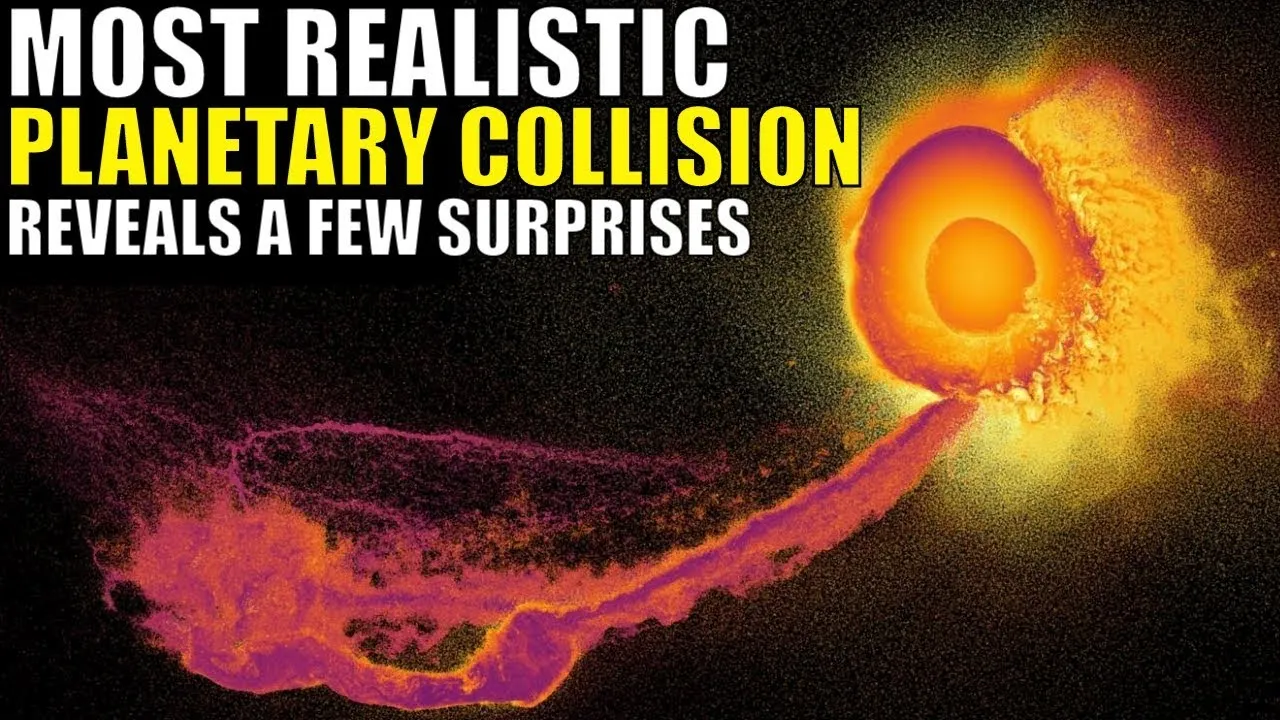
If this is right, Uranus's rings are temporary. A few billion years from now, they'll be gone, dispersed by the same shepherd moons, keeping them sharp today. For now, they roll. 13 dark halos, perpendicular to everything else. How did Uranus get tilted? The most widely accepted answer is a collision. An oblique impact early in the solar systems history from a body large enough to knock Uranus onto its side. The early solar system was dramatically more violent than the one we inhabit.
For the first few hundred million years after the sun ignited, large numbers of planet decimals and protolanets were still moving through the solar system on crossing orbits.
Jupiter's gravity was deflecting objects onto new trajectories.
Gravitational resonances were hurting bodies into unstable configurations.
Large collisions were happening throughout the system. The moon formed during this period. from the debris of a Mars-sized body that struck the early Earth. The outer solar system was not immune. The leading model says a body somewhere between one and three times the mass of Earth struck Uranus at an oblique angle. An off center strike, not headon. The geometry is critical. A head-on impact transfers energy primarily into heating and disrupting the target and doesn't efficiently change the spin axis. An oblique impact does almost the opposite. It deposits angular momentum sideways.
It can tilt the spin axis with comparatively less internal disruption.
Think of striking a spinning top squarely from above versus catching it on the side. The glancing blow is what changes the tilt. Computer simulations of oblique impacts in the relevant mass range reproduce axial tilts consistent with the observed 97.8° and they reproduce the moon geometry.
After such an impact, the debris thrown into orbit around Uranus settles into a disc aligned with the new tilted equatorial plane. That disc accretes it builds moons. Moons orbiting in the new equatorial plane which is perpendicular to the solar system plane which is exactly what we observe.
The orientation of the uranian satellite system is one of the strongest pieces of evidence for the impact hypothesis.
It's very difficult to explain moons orbiting at 90° to the solar system without a tilting event that happened before or during their formation.
If the tilt happened gradually, the existing moons would have had time to precess into a different orbital configuration. The fact that they sit neatly in the equatorial plane argues for a rapid tilting, the kind a collision produces.
And then comes the heat problem. An impact large enough to tilt Uranus by nearly 98° should have deposited enormous energy into the planet. That heat should still be leaking out. It isn't. Uranus radiates almost no excess heat. Its atmosphere is colder than Neptune's.
Something trapped the heat.
The leading explanation is stable stratification created by the impact itself.
When the impactor struck, it scrambled Uranus's interior, mixed it. After the impact, the interior began settling.
Materials of different densities sorted themselves.
Denser material sank.
Lighter material rose.
A stable density layering developed in the interior.
Once established, this stratification suppresses convection.
In a stably stratified fluid, hot material trying to rise finds itself surrounded by less dense material and sinks back down.
Convection can't establish itself against a stable density gradient.
Heat can only move outward by the much slower process of thermal conduction.
4 and a half billion years of conduction through thousands of miles of pressurized fluid hasn't moved much heat.
Most of it is still down there locked in sealed off from the outer atmosphere.
The outer atmosphere cut off from internal heat is left to reach equilibrium with sunlight alone which turns out to be the coldest planetary atmosphere in the solar system.
This is elegant.
The same event explains both the [music] tilt and the cold atmosphere.
One collision, two anomalies explained, but it needs verification.
The stable stratification should leave specific signatures in the atmospheric temperature profile.
Anomalies in how temperature changes with depth.
An atmospheric probe descending into Uranus would measure this directly.
That measurement doesn't exist.
The cold atmosphere deserves its own extended consideration because it gets to the heart of how different Uranus is from what we'd expect.
When astronomers measure the energy budget of a planet, they compare how much energy it receives from the sun to how much energy it radiates back into space.
For a planet in thermal equilibrium with its star, these two numbers should be roughly equal. Energy in, energy out, balanced.
For Uranus, these numbers are almost perfectly equal. energy received from the sun about the same as energy radiated away.
This would be unremarkable except for the fact that no other giant planet behaves this way.
Jupiter radiates about 1.7 times more energy than it receives.
Saturn radiates about 1.8 times more.
Neptune radiates about 2.6 times more.
All three of these planets have hot interiors that are still slowly releasing the primordial heat of formation and subsequent impact. That internal heat drives convection, stirs the atmosphere, feeds weather systems.
Neptune, despite receiving barely 40% of the solar energy that Uranus does, is warmer than Uranus because its interior heat makes up the difference.
Uranus has no such contribution.
Or if it does, that contribution is trapped so deep inside the planet that it never makes it out.
The cloud top temperature of Uranus around -371° F, roughly -224° C, is the coldest recorded for any planetary atmosphere in the solar system. Not by a small margin, by a meaningful one. And the consequence for atmospheric dynamics is significant.
Weather on giant planets is driven largely by internal heat.
Jupiter's persistent storm systems, including the Great Red Spot, are powered by the continuous upwelling of heat from below.
Neptune's extraordinary wind speeds, the fastest in the solar system, are driven by internal heat.
Uranus, without a significant internal heat source reaching the atmosphere, is driven primarily by sunlight alone. And sunlight at Uranus's distance from the sun is faint, about 1400th of what Earth receives.
The atmospheric engine is running but on a very small energy input, which is why the atmosphere looked so quiet to Voyager 2 and why storms when they do appear are linked to the seasonal transitions when the sunlight distribution shifts dramatically.
The planet is being run on low power.
Its weather is real but subdued most of the time. This matters beyond Uranus.
Sub Neptune exoplanets close to their host stars receive enormous amounts of stellar energy.
Their atmospheric dynamics would be dominated by stellar heating.
Sub Neptune exoplanets far from their stars would behave differently.
If they have interior heat sources, those could dominate.
If they have something like Uranus's thermal suppression, they could be anomalously cold.
Understanding why Uranus's heat budget works the way it does is directly applicable to interpreting the climates of the most common type of large planet in the galaxy.
Let's spend some time with the broader picture of what Uranus and Neptune represent in the context of planetary formation.
The solar system has two clear classes of giant planet. The gas giants Jupiter and Saturn and the ice giants Uranus and Neptune.
This distinction runs deeper than just saying some are bigger and some are smaller. It reflects fundamentally different formation histories.
Jupiter formed early and fast.
It grew to sufficient size quickly enough to gravitationally capture large quantities of hydrogen and helium directly from the solar nebula, the cloud of gas and dust that surrounded the young sun.
The nebula was still dense and hydrogen and heliumrich when Jupiter reached the mass threshold for efficient gas capture.
Saturn did the same, though somewhat less efficiently.
Both planets are dominated by hydrogen and helium because they were big enough, early enough to claim those most abundant elements in large quantities.
Uranus and Neptune had a harder time.
The outer solar system where they formed was a thinner region of the primordial disc. Material was more spread out.
Accretion [music] took longer. By the time Uranus and Neptune grew massive enough to start pulling in substantial quantities of hydrogen and helium, the solar nebula was already being dispersed.
The young sun had heated up. Its radiation and early solar wind were beginning to strip the remaining gas from the inner solar system and then from progressively outer regions.
The window for efficient hydrogen and helium capture was closing.
What Uranus and Neptune captured efficiently before that window closed was heavier volatile material.
Water, methane, ammonia.
These are the compounds that condensed out of the solar nebula at greater distances from the sun in the cold outer regions where Uranus and Neptune were forming.
They accreted primarily from icy and rocky material with hydrogen and helium only as a thin outer envelope.
This is why they're called ice giants rather than gas giants. Their bulk is icy material, not gas.
And this formation story has problems which are themselves scientifically revealing. Standard models of planetary accretion have difficulty explaining how Uranus and Neptune formed at all at their current distances.
The outer solar system is sparse enough that the accretion time scale, how long it takes for planet decimals to collide and stick together and grow, should be extremely long, longer than the age of the solar system in some models.
And yet, Uranus and Neptune exist at their current masses in their current locations.
Something about the standard accretion model isn't quite right, or the history of Uranus and Neptune's formation and migration is more complex than simple in place accretion.
Some models suggest they formed closer to the sun and migrated outward.
Others suggest the formation process was accelerated by the presence of Jupiter, whose gravity stirred the outer solar system and may have enhanced accretion rates.
Others invoke disc instability where gravitational collapse of the disc forms giant planet cores more rapidly than standard accretion allows.
The formation of Uranus and Neptune is an active unsettled question in planetary science.
and understanding their internal structure, their bulk composition, the boundaries between their layers goes directly to constraining these formation models.
A Uranus orbiter would provide exactly the gravity science, magnetic field measurements, and atmospheric composition data needed to test these models.
The question of whether any of Uranus's moons might harbor liquid water is one of the more recently appreciated scientific questions in the Uranian system.
For a long time, the assumption was that the Uranian moons were too cold and too small to be geologically interesting in this way. But that assumption has been challenged by the recognition of how common subsurface oceans appear to be in the outer solar system.
Europa, one of Jupiter's four large Galilean moons, is thought to harbor a global subsurface ocean beneath about 10 miles of ice.
The evidence comes from the moon's induced magnetic field, which requires a conducting layer, most likely salt water, beneath the surface.
Enceladus, a small moon of Saturn, actively vents plumes of water vapor and ice particles from cracks near its south pole.
The material is confirmed to contain salts, indicating contact with liquid water in an interior ocean.
Titan, Saturn's large moon, has a surface of liquid methane and ethane lakes and may have a subsurface water ocean.
Ganymede, Jupiter's largest moon, appears to have a subsurface ocean, confirmed by its induced magnetic field.
Even Pluto, far out in the Kyper belt, shows evidence of a subsurface liquid water layer beneath its icy shell. The outer solar system is remarkably wet.
Subsurface oceans appear to be commonplace maintained not by proximity to the sun but by internal heat from radioactive decay, tidal flexing or residual formation heat. The Uranian moons are in many ways similar to the moons where subsurface oceans have been found.
Their icy worlds of significant size.
They have interior compositions that could include liquid water if the right heat source exists.
Whether any of them have that heat source is unknown.
The geological activity suggested by the surface features of Titania and aerial may indicate past internal heat. Whether that heat is ongoing, whether it's sufficient to maintain any liquid layer, we simply don't know. We haven't looked.
A Uranus orbiter equipped with a magnetometer could search for induced magnetic fields in the moons, a technique that detected Europa's ocean.
It could use radar to probe below the surfaces. It could measure the gravitational signatures of density variations inside the moons that would be consistent with liquid layers. If any of the Uranian moons turn out to harbor subsurface liquid water, even a small pocket of it, it would change the calculus of where life might be possible in the solar system. It would extend the habitable zone of our solar system even further into the outer darkness than we already know. It extends.
That question has a real answer.
It's out there in the Uranian system waiting to be found by the right instruments.
There's a specific piece of Uranus's discovery history that deserves attention because it reveals something about the nature of scientific progress.
When William Hershel first spotted Uranus in March of 1781, he classified it as a comet. Not because he was a careless observer. He was one of the most skilled and dedicated observers of his era. A professional musician who had become deeply passionate about astronomy and built exceptional telescopes with his own hands.
He classified it as a comet because it had a disc a small but detectable width rather than the point of a star and it was moving relative to the background stars.
Those were the characteristics that distinguished comets from stars at the time. It took other astronomers calculating the orbit and finding it circular rather than elongated to establish that this was something new, a planet orbiting beyond Saturn. The announcement was transformative.
For all of recorded human history, the solar system had contained five planets visible to the naked eye. Mercury, Venus, Mars, Jupiter, Saturn, known since antiquity, named for ancient deities, incorporated into calendars and astrology and mythology across dozens of cultures.
The edge of the solar system in the human imagination was the orbit of Saturn.
And then in one observation, Hershel moved that edge.
Uranus orbits at roughly twice Saturn's distance from the sun. The solar system was instantly doubled.
What had been the outer limit was now the midpoint.
Hershel's discovery rewrote the scale of the world and the name issue was itself revealing.
Hershel wanted to name his discovery after his patron King George III. He called it Georgium Sidus, George's star. The British astronomical community supported this. Astronomers in France and the rest of continental Europe were not interested in naming a planet after the English king. There were competing proposals.
Hersel, Hyperronius, Neptune. [music] Eventually, the name Uranus after the ancient personification of the sky proposed by Yan Bodde won the consensus.
It was the only proposed name that fit the convention of naming planets after ancient deities.
Though Uranus is somewhat unusual in being the grandfather of the more commonly known Olympian deities rather than one of them, the English pronunciation of the name has caused a certain amount of amusement for generations of school students, which has not meaningfully advanced our understanding of the planet, but has perhaps made it more memorable.
When the planet began to accumulate careful positional measurements over the following decades, something emerged from those measurements.
Uranus was not moving quite the way Newton's equations predicted.
Its position in its orbit drifted from the calculated position.
The discrepancy was small but persistent, systematic.
Every attempt to reconcile the observations with the mathematics failed unless an additional gravitational influence was included.
Something was pulling on Uranus.
Something beyond it. Two mathematicians working independently attacked this problem. John Couch Adams in England computed the position that an outer planet would need to occupy to produce the observed pertubations. Urbane Leia in France performed a parallel calculation.
Both men arrived at predictions pointing to roughly the same region of sky. Leier sent his prediction to the Berlin Observatory.
On September 23rd, 1846, Yan Gotfrieded Gala pointed his telescope at that region of sky.
Within the hour, he had identified Neptune exactly where Leier's mathematics said it would be. It was one of the greatest demonstrations in the history of science that the universe follows mathematical laws precisely enough that you can calculate where something is before anyone has ever seen it. Uranus was strange enough in its orbital behavior to reveal the existence of its neighbor. The planet that didn't fit pointed to something new. The history of how we came to understand Uranus's interior goes back to the first serious attempts to model what gas and ice giant planets are actually made of.
In the early 20th century, the dominant view was that all giant planets were composed primarily of hydrogen and helium in proportions similar to the sun.
This made sense as a first approximation.
The sun is the dominant body in the solar system and its composition should inform what material was available for the planets to form from. If you make a giant planet from solar composition material, you end up with something hydrogen and helium rich. Jupiter and Saturn fit this model reasonably well.
Their densities, their sizes, their gravitational fields were all broadly consistent with a hydrogen and helium dominated composition.
Uranus and Neptune were the problem.
Their densities are too high to be explained by hydrogen and helium alone.
Uranus has a mean density of about 1.27 g per cm.
Water has a density of 1 g per cm.
Rock is about 2 to 3 g per cm.
Uranus is denser than water but less dense than rock. This tells you immediately that Uranus can't be primarily hydrogen and helium which have much lower densities even under compression.
Something denser is present in substantial quantities.
the ices, water and methane and ammonia have the right density ranges to explain the observations.
This realization developed through increasingly sophisticated modeling in the latter half of the 20th century established the ice giant category and it raised the question of how exactly these ices are distributed through the interior.
The models suggest a layered structure, a hydrogen and helium outer envelope, a deep icy mantle of water, methane, and ammonia, a rocky core of heavier elements. But the boundaries between these layers are not sharp interfaces.
They're gradual transitions.
And the relative proportions, how thick each layer is, how the density changes with depth, is uncertain because we've never directly sampled any layer below the outer atmosphere.
All interior models are constrained by gravity field measurements which reflect the distribution of mass and by our knowledge of how these materials behave under pressure which comes from laboratory experiments.
But laboratory experiments can only approximate the conditions inside Uranus.
Reaching pressures of hundreds of millions of atmospheres in a laboratory requires specialized equipment, extremely short time scales, and produces conditions that don't perfectly replicate what exists inside a planet over geological time. The interior of Uranus remains uncertain in important ways.
How thick is the icy mantle? Is the rocky core solid or in some exotic high pressure phase?
Is the stratification that is theorized to trap heat actually present? And how sharp is it? All of these questions have model answers.
None of them have measured answers.
Let's also consider what Uranus's extreme axial tilt means for any future human or robotic presence in the Uranian system. This is a practical consideration as much as a scientific one. If you want to operate in orbit around Uranus, the tilted axis creates some unusual operational challenges.
A spacecraft orbiting Uranus in an equatorial orbit, the most natural orbital choice for studying the planet's atmosphere and rings, would orbit in the same tilted plane as the moons and rings.
During the period when the south pole is pointed at the sun, an equatorial spacecraft would spend its entire orbit in sunlight.
No shadow, no thermal relief. 24 hours a day of continuous solar illumination.
For thermal management of the spacecraft, this requires robust radiators capable of handling continuous heat load without the relief of passing through shadow. At other points in Uranus's orbit, when neither pole is pointed at the sun, the spacecraft would experience normal alternation between sunlight and shadow on each orbit. But for years at a time during the extreme polar seasons, the thermal environment would be unusual. Polar orbits which pass over the poles of Uranus would have a different character. During the extreme polar seasons, a polar orbit would alternately pass over the sunlit pole and the shadowed pole. The radiation environment on the sunlit pole side would be very different from the shadowed pole side. For an instrument trying to study the atmosphere uniformly, this hemispheric asymmetry during the seasonal extremes would need to be accounted for in how data is collected and interpreted.
And for any operation of the Iranian moons, the geometry changes depending on when in Uranus's 84year orbit you arrive.
This is one reason why the timing of a Uranus mission matters.
The early 2030s launch window would result in arrival at Uranus at a specific point in its seasonal cycle.
The scientific questions you can best answer depend somewhat on which season you arrive in. Planetary scientists have been thinking carefully about what science is achievable from each possible arrival point in Uranus's orbit.
The current proposed mission timeline is designed to take advantage of the available science at the expected arrival season. There is also something worth spending time on about the way Uranus relates to our understanding of planetary atmospheres more broadly. The atmosphere of Uranus is in certain ways one of the most extreme natural laboratories in the solar system. The chemical reactions that occur in a cold atmosphere at temperatures hovering around -371° F roughly -224° C at the cloud tops are fundamentally different from what occurs in warmer planetary atmospheres.
At those temperatures, methane and other hydrocarbons don't behave the way they do at room temperature.
Photochemical reactions driven by the ultraviolet light that does manage to reach Uranus from the distant sun break apart methane molecules and drive the formation of longer chain hydrocarbons.
Acetylene, ethane, diaetylene, benzene.
These complex organic molecules form high in the atmosphere and then slowly settle downward, contributing to the haze layer that distinguishes Uranus's color from Neptune's.
Understanding this photochemistry on Uranus is relevant to understanding the photochemistry on cold exoplanets.
Many of the exoplanets found by the Kepler telescope and its successors orbit far from their stars in cold regions where temperatures similar to or even lower than Uranus's prevail.
What does the chemistry in those cold atmospheres look like? How do hydrocarbons behave when they're frozen into solid particles rather than staying in gas phase?
Uranus provides a real accessible example of an atmosphere running these cold chemistry experiments at scale. An atmospheric probe descending through Uranus's cloud layers would measure not just temperature and pressure, but chemical composition at each level. It would give us the vertical profile of hydrocarbon species from the upper atmosphere down to the deeper cloud layers.
That profile is a direct measurement of the photochemistry in action.
Information that would constrain models of cold atmospheric chemistry that we apply to dozens of exoplanets we can study only from afar.
Wind speeds and their distribution in Uranus's atmosphere are another area of significant uncertainty.
We know from Voyager 2's observations that the winds on Uranus at the time of flyby were not negligible.
They blow at hundreds of miles per hour in the equatorial regions, decreasing toward the poles, but Voyager 2's measurements were limited to a snapshot during an extreme seasonal configuration.
Whether the wind patterns change significantly across the 84year seasonal cycle is unknown.
On Earth, the largecale wind patterns, the trade winds, the jet streams, the polar vortices are driven by the combination of differential solar heating between the equator and the poles and the corololis effect from Earth's rotation. The distribution of sunlight on Uranus changes enormously across its seasons.
During the extreme polar summer, the sunlit pole receives most of the solar energy. During the equinox, the equatorial regions receive more. These dramatic shifts in where solar energy is deposited should drive corresponding shifts in the large scale circulation patterns. On Earth, we have observed how jetream patterns shift with the seasons.
On Uranus, with season changes a 100 times more extreme, the atmospheric circulation shifts should be correspondingly dramatic. An orbiter studying Uranus across multiple years would observe this seasonal evolution directly.
It would watch the wind patterns change as Uranus moves from one extreme to another. It would measure how storm activity correlates with the seasonal forcing.
It would potentially observe the planetary scale reorganization of atmospheric circulation that must accompany the transition from one extreme polar configuration to the other. This kind of multi-year seasonally resolved atmospheric observation is simply impossible from a single flyby and it's one of the primary scientific objectives [music] of any serious Uranus mission. There's a specific numerical fact about Uranus that tends to surprise people when they first encounter it. Uranus is the third largest planet in the solar system by diameter.
Its diameter is about 31,500 mi. That makes it about four times wider than Earth. Jupiter and Saturn are both larger.
But Neptune, even though it's farther from the sun and generally discussed alongside Uranus as its twin, is actually slightly smaller.
Neptune's diameter is about 30,600 mi. Uranus is slightly bigger across, and yet Uranus is less massive than Neptune.
Uranus is about 14.5 times the mass of Earth.
Neptune is about 17 times the mass of Earth. Neptune is heavier than Uranus despite being slightly smaller.
This means Neptune is denser than Uranus. Neptune's mean density is about 1.64 g per cm.
Uranus's mean density is about 1.27 g per cm.
Neptune is denser than Uranus by a significant margin.
This difference in density is another puzzle. If the two planets formed in similar environments with similar material, why do they have different internal density profiles?
Part of the answer may relate to the impact that tilted Uranus.
A large oblique impact could have changed the distribution of material inside Uranus.
mixed different layers altered the overall density profile relative to what an undisturbed Uranus might have had.
Neptune, which presumably didn't suffer the same kind of catastrophic impact, retained whatever density profile it developed through normal formation and evolution.
The density difference between the two planets is another potential piece of evidence for the impact hypothesis.
It's the kind of measurement that's straightforward to make and has potentially significant implications and it fits naturally into the broader story of Uranus as the planet that was hit. William Hershel, the astronomer who discovered Uranus in 1781, spent years after the discovery trying to understand what he had found.
He made extensive observations of the planet and noted several properties that he couldn't fully explain with the tools available to him. He detected or thought he detected a ring around the planet at one point, though this observation was not confirmed and was eventually attributed to an observational artifact.
He discovered Titania and Oberon in 1787.
Ariel and Umbreel were discovered by William Lassel in 1851.
Hershel also made early attempts to measure the period of Uranus's rotation, estimating it at about 60 hours. The actual rotation period, 17 hours and 14 minutes, is very different from his estimate.
With the instruments available at the time, measuring the rotation of a featureless disc at such a distance was essentially impossible.
But Hershel's attempts are a reminder that the scientific investigation of Uranus began almost immediately after its discovery and has continued with varying levels of intensity ever since.
The 19th and early 20th centuries saw the discovery of the large moons and initial attempts to characterize the planet's physical properties.
The development of spectroscopy in the mid 19th century allowed astronomers to identify the gases in Uranus's atmosphere for the first time. In the early 20th century, the presence of methane was confirmed through its distinctive absorption bands in the spectrum of reflected sunlight.
Each decade brought new tools and new measurements.
And yet, for most of its observed history, Uranus remained poorly characterized compared to the inner planets. The inner planets, Mercury, Venus, Earth, and Mars are close enough for detailed telescopic study and have been visited by multiple spacecraft.
The giant planets Jupiter and Saturn attracted early flyby missions and then dedicated orbiters.
Uranus sits in a curious middle ground far enough away that telescopic study has real limits, but not so obviously dramatic at first glance as to attract the dedicated mission attention it actually deserves.
The discovery of the rings in 1977 changed the conversation somewhat. The announcement that Uranus had a ring system, completely unexpected by the planetary science community, generated new interest. Here was a world that was still surprising people two centuries after its discovery. The rings weren't as spectacular as Saturn's, but they were there. The decision to route Voyager 2 past Uranus, then Neptune, was made partly in light of these discoveries.
A ring system meant there was more to study.
The 1986 flyby generated an enormous amount of data and at the same time revealed how much remained unknown.
The scientific community came away from Voyager 2's Uranus encounter with more questions than they'd arrived with, which is the normal outcome of a good scientific encounter with a new world.
The questions are still waiting. The planet's name deserves one more note. In ancient Greek mythology, Uranus is the personification of the sky, a primordial deity, the great vault of the heavens given divine form. In the mythological tradition, Uranus was the parent of the Titans, the grandparent of the Olympian gods, the original ruling figure before being overthrown by his own children.
There's an inadvertent aptness to naming this particular planet after the primordial sky deity. Uranus, the planet, was the first world discovered beyond the domain of ancient observation.
Before 1781, the five naked eye planets were the sky as humans understood it. The sky ended at Saturn. Uranus broke through that boundary. It extended the sky. It was in a sense the primordial thing that was there before anyone knew to look for it.
And like its mythological namesake, it has secrets.
Old secrets.
Things that happened to it before human civilization existed.
An impact that knocked it sideways.
An interior stratification [music] that locked away its heat. A magnetic field generated in ways unlike the other giants.
All of it predating us by billions of years, waiting for us to build the tools to understand it. The primordial sky has patience.
We're the ones who need to show up.
There's a remarkable historical irony in how planetary science has deployed its most capable missions. The Cassini mission to Saturn cost about $3.9 billion and ran for 13 years. It produced a scientific revolution.
Dozens of new moons found. Complex ring dynamics revealed. Enceladus' plumes and subsurface ocean discovered. Titan's hydrocarbon weather system mapped. The storm structures and jetream patterns documented in unprecedented detail.
13 years of data transformed Saturn from a planet we thought we understood into a world we were just beginning to understand. The Galileo mission to Jupiter cost about $1.4 billion in '90s and operated for almost 8 years.
It dropped an atmospheric probe directly into Jupiter's atmosphere. The probe transmitted data for about 58 minutes before being crushed by the pressure. In those 58 minutes, it measured wind speeds far higher than models predicted, found an anomalous water distribution, and revealed that the atmospheric structure at the probe entry site was different from what most models had assumed.
58 minutes of insitue data revolutionized our understanding of Jupiter's atmosphere.
The data from that probe is still being analyzed and its implications are still being debated. If 58 minutes of atmospheric probe data from Jupiter could do that, what would an atmospheric probe entry into Uranus produce? We don't know. And that's the point. We've sent spacecraft to visit every major planet multiple times. In most cases, Mercury has been orbited. Venus has been mapped by radar.
Mars has had continuous robotic presence for decades.
Jupiter has been visited by Pioneers, Voyagers, Galileo, New Horizons, and now Juno. Saturn has been visited by Pioneers, Voyagers, and Cassini.
Neptune has been visited by Voyager 2.
Even Pluto, the distant world at the outer edge of the solar system proper, was visited by New Horizons in 2015 and was revealed to be a geologically active world with a nitrogen glacier and a complex layered atmosphere.
Uranus alone has had one visitor and that visitor stayed for a matter of hours. In any accounting of what planetary science knows and what it doesn't, Uranus represents the single largest gap between what a world deserves to be understood and what we actually understand.
That gap is what the proposed Uranus orbiter is designed to close.
The auroras of Uranus are another expression of the planet's strange magnetic environment, and they deserve attention.
Auroras occur when charged particles from the solar wind or from trapped radiation belts travel along magnetic field lines and collide with atmospheric molecules.
The collisions excite those molecules, which then release light as they return to their ground state.
On Earth, this produces the northern and southern lights visible most commonly in high latitude regions near the magnetic poles. On Jupiter, the auroras are the brightest in the solar system. The Jovian auroras are powered by both the solar wind and by charged particles generated by Io's volcanic eruptions.
They form complex structures around Jupiter's magnetic poles.
Uranus has auroras.
Hubble's space telescope observations have confirmed this. But Uranus's auroras are unlike those anywhere else in the solar system. Because the magnetic poles are not near the geographic poles. And because the magnetic axis is tilted so far from the rotational axis, the auroras don't appear at fixed high latitude positions.
They move. As Uranus rotates, the magnetic poles sweep through different positions.
The auroras sweep with them. An aurora can appear in the mid latitudes on one side of the planet and then 8 hours later be located in a completely different region as the planet has rotated.
Additionally, because the magnetic field axis doesn't pass through the center of the planet, the field strength varies enormously across the planet's surface.
In regions of stronger field, more particles are channeled toward the atmosphere and more energetic auroras result.
In regions of weaker field, the auroral activity is subdued.
The result is auroras that are spatially variable, temporally variable, and located in positions that would make no sense if you were used to Earth's or Jupiter's aurora systems.
Studying these auroras properly requires monitoring them over extended time periods, watching them migrate across the planet's disc as it rotates, correlating their activity with variations in the solar wind, understanding how they change across the seasons as the magnetosphere's orientation relative to the solar wind changes.
This requires an orbiter. Hubble can see the auroras from Earth's distance, but it can't track them continuously.
It can't measure the particles responsible for them. It can't correlate them with insitu measurements of the local magnetic and particle environment.
An orbiter sitting inside the uranium magnetosphere could do all of this. It could watch the auroras evolve in real time while simultaneously measuring the field and particles responsible for them. It would transform our understanding of how ice giant magnetospheres work and through that our understanding of what's happening in the dozens of ice giant exoplanets that have magnetic environments we can never directly probe. There's a final thought about what Uranus represents in the long view of planetary exploration.
The history of space exploration is in one sense a history of surprises.
Every world we visited up close has turned out to be more complex, more dynamic, more surprising than telescopic observation suggested.
The moon viewed through telescopes for three and a half centuries seemed to be a simple dead world of impact craters.
Apollo revealed a geologically complex history spanning billions of years. Mars viewed for decades through improving telescopes appeared to be a simple desert world. Close-up exploration revealed ancient river valleys, towering volcanoes, polar ice caps, ongoing geological processes, and a history of liquid water. Titan, Saturn's largest moon, was thought to be interesting primarily because of its dense atmosphere.
Cassini and the Huygens's probe revealed a world with hydrocarbon lakes and rivers, complex weather systems, and a surface that mimics Earth's geography in some ways while being utterly alien in others. Pluto, dismissed as an uninteresting distant ice ball, turned out to have a nitrogen glacier flowing into a heart-shaped basin, a layered haze atmosphere, possible cryovalkcanism, and a geological activity level that nothing in our models predicted. The pattern is clear. Every world, when we actually go there with instruments capable of measuring what's there, reveals more than we expected.
more complexity, more history, more activity, more surprises.
Uranus is the world where this pattern is most overdue to manifest. We've looked at it carefully enough to know its strange.
The tilt, the cold, the magnetic field, the moon geometry, Miranda's impossible cliff. We know enough to know that we don't know much. And the pattern of planetary exploration tells us exactly what to expect when a proper mission finally arrives.
Surprises.
Things we didn't predict. Things that will require us to revise our models.
Things that will expand our understanding of what planets can be and do and how they form and evolve.
That's what a world holding this many unanswered questions offers.
A chance to be surprised by the universe again. And in planetary science, that's about as good as it gets. The question of what the interior of Uranus actually looks like in detail and how we would go about probing it is one of the most technically sophisticated problems in planetary science.
We can't drill into Uranus.
We can't lower a probe on a tether. The pressures at even modest depth would destroy any instrument we could build.
What we can do is use the planet's external gravitational field to infer what's inside.
This is the same principle that allows geologists to study Earth's interior without drilling to the core.
Earthquakes generate seismic waves that travel through Earth's interior and are recorded at surface stations around the world. The way those waves bend and reflect and slow down tells geologists about the layers they've passed through.
Uranus doesn't have earthquakes.
Or at least we've never detected anything comparable, but it does have a gravitational field.
And that gravitational field carries information about the internal density distribution.
A spacecraft in orbit around Uranus is constantly being pulled by the planet's gravity.
If the interior were perfectly uniform, the gravitational pull on the spacecraft would be smooth and predictable.
But Uranus's interior isn't uniform. It has layers of different densities.
It may have asymmetries.
It has a core that's denser than the surrounding mantle.
These density variations create subtle variations in the gravitational field.
tiny deviations from a perfectly smooth gravitational tug by precisely measuring the orbiter's position and velocity from Earth. Using radio signals sent between the spacecraft and Earth-based receivers, scientists can detect these tiny gravitational variations.
The radio tracking has to be extraordinarily precise.
We're talking about measuring velocity changes at the level of a fraction of a millimeter/s changes caused by the gravitational tug of density variations thousands of miles inside the planet.
Modern radio tracking technology can actually achieve this precision. The same technique has been used to probe the interiors of the moon, Mars, Jupiter, and Saturn. It's a mature technology with proven results.
Applied to Uranus, over years of orbital data from many different orbital positions, it would build up a detailed model of how mass is distributed inside the planet. Where is the boundary between the hydrogen and helium atmosphere and the icy mantle?
How rapidly does the density increase with depth? Is there a sharp boundary between the icy mantle and the rocky core?
Is the interior actually stratified the way the heat budget models suggest?
All of these would leave imprints on the gravity field. An orbiter could measure them and from those measurements the interior structure could be inferred with a precision that currently exists only in models.
Normal mode oscillations are another potential window into planetary interiors.
The earth rings like a bell after large earthquakes.
The oscillations called normal modes or free oscillations have specific frequencies that depend on how material is distributed inside the planet.
Measuring those frequencies tells you about the internal structure.
Seismologists use Earth's normal modes as one of the primary tools for constructing models of Earth's interior.
Jupiter oscillates too, and the oscillations of Jupiter have been measured. The measurement was extremely difficult, requiring careful analysis of tiny periodic variations in brightness.
But it was done. And the frequencies of Jupiter's oscillations constrain models of its interior.
Does Uranus oscillate? Almost certainly.
All planets oscillate to some degree.
The question is whether the oscillations are large enough to detect from outside the planet and whether we have instruments sensitive enough to measure them. An orbiter equipped with sensitive measurements of the uranian atmosphere, watching for tiny periodic variations in the cloud structure or in reflected light intensity might be able to detect normal mode oscillations in Uranus.
If those oscillations could be measured and their frequencies determined, they would provide independent constraints on the interior structure.
a second set of evidence that could either confirm or challenge the gravity field-based models.
This kind of multi-pronged approach, multiple independent measurements, each constraining the same underlying reality, is how planetary science builds understanding that's robust, not just consistent with one type of measurement, but consistent with many. Uranus's interior structure has so far been constrained by almost no measurements at all. Just one gravity field measurement from a single flyby.
The information content of a year's long orbiter campaign would be vastly greater.
The wind structure of Uranus is known only in outline. From Voyager 2's flyby and from groundbased and space telescope tracking of cloud features, we know that Uranus has prograde equatorial jets at certain latitudes where winds blow in the direction of the planet's rotation and retrograde jets at other latitudes where winds blow against the rotation direction.
This alternating band structure is seen on all the giant planets.
It's thought to reflect deep rotating columns of fluid aligned with the rotation axis. On Jupiter, where the cloud features are dramatic and numerous, the zonal wind profile, how wind speed varies with latitude, has been measured fairly precisely.
On Saturn, Cassini tracked cloud features across the entire disc over 13 years and built a detailed picture of how the wind structure evolves.
On Uranus, the measurements are sparse.
From Voyager 2, a handful of cloud features were tracked during the brief flyby.
From subsequent groundbased and Hubble observations, additional cloud features have been tracked. But the coverage is thin. The temporal coverage is essentially non-existent.
We have snapshots of cloud features at specific moments, but no continuous monitoring. We don't know how the wind patterns change with the seasons.
We don't know whether the alternating jet structure remains stable over time or shifts.
We don't know how the wind speeds at specific latitudes evolve as the extreme polar seasons change the distribution of solar heating on Earth. The winter polar vortex strengthens and weakens seasonally.
The jetreams shift position. The Hadley cell, the large scale overturning circulation driven by solar heating at the equator, intensifies in summer and weakens in winter.
on Uranus with seasons lasting 21 years and spanning from polar daylight to polar darkness. The scale of these seasonal circulation changes should be much larger. An orbiter tracking cloud features and wind patterns over years would watch this evolution happen. It would document how the atmosphere reorganizes as Uranus moves from one seasonal extreme to another. It would reveal whether Uranus's extreme seasons drive largecale circulation changes comparable to what the heat budget anomaly already suggests or whether the atmosphere is more inert than we expect. Either outcome would be scientifically significant.
Either would tell us something important about how giant planet atmospheres function. There's also the question of lightning on Uranus.
Lightning has been detected on Jupiter, Saturn, Uranus, and Neptune.
On Jupiter, the Galileo and Juno spacecraft have detected radio emissions consistent with powerful lightning discharges, and Juno has recently imaged what appear to be lightning flashes directly.
On Saturn, Cassini detected powerful lightning discharges in Saturn's atmosphere associated with large storm systems called Saturn electrostatic discharges.
On Uranus, Voyager 2 detected radio emissions that were interpreted as Whistler waves, a type of electromagnetic wave that propagates along magnetic field lines and is typically produced by lightning.
The detection was indirect, not a direct measurement of a lightning stroke. But the Whistler waves are a reasonable signature.
Lightning on Uranus, if it occurs, would be driven by the same basic mechanism as lightning on Earth. Convection separates electric charges, positive charges accumulating in some regions and negative charges in others. When the charge separation becomes large enough, the electrical potential breaks down the intervening gas and a discharge results.
On Earth, convective updrafts, separate ice crystals carrying positive charges from larger ice particles carrying negative charges.
On Uranus, the relevant materials would be different. Water droplets and ice particles exist at different levels in the atmosphere. Ammonia ice clouds form at high altitudes.
If convection is active, even at the modest levels driven by the weak solar heating Uranus receives, charge separation could occur. Whether uranian lightning is common, rare, or essentially absent is unknown. An orbiter equipped with radio wave detectors would monitor the uranian atmosphere continuously for the radio signatures of lightning. It would build a statistical picture of how often lightning occurs, where in the atmosphere it concentrates and how its frequency correlates with the visible storm activity observed in the cloud imagery. Lightning frequency on giant planets is thought to reflect the vigor of convection.
More convection means more lightning. On Uranus, where convection is thought to be suppressed by the internal stratification, we might expect less lightning than on Neptune. Or perhaps the lightning occurs specifically in the regions where solar heating does drive localized convection concentrated in the visible storm systems.
Measuring this would tell us something about where convection is actually occurring in Uranus's atmosphere and how the stable stratification hypothesis actually plays out in the real dynamics of the planet. The potential for Uranus to reveal clues about the history of the entire outer solar system is another dimension worth exploring. When giant planets form, they don't just sit quietly in their orbits.
They interact with each other gravitationally.
They push and pull on each other. They disturb the smaller bodies around them.
And in the early solar system, they may have moved. The nice model proposed by a group of planetary scientists including Rodney Gomes, Harold Leverson, Aleandro Morbidelli and Clemenist Siganis suggests that the giant planets of the outer solar system underwent a period of dramatic orbital migration early in their history. In this model, Jupiter and Saturn briefly entered a 2:1 orbital resonance, meaning [music] Saturn completed exactly one orbit for every two orbits that Jupiter completed.
This resonance destabilized the outer solar system, sending Uranus and Neptune on new trajectories.
Uranus and Neptune may have migrated outward substantially during this period. Their current orbital positions may not be where they formed. And this migration may have scattered enormous numbers of small bodies into new orbits throughout the solar system. The late heavy bombardment.
The period around 3.9 billion years ago when the moon and inner solar system appear to have been struck by an unusually large number of impactors may have been the direct consequence of this orbital upheaval in the outer solar system. The composition of the objects that bombarded the moon, their mixture of rocky and icy material carries information about where in the solar system they came from. The internal composition of Uranus, particularly its ratio of rock to ice and the detailed abundances of different volatile compounds, carries information about where in the solar nebula Uranus accreted its material. If Uranus formed at one location and migrated to another, the chemical composition of its interior should reflect its formation location, not its current location. An atmospheric probe measuring the precise abundances of noble gases and other diagnostic species in Uranus's atmosphere would provide information about the formation environment, not just about Uranus itself, about where in the solar nebula it was assembled.
And that information constrains the migration history of the entire outer solar system. Everything that happened in the outer solar system affected the inner solar system. The late heavy bombardment delivered water and organic molecules to the young earth. Some of the building blocks of life on Earth may have been delivered by comets and asteroids that were destabilized when the giant planets migrated.
Understanding the migration history of Uranus and Neptune is in a very real sense part of understanding the history of Earth and the conditions that made life here possible. The search for active processes on Uranian moons is one of the most potentially transformative aspects of any future mission. When Cassini arrived at Saturn, nobody expected to find Enceladus erupting. The moon was thought to be too small and too cold to be geologically active. It's only about 300 m in diameter, smaller than any of the Uranian moons except the inner small ones.
But Cassini discovered enormous plumes erupting from the south pole of Enceladus, venting water vapor, ice particles, and organic molecules into space. The plumes are powered by tidal heating from the gravitational flexing of Enceladus in its slightly elliptical orbit around Saturn. The interior of Enceladus is kept partially liquid by this tidal heating. There's a global subsurface ocean of liquid water confirmed by gravity measurements.
The ocean has been in contact with rock, creating the chemical conditions that on Earth are associated with life.
Hydrothermal vents on the ocean floor.
Organic chemistry. The ingredients.
Nobody predicted any of this before Cassini arrived.
The detection required years of observation, multiple close flybys and a specific geometry that allowed Cassini to fly directly through the plumes and taste what was in them. The uranian moons are in many ways comparable to Enceladus.
Their icy worlds with rocky interiors.
Titania and aerial are both larger than Enceladus.
They have geological histories that suggest past [music] internal activity.
Whether any of them are currently active, whether any of them have subsurface liquid water being maintained by ongoing internal heating is unknown.
An orbiter of the Uranian system equipped with the right instruments, spending [music] years studying these moons, might find something nobody expected. It might find plumes.
It might find an induced magnetic field indicating a subsurface ocean.
It might find evidence of recent geological activity on a surface that looks mostly ancient.
Or it might find that all five large moons are geologically dead and cold through and through. Either result would be significant.
Finding activity would extend the known range of environments where liquid water can exist [music] in the outer solar system. Finding nothing would tell us something about the minimum conditions necessary for geological activity to persist in icy bodies at this size and at this distance from the sun. Either way, the measurement is worth making.
And currently, it hasn't been made.
There's a specific aspect of Uranus's seasonal dynamics that doesn't get discussed very often, but is one of the most physically interesting features of the system. When the south pole of Uranus is pointed toward [music] the sun, as it was during Voyager 2's flyby, the atmospheric circulation in the southern hemisphere is driven by continuous sunlight. The sun never sets.
The atmosphere is being heated continuously from above.
The thermal structure of a continuously sunlit hemisphere is different from one that experiences a normal daily cycle.
On Earth, the atmosphere heats during the day and cools at night. This daily cycling drives the sea breeze, the land breeze, and other dal circulations that are superimposed on the larger seasonal patterns on Uranus's summer pole. During the 21-year polar day, there is no daily cycle. The heating is continuous.
The atmospheric response to that continuous heating is unlike what we experience on Earth. Meanwhile, the winter pole is in continuous darkness.
The atmosphere there is not receiving any direct solar energy at all. It's cooling continuously, radiating thermal energy into space.
The thermal contrast between the continuously heated summer pole and the continuously cooled winter pole should drive massive atmospheric circulation.
Warm air rising over the summer pole, flowing polewood at altitude, descending over the winter pole, and returning toward the summer pole at lower levels.
a single enormous overturning circulation cell driven by a 21-year differential heating event. This kind of Hadley circulation should be one of the dominant features of Uranus's atmospheric dynamics during the extreme polar seasons.
It should drive powerful winds from one pole toward the other. It should create distinctive temperature patterns at different latitudes.
It should transport chemical species from one hemisphere to the other, mixing the atmospheric composition across the planet over the course of the polar season. Whether this circulation actually exists, how powerful it is, what its structure looks like is completely unknown. We have models. We have theoretical predictions.
We have one snapshot from Voyager 2 that captured the atmosphere during an extreme southern summer, but the snapshot was at the wrong season to clearly see the circulation and the instrument capabilities weren't optimized for it. An orbiter arriving during or after the equinox, watching the circulation evolve as the seasonal forcing changes would be watching one of the most unusual atmospheric dynamics experiments in the solar system unfold in real time. The scale of what drives it, 21 years of continuous daylight versus 21 years of continuous darkness, is completely outside the range of anything we have direct experience with on Earth. And the atmospheric response to that forcing is almost certainly outside the range of anything we've measured anywhere.
One last dimension of Uranus's story that adds something important to everything else we've discussed. The relationship between Uranus's tilt and Earth's oblquity is closer than most people realize. Earth's axial tilt of 23 12° is not an accident of formation.
It's believed to be substantially shaped by the same kind of large impact history that set Uranus spinning on its side.
The leading model for the formation of the moon, the giant impact hypothesis, proposes that a body roughly the size of Mars struck the early Earth roughly 4 and a half billion years ago. The impact was oblique.
The impactor was partially absorbed by the Earth adding material to our planet while the debris from the collision was ejected into orbit and coalesed into the moon. The geometry of that impact also adjusted Earth's axial tilt. Without the impact, Earth's tilt might have been close to zero. With it, we got the 23 1/2° that gives us seasons. The moon's gravity has since acted to stabilize Earth's oblquity, preventing it from drifting wildly.
Over geological time. Without the moon, Earth's axial tilt could oscillate chaotically between nearly zero and more than 50°.
Driven by gravitational interactions with the other planets, the moon has kept Earth's tilt [music] relatively stable for billions of years, maintaining the moderate life friendly seasonal cycle we take for granted.
Uranus received a much more extreme version of this impact and Uranus has no large moon to stabilize its tilt afterward.
So the extreme tilt has persisted. What Uranus shows us is what Earth might have looked like if the moon forming impact had struck at a more extreme angle, imparting a larger tilt, and what Earth would look like if the moon then didn't form to stabilize things afterward. The moderate seasonality that allowed complex life to evolve on Earth. The reliable cycles of temperature that drove agriculture and shaped the conditions for civilization may trace back to a cosmic accident of geometry. The impact that formed the moon struck at just the right angle, not so glancing that Earth was barely tilted, not so oblique that Earth was knocked nearly onto its side. just enough of a tilt for seasons, just enough to create the moon, which then kept the tilt stable. Uranus got the more extreme version. And the difference between Earth and Uranus in this particular sense comes down to the geometry of ancient collisions, to the angle at which two bodies happen to meet in the early solar system.
That's the thread connecting the mild seasons of Earth to the extreme rolling orientation of the seventh planet. Two worlds shaped by impacts.
One at a tilt that supports complex life as we know it. One at a tilt that makes the word seasons almost meaningless. The difference is the angle and 4 and a half billion years of consequence.
Let me close with one more thought about what it means that Uranus is still waiting. In the history of human exploration, there's a particular relationship between the things that seem boring and the things that turn out to matter most. The seemingly unremarkable places on Earth, the deep ocean floors, the polar ice sheets, the ordinarylooking geological formations in the middle of continents, have repeatedly turned out to hold extraordinary secrets. The deep ocean floors, when finally explored in the 1970s, were found to be volcanically active, covered in hydrothermal vent systems supporting life without sunlight, and sculpted by the tectonic processes that were driving the motion of entire continents.
Nobody would have looked at the ocean floor from above and predicted what was there.
The polar ice sheets, when drilled and studied in detail, were found to contain detailed records of Earth's climate going back hundreds of thousands of years. Trapped air bubbles, preserving ancient atmospheres.
The composition of the ice layer by layer, reflecting the temperature and atmospheric conditions of every year since it was deposited.
The history of the climate written in layers of ice that nobody thought to read for a very long time. Uranus is like that. The pale blue green disc that nobody found compelling enough to study closely. The planet that was visited once and then set aside in favor of more dramatic destinations.
And yet the secrets it holds, the clues it carries in its rolling, asymmetric, cold, diamond making, moonbearing, ring circling, magnetically bizarre existence are among the most important pieces of the solar systems history that we have access to. It carries the evidence of a catastrophic collision in everything it does.
It carries information about ice giant planetary interiors that we can't get any other way. It carries clues about where the most common type of large planet in the galaxy came from and what it's actually like inside. It carries the fingerprints of the early solar systems most violent period.
All of that in a pale blue green disc that most people's eyes skip past in the textbook diagram.
The boring planet. The one that was never boring. Still rolling. Still there. Still waiting for someone to look properly. There is something in that thought that resists easy articulation, but feels true anyway. The universe is not obligated to make its most important things look important from the outside.
Uranus didn't announce itself as extraordinary.
It just was.
Up Next

How Saturn's Shepherd Moons Shape Its F Ring | Orbital Mechanics
@videolectures7298
127 views•2023-04-14
First Billion Years of the Universe with the Square Kilometre Array
@iaaudc
121 views•2022-05-26

The True Scale of the Universe: A Cosmic Journey Explained
@CalmSpaceToSleep
91.2K views•2025-12-27

Gamma-Ray Bursts: Cosmic Snipers Explained | Astronomy
@kurzgesagt
15M views•2016-07-31
Related Study Plans & Knowledge Roadmaps
Structured learning paths in Astronomy