









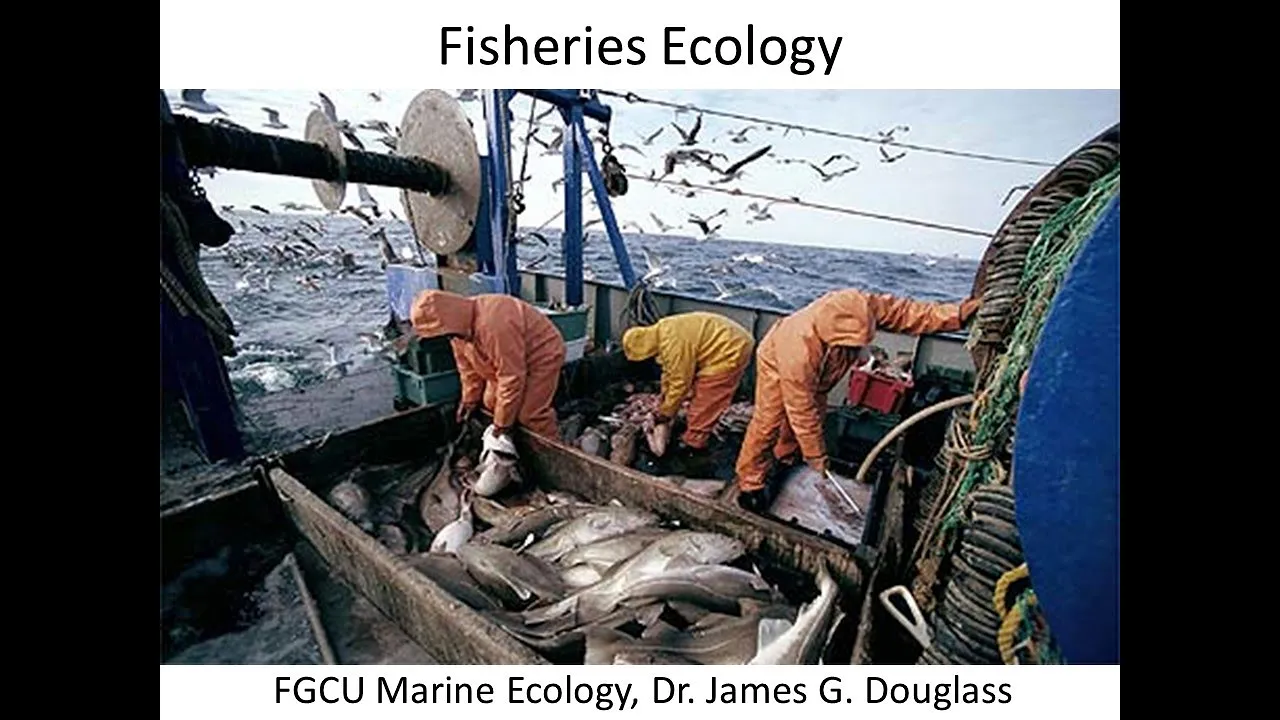

























Individual Transferable Quotas (ITQs) are a fisheries management tool that assigns each fisherman a specific portion of the total allowable catch, transforming open-access fisheries into systems where fishermen hold property rights to fish while they remain in the water; this approach reduces the 'race to fish' by allowing fishermen to plan their operations more efficiently, and when quotas are made tradable, the market mechanism allocates fishing rights to those who can harvest fish most economically, though ITQs may encourage wasteful behaviors like discarding smaller fish and do not necessarily improve fish stock health compared to other management systems.
Fisheries Economics & Policy: Individual Transferable Quotas
Added:The concept of the 'Tragedy of the Commons' and how it applies to open-access common-pool resources.
Basic economic principles of market failures, negative externalities, and the definition of property rights.
Biological foundations of marine ecology, specifically Maximum Sustainable Yield (MSY) and fish population dynamics.
Traditional 'command-and-control' fisheries management methods (e.g., gear restrictions, seasonal closures) and the phenomenon of the 'race to fish'.
The design and implementation challenges of ITQs, such as determining the initial quota allocation (grandfathering vs. auctioning).
Socio-economic consequences of ITQs, including fleet consolidation, quota concentration, and the impact on small-scale fishing communities.
Monitoring, enforcement, and compliance mechanisms necessary for ITQs, such as tracking 'high-grading' and illegal, unreported, and unregulated (IUU) fishing.
Alternative rights-based management frameworks, such as Territorial Use Rights in Fisheries (TURFs) and community-based co-management.
Comparative analysis of real-world ITQ case studies, such as the Quota Management System in New Zealand and the ITQ system in Iceland.
36.4K views334likes10:23Original Release: 2015-01-27
in the previous video we looked at some of the players in the management of fisheries and some of the problems that can arise the solutions are numerous diverse and changing so we're not going to be able to do them Justice in these short videos but let's look at a few of the charismatic options that are around today in this video we're going to look at individual and transferable quotas one way of limiting fishing is by having an industrywide quota to enforce the quota those in charge could ban fishing for some amount of time monitors look at past patches or population data estimate how much can be taken and decide how much fishing time the stock of fish can handle or they just open the season to fishing and monitor catches until the limit is reached and then close the season but by just limiting effort we haven't changed the incentives of the fishery there's still money to be made for the individual by putting in more effort so if we just limit the amount of time that they can spend fishing just one of the factors that goes into the effort equation the fisherman will adjust with bigger boats or more boats or better equipment because because the fish they would have caught in that time are still there and the fishermen are still free to exploit the fish and other fishermen are free to enter the fishery so the industry as a whole just ends up reacting by putting in more effort with other means then the policy makers react by shortening the season again and the fishermen react by putting in more effort the end result isn't really a reduction in effort but the creation of a very short fishing season an increase in the fishermen's costs and an increase in occupational hazard because they can't wait for good weather and they need to pack as much fishing into that time as they can the Fisheries that operate like this can be some of the most dangerous professions in the world one way to prevent this is by instead of having an industrywide quota is by having individual quotas so you basically take a portion of the total allowable catch and then split it up to give to all the fishermen normally it's an Open Access game and a fisherman doesn't have rights to the fish until they're in the boat so they're managing their tools to try to get as much of the fish as they can instead give them each an individual amount of the total quota this way each fisherman knows more about how much fish they're going to get that season so they know how much to invest in equipment and maybe when to go fishing it's basically giving the fishermen the rights to a certain number of fish while they're still in the water in theory it's taking this rival resource where people race a take from a pool of fish and separating it into non-rival rist sections this way there's less of a race to fish and fishermen can plan ahead just a simple system like this that we've been talking about doesn't get rid of all competition but it's a step in the right direction also by making these quotas tradable you can get a more efficient outcome for how much each fisherman is fishing let's say we have a fishery with just two fishermen who are each given half The Season's quota for a stock of fish we've been generally assuming up until now that all the boats are equal in their cost per unit effort but that's not the case let's say in the beginning for this fisherman that first bit of fish quota that first 100 tons of fish has a lot of value to him he's got his ship and crew ready with nothing else to do and it would be relatively easy and inexpensive to fish that first bunch of fish so he's willing to pay a lot for those quotas for the second H hundredth ton maybe to be able to fish that much he would have to hire some additional crew so if he had to buy more quotas he would need the quotas to be a bit cheaper they're a little bit less valuable to him because his costs are higher if he gets even more quotas he would need to hire even more crew or maybe pay them overtime wages or maybe he doesn't even think he can sell that much fish so he continually values additional fishing rights less and less in other words his marginal value of fish quotas decreases as he gets more of them okay and let's say the other fisherman has a similar line her number of quotas comes in from the right here this is his amount of quotas this is her amount of quotas added together they always have the total number of quotas this just represents them trading okay but let's say with her maybe she has a more fuel efficient boat or she knows some great secret fishing spots or techniques or something that makes it so that she can fish for a bit cheaper if she can fish for cheaper but the price of fish isn't changing then she can make more money per fish which after all is said and done makes it so that she's able to pay more for fishing quotas so her value per quota is higher and let's say just like with him her marginal benefit from another quota goes down as she gets more of them and her demand for quotas looks like this okay so right now with the initial allocation let's say they're each getting half to start for Simplicity in reality these types of systems are generally distributed based on the fisherman's historical catches or current level of investment here at the initial allocation she values quotas more than he does so if the quot quotas were tradable he would be willing to sell some of his quotas to her and she would be willing to buy to her this quota is worth this much money but she would be able to pay less than that to somebody who values the quotas less to him it's only worth this much but there's somebody willing to pay more than that so they would be willing to trade their quotas after that they're in a similar position so they'll trade again and they'll keep trading quotas until here now they value the quotas the same amount she wouldn't buy any more past this point because he would expect more money than she cares to pay this is the benefit of trading quas allocate the quas as fairly as you can in the beginning then through trade they will reach an efficient allocation of how much each Fisher is fishing based on their abilities and their preferences okay let's say she was just way more efficient than he was at fishing he doesn't value any of his quotas as much as she does she would be willing to pay him for all his quotas and he would be willing to sell them all so this means that he would make more money if he just fired his crew didn't worry about equipment and gas and fishing just sold all of his rights to somebody who places a higher value on them she's basically leasing all of his rights to fish for that period this is another benefit the system encourages some people to leave and the fishermen Who Remain the ones who are gaining that extra rent from fishing are the ones paying for the transition this can sometimes mean that it's the offshore or large scale commercial fishermen that end up with all the quotas since they can fish for cheaper and it's probably the smaller more labor intensive boats that are losing out this might be what you want or can be corrected by separating the total allowable catch into two sets of markets and restrict trade between the markets or something the benefit to allowing a market for quotas is that they take into account all of the fisherman's values for example yes he may be less efficient than she is but what if he really likes to fish it's a family tradition and he's always loved it in theory this is going to raise the value of his quotas he's going to take that into account this is a madeup situation but in theory this is the benefit of aist like this we as policy makers let's say can sit here and try to find out or decide what the people want what's important to them who should be fishing and how much or just put the choice into the hands of the players who know the most about their costs their revenue and what they want it lets him decide exactly what amount of money if any is required to make him stop fishing one problem with individual transferable quotas not necessarily exclusive to the system but they may encourage wasteful behaviors like throwing back the smaller fish depending on the species the larger fish might have more value per pound than the little ones so much so that it can be worthwhile to just throw back the little ones so they're not wasting their precious quotas on less valuable fish some species can survive being thrown back I think something like 80% of hibit brought up and thrown back will actually survive but other species like cod will die from the pressure difference but individual transferable quota systems have seen some success in 1980 in the Canadian province of British Columbia it took 65 days for the fisherman to catch 5.7 million pounds of Pacific hibit by 1990 because of more Advanced Technologies it took them 6 days to catch 8.5 million pound policy makers tried to limit catch by limiting the length of the season but just like we've been talking about it didn't eliminate the incentive to race to fish so the fishery attracted too many fishermen the fishermen over invested in equipment they had to deal with unsafe working conditions and something we didn't talk about before because the fishermen are getting a huge supply in very short time period the fish has less value per pound because of the abundance and because it's probably going to have to be sold Frozen and with six days of crazy fishing it's even harder for monitors to know what the population is at the actual catch in this system was always greater than the total allowable catch they decided to do a trial run testing individual quotas after starting in 1991 the total catch was actually below the total allowable catch the fishing season changed from 6 days of Derby style fishing producing fish of lesser value to a 28-day season the fishing being more spread out with them able to provide fresh fish at a greater value in that first year of trying the individual quotas the revenue of the industry increased after trading was allowed the number of vessels decreased as fishermen sold their quotas and apparently overall fishing costs also decreased although I couldn't find data to put it on the graph biological monitoring catch monitoring and enforcement increased as quota holders were expected to supplement the funding in 199 92 91% of the Fishers voted to continue the program so an individual quota system helps reduce competition helps the fishermen plan out their tools and how they're going to spend their time which can decrease their costs increase their revenue and make things safer does it help the fish stock they don't really seem to something like 10% of all Fisheries today are managed with some sort of individual quota system but on average They Don't Really display a healthier fish stock or an increase in catches compared to other Management Systems which makes sense really how much fish is caught is still based on how well management can estimate fish stock size measure fish catches and accurately decide the quota and then monitor the fisherman's activities what's mostly changed is just the fisherman's relationship to the total allowable catch but because the system is more efficient more efficient meaning there would be more money being made for the same amount of fish being caught some of that money can and should be rolled back into monitoring enforcement Etc that pushes the industry towards the maximum economic yield we really just scratched the surface on these kinds of systems but you know we're out of time in the next video we're going to look at management by space or territory rather than just by a single species like we've been looking at in this video
Up Next

14:54
Open-Access Fisheries Economics: Tragedy of the Commons
@RichardTWoodward
21.1K views•2013-07-22

5:07
Impact of Yuan in Indo-Russian Trade Amid Sanctions
@WION
261.9K views•2022-07-01
10:33
Behavioral Economics Explained: Rationality, Nudges, and Risk
@crashcourse
1.1M views•2016-03-12

113:18
The Age of Easy Money: Fed & Inflation | Full Documentary
@frontline
21.2M views•2023-03-15
Related Study Plans & Knowledge Roadmaps
Structured learning paths in Economics
economics
Sovereign Debt: Defaults, IMF & Restructuring
01Introduction to Sovereign Debt & Government Bonds
02Debt Sustainability & Credit Ratings
03Anatomy and History of Debt Crises
+ 2 more learning modules
12h5 modules
Explore Roadmap
economics
Market Design: Matching Theory & Gale-Shapley
01Introduction to Market Design and Price-Free Markets
02Two-Sided Matching & The Gale-Shapley Algorithm
03School Choice Systems and Mechanism Design
+ 2 more learning modules
10h5 modules
Explore Roadmap
economics
Impossible Trinity: Forex, Capital & Policy
01Introduction to Monetary Policy and Central Banking
02Exchange Rates and International Capital Flows
03The Mundell-Fleming Model
+ 2 more learning modules
8h5 modules
Explore Roadmap
economics
Healthcare Economics: Market Failures & Systems
01Introduction to Healthcare Markets and Market Failure
02Asymmetric Information and Adverse Selection
03Moral Hazard and Insurance Design
+ 2 more learning modules
12h5 modules
Explore Roadmap