Asymmetric information occurs when one party in a transaction has superior knowledge over the other, leading to market failures such as adverse selection (where informed parties make unfavorable deals before transactions, like high-risk individuals signing up for health insurance) and moral hazard (where parties change behavior after transactions because they don't bear the consequences, like banks taking risky bets knowing they'll be bailed out).
Asymmetric Information Explained: Economics of Market Failure
Added:Deep Dive
The assumption of perfect information in classical economic models of perfect competition.

UGC NET Economics Paper 2 | Classical School of Thought By Shivani Sharma
1.1K
Classical economists assumed perfect information (परफेक्ट इंफॉर्मेशन) in markets. All economic agents, including producers and consumers, have complete knowledge about prices, production costs, and market conditions. This perfect information ensures that markets function efficiently and resources are allocated optimally.
Click to watch →
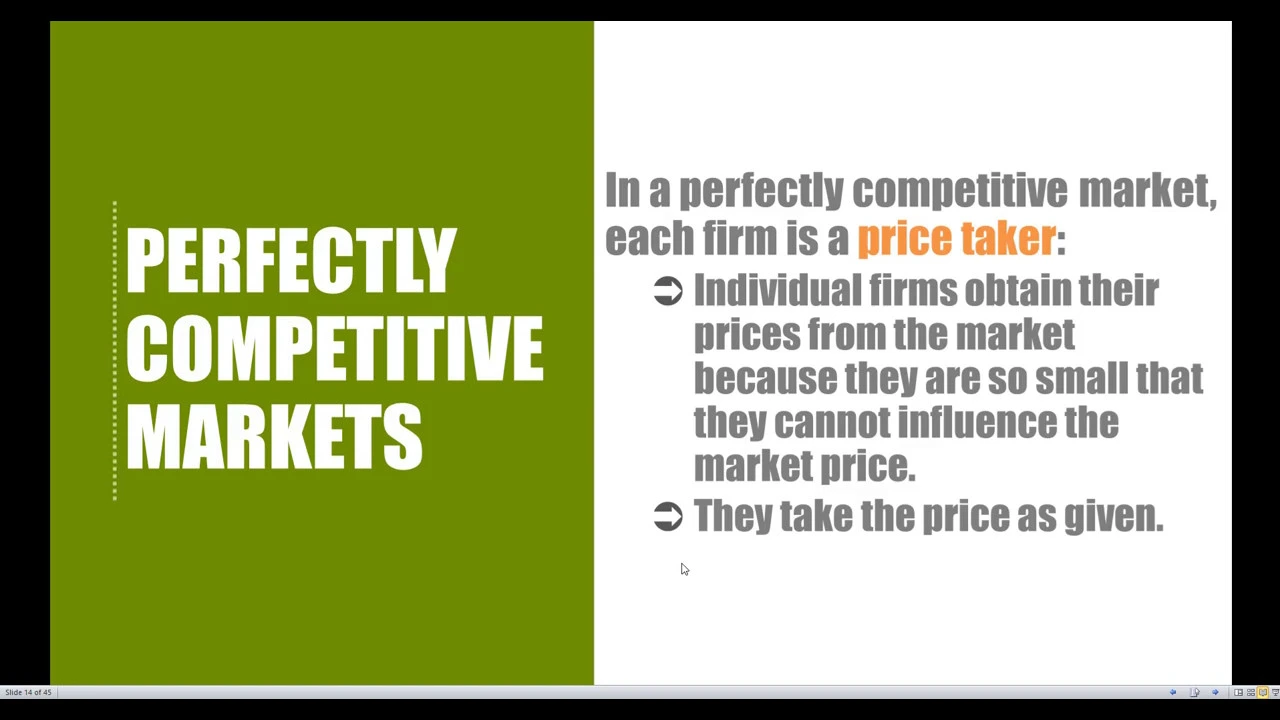
ECO 2023 Microeconomics -- Chapter 8.03: Perfect Competition Assumptions
773
In a perfectly competitive market structure, every firm is a price taker, meaning they must accept market prices as given and cannot influence them. Firms are so small relative to the market that they cannot raise or lower prices. A fundamental assumption underlying all market structure analysis is perfect information, where all buyers and firms have complete knowledge about prices and product quality to make informed decisions. This assumption distinguishes perfect competition from scenarios with asymmetric information, where one party has better knowledge than another. The perfect information assumption simplifies economic analysis and enables meaningful predictions about market behavior.
Click to watch →

11th GSEB Economics Chapter-6 Lec 2 | Class 11 | Session 2022-23 | UKIC | Prof. Khushalee Kachchhy
15.9K
Perfect competition assumes that all market participants have perfect knowledge about prices, product quality, and market conditions. This means buyers and sellers are fully informed about all relevant market information. This assumption is necessary because when all products are identical, buyers can easily compare prices and switch to the lowest-priced seller, making any information asymmetry impossible to maintain.
Click to watch →

Class 11 Economics Chapter 5 | Non-Competitive Markets- Perfect Competition
389.2K
Perfect competition assumes that all market participants have perfect information about prices, product quality, and market conditions. This means: (1) Consumers know the lowest price available for any product, (2) Producers know the prices at which they can sell their products, (3) No buyer or seller has market power to influence prices. This perfect information ensures that all transactions occur at the equilibrium market price.
Click to watch →
Perfect Competition Explained | ECON 208 @ McGill | Wizeprep
192
Perfectly competitive markets assume perfect information, meaning both producers and consumers have complete knowledge about all aspects of the market including the number of firms, the number of consumers, and all product characteristics. Neither side of the market possesses more information than the other, eliminating asymmetric information problems. This strong assumption ensures that all market participants make decisions based on identical information, which is essential for the theoretical framework of perfect competition.
Click to watch →
Deep Dive
The definition and basic causes of market failure, where free markets fail to allocate resources efficiently.

THE PUBLIC SECTOR/GOVERNMENT SECTOR
902
Market failure occurs when markets cannot allocate resources efficiently, producing neither the right goods nor the right quantities consumers need. The five causes are: (1) Monopoly and imperfect competition (oligopoly, monopolistic competition) causing allocative inefficiency, (2) Public goods with non-excludability and non-rivalrous consumption, (3) Externalities (spillover effects to third parties), (4) Asymmetric information between buyers and sellers, and (5) Common property resources requiring government regulation to prevent overexploitation.
Click to watch →
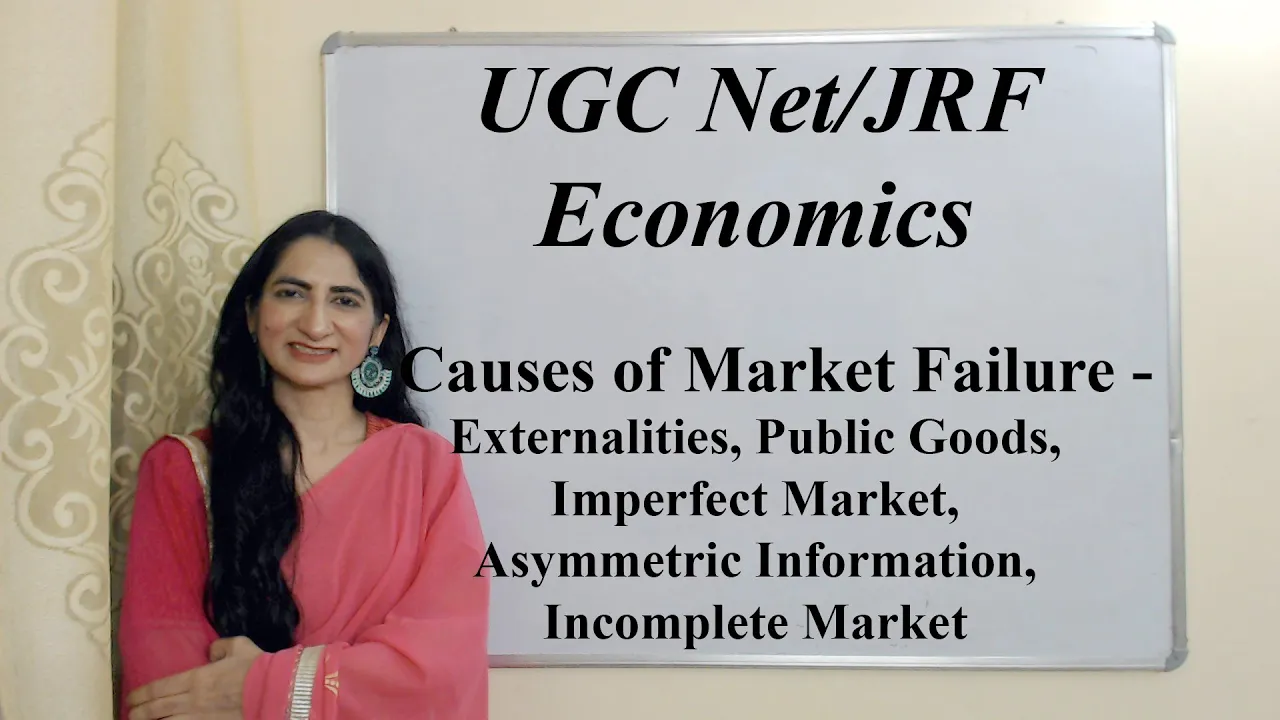
Causes of Market Failure- Externalities, Public Goods, Imperfect Market, Asymmetric Info UGC Net/JRF
13K
Market failure occurs when markets fail to allocate resources efficiently, caused by five main factors: (1) Externalities—when production or consumption imposes uncompensated costs or benefits on third parties, such as pollution creating negative externalities; (2) Public goods—non-excludable and non-rivalrous goods that lead to free-rider problems and inefficient provision; (3) Imperfect markets—such as monopolies that restrict output and raise prices above competitive levels; (4) Asymmetric information—where one party has more information than another, leading to adverse selection and moral hazard; and (5) Incomplete markets—when private sector fails to provide goods and services even when consumers are willing to pay more than production costs.
Click to watch →
#15 Public Finance | Lecture-2 | Fiscal Functions | Business Economics I CA Foundation.
244
Market failure is a situation where free markets lead to misallocation of resources, resulting in over-production or under-production of goods. Four main causes include: (1) Market and Monopoly Power - firms restrict output to maintain high prices, (2) Externalities - costs/benefits not reflected in market prices, (3) Public Goods - non-excludable goods that private sectors won't produce, and (4) Incomplete Information - market participants lack necessary information for optimal decisions.
Click to watch →
Market failure | Economics | Simranjit Kaur | Unacademy UGC NET
41.6K
Market failure occurs when free market allocation is inefficient, failing to achieve Pareto optimality. Externalities represent a primary cause: positive externalities (social benefits exceed private benefits) cause underproduction, while negative externalities (social costs exceed private costs) cause overproduction. Public goods possess non-excludability and non-rivalry, creating the free rider problem where individuals benefit without contributing. Asymmetric information prevents fully informed decisions, causing market inefficiency. These structural failures prevent markets from achieving optimal welfare allocation.
Click to watch →

CA Foundation Economics - CH-07 - Public Finance Part -1 | Best Revision Series JAN'25
3.5K
Market failure occurs when resources are not allocated efficiently, leading to overproduction of some goods and underproduction of others. The four main causes are: (1) Externalities - costs or benefits not reflected in market prices, causing negative externalities to lead to overproduction and positive externalities to underproduction; (2) Monopoly power - single sellers restrict supply to increase prices; (3) Public goods - non-excludable and non-rivalrous goods that markets fail to provide; (4) Information asymmetry - unequal information between buyers and sellers leading to adverse selection and moral hazard.
Click to watch →
Deep Dive
The fundamentals of supply and demand, market equilibrium, and consumer/producer surplus.

NEW- Micro Unit 2 Summary- Supply and Demand
234.9K
This video covers Unit 2 of Microeconomics, explaining the law of demand (inverse relationship between price and quantity demanded) and the law of supply (direct relationship between price and quantity supplied), along with five demand shifters (taste, number of consumers, price of related goods, income, and future expectations), five supply shifters (input prices, number of producers, technology, government intervention, and expectations), four types of elasticity (price elasticity of demand, price elasticity of supply, cross-price elasticity, and income elasticity), market equilibrium where quantity demanded equals quantity supplied, consumer surplus, producer surplus, and deadweight loss, plus government interventions like price controls, taxes, and international trade.
Click to watch →

Principles of Microeconomics-I | GE Important Questions with Solutions | DU & DUSOL Exam One Shot
10K
Market equilibrium occurs where quantity demanded equals quantity supplied. To find equilibrium, set demand function equal to supply function and solve for price and quantity. Consumer surplus is the difference between what consumers are willing to pay and what they actually pay, calculated as 1/2 × (maximum willingness to pay - equilibrium price) × equilibrium quantity. Producer surplus is the difference between the minimum price producers are willing to accept and the equilibrium price, calculated as 1/2 × (equilibrium price - minimum acceptable price) × equilibrium quantity.
Click to watch →

TEMA: EQUILIBRIO DO MERCADO
5.2K
This comprehensive lesson covers three fundamental concepts in microeconomics: market equilibrium, consumer surplus, and producer surplus. Market equilibrium occurs when quantity demanded equals quantity supplied, found by equating demand and supply functions. Given Qd = 9 - P and Qs = 2P, solving yields equilibrium price P = 3 and quantity Q = 6. Consumer surplus represents the benefit consumers receive by paying less than their maximum willingness to pay, calculated as the triangular area above equilibrium price and below the demand curve: CS = (1/2) × 6 × 6 = 18. Producer surplus measures the benefit producers receive by receiving more than their minimum acceptable price, calculated as the triangular area below equilibrium price and above the supply curve: PS = (1/2) × 6 × 3 = 9. These concepts are essential for understanding market efficiency and welfare distribution.
Click to watch →

INTRODUCTION TO MICROECONOMICS - DEMAND AND SUPPLY (MARKET) ANALYSIS
15.2K
In microeconomics, market equilibrium occurs where the demand curve (downward-sloping, showing inverse relationship between price and quantity demanded) intersects the supply curve (upward-sloping, showing direct relationship between price and quantity supplied), with the equilibrium price and quantity determined by equating quantity demanded to quantity supplied; consumer surplus represents the difference between what consumers are willing to pay and what they actually pay (area above equilibrium price under demand curve), while producer surplus represents the difference between what producers receive and their minimum acceptable price (area below equilibrium price above supply curve), and total welfare is maximized at equilibrium when these two surpluses sum together.
Click to watch →

Economics - Ch 1 & 2 🔥 COMPLETE ! CA Foundation Ultra Pro Revision 🔥 June 2024 | CA Parag Gupta
96.6K
Market Equilibrium occurs where Supply and Demand curves intersect. At this point, the equilibrium price and quantity are determined. Consumer Surplus is the area below the demand curve and above the equilibrium price, while Producer Surplus is the area above the supply curve and below the equilibrium price.
Click to watch →
Deep Dive
The concept of rational self-interest and utility maximization in economic decision-making.
MICRO 1- 30/08
1.9K
A key assumption in economic theory is that economic agents act rationally and are utilitarian or egoistic. Rationality means agents are logical in both formulating economic problems and choosing solutions. Utilitarian behavior means agents always attempt to maximize some magnitude, typically utility. This is exemplified by consumers who, given a budget constraint (income), seek to maximize the satisfaction of their needs within their financial limitations. This assumption of rational utility maximization is fundamental to understanding economic decision-making.
Click to watch →

Lesson 1 Introductory concepts, definitions, branches, economic thoughts, assumptions, economic art
1.9K
Economic agents (individuals, households, firms, governments, international actors) are assumed to be rational beings who make decisions to maximize their self-interest. Consumers maximize utility (satisfaction from goods/services), while producers maximize profits. This rationality assumption is fundamental to economic analysis, enabling mathematical modeling of decision-making processes.
Click to watch →

Microeconomics-Chapter 1: Limits, Alternatives, and Choices
1.3K
Rational self-interest is the principle that individuals act to maximize their own satisfaction or utility. Utility refers to the personal benefit or satisfaction derived from consuming goods and services. This behavior is not necessarily selfish but reflects the natural tendency of individuals to seek outcomes that benefit them personally given their constraints. At the firm level, the basic objective often revolves around profit maximization, which is the financial gain earned when revenue from selling goods or services exceeds production costs. These desire outcomes—utility maximization for individuals and profit maximization for firms—are influenced by external factors such as market conditions, government policies, technological advancement, and societal trends.
Click to watch →

What Is Rationality, Anyway?
5.8K
The economic conception of rationality holds that rational agents maximize their expected utility by acting in their own self-interest. At its extreme, this conception identifies rationality with selfishness—doing whatever serves one's narrow individual interests best. This view has led to widespread associations between rationality and cold, calculating behavior focused solely on personal benefit.
Click to watch →

LEC 1 MA ECONOMICS INTEGRATED BATCH | IIT JAM ECONOMICS | CUET PG ECONOMICS COACHING | ISI MSQE
190
A rational human being maximizes their own utility or welfare. Rationality is subjective—what one person considers rational (like smoking) may differ from another's perspective. The opposite of rationality is altruism, where one's satisfaction depends on others' happiness. Rationality focuses on self-satisfaction.
Click to watch →
Prerequisite Knowledge
- Concept 01The assumption of perfect information in classical economic models of perfect competition.
- Concept 02The definition and basic causes of market failure, where free markets fail to allocate resources efficiently.
- Concept 03The fundamentals of supply and demand, market equilibrium, and consumer/producer surplus.
- Concept 04The concept of rational self-interest and utility maximization in economic decision-making.
Subsequent Learning
- Step 01Signaling and screening mechanisms, such as warranties, brand reputation, and educational credentials to mitigate information gaps.
- Step 02The Principal-Agent problem and contract theory, exploring how to align incentives between contracting parties.
- Step 03Government policy interventions to address asymmetric information, such as mandatory disclosure laws and public provision of insurance.
- Step 04Real-world applications in the healthcare and insurance industries, such as individual mandates, co-pays, and deductibles.
Asymmetric Info
Asymmetric Info
0:00Playing Section
- 1
Defines asymmetric information and its role in market failure.
- 2
Explains adverse selection and moral hazard with real-world examples.
- 3
Uses lemons market to show how warranties bridge information gaps.
The Market-Process and Information Discovery Perspective
While mainstream economics views asymmetric information as a source of market failure, alternative perspectives—particularly from the Austrian School and free-market theorists—argue that asymmetry is not a failure but a natural driver of market dynamism. According to this view, information asymmetry provides the very profit incentives that spur entrepreneurial discovery and innovation. Furthermore, critics argue that markets naturally evolve highly effective private-sector solutions to overcome information gaps without requiring government intervention. These mechanisms include brand reputation, warranties, third-party grading and certification (such as Carfax or Yelp), and signaling. From this perspective, labeling asymmetric information as a 'market failure' commits the 'nirvana fallacy' by comparing imperfect real-world markets to an unrealistic ideal of perfect information. They contend that state interventions often create worse inefficiencies and moral hazards than the market forces they seek to correct.
Deep Dive
Signaling and screening mechanisms, such as warranties, brand reputation, and educational credentials to mitigate information gaps.

Implications of asymmetric information | Deepesh Manoharan | Malayalam | LIFE ECONOMICS
316
Signaling and screening are mechanisms to reduce asymmetric information. Signaling involves the informed party sending signals (like education as a signal of productivity) to convey information. Screening involves the uninformed party gathering information (like banks checking credit history). These mechanisms help reduce information gaps but involve additional transaction costs.
Click to watch →
![[2027 수능특강 독서] 사회문화2 정보 비대칭과 역선택](https://i.ytimg.com/vi_webp/irGFbcBBL90/maxresdefault.webp)
[2027 수능특강 독서] 사회문화2 정보 비대칭과 역선택
2.8K
Signaling allows informed parties to reveal hidden characteristics through costly actions. In labor markets, education and certifications signal productivity—high-productivity workers face lower relative costs to obtain credentials. For signaling to work, better characteristics must correlate with lower signaling costs; otherwise, all agents send signals, eliminating distinguishing power. Warranties serve as product quality signals: high-quality producers can offer longer warranties because they expect fewer claims, while low-quality producers cannot afford such costs.
Click to watch →

Asymmetric Information (Lecture 14)
764
Signaling manifests across diverse contexts. In used car markets, warranties are cheaper for sellers of genuinely high-quality cars (who know their vehicles won't break down) than for sellers of problematic cars (who face expensive repair costs). In labor markets, college degrees signal worker capability because completing college is more difficult for less skilled workers. Even if college taught nothing useful, employers prefer degree holders because degrees prove persistence and discipline. Biologically, peacock feathers signal male strength: only strong males can afford the caloric costs of growing elaborate feathers while avoiding predators, making feather display an honest signal of genetic quality.
Click to watch →

【数式なしの経済学】スティグリッツの考え方を紹介!なぜ世界銀行やIMFを批判したのか?
179
Two mechanisms help reduce information asymmetry: (1) Signaling - informed parties actively demonstrate their quality through observable credentials (education, qualifications, experience) to reduce uncertainty for uninformed parties; (2) Screening - uninformed parties actively gather information through tests, interviews, or other methods to assess the informed party's characteristics. Both mechanisms help bridge information gaps and improve market efficiency.
Click to watch →

Game Theory - Chapter 8 - Part 1
256
Two primary mechanisms address asymmetric information: signaling and screening. Signaling involves the informed party taking costly actions to credibly reveal information, such as workers obtaining good education to signal productivity. Screening involves the uninformed party creating tests or mechanisms that induce the informed party to reveal their type. Direct communication alone cannot resolve these problems because claims lack credibility when incentives are misaligned. The key insight is that credible information sharing requires either costly signals that differentiate types or screening mechanisms that make truthful revelation beneficial.
Click to watch →
Deep Dive
The Principal-Agent problem and contract theory, exploring how to align incentives between contracting parties.
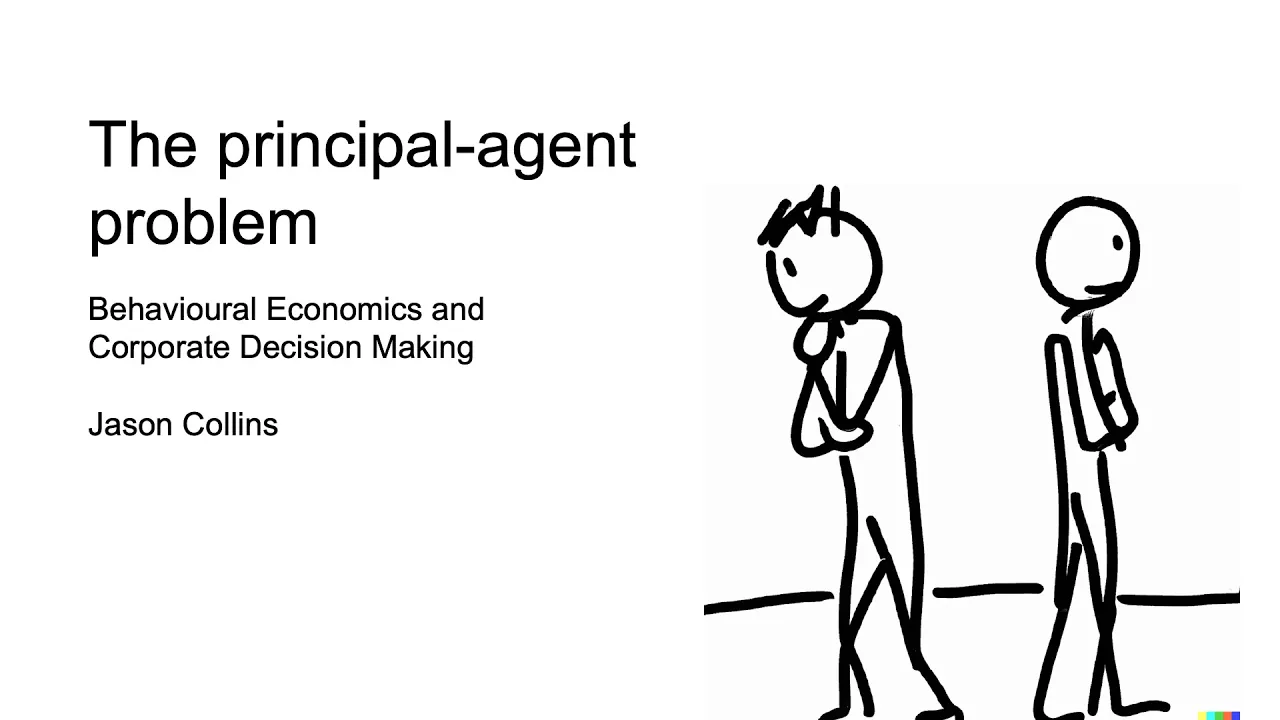
The principal-agent problem
130
The principal-agent problem occurs when decision rights in a firm create misaligned interests between owners (principals) and employees (agents); when effort is observable, firms can directly contract on effort levels, but when effort is unobservable, firms must use incentive-compatible contracts like output-sharing to align agent behavior with firm objectives.
Click to watch →

Die Prinzipal-Agent-Theorie. Das Prinzipal-Agent-Modell.
15.4K
The Principal-Agent Theory, developed in the 1980s, explains that when one party (principal) hires another (agent) to perform tasks, information asymmetry can lead to hidden actions and market failure; this can be mitigated through incentive-based contracts, monitoring systems, and performance-based compensation to align interests between the two parties.
Click to watch →

Game Theory | Principal Agent Problem | Part 1 | Joel Watson, Ch 25 |
1.9K
The principal-agent problem arises when one party (principal, e.g., employer) cannot directly observe the effort of another party (agent, e.g., employee). In this framework, the employer observes only project outcomes (success or failure), not the worker's effort level. The agent can choose between high effort (with 50% success probability) or low effort (guaranteed failure). High effort incurs a utility cost of -1, while low effort costs nothing. This asymmetric information creates moral hazard, requiring contract mechanisms to align incentives between parties with different risk preferences.
Click to watch →

Why Delegation Fails Without a Proper Contract
890
The principal-agent problem occurs when agents (employees, politicians) act in their own self-interest rather than the principal's (employer, citizens) best interest, leading to misaligned incentives and potential exploitation; this problem can be mitigated through well-designed contracts that clearly define roles using the 5W2H framework (What, Why, When, Where, Who, How much, How) and establish proper incentive structures to align interests.
Click to watch →

ÖRGÜT KURAMI - Ünite 5 Ünite Anlatımı
23.8K
Agency theory views organizations as contracts between principals (owners/shareholders) and agents (managers). Agents act on principals' behalf, with detailed contracts specifying duties to ensure intended behavior. Agency costs arise from behaviors not serving organizational objectives. Two core problems exist: the agency problem (misaligned goals and monitoring difficulties) and the risk preference problem (different attitudes toward risk). Two contract types address these issues: behavior-focused contracts (salary-based, specifying expected actions) and output-focused contracts (performance-based, aligning incentives). Key problems include shirking (agents not exerting expected effort), adverse selection (agents misrepresenting capabilities), and hold-up problems (mutual dependency from asset-specific investments). The theory applies across attorney-client, doctor-patient, employer-employee, and manufacturer-supplier relationships.
Click to watch →
Deep Dive
Government policy interventions to address asymmetric information, such as mandatory disclosure laws and public provision of insurance.

Public Finance Unit - 2 - Detailed ONE SHOT - CA Foundation Economics | Roopa Trivedi | Jan 26 |
258
Asymmetric information creates adverse selection (high-risk individuals select into markets) and moral hazard (insured take more risks). Examples: Insurance markets where healthy people opt out, used car markets where sellers hide defects (Lemons Problem). Governments address this through mandatory disclosure, regulation, and penalties. Governments redistribute income through progressive taxation, targeted budget allocation, unemployment compensation, and welfare programs. However, government failure occurs when interventions waste resources, create new problems, or fail to achieve objectives. Examples include ineffective public sector projects and farmer protests due to policy changes.
Click to watch →

Foundation Paper 4: BE | Topic: Ch 7: UNIT III- Government Interventions...| Session 2 | 17 Feb 2024
13.3K
Government corrects information failure through: (1) mandatory content disclosures (e.g., SEBI requiring accurate information for prospective stock buyers), and (2) regulation of advertising and setting advertising standards to make advertising more responsible and informative. The instructor gives examples like mandatory nutritional information on food products.
Click to watch →

Public Finance | Chapter 2 (2 of 5) | สาเหตุของความล้มเหลวของตลาด (ต่อ)
680
When information asymmetry prevents private markets from functioning efficiently, governments intervene through regulation and public programs. For unemployment and poverty insurance, governments establish social security funds that provide income replacement when workers lose jobs. For consumer protection, governments mandate that producers display complete product information (nutritional labels, ingredients, safety warnings) to ensure consumers can make informed decisions. This intervention addresses the fundamental problem that private companies cannot profitably offer essential services when they lack complete information about buyers' behavior or needs.
Click to watch →
24. Market Failures II: Informational Asymmetry
59.2K
Three main government solutions address adverse selection in insurance markets. First, subsidization through tax credits reduces effective prices, encouraging healthy individuals to enter markets. The U.S. implements this through employer-sponsored insurance subsidies costing nearly $300 billion annually. Second, mandates require universal purchase, allowing accurate risk pooling but facing political opposition. Third, direct government provision guarantees coverage through Social Security, Medicare, unemployment, and disability insurance—the largest government expenditure category at approximately $1.7 trillion annually. Each approach has trade-offs between effectiveness, cost, and political feasibility.
Click to watch →

#20 Public Finance | Lecture-7 | Business Economics I CA Foundation.
120
Government corrects information failure through: (1) Mandatory accurate labeling and content disclosure by producers, (2) Mandatory disclosure requirements like SEBI prospectus for companies, (3) Public dissemination of information to improve public knowledge, and (4) Advertising regulation to ensure responsible and informative marketing. These measures address asymmetry between buyers and sellers.
Click to watch →
Deep Dive
Real-world applications in the healthcare and insurance industries, such as individual mandates, co-pays, and deductibles.

Health Care Debate - Conversations from Penn State
5.1K
An individual mandate (requiring everyone to have health insurance) could create a new marketplace of 47-50 million individuals. With government subsidies for lower-income individuals, this represents a potential boon for the insurance industry. Healthy young individuals pay premiums with minimal healthcare costs, creating pure profit opportunities for insurers.
Click to watch →

Michael Tanner on The Affordable Care and Patient Protection Act
337
The individual mandate requires every American to have health insurance, with penalties increasing from 1% to 2.5% of adjusted gross income over three years. Insurance must meet government standards including limits on deductibles, co-payments, and prohibited lifetime/annual limits. Required benefits include mental health parity, drug rehabilitation, prescription drugs, children's dental/vision care, autism coverage, and contraception including abortion. Grandfathered plans must comply upon any substantive change. The employer mandate requires businesses with 50+ employees to provide insurance or pay penalties, with compliance required for 80% of small businesses over five years.
Click to watch →

House Commerce Finance and Policy Committee 3/6/24
459
Healthcare mandates create costs passed to all premium payers. Minnesota has over 60 mandates, adding half dozen last year at $114 million cost. The defrayal process allows plans to seek state reimbursement but is rarely used. Mandates increase insurance costs, balanced by increasing deductibles. The legislature must balance individual mandate benefits against overall affordability. Personal testimony from individuals with medical conditions (Mass Activation Syndrome, Chronic GI issues) demonstrated how lack of statutory coverage creates barriers to necessary medical treatments, with families fighting insurance companies for formula coverage.
Click to watch →

House Commerce Finance and Policy Committee 3/5/26
148
Healthcare mandates in Minnesota generally apply to the individual market, small group market, and fully insured large group market, while exempting self-insured ORISA plans, Medicare, and other programs. This creates a shrinking market for mandates as businesses move to self-insured plans. The individual market includes small business owners, early retirees, and gig workers facing the highest premiums ($1,200-$1,400/month) and deductibles ($5,000-$10,000). Adding mandates makes insurance less affordable for those who need it most. The reinsurance program addresses this by subsidizing high-cost claims, preventing adverse selection where only sick people remain in the market.
Click to watch →

The Randi Rhodes Show: WHEN THE GOING GETS TOUGH – TWEET?
12.2K
The hosts discussed how the individual mandate was necessary because hospitals and ERs were overburdened with people coming in due to lack of preventative care. They noted that the mandate helped spread costs across the insurance market and that without it, premiums could go up by 20%. They also discussed how the ACA provided tax credits to help people afford premiums and co-pays, and that the bill would affect everyone regardless of whether they have employer-based insurance or Medicare.
Click to watch →
Asymmetric Info
Asymmetric Info
0:00- 1
Defines asymmetric information and its role in market failure.
- 2
Explains adverse selection and moral hazard with real-world examples.
- 3
Uses lemons market to show how warranties bridge information gaps.
The Market-Process and Information Discovery Perspective
While mainstream economics views asymmetric information as a source of market failure, alternative perspectives—particularly from the Austrian School and free-market theorists—argue that asymmetry is not a failure but a natural driver of market dynamism. According to this view, information asymmetry provides the very profit incentives that spur entrepreneurial discovery and innovation. Furthermore, critics argue that markets naturally evolve highly effective private-sector solutions to overcome information gaps without requiring government intervention. These mechanisms include brand reputation, warranties, third-party grading and certification (such as Carfax or Yelp), and signaling. From this perspective, labeling asymmetric information as a 'market failure' commits the 'nirvana fallacy' by comparing imperfect real-world markets to an unrealistic ideal of perfect information. They contend that state interventions often create worse inefficiencies and moral hazards than the market forces they seek to correct.
The assumption of perfect information in classical economic models of perfect competition.
The definition and basic causes of market failure, where free markets fail to allocate resources efficiently.
The fundamentals of supply and demand, market equilibrium, and consumer/producer surplus.
The concept of rational self-interest and utility maximization in economic decision-making.
Signaling and screening mechanisms, such as warranties, brand reputation, and educational credentials to mitigate information gaps.
The Principal-Agent problem and contract theory, exploring how to align incentives between contracting parties.
Government policy interventions to address asymmetric information, such as mandatory disclosure laws and public provision of insurance.
Real-world applications in the healthcare and insurance industries, such as individual mandates, co-pays, and deductibles.
238 views2likes1:46@tutor2u-officialOriginal Release: 2026-04-21
60-second economics on asymmetric information. Well, this happens when one party in a transaction has more or better information than the other. In economics, this asymmetric information gap can lead to market failure where prices and quantities of goods and services exchanged are not optimal. And there's loads of good examples ranging from health insurance to used vehicles.
Let's look at this adverse selection as an example.
Now, this happens before the transaction. The party with less information ends up making the deal with the wrong person.
So, consider private health care insurance. For company like Bupa offers a standard insurance premium, the people most likely to sign up are those who who know they have underlying health issues.
Indeed, healthy people might then opt out because it's just too expensive for them, leaving the insurer with a a concentrated pool of high-risk clients.
And this can lead to the famous death spiral where health insurance premiums keep rising until the market collapses.
Moral hazard is another example. This happens after the transaction. One party changes behavior because the other party bears the cost of their risks. Go back to the global financial crisis of 2008.
Large UK and international banks like RBS took high-risk gambles in the subprime mortgage market. And bankers knew instinctively that if they succeeded, they kept the profits, but if they failed, the government would likely bail them out.
The market for lemons is another good example. The term lemon refers to a car with hidden defects. In the UK, platforms like Auto Trader or Cazoo fight asymmetric information. Indeed, cars sold by private individuals are often priced lower than sold those sold by dealers. This is because a dealer provides a warranty to help bridge the information gap.
Up Next

11:50
Asymmetric Information & Market Failure: Akerlof's Lemons Explained
@MarkSeccombe
65.4K views•2016-02-20

5:07
Impact of Yuan in Indo-Russian Trade Amid Sanctions
@WION
261.9K views•2022-07-01

7:29
What Are Government Bonds? A-Level & IB Economics Explained
@tutor2u-official
2.3K views•2025-01-09

113:18
The Age of Easy Money: Fed & Inflation | Full Documentary
@frontline
21.2M views•2023-03-15
Related Study Plans & Knowledge Roadmaps
Structured learning paths in Economics
economics
Sovereign Debt: Defaults, IMF & Restructuring
01Introduction to Sovereign Debt & Government Bonds
02Debt Sustainability & Credit Ratings
03Anatomy and History of Debt Crises
+ 2 more learning modules
12h5 modules
Explore Roadmap
economics
Market Design: Matching Theory & Gale-Shapley
01Introduction to Market Design and Price-Free Markets
02Two-Sided Matching & The Gale-Shapley Algorithm
03School Choice Systems and Mechanism Design
+ 2 more learning modules
10h5 modules
Explore Roadmap
economics
Impossible Trinity: Forex, Capital & Policy
01Introduction to Monetary Policy and Central Banking
02Exchange Rates and International Capital Flows
03The Mundell-Fleming Model
+ 2 more learning modules
8h5 modules
Explore Roadmap
economics
Healthcare Economics: Market Failures & Systems
01Introduction to Healthcare Markets and Market Failure
02Asymmetric Information and Adverse Selection
03Moral Hazard and Insurance Design
+ 2 more learning modules
12h5 modules
Explore Roadmap