


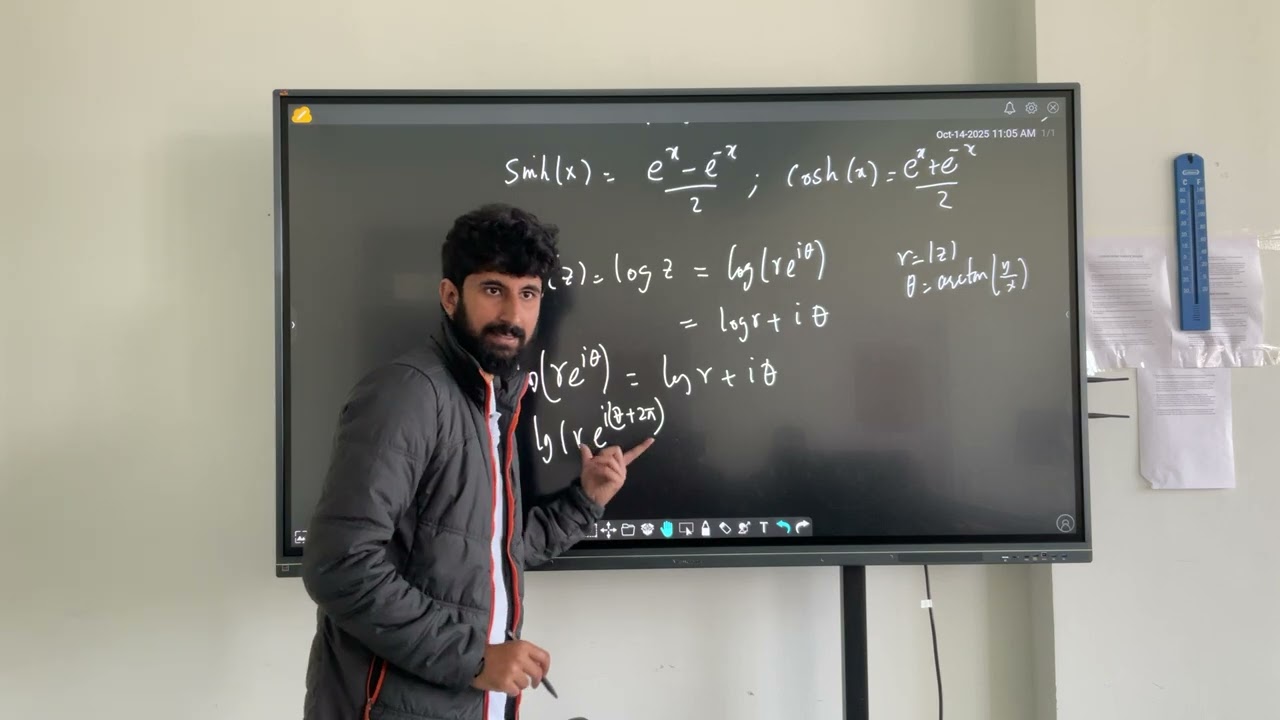
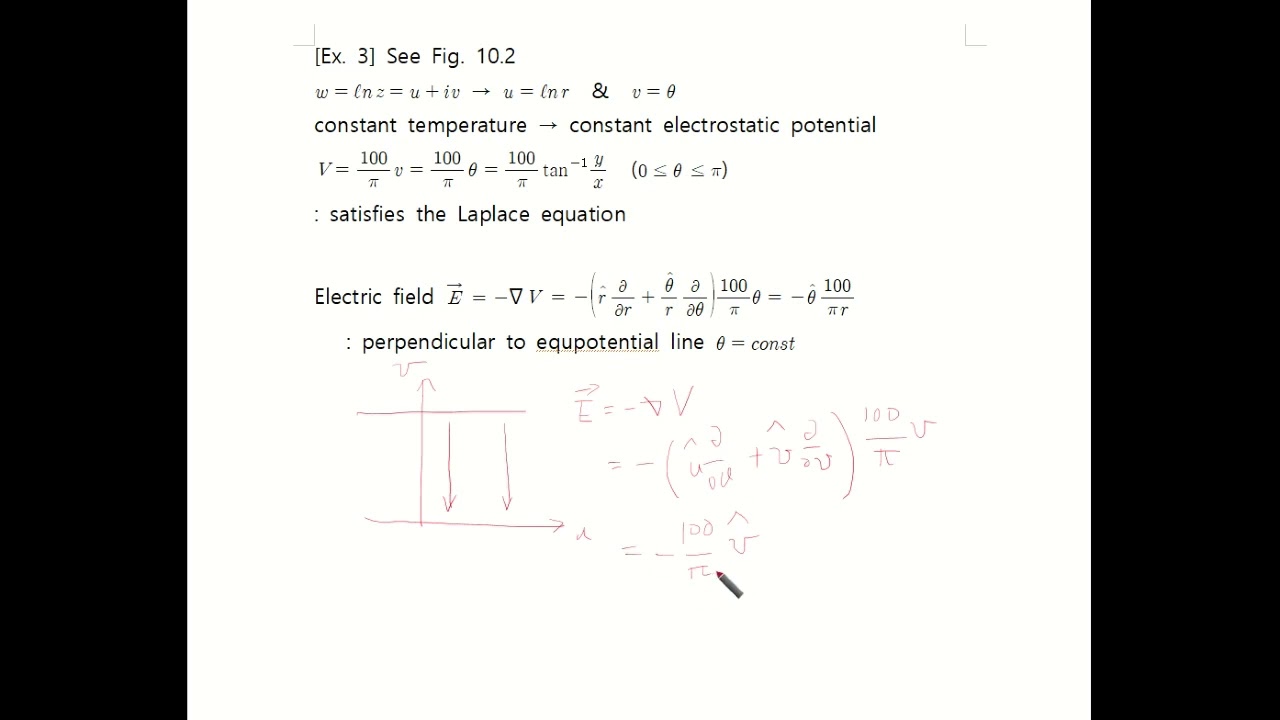


Möbius transformations are the most general one-to-one analytic maps from the extended complex plane (Riemann sphere) to itself, defined by the formula w = (az + b)/(cz + d) where a, b, c, d are complex numbers with determinant ad - bc ≠ 0; these transformations form a group under composition, preserve angles (conformality), map circles to circles, and are uniquely determined by their action on any three distinct points; they can be classified by their fixed points into four types based on whether the fixed points are finite and distinct, coincident, or include infinity, with the cross ratio being invariant under such transformations.
Mobius Transformations in Complex Analysis | Part 1 | Mathematical Physics
Added:Fundamentals of complex numbers, including basic arithmetic, polar representation, and the complex plane.
The concept of complex functions and geometric mappings (how functions transform coordinates from the z-plane to the w-plane).
Basic group theory, specifically the definitions of a group, identity, inverse elements, and group operations.
Introductory linear algebra, particularly 2x2 matrices, determinants, and matrix multiplication.
The concept of stereographic projection and the definition of the Riemann sphere (extended complex plane).
Conformal mappings and their applications in mathematical physics, such as solving Laplace's equation in electrostatics and fluid dynamics.
Hyperbolic geometry and its models (e.g., the Poincaré half-plane and disk models) where Möbius transformations act as isometries.
The study of the projective special linear group PSL(2, C) and its algebraic properties in complex analysis.
The Riemann Mapping Theorem and the classification of simply connected Riemann surfaces.
83.2K views874likes36:53Original Release: 2014-06-04
[Music] [Music] We can regard every analytic function as a map of the complex plane to the complex plane. You can always regard if I call W equal to f of zed and this is analytic then what's happening is that every time you give me a value of zed in the z plane you give me a value here you give me a value in the complex w plane so this map is f out here now the thing about analytic functions is that this map has very specific properties. In particular, just as the lines of constant imaginary zed and constant real zed are right cut each other at right angles, it's the rectangular grid here in the Z plane.
Similarly the lines of constant u and constant v. If I call this uh u= equal to u + i v. Recall that because of the koshiran conditions one of the uh criteria one of the consequences of that was that gradu was equal to zero.
What that meant was that in the W plane if these are the lines for which the real part is constant namely U is constant. These are the parts where V is constant on this side.
Right? Plotted in the Z plane they're going to look like this and something like this. Okay. So these curved lines are getting mapped onto this rectangular grid here. Okay. Now these two will satisfy the property of conformality.
Namely that the angle between these is going to be at right angles all the time. And this is a special case of what's called conformal mapping which says that angles are preserved between curves when you do this mapping. Now you could of course say all right is this going to work for the entire plane? Well, is the map invertible is the first question.
Suppose I go from zed to zed squared, for every value of zed, there is a zed squ. But for every value of zed squ, there is no unique zed because minus zed would give you the same point. So the question is what are the one maps?
What's the most general one to one map that you can think of to take you from zed to w? It should be invertible and it should be one one.
It obviously can't involve anything higher than any higher power of zed. It can't involve z^ squ zed cubed etc e to the zed nothing. So the only thing it can do is be a linear map. So zed goes to a z + b and that is invertible completely. But it's a sort of trivial map. Doesn't do anything interesting. It's an extremely trivial map. It means only linear functions nothing more than that. So this question is a trivial answer. If I say in the Z plane, what's the most general one to one map? It's a trivial thing. Uh the reason is that the point Z equal to infinity is mapped to the point W uh equal to infinity. If I say W is a Z + B, if Zed is infinite, W is also infinite. So you've kept that as a fixed point. Now I say no, no, no, I don't want to do that. I have the reman sphere, the extended complex plane. I have the reman sphere and that's mapped by an analytic function to the reman sphere to another reman sphere and I ask what's the most general one to man map from this sphere to that sphere and I don't say that the point at infinity has to remain the same this set of points this sphere on the sphere should be mapped in a onetoone fashion invertible fashion onto the set of points in the other sphere and I ask what's the most general map in this case when the answer becomes very nont non trivial and it turns out that the most general such map and we will make this very formal is uh zed goes to w equal to a z + b over cz + d where a b c d are arbitrary complex numbers and in order to make sure that the map doesn't become degenerate you require that the determinant not be zero. If the determinant is zero, then this becomes a trivial map as we'll see. So this is the most general map of the reman sphere S to the reman sphere S which is analytic and invertible. And this kind of map has a very large number of names. One of which is linear fractional transformations.
Sometimes they're called fractional linear transformations. But we're going to use for this the term mobius transformations.
Okay. So in the next couple of lectures we will talk about the properties of mobious transformations. Once we finish that then we'll come back and look at multivalued functions. So this means that we're still in the realm of single valued functions. But the fact is that now we've got very non-trivial situation here because this is not a linear map at all. It should be immediately clear to you that if I multiply a b c d by the same constant number then in this ratio that cancels out and the point to which zed is mapped doesn't change at all.
Therefore it's immediately clear that I can take these a b c d and normalize them in some suitable fashion. and I'll normalize it in such a way that a d minus bc equal to one. I can always do this. If a minus bc is not equal to one, I'll divide each of these coefficients by that number so that the determinant becomes one always. Now, this immediately should suggest to you that there's a kind of group property involved here and we're going to see that in great detail. You see you can write this ABCD as a matrix 2x2 matrix and of course when you multiply two 2x2 matrices you get another 2x2 matrix. So all non-s singular matrices will form a group. So it's clear that these transformations also provided they also operate in the same way will also form a group and we'll see that the connection there's a deep connection between this group of 2x2 matrices and the group of mobile transformation. Let's uh now take up the study of uh the set of transformations called mobius transformations and these transformations are defined as follows as I started mentioning the last time if you ask what's the most general one toone map of the complex plane to itself. Since it has to be one one, it has to be invertible. There has to be each zed has to go to a unique W and vice versa. The only thing that you can do is to say uh zed goes to W equal to some Az + B. That's a linear transformation. It's a sort of trivial linear transformation. But you see this is not very interesting because we know all its properties immediately. And the other point is that it leaves the point at infinity unchanged. So it's uh Z equal to infinity maps to W equal to infinity in this case. So it's as if on the reman sphere you have insisted that the point at infinity be unchanged and then asked what's the most general one toone transformation between the reman sphere of zed and the reman sphere of w.
But if I relax that condition and simply say that the reman sphere has to be mapped to the reman sphere in a onetoone fashion and ask what's the most general possibility then this is not the most general possibility but a very interesting thing happens and one can show that the most general map of the reman sphere s to the reman sphere s one to one the most general possib possibility is zed equal to zed goes to w. This is a function of zed which is of the form a z + b over cz + d where a b c d are arbitrary complex numbers. That turns out to be the most general map of the Rema sphere to itself which is invertible one to one where ABCD are arbitrary complex numbers with just one proviso and that proviso is that the determinant a d minus bc cannot be equal to zero because it's easy to see that if indeed a z minus bc should turn out to be zero then f of zed is a constant for all zed and that's not a very interesting interesting map.
Okay, all the points in the Z plane mapped onto a constant and that's the end of it. So we'll take a d minus bc to be non zero in general. And in fact you can go further. You can always divide each of these coefficients by the same number without changing the map. And you can divide by square root of a d minus bc whatever complex number that is. And once you do that then the new new coefficients will satisfy a d minus bc equal to 1. So we'll in general say a d minus b c equal to 1 always.
Okay. So now the statement is that this most general map called a moius transformation is a map from z to w which is defined by this ratio here such that these coefficients are arbitrary complex numbers satisfying this condition a d minus bc equal to 1. And that's what a mobius transformation is in the most general case.
H now these transformations have a very large number of very very interesting properties. Uh they will form a group a certain group. The group itself will be isomeorphic to other groups and so on and so forth and we'll try to classify all possible transformations of this kind. So the task is fairly non-trivial.
But the first thing you have to note is what happens to the point at infinity.
Well, it's clear that zed equal to minus d / c is mapped to w equal to infinity. So this point z= minus d / c goes to wal infinity. That's immediately clear. On the other hand, this also implies and is implied by the fact that zed equal to D W - B over minus C W + A. That's just the inverse transformation. So from Z I go to W, but I invert this and I get DW minus B over minus C W + A. I could write this down because I'm thinking of it always as a matrix A, a B, C, D with determinant 1.
And the inverse of that 2x2 matrix is just D minus B minus C A. Notice that a d minus bc is still equal to one in this case. So the the transformation has determinant one. The inverse transformation also is a mobious transformation has determinant one. Now what we need to show in further to show that these form a group is that every transformation has an inverse. We need to show that the product of two transformations is again a moious transformation of the same kind. And that's very reasonable to expect that that will indeed be the case because if I make a further transformation here, it's clear that you're going to get something very similar with just the matrices multiplied A B C D multiplied.
But we'll see how this comes about later. Uh incidentally, that also tells you that the point uh Z= infinity is mapped onto Wal C.
So in general the point at infinity in the original remon sphere is mapped to some other point and vice versa some other point the point at infinity there is mapped to something else here.
Okay. Okay. Now how do we go about analyzing all possible such transformations? Well the first important concept is that of a fixed point. Whenever we we look at transformations, one should always ask what points if any are left unchanged by this transformation and then you work around those points just as in dynamical systems and we'll see that there's a very close connection between this and what happens in discrete dynamical systems.
Okay. So let's ask what are the fixed points of this transformation. These are those points which do not change under the transformation. So there must be solutions of this equation z equal to a z + b over cz + d or uh cz² + d - a z - b = 0. So let's call the roots z1 comma 2. These roots are at a minus d plus or minus square<unk> of a minus d all squared uh + 4 bc or c. But remember that we've set a d minus bc equal to 1. So I could also write this as a minus d plus or minus square root of I'll make this an a + d. So you get a + d^ 2 - 4 a d + 4 b c. So that becomes -4 / 2 c. These are the fixed points of the transformation. So it's clear immediately that at best you can have two fixed points for any general transformation and they're given by z1 and z2. Now the reason I wrote it as a plus d is because I'm going to use this fact this a plus d is the trace of a matrix.
If I write this as a b c d. So there's something invariant going on here and I'd like to write it in that term in terms of this trace. Okay. So now the following possibilities occur. The first possibility is that Z 1 Z2 are finite and distinct. That would mean that C is not zero. There are finite points and A plus D is not equal to plus or minus 2.
That's the most general case that you can have. So C not =0 A + B not = plus or minus 2 distinct fixed points somewhere on the reman sphere. Now the second case corresponds to Z1 uh finite Z2 equal to well let's look at second case would be when they're coincident. So let's say z1 equal to z 2 equal to z which happens c not equal to 0 a + b = plus or minus 2 and this uh incidentally is equal to a minus d / 2 c. So when this thing vanishes the two roots coincident and they're at the same point and there's only one fixed point here and it's finite since C is not zero. The third will happen when Z1 is finite. So if C is zero Z1 finite Z2 equal to infinity. So this would correspond to C equal to zero. And then you can see immediately that the fixed points there are two fixed points and remember that you must have now a D equal to 1 because BC is zero since C is zero. So this will imply that D equal to 1 / A immediately. And what happens to the transformation? It says zed goes to a z + b / d which is equal to a / d is z but a d is equal to 1. So this can be written as a 2 z + a and this has two fixed points of course. So you have z equal to if I bring this a squ here it's equal to a b over 1 - a² z1 equal to this and z2 by inspection is infinity because if I set zed equal to infinity here that's infinite here too. So Z equal to infinity is a fixed point but there's another non-trivial fixed point finite fixed point which at a b / 1 - a². So that's the third case and then the fourth and final case is becomes completely trivial. So z1 equal to z2 = infinity in this case which will happen when c equal to0 and a equal to d. So if you set a equal to d and put c equal to z then you get just a translation. So this immediately implies zed goes to a z + b a / d that's z plus b / d that's a b this fashion. Okay. And now remember that you must also have a d equal to 1.
So it says a² equal to 1. So this means zed goes to z plus or minus b.
just a translation trivial translation. These are trivial cases but it's important to have them also in place. So we have four possible kinds of transformations depending on the number of fixed points and where they are. In the case when C is not zero, you have two possibilities. Either you have two finite points which are fixed points which are distinct or the two points are finite but coincide with each other. In both cases the transformation is non-trivial. You still get a linear fractional transformation. But the moment you put C equal to zero this becomes a linear transformation immediately. And in that linear transformation there are two possibilities. One of them has a non a finite fixed point and then another one at infinity. And the last one is when the thing is completely degenerate, you just have a shift and nothing more than that. So these are the four uh to start with these are the four kinds of mobious transformations you could have. But you must remember all the time that the most general case is this is the most general case and this is a special case slightly less trivial. These two are relatively easy. They're just linear cases. They're subsumed in the general transformations.
Okay, so so far so good. But the next question to ask is how do we classify these things? I mean what's the flow?
What does it look like? How do these points change? And so on and so forth.
For that it turns out to be very useful to introduce a concept called a cross ratio of all points. So let's write that down.
cross ratio. Okay.
So if you give me any four any four points on the Z plane or on the reman sphere uh zed 1 zed 2 zed 3 zed 44 I define the cross ratio of these four points by this this definition zed 1 - zed3 zed 2 - zed 4 divided by zed 1 - z4 4 2 - 8. So this minus that time this minus this divided by this minus that and this minus this. Okay, that's defined as a cross ratio of these four points. And those of you who are familiar with projective geometry will recognize that this cross ratio is the fundamental concept in projective geometry and plays a very very important role in that entire subject. Now this cross ratio has some very beautiful points, beautiful features which we're going to analyze and look at. But uh before that I'd like you to verify that the product of two mobius transformations is yet another mobius transformation. So they actually form a group. It's a trivial thing to prove and I'm going to assume that you're going to do this and check out that it's so we've already seen that there is an inverse for each transformation.
Okay. So now the important thing about the cross ratio is the following. Under a mobius transformation this ratio doesn't change at all. So it remains invariant. That's not hard to see because suppose Z i goes to a Z I + B or C Z I + D and Z J goes to A Z J B C plus D. This will imply that this difference Z I minus Z J goes to well let's put the product here C Z I + D C Z J + B and then it's this times that minus this times this and you can see that the Z I Z J term cancels and you have a D times z i minus z j and b uh so let's write this out a c z z i j plus a d z i i plus b d uh plus bc sorry b c z j + b d minus the same thing which is a C Z J uh Z I Z J uh minus A C uh minus A D Z J minus B C Z I minus B Okay. And this BD cancels. And what are we left with? This stuff also cancels here. And you have AD minus BC * Z I minus Z J. But AD minus BC is one. So this immediately tells you the magic trick. This is just Z I minus Z J divided by this denominator out here. And now it's easy to see that if I take I J K L four points then the cross ratio will be unchanged because these denominators will cancel.
So this implies that uh this quantity goes to is equal to w uh is equal to w1 w2 w3 w4. If Z i goes to WI where I is 1 2 3 4 under the transformation then this cross ratio doesn't change at all. It's invariant. So that's the basic property we're going to exploit in everything because this is a very crucial thing this property of these transformations which will make life very easy now for us. Okay. Now the cross ratio itself of four points has a lot of interesting properties a lot of symmetries. First of all, you choose four arbitrary points and you're asking for a cross ratio, but you can define a large number of cross ratios. You can define 24 of them, four factorial because you can write this 1 2 3 4 in any order you like. And therefore, from a set of four points, you can have 24 cross ratios, but all of them are related to each other. And there's only one independent cross ratio because you can see the following symmetries which are easily established.
Let me just for short hand let's call uh let me write it as I J K L where this stands for Z I Z J Z K Z L is equal to this then the following symmetry properties are immediately obvious uh immediately established I J K L is equal to if you flip these two K L I J it's equal doesn't change at all it's also equal to uh J I l K if you flip these two and flip these two doesn't change at all it's also equal to if you flip just one part so this is equal to 1 / J I K L equal to 1 / I J LK in this position. So there are lots of such relations. uh it's also equal to this guy is also equal to 1 minus the cross ratio I J I K J and then you can use all these symmetry properties on this and derive all the relations um that that exist between any four points the cross ratio of any four points so it's a very very it's a quantity with a lot of symmetry properties is and the beautiful thing is it's invariant under Mobius transformations. Okay.
Now the statement is I should also mention one more thing. Suppose one of these points is infinity then what happens to the cross ratio? So let's suppose for instance that zed 1 is infinite doesn't matter any of these points could be infinity.
So infinity zed 2 zed3 zed 4 is defined as a limit of this as z1 goes to infinity. So it's just zed 2 - zed 4 over zed 2 - zed3. All you have to do is to take the limit zed 1 goes to infinity and that's it. Okay. So I treat infinity on par with everything else with every other point. And that's the definition if one of the points is at infinity.
Okay. Now with this in place, it's now possible to look at what a mobious transformation looks like in terms of the fixed points because there's something very special going on with these fixed points under this flow. Uh under this map, the fixed points alone remain unchanged. So you'd like to ask what happens to points in the neighborhood of these fixed points? What kind of things do they go to? Well u let me let me point out one thing first that if you give me if you give me any three points on the complex plane say zed 1 zed 2 zed 3 or something like that and they get mapped to w1 w2 w3 then there is a unique transformation which takes you from the first set of points to the second set of points.
Okay. In other words, if on the reman sphere you specify for me a Z 1, a Z2 and a Z3 and you tell me that these points should be mapped to W1, W2 and some W3 and you specify these then my assertion is there exists a unique moius transformation which will do this mapping one to the And the way to prove this is to construct this transformation. Just explicitly construct it. And you construct it by considering the the following cross ratio zed 1 zed 2 zed3.
And I know that this is equal to w1 w2 w3. I know this has to be true under this transformation. Right? And now just write this out and that's it. And solve for for W in terms of zed and you know that it's a mob transformation and it's unique completely. So there is a unique transformation which takes any three prescribed set of points here any specified set of points to any other three specified set of points there.
There's only one and only one moious transformation which takes you from one to the other. Now you know that once you specify three points on the complex plane you also specified a circle. So this is a way of showing that a mobious transformation map circles onto circles. Okay.
So no base transformation max on the remon sphere. Now let's go back and look at what our transformation does uh in terms of the fixed points. So let's consider the following. I'll do this for the general case and then we will look at what happens in the special cases. So we look at Z1, Z2 distinct and finite this case. And remember that z1 2 was equal to a minus d plus or minus square roo<unk> of a + d squ - 4 / c where I've used the fact that a d minus bc is 1. Okay. Now consider this.
Consider uh Z infinity Z1 Z2.
Okay. And I make a moious transformation. And what does this go to? Well, zed goes to W.
What does infinity go to?
A over c. So this goes to a over c and z1 and z2 go to themselves. They're fixed points, right? So this and the cross ratio is invariant under this transformation. So this must be equal to that. Okay. where zed is an arbitrary point and its map is w. So this must be true which immediately tells me that z - z1 divided by z - z2 then infinity minus z2 this part cancels out. This is equal to w - z1 * a / c - z2 divided by w - z2 a / c - z1. This must be true.
So it says it therefore says that w - z1 / w - z2 is equal to uh a - c z1 / a - c z 2 multiplied by the same ratio. So it's rewritten this projective this mobius transformation in a very suggestive form. It says under this transformation this ratio the distance between zed and z1 and zed and z2 the ratio of these two numbers is equal to the new ratio is equal to the old ratio multiplied by a certain quantity a certain complex number in general which is a function of the coefficients abcd of the transformation. So this number there's a symbol for it. It's equal to K and it's called the multiplier.
[Applause] [Music] Okay. Heat.
[Music]
Up Next

159:46
Cartesian Coordinates for Geometry: Christmas AMO Problem Walkthrough
@vEnhance
981 views•2021-04-24

8:17
JEE Maths | Circles: Pole & Polar Explained with Equations
@TargetPublications
14.4K views•2019-02-23
24:22
Combinatorial Games: Introduction & Examples | Game Theory Course
@IITBombayJuly
14.1K views•2019-07-27

6:00
The Mathematical Impossibility of Accurate World Maps
@Vox
23.3M views•2016-12-02
Related Study Plans & Knowledge Roadmaps
Structured learning paths in Mathematics
mathematics
Projective Geometry: Coordinates & Conics
01From Euclidean to Projective Space
02Homogeneous Coordinates
03Duality and Projective Transformations
+ 2 more learning modules
14h5 modules
Explore Roadmap
mathematics
Tensor Calculus: Vectors to Riemann Curvature
01Mathematical Foundations: Linear Algebra & Calculus
02Covectors, Dual Spaces, and Tensor Basics
03The Metric Tensor and Index Gymnastics
+ 2 more learning modules
40h5 modules
Explore Roadmap
mathematics
Gödel's Incompleteness: Logic, Proofs & Limits
01Introduction to Formal Systems & Hilbert's Dream
02Set Theory, Cardinality, and Cantor's Diagonal Argument
03Arithmetization and Gödel Numbering
+ 2 more learning modules
14h5 modules
Explore Roadmap
mathematics
Galois Theory: Fields, Groups & Solvability
01Foundations of Abstract Algebra: Groups & Fields
02Polynomials & Field Extensions
03Splitting Fields & Symmetries
+ 2 more learning modules
24h5 modules
Explore Roadmap