

![[s3 | 2025] Математический анализ, Трифанова Е. С., лекция 14](https://i.ytimg.com/vi/WxHtRRO1xfk/maxresdefault.jpg)


















The Fourier Transform is a mathematical tool used for frequency analysis of signals, converting time-domain signals to frequency-domain representations. It exists for energy signals, power signals, and impulse-related signals, but not for signals that are neither energy nor power and not absolutely integrable. The Fourier Transform formula is X(jΩ) = ∫₋∞^∞ x(t)e^(-jΩt)dt, and the Inverse Fourier Transform is x(t) = (1/2π)∫₋∞^∞ X(jΩ)e^(jΩt)dΩ. The Fourier Transform can be derived from the Laplace Transform by replacing s with jΩ.
Fourier Transform Explained: Definition, Formula, and Applications
Added:Advanced calculus, specifically improper integration and integration of complex-valued functions over infinite intervals.
Complex algebra and Euler's formula (e^{ix} = cos(x) + i sin(x)) to comprehend complex exponentials.
Fourier Series representation of periodic signals, which serves as the theoretical precursor to the continuous Fourier Transform.
Basic signals and systems concepts, including the distinction between time-domain and frequency-domain representations.
Properties of the Fourier Transform, such as linearity, time-scaling, frequency-shifting, and the highly critical Convolution Theorem.
The Discrete Fourier Transform (DFT) and the Fast Fourier Transform (FFT) algorithm, which are essential for digital signal processing.
Practical applications in communications and signal processing, including modulation, demodulation, and analog filter design.
The Short-Time Fourier Transform (STFT) and spectrograms for analyzing non-stationary signals that change over time.
Two-Dimensional (2D) Fourier Transforms and their applications in image processing, such as filtering, reconstruction, and compression.
990K views8.8Klikes8:19Original Release: 2018-01-04
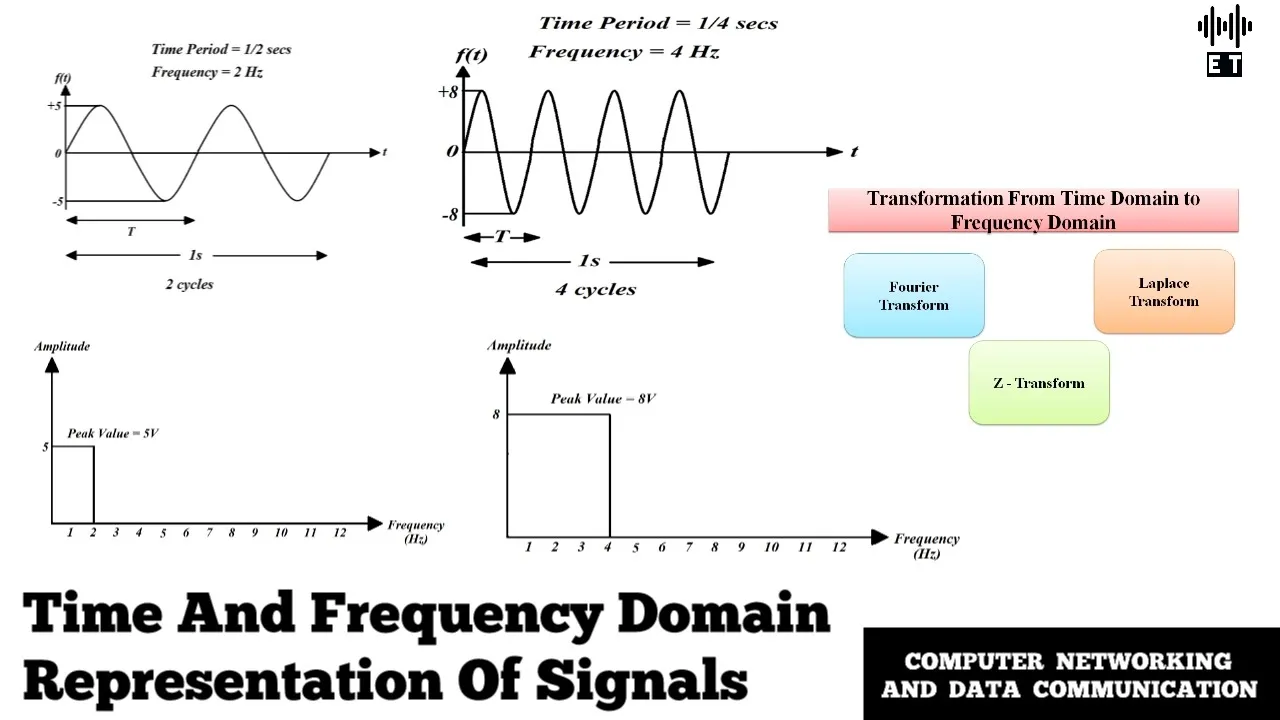
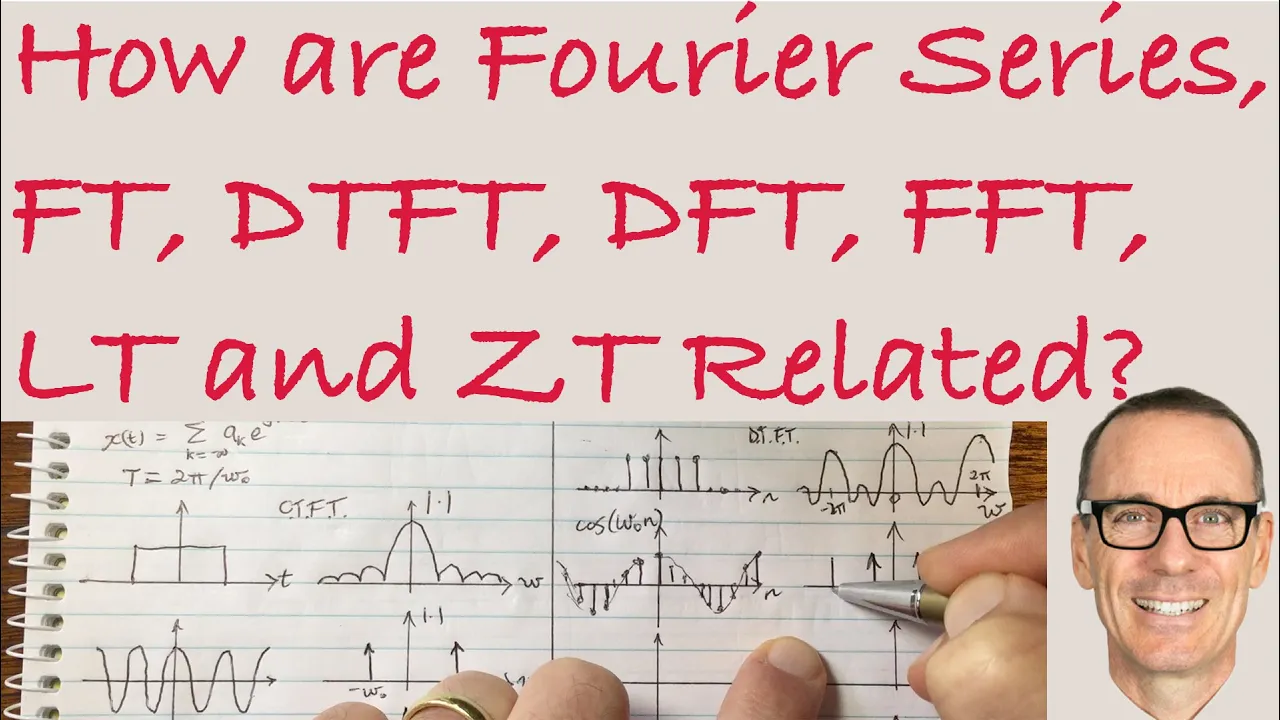
from this lecture we will start in your chapter and the chapter is Fourier transform Fourier transform is an important chapter and in this chapter the main things are properties so we will try to understand all the properties and then we will implement them why are the questions so don't forget to watch the lectures related to the questions and in this particular lecture I will introduce Fourier transform in which we will understand few basic points related to Fourier transform so let's start our discussion by understanding what is Fourier transform and why we use it Folie transform is a mathematical tool used for frequency analysis of signals so Fourier transform is a mathematical tool which we use to analyze these signals in frequency domain now what do we mean by the frequency analysis of signals this means observation and study of signal variations while changing the frequency and as we are using Fourier transform to perform the frequency domain analysis of the signal Fourier transform is also known as frequency domain representation of the original signal now what about Laplace transform like Fourier transform Laplace transform is also a mathematical tool but we use Laplace transform for the analysis of systems and circuits so analysis of systems and circuits is done using Laplace transform and now we will move to the next point that is the existence of Fourier transform Fourier transform can exist for number one energy signals number two power signals and number three impulse related signals so Fourier transform can exist for impulse related signals also however Fourier transform do not exist for neither and nor power signals now you will say impulse related signals are neither energy nor power signals so why do we have Fourier transform for impulse related signals the answer is it is an exception it is an exception because impulse related signals are absolutely integrable signals and other neither energy nor power signals are not absolutely integrable and according to deletion a condition absolutely integrable signals will have Fourier transform we will discuss more about deletion conditions in the next presentation right now I am just giving you one overview we already knows energy signals are also absolutely integrable signals so Fourier transform will exist for energy signals also now what about power signals power signals are not absolutely integrable but power signals also have Fourier transform and to obtain the Fourier transform for power signals we need to use the properties it is important to use the properties because the formula of the Fourier transform is applicable to absolutely integrable signals only we will discuss more about these things in the coming presentations but right now you only have to focus on existence of Fourier transform it exists for energy signals power signals and impulse related signals now what about the existence of Laplace transform Laplace transform will exist for energy signals it will exist for power signals and it will also exist for neither energy nor power signals but the existence of Laplace transform for neither energy nor power signals is only up to some extent we will talk about these points in the respective lectures now if you remember the Fourier series expansion chapter I told you Fourier series expansion is only for the periodic signals and this is one major drawback in the Fourier series expansion in order to analyze the given signal therefore we use Fourier transform Fourier transform can be used for a periodic signals as well now we will move to the next point in which I will give you the representation of Fourier transform let's say we have a signal XT then the Fourier transform of this signal XT is equal to capital X inside the bracket J Omega there is one more representation and it is capital X inside the bracket F and if we talk about the units then the first representation is having the unit radians per second and the second representation is having the units Hertz and in some books you will find X of J Omega represented has X of Omega and this is to simplify the symbol by omitting J the Fourier transform of a signal is a complex number X J Omega is a complex number therefore it will have the magnitude and also the angle usually in the questions we are required to calculate XG Omega but if in some question it is asking XF then first calculate X J Omega and then replace Omega by 2 pi F and you will have X F so this is all for the representation of Fourier transform and now we will move to the formulae the first formula is used to transform the time domain signal XT to the frequency domain signal X J Omega I will write the formula X J Omega is equal to integration minus infinity to infinity signal XT multiplied to e power minus J Omega T DT so this is the formula and this formula is known as Fourier transform now we will move to the second formula the second formula is used to transform the frequency domain signal X J Omega to the time domain signal XT and the formula is XT equal to 1 o two pi integration minus infinity to infinity signal X J Omega multiplied to E power J Omega T D Omega and this formula is known as inverse Fourier transform inverse Fourier transform and together the two formulas are known as Fourier transform pair and the two formulas are valid only for absolutely integrable signals this is one important point the two formulas are valid only for absolutely integrable signals and in the coming presentations we will use the two formulas to solve the questions now we will move to the next point that is the conversion of Laplace transform to Fourier transform this point is very important and in the coming presentations I will prove this point but right now I will just give you the conversion if you are having the Laplace transform then to get the Fourier transform simply replace s by J Omega and I will prove this point in a separate lecture this conversion is valid only for absolutely integrable signals so the two formulas and this conversion is valid only for absolutely integrable signals so this is all for the introduction to fourier transform if you have any doubt you may ask in the comment section [Applause] you [Music]
Up Next
12:56
Fourier Transform Scaling Explained | Mathematics of Frequency Analysis
@BrianBDouglas
531.7K views•2013-01-19
4:43
Elliptic Curve Cryptography Explained: ECC, ECDSA, ECDH
@PracticalNetworking
28.5K views•2024-10-21
10:19
Prime Numbers in Cryptography | Network Security Concepts
@nesoacademy
147.6K views•2021-09-03

6:00
The Mathematical Impossibility of Accurate World Maps
@Vox
23.3M views•2016-12-02
Related Study Plans & Knowledge Roadmaps
Structured learning paths in Mathematics
mathematics
Tensor Calculus: Vectors to Riemann Curvature
01Mathematical Foundations: Linear Algebra & Calculus
02Covectors, Dual Spaces, and Tensor Basics
03The Metric Tensor and Index Gymnastics
+ 2 more learning modules
40h5 modules
Explore Roadmap
mathematics
Gödel's Incompleteness: Logic, Proofs & Limits
01Introduction to Formal Systems & Hilbert's Dream
02Set Theory, Cardinality, and Cantor's Diagonal Argument
03Arithmetization and Gödel Numbering
+ 2 more learning modules
14h5 modules
Explore Roadmap
mathematics
Galois Theory: Fields, Groups & Solvability
01Foundations of Abstract Algebra: Groups & Fields
02Polynomials & Field Extensions
03Splitting Fields & Symmetries
+ 2 more learning modules
24h5 modules
Explore Roadmap
mathematics
Non-Euclidean Geometry: Models & Geodesics
01Euclid's Fifth Postulate and the Birth of New Geometries
02Hyperbolic Space and the Poincaré Disk Model
03Geodesics: Defining Straight Lines in Curved Spaces
+ 2 more learning modules
15h5 modules
Explore Roadmap