











![Showcase Panel III: Sex, Gender, and the Law [2024 NLC]](https://i.ytimg.com/vi/WXOiWgIKciU/maxresdefault.jpg)





In Bostock v. Clayton County (2020), the U.S. Supreme Court unanimously ruled that Title VII of the Civil Rights Act of 1964 prohibits employment discrimination based on sexual orientation and gender identity, holding that an employer who fires an individual for being gay or transgender fires them for traits or actions they would not have questioned in someone of a different sex; the 6-3 decision, authored by Justice Neil Gorsuch, established that the written text of the law must be followed regardless of what the drafters may have intended.
Bostock v. Clayton County: Title VII & LGBT Employment Rights
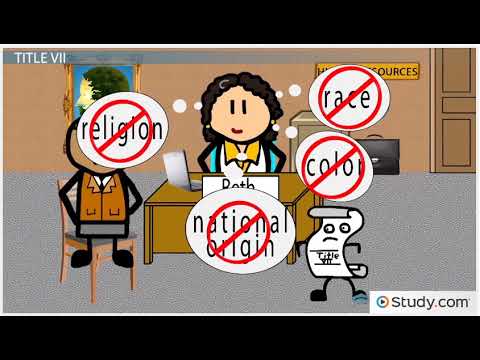
Added:The Civil Rights Act of 1964, specifically Title VII, which prohibits employment discrimination based on race, color, religion, sex, or national origin.
The principles of statutory interpretation, particularly 'textualism'—the legal theory that looks at the plain meaning of the words in a law when it was written.
The role and structure of the U.S. Supreme Court, including how it selects cases (certiorari) and establishes binding national precedents.
The legal doctrine of 'employment-at-will' in the United States and the specific exceptions created by federal civil rights legislation.
The legal interaction between Title VII protections and religious exemptions, such as the Religious Freedom Restoration Act (RFRA) and the ministerial exception.
How the reasoning in Bostock is being applied to other federal statutes prohibiting sex discrimination, such as Title IX (education) and the Fair Housing Act.
The definition and practical application of the 'but-for' causation standard in employment discrimination lawsuits post-Bostock.
Subsequent legal challenges and policy debates regarding transgender rights, specifically in public accommodations, healthcare, and athletics.
177.4K views12.3Klikes5:32Original Release: 2024-11-08
Mr. Beat presents Supreme Court Briefs Clayton County, Georgia January 2013 Gerald Bostock, a gay man, joins a gay-focused recreational softball league. Bostock had been a child welfare services coordinator for the Juvenile Court of Clayton County for a decade at that point, and he made the apparently fateful choice of promoting the gay softball league at work. After this, Bostock began getting criticized at work not only for participating in the softball league, but for his sexual orientation. In April, Clayton County audited the program funds controlled by Bostock and then promptly fired him for “conduct unbecoming a county employee.” Well, Bostock thought this was just an excuse for the county to fire him for being gay. That said, Georgia had no law protecting LGBT+ people from employment discrimination at the time. Bostock thought it over for around three years before finally filing a claim for workplace discrimination in the U.S. District Court for the North District of Georgia. He claimed that Clayton County went against Title Seven of the Civil Rights Act of 1964 when it fired him. However, the U.S. District Court for the North District of Georgia dismissed the claim, saying that Bostock’s claim was based on a fairly loose interpretation of Title Seven of the Civil Rights Act saying that Title Seven didn’t include protection against discrimination towards sexual orientation. It even used the U.S. circuit court case Evans v. Georgia Regional Hospital (2017) as precedent to back up its decision.
Bostock was like, “nope,” and then appealed to the same Court that made the decision in Evans v. Georgia Regional Hospital, as a matter of fact, the U.S. Court of Appeals for the Eleventh Circuit. As you may have already predicted, though, it sided with Clayton County and cited the Evans decision as precedent.
However, things got complicated when other circuit courts weighed in on the same legal issue, leading to what’s known as a “circuit split.” In the case R.G. & G.R. Harris Funeral Homes Inc. v. Equal Employment Opportunity Commission…woo that’s a long title of a case…the U.S. Court of Appeals for the Sixth Circuit found that a transgender funeral home worker wasn’t protected under Title Seven of the Civil Rights Act from being fired for her GENDER IDENTITY. On the other hand, the U.S. Court of Appeals for the Second Circuit said that employers can’t discriminate based on sexual orientation in Altitude Express, Inc. v. Zarda, a case involving a gay skydiving instructor.
Because of the circuit courts being split, the Supreme Court agreed to step in to look at all three cases, combining them and hearing oral arguments on October 8, 2019.
The big question they had to consider? Does Title Seven of the Civil Rights Act of 1964 prohibit employment discrimination based on an individual’s sexual orientation or gender identity?
The Court said “yes.” On June 15, 2020, it announced it had sided with Bostock and the other employees discriminated against. It was 6-3, with the typically right-leaning Chief Justice John Roberts and Justice Neil Gorsuch siding with the more left-leaning justices. The Court said it was illegal for employers to fire employees for being gay. Not only that, it said it was illegal for employers to fire employees for being transgender. Neil Gorsuch actually wrote the majority opinion, saying, “An employer who fired an individual for being homosexual or transgender fires that person for traits or actions it would not have questioned in members of a different sex.” He added, “Those who adopted the Civil Rights Act might not have anticipated their work would lead to this particular result. But the limits of the drafters’ imagination supply no reason to ignore the law’s demands. Only the written word is the law, and all persons are entitled to its benefit.” Bostock v. Clayton County was a huge victory for LGBT+ rights in the United States. More than any other Supreme Court case in history, the Bostock decision made it clear that if an employer was going to discriminate against an employee based on their sexual orientation or gender identity, they would be breaking the law. The Clayton County Board of Commissioners ultimately paid Gerald Bostock $825,000 in damages for his wrongful termination.
I’ll see you for the next Supreme Court case, jury!
Yep, it’s been awhile since I released a Supreme Court Briefs episode. Why haven’t I? Well, to be perfectly frank and be perfectly Matt, because this series doesn’t do that well. So, if you liked this video, share it and if the views are good, I’ll keep making this series. It’s that simple. Thanks for staying curious!
Up Next

69:40
Sexual Harassment Employer Liability Lecture | LGLA 1323
@GruverCollinCollege
244 views•2020-09-14

4:27
US Secondary Sanctions Impact on EU Businesses and Blocking Legislation
@Bureauvandijk
1.6K views•2019-03-20
5:03
Recorded Testimony in Court: Crawford v. Washington Explained
@iammrbeat
68.6K views•2018-01-26

24:42
Police Interrogation Tactics: False Confessions & Legal Reform
@LastWeekTonight
7M views•2022-04-18
Related Study Plans & Knowledge Roadmaps
Structured learning paths in Law
law
Self-Defense Law: Imminence & Castle Doctrine
01Foundations of Self-Defense Law
02Imminent Threat & Reasonable Belief
03The Principle of Proportionality
+ 3 more learning modules
12h6 modules
Explore Roadmap
law
Defamation Law: First Amendment & Actual Malice
01Introduction to civil torts and the First Amendment
02Elements of Defamation: Libel and Slander
03Public Figures vs. Private Individuals
+ 2 more learning modules
8h5 modules
Explore Roadmap
law
Hearsay Rule: Trial Evidence & Exceptions
01Introduction to Trial Evidence & Courtroom Basics
02Demystifying Hearsay: The Core Definition
03Non-Hearsay: Exclusions Under FRE 801(d)
+ 3 more learning modules
14h6 modules
Explore Roadmap
law
Medical Malpractice: Law, Liability & Care
01Foundations of Tort Law and Civil Liability
02The Four Elements of Medical Malpractice
03Defining and Proving the Standard of Care
+ 2 more learning modules
12h5 modules
Explore Roadmap