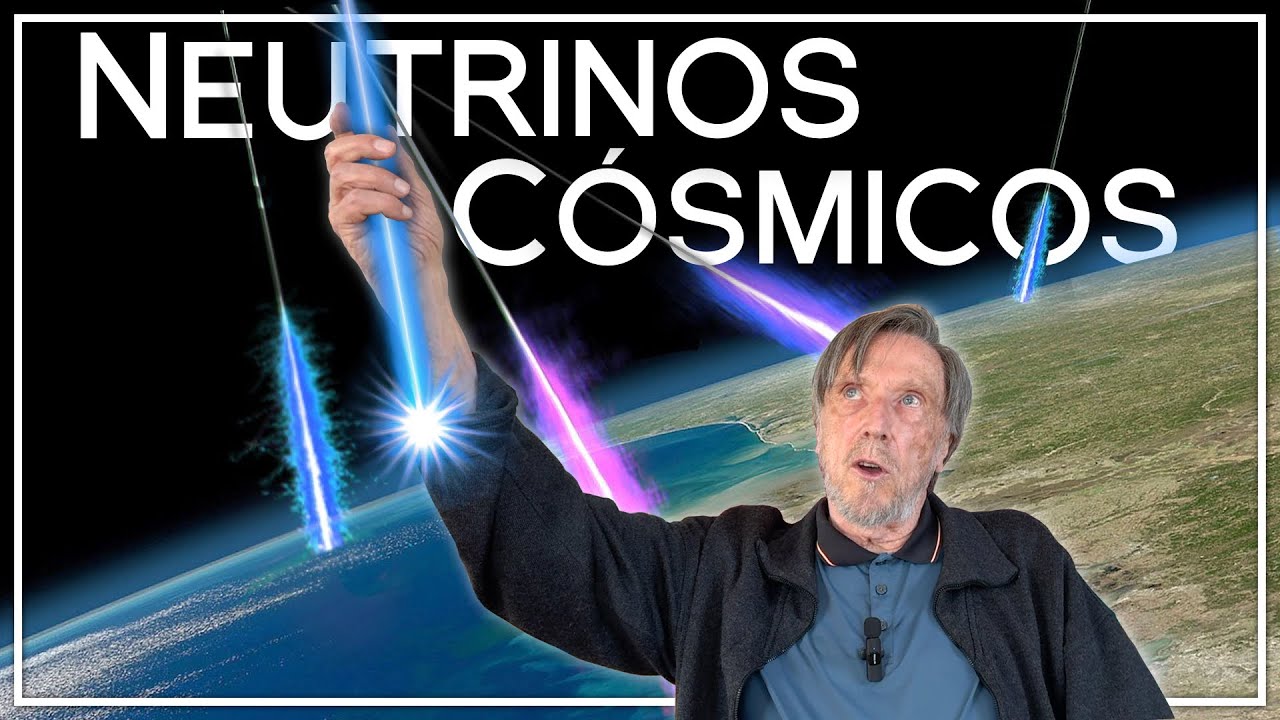

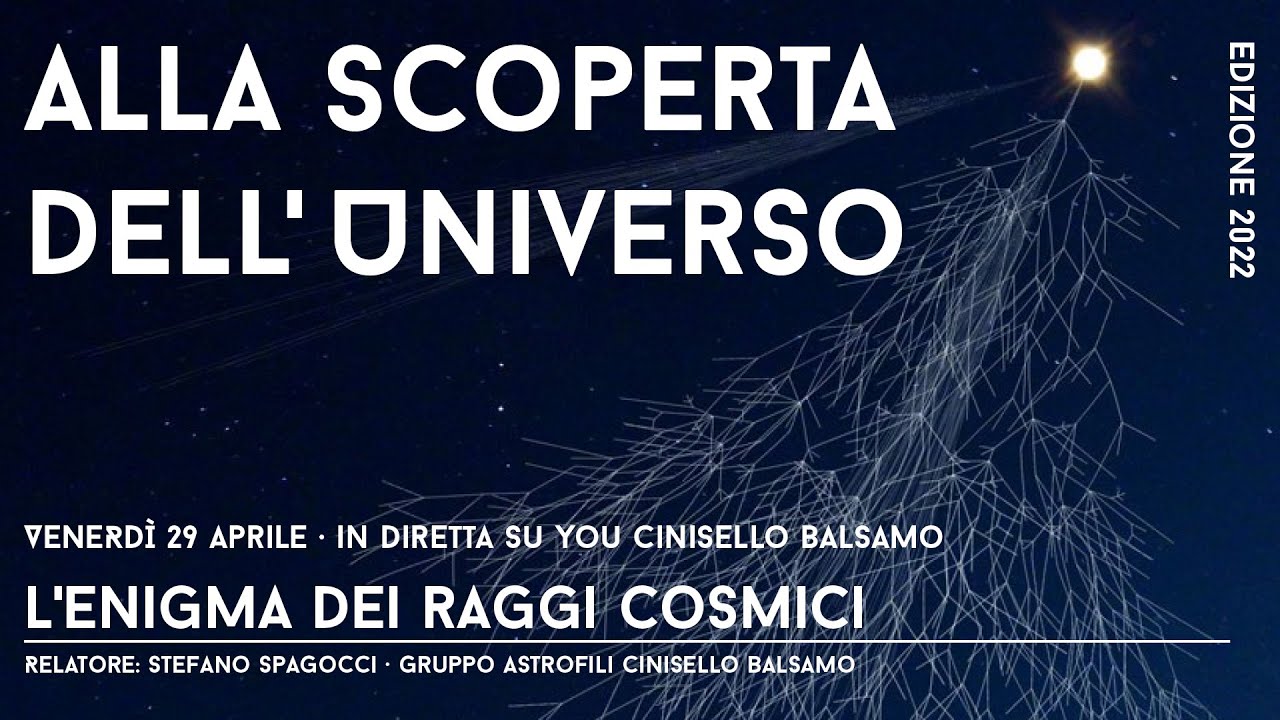












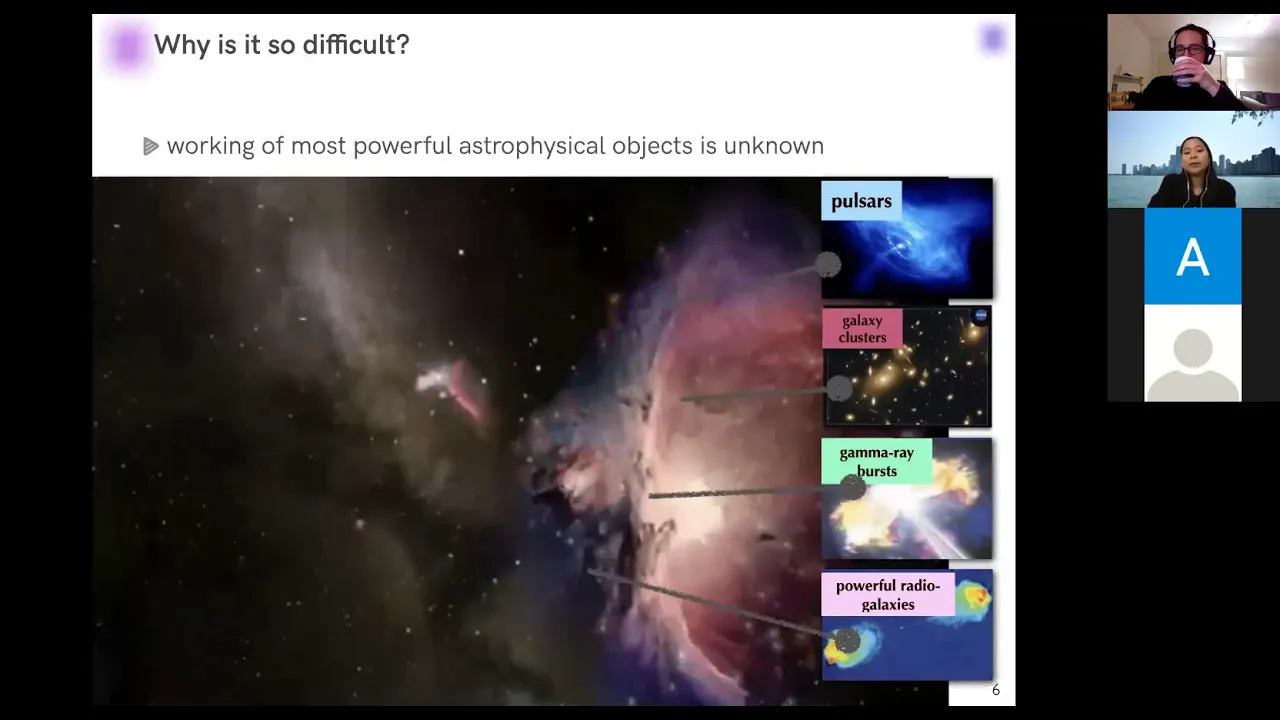
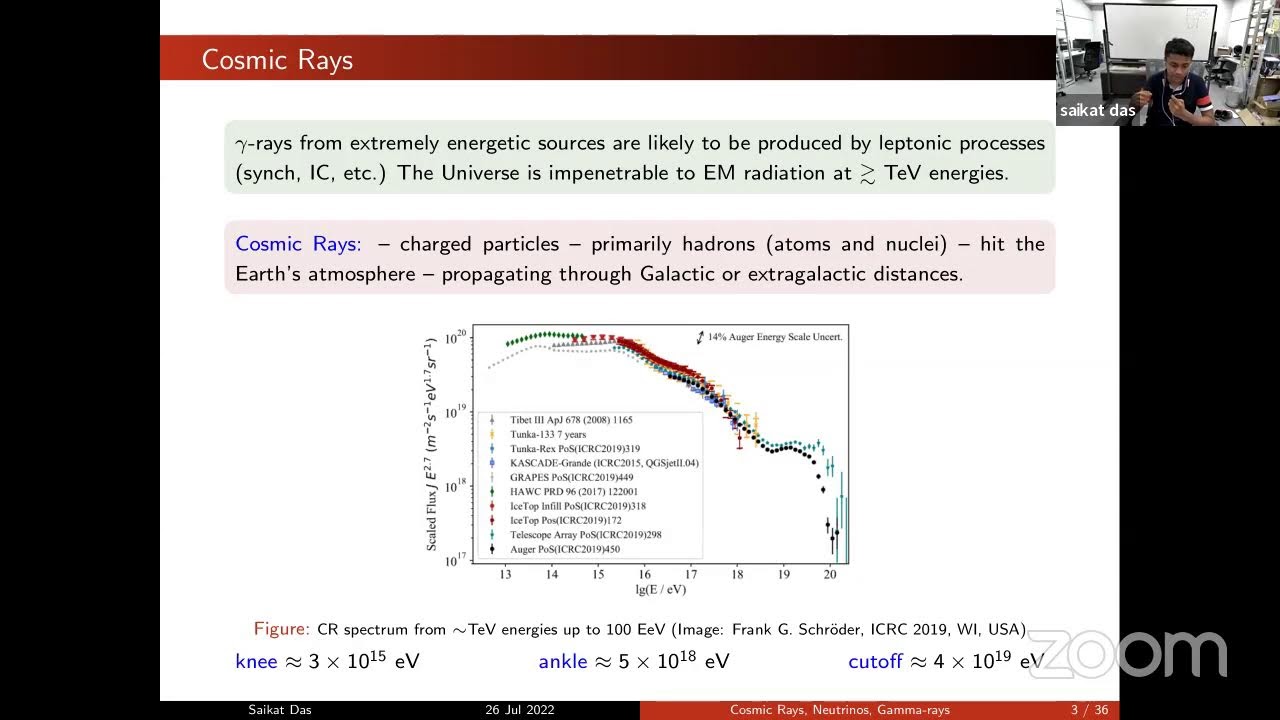



Ultra high energy cosmic rays (UHECRs) with energies above 10^18 eV are primarily accelerated at intergalactic shock fronts associated with galaxy clusters, rather than at supernova remnants or active galactic nuclei. These cluster shocks can accelerate particles to energies around 10^20 eV, which then propagate through the low-density intergalactic medium with minimal deflection. The observed composition of UHECRs showing increasing fractions of medium and heavy nuclei at the highest energies supports this model, as these heavier nuclei have higher rigidity and can achieve greater energies at the same magnetic field strength. This hierarchical model proposes that cosmic rays are accelerated at multiple scales: supernova remnants produce galactic cosmic rays up to ~10^15 eV, galactic wind shocks accelerate particles to the knee (~10^15 eV), and finally cluster shocks accelerate particles to the highest energies observed.
Ultra-High Energy Cosmic Rays: Origins and Acceleration
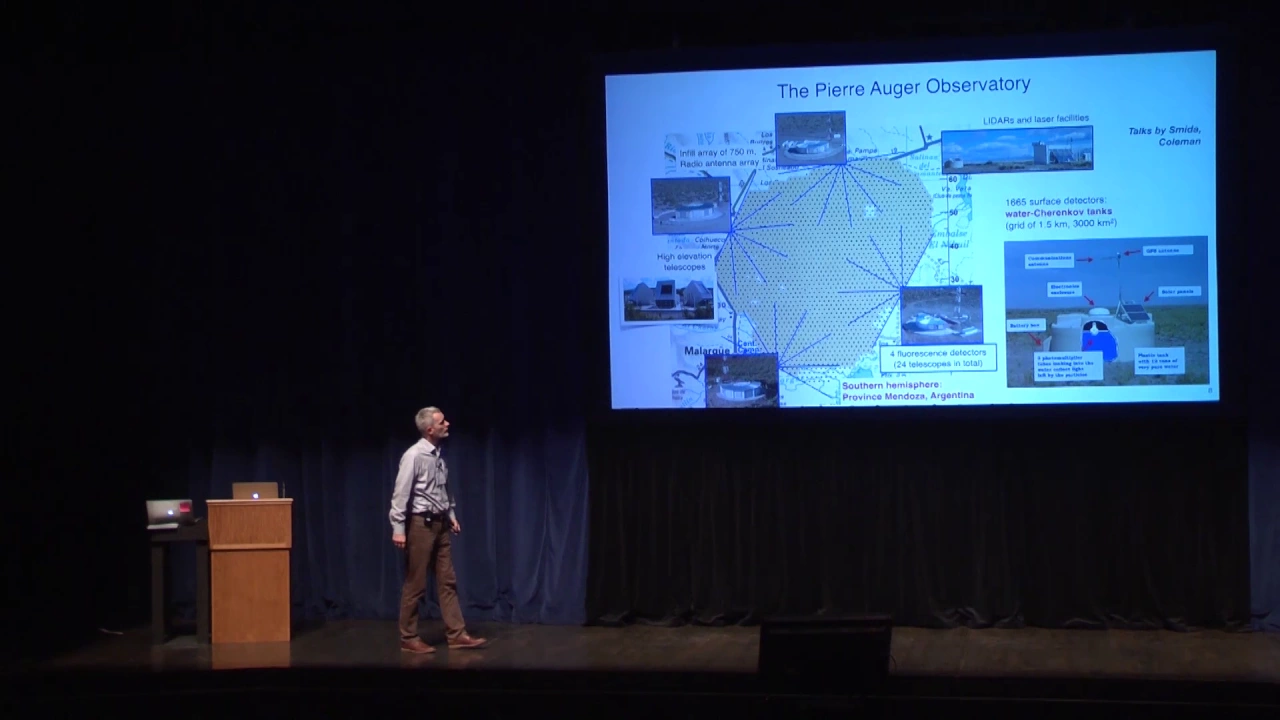
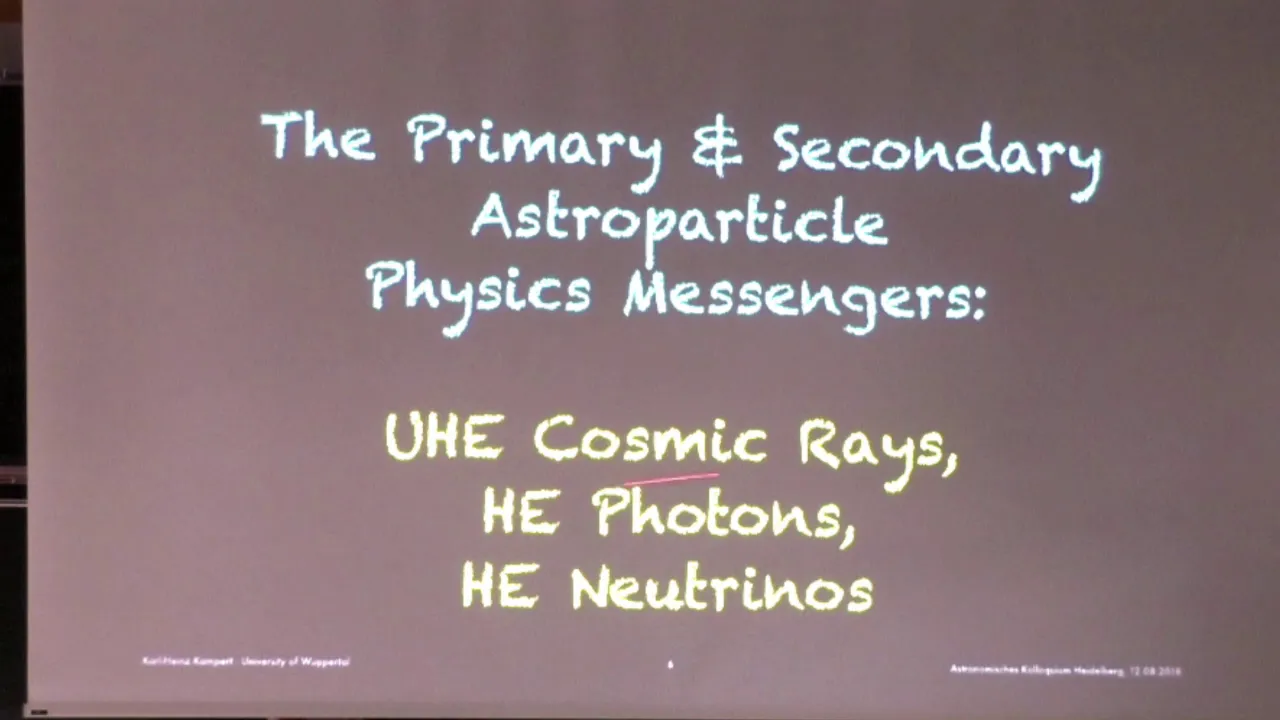
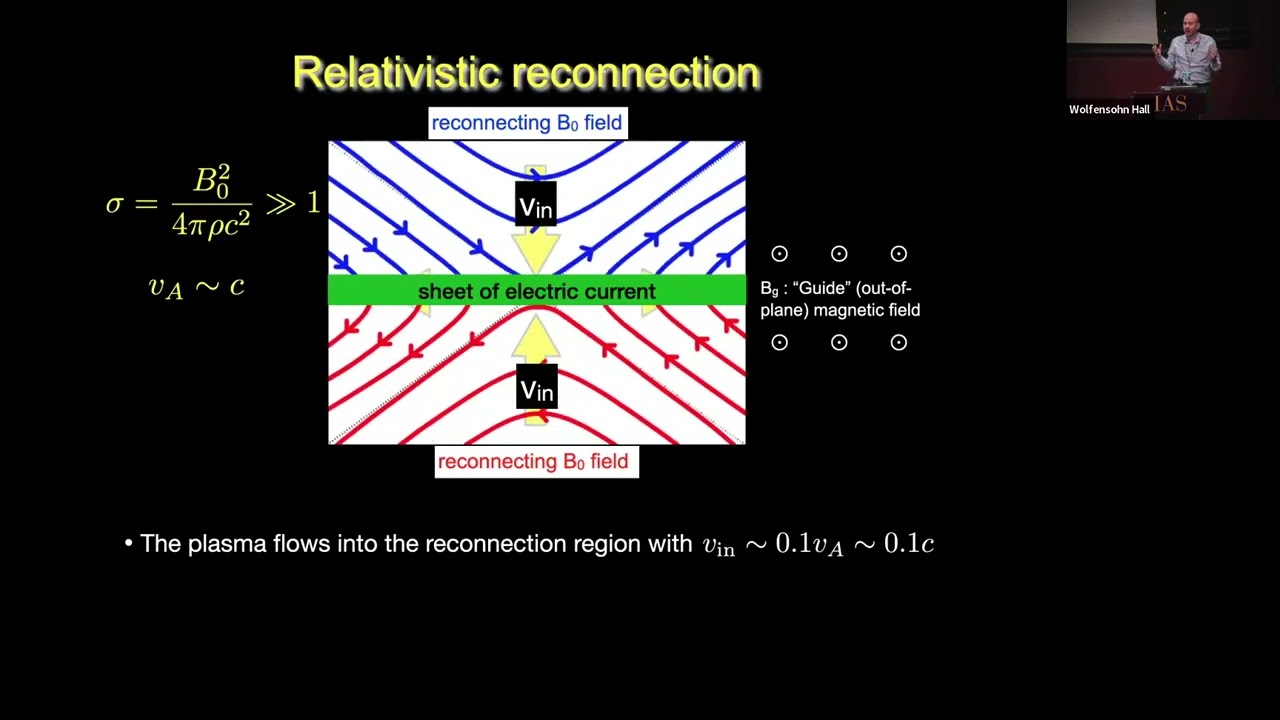
Added:and the topic is uh ultra high energy cosmic rays which is a rather hot subject i think as we will hear from roger so roger the floor is yours thank you very much indeed mark and thank you everybody else um let me see perhaps i should try and share my screen now it'll be this one share and then if i go into uh presenter mode uh sorry wrong one presenter mode that's that one do you see the uh the screen it works perfect okay well um well thank you very much so my fourth topic is um i'll try this time is ultra high energy cosmic rays and um i'll try and give you some sort of flavor of where of the perhaps the history but also where the subject might be going right now in a sort of general i think commonly accepted way although obviously i'm going to have to be a bit selective in the time available but i will also as has been my um custom in these lectures go off on a tangent towards the end of this lecture suggesting some possibilities um some of which i think are new for explaining what is being measured and observed my collaborators over the years on this topic are listed at the bottom of the title slide and the ones that are emboldened are the ones i'm currently working with uh right now on some of these topics and of course none of them should be blamed for errors on my part but all of them should be thanked for what they have taught me okay so um let's uh just i i said i'd just show you some pictures it's completely idiosyncratic the list i've got here but they're kind of interesting um in the top left hand corner there's victor hess who in 1912 made balloon flights to show that uh cosmic rays came from outside the um the earth and in fact from perhaps outside the solar system as well eventually um and of course he was a very brave man going up in this balloon to enormous altitudes at that time wearing his hat and uh he was quite confident that he would return to earth but it was a very perilous business and that's that's experimental physics in the raw um here's another experimental physicist pierre roger um will come come who uh understood about their shows and so on and we'll come to his name again shortly um next is john linsley who was one there were many reports of of of cosmic rays of prodigious energy in the literature but real ones uh i think can be attributed to john lindsay and then a facility that will call doj which is one of several actually facilities that explore high energy cosmic rays bluff i'll hide them slightly more uh was led uh originally by jim cronin and alan watson did a tremendous job as you'll see and then three more theoretical people although fermi is not just an expert not just a uh a theorist by any stretch of the imagination um but um enrico fermi who contributed historically to uh thinking about cosmic rays and here's one is the famous picture of him with his famous uh definition of the fine structure constant if you look at the top left hand corner there um and uh chandrasekhar who actually collaborated with uh fermi and the one paper they wrote together um that was relevant actually to the story but he also in his book um thought about acceleration of cosmic rays by cosmic rays to which i will return and then ginsberg who was a russian astrophysicist and physicist who um understood many important and correct things about cosmic rays in particular where their sources were likely to be unsolved and and survived many big debates where he was basically came out on the winning side um so uh let's say just a little bit about um cosmic rays uh on the whole and i'm going to ultimately build up to trying to explain the higher energy particles which can are often detected on the earth they don't have to be they can also be seen from space but uh best to see them from the moment that's mostly seen from from the earth as a result of giant airshares that are created that create lots of particles and of course you see a lot of muons which survive uh to the ground and you can either see them in in nitrogen fluorescence and so on it's like light flashes or you and you can see them as particles which are seen by a variety of of ground-based detectors now for if you look at the not the totality of the cosmic ray spectrum but if you look above about a tev or they're about so here's a tv here a pv an extra electron volt which is 10 to the 18 electron volts so those are unfamiliar with these units but get used to them and then right up here which is the extreme end of what's um what's observed reliably is a zeta electron volt and probably nowadays the most credible high energy particles about a third of a zeta electron volt but if you think about them in their sources then the source spectrum probably does go up to a zeta electron vault and of course if one thinks about uh the large hadron collider and so on or even the temperature on then um then runs down here in terms of the energies of the individual particles if you care about how they're accelerated which i'm going to do so in this um in this talk then um this is what's relevant is you know nature has accelerators that take you all the way up towards the zevitrons we like to call them cemetrons perhaps um if you care about them as interacting as having collisions then it's the center of mass energy that's that's more relevant and another way of saying what's going on here here's his 13 tv center of mass of the large hadron collider and here's some futuristic uh circular collider up here but this is this exists and uh then what that means is that data from the large hadron collider treated empirically as is an extrapolated is is it's not as big an extrapolation to try and it's it's an extrapolation enormous one to try and understand the detailed physics of the shower models which are used to infer the energies and directions and so on of the incident cosmic rays so we see the spectrum here and i'll return to this later but it's we know a lot more about it than we did say 20 or 30 years ago thanks to fine measurements and um and notice that it's this is sort of scale it's a flux of cosmic rays per unit energy and so on and then um it it the the spectrum steepens around about a pev and then flattens there again just a few ev this feature is known as the knee and that's known as the ankle again we'll return this a little bit um just to give some some scale um sorry um so that's as i say if we take the actual energies is the large hands on collide if you like there but it's always kind of kind of nice unknown this is a gentleman you might recognize um when he kicks a soccer ball uh rather rather well he's up in the 160 joule which is one zetta electron volts 160 joules and um so in terms of energy these cosmic rays are impressively energetic in terms of momentum it's a slow and sneaky sleepy snail so um so that's the difference between if you think about the momentum non-relativistically of relativistic particle that's what it is but um uh so it's an impressive thing that nature is able to make these particles with these these prodigious energies hundreds hundred hundred um extra electron volts or thereabouts hundreds also a hundred joules or they're about sorry um yeah okay so here are just some of the detectors and again this is just a personal selection there are many others out there and i mean uh this one doesn't have a caption as cascade cardi grande this is the lowest energy this is aces it's a looking at the very lowest energy uh mev and 100 mbv or so cosmic rays in the solar system and and beyond his cream which has flights from the antarctic and there's now actually a cream module on space station his cascadi grande his uh ams which you probably heard about uh which is a magnetic spectrometer uh deployed on space station and here's o'shea which i mentioned before there's also telescope array and other other facilities that are looking at the very highest energy cosmic rays i like this picture i i've been there it's a truly beautiful place in in argentina and uh if you ever get a chance to go there i'll see it sees it um and sorry um and if we look at what they've sort of discovered then aced has made exquisite low energy spectra as you can see here mev per nucleon up to about 100 or so and you do fantastic isotopic decomposition of the cosmic rays which we've learned a lot and it's got four consistent chronometers to give you the age of the particles go to cream it's it and other facilities have been looking at the um uh cosmic ray spectra as a function of composition up to the um up to the knee in the spectrum um if we go to uh ams that's been doing somewhat similar things and i want to just draw attention to something that's been known about a long time but is measured in a very exquisite way here if we take the primary cosmic rays these are the ones that we believe are accelerated and then we just see them propagating to earth and this would include helium say carbon and oxygen and so on there's a spectrum the number of particles per unit energy we actually use rigidity which is momentum per unit charge but as you increase the energy or the rigidity we see it's in these units it's more or less constant um whereas if we look at the secondary particles which are made but by collisions exploration collisions of these primary particles hitting interstellar protons so a proton breaks up the say the carbon or the oxygen and it gives you lithium beryllium boron which there aren't a lot of intrinsically but they are made of secondary particles from breaking up carbon and oxygen we see the spectrum is steeper and i'll come to the significance of that well-known observation uh as we uh as we go go on so i just want to draw attention to that um i think we go to cascade grande this is looking at particles above that knee between the knee and the ankle in the spectrum and i'm not going to go into details here but the obviously there are fewer of these particles and it's much harder harder to define a spectrum but you're seeing features there in this spectrum and the data as i say is getting better all the time and then if we go up to uh oj and i think i'm going to return to this again um what we'll see here is firstly above the the ankle in the spectrum we see that we get more particles and the extrapolation from lower energies would would indicate it looks like there's a new source there and i'll say a bit more about this but also there is a uh you were able to make a decomposition it's a very hard business this but now i think it's generally agreed that medium and heavy nuclei are more and more a feature of the spectrum as you go to the highest energies so this really is seeing medium and heavy nuclei as you go to higher energies the protons are way down here at lower energies only up to about 10 extra uh extra electron volts okay so those are some of just some of the detectors um let me start by talking about the galactic cosmic rays and i'm just in very round numbers i'm going to talk about uh protons and then all the accompanying heavier heavier nuclei from gev to say 100 tv rough energies that's like somewhat below the knee but um and i'm not going to be very precise about this uh but uh if the primary thing that has been known for a long time of course is that when you observe them at earth then they're essentially isotropic to one part and 10 000 or maybe even better and this indicates that they're not just propagating like a particle accelerator they're diffusing through the galaxy and so here's a sort of cartoon of our galaxy we're out here and then there's cosmic ray sources but probably mostly concentrated at these energies in the galactic plain this part here but they propagate through a much larger volume and we kind of know that from chronometers and so on and probably there's many more sources in the in the center of central regions of the galaxy this red part here so this but what we see at earth is very isotropic which means that it's re it's really a diffusive medium these cosmic rays although they're traveling at the speed of light they're they're they've got relatively short mean three parts and uh if we look at the actual observed spectrum and if we measure it in terms of energy density of cosmic rays per unit log energy then that will go as about energy to the minus 0.6 these are all relativistic particles so it doesn't matter energy kinetic energy it's all the same um but if we look as as you saw with with that particular set of ams data that the secondaries the primaries have us have a spectral slope difference in very round numbers it's more complicated than this but it it's e to the minus 0.4 or thereabouts and that this tells you several things um one is that the particles themselves are probably getting one sort of acceleration rather than many many contributions to the acceleration because if there were many contributions to that acceleration then the secondary particles would have more or less the same spectrum as the primary particles and they don't so it looks like what you get is the primary particles the protons the carbon and nitrogen oxygen and so on are accelerated in some accelerator and then they make secondary particles in the as they propagate and diffuse through the interstellar and circumstellar medium um so the second thing that you can get from this is that the lifetime in the galaxy scales is probably about e to the minus 0.4 that follows directly from the secondary to primaries and it basically means that the higher you go up in energy the less time the particles stay in the galaxy and this makes reasonably good sense because their mean free pulse ought to be longer and they ought to be diffusing out of the galaxy faster but it also means you can correct the spectrum that you observe this ease of the minus 0.6 to get a source spectrum so that the energy density in the cosmic rays say per unit log energy will go as e to the minus 0.2 which means there's more energy at low energy but not a lot much more so there really is quite a lot of power that these sources are producing up at the 100 tv or thereabouts range now another thing you can infer from this is that we know from the ratio of the number of lithium beryllium boron secondaries to the primary carbon nitrogen and oxygen we can just tell how many grams per square centimeter the so-called gramage that these cosmic rays of traverse say it a few gv and it's roughly roughly roughly five grams per square centimeter at about a gev and uh this means that um you know roughly half or so slightly less than half of those some of those elements are actually broken up as into the the like the lighter particles um but you can learn something rather more important from this is that we know that the grammage through the disk of the galaxies we measure the number of grams per square centimeter of stuff through the disc at the galaxy and the astronomers know this sort of thing rather well is about two milligrams per square centimeter and so from the ratio of these two we can relate the energy density of cosmic rays we see at earth to essentially the power of the galaxy the the the flux of cosmic rays leaving the galaxy it's just essentially the ratio of those two that matters and for and there's a considerable amount of uncertainty here because we don't really know what's going on the center of the galaxy but uh an educated guess as to what's happening it hasn't really changed over 50 years is about three times 10 to the 33 watts which is about 1 000th of the stellar luminosity of a galaxy like ours now it isn't as i say uncertainty for the reasons i've given but these these these are probably reasonable um estimates and certainly what i'll use going forward so um now that where do these cosmic ray come from i'm not going to go through all the arguments here but i you know going back to ginsburg and earlier um the culprit is is now generally agreed to be mostly um supernova the remnants of supernova explosions and basically in the interstellar medium of our galaxy uh massive stars mostly it's mostly massive stars that are doing this massive stars explode at the end of their lives and they create these spherical shells of gas that uh blast out explosively into the interstellar medium and that those typically have an energy of about 10 to the 44 joules and a um somewhat uh probably my guess is it's probably a bit high but it's a commonly assumed assumption a calculation of how many how many supernovae there are uh in our galaxy is there's about one every 30 years or so um uh this number has gone up as people have tried to convince herself they're going to see see superno another supernova with with the neutrino detector so obviously one hopes that happens um but it it it if we just take out around numbers as one per 30 years per galaxy then it says the supernova power in the interstellar medium of our galaxy is about 10 to the 35 watts which is about 30 times the cosmic ray power so roughly you know somewhere between one and 10 percent of the cosmic ray of the supernova power has to go into the um cop into the cosmic rays on this interpretation and if you don't like that source then you have to find a more energetic one um in in the galaxy and there aren't many there are no real credible candidates to be honest and so really the only thing that it could be a supernova remnants and and in fact there is prima facie evidence that these supernovae are accelerating cosmic rays here are uh observations that sorry at x-rays of a famous supernova random called tico supernova remnant and you can see uh relativistic electrons these are non-thermal electrons outside the expanding thermal debris and we see them defining a shock front going into the interstellar medium and relativistic electrons being accelerated then we see this in a little bit more detail with more contrast here we see magnetic striations and so on i'll come a bit back to that in a moment and then we also have prima facie evidence and not just relativist electrons are accelerated there but also relativistic protons from seeing evidence of pion features in denser regions with supernova remnants like this one here so there really is prima facie evidence that uh these su supernovae do accelerate cosmic rays and i'll i'll take that as a given going forward um so let's talk a little bit about this diffusion of cosmic rays it's going to be quite important um the cosmic rays as i said are isotropic but the sources are not so that means they diffuse and we but we know from spacecraft measurements in the interplanetary medium and what we infer about the interstellar and intergalactic media that there are uh there's a spectrum of what are called alphane waves so for those who don't know what an alfven wave is um let me just say that basically what you have is a a plasma which will be ionized basically ionized hydrogen it's permeated by a magnetic field these magnetic field lines have tension in them and just like tension in a string you they can uh sustain a wave and that wave will propagate at the alpha and speed given by the intensity and the density per unit length and that speed is b over the square root of mu naught rho in in si units and that will be something like about uh one to ten kilometers a second in the in the interstellar medium now what actually happens is that the interstellar medium appears and these all these media have lots of these waves around and the waves with wavelengths comparable with the larmor radii of the um of the co of the cosmic rays which are about 10 to the 10 meters for uh for a gv cosmic ray and obviously increasing in proportion to their energy um so when the wavelength is comparable to the alarm or radius of the cosmic ray then you get scattering there's a resonance scattering and basically you get a diffusion in pitch angle the angle that the cosmic ray momentum makes with the magnetic field and in if the amplitude of the scattering wave is delta b then in basically b over delta b squared wavelengths then you get a uh a turnaround of the cosmic ray so that's essentially its mean free path it's not a single scattering of a hard target it's really a steady diffusion in pitch angle and uh and so this this is responsible for the uh for the diffusion of the cosmic rays in the galaxy and the waves themselves are produced um uh in probably in two main ways and i'm gonna go not gonna be able to have time to go into this in much detail here but i mean here we can see a sort of cosmic rays of diffusing through the galaxy if you like a cartoon model of the galaxy so here's cosmic ray sort of diffusing through it but the ways that are doing this the scattering they're produced by the cosmic rays themselves it turns out that if they try to stream on average faster than the alpha and speed say that's 10 kilometers a second or so then they will excite the production of these alfine waves which stop them streaming any faster so that explains why their anisotropies are so low is because if they try to escape the galaxy any faster they they create the waves which stop them go moving moving any faster on average and um the other way of making these ways is to imagine that there's some great big spoon on the on the very large scale and just like happens in fluid mechanics uh if you stir up a uh a a fluid with a high reynolds number then you'll create a a a spectrum of of waves of shorter and shorter wavelengths and so there's a propagation of n of um uh of energy in in in wavelength or wave number space if you like the higher and higher wave numbers and so you sustain as a scattering turbulence by some external um uh disturbance in the wave on very long wavelengths and that makes a continuous spectrum of shorter wavelengths and both of these will be important points that i'll i've returned to now it's clear that the um the part one thing is clear is if you think about the just the motion of a charged particle in the in the magnetic electromagnetic field it all depend on the rigidity it's not the energy that matters it's the momentum per unit charge which is known to cosmic ray physicists as the rigidity again i'll return a little bit to this point as well okay um so now let's talk about how the particles might be accelerated at shock fronts and this is this is an old idea in some sense it has it roots its roots in the in the ideas enrique fermi um and if one makes a very uh uh imagines a shop front let me take a shop front here is a cartoon of a shop front and this is a discontinuity in a fluid and in the frame of the shock front we have from the upstream part of the shock we have a fluid moving inwards with a non-relativistic speed let's call it u and it will leave in the downstream side of this shock front with a slower velocity which is u over r where r is the density compression ratio so we have a fluid coming in with speed u and leaving on the other side with speed u over r now let's imagine there's a magnetic field here and the cosmic rays um are going to diffuse in this medium relative to the center of ma center of momentum frame say of this fluid here or the fluid there and they're going to be scattered backwards and forwards and so they're going to have a mean free path that is much smaller than the scale of the shock front and this is indeed what what we can actually observe is happening and um if we then describe the cosmic rays using a distribution function the number per unit volume of momentum space the new volume of real space and as a function of time two um then it is if we just consider this in the in the sort of diffuse in in in the uh in the limit when um the cosmic rays are diffusing through their background medium and gaining energy by being scattered off these these diffusing features and in particular if we've got scatterers on this side they're going to be approaching the scatterers on that side and the cup particles that cross backwards and forwards across the shock front are going to gain energy because they're seeing approaching scattering centers kinematically and that's essentially taken account of in this kinetic equation here here's a convective term a diffusive term and here's an acceleration term that can be certainly important for when you considering the scatterers approaching each other on either side of the shock front and as i've written it here in the simplest test particle approximation you can actually solve it and it turns out it's slightly surprisingly that if we start off with a distribution function upstream that's coming into the shop front then the downstream distribution function far down away from the shock front downstream is just going to be related by some greens function to the upstream distribution function f minus and it's just a parallel and the slope of this power loss again this is the surprising part just is just three r over r minus one where r is the compression ratio and um this is independent of the details of the diffusion and for a strong shock in an ionized gas which is the sort we have around the supernova element r should be four this therefore evaluates to four and this is a momentum space distribution function so in terms of energy we multiplied by p to the fourth and so we get essentially a flat spectrum with almost as much energy and with as much energy logarithmically in the high energies as the low energies and if we say well it isn't quite that compressive and there are other sort of weakening effects going on then it's a little little bit more than 4q and and this is just what we need to explain the source spectrum as i advertised in an earlier slide so this this simple sort of theory of diffusive shock acceleration as we call it um uh is is able to account for a lot of the um features of the that are inferred about the cosmic ray sources and um but you know but the real world is of course much more complicated and there are many sort of difficult problems we've got to consider the details of how the the the the diffusive uh alpha the the alfine waves that are doing the scattering are sustained the pressure has to be included in the in the um in the jump conditions for the shock front here so the compression ratio will be affected in two diff two competing ways actually can be more or less this value are uh because of the cosmic rays themselves and then a very important point which i'll return to is we have to ask ourselves the question about this f minus here the particles that are coming into the cosmic rays into the chakra and sorry are they low energy particles very low energy particles that are exalted by the shock front and given very high energies or are they already existing cosmic rays that are further accelerated re-accelerated if you like in the shock front and both of those can happen so those are some details let's just talk about this a little bit more you know because this is going to be very important and i really can't do justice to to the issues here but let me just give a cartoon of say one of these supernova shock fronts then i've sort of all emphasized this scheme that the mean free path is going to increase with energy so what that means is if you've got gv cosmic rays near a shock front here and this is upstream then they're going to be able to not stream very far upstream because their mean free paths are short tv particles can can get much further upstream and then if you can get up to pv particles which is a stretch for the supernova shock fronts then um they go a long way upstream and will basically escape escape the shock front so um and if we look at some sort of intermediate energy here we'll see a distribution function that looks like that and not surprisingly that is quite unstable and so this so the cosmic rays it isn't a contrivance they really should be creating the the in these shock environments they should be creating the scattering alfine waves which prevent them from escaping and allow them to be accelerated to very high energies um there are mechanisms that are invoked to do this i won't have time to go into these um but i will just sort of say that my own personal preference and here i'm i emphasize i'm i'm in the minority amongst my colleagues here but uh is that the action what is actually go goes on is that the escaping cosmic rays far ahead of the shock front are unstable through a a a a an alpha wave instability known as the fire hose instability and these create quite long wavelength uh um alfane waves and they make it essentially a spectrum of shorter wavelength alpha waves that do all the scattering downstream other models have uh these particles making one of these instabilities here that one is is quite irrelevant but these two are are strong candidates for what's going on and that may well i all of them are obviously happening but it's a question of what's most important and i will claim that and i think most other people in this field will claim that one of these two is most important another very important feature of thinking about this and this is something that many of the simulations don't capture is that real shock fronts are spherical and that means that when they uh when if the mean free path is more than um u r over c where u is the speed of the shock and r is the radius of the shock front then those particles are not going to return they're going to essentially escape and so this really determines when the highest energy part what the highest energies that can be accelerated are and the final point that should be made is particularly in the context of the supernova remnants is that when you come to consider the implications of all of this the particles that are transmitted downstream are going to be find themselves in the expanding medium and they are going to lose energy as a result of that expansion so a gas that basically loses energy as a result of the expansion and that has to be taken into account when you try and figure out how efficient all of this is now let's turn from these lower energy particles to the ultrahanging cosmic rays and and think about some of the same considerations the first thing that's important is that the losses that are are that matter here and not the sort of spallation losses that we saw in the interstellar medium but instead our interactions with the microwave background and at this range of energies from about um three to make maybe a hundred um extra electron volts uh a proton it's different for the other particle different for the other particles but the protons are good to make the point the protons um will uh be subject to losses which take sap energy from them and give them a limited range because they create pairs electron positron pairs on the microwave background when we go to even higher energies around around about above an extra electron volt then you start creating creating pions and the range gets even shorter this is the sort of famous gzk cutoff and there are many implications for this uh that firstly the sources are nearer than about a hundred uh have to be nearing about a hundred megaparsecs at these very highest energies and the some qualification has to be made if we don't look at protons as we say our very highest energies are not protons but still it's true that the particles the sources have to be pretty close to us as we go to the very highest energies and then the second implication is because the range or equivalent the lifetime of these particles is short gets very short um less than 100 million years at the highest energies then that means that although we may not see such a large energy density the ultra high energy cosmic rays from our original spectrum the fact that they don't live very long means that they um they do have a quite impressive luminosity density or power density and it works out to be very roughly a few percent of the cosmic ray luminosity it's a gv energies per galaxy so there are these aren't just some collectors item these uh highest energy particles they are actually a significant amount of power and the source has to explain that but at least and i emphasize again that composition is uh is very important here and i'll keep emphasizing this point so we've learned again i'm not going to do justice do a huge amount of work that's gone in from the og and telescope array and other collaborations but just to give you two i think key recent developments really over the last decade is firstly an isotropy after many false alarms is now a real thing it really is a significant above about eight extra electron volts and not not at the very highest energies because you don't have the statistics to demonstrate an isotropy but certainly above eight extra electron volts there seems to be an isotropy as shown in this um map in galactic coordinates here um there's no obvious source for the you know it's about a 10 or so effect there's no obvious source of these particles but that may not be such a surprise because there could be many of many sources for one but not too many but also the galaxy itself turns out to be a significant deflector so we um so we have uh so the actual sources may be in a different direction from where the particles are arriving the other important thing is and i emphasized this before but let me say it again is that the the composition uh one's looking at uh medium and to some extent heavy nuclear here's a he's a he's an uh a best guess decomposition from the og data of above the ankle here and again one sees um uh in this case a between five and twenty two say and uh this thing the spirit of this is quite general i think the different collaborations are are differing in the details on the spectra but i think everyone will agree that i think everyone agrees now that the highest energy particles are probably not protons okay um so where are the high highest energy particles coming from where do where does eden hazard get his football from and well returning to a theme of the the jet talk uh if we're going to say there's an electromagnetic accelerator there do you want to make a high energy partic charged particle you want to use electric fields or potential differences then the most simple-minded way to get a voltage of say a zeta vault just for the sake of arguments then you've got to find a 10 to the 40 watt source and there aren't very many of those around and so for that reason um uh people have turned to active galactic nuclei and the jets here's 3c273 again a nearby um quasar uh and here's the jet and there's probably is this so there's that power there probably almost that within reasonable close to that power and a voltage probably there near a spinning black hole at the center so you've got the you know the possibility of making a um uh uh a very high energy cosmic ray there an ultrahanging cosmic ray but the problem is that these quasars are mostly very distant and the other problem is that you know they're extremely bright objects and so the problems you have with the microwave background are really serious there because you get a lot of opportunity for photo pair pine production and so on so to evading that that that is is very hard and you have to accelerate a long way away from the black hole to make this credible um same sort of thing applies to the gamma-ray burst which i i mentioned in the in the in the jet talk um and those gamma ray bursts are uh you know that they have the same problems they're even further away probably the incredible ones and they're even brighter so it really is a challenge to get get the particles out of those sources another possibility that people have suggested which is again came up in the third lecture if you like are the magnetars but if you imagine making one with a millisecond period not with the five or so second periods that are observed today then that could also be prodigious accelerator it's a this is this is a possibility i would say still um but it is there are serious challenges associated with with making the cosmic rays that way and then another thing that over the years physicists in particular have written papers on our sort of exotic sort of top-down mechanisms that it invokes some uh usually cosmological entity which breaks up in some way uh to give you extremely high energy particles which cascade down to low energies and so these cosmic rays are in fact just all losing energy um the argument against that is really rather a strong one um is that it's very hard to avoid making a much larger gamma-ray background than the one with we measure and um and fully account for by active galactic nuclei so i think most people now accept that the cosmic rays are not a top-down model but they're they're bottom up in the lower energy particles are accelerated up to these almost setter electron volt energies now the alternative to these the that i'm going to discuss a little bit here and i actually think might be right is that it's it's actually cluster intergalactic shock fronts associated with clusters of galaxies rather than any of these sources that are responsible for the highest energy particles again this is probably a minority viewpoint it's not an original viewpoint but i should say but it's probably a minority viewpoint and you know the arguments against in particular the agent are not are not that good not that strong but i i i think they're worth it they're sufficiently compelling that one should take this alternative seriously and he said he doesn't have the problems of having high radiation densities it's about the darkest place in the universe so let's say a little bit about the so just sort of sketch the idea here that my colleagues and i have been thinking about uh again is if one looks at a cluster of galaxies and this is just one of them the perseus cluster it's not the one we actually favor favor most but it's one that is a good exemplar these are all the galaxies and the centers about a thousand galaxies in the center they're all clustered together in a relatively small volume so there's a um large gravitating mass there about 10 to the 14 and a half solar masses worth and it there's a lot of hot gas in there this is all this hot gas and looks like it looks like a it always looks looks to me like a halloween mask with the eyes and the mouth and so on but these are bubbles made by radio sources i think i said this last time and this is all the hot x-ray emitting gas there and that was heated up from the intergalactic medium by passing through a strong shock front which probably has a high mach number and can is quite capable of accelerating cosmic rays just in this much the same way as a supernova shock front is but instead of having the gas moving outwards we have the gas falling inwards and passing through this schematically shown strong shock throat and we know quite a bit about that gas we know the entropy increases with radius so it's passed through a shot from we know there are heavy elements there so it's gas that's been processed by galaxies the typical radius is in astronomical units about a megaparticle or so and we know there's almost there has to be almost certainly strong scattering at that shock from that's made at a shock front by the particles themselves and the general scheme is that um the uh the particles that can be accelerated in a shock front like this if we just essentially scale from what we know happens at supernova remnants the particles that can be accelerated are have energies in the 10 to 100 extra electron volt range those are the maximum energies that you can get oh the rigidities are consistent again with the composition that's reported for these highest ng cosmic rays now this is where the story gets a little bit more interesting is that if you consider not just the particles that are transmitted downstream which was what gave you the um the agreement with the cosmic ray spectrum of what is seen seen at earth but instead if you consider the particles the very highest energy if they stream far enough ahead of the shock front yeah actually say get out of that point there then they're not going to get back again and they're going to basically escape but those particles have a lot of pressure compared with the surrounding intergalactic medium and the contention is that those particles are going to be fire hose unstable they're going to have this instability caused by caused by their pressure and this creates a turbulence say in this that's initiated say at this distance here and then it's conduct those alfain waves are then convected downstream towards the shock front they create shorter and shorter wavelength waves which are responsible for the scattering of lower and lower energy particles but after the particles have escaped their energy density and pressures are going to go down in versus all of that from the source and they're not going to be able to create scattering waves at all they're just going to propagate in the ambient intergalactic medium which has very little scattering and so they're going to properly propagate pretty close to in an uninterrupted way to come from say something like uh a cluster like the persist bust or more reasonably actually the virgo cluster which is the one that m87 the event horizon telescope uh sources in and they're going to propagate from there to earth so sorry um let's go that way that way there we go so so essentially they can spend more time being accelerated these colonic rays and propagating which is the opposite of what happens with the galactic cosmic rays so what i've told you about so far is the um uh a story which i think is sort of generally accepted um that the uh galactic supernova remnants make the galactic cosmic rays up to say about a hundred tera terror electron volts for example and uh and then a more speculative contentions it's the shocks around clusters of galaxies that um uh make the um the highest ultra high energy cosmic rays so what what actually makes the uh cosmic what makes the cosmic rays between the knee and the ankle and so here's the ankle and there's the knee his letter electron bolts extra electron volts and so on and um oops sorry uh and so as i say the supernova remnants probably supplemented by hot stars uh are responsible for this region here and the contention is that the clusters and possibly possibly i think the jets from agn could could still be could still be the primary source uh after these highest energy particles above the ankle and then for the this range that's being explored by cascadi grande and other other telescopes uh between the knee and the ankle uh the prime candidate i think is probably shocks associated with galaxies themselves uh secondary candidates i say one should take seriously are probably the pulsars um so let's talk about the galactic shocks and this would be part of our story um basically this is just the cartoon of say of our galaxy here the spiral galaxy and so on it's going to create an outflow a shock which is going to be fueled by supernova remnants in the disk of our galaxy and in looking at the disk of our galaxy this is a an image by of the x-ray telescope eurozita and we can see these features here and and that sort of reminding us that it may not just be the wind may not just derive from local supernova remnants it may be dominated by an outflow uh from the center of our galaxy they call this ultra fast outflows i think they were attracted to the acronym and uh although it's not strong at the moment in the past it could have been much stronger and that drives a wind like the sun drives the wind outward into away from the galaxy and at some distance perhaps a hundred hundred kilopascal thereabouts it's going to pass through a series of shock fronts and those shot fronts can oops sorry those shock fronts can ex uh that's right can accelerate cosmic rays and so it's almost like the uh inverse of what happened what i've said is happening at the cluster shocks here we've got an outflow and a spherical shock front a bit more like the supernova remnants and and the shocks the particularly way you stop the wind can be those that can um accelerate cosmic rays in this knee part in this uh shin if you like part of the spectrum between the knee and the ankle between in the peta electron volt range so the petrol electron bulk particles are accelerated to these galactic sharks and then and then some of those particles are going to get reflected back into the galaxy they're going to escape upstream get into the galaxy and will will observe them at earth so they can be the the particles that we observe at earth but also uh some of them are going to go down go downstream and then escape from the galaxy altogether and get out into the intergalactic medium where until they get to interact with the microwave background they're essentially eternal so they're going to live for the you know for the lifetime of the universe in the intergalactic medium and so what we've actually been working towards is trying to establish a hierarchical model um where uh we combine all of these features if you like we start off with very low energy particles which might be accelerated at the supernova remnants or there's other possible sources of them including the hot stars we've got uh the gev to say roughly 100 tv cosmic rays that are accelerated the supernova remnants and then propagate around the galaxy with the account for the observed spectrum and um some of them escape upstream i think we now recognize more than we did in the past that the ones that escape upstream are are are are pretty important um they're only the highest energy particles but there's an evolution of the supernova remnant and then there are some that are transmitted downstream and they have to escape the galaxy before they get re-accelerated and i think that that's a constraint but it's not a difficult one the pv range particles if you like the contention is that those are accelerated at these these galactic shocks say here uh some regions sort of ran like that and uh they're observed at earth transmitted in the intergalactic medium and as we already know and there's good reasons to explain that explain this that they're medium and heavy nuclei and then the claim is that those from not from our galaxy but from galaxies closer say to the virgo cluster or the perseus cluster are going to be um they've still got you know energies of say 100 pv or even an ev they then get carried into the shop front surrounding a cluster or some other large intergalactic uh mass concentration and there they're further accelerated and those that escape upstream um can propagate to earth and be observed by the og telescope and so on and so that's the sort of outline of a more general scheme and i think that the important thing to say here is the test of this and mother mods like this i think i think is going to be the composition and as the composition and the spectra of the different elements uh gets better and better defined that's going to be more and more constraining of a model like this and models uh alternative models say those associated with jets and so on so just just to summarize um i i hope i persuade you that there's good evidence that galactic cosmic rays are accelerated by supernova shock fronts but there are many puzzles too associated with making the details that are now being uh provided by these wonderful cosmic ray telescopes um because the ultrahanging cosmic rays they you know anybody who works in the public accelerator on earth ought to be impressed by this uh and um and the sources are a significant amount of power and a cosmic sense um i would you know i would my colleagues and i would say probably the best candidate is intergalactic shock waves but active galactic nuclei are a strong contender and and it's interesting to think about a hierarchical model where in fact it's all it's holistic they're all linked together so the you know the lowest lowest energy uh particles then feed um high energy particles and so on it's it's a sort of cosmic plutocracy if you like um and uh you know trichological economics if you like and um and so the very few very highest energy particles actually began their life not in that shock front or not in that source but in in in in an interstellar medium like the one that surrounds our sun and uh and so this this combination um he is is uh provide you know provides i think an opportunity for testing it using as i say improved uh composition uh spectra and isotropy measurements and so it's an exciting time in cosmic ray physics and i hope i've been able to convey some or some of that thank you very much indeed and again keep well so thank you very much this beautiful talk uh we have time for questions so please raise your hand if you have questions ah i can see peter tiniaco if you have to unmute yourself peter you are now so good yes uh hi roger thanks for hi for a very interesting talk huh i i have a couple of questions the first one concerns your uh proposal of acceleration of ultra high energy cosmic rays in the intergalactic shocks uh in in the intergalactic medium i would normally expect there are mostly protons and helium so where do you get this heavier guys there insufficient amount i would expect you would spend much much more power accelerating protons in this same region uh then you would just by the number get heavier elements what would be 10 to 3 factor or something like that perhaps right um uh this is where this is where the sort of composition becomes very important the contention is that the uh what you're really accelerating you're actually re-accelerating the very highest energy particles that are made by local galactic shocks so we've got these local galactic shocks and and we're see we're seeing a version of that those particles the ones that escape upstream we see them at earth um in in in the shin part of the spectrum and those are our heavier particles and the contention is that uh you've got to work at a given rigidity not at a given energy the spectra i showed you were energy and it really is rigidity that matters and the contention is if you do it um integrating over the composition of what is likely to escape upstream from a galaxy like ours in the vicinity say the virgo cluster then that will have preferentially these up medium and heavy elements and they will be the ones that will make it up to the highest energy highest rigidity uh as they escape and if you planted those rigidity it doesn't look quite so alarming but but uh did did you ever estimate how many protons you would uh you would need to accelerate just because they are there uh yes oh yeah yeah i mean i mean there will be protons of course there will be there but it it's again it's it's a given rigidity that it matters remember you've got um if you've got a the we're talking about what's what's plotted usually is the energy of the particle and then um the momentum per unit charge you know or iron or something like that momentum per unit charge charges much less do you then expect that vehicle is going to be the brightest thing um it's more um my colleague naomi gerbis has actually written done quite a lot of work on that it's complicated it should be a prominent source but there are other excessive accessible sources across the sky and you can't have too many of them because you wouldn't see any isotropy so it's a sort of balance so the on so i think over simplifying a more complicated story um you are yes you do expect to see virgo but not at the not the same place that the optical and radio astronomers see it because the cosmic rays from virgo will be significantly deflected by the large-scale magnetic field associated with our galaxy so it isn't just an exclusive source it's it's it's it's a prominent source in a in the distribution of large-scale structure uh then the second question is well in in is to the uh to this second to the last part of your talk of your hierarchical model so if i understood right you sort of have several three at least different sources uh but how do you how do you adjust three different spectra so that they form a nearly perfect power law at the end well it's not uh okay um wait a minute um i'm oh i'm still on on this so um you're sort of three three exactly power law but it's quite quite close to parallel i mean i would worry that you would have steps if you have three different sources and not adjust them carefully um i'm not sure this is how well this is working but i would say there are steps there there's the in fact um the cosmic ray spectrum the cause a true cosmic ray physicist say no there isn't a knee there there are many knees and they use the latin coinage to express that thought so they actually have more than more than one knee and then there's there's the ankle here which is a rather steep feature and then if you look at the cascadi grande date which i think i showed you can see wiggles that they claim are significant there and so on so um it is it is more complicated um um i don't i don't think it really is that smooth but you know if you're more impressed by the smoothness than the wiggles then i would say diffusion is an awfully good way of smoothing things out it's a quantitative question i mean yes absolutely absolutely and that that's why we're working on this because um you know the i think the observations are now ahead of the interpretations and i think you know you know not necessarily using the particular ingredients that i've i've presented here um combining many source models and then looking at the total cosmic ray spectrum all that is now being measured about uh isotropy composition and spectrum um is the way forward and you'll be able to rule out a lot of models i think that way um including possibly the one i i i've just sort of outlined okay thank you okay now we have a question from christoph meisner yes uh that was a very nice stock and it's exactly the problem that the content of this highest energy cosmic rays is mostly we gas iron nuclei that we propose with harmony nicolai that they come from the skins of neutron stars which are naturally made of the iron nuclei and accelerated by whatever plant mass energy so don't you think that the multiple going through the shock wave would disintegrate the iron nuclei that they should come from somewhere else in a sense um well uh not not in the the there is spellation um of iron especially the so-called giant dipole resonance and uh photons you know can destroy iron as well as um in fact that that that that got uh the cross section for that got changed recently so you have to be careful about that so iron itself was a little fragile but if you look at these these this composition from alberto 2020 um you'll see that you know around this part here where the statistics are best um it says between 5 and 22 they're claiming so it isn't necessarily but i i agree with you i i would i would put what you you said the other way around is is the difference you know i try to emphasize this that it is it remains in my book identity a credible possibility that neutron stars do uh particularly when the second moment from magnetized or something like you have very high energies are the source of a significant number of cosmic rays then you are looking at you know what you expect the surface composition to be which is something like iron i i completely agree with that and they will not they would not produce the gamma background that strong so that's that evades this this this problem with the gamma background so oh no but but i think you know for the gamma-ray background i think there i was the old ideas do you you know david schramm and others um uh where they had quark nuggets and various other sort of exotic structures which you know would be very exciting if there was some evidence for them but it really that was a sort of top what they called a top-down model which was making things you know close to the plank energy or whatever and then having them create showers of particles cascading down to lower and lower energies and we were seeing way down the food chain as it were at zetter electron volts that was the the original idea and i think the problem with that is it vastly overproduces the gamma-ray background that we have no problem explaining using more prosaic sources but not necessarily in this case but okay that's the the the way for them okay thank you very much okay any other question i don't see any hand being raised so let's thank roger again thank you very much indeed and so tomorrow we have the last lecture where we will also hear about cosmic rays but also about biological homochirality so tomorrow same time and link will be sent by isabel before the meeting so thank you very much again roger for this very beautiful talk and
Up Next
Gamma-Ray Bursts: Cosmic Snipers Explained | Astronomy
@kurzgesagt
15M views•2016-07-31
First Billion Years of the Universe with the Square Kilometre Array
@iaaudc
121 views•2022-05-26

Kepler's Laws of Planetary Motion Explained (Educational Astronomy Video)
@Peekaboo_Kidz
404.9K views•2023-02-17
How Very Long Baseline Interferometry Captured a Black Hole
@veritasium
7.7M views•2022-05-12
Related Study Plans & Knowledge Roadmaps
Structured learning paths in Astronomy