





![Lecture3-Equivalence Principle-SHEAP2022 [July11]](https://i.ytimg.com/vi/0px3gku6f1o/maxresdefault.jpg)


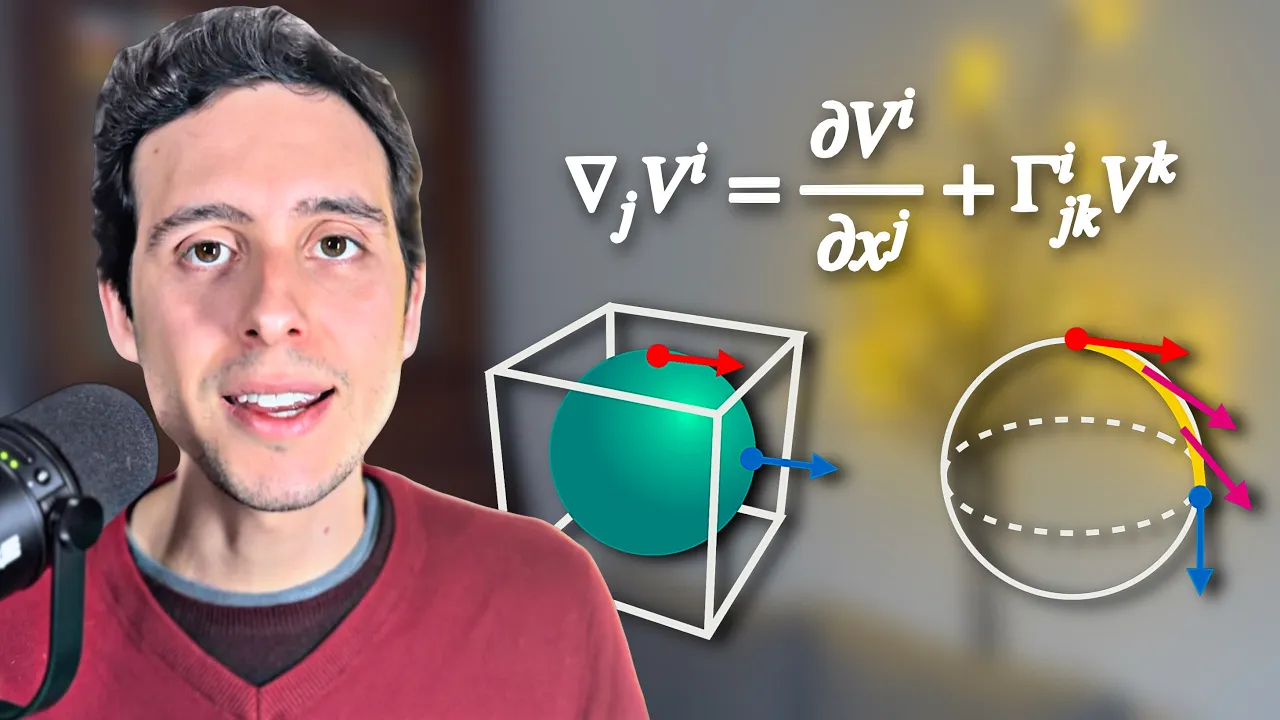




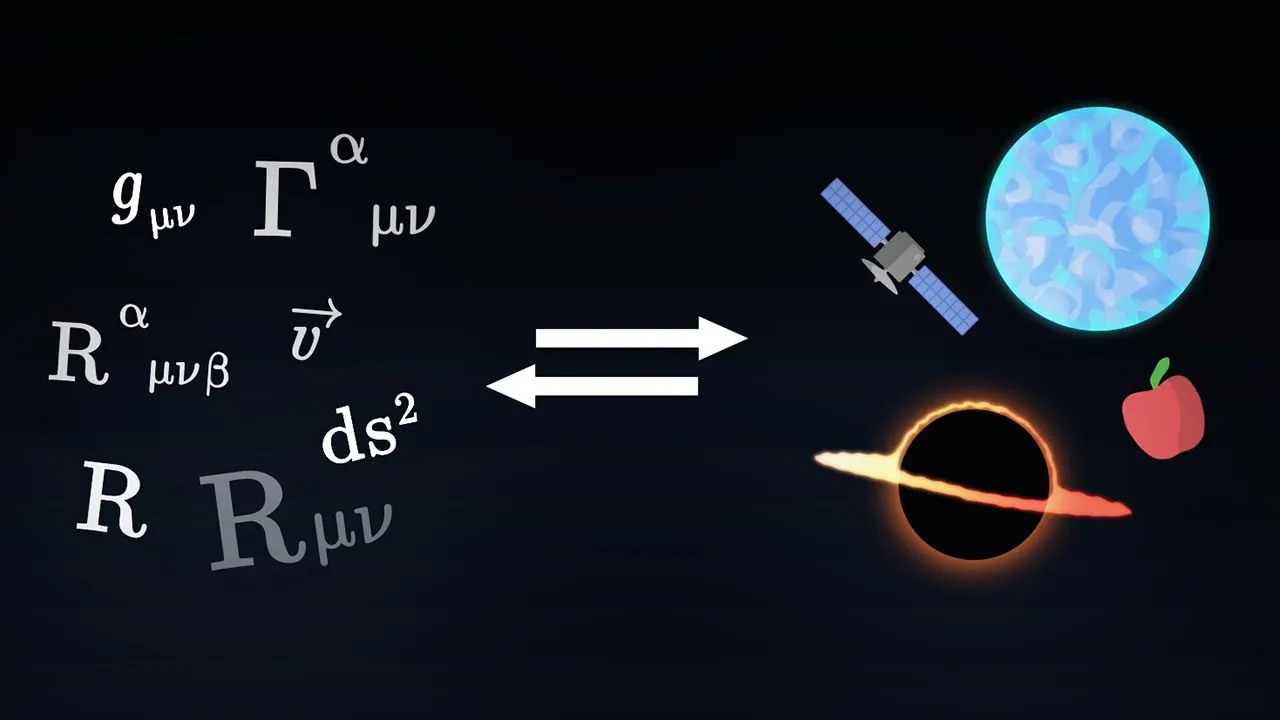


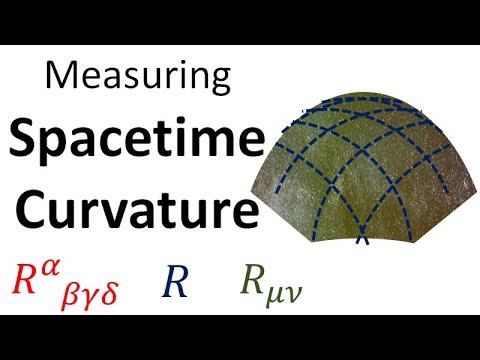


This video is the fourth in a series building the theory of general relativity, focusing explicitly on the metric tensor. It explains the metric tensor as a fundamental object that encodes the geometry of spacetime and enables the calculation of physical distances. The video connects the abstract mathematical definition of the metric tensor to its geometric interpretation, showing how it determines local spacetime structure. It demonstrates how Christoffel symbols, which describe how vectors change under parallel transport, are derived directly from the metric tensor through explicit mathematical relations. The video further shows how the metric tensor determines the trajectories of free-falling particles, linking geometry to motion in curved spacetime. Two concrete examples are provided: the first illustrates a general application, and the second specifically examines the Minkowski metric, which describes flat spacetime in special relativity as a special case of the metric tensor. The presentation emphasizes the direct computational pathway from the metric to physical predictions, such as distances and geodesics, without introducing unrelated concepts. The content is presented in a structured, step-by-step manner, progressing from definition to application.
Metric Tensor in General Relativity Explained | Geodesics & Spacetime
Added:[Music] welcome back to science clique today the mathematics of general relativity part 4 the metric tensor our model is getting more and more precise we have built a coordinate system to describe the position of objects we have defined proper time in order to interpret world lines as movements through space-time and we have obtained a fundamental equation the geodesic equation which predicts the trajectory of objects as long as we know the christopher symbols however a problem remains although our coordinates locate points they do not give us any information about the distances and angles between them indeed the intervals on the grid do not represent the same distance everywhere nor the same orientation and this has to be taken into account [Music] to do this imagine two points on the sheet very close to each other knowing their coordinates we wish to express the distance between these points at first glance we could think of the pythagorean theorem calling dx0 and dx1 the differences in coordinates between the two points we might write the square of the distance as the sum of the squares of both sides but the pythagorean theorem only applies if the lines form an orthonormal coordinate system if the grid is stretched in some way or if its axes are not perpendicular the pythagorean theorem no longer works and we have to find a more general expression which works regardless of the grid we use generally the square of the distance can always be written as a sum of all possible combinations of two sides multiplied by some numbers these numbers depend directly on the shape of the grid in the special case where the lines form squares of side 1 the coefficients are respectively 1 0 0 and 1 which brings us back to the pythagorean theorem [Music] all these coefficients which multiply each combination can be brought together in a table with one row and one column for each coordinate we call this object the metric tensor it is represented as a table whose components allow us to calculate small distances usually this table is called g and its components are numbered by two indices we can therefore write the square of the distance which separates two points as the sum of each component of this table multiplied by the corresponding differences in the coordinates between the points [Music] this formula in particular allows us to express the norm of the velocity vector to do this we replace the coordinate differences by the components of the vector bearing in mind that the norm of the velocity is always the speed of light we can write a more precise version of this equation it is very important to understand that the metric tensor is a fundamental tool in the theory of general relativity indeed before this point we only had coordinates abstract numbers mathematical descriptions which do not represent anything concrete thanks to the metric tensor we can transform these abstract descriptions into real measures of distances and angles the metric tensor is the key allowing us to relate abstract numbers to physical geometry finally let's remember the geodesic equation we saw previously that this equation predicts the trajectory of an object provided that we know the christopher symbols but so far nothing told us the value of these symbols and the equation was therefore impossible to use it turns out that this object the metric tensor will allow us to calculate the christopher symbols indeed we previously saw that the christopher symbols describe how basis vectors vary along the grid but the basis vectors are directly related to the shape of the grid and as we saw the shape of the grid is expressed through the metric tensor itself by measuring how the metric tensor varies along the grid we can thus determine how the basis vectors change and therefore the christopher symbols thanks to the metric tensor we can now calculate the value of the symbols and thus use our equation when we perform this calculation which uses the variation of the metric tensor to express the christopher symbols we obtain an expression which involves derivatives of the metric tensor because we look at how it varies along the grid but also its inverse denoted with indices at the top which is another table quite hard to calculate most of the time however this expression can be simplified by choosing an appropriate coordinate system in particular we can manage to choose a grid whose axes are perpendicular to each other with such grid the expression of the christopher symbols is simplified as it no longer involves the inverse of the metric but only its components and their derivatives supposing that we know the metric tensor we can now calculate the christopher symbols and using them in the geodesic equation we are able to predict the trajectories of objects in the universe basically we have a method to describe the movement of a free body depending only on the geometry of space-time the geometry of space-time is embodied by the metric tensor which alone describes the relationships between real distances and our coordinates unfortunately we still lack a method to determine the metric tensor in the next videos we will see how to relate the metric tensor to the curvature and the energy content of space-time as usual let's summarize all these concepts with a concrete example to begin with we take the example of the earth described by coordinates of latitude and longitude on the surface of a sphere with respect to this grid the metric tensor can be expressed as the following table the letter r stands for the radius of the planet and the angles theta and phi are the coordinates of latitude and longitude this general expression allows us to calculate the metric tensor at any point along the sphere wherever we need to calculate it we just replace theta by the corresponding latitude and if we want to measure small distances around this point we only need to sum each component of the table multiplied by the differences in the coordinates this sum gives us the value of the square of the distance between the two points that being said the metric tensor only gives us access to very small distances if we want to measure a large distance we have to calculate it all along the trajectory because the shape of the grid might change from one point to the other in mathematical terms this is called an integral a sum over an infinite number of very small distances the metric tensor is an extremely powerful tool from abstract descriptions namely coordinates it allows us to measure real physical distances on the surface of the sphere finally we will at last apply these notions to a real space time we look at the simplest example an empty space time in which an object moves we imagine for instance a satellite lost in outer space to describe its trajectory we provide our space time with two coordinates time t measured on our clock and space x which measures the position of the satellite along an axis as its proper time passes the satellite will evolve along these two coordinates in such an empty space time the metric tensor takes the following form this metric tensor is quite simple especially since it does not depend on the coordinates it is the same everywhere on the grid and because it does not vary on the grid all its derivatives are zero and therefore all the christopher symbols are also zero injecting them in the geodesic equation this simply tells us that the components of the velocity of the satellite do not vary the satellite traces a straight line through our coordinates this particular metric which describes an empty space-time is called the minkowski metric the minkowski metric describes the space-time of special relativity it is rather simple in that it does not depend on the coordinates this space time has the same geometry everywhere on the grid a first prediction that we make with this metric is the phenomenon of time dilation to do this we remember our previous equation which related the norm of the velocity to its components using this equation for the satellite we can express its temporal speed as a function of its spatial speed this value is greater when the satellite moves faster through space this means that the faster the satellite moves through space the faster our time will pass compared to its proper time the faster an object moves through space the more its proper time slows down compared to our time at first glance the minkowski metric may seem rather simple but it is actually very special because the metric contains a negative one this negative one is a strange and fundamental property of our universe it tells us that the dimensions of space and time are fundamentally different let's take our satellite again and measure the distance that separates it from a point in the future here for example two light seconds if we shift this point in space we would expect a greater distance but because of this negative one in the metric the distance is actually smaller and the more the point is offset in space the more this distance decreases when the point is placed diagonally that is to say that it's separated from the satellite by as much space as time the distance between the satellite and the point is strangely zero an object moving along this diagonal would actually travel no distance through space-time and its proper time the graduation along its trajectory would not pass this is more commonly called light beyond this diagonal distances become square roots of negative numbers they are imaginary numbers and the satellite will never be able to reach such points nothing moves faster than light [Music] you
Up Next

Tensor Calculus for Physics: Christoffel Symbols Derivation
@AndrewDotsonvideos
50.8K views•2020-03-16

21cm Hyperfine Transition in Neutral Hydrogen: Radio Astronomy Basics
@AaronRobertParsons
12.4K views•2011-10-13

General Relativity Explained: Geodesics & Christoffel Symbols
@ScienceClicEN
256.1K views•2020-12-08

Entropy and the Second Law of Thermodynamics Explained
@veritasium
27.5M views•2023-07-01
Related Study Plans & Knowledge Roadmaps
Structured learning paths in Physics