





















The first X-ray diffraction image of a crystal, taken in 1912 by Max von Laue's colleagues, provided definitive proof that atoms are real physical entities by revealing the symmetrical spot patterns created when X-rays interact with the regular atomic arrangements in crystals, solving the long-standing scientific debate about whether atoms existed as tangible particles rather than just mathematical concepts.
Atoms Proven: X-Ray Crystallography in Science
Added:Basic atomic theory and the historical models of the atom proposed prior to the 20th century.
The nature of electromagnetic radiation, specifically the properties and wavelength scale of X-rays.
The wave phenomena of diffraction and interference, including constructive and destructive interference.
The concept of crystal lattices and the ordered, repeating arrangement of particles in crystalline solids.
Bragg's Law and the mathematical formulation used to calculate atomic spacing from diffraction patterns.
The discovery of the DNA double-helix structure, focusing on the role of Rosalind Franklin's Photo 51.
Modern applications in structural biology, such as protein crystallography and its role in rational drug design.
The transition to advanced X-ray sources, including synchrotrons and X-ray Free-Electron Lasers (XFELs) for dynamic molecular imaging.
236.2K views12.4Klikes8:54Original Release: 2026-03-13
This little spinner has on it what in my opinion is the most important picture in the history of science. And while I work up to telling you about it, I'm going to spin it and see how long it can go.
Because in order to tell you about this image, I have to ask you a question about atoms. And that question is, do you know that atoms exist? Like for sure. And more than that, do we know that atoms exist? Is that a thing that humanity like 100% definitely has nailed down? Like if you pressed me, I couldn't really tell you what atoms are.
Certainly they are some combination of protons, electrons, and sometimes neutrons. Certainly there's a nucleus and an electron cloud. Also, by definition, they're neutral. If there's more electrons than protons or more protons than electrons, then that's an ion. And certainly, when you do chemistry, it only ever happens in whole number increments. There's like definitely an atomlike thing going on there. And this was actually the first big hint that atoms might really be a real thing. When early chemists did early chemistry, they kept finding these nice big whole numbers. You break water apart, you don't just get hydrogen and oxygen, which is a very weird outcome on its own. You get exactly two parts hydrogen for every one part oxygen. I mean, as exactly as their methods and instruments would allow, but that is not enough on its own to say that an atom is a real physical thing. Like maybe there's just some other force pushing everything toward these whole number ratios. A century after John Dalton and Joseph Pra noticed these ratios, scientists were still arguing about whether atoms were a real physical thing or just a useful mathematical tool is still going. But if there's one thing you know about Albert Einstein, it's the whole E= MC² thing. But if there's two things you know, it's probably the photoelectric effect. But if there's three things you know, it's that he also kind of proved that physical atoms actually exist. This is a big deal. The fact that this is not his most famous discovery is honestly pretty messed up.
Perhaps he should have like done a little less. You know, leave something for the rest of us. In 1905, Einstein used math to describe a very weird effect called brownie in motion, where little flexcks of stuff on the top of water would jitter seemingly at random.
Einstein's math proved very elegantly that this would only happen if the water itself were made of tiny particles bumping into pollen grains. Oh, it stopped. It stopped. Turns out I could go longer. The fact that Einstein showed that if atoms were real, tiny particles suspended in water should jitter in a very specific way that was indeed the way that they jitter here in the real physical world convinced a lot of people. It was kind of seeing atoms with our own eyes, but it was not actually seeing atoms. And even though Einstein's 1905 Brownie in motion paper is often cited as the moment that we knew for sure that there really were atoms, many scientists continued to argue that atoms weren't a real thing and they were more of an idea for quite a long time. After all, if atoms were real, why couldn't anyone see one? Now, you might be thinking, is this what I think is the most important image in the history of science? Is this the first picture of atoms? No, it's not. But it kind of is.
We're going to get to it. atoms, it turns out, are incredibly small. About 110 billionth of a meter across, which is pretty strange. Like that's just that's just very small. Also, it turns out quite a lot smaller than the wavelengths of visible light. So, atoms actually are literally impossible to see with the light we use to see things. So, surely seeing would not be the thing that would put the final nail in the coffin of the atoms don't physically exist theory. But right around this time, something else very interesting had been discovered. A new kind of light. God, this must have been very exciting and weird at the time. That new kind of light was the X-ray. And importantly, no one in the early 20th century knew what the heck an X-ray was.
Some scientists thought that they were particles. Others thought that they were waves like light, just with like way shorter wavelengths. And if that were true, then perhaps those waves might be small enough to interact with atoms. And this was the very clever insight of not Einstein but the German physicist Max von Laauo. He thought that perhaps X-rays could interact with atoms. And he had the perfect tool for testing this crystals. The atoms of crystals are arranged in extremely regular repeating patterns. Salt, quartz, diamond, they all have atoms arranged in orderly grids. And if X-rays were really waves and atoms were really physical objects arranged in these orderly patterns, then sending X-rays through a crystal should do something very specific and very cool. Each atom would scatter the X-rays a little bit and those scattered waves would interfere with one another, reinforcing in some directions, canceling out in others. If you placed a photographic plate behind the crystal and shot an X-ray through it, you should see a specific and symmetrical pattern when you develop the plate. If that happened, X-rays would definitely be waves and atoms would definitely be things. And in 1912, while the atom debate continued to fester, two of Von Laauo's colleagues did exactly this, firing X-rays through a crystal of copper sulfate and onto photographic plates. And when they went and developed the film, this must have been very exciting. They saw this, a constellation of spots arranged in perfect symmetry.
This photograph revealed two deep truths about the universe at the same time.
X-rays were not mysterious particles.
They were a new kind of light, electromagnetic radiation with much smaller wavelengths. And second, crystals were not smooth continuous solids the way they appear to be to us.
They were built from extremely tiny objects arranged in precise repeating structures. Now this was not a photograph of atoms. We would have to wait decades for that if you can call what we do now when we image atoms a photograph. This was instead the pattern atoms imprint on light as it passes through them which let's be honest is cooler. It is so cool that I would like to make you a deal. Are you ready? So, some of you watching this video, you would like to celebrate Von Laauo's work and humanity's labor of never being satisfied and always striving to figure out more to the point where we now teach seemingly unknowable truths to every elementary school student. This is remarkable work. This is human work. It is the work of science. And here at SciHow, we love to tell you about that work. We love what we do. We are also part of Complexity, which is a 501c3 nonprofit filled with people working their butts off to make highquality, accurate videos free for everyone. Now, many of you support Complexity or Sihow on Patreon, which is amazing. But we know that some people like to donate just once instead of a monthly payment.
So, for the third year in a row, we are selling a $60 postcard. This time with a bunch of very cool Sihow stickers on it.
Now, $60 is too much for a postcard, but it's pretty good for four Sihow videos a week all year round. $5 a month for 16 brand new videos. I don't mind it. Send it to a friend. The whole idea is that a very small number of people support us with money so that the content can be free for everyone. Some of you have been asking for something cooler, something shiny, something collectible to represent your love of Sihow to show all those Crash Course fans that Sihow has super fans, too. And that's why I asked the team to cook up this spinner. On one side, it's got this X-ray crystalallography image. On the other side, our Sihow logo. You can buy this right now and only for the next two weeks at the link on the screen or in the video description. It costs $500, which is a lot of money, but it's less than $3 per video we produce in a year.
When you buy this, you make it possible for us to make Sihow for everybody else.
And it will come in a package sealed with a very cool Sihow wax seal. And did I tell you that we are a nonprofit now, so it's also taxdeductible?
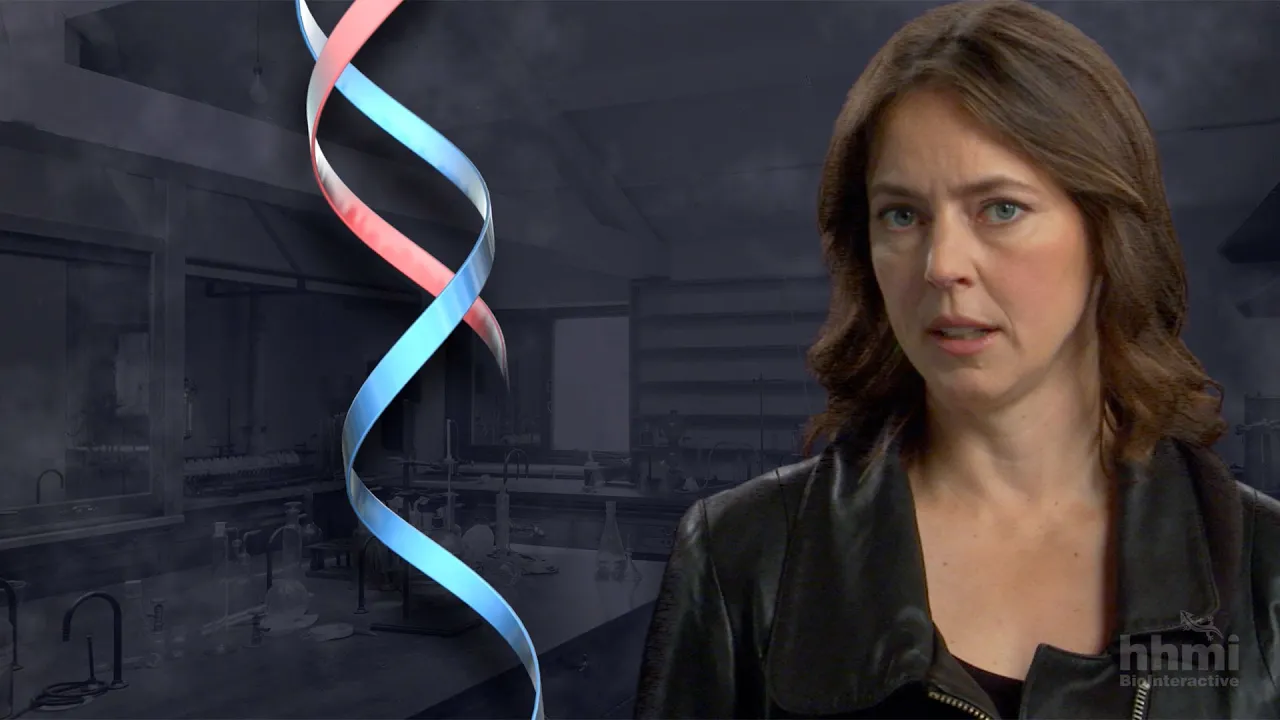
These X-ray defraction pictures of crystals called X-ray crystalraphs. it turns out weren't just good for learning about the nature of our universe. They also became an important tool for understanding chemical structures. Most famously, Rosyn Franklin managed the finicky work of creating a crystal of DNA and then shining X-rays through it to create this famous image. Once scientists learned how to read these patterns, they had a way to map the invisible architecture of atoms. From minerals to metals to complex molecules to eventually the molecule that encodes our genome, DNA, science is a process, and we love to follow along with the developments here on Scihow. You'll see our list of references in the notes of every video because we like to keep up on peer-reviewed research. But that's a lot of work for a YouTube video and we can only do it thanks to you. So if you can help us keep making hundreds of videos every year, check out the Sihow postcard and the spinner in the link in the description. Only available for the next two weeks. Still going.
Up Next
12:08
Derivation of Bragg's Law in X-Ray Diffraction | Crystallography
@ScottRamsay
159.9K views•2014-10-28

12:53
21cm Hyperfine Transition in Neutral Hydrogen: Radio Astronomy Basics
@AaronRobertParsons
12.4K views•2011-10-13
3:50
How Do Whales Avoid Deafening Themselves? Hearing Explained
@SciShow
187.4K views•2018-06-30

27:14
Entropy and the Second Law of Thermodynamics Explained
@veritasium
27.5M views•2023-07-01
Related Study Plans & Knowledge Roadmaps
Structured learning paths in Physics
physics
Nuclear Physics (Decay, Fission & Reactors)
01Atomic Structure and the Binding Force
02Radioactive Decay and Half-Life
03Nuclear Fission Mechanics and Chain Reactions
+ 2 more learning modules
12h5 modules
Explore Roadmap
physics
Soft Matter (Polymers, Colloids & Rheology)
01Foundations of Soft Matter & Thermal Forces
02Polymer Physics and Macromolecules
03Colloids, Surfactants, and Self-Assembly
+ 2 more learning modules
38h5 modules
Explore Roadmap
physics
Analytical Mechanics: Lagrangian & Hamiltonian
01Mathematical Foundations: Calculus of Variations
02From Newtonian Mechanics to Constraint Dynamics
03The Principle of Least Action & Lagrangian Mechanics
+ 3 more learning modules
28h6 modules
Explore Roadmap
physics
General Relativity (Spacetime & Cosmology)
01Foundations of Relativity: Special Relativity
02The Geometry of Spacetime: Equivalence Principle & Curvature
03Einstein's Field Equations: The Mathematics of Gravity
+ 2 more learning modules
55h5 modules
Explore Roadmap