

















![[Sách nói] Lập trình não bộ - Phần 1 | Dave Farrow | Bizbooks Audio](https://i.ytimg.com/vi/UlsYFffjvYg/maxresdefault.jpg)





Growth mindset is fundamentally about deriving dopamine release from the effort and strain process itself, not just from achieving outcomes; this is supported by neuroscience showing that dopamine is released during the pursuit of goals (like Tiger Woods trusting the process) and that the brain can be trained to associate reward with effort through deliberate practice, enabling sustained high performance.
Brain Science of Growth Mindset and Peak Performance with Dr. Andrew Huberman
Added:The psychological foundation of Carol Dweck's Growth Mindset vs. Fixed Mindset theory.
Basic concepts of neuroplasticity, specifically how the brain reorganizes its neural connections in response to learning and experience.
An introductory understanding of neurotransmitters, particularly the role of dopamine in driving motivation, anticipation, and reward.
The basic structure of the brain's reward pathway, including the mesolimbic pathway, to understand how reinforcement works.
Advanced protocols for dopamine regulation, including understanding how to manage dopamine baselines to prevent burnout and maintain long-term drive.
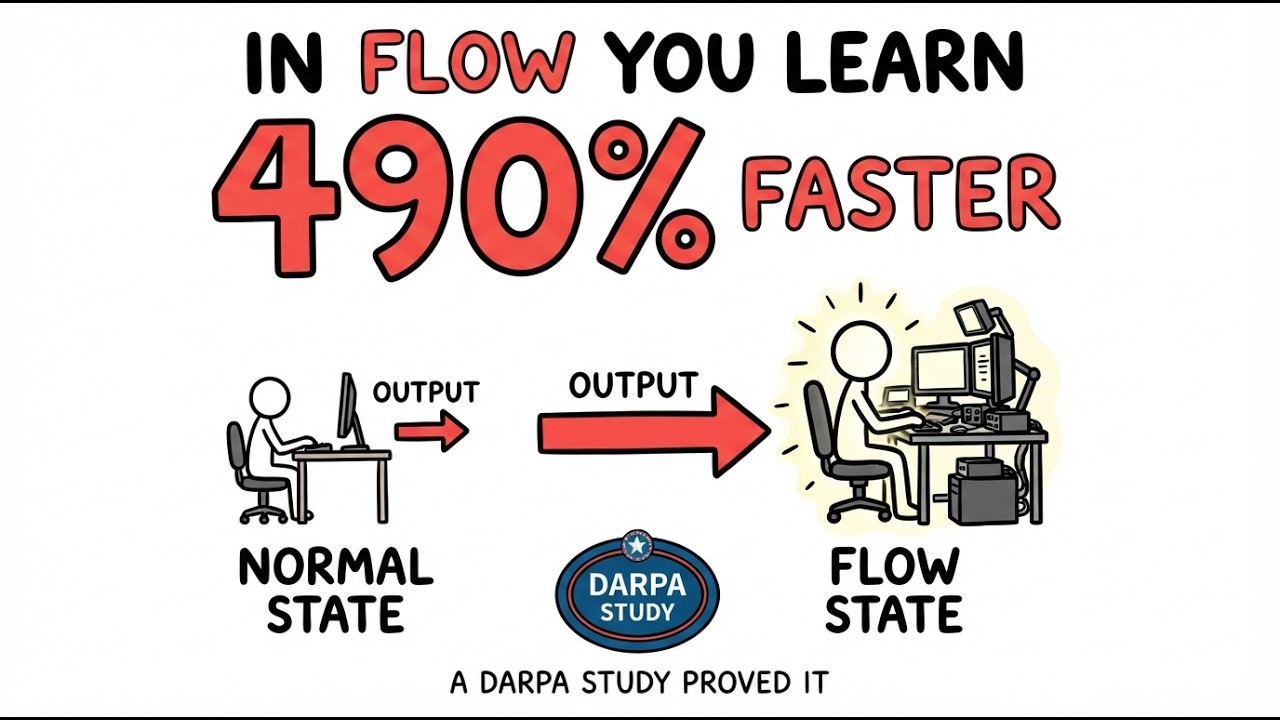
The neuroscience of flow states and how optimal neurochemical conditions facilitate deep focus and peak cognitive performance.
The study of neurobiology-based behavior modification, specifically applying neuroplasticity principles to habit formation and elimination.
The physiological mechanisms of stress and resilience, particularly how biological friction and autonomic nervous system regulation affect performance under pressure.
188.4K views5.7Klikes1:17:12Original Release: 2020-08-10
I actually worry that if humans keep seeking for these comfort zones at the outset of effort, we could actually devolve as opposed to evolve. Wow.
[Music] Growth mindset at its core is about deriving dopamine release from the effort and strain process. I think we're conditioned as young people that the dopamine only comes when we hit the home run. When we bring home the A. That's when mom and dad are proud of us. That's when we got the dopamine hit. Tiger Woods, the greatest winner in the history of golf. What does he usually say? I'm just trusting the process. Even when he was going through swing changes, he got the hit from the process. the super high performers that I know and I know you fall into this category Ed, they know that this is the system that's going to allow them to pursue things forever. Welcome back to Max Out everybody. My guest today is Dr. Andrew Huberman and he's a neuroscientist. His lab is at Stanford. Today's going to be one of the more interesting shows for me that we've ever done before because I'm fascinated with this man's work. And he's unique because although he's a brilliant person, he's a neuroscientist, he speaks in terms that people like me can understand. And so he's got a very unique ability to understand information and articulate it in a very understandable and digestible fashion.
His lab, and Andrew, you can correct me if I say this wrong, but his lab mainly studies two things, which is really vision, literally vision, the workings of the retina, and then secondly, really different states of mind. And um is that about accurate, Andrew? Would you say that's exactly accurate?
Okay, good. And uh and so today we're going to stay on the ladder. We're going to talk today predominantly about states of mind, growth states, peak performance states. And so I'm really honored to welcome Dr. Andrew Huberman to the show today. Welcome to Max Out, brother.
Thanks. So great to be here. It's an honor and a privilege to be here. So looking forward to our discussion.
I am as well. And we could go so many different places and we will. If you're in your car listening to this or on the treadmill, it's one of these you're going to listen to twice or go over to YouTube and watch it or vice versa because there's going to be so many nuggets in here. Let's start out the concept of first off, what's a neuroscientist do and what do they study just for the edification of our audience.
Sure. Well, it's a great question. You know, the the term neuroscientist only really emerged in the last 10 years or so. When I started my training, which was about 25 years ago, I'm 44 now, so I got into this pretty young, there were fields like neurochemistry and there was psychology. There was even a a degree at some universities called psychobiology, which was really the merge of psychology and biology. But they fortunately they got rid of that name because that was really offputting.
Yes.
Um, you know, a neuroscientist is somebody that's interested in understanding the workings of the nervous system. And the nervous system is the brain. So all the neural tissue encased in the skull. Although there are two little pieces of the brain that are outside the skull that we'll talk about as well. Um the spinal cord which is the other part of the central nervous system. And then what we call the peripheral nervous system. So all the connections between the brain and spinal cord with the organs of the body and from the organs of the body back again.
So a neuroscientist wants to understand how the nervous system works, what it does and that really encompasses everything. So memory, experience, perception, um states of mind like fear or stress or sleep or awe. Um every organ in your body is governed by the nervous system. Your digestion is controlled by the nervous system. Your heartbeat is controlled by the nervous system. Your immune system is controlled by the nervous system. So, a neuroscientist is sort of a catchall for somebody that's interested in understanding how nerve cells, neurons, and some of the other cells in the nervous system, how those work together to control all the functions of the brain and body. And I'm a research neuroscientist. So, I'm not a physician.
I'm not a clinician. There are some clinicians and MDs in our field. So, what I always say is I'm not a medical doctor. I don't prescribe anything. I'm a research professor. I profess lots of things.
Um, and my daily life consists of taking the nervous systems mainly of mice because that's a traditional research model where we can do really invasive things like leion brain areas, activate brain areas at will and humans. My lab works on mice and humans to try and understand what are the physical structures in the brain, what brain areas, which cells, which molecules, how do they connect, how does that lead to behavior and states of mind, etc. And we also want to understand how that actually impacts like what everyday people would think of as depression or happiness or motivation or drive. And so my life is um typical for a neuroscientist in the sense that we do experiments on humans and mice.
It's unusual for a neuroscientist in the sense that my lab does work on a lot of things. And I also we can talk about this. We we don't just do experiments in my lab right now. For instance, we have a study going on with 125 human subjects that are out in the world wearing devices where we're monitoring their brain and body 24 hours a day. We're monitoring their body position 24 hours a day and we are collecting data, neural data on them. So, we do experiments in the lab and outside the lab. It's a long answer, but um you know the neuroscientist upstairs from me, he studies gut brain interactions. One two doors down from me studies neuroplasticity. Two doors down from that, there's a woman studying navigation systems in the brain, kind of GPS systems in the brain. So you walk around my department or another neuroscience department, any other major um place in the country or out in around the world and people are just really obsessed with trying to figure out how this nervous system thing works from a different kind of narrower perspective.
So you're leading down the road I wanted to go, which I knew this would flow like this. So take this nervous system and it's processing feelings, thoughts, sensations, meanings, these other things. And I'm sort of well known for saying, listen, it's not the events of your life that matter. It's the meaning you attach to those events. Yet, one of the things that the nervous system has sort of done is it's we've all sort of agreed to some consensus of what things are. So, we've agreed to what certain colors are. We've agreed to certain what words mean, language, uh there's a general societal belief about certain things. So, if if that's true, but I've also heard you say your thoughts are a choice. So, if it's this involuntary process that's happening where we've all sort of agreed to this and we're almost pre-programmed through a series of evolution to believe certain things, how is it also that we choose our thoughts?
Great question. It's it's the question that neuroscientists think about. Um, and just as a bit of a disclaimer, there's going to be a little bit abstract, but I promise to get concrete and I'll do my best to be as succinct as possible. uh succinctness is not the quality that's typically associated with academics.
What I what I will promise, however, is um I'll try and use as few acronyms as possible and I'll only name things if I think it's going to be important for people to go look up more as opposed to just raining terminology down on people because that's not useful.
So, you are absolutely right. The nervous system is responsible for sensation, perception, feelings, thoughts, actions, and memories. All of that numbers.
Let's talk about what's non-negotiable.
What's non-negotiable are the sensations. I have receptors in my eye.
You have receptors in your eye. We have receptors in our skin, in our tongue, in our ears, etc. that take physical events in the universe, of which there are many, and can only sense some of those. So, for instance, I'm not a pit viper. I can't see in the infrared. A pit viper can. I can see in the infrared if I snap on infrared goggles, but if I don't do that, my eye can't sense those. So, I can't sense magnetic fields. There are people that claim that they can sense magnetic fields. If they can, it's an unusual quality. It hasn't been shown very robustly in the lab. Turtles, on the other hand, navigate extremely long distances by virtue of magnetic fields.
They are magneettosensing organisms. So the s the things that we can pull out of the universe and into our nervous system to work with those are fixed entities.
Now a colorblind person one in 80 males is red green color blind. They can't see reds the way I you and I can. My dog is red green color blind. So there are some unusual cases but in the absence of any technology the sensations that we can detect are fixed. They are non-negotiable as much as gravity is non-negotiable. We have to develop technologies to overcome them if we want to see into the infrared or see ultraviolet light etc. Okay. Now perceptions, feelings, thoughts, those are where it gets negotiable because for instance I can decide that the color of your shirt has meaning to me like we're both wearing a black shirt and therefore I'm we must have met in a previous lifetime and pretty soon I'd start to sound like a crazy person because the definition of psychosis or crazy is is assigning meaning to something for which there's none. Right? So we have to agree as in as groups or individual groups of individuals and society what what sorts of meanings matter and that's where it gets very subjective. You know we have we place value on the fact that somebody who commits a crime before the age 18 versus after 18 we call them an adult.
But developmental trajectories are from birth to death. Not there isn't some cliff that you know biological event an adult. So, we could go really deep down this rabbit hole or not. And I'm um but what we know is that sensations are non-negotiable. What we know is that societies and the way that we function as families and couples and in the workplace, they obey certain principles or rules of engagement that on average are adaptive for a given culture. So we meet, we say hello, we we agree on these cultural things that because on average they're adaptive. Whereas if we met and we decided first we were going to fight, first of all, we both know you're going to win that. We're going to physically fight. Uh and second of all, it's just not adaptive for the evolution of cultures, most cultures. There are circumstances where that's appropriate.
So what's important for us to understand is that the human brain is very very good at all these things sensation perception feeling thought and action.
It's also very good at two other things.
One is interosception paying attention to what's going on inside me and exterception. Paying attention to what's going on in the outside world and balancing the the weight of one or the other in order to move adaptively through life. Now, and I'll just throw this out as one more kind of conceptual thing, but I this I promised I would make it more concrete as opposed to abstract. When we say it's adaptive, what we mean is that this neural machinery in our heads, literally, I've opened up a lot of skulls. I've held a lot of brains in my life. I teach neuro anatomy to medical students now for 10 years. I promise you, it's just meat in there. Meat and some fluid.
And so, the neurons of the brain take sensations. And the only thing neurons can do, the only language they can speak is to be electrically active at certain times and in certain sequences like the keys on a piano. And it's this amazing thing like it still inspires wonder in me when I think about it that you do this, I do this, and we agree on some common rules of engagement that are adaptive. And it's what led us out of caves, huntergatherer cultures, technologies, the car, the plane, the the iPhone. It's amazing. And we are I think the important thing to remember is that we are still in our evolution as a species. We are still trying to work out whether or not 10 hours a day with the smartphone is good or bad for us. We're still trying to figure out whether or not traveling to other planets is good or bad for us. What should we do about this COVID thing? We are still trying to work this out. And the language that we do to work that out is neural language.
Yes. And so I'm I apologize if I made things more abstract than before, but you didn't.
We just have to agree on some rules of a game. Just like if we're going to play chess, we need to set up some constraints. And so those are the constraints in broad terms.
How do those So good. So no, it's perfect because I want to now I want to move it into like where we are in culture and also performance. Just what you just said. And so I know what I teach, but I don't know that I always know why it works the way it does. So these this nervous system I'd like you to speak to maybe it makes no impact. I have an assumption that it does previous experience in life and does the importance of something in one's life change one's sensory acuity to it. So what I mean by that is there's this great debate right now about racial and social issues. And so, uh, I wonder I've I've wondered if someone has not had an experience with something that they literally perceive sensory-wise less of it. And if they've got a history of some sort of a situation with a racial issue or sexual abuse or something like that that they see or feel more of it because it's important to them. And perhaps that's why there are certain things in society we can't come to a consensus on because importance in previous experience may change the way in which we gather this information. And on the other flip side of that is that also then true to program yourself to win that when something is important enough to you, you begin to see, feel, and hear things that will lead you towards those particular goals that you wouldn't see if it wasn't important in terms of your sensory acuity or your nervous system picking up on it or are they not correlated in any way? Can you speak to both of those?
Sure. Um, again, a great set of questions. So moment ago I mentioned that you know we have this interosception which is really just paying attention to what's going on internally like I could stop now and think about how my stomach feels or my breathing or you know really go internal or I can be externally focused and that's what the nervous system is doing. The nervous system has some very basic jobs. It's it wants to so it learns things. We're born into this world and the organization of the nervous system when we come into this world is not a completely blank slate.
It's designed to learn. It's a learning machine. The brain is amazing because it's the only organ that wires up itself, which is incredible.
Yeah.
So, it's a self-learning, self-building machine. And for the early part of life, the goal of the brain is twofold. One is to maintain all the housekeeping stuff.
keep the heart beating, keep digestion going, keep breathing going at a minimum to keep the organism alive, to keep us alive. And then it wants to learn things that are specific to its environment, and learn the rules of these sensations.
Objects fall down, not up, right? um mom walks in the room, she leaves the room, she comes back on average or doesn't or on you know learning these rules, contingencies and then passing those off to reflexive parts of the nervous system. So just like a baby never has to think about taking a breath or or governing its heartbeat with conscious thought. The nervous system wants to learn things and then push that to reflexive action. It's a lot of work to be do what's called serial processing.
Yes, not serial like me, but like serial as in series. I know you know this, but just for those, you know, maybe second language, English second language or something. So serial processing is hard for the nervous system. It's about thinking if A then B, then B, then C. Oh, wait. Was it C? Yes.
A, B, then C. It's it's work. And it requires areas of the brain that are very metabolically costly to engage.
It's why thinking hard kind of hurts.
There's some strain associated with it.
So the more we experience something, the more our reactions to it are going to become reflexive. For better or for worse, if it's a bad event, the nervous system or it creates a sensation that's uncomfortable, the nervous system will create an association whereby we naturally start to avoid that thing, whether or not it's good for us or bad for us.
If it's something that we like, we get rewarded and we want with a chemical, typically dopamine or serotonin, and we want to move toward that thing again.
And that illustrates the other key feature of the nervous system that I think will help simplify some of this kind of overwhelming number of things that the brain can do and how it can do it, which is we have in our brain a few chemical systems that are called neurom modulators. They're not responsible for the communication between neurons. What they do is they modulate or change the likelihood that certain brain circuits will engage and other ones won't. and they fall into very specific categories.
The most famous of these is the neurom modulator dopamine.
Yeah.
Dopamine is is released anytime we experience something we really really like but under very specific conditions.
Anytime we are moving towards something and we think we're on the right path, dopamine is released. And this is nature's way of telling whatever neurons are active during that movement down that path. So, this could be exercise.
It could be a relationship breakthrough.
It could be a business breakthrough. It could be learning some little piece of a puzzle that you're excited to learn or you've been straining on. It tells you more of that, more of those neural symphonies or or neurons being active in the way they just were. Whatever you were doing just there, more of that. So, it sends you down this path. And dopamine is very misunderstood. People think dopamine is about getting the reward. Dopamine is about sending you toward the reward. Think of it like a jet propulsion system. Wow.
Right. It's not that just the finish line. It's a jet propulsion system. And every animal needed that. An jump on. I just got I'm give it back to you. I just got to say something.
I think it's one of the most significant things ever said on the show, honestly.
And and it explains my own life experience or my relationships. I want you to hear what he just said, everybody. That you're getting more dopamine on average in the pursuit of your dream and your goal than you actually do with the attainment of it.
And that maybe there's a little key here to if dopamine sort of a happiness drug, right? If you want to call it that, you feel good.
Could it not possibly be true that one of the keys of happiness in life is the pursuit of something great, the pursuit of growth. and and that that's the key that it's that you don't have to achieve everything in order to give yourself the gift of happiness. I didn't mean to interrupt you. It's just that's so freaking significant because I think a lot of people sort of cheat themselves from just the pursuit because they think, well, I'll only be happy when I get there. I'm not qualified. I haven't read enough. I don't know enough people.
I don't have enough context. And they're they stand still and they're not happy.
And what they're missing is the science that tells us actually if you just begin to pursue this and show some progress towards it that you're going to get that happiness you're seeking that you think you will only get when you get there.
Correct.
Absolutely. Absolutely. And and I'm I'm so glad you bring this up because you know there are some concepts from psychology that we can start to weave into this. Um you know I can give examples from evolutionary biology. You know, an animal that's thirsty goes out looking for water and when it's finds that first drop of clean water, dopamine is released, but maybe that's not the the big lake that it needs. But that's going to tells it it's on the right path and it's and dopamine naturally causes neuroplasticity of whatever brain circuits were active previously. So, it says, "Hey, whatever I did to get to this point, this milestone, not the finish line, that is something that I might want to repeat reflexively in the future. I might not want to have to work so hard to do that. Now, the cool thing about dopamine, many cool things about dopamine and then it has a dark side and we should talk about the dark side because even if and I'm not and of course the dark side can be associated with drugs of abuse like cocaine and things but actually there's a there's a more even more sinister dark side that I think a lot of people fall into this trap. So, the great things about dopamine is it rewards us and it gives us energy. And when I say energy, I don't mean glycogen. I don't mean glucose. I mean neural energy and the reason is effort of all kinds whether or not you're writing with a pen whether or not you're racing uphill with a weight vest or whether or not you're you know slogging it out through any discomfort is generally associated with the neurom modulator adrenaline also called epinephrine. Okay, so adrenaline in the body is it's called adrenaline in the body. It's released from the adrenals and then epinephrine in the brain is released from a couple places but there's one particular place for the aicionados. It's called the locust ceruius. It's in the brain stem. It wakes us up. It gives us a sense of urgency and it's about effort and it doesn't care if you're doing something out of love or out of hate, out of revenge. It does not care. These are neurochemicals and they don't care about you or your life experience. But they are in your brain and they are the engines. Okay.
Wow. Now, the cool thing is it gets you going and it's the effort molecule, but the problem is too much epinephrine or adrenaline eventually triggers literally a quitting circuit. There was a study published in 2019 which showed that for every bout of effort, a bit of adrenaline or epinephrine is released. And once those accumulate enough times, it's like spending money on an account, a a set of cells in the brain, they're called gal cells, activate and they turn off voluntary control. This is the reason why if you're running, you eventually might just say that's it. I give up. It's the despair moment and it's a chemical moment. Now what's we could go deep into that but the important thing for now to understand is that dopamine allows the brain and the body to tolerate higher levels of epinephrine and to continue in effort as well as pushing down that level of epinephrine. You've experienced this before Ed. If you've been working really really hard and it's just or something's just terrible and you feel like you can't continue and someone cracks a joke instantaneously you have more levity, more energy, that couldn't have been liver glycogen or anything kind of in the body. That was neural energy. That was dopamine.
Likewise, if you suddenly have the moment where you think you're at a breakthrough, not a falsely created belief like, "Oh, I'm performing well when I'm not performing well," but you have a breakthrough like, "Oh my goodness, I think I'm on to something."
You feel that more energy, and that's dopamine in action. And the the beauty of dopamine is it's very subjective.
There are chemicals that will release dopamine in the body, but it is very subjective. And so I always like to give the example, you know, people always say, "A journey of a thousand miles starts with a single step. How do you eat the elephant? One bite at a time."
But what's missing in those kind of those common phrases is that the key is to reward each bite subjectively. Or let's say you're full, so to speak, metaphorically speaking, you can't put put in more effort. If you subjectively reward and you say, "I'm on the right path. Effort is the path." and you start to tap into these systems, you develop what my colleague at Stanford, Carol Dw, coined growth mindset. Yes. Which is not just the belief that you can be better, but growth mindset at its core is about deriving dopamine release from the effort and strain process. It's about f enjoying friction. And this is what people like you what you know uh David Gogggins is a famous and and shining example of this. And there there are others as well of course. So dopamine is your best friend in mitigating or making sure that the effort process is not self-limiting. It's and you have to regularly dose your behaviors and your thoughts with this dopamine association.
And people get very hung up on this.
They're like, "Wait, how do I know if I'm doing it right?" Well, it's a skill you have to learn in your mind because thoughts are spontaneous. They are like popups on a poorly filtered internet.
But thoughts can also be deliberate. I can decide to tell myself, look, I'm straining, but I'm going to reward this.
I'm going to tell myself I'm on the right path. And the brain and the body don't know the difference. And this is not lying to yourself. This is not saying, oh, you know, I'm really back on my heels. I'm performing poorly. It's not telling yourself you're performing well. It's telling yourself that performing itself, the verb effort, the verb of performing is what you want to reward, not the noun.
Gigantic. I got to jump in again.
Gigantic. Gigantic. Because one of the things that I teach the athletes I work with are the business people. And I love understanding why even more. One of the things that I've noticed is people that continue to make an effort are intentional about acknowledging that effort to themselves. and you call it giving self credit or celebrating. So, this is really critical, guys. If you've heard me say this before, Andrew is telling you why it works. The bottom line is is that as you're making these effort deposits, it's being intentional and aware that you're doing it. Giving yourself credit for a real thing you're doing gives you this dopamine reward and you continue to move forward. I I I want to go like 11 hours with you, bro, but I think I always want to pull out like unpack how's this application to the performance piece. And again, you athletes that are out there listening to this that are doing this one more that I teach, when you do the one more, it's reminding yourself, I just did one more.
Maybe you didn't lift more weight today.
Maybe you didn't run faster. Maybe you missed 35 putts. But that effort deposited and that intentional acknowledgement of the effort reward is so critical in confidence, in happiness, in progress as he's told you. Can I unpack another piece and ask a question about that please? No. and and and I love your synthesis of it because um yes, please.
Okay, so you said something earlier, but I don't want to move past because you hear people talk all the time about habits and rituals and you know and every that's like this vogue thing to talk about, right? But you said something earlier, but I want you to if you would just explain again. One of the things I've learned from your work is this concept that you said earlier, but I it was in the middle of so many gems is that the brain would like to preserve energy. and I'll use it say it my way and move to default reflexive mode. So as many things as it can process and just default to reflexive mode rather than effort mode with critical thinking and adjustment it will do. So your brain is constantly trying to find ways and situations and circumstances you're in to default to what you do reflexively.
Okay. So would that not mean then Andrew that those things you do reflectively called habits and rituals better serve you or you'll default continuously to the reflexive mode of drinking or laziness or the video game or Instagram?
That's a reflective default mode. Some people for stress they encounter stress the brain reflects to a default reflexive mode of whatever they do to cope with that stress. True.
Absolutely. You know, I think um I'm not alone in the noticing that occasionally I pick up my phone and I log into an app and I didn't make the conscious decision to do it. I just do it reflexively. I might even go into a sub window within that app. And the reason is that the brain and the nervous system are constantly seeking rewards and novelty.
And if we're not deliberate about how we're doing that, we will do it entirely reflexively. And that's not necessarily a bad thing. I enjoy social media, teaching our science on Instagram. I enjoy doing that and and I I enjoy the feedback most of it. Um, you know, I'm human. Um, right? So, but I think the brain and nervous system wants to make things reflexive and habits are very powerful because they are they set us on trajectories. Now some people they are uncomfortable with the fact that effort is the first gate that you have to go through in order to build this pathway that involves norepinephrine or adrenaline and epinephrine. And and I sometimes people jump on me about using norepinephrine and epinephrine interchangeably. I know they're not the same thing, but today we're just going to broadly describe them as systems in the brain and body, not get too down in the weeds. But the idea is you've got effort. You can associate that with adrenaline epinephrine. You've got dopamine which is your internal reward system and it can be externally rewarded. So this is very important.
There are intrinsic rewards and exttrinsic rewards. There's a beautiful study that was done at Bing Nursery School at Stanford. I had nothing to do with this study in the mid70s where they took kids that like to draw and they then rewarded some of those kids with just a little star like kids like you know the shiny star makes them special for drawing. Then they took away the star next day or the next day. And the kids that liked drawing just for the intrinsic pleasure of it, they drew less. So the the so these reward systems can attach to external things or internal things. I have a good buddy um he's he's friends and co-uh co-founders of this company made for that you talked with Blake Mikoski about. His name is Pat Nass. a former Navy Seal and he and I were giving a talk once to a bunch of people and we were talking about reward processes in the brain and how seals do it and what neuroscience thinks and someone asked us a really good question.
They said, "How do I continue to tap into this dopamine system?" And our answer was, "Be very careful with extrinsic rewards. Make sure that your dopamine system is attached more to the effort process than it ever is to any external reward. And it's because of a very important principle of dopamine rewards. It's what neuroscientists call dopamine reward prediction error. It is the reward prediction error is the reason why people that work work work work in pursuit of a goal and then reach that goal become miserable and don't know what to do with themselves. Reward prediction error says you always need the dopamine at the final stage to exceed all the the little bits of dopamine you got and root to that reward or you will actually be disappointed.
You'll experience a sort of postpartum depression of sorts.
So the key is learn to attach reward to the effort process. You know I'm not David Gogggins psychologist and um but I do know David and he's come out to my lab before. We've had some conversations. I don't know what his process is except as he's described it.
But I have the sense based on what I know about neuroscience and knowing a little bit about his story and having read his book that he's learned to attach some sort of internal reward mechanism to the pursuit and friction process. It's not about feeling good about some external milestone. It's about learning how to tap into this this engine that we have. And I actually do believe to that in knowing some people from the special operations community that this is actually one of the things that they are selected for is not just grit or resilience. It's actually this ability to reward oneself internally in their mind as a way to buffer the effort process. It gives them more gas, more of an engine. And it's not just special operations. people that make it through cancer treatment, people that raise a a special needs child or make it through a tough stage of, you know, economics in their life. You know, many people are probably in that situation right now.
It's about learning how to take that strain, the feeling that you're being something or some force or some life force is trying to push you back on your heels and learning how to use self-reward, not delusional thinking, but self-reward as a means to get more energy to continue to plow forward. It's a it's a real thing.
Wow. So good. By the way, it's interesting you say that when I interviewed David, we've become real good friends. We've done a lot of things together since that. He said something I interviewed him that's along those lines and it surprised me. It's I sort of stared at him for a minute. We were talking about the uh the endurance races that he does. And he goes, "Uh, and I don't care if I win."
And I just stared at him and he goes, "I'm I'm more concerned with the fact that I'm making the effort and that I finish." And I thought, "Wow, that's exactly along the lines." One of the it was actually the thing that stood out to me u when we were having that conversation. And as you just said, in a nutshell.
Yeah.
Yeah. That's that's growth. That's the real growth mindset. You know, a lot of people hashtaggrowth mindset is one of the most popular hashtags in social media, but most people don't actually know what it means. And again, this is Carol Dwek's discovery, not mine. It was discovered in a group of kids that were doing math problems or other kinds of puzzles that they knew they couldn't get right, but they enjoyed doing them and they perform exceedingly well on lots of sorts of tests of that sort when there is a right answer, of course. And so what they do is they somehow they're wired for effort. They're wired for the puzzle, not for the solution. And when I say puzzle, I don't mean the noun puzzle. I mean the verb for being puzzled it for them feels good. And so we need to think if we're talking about the nervous system and we want to make it actionable for high performance whether it's in business or sport or otherwise we want to think in terms of processes not events and verbs not nouns. So growth mindset as a verb as an action item you know uh reward as a verb not just as a oh you're going to just pat yourself on the back like it's no it's what you internalize. It's a process. That's how the neural circuits that underly reward get stronger. And the beauty of of the brain is that you have this thing of neuroplasticity, which is its ability to change itself throughout the whole lifespan. And the more you practice this, the better you get at it. And it does not mean you're walking around talking delusionally about how great life is when everything is terrible. It means you might even be very stoic. You might be hopefully you're very rational, but you have the energy to continue to push forward. Whereas other people are going to be dropping out because everybody shows up gritty and resilient and they watch their inspirational aspirational story. One of the big motivations for me being here today and in general of my lab is to try and make these concepts from psychology and personal development and high achievement to make them what we call operational. meaning give them definitions that people can grab on to and apply and not just have to watch, you know, 50, you know, everyone loves the Rocky movie. I mean, it's super makes you feel really good. It makes you feel like anything's possible, but you don't always have access to that.
By the way, it's amazing that you just said that because I was reflecting God, brother, I love when energyy's prevalent even on Zoom. While you were talking, I was thinking about David and I talking again. We were both as kids these crazy Rocky fans. We both watched Rocky one and two literally thousands of times.
And what we were both struck by in the movie is exactly what you're describing.
It wasn't Rocky winning. It's this time where Apollo Creed knocks him down. He puts his arms up and he thinks he's won the fight. I get emotionally even saying it. And it's a movie and Sly is a buddy of mine and I know he's an actor, you know, and you turn back and Apollo Creed looks at Rocky and he starts to get back up again. And Creed's just like what?
And the inspirational aspect of that Rocky wasn't winning was the effort deposit was the pursuit, right? And so guys, if you've ever heard about this before, like this is scientific proof that you've got to be giving yourself the reward for the effort deposit. Now, one of these things about neuroplasticity that I want to talk about about changing like I think there's a lot of people listening to this brother who go, "Look, man, I've just not had any winning streaks. You know, I've not learned to win." One of the reasons that what Andrew is saying is so important is I think we're conditioned as young people that the dopamine only comes when we hit the home run. When we bring home the A. That's when mom and dad are proud of us. That's when we got the dopamine hit. And there was not a lot in the raising of children. And those of you that have children should be thinking through this. If what Andrew is saying is true, how critical it is that you begin to show rewards for effort with your children rather than just the recital, rather than just the performance. I think of Tiger Woods, the greatest winner in the history of golf. And what does he usually say? I'm just trusting the process. Even when he was going through swing changes, he got the hit from the process. He doesn't even talk about winning even though he's been the greatest winner. What does he always say? I want to put myself in a position on Sunday on the back nine where I've got a shot. That's what he says. So, if you're looking for a great example, uh, sorry, I didn't mean to interrupt.
No, no, go ahead, please.
You know, um, Tiger was at Stanford, right? I think um it's interesting. We used to because I grew up in this area.
I used to go watch him watch him drive and um I'm not a golf player, but super impressive. What's interesting and I think this we could validate this. I I don't want to put out things that aren't true, but what I heard was that um you know, there was discussion about him collecting an honorary degree and he actually declined it.
Heard this.
Um you know, and that's really interesting. It it speaks exactly to what you're saying. So the reward process, again, I know I said this earlier, but the reward process is critical. We need to reward our efforts, but we need to make sure that our internal rewards, the ones that are milestones and put us on our path, the ones that are associated with effort are greater than the external rewards that we ever give ourselves. This is this could be about going out and buying yourself, you know, like I bought myself the truck I always wanted when I got tenure, you know, I did. But but really we have to be careful with external rewards because if you want to continue to perform well, you have to foster this internal reward mechanism. That's what's going to allow you to continue to perform well.
So no external reward.
That may now have become my favorite thing we've said on the show, too, because this external thing, the reward is an element of the social media world that I do think has some danger to it. I just want to stay on one point. I know I interrupted you again. I'm sorry because we're on Zoom, guys. So we there's a tendency to do this a little bit more.
But the question comes up, can I learn to win? And I've looked for evidence that somebody a being can actually be reprogrammed to win. And I think I kind of found it in something you talked about, which was would you mind sharing with them the story of the two mice in the tube and how one of I'll just let you tell it, but if you've ever, if you're listening going, can I ever learn to win? Can I change my current way I am? Because the neuroplasticity is a fact. It's a complicated word, but for just for the sake of your belief, everybody, this story, I think, will give you some hope. Ironically, I'm I'm using the story in a different way than you've told it before, but I think you know where I'm going. Tell them about these two mice in the tube and how one was changed by just winning once.
Yeah. So there's a classic experiment in bi in behavioral biology called the tube test where you take two mice, you put them in a tube and they try and push each other out. They fight for that tube and one mouse inevitably pushes out the other mouse. The one that stays in the tube is the winner. The one that got pushed out is called the loser. What's interesting is that if you take those same mice and give them new competitors, the one that won has a much higher than chance probability of being a winner.
the subsequent battle, what's called a battle, the loser has a much higher probability of losing. Now, that's the first experiment. And you go, okay, well, winners become winners, losers become losers. But it's actually far more interesting than that because if you take the loser and you put them against even a known winner and you push the loser from behind, the loser becomes the winner and the winner becomes the loser. And even if the effort that the loser that became the winner exerted wasn't their own, right? You've got a human pushing with a stick on this little mouse. So the important thing is the third experiment which only arrived a few years ago. This is an experiment that was published in the journal Science. Um science and nature are our Super Bowl and NBA championships of science. um very 90 99% rejection rates very stringent thoroughly peer-reviewed not just any publications a laboratory not mine unfortunately uh did the experiment where they monitored the brains of these mice while they were doing engaging in this tube test battle and they found that there was one brain area it's a sub region of the prefrontal cortex not the whole prefrontal cortex that's more active in the winner and less active in the loser so much so that if you chemically or electrically activate this brain area in the loser, that loser becomes the winner. If you quiet this brain area in the winner or an animal that's about to win, it suddenly becomes the loser. So you say, what in the world is this brain area doing to the body and to the psychology of these mice? Now, we don't know the psychology of the mice, but they did do some important controls and they it's not testosterone. Although there's a testosterone increase associated with winning, it is not testosterone in the moment.
It's not cortisol. It's not any of the other normal things that you might think to look to. It's not muscle strength. It turns out that stimulation of this brain area that causes winning is associated with increased anxiety, effort, and adrenaline. And all it does is it converts that anxiety into more steps forward per unit time. Literally just steps forward. So if you take this brain area and you quiet it for a given level of stress, the animal backs up a little bit more or pauses a little bit more. If you stimulate this brain area for the same amount of stress, the animal advances a little bit more as opposed to pauses or backs up. And the thing that's really key to take away from this for everyone's individual lives and goals is that if you really think about it, you always have only three options. You can either be stationary, you can back up, you can retreat, or you can go forward. And you want to do it, you want to move forward in an adaptive way. You don't want to walk off a cliff or do something stupid financially or physically. But anxiety and stress and what we call autonomic arousal were designed to move us. They create a sense of agitation and discomfort for a reason. But it wasn't just designed to move us to run and hide. It was also designed to move us forward. And a lot of people take the agitation, the fear, the anxiety about starting something new and they try and work with that and push down on it.
There's just so much in our culture that's about trying to get homeostasis, a word that I really despise that homeostasis and trying to get back to this place of calm or flow so that they can move forward. And what they don't appreciate, what people haven't been told because the science is very new, is that all forms of adaptive behavior in the animal kingdom and in humans, whether or not it's with the mind or the body or both, involve a fairly high level of stress and anxiety that was designed to move us forward. And it doesn't have to be just competition and battle. This could be writing your book.
This could be uh finding the mate that you you know that you want to find a lifemate. It could be any number of different things that you're going to pursue. There's always anxiety associated with that. And trying to bypass that could actually represent the failure of our species. I actually worry that if humans keep seeking for these comfort zones at the outset of effort, we could actually devolve as opposed to evolve. And and if we I don't want to get geopolitical, but if we look at countries right now that are hard charging toward higher status in the world like China, they are they embody this in their psych in their social psychology. The United States, and I'm a patriot, so I'm going to just speak from the heart here, was founded on the idea that we do this as a culture, as individuals. And it's not about being ruthless or being unethical.
It's about taking the notion that it's not supposed to feel good at the beginning, folks. It doesn't feel good for any animal. It's not supposed to feel good for you and me. And I will balance this with something about restoration and recovery of this process. But it's so vital. And I think it's why the movie Rocky, why cancer survivors, why the Rosa Park story, why David Gogggins, why why these stories evoke such a deep sense of of inspiration in us is because it's as tapping into something as vital and primitive primitively important as thirst or hunger or the desire to mate.
It's at the core of how we got to where we are and it's at the core of how we're going to move forward. And there, forgive me for getting a little soapboxy, but I do believe this at that these are fundamentals of biology and we need to respect them if we if we're going to evolve.
The validation is unbelievable. No, I've always thought, you know, you watch a an athlete do something heroic and it brings you to tears almost. And I've always felt like there's this part of us intuitively that seeks it and also that knows we have the capacity to do likewise in our own way and we seek that. What a beautiful sense. Is that part of the brain, the phalmus, or am I on a completely different path in the brain?
No. So, it uh the prefrontal cortex is just a kind of frontal real estate. We have a lot more of it than mice do. Um it's the area of the brain that actually causes humans a lot of neurotic discomfort because it's so good at thinking and multitracking. Just a little fun tidbit, we can multitrack. We can multitask. Anyone says that they can't multitask u has never picked up a neuroscience textbook. There's something called covert attention. We can split our attention between two things very easily. I can look at you for instance and I can monitor the periphery of the room at the same time if I wanted to. I can also bring my full attention to just our conversation which is what I'm I'm doing. So we can split our attention. We can multitask. What we need to do is when we want to get better at something we need to bring our full attention to that thing and we need to start to engage this re internal reward process. I just want to briefly say about internal versus external rewards.
Yeah. the car you've always wanted, the watch you've always wanted, the piece of jewelry you've always wanted, the reward is still internal. You don't take that watch and cram it in your ear and dopamine gets, you know, released. It's the dopamine release is always internal.
The key is to learn how to attach some internal process of thinking and self-reward to the release of dopamine.
And the brain wants to do that. It wants to learn how to do that. But as long as we're backing away from anxiety, stress, and trying to get super calm at the front end of of the the, you know, the pursuit.
Yeah.
Then you there's no way you can get there. You're in a pause mode or retreat mode. You are the losing mouse. You want to be the winning mouse. You want to take more steps forward per unit time.
That's all it is.
So good. All right. I got to go through some random things I get to ask you about and my audience gets to listen.
Okay. So not rapid fire but like I got a few things I want to ask you about their efficiency. Do they work? Can we improve when we use these things? What do you think of acetylcholine?
Acetylcholine is the neurom modulator associated with attention.
It is a vital to the neuroplasticity process. Neuroplasticity just being the brain changing adaptively. We typically we mean adaptively in response to experience. Brain injuries neuroplasticity too. But think adaptive plasticity. Acetylcholine is released from multiple places in the brain and there's a little place in the base of the brain called nucleus basalis which means base that releases acetylcholine when we are paying a lot of attention to something and we subjectively tell ourselves it's super important like I need to do this in order to eat tomorrow or I need to do this for whatever reason whatever meaning you attach to it that acetyloline marks those neurons for getting stronger later so that they reflexively engage age, you could in theory increase levels of acetylcholine in your brain and get more neuroplasticity. There's a very famous Nobel prizewinning neuroscientists who choose nicarette specifically for this purpose because nicarette stimulates the nicotinic acetyloline receptors. I don't recommend smoking. Some people smoke to accomplish this. the the it's a double-edged sword though because you want to increase in acetyloline primarily through thoughts and behaviors and bringing focus and I can explain how to do that. You actually want to bring more visual focus if you're cighted or auditory focus if you're non-sighted blind individual. But you want to bring more visual focus to what you're doing which will bring more acetylcholine to the particular synapses that and brain connections that you want to change and that doesn't require ingesting anything.
Now, if you ramp up the levels of acetyloline in the system using a supplement, yeah, like alpha TPC or a choline donor of some sort, there's some breakdown in the gut, but there are increases in acetyloline um and activation of these nicotinic receptors that can enhance the plasticity process. That's a real thing.
And you know, the neutropic space is kind of an emerging space about smart drugs and things like that. I think learning to I always say start with behaviors and thoughts because those are in your power. That's where the real power is. Then nutrition. There are ways to increase acetylcholine. Typically meat and nuts in particular can increase acetylcholine. Doesn't mean eat three ribe eyes because then you'll just pass out from fatigue. Uh too much blood in your gut. But um then supplementation can be a positive force in this. Then if there's a clinical need or if it's in your I'm not a doctor so you know drugs right um there are prescription drugs that can do this and people do that for treatment of clinical disorders and Alzheimer's in particular to bring more focus and memory so acetyloline is really the molecule of focus and you want to have focus when you are trying to engage plasticity or learn anything you need alertness and you need focus you need urgency and focus together and if you're too stressed you won't be able to focus you need to bring that urgency level up, but then you just dial it in.
And if you want to get better at focusing, do what the experts do. Put a little crosshatch on a piece of paper across the room and gradually extend the amount of time that you can focus your visual attention on it. And as you get up to higher and higher levels, you can bring that same level of visual focus to any kind of other thing that you're doing.
That's how one expands visual focus. I thought you were going to say I thought you meant so I thought you meant visualization of something specific that you want. That's visualization tends to be very hard to keep in mind for some people. Some people are very good at v visualization.
There's a guy in the 80s named Roger Shepard also at Stanford. It sounds like I'm shamelessly plugging. We have a lot of good people. What can I say? My colleagues are amazing. I'm always humbled by them who did studies of mental visualization. And some people are very good at mental visualization.
Other people really struggle to stay focused in the visualization.
So start with the visual system. Um, there are only two pieces of your brain outside your skull and those are your eyes. These are literally two pieces of central nervous system. And if you don't believe me, come to my neuro anatomy class. I'll show you. They are connected to the brain. They guide the the alertness of the brain or the sleepiness of the brain. There's a reason why your eyes flutter and close when you're getting sleepy, folks, is because open eyes is alertness. It tends to, you know, and visual focus brings cognitive focus. and look look at any sports event and look at the eyes of like Michael Jordan in this recent documentary on Netflix. He's just totally dialed in visually right now. He can expand his gaze when he needs to to pass the ball, but visual focus drives cognitive focus.
So, good. Okay. So, staying on that topic, you're going down my list here.
Um, blue and yellow light. Would you talk about that a minute? When you're talking about, you know, getting eyes closed and getting to sleep, the impacts, I mean, this is awesome right here, everybody. the im the real impact of blue and yellow light and its origins too.
Yeah. So, let's start with the don'ts.
So, here's why you don't want to view lights of any color, blue or otherwise, that are too bright between the hours of 11 p.m. and 4:00 a.m. The reason is there's a study published by my good friend Sam Hatar, who's head of the chronobiology unit at the National Institutes of Mental Health. So, he's a heavy hitter.
He found that blue light and bright lights of all kinds in the middle of the night, if you look at them too often, there's a neuron in your eye that signals to a brain area called the habenula, habula, that literally suppresses the amount of dopamine in the brain and gives depressive like symptoms and impairments in learning and memory for about two days that follow. Now, if you look at some light once in a while in the middle of the night, you go to the bathroom, no big deal. But if you're up in the middle of the night and looking at lights of any color, not just blue light, and those lights are bright enough, you're going to suppress your dopamine levels and it can lead to bad places.
Wow.
So, on average, try not to do that. If you're a night shift worker, you might want to use blue blockers. Blue blockers for some people can be helpful in just reducing the overall brightness of light in the evening. But lowering the the you know dimming the lights in the evening and actually setting lights low in your environment not having overhead lights is good because the cells that read this stuff out are in the and signal the brain are in the lower half of the retina which we use the upper visual field. So that I suggest to almost everybody. The the flip side of that is during the daytime in particular within the first hour of waking you want to get as much bright light stimulation of the eyes as you possibly can. You don't want it to ever be painful. Okay? So if you're if it's painful, you get you're injuring the retina and you don't want that. But bright light, ideally you get outside through a window, you're only going to get about a thousand what's called about a thousand lux, which is a measure of intensity of light. Outside, it's about 50,000. Even on a cloudy day in Boston in winter, you're getting more light through those clouds outside than you are with a bright light inside. And it's very important because early in the day, your brain needs to wake up. your whole system, your biology needs to wake up. And it does that by releasing cortisol in a bump early in the day.
That's a good cortisol release. And it sets a timer so that melatonin, which is a sleepy hormone, comes on about 16 hours later. We know from a lot of studies that if you don't get that bright lighted during the early part of the day, you get a second cortisol bump at 900 PM. And that second cortisol bump is very closely associated with anxiety, depression, feelings of kind of low low affect later. So the things I'm talking about right now are slow. They're slow acting. They work over the course of days or weeks. And so a lot of times it's like people will stay up late watching a movie till 2 or 3 in the morning. Fine, do that. Enjoy life. Go out dancing. Do well, you know, now no one does that, but eventually when it's when it's safe to do it or whatever your protocol is, enjoy life. But if you're chronically getting a lot of light in the middle of the night and you're not getting a lot of bright light in your eyes early in the day, you're wearing dark sunglasses all day, you're coming inside and you're not getting that bright light stimulation from sunlight, you're setting yourself up for low affect and mental health issues and worse perhaps or at least just as bad, the habenula, this brain area has connections to the pancreas. You start disrupting blood sugar rhythms and people start getting hungry for in the middle of the night.
It's it's associated with type two diabetes. There's a paper published in the journal Nature last year. So look, these two pieces of brain were designed to see objects, but their first job was to tell the rest of the brain and nervous system and body when to be alert, when to be awake, how to run its digestive system, its immune system. Get that bright light early in the day for just, you know, 5, 10 minutes. Just go outside and get that bright light. Drag your kids out there. You don't have to do it at sunrise. You don't have to see the sun crossing the horizon, but there's so much data to support this these behaviors that I'm talking about.
We're talking dozens if not hundreds of studies supporting this stuff. So, so good.
Totally cost free, right? None of this none of this involves buying anything, but it does require some discipline.
Yeah. I gotta tell you, um I hope everybody I told you and we're going to go longer than I normally go because it's too good. So, can I keep you for a few more minutes here because it's You bet.
As long as Andrew's work that impacted me was about a year ago, guys. I'm always looking for what's my little millimeter edge that could improve my wellness, my happiness, my performance, and just I'm addicted to understanding me like many of you are that are listening to this. That's the most fascinating part of talking to Andrew is I feel like I understand me more and whether that helps me perform better, which it does, as a byproduct.
So, one of the things that I learned from you and then I've sort of become obsessed with is breathing and um and how it's really impacted one my energy, my performance, my I think my cognitive abilities. And I don't think everyone says, "Yeah, you got to make sure you breathe." I don't think most people truly understand how critical it is to understand your diaphragm and understand breathing correctly and the impact and change that it can make for you. Could you talk a little bit about that? Sure. Yeah, my lab's um really actively involved now in um studies of respiration and how it impacts brain states. I'd be remiss if I didn't tip my hat to my um colleague.
His name is David Spme Spiegel. He's our associate chair of psychiatry at Stanford. Extremely smart and and really creative, brilliant guy, one of the world's experts in clinical hypnosis.
And he and I are very interested in brain states and states of mind. And you can't talk about states of mind without talking about respiration. I'm stealing David's words now. So David, forgive me.
Um, but what he said and I is I know to be true is that the neurons in the brain stem deep in the brain that control respiration or breathing sit right at the boundary between conscious control of the nervous system and unconscious control. So we're always breathing, but I can immediately take hold of my breathing and breathe deliberately. And that's because we have a very special connection involving a nerve called the frennic nerve. P HR E N I C. The frenic nerve that runs from the brain stem to this muscle we call the diaphragm.
Mammals, not other types of animals, have a diaphragm. And it allows us to move our lungs deliberately, voluntarily by decision. And it's made of skeletal muscle unlike your heart, your spleen, or other organs. It's just like a bicep, a tricep, a quadricep, or a calf. It can be it can work involuntarily, rhythmically in the backdrop, or I can decide to take control of my limbs, right? I don't think about walking anymore because I know how. Or I can think about walking. The beauty of the frenic nerve is that it sends signals not just to the diaphragm, but it sends signals back to the brain and informs the brain about the status of the body.
And so if I breathe slowly and rhythmically and in particular through my nose, my brain thinks I'm calm. If I'm breathing fast, my brain thinks that I should be alert. Now, there's a little bit of important nuance to this. If you're going to get into this, I know um a lot of people are into kind of Wimhof breathing and all this kind of stuff, and that's really cool, but there kind of two ways to think about applying respiration practices for your life. I believe everyone should have what I call a real time tool that can allow them to adjust their level of alertness. You know, there are times when we're feeling too amped up and we want to calm down.
And I worked hard to try and find a tool that didn't require running off and meditating or doing daily breath work because a lot of people just won't do that. And the tool is anchored on the discovery made by several labs. Um, one in particular is a guy named Jack Feldman at UCLA discovered these neurons in the brain stem that control sighing.
These neurons are activated anytime you inhale twice and then exhale. That's what we call a physiological or proper sigh. Your dog does this before it lays down to take a nap. You do this anytime carbon dioxide in your bloodstream gets too high. A double inhale followed by an exhale does something really special.
You have all these little sacks of air in your lungs. If we were to spllay out your all these sacks, they would fill about a half a tennis court. That's how much surface area you have in your lungs. You have these little tiny sacks and as you breathe throughout the day, they collapse. They get flat like a balloon. The double inhale is how you snap them open, which pulls carbon dioxide out of your bloodstream. And then when you exhale, you offload it.
So, put simply, if you want to calm down fast in real time, inhale twice followed by an exhale. So, it's two or three of those. Sometimes even one is the fastest way that I'm aware of to calm down. And actually, you can do this between sets at the gym. You can do this while running if you're feeling like you're too amped up. You can do this in a hard conversation. Kind of sneak those two breaths and then a long exhale. You can do it through the nose or through the mouth. Most important thing is it's double inhale followed by an exhale. So, that's a real time tool.
It's not breath work. It's designed to give you a lever to control your level of stress, which is a good thing to do because you don't want stress through the roof. So, if you're ever feeling too stressed, I always say don't try and control your mind with your mind. Don't try and don't tell someone or tell yourself to calm down. Go to your physiology. Double inhale followed by an exhale. The other thing that you can do with respiration that's really powerful is if you're somebody who has anxiety or you find that you're just burning too much energy, you're finishing your days grinding or depleted. That's where a what sometimes it's called super oxygenation but really should be called carbon dioxide offloading breath practice should come into play. It's very simple. You sit down, never do it near water. Don't do it lying. Yeah, you don't do it driving, but you can sit down or lie down. You inhale and exhale 25 times.
Be a little forceful about it. Excuse me. And after the 25th one or 30th, doesn't matter so much, exhale all your air and hold your breath for 15 seconds and stay calm while you experience that heightened level of activation. What you're doing with those 25 or 30 breaths is you're triggering the release of adrenaline into your system. You're creating a little mild form of stress.
You might say, "Well, why would you want to do that?" Well, when you exhale and you remain calm, you're now teaching the brain to be calm when you have a shot of adrenaline in your system. You can accomplish the same thing through an ice bath or a cold shower and learning to relax in that kind of confrontational situation, but there's nothing quite like breathing because, and here I'm quoting David Spiegel again, he always says, "It's not just about the state you're in, but whether or not you had anything to do with getting there."
Right? When you self-induce these states, you're teaching your brain how to drive and kind of maneuver within these different states of mind. It's different than like driving along and all of a sudden you're skidding on ice or you're in a blanket of fog. It's sort of like you're turning on and off the fog. You're learning how to drive in fog by turning on and off fog or you're going black ice and then onto nice dry concrete. So, it's it's a process that you can learn to play with. Now, if you really want to get good at it and kind of push it, you can do these 25 breaths.
Exhale, hold your breath for five to 15 seconds, then inhale and hold, but you have to be careful. If you have cardopulmonary issues or heart issues, you definitely want to talk to a doctor first because it does build up a lot of pressure in your system. But that will ramp up the intensity more. And so, what this is really doing is it's increasing your threshold for what you consider stressful. It's it's self-induced stress inoculation. So, you can also sit in an ice bath and learn how to stay calm in an ice bath. You can also get into an argument with your spouse and learn how to stay calm, but I don't recommend that one. Um, you know, so these are ways of teaching our nervous system using physiology how to calm down and how to tolerate discomfort from a place of calm and clarity, both of which are powerful.
So, I'm not saying just do the physiological side. I'm not saying just do the breath work. I'm saying if you're willing to invest the time and energy, do both. You want a couple different things in your kit. You want different caliber bullets, right? For different tool, you need different weapons for different things. Or if you prefer, you need different paint brushes to paint different pictures if you want a more, you know, docile example, brother. So damn good. I almost want to move that to the front so no one missed it because it's so usable. And that you guys first that was more learning for me, but that's made a huge huge impact in my life is my taking control intentionally of my breathing and uh the two breaths and exhale is a new one for me. So that thank you for that. So my last you can try that one after you finish like a really hard set.
Yeah.
In the gym and you want to recover for your next set. I always make the last rep of any set that I don't do it while I'm lifting. I'll set the weight down, but that's not my last rep. My last rep is a double inhale followed by an exhale because my goal is to bring my, you know, they talk nowadays about heart rate variability. You want a lot of variability in your heart rate throughout the day. You want, in many ways, you want to keep your nervous system tuned up for high levels of stress and low levels of stress. I I'll just take the liberty of saying earlier I said I don't like the word homeostasis. The word that needs to get more airtime is allostasis. Homeostasis is the idea that there's this perfect sweet spot that we're always trying it to be, a perfect temperature, a perfect breathing cadence, a perfect state of mind, and it just ain't so. The real physiologists will tell you it's allis.
Allostasis is the ability to steer into pressures. When you're running, you don't want your heart rate to be low if you're trying to increase cardiovascular fitness. when you're in, you know, when you're sick, you might want a a mild fever to, you know, this is we've become so attached to this idea of a perfect plane of existence that we're forgetting that we need to be at max effort during that set, but then we want to be at max relaxation in between those sets so we can lean back into max effort sooner.
Wow. Wow. So, you kind of answered my last question there, but I want to still ask you. I'll give you a different one.
Thank you by the way for I want to say this before the last question. I want to thank you for the day because you change lives and in a dialogue like this today it's impossible for someone to have spent the last hour or so with you and me along for the ride as well and their life not got better. And that's why I do this man like you're the reason I do this and I we're going to do more together. We talked about that off camerara. I just have this sense that this is the beginning of um you and I doing more and more together. enjoy you personally also, brother. So, thank you.
Likewise. I would really It's very gratifying to hear that these things could be of value to people because I've I was walled up in my lab for 20 years doing science and you know, science is look, you paid for it. You already bought that the taxpayers pay for science, right? Foundations as well, philanthropy as well. But but science was designed to be put into society and it's and it's opportunities like this that allow that to happen. you know, I can, you know, read my own papers or we my my colleagues, we can read each other's papers, but it's I'm I'm very grateful to you for the opportunity to share. And so, thank you.
You were talking about here's what's unique about you. I said it in the beginning and everyone's thinking about this. You just listened to a neuroscientist for the last hour and 10 minutes and he didn't lose you. And that's what makes you special, right?
You were talking about my friend uh David Sinclair who was on the show. He's another brilliant man. you both have something really beautiful in common which is you're the smartest guy in the room and you don't have any need to prove it and you elevate other people by doing it and um that's just really special. It's unique and it's special which is why there aren't thousands of guys in your profession doing what we're doing right now. Last question. It's kind of a science question but it's more like a human question. There's a lot of people at the time they're going to see this or hear this, but if it's right now, it's during COVID and high unemployment and stress in society. And I I just say overall, it feels to me recently like consciousness is a little down, you know? And then maybe someone will watch this two years from now and we just find them at a tough time in their life, right? And so this is really a science question. I'm probably catching you off guard, but maybe science applies. Is there a hack, a thought, a message you might have for somebody who says like, "I just like to start changing either how I feel or my conditions currently." Is there some recommendation whether it be, you know, change my physical state or something along those lines that you might add that we've not covered today? Anything?
Yeah. Um, thanks for asking that. I I you know, everyone goes through periods of challenge and um and it's so hard to know what the perfect tool is going to be, but uh I do think that you want to attack the foundation first. You want to build the foundation first, I think, is the better way to put it. The reason you want to go at the foundation first is because it has the capacity to change everything else. And so here here's what I this is going to be more of a synthesis than um than a specific new tool. But the most important thing is to get into action and start implementing tools. The ones I talked about today hopefully but others as well. One of the things I really enjoy about doing work with the military and special operations community is they're very actionoriented. They do the stuff. They don't always decide to stay with it. If they find it doesn't work for them, they they move on to something else. They keep searching, but they're very actionoriented. So there's we have to lead with action. And you know, I said, you know, nervous system, sensation, perception, feeling, thoughts, and behaviors. That's what it does. Memory and other stuff as well.
But you can't sit around waiting to feel ready or feel the perception shift.
Behaviors are the way that you shift your perceptions and the rest of it will follow. And so because for some people that feels like a mountain and they're way down at the bottom or even down in a pit, the key is to take very small behaviors like one minute of sunlight or getting outside even if there isn't sunlight first thing in the morning.
Reward that process. Tell yourself great I I I'm in control of my nervous system.
We have to remind ourselves sometimes that our nervous system is under our control. Now the rational person will say well external circumstances haven't changed. Ah, but internal circumstances at the chemical level have which have then placed you into a position to lean into external circumstances with a bit more resources. Just a bit more. People will are desperately trying to find the inspiration, the source of love, the meaning to do it. That's great. But there are times to just be actionoriented and to just build layer upon layer of action and action. And it starts with waking up and getting some sunlight. Then it's about deeply embedding the reward process. Just rewarding the verb of having gotten up and moved toward sunlight, then coming back inside. You have to learn to build up these circuits and it takes a little bit of time, but they do work. They work in every species and they absolutely work best in humans because you have this power of subjectivity. You can tell yourself, even though I'm not obtaining the results I want just yet, the action steps are putting me on the right path.
and and so it's really a synthesis of what we've said before. The other thing that I'll just add to it is that there's no way anyone can do these things consistently without proper rest and rewards associated with the other reward system. There's the dopamine system and adrenaline and all that we talked about before, but there's also the serotonin and oxytocin system. Hard driving people that don't know how to obtain reward from things that are completely contained within the confines of their skin with no action are also going to lose out. And so this is the key thing.
If you want to be able to lean into effort, you have to also tap into the reward systems that nature designed are fully contained within you. This would be gratitude. I always say gratitude is not complacency. It's not going to make you a naval gazer. It's not about saying you have enough. It's about saying something you have is of value and you are grateful for it. That allows you to then have a more positive outlook and lean into those dopamine pursuits and rewards. So gratitude for some people it's prayer. For some people it's just the conscious thought of one thing that you're breathing that you're alive. I mean really bring it down to a foundational level. So learn how to access that reward system too because that was a mother nature built reward system that was designed to make you feel good about what you've got. so that you can feel safe, so that you can continue to lean into more unsafe challenges. And so those systems are like kind of like a seessaw, dopamine and serotonin. And when I see people that have been hard driving their whole life, going after things, pursuing, pursuing, pursuing, and they don't haven't built the capacity for gratitude or appreciation or relationships where you have, you know, we shouldn't just pray before a meal or say grace before a meal or thank whoever, whatever. I'm not here to instill any kind of, you know, um, uh, philosophy on people, but we should also when we're full, we should be grateful that we're full. Like, this is what allows us then to wake up the next day feeling more capable of leaning into effort. And these are, it sounds subjective. It sounds psychological. The serotonin side always sounds a little softer, a little wishy-washy, but believe me, the super high performers that I know, and I know you fall into this category, Ed, they know how to work both these systems. They know that this is the system that's going to allow them to pursue things forever, their entire lifespan. And if we think it's just about dopamine, the watch, the car, the external stuff, it's a fail.
And it's also a fail to just be content with what you have. We were designed to be in pursuit, but not all the time. So that's that's what I'll offer.
I loved loved loved today, bro. I loved it, and I'm grateful, guys. This is uh Dr. Andrew Huberman. Man, this is going to blow up, just so you know. So, thank you, brother. Is there somewhere you we can send them to find you?
Yeah. Well, um, so I teach neuroscience on Instagram at Huberman Lab. H U B E R M- an L- AB. Uh, I don't do it every day, but I try and put out some tidbits about neuroscience, many of which are actionable. I sometimes announce studies there where we look at people's physiology out in the real world who are doing breathing stuff, and we actually pay you to do that. the um the uh the subjects in those studies, I announce those on Instagram from time to time.
We'll have more on that that soon. Um and in general, you know, if people want to learn more about the science, like really go down in the weeds of the papers we publish, they can look at hubmanlab.com. But really the Instagram is where I'm updating things. And I also I want to say thank you uh for having me on today. I really enjoyed the conversation. I realized I was doing most of the talking and so forgive me.
Hopefully uh we'll get the opportunity to sit down sometime and I can learn uh more about you and your practices and your your philosophies because I'm always eager to learn.
Thank you. I wish it will be reciprocal and equal but it won't be. So you guys also can find me on Instagram as well and you know every day follow me there and participate when I make a post. I make a post every day at 7:30 Pacific time 10:30 Eastern and then something commences called the two-minute drill.
You got two minutes if you make a comment. I pick a winner every day. If you miss the first two minutes, just make a comment on my five posts a week, every day at some point, doesn't matter what time, and comment other people's comments. I pick people to get coached by me. They meet my guests, copy of my book, Max Out Gears. I've had people fly on the jet with me, come see me speak.
It's just really cool stuff. It's called the Max Out Drill. Bottom line, comment on my post on Instagram. Okay, everybody. Andrew, thank you for today.
God bless everybody. Continue to max out your life. Share the show.
Hey guys, thanks for sticking around. If you'd like more, click the videos right here. They're exactly what you need to see next. And if you're new here, hit subscribe and become a part of the Max Out community. And tell me what you think about the videos in the comments below. I read all of them every week and I select winners and get all kinds of prizes, gear, coaching calls with me.
Make a comment.
Up Next

27:55
Dating and Marriage: A Sociological Overview
@sociologyndg2689
1.3K views•2017-05-19

68:32
Cognitive Skills for Differentiated Instruction | Teacher PD
@BrainWareLearning
631 views•2017-12-17

9:55
Thinking, Fast and Slow: Daniel Kahneman Animated Book Summary
@FightMediocrity
2.3M views•2015-06-05

6:40
The Nocebo Effect: How Beliefs Can Cause Real Harm
@CGPGrey
10.4M views•2013-12-23
Related Study Plans & Knowledge Roadmaps
Structured learning paths in Psychology
psychology
Neuroscience of Creativity: Networks & Training
01Foundations of Creative Cognition
02The Cognitive Neuroscience of Insight & Fixation
03The Triple Network Model of Creativity
+ 1 more learning modules
15h4 modules
Explore Roadmap
psychology
Imposter Syndrome: Etiology & CBT Framework
01Defining the Imposter Phenomenon
02Socio-Developmental Etiologies
03CBT Fundamentals & Thought Distortions
+ 2 more learning modules
15h5 modules
Explore Roadmap
psychology
Adult ADHD: Executive Dysfunction & Scaffolding
01Neurobiology of the ADHD Brain
02The Core Triad of Executive Deficits
03Executive Dysfunction and Emotional Regulation
+ 2 more learning modules
12h5 modules
Explore Roadmap
psychology
Loneliness: Evolution, Neurobiology & CBT
01Evolutionary Origins of Human Connection and Loneliness
02The Neurobiology and Physiology of Chronic Loneliness
03Maladaptive Social Cognition: The Psychological Loop
+ 2 more learning modules
12h5 modules
Explore Roadmap