


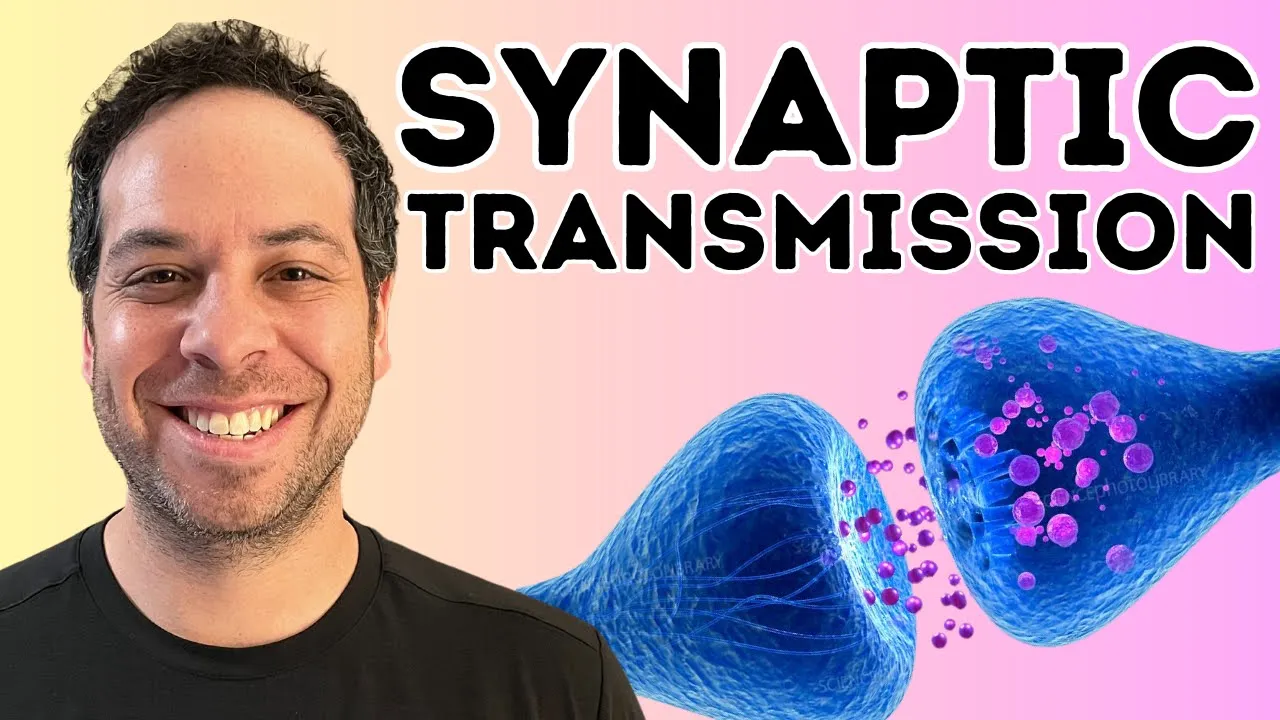






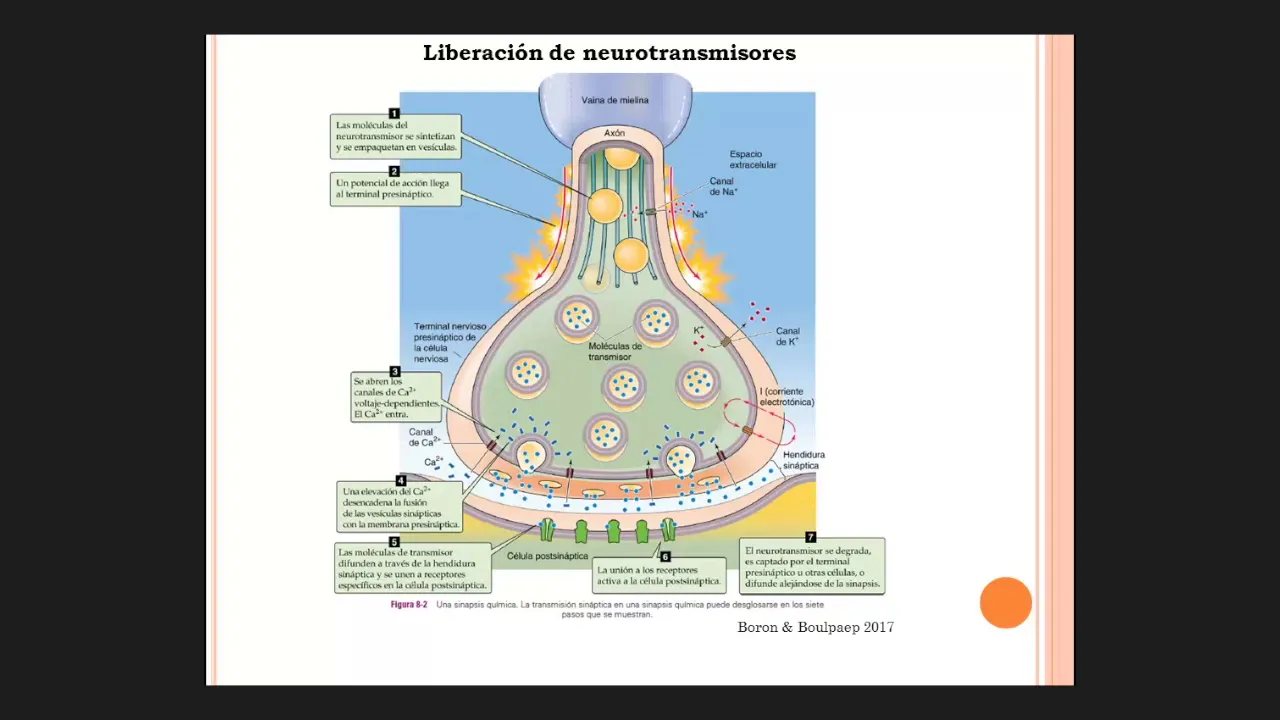




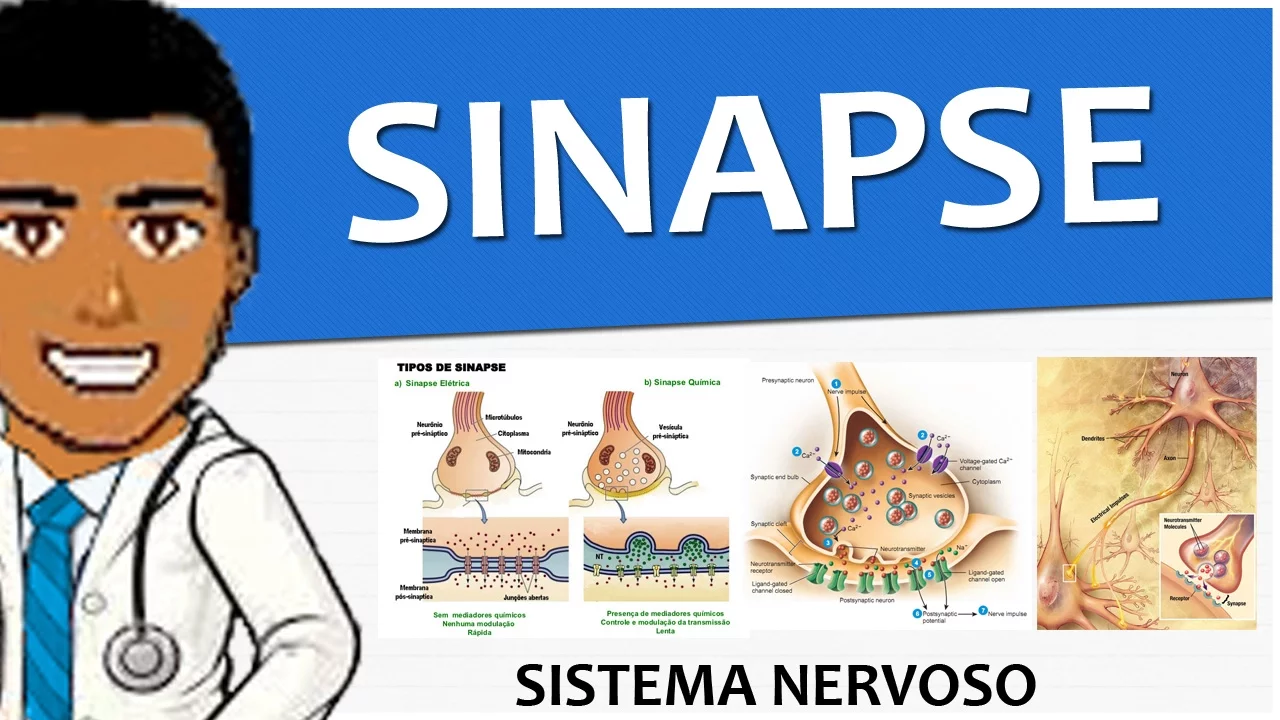










Neurotransmitter release at chemical synapses involves a rapid, calcium-dependent process where action potentials trigger voltage-gated calcium channels to increase intracellular calcium concentration, which then binds to synaptotagmin to drive vesicle fusion with the plasma membrane through the SNARE complex (composed of synaptobrevin, syntaxin, and SNAP-25), releasing neurotransmitter into the synaptic cleft; this entire process occurs within approximately 100 microseconds and is regulated by calcium influx levels, vesicle priming, and the stochastic nature of individual vesicle release.
Neurotransmitter Release: SNARE Complex & Exocytosis | Neuroscience
Added:Basic anatomy of a neuron and the structure of a chemical synapse, including the presynaptic terminal, synaptic cleft, and postsynaptic membrane.
The generation and propagation of an action potential, particularly how membrane depolarization reaches the axon terminal.
The function of voltage-gated calcium channels and the role of calcium ions (Ca2+) as intracellular messengers.
Fundamental cellular membrane dynamics, including the structure of lipid bilayers and basic principles of vesicle transport.
Postsynaptic receptor activation, exploring how neurotransmitter binding triggers graded potentials (EPSPs and IPSPs) via ionotropic and metabotropic receptors.
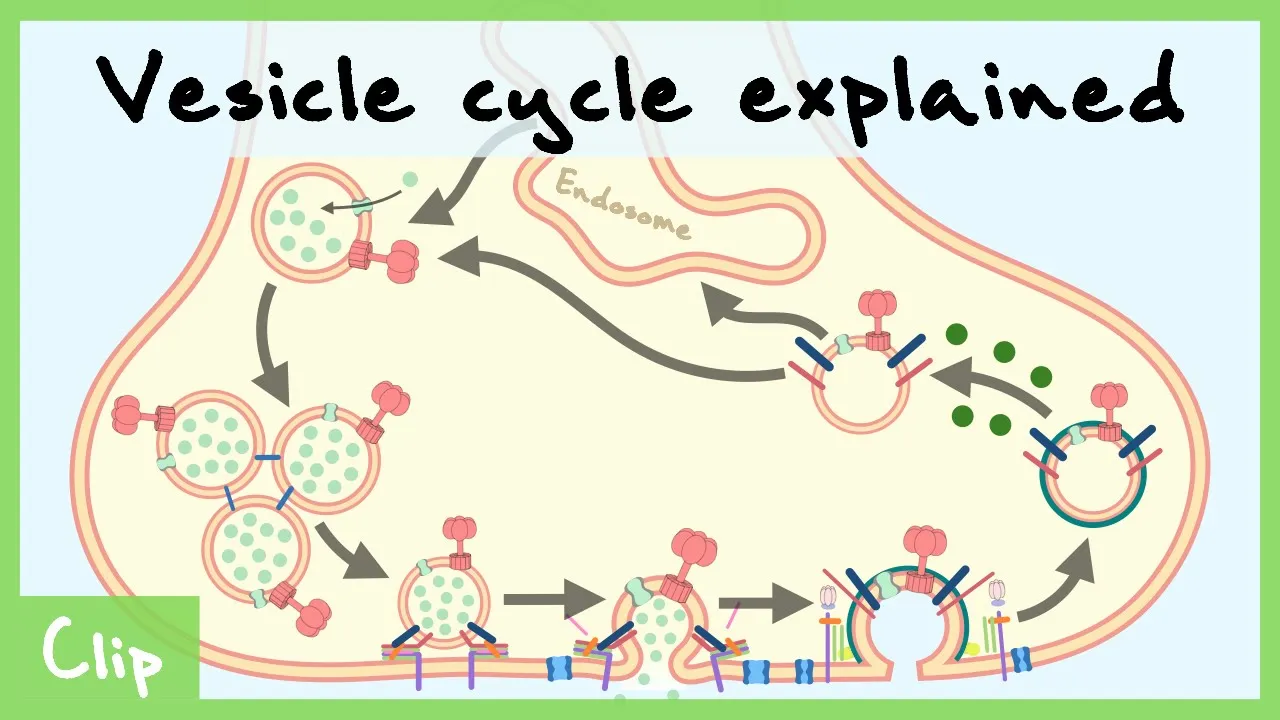
Synaptic vesicle recycling and endocytosis pathways, including clathrin-mediated endocytosis and the 'kiss-and-run' mechanism.
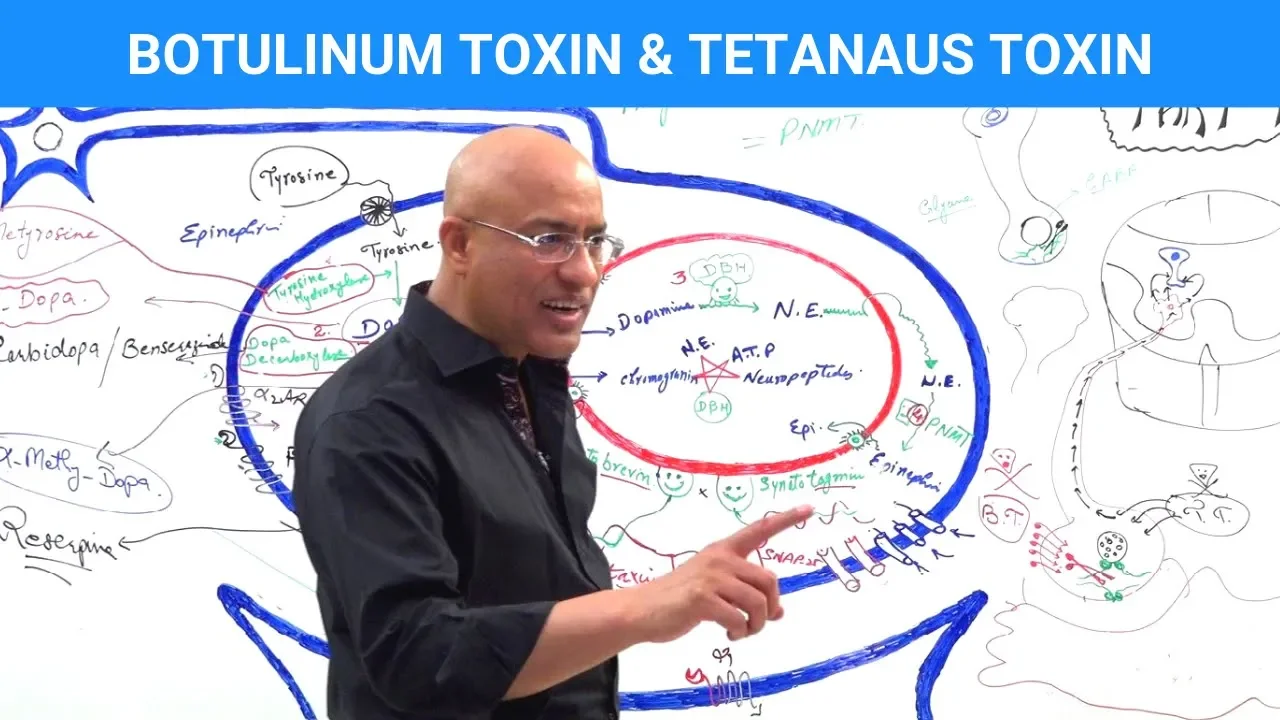
The clinical and pharmacological impact of neurotoxins, specifically how Botulinum (Botox) and Tetanus toxins cleave SNARE proteins to block neurotransmission.
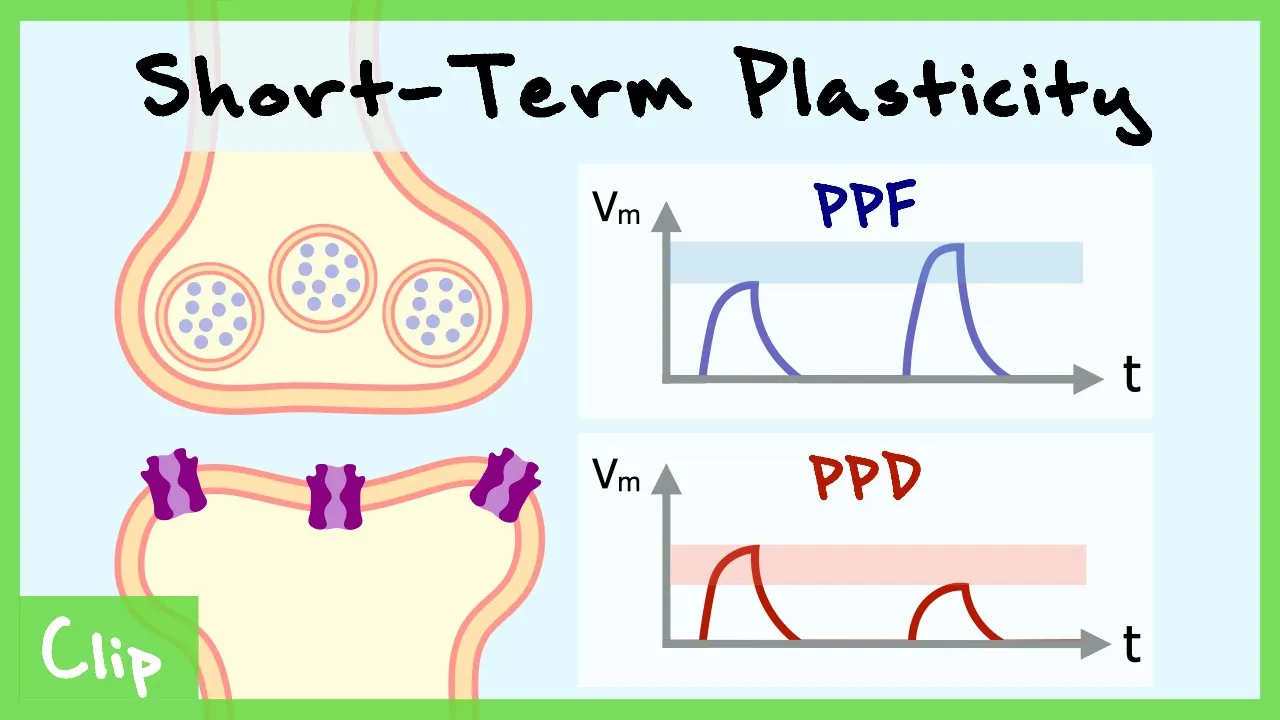
Presynaptic modulation and synaptic plasticity mechanisms, such as how changes in neurotransmitter release probability contribute to learning and memory (LTP and LTD).
9.2K views115likes21:37Original Release: 2016-02-05
In the last lesson we began to think about how neurons talk to each other through the process of chemical synaptic transmission.
An action potential is initiated at the axon initial segment.
It travels down the axon, reaches pre-synaptic specializations where calcium influx occurs, and that drives neurotransmitter release.
That, in turn, acts upon receptors in the post-synaptic membrane, driving post-synaptic potentials.
In this lesson we're going to take a closer look at what happens inside the pre-synaptic specialization.
How can the action potential drive neurotransmitter release on such a fast timescale.
There are three key events that need to take place in the pre-synaptic specialization: first, synaptic vesicles full of neurotransmitter need to dock and be primed to be release-ready in immediate apposition to the pre-synaptic plasma membrane.
The vesicle then waits until an action potential invades the terminal.
That, then, drives an increase in calcium concentration and then in the third step, the increase in calcium drives fusion of the vesicular membrane with the plasma membrane, thus driving exocytosis of the neurotransmitter inside the vesicle.
Let's begin by thinking about how calcium rises occur in the presynaptic bouton.
The action potential is traveling down the axon, it reaches swelling where there are many synaptic vesicles present.
In addition to these synaptic vesicles, there's also a high concentration of voltage-gated calcium channels.
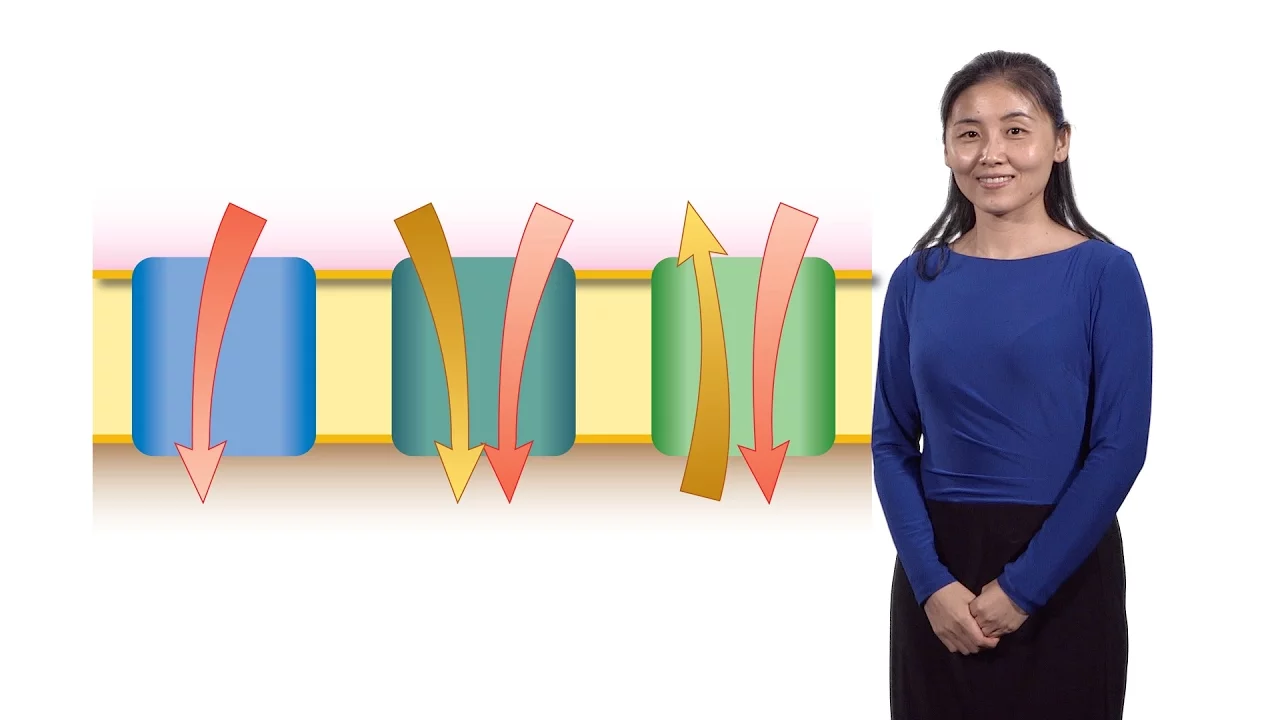
Voltage-gated calcium channels are similar to voltage-gated sodium and potassium channels, except they have a high permeability for calcium, rather than for any other cation.
The voltage-gated calcium channels also have a similar voltage dependence, so if this is our membrane potential across the plasma membrane and the bouton, and this is the open probability of a calcium channel, then at hyper-polarized potentials, the open probability is low, and then as we get more positive than around -40 mV the calcium channels begin to open and they can then let calcium flood into the cell.
Remember, there's about 2 millimolar of calcium in the extracellular space, and at resting conditions, there's about 100 nanomolar of free calcium ions that are present inside the cytosome.
So, there's a strong gradient for calcium to enter when the open probability of the calcium channel increases at depolarized potentials.
So let's see what happens when an action potential invades this pre-synaptic specialization?
Here we see the action potential in a nerve terminal it has a duration of something like 500 microseconds or one millisecond.
The upstroke, as we know, is driven by the activation of the voltage-gated sodium conductances.
The voltage-gated potassium conductances drive the repolarization and smaller than those sodium and potassium currents, also a calcium current is found in the presynaptic terminal.
It's not activated as rapidly as the extremely fast voltage-gated sodium conductances, so there's some delay before the calcium current turns on.
It turns out that the peak of the calcium current is somewhere on the falling phase of the action potential, so delayed some hundred microseconds or so from the peak and the onset of the action potential.
This influx of calcium, the calcium current flow through the voltage-gated calcium channels then increases the calcium concentration in the immediate vicinity of the synaptic vesicles, and it's that increase in calcium concentration that directly drives vesicle fusion.
It turns out that there's an extremely steep dependence upon calcium concentration and neurotransmitter release rates.
In this graph, which has logarithmic axes in both the X and Y scales, so it's a log-log plot, you see a very steep dependence upon the cytosomic calcium concentration inside the nerve terminal, and the release rate, the number of vesicles being released per millisecond.
You'll see that there's a range of calcium concentrations here that goes from one to ten micromolar.
This is a tenfold increase in calcium concentration, whereas on the Y axis, you'll see that the release rate increases by a factor of 10,000.
You can plot a line through data points, and it turns out that there's a nice linear relationship between calcium concentration and the vesicle release rate, and it has a slope of around four.
That's the so-called Hill coefficient, and that tells us that if there's a tenfold increase in calcium, then there's a ten to the power of four-fold increase in release rate.
Ten times calcium, 10,000-fold increased release rate.
Here's the relationship then.
The release rate goes as a fourth power of the cytosomic calcium concentration in the nerve terminal.
So increases in calcium irrespective of action potential or membrane potential drive neurotransmitter release at resting calcium concentrations of around 100 nanomolar, the release rate is very, very small.
It's nearly negligible.
There is still a small amount of vesicles that are fusing spontaneously, even at resting levels.
But that release rate increases very dramatically in the presence of calcium, so calcium is really the direct signal that drives vesicle fusion, and it does so in an extremely steep dependence where small increases in calcium cause huge changes in neurotransmitter release rates.
In order for the calcium to be able to work, there must be calcium-sensitive binding proteins that bind the calcium and translate that into the exocytosis of the synaptic vesicle.
In addition, for the process of exocytosis to occur on the 100 microsecond timescale, there must be an extremely efficient machinery that's able to couple the calcium signal to vesicle membrane fusion events.
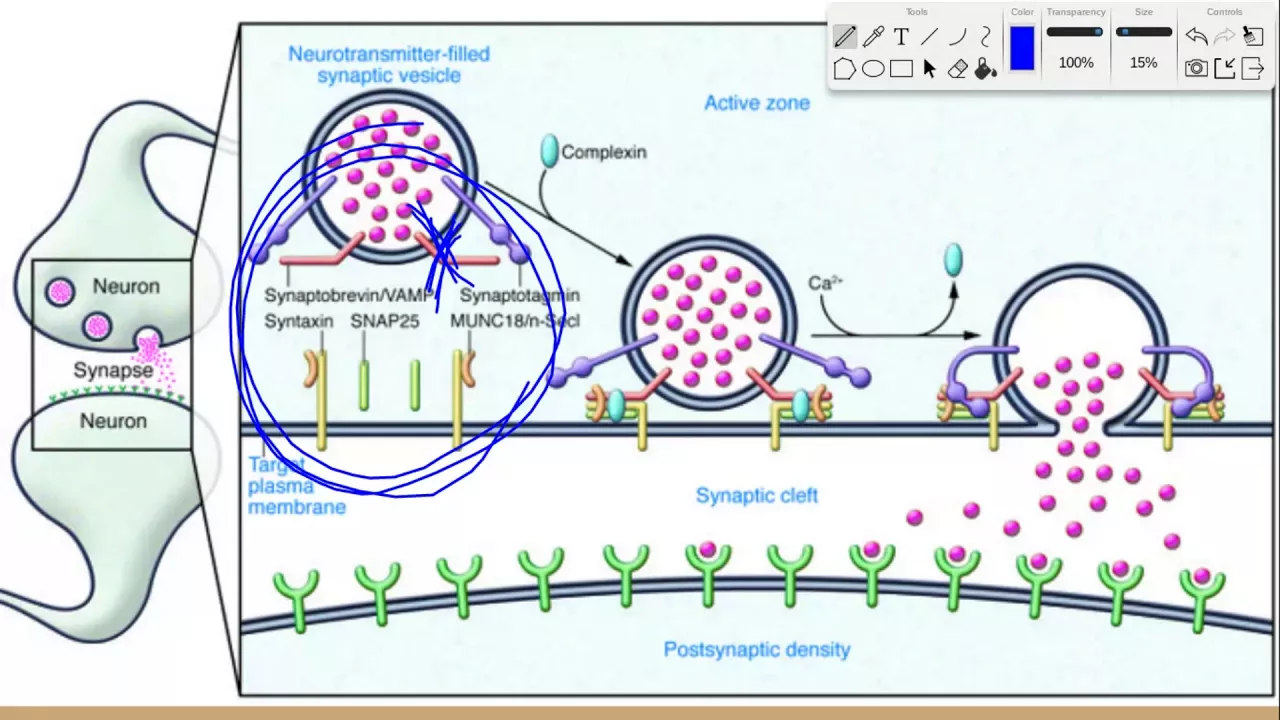
Here we see a schematic drawing of a synaptic vesicle that's in immediate apposition to the presynaptic plasma membrane.
So these two lines here represent the phospholipid bilayer of the plasma membrane and the two black lines here around the vesicle are the phospholipid bilayers of the synaptic vesicle.
The membrane of the synaptic vesicle is almost identical in terms of its composition to the membrane phospholipids of the plasma membrane.
The synaptic vesicle with a diameter of around 40 nanometers is brought into close apposition with the plasma membrane through the action of three important proteins that form the so-called SNARE complex.
The SNARE complex is composed of synaptobrevin which is a so-called vesicular SNARE; syntaxin, which is a plasma membrane SNARE; and SNAP-25 that's closely associated to syntaxin.
Through binding to each other with very strong strength, they pull the plasma membrane and the vesicle membrane into extremely close apposition with each other.
It may, in fact, be that there's already a pre-bound where the inner leaflet of the plasma membrane is already in continuum with the outer leaflet of the plasma membrane of the synaptic vesicle membrane.
So this would then be the release-competent primed vesicle ready to be released.
It's brought into close contact with the plasma membrane through the action of the SNARE complex, and it's waiting for an action potential to come.
The action potential invades, opens the voltage-gated calcium channel, calcium floods in, and calcium then binds to the calcium sensor synaptotagmin and other vesicle-associated protein.
Synaptotagmin has five binding sites for calcium and when calcium binds to it, it changes its conformation quite dramatically.
It changes the way it interacts with the SNARE proteins and perhaps also with the phospholipids in the immediate environment.
The action of calcium on synaptotagmin opens the fusion pore, and so, there's an opening that's created where the inner leaflet of the synaptic vesicle membrane becomes continuous with the outer leaflet of the plasma membrane, and that creates a pore where the contents of the synaptic vesicle are now in continuum with the extracellular space.
There's a diffusion of the vesicle of the neurotransmitter across the cleft, and it can then bind to the post-synaptic receptors driving post-synaptic potentials.
So the core elements in terms of molecular mechanisms of fusion are the priming and docking of the event setting up the vesicle through the SNARE protein so that it's release-competent, and synaptotagmin then acts as a calcium sensor that converts the action potential and calcium influx into the vesicle fusion event itself, and all of this occurs on the microsecond timescale.
After the neurotransmitter has been released from the synaptic vesicle, the synaptic vesicle is empty, and there's no neurotransmitter left in it.
Before that synaptic vesicle can be useful again in terms of releasing neurotransmitter, it must then be refilled.
The refilling process of synaptic vesicles occurs through an ATP dependent process.
A so-called vacuolar proton pump in ATPase uses ATP to pump protons, that is, charged hydrogen atoms, into the vesicle.
It then becomes acidic inside the synaptic vesicle, and it also becomes positively charged.
And so, just like there's a membrane potential across the plasma membrane, there's also a vesicular potential across the synaptic vesicle membrane, and it's a combination of the acidification and the electrical potential here that gives energy for the vesicular neurotransmitter transporters that then bring neurotransmitter inside the synaptic vesicle.
So, this is a glutamatergic synapse, there would be a vesicular glutamate transporter, VGlut present on on individual synaptic vesicles that then sucks glutamate in and concentrates glutamate inside the synaptic vesicle.
When the vesicle is refilled, it then needs to move it into these sites where it can be released.
It needs to interact with the SNARE complex.
The SNARE complex needs to bring the membranes into close apposition for each other and will then be ready for another action potential to invade, and release neurotransmitter.
There are various ways in which this synaptic vesicle cycle is thought to work.
One way is signaled here.
This is a so-called Kiss and Run exocytosis where there's a brief fusion event, a fusion pore opens, the contents are diffusing out, and the empty vesicle then closes, moves aside a little bit, maybe some nanometers away from the plasma membrane, refuels with neurotransmitter, and then re-docks.
That's called Kiss and Run exocytosis.
And as a possibility, there's so-called Kiss and Stay exocytosis where after the vesicle is fused, it simply reseals and remains docked and simply replenishes its neurotransmitter content while remaining in a docked conformation.
Finally, another possibility is that this fusion pore enlarges and the membrane gradually simply becomes part of the plasma membrane so the vesicle fuses completely and then becomes part of the plasma membrane from where it can then be endocytosed in a KLAF independent manner and then enter into the vesicle cycle.
The fastest forms of exocytosis and recycling are the so-called Kiss and Run and Kiss and Stay types of vesicle recycling which can occur on the 50 to 100 millisecond timescale.
And so, the whole process here might occur very rapidly and help sustain fast rates of neurotransmitter release if necessary.
So we've now seen some of the key steps that are able to sustain neurotransmitter release at these extremely fast rates of 100 microseconds or so between the invasion of the action potential into the bouton and the release of the neurotransmitter.
The key steps are the priming and docking of the vesicle so that it's ready to react in case of calcium concentration increases.
So, the SNARE complex forms a key feature in an ATP dependent process that brings the membranes of the synaptic vesicle and the presynaptic membrane into close apposition with each other.
The vesicle then waits there release-ready until a calcium signal appears that's driven through the activation of voltage-gated calcium channels driven by the voltage depolarization of the action potential as it invades the bouton.
The calcium binds that cell to synaptotagmin, and it's that change in conformation of the synaptotagmin protein that allows the vesicle to fuse with the plasma membrane releasing the neurotransmitter content.
Now, it should be remembered that the exocytosis, the release of a vesicle, is a stochastic process.
A given docked and release-ready vesicle may have something like a 10% chance of being released when an action potential invades the nerve terminal.
This means that synaptic transmission is unreliable, but it also means that the process can be highly regulated.
We can increase the efficacy of the synaptic transmission by, say, increasing the amount of calcium influx into the terminal or we can also decrease the amount of neurotransmitter release.
It's that ability to regulate synaptic transmission that's thought to be extremely important.
And so, in the next slides we'll take a little look at how one might regulate neurotransmitter release.
The first, and perhaps most obvious way in which we can control neurotransmitter release is by controlling the amount of calcium that enters into the nerve terminal.
You'll remember that we have an extremely steep dependence of calcium where if calcium goes from one to ten micromolar, then we go from release rates of 0.1 to 1,000 so a factor of 10,000 increase in calcium and typically during an action potential invading the nerve terminal, we think that we're reaching something like 10 micromolar of calcium.
So by increasing or decreasing the amount of calcium we can also increase or decrease the amount of neurotransmitter being released.
There's an extremely steep dependence that will go with the fourth power of calcium.
So small changes in calcium can give rise to very big changes in the amount released from the presynaptic terminal.
So how do we change the amount of calcium that comes into the presynaptic terminal?
Well, there are two obvious ways.
We can change the action potential waveform.
So if the typical action potential has a duration of 500 microseconds, the calcium influx occurs during the repolarization and by the time the membrane potential is hyperpolarized, the calcium influx has come to an end.
So, by increasing the duration of the action potential we can then increase the amount of calcium influx that occurs, and thus, we increase the amount of neurotransmitter release.
That can be done by regulating potassium channels.
So potassium channels govern the repolarization phase of the action potential, and if we simply reduce the amount of potassium current, then we'll delay the action potential waveform and we'll increase calcium influx into the presynaptic terminal, and hence, increase neurotransmitter release.
That's one way in which neurotransmitter release is really being regulated physiologically.
Another obvious way is by acting on the pre-synaptic calcium channels themselves.
Increasing the open probability or increasing the voltage dependence of these calcium channels will, of course, increase the amount of calcium that floods into the pre-synaptic membrane, and that's another way that's used heavily inside the nervous system to regulate neurotransmitter release.
Other possibilities in terms of regulating neurotransmitter release are, of course, how much neurotransmitter is actually inside a synaptic vesicle.
That's controlled in part by the proton pumps that give rise to the gradients that drive the uptake of the neurotransmitter into the synaptic vesicle, and so, you can change the efficacy of the proton pumping or the efficacy of the neurotransmitter transporters.
Both of those are used to some extent to regulate neurotransmitter content inside synaptic vesicles.
And although synaptic vesicles typically have a size of something like 40 nanometers, there's also some variance.
So there are some bigger vesicles and some smaller vesicles, so that's another way in which one can control the amount of neurotransmitter that's being released.
Presumably, a big vesicle would have more neurotransmitter content than a small vesicle.
Another key way in which one can release different amounts of neurotransmitter is by controlling the amount of vesicles that are being released in response to calcium.
So the complex machinery associated with the docked synaptic vesicle here and the calcium channel can then change its composition in terms of what proteins are present, what isoforms, there are many different isoforms of these different proteins, so for example, synaptotagmin has something like 15 different genes that code for it and they're expressed differentially at different synapses.
Equally, there can be phophorilation events, so that can change the structure of these different proteins, and maybe even the physical arrangement, whether the calcium channels are close to the synaptic vesicles or far away can make a big difference to whether the calcium is likely to drive a lot of neurotransmitter release or whether the probability will rather be lower.
So we can change the release probability and its sensitivity, of course, to calcium and that's a key way in which neurotransmitter release is regulated physiologically.
Equally, of course, it's possible to change the number of vesicles that are present on the pre-synaptic specialization.
So if we only have one vesicle that's there and it has a 10% chance of being released when an action potential invades, we can also put in more synaptic vesicles.
We can simply dock more and more synaptic vesicles, put them close to calcium channels, and each one of these might then have a 10% chance of being released in response to an action potential, and clearly, the more vesicles we have that are in the release-ready state, the more likely we are to get neurotransmitter release, and large amounts of it, when an action potential invades the presynaptic terminal.
So we've now seen the key events responsible for coupling an action potential to neurotransmitter release.
The depolarization of the bouton causes the activation of voltage-gated calcium channels on the timescale of 100 microseconds or so from action potential invasion, calcium rises in the immediate vicinity of the synaptic vesicles that are release-ready and competent.
The calcium binds to synaptotagmin, five calcium ions bind to a synaptotagmin molecule, high affinity, and they then drive the fusion of synaptic vesicle membrane with the pre-synaptic membrane.
The whole process involves some 50 or so proteins, all of which play an important role in synaptic release.
They can be regulated in a large number of interesting ways that are physiologically important.
In the next few lessons we'll consider in more detail how the neurotransmitter release is regulated by the action of other neurotransmitters acting on the nerve terminal, and also by their recent history of action potential firing in that nerve terminal.
Up Next

7:40
G Protein-Coupled Receptor Signaling: GPCR Mechanism Explained
@animatedbiologywitharpan
97K views•2016-03-24

50:12
Bacterial Communication: Quorum Sensing and Biofilm Formation Explained
@JHUAAP
12.6K views•2011-06-28

5:35
Enteric Nervous System Explained: The Gut's Brain | Neurobiology Lecture
@alumniu6029
438 views•2018-09-12

7:08
Bacteriophages: Earth's Deadliest Killers and Future Antibiotics
@kurzgesagt
34.6M views•2018-05-13
Related Study Plans & Knowledge Roadmaps
Structured learning paths in Biology
biology
RNAi: Biogenesis, RISC & Gene Silencing
01Molecular Biology Foundations: DNA to Protein
02Introduction to RNA Interference (RNAi)
03Molecular Biogenesis of miRNA and siRNA
+ 2 more learning modules
10h5 modules
Explore Roadmap
biology
Mycorrhizae: Signaling, Biophysics & Ecology
01Foundations of Mycorrhizal Symbiosis
02Molecular Signaling and Root Colonization
03Biophysics and Bioenergetics of Nutrient Exchange
+ 1 more learning modules
11h4 modules
Explore Roadmap
biology
Circadian Clocks: TTFL, SCN & Periphery
01Foundations of Molecular Biology & Gene Expression
02Introduction to Chronobiology and Actograms
03The Core TTFL: Molecular Architecture of the Clock
+ 3 more learning modules
14h6 modules
Explore Roadmap
biology
Population Genetics: Math, Drift & Selection
01Genetic & Probability Foundations
02The Hardy-Weinberg Principle and Baseline Models
03Mathematical Modeling of Natural Selection
+ 3 more learning modules
18h6 modules
Explore Roadmap