




















In India, taxation is divided into direct taxes (levied on income and wealth, including personal income tax, corporate income tax, and wealth tax) and indirect taxes (levied on commodities and services, including custom duty, excise duty, and service tax). The union government levies taxes like corporate income tax, service tax, and custom duty, while state governments levy taxes like sales tax, professional tax, and land revenue. The 14th Finance Commission recommendations increased the fiscal space available to states from 32% to 42% of union tax revenues, reflecting the federal structure of India's tax system.
Indian Taxation Structure: Direct vs Indirect, Union vs State | Explained
Added:Basic understanding of the Indian federal system, specifically the constitutional division of powers between the Union and State governments.
Fundamental concepts of public finance, including how governments generate revenue and the definition of a tax.
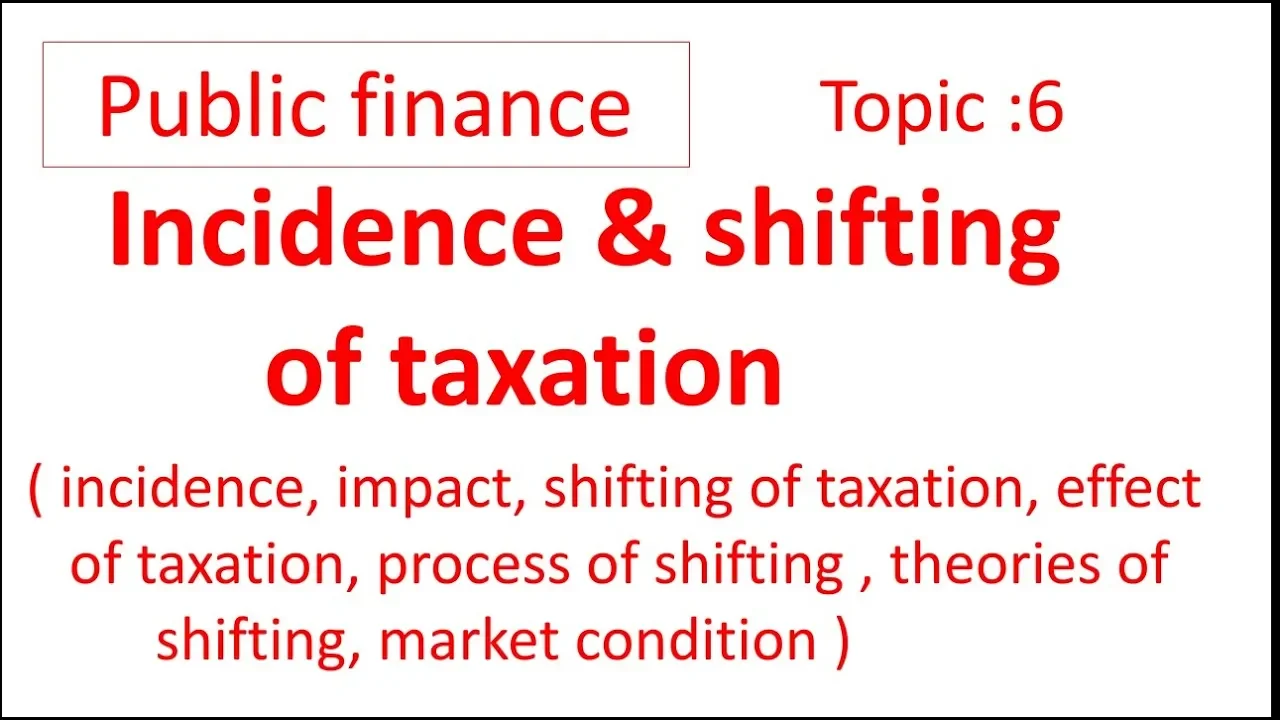
The economic concepts of tax incidence (who bears the ultimate burden) and tax impact (on whom the tax is legally imposed).
An introductory awareness of fiscal policy and its role in a country's economic development.
An in-depth study of the Goods and Services Tax (GST) mechanism, including GST slabs, the GST Council, and its impact on federal relations.
The role of the Finance Commission of India in determining the devolution of tax revenues between the Centre and the States.
Advanced fiscal policy concepts, such as tax-to-GDP ratio, fiscal drag, and the relationship between taxation and the fiscal deficit.
Current direct tax reforms, including the proposed Direct Tax Code (DTC), faceless assessment, and corporate tax rate adjustments.
International taxation challenges for India, such as Base Erosion and Profit Shifting (BEPS), Double Tax Avoidance Agreements (DTAAs), and the equalization levy.
28.8K views479likes1:34:36Original Release: 2017-02-05
So welcome back. So in the next lecture of public finance, in the previous lecture of public finance under the budget we discussed uh the types of budget we discuss zerobased budgeting, then performance budgeting and then outcome based budgeting, gender budgeting. Then afterwards we discussed the budget of the states and then we discussed how the plan versus non-plan revenue versus capital and development versus non-development expenditure. So all these things we have already discussed.
So the next topic under public finance will be taxation. This is one of the most confusing as well as one of the most technical topic from the perspective of exam because taxation is always a little bit of confusing one because most of us most of you are not from economics background. So in that case students sometimes they have phobia with this taxation. What is corporate income tax? What is personal income tax? What is sajge? What is c? What is excise duty? duties, custom duty, all these things. So I tried to frame this unit in a conceptual manner. I related few concepts like what is direct tax, what is indirect tax, what is the tax divided by union government, what is that are the taxes divided by the state government and then because sometimes in exam the question comes which of the following taxes are divided by union government and sometimes it comes which of the following taxes they they are direct taxes they're indirect taxes or something. So try to club together these things. But before coming to this topic first let me tell you let's discuss some few definitions which are related to taxation. So first of all I want to discuss what is tax. So tax is nothing but it is a compulsory amount of money which you have to give to the government without any quid procure.
Quid proQure means nothing in return.
You are paying something to the government. Suppose your income is 10 lakh rupees. You have to pay certain amount of personal income tax to the government. But you don't you can't expect that that 10 lakh rupees should be invested by the government maybe to make some road or maybe to make some power project or some other project. You cannot dictate these terms to the government. So taxation is nothing but it is a compulsory payment to the government without any quid procure.
This is what we have taxation and next class we will discuss the different different types of articles which are related to taxation and the fiscal federalism chapter we are going to discuss the different type of taxes center state finance relations we have which starts from article 265. So the definition of taxation is defined in article 265 which also says no taxation without representation or in other words there cannot be any tax which can be divide without the authority of law. So if the parliament decides or if the state government decides they can divide some taxes but arbitrariness should not be there while you are paying the taxes. So it should be only be decided by the authority of law. So this is what we have the definition of taxation. Then we have few related definitions like what is fiscal marksmanship. Often in the newspaper these terms come the fiscal space of union government has decreased.
There is a consolidation phase being started by the union government. So first we'll discuss what is fiscal marksmanship. Marksmanship is nothing but what is the target that you have decided. Suppose in the budget we decide that for next financial year our revenue deficit will be this much. Our budget deficit will be this much. The details of these individual targets will be discussed in that contemporary units.
The last two or three units of this economics under which we will cover the budget of 201617 and the economic survey of 201617. There we will discuss the specific targets. But suppose the fiscal deficit target of 2016 and 17 is 3.5%. And once this 2016 and 17 will be finished then you have to evaluate it whether you were whether the government or we were able to achieve this 3.5%. Or we have achieved more than 3.5 or less than 3.5%. So whatever targets we have set if we are able to fulfill these targets then our marksmanship is good and if we are not able to fulfill our targets it means our marksmanship is bad. So fiscal marksmanship means whatever the targets or the objectives set by the government. If the government is able to achieve these targets then the fiscal marksmanship of the government is good. Otherwise the fiscal marksmanship of the government is not good. This is what the marksmanship means. Then we have the fiscal consolidation.
The fiscal consolidation means we have already discussed that there is a fiscal deficit in India and that fiscal deficit is roughly equivalent to last year it was 3.9% or in uh actual terms it was roughly 5 lakh crores roughly it is five lakh cr so five lakh cr we have to borrow fiscal consolidation means you have to consolidate something. Consolidate what?
You have to consolidate your expenditure. If my expenditure is more and my received is less then the option is I have to borrow from the market and fiscal consolidation means you have to rationalize your expenditure. So consolidation means nothing but you have to decrease your expenditure. Now how you can decrease it? So the means the tools which the government is going to adopt to implement this fiscal consolidation can be different. For example during UPA time the government decided that no government meetings will be held in fivestar hotels. So through that by not allowing the bureaucrats and the politicians to do to take their meetings in a five-star hotel the government has decreased the expenditure. So these are the tools through which the government can achieve this fiscal consolidation. But consolidation in simple words means the government should decrease or rationalize their expenditure. This is what the fiscal consolidation means.
Then we have the fiscal space. Fiscal space. Space means suppose this is uh the money being collected by union government. For example, the total tax collected by union government is 15 lakh crores. But out of this 15 lakh cr, the union government has to pay 5 lakh cr to the states. Now before the recommendations of 14th finance commission, it was only 32% of this 15 lakh cr which the government was supposed to devolve to the states. Once the recommendations of 14th finance commission has been accepted now it is 42%. Maybe in next lecture or next to next lecture we'll discuss the recommendations of 14th finance commission. So once the recommendations of 14 finance commission has been accepted now the fiscal space available with the union government has decreased and the fiscal space available with the states it has increased. So space is nothing but the amount of money the amount of tax which is available with that particular government. So this is what we have the fiscal space. So it in the newspaper it often comes that by accepting the recommendations of the finance commission the fiscal space available with the union government has decreased. So this is what we have fiscal space means and then we have one more term that is known as bancy.
Usually it comes in the newspaper that this tax is bind this tax is not biant. By means a tax will be regarded can be regarded as biant if the increase in GDP is 1%.
leads to increase in the tax by more than 1%. Then only we will say that this particular tax is binding. In other words, it means when I'm saying the GDP is increasing, so when the GDP will increase, what is GDP? GDP is nothing but the money value of all the goods and services produced in any economy in one financial year. Suppose this is India and in in in this India we are producing one lakh items one lakh items which includes maybe this 50 pen 50 markers 50 registers 50 tables and all these things 50 laptops. So after adding all these items it makes one lakh items. So whatever is the money value of all these items which are being produced in this economy in one financial year that is known as the GDP. when I'm saying the GDP is increasing. So when the GDP is increasing, so the money available with the public is increasing as well as the tax of the government is also increasing because if your income increases maybe from five lakhs to 10 lakhs because the GDP is increasing. So it means the money is increasing. So somebody is getting more money. So suppose your income increases from five lakh rupees to 10 lakh rupees. So now you have to pay more tax to the government. So the personal income tax will be binded in this case.
So bansancy means if the increase in GDP is 1% if that particular tax collection is more than 1% then that tax is known as bind. Uh I want to take some example for example we'll discuss in detail in this p up to 2.5 lakh rupees you don't have to pay any tax. So suppose your income is 5 lakh rupees on this five lakh rupees up to 2.5 you don't have to pay any tax for rest of the 2.5 lak rupees you have to pay tax at the rate of 10%. So 25,000 rupees is your tax liability but suppose the GDP increases and your income becomes 10 lakh rupees.
So now up to five lakh rupees you have to pay this 25,000 and for rest of the remaining the increased five lakh rupees that comes to slab number two details we'll discuss here. So now this will come under slab two and here you have to pay 20% of five lakhs which equals to 1 lakh rupees. So now your tax liability becomes 1 lak 25,000 rupees. So if the increase in GDP is by 1% the increase in tax collection of the government is more than 1%. So this is known as bind taxes. This is known as the tax binance. These are the few definitions which are related to taxation. Next we have different different types of taxes. We can classify the taxes on the basis of different different things. First classification is on the basis of tax rates.
So on the basis of tax rates we can classify taxes into progressive then we can have proportional regressive and degressive. So this is the first classification. This is the first type of tax and this classification is on the basis of tax rates. So first progressive tax. So progressive tax is nothing but when your income increases. Suppose this is what your net income and this is the tax rate. So when your income increases the tax rate increases. This is known as progressive tax.
So the progressive tax is based on the ability to pay. When your income is increasing, your ability to pay taxes is increasing because now you have more money in your hand. So this progressive taxes they based on the ability to pay.
So when your income is going to increase the tax rate is going to increase. For example, up to 5 lakh rupees it is just 10%, in case of personal income tax.
Then five lakh to 10 lakh rupees it is 20%. And about 10 lakh rupees it is 30%.
So this the example of progressive tax is personal income tax and these progressive taxes are good because they decreases the vertical and horizontal inequality. Suppose one person is having the salary of 1 cr rupees and second person is having the salary of 10 lak rupees. So both should not pay same amount of tax because this person whose salary is 1 cr rupees is having more ability to pay. So the government should charge more tax from this 1 cr and less tax from a person whose salary is 10 lak rupees. And if more tax will be charged from this guy and less tax will be charged from this guy, the horizontal equality inequality sorry the horizontal inequality across the society will decrease. So progressive taxes are good for any economy. Then after this progressive taxes, next we have is proportional tax.
Proportional tax means the tax is fixed.
It is a certain percentage of your income. The example is corporate income tax. So corporate income tax is fixed for Indian firms it is 30% for example.
So whatever your income is for example we have a big company like Infosys and we can have a small MSME a small company is there and suppose the profit of Infosys is 5,000 K and the profit of this MSME is just 10 cr but both have to pay 30% of their profit that means proportional tax is certain is is the certain specified proportion portion of your income. So this type of tax or the proportional tax does not quantify the horizontal inequality of the society. But the pro um progressive tax it decreases the horizontal inequality. So the graph of proportional tax will be suppose this is income and this is tax rate. So whether it will be parall to x ais or parall to yaxis obviously it will be parall to x-axis it will be like this fixed 30% is the tax rate whatever your income is the tax rate is fixed that is 30% in case of Indian firms then we have the regressive taxes so regressive word is having two meanings first is it is a type of tax and second one is a general word which means regressive So regressive is just the opposite of progressive which says if your income increases the tax rate decreases. So it will be like this. Can you tell me any example of regressive tax in the present society?
So as such there is no example of any regressive tax because it's not possible. It is as if like a poor person whose income is just 2 lak rupees has to pay 70% tax and a rich folk having salary of 20 cr rupees has to pay just 10% of tax. So it is not possible. Before French revolution very similar type of text was there in France but now in the present day society on the present century there is no such text like regressive tax but yeah we can say few taxes are regressive that regressive is different the meaning of regressive is which affects the poor most indirect taxes are there we'll discuss later on let's suppose everybody I want to buy this marker so there can be two customers a person whose income is 2 lakh rupees and a person whose income is 20 K rupees. So both have to pay the same amount of indirect tax the same excise duty they have to pay. That is why we say the indirect taxes are regressive because for a person whose income is 20 K rupees maybe if the government increase the tax from 10 rupees to 20 rupees. So 10 to 20 is not a problem for this person but maybe this increase of excise duty from 10 rupees to 20 rupees can be a problem for person A. So that is why we say indirect taxes are regressive. But indirect taxes are not example of regressive taxes. Make this thing very clear in your mind that the this as per this classification there is no example of any regressive taxes in present day society. Then the last one last type of tax on the basis of tax rate is degressive taxes. So degressive is nothing but it is a type of progressive tax only under which the tax rate increases up to a certain level and then it becomes constant. This is very much the example of personal income tax where when it is 10% then it is 20% and at 30% of tax rate it becomes constant. So it means if your income is 20 lakhs or 30 lakhs or 40 lakhs or 50 60 whatever your income is after this slab of 30% it is constant. So such type of taxes they are regarded as degressive taxes. So personal income tax is an example of degressive tax. So this is what the first classification of the taxes.
Now the second classification of taxes is on the basis of shifting of tax burden. So most of you must have heard this direct and indirect taxes. So on the basis of shifting of text burden. Shifting of text burden means the impact and incidence of tax.
Impact means point or a person to whom this text has been applicable and the incidence means the final burden. Let's discuss this thing with an example. Suppose your income is 5 lak rupees. So you have to pay some tax to the government. You cannot tell your friend that my income is five lakh rupees. Please pay some tax to the government on this my income of 5 lakh rupees. The impact the tax is being p should be paid or it is the point of uh impact is a only and the incidence the final burden has to be bound by a only it cannot be shifted. But this is not the case in case of indirect taxes.
In case of indirect excesses for example it is excise duty. So what excise duty means? We'll discuss in detail here.
Excise duty is nothing but whatever you are producing whatever is being produced in any country. So on that production only you have to pay some tax. So whenever a company is this gambling is making this pen so they have to pay some tax to the government but whatever tax they are paying suppose the price of the raw material will be involved this plastic ink and all so suppose the price of raw material is 15 rupees now excise duty they have to pay and the excise duty is 10 rupees then sales tax and all this thing forget about that so it becomes 25 rupees so this 10 rupees is the impact of this tax is on this company who is making this pen this Camden company but the burden will be for the burden of this tax will be born by the person A who is going to purchase this particular marker because the MRP will be MRP includes the price of the raw material as well as the commissions omissions as well as the tax. So the impact of this tax is on this company but the incidence the final burden is being born by this person A.
But in case of direct taxes it is not possible because in case of direct taxes the impact and incidence is on the same person. If your income is 5 lakh rupees you have to pay this tax. If this company's income is 10 lakh rupees so this company has to pay this tax on this thing. So this is what the definition of direct taxes and indirect taxes. In case of direct taxes the impact and incidence is on the same person and in case of indirect taxes the impact and incidence may be or may not be same. So it can be shifted.
The simple definition of direct taxes is nothing but it is on the income and expenditure of individuals and firms and the indirect access is it is on the sale and purchase of commodities.
ities and services. So whatever the total income of anybody or the total expenditure. So the example of expenditure we'll discuss under this fringe benefit tax or dividend distribution tax. Suppose I'm a company whatever is my income. Suppose the income of a company is 10 cr rupees.
So on that income I have to pay some tax. So direct tax is there on the income or expenditure of individuals or firms and in case of indirect taxes it is on the sale or sale purchase or we can say production and distribution. It is on the production and distribution of commodities and services. So indirect taxes they are being required on production you are making this pen. So while you are producing this pen you have to pay some tax that is known as excise duty or on the distribution stage. So while distributing you have to pay some sales tax and all these things. So that is what we have the indirect taxes. And the next one is here we can see it is based on the ability to pay. So it means direct taxes are progressive in nature and indirect taxes because everybody has to bond the same tax. If the excise duty is 10 rupees on this particular pen. So everybody whether your income is 5 lak rupees or 50 lak rupees or 50 cr rupees you have to pay same 10 rupees while you are buying this particular pen. So indirect taxes they does not distinguish between rich and poor. Everybody has to bond the same amount of burden. That is why indirect taxes they are regarded as regressive in nature. Sometimes in the newspaper it comes that indirect taxes are regressive taxes. So that does not means indirect taxes qualifies into the example of regressive taxes. No. And in present society no example of regressive taxes. Indirect taxes are only regressive in nature not an example of regressive taxes. In in detail we'll discuss this direct and indirect taxes here. Then we have the imposition on the basis of imposition of indirect taxes. Again we classify the taxes into two parts. adorum taxes and specific tax. Under this advorum taxes and specific taxes, it is based on the certain percentage of output.
Suppose you visited any restaurant and in that restaurant if you have consumed food of 1,000 rupees or if you have consumed a food of 5,000 rupees you have to pay the amount of tax the service tax that will be certain percentage of the final output.
It means for example the service tax is 15%. So in this case you have to pay 150 rupees and in this case you have to pay 750 rupees because service tax is an example of ad bollum tax. So this adorum taxes are nothing but which are based on the certain percentage of the output value. It means the tax is not fixed. In case of this specific tax they are based on certain criteria.
Criteria like what? Criteria like size, criteria like volume or the criteria can be different.
For example, usually in the case of vehicles, car also we have if the length of the car is 4 m, the tax applicable will be like this. If the length of the car is this much, the tax applicable will be like this. Similarly in case of cigarettes also if the length of the cigarette is this much tax applicable is this much. If the length of the cigarette is this much the tax applicable will be different. So on a specified criteria you have to pay different different taxes. So whatever will be the price of the raw material of this cigarette or of this car the tax will be same. Suppose the raw material of this this is a cigarette of one company and this is cigarette of second company. If the price of raw material is suppose 50 rupees and in this case the price of raw material is 100 rupees but both these companies they have to pay same amount of tax because the tax is being led on a specific criteria and that criteria is the length. But had these taxes on cigarettes be example of adalorum taxes.
So under this thing it is based on the percentage of the output. So in that case the output price is on 50 rupees.
In this case it is 100 rupees. So the tax liability would have been different.
But in case of specific taxes it is based on a certain criteria. The specific tax a very famous example of specific taxes it is on the patrol and diesel.
Because suppose in the international market now petrol and diesel they are not only an economic commodity they are also a political commodity at least in case of India because if the prices of petrol and diesel they are they are increasing in the international market.
So the government tax collection will increase if the taxes on petroleum and diesel are based on this percentage of the output. So suppose in the international market the price of one liter of petrol is 50 rupees and the government is buying a tax that is based on 20% of 50. So the final price is 60 rupees.
Suppose in international market the price is increased to 90 and now you have to pay 20% of 90. So the final price the tax collection by the government has increased. Earlier it was 10 rupees now it is 18 rupees. So in that case the final price will be more will be very high. So to to resolve such problems the government has decided that the taxes on petrol and diesel will be specific tax only because in this case if the price becomes 90. So there is an option to the government that they can make their this type of tax to zero because it is a specific tax. The tax is not dependent on the output the value of the output. So this is the advarum tax and specific tax. Very famous example of specific tax is specific tax on the petroleum and diesel motor spirits.
Then the next classification is tax on text. Ideally from economics perspective this classification divides into searchcharge and cess. But the government has modified the usage of cess from text on text to some other thing. Tax on tax means there these two things are common.
It means suppose the corporate income tax is 30%. So on this 30% you have to pay this search charge assess for example the government says that you have to pay a search charge of 5%. So 5% of 30%.
which equals to 1.5%. So 30 + 1.5 it makes 31.5%. And now on this 31.5% you have to pay this S. It means both are tax on tax. The search charge you are relying on this tax only. That tax is 30%. S also you are relying on this tax only.
So ideally sir charge and c both are tax on tax but recently the government has changed the s we'll discuss later on but the first common thing is both are tax on tax. So both are tax on tax what is the difference? The difference is s is for a specified purpose.
Whatever the purpose has been defined for example we have education says 3%.
So underate education says of 3%.
Primary education is 2% and middle and upper education is 1%. So the government cannot use this 3% for anything else but education only.
So CAG ensures that whatever money you are collecting CAG will do the audit and they ensures they ensures that this 3% cannot be utilized for any other purpose but education. For example in this budget the government introduced Krishi Kalyan says so that Kishi kalyan says can be used only for agriculture or that swatch bharat says of.5%. So that can be used only for the purpose of clean India or swatch bar. But in case of searchcharge no such purpose is attached. So government will collect the money and government will use wherever the union government wants to use it. So this is not for specified purpose. The next difference is or the next common thing is both are not shared with the state government. On the recommendations of finance commission you have to devolve certain amount of funds with the states but this searchcharge in says they are not a part of this devolution. So both are being kept with the union government only. That is why this is also some critics they are saying that ideally this searchcharge yourself there for a shorter duration of time because if you want to improve the education maybe for 10 years 15 years it should not be like the C is continued from last 30 years 40 years 50 years so whatever is the purpose once that purpose has been achieved it should be abolished but because there's a personal stake of the union government because they don't have to share this tax with the state government that increases the fiscal space of the union government. That is why uh the Union government is not proactive to abolish this search charge as well as SES. On the other hand, they are increasing the type of CIS and the type of searchcharge. The search charge and SES not being shared with the states by the union government. Then where this search charge goes? The search charge goes to consolidated fund of India.
We discussed under the budget that we have three types of account being maintained by the union government.
Consolidated fund of India, then we have the public account fund of India and third one we have is the contingency fund of India. So searchchar directly goes to CF CFI. But in case of SE it is outside consolidated fund of India. So a separate fund will be there for education. So CES will go to that particular specific fund. So it means automatically we also discussed that lapsible and non-lapsible fund. So suppose a fund you have created for education purpose by using this. So it will not be lapsed next year automatically it will be carry forward.
So suppose in this year the total six excesses collection is 500 K rupees and you are not able to utilize this 500 K rupees. So whatever the remaining funds maybe 50 Ks they will be automatically transferred to the next year. So SES is being maintained outside the consolidated fund of India. A separate fund will be there and for a specific purpose only you can use that CIS and in the constitution search charge is mentioned in article 271 there's no specific mentioning of cess in the constitution but ces derives its power from article 270 but as such like search charge nowhere cess is directly mentioned but searchcharge is directly mentioned under article 271 where it is written to temporary ly increase the tax revenue of the government. The government can live by this search charge. So this is what we have search charge and cess. But recently the government has changed the concept of ces. It's like in case of service tax we'll discuss that service tax at present is 14%.
So ideally the sess should be on this 14% maybe 5% of 14% 10% or 14% but no the government has directly said on this search charge uh on this service tax there will be 0.5% of switches it means it is not tax on text it is a direct value plus from this year a krish Kalyan S will be applicable. So it means the government has modified the economic concept of SE. Now they are directly putting it 0.5% 0.5% 1% 2% whatever it is. Ideally the S should be maybe 5% of 14% or 10% of 14%. Because the SE is tax on tax but now the government has modified it. So this is what we have the search charge in SES.
Next we'll discuss union taxes and states taxes being divided by states as well as we'll discuss what is direct tax and different different direct taxes that we have. So these are the taxes. So taxes can be divided by union government and taxes can be led by the state government. So whatever is mentioned in this red ink is known as direct tax.
Whatever is mentioned in this red ink is also an example of direct tax. Now direct taxes can be led by union government like this or direct taxes can be led by the state government. But where it is mentioned somewhere it should be mentioned that corporate income tax will be led by union government. Otherwise maybe from tomorrow the states can say that suppose this company Maroti has set up a new base in Gujarat. So now they have to pay tax to Gujarat government. So in the constitution itself it is mentioned under that schedule 7 we have three list union list and concurrent list. So in that schedule 7 itself it is mentioned under that list in list one it is mentioned that following items will be taxed by union government. Under schedule two it is mentioned following taxes will be led by the state government and because the residary power is left with the union government. So suppose something was not mentioned in the constitution while framing the constitution the constitution makers they were not able to foresee that maybe in future after 50 years 60 years there can be some more type of tax which can come now because residary power rest with the parliament or the union government. So residuary tax are being led by the union government. The perfect example is service tax. We'll discuss later. So under this union government taxes we have direct taxes mentioned here and indirect taxes mentioned here.
Similarly state government direct taxes and indirect taxes. So these are the example of direct taxes. Individually we'll discuss and these are the examples of indirect taxes. So under this direct taxes, direct taxes are further divided into two types. Taxes on income and income and wealth we can say and taxes on the property and the transactions related to property. So under this taxes on income, the first type of tax is personal income tax.
So under the personal income tax it is nothing but the individuals me and you guys we have to pay this personal income tax also known as income tax. So suppose your income is 2.5 lak rupees. So there are certain exemptions and deductions given by the government because you have to confirm the horizontal equality or you have to decrease that inequality. How you can do it? If your income is more, you should pay more tax. If your income is less, you should not pay any tax. So up to 2.5 lakh rupees, you don't have to pay any tax. And 2.5 to 5 lak rupees, you have to pay 10%.
5 to 10 lakh rupees it is 20%. More than 10 lak rupees it is 30%. And there will also be a search charge. If your income is more than 1 cr sorry if it is more than 1 cr.
If your income is more than 1 cr then you have to pay a search charge of 10%.
So this 10% of 30% will be there because your tax liability is 30%. So 10% of 30%. So there will be a search charge.
This will be search charge but the government has given some deductions some exemptions because the government has to increase the savings of the India. So how to promote the savings? So to promote savings you should give some income tax exemptions like what if you are investing in some LIC some insurance you don't have to pay some tax so tax limit has been given that if you are investing in these specified ATC ATD and all if you are investing in this specified list up to 1.5 lakh rupees you don't have to pay any tax this is after this 2.5 lakh l rupee. So if your income is four lakh for example, if your income is 4 lakhs up to 2.5 you don't have to pay any tax. The remaining 1.5 is there. Now you have two options. Either you will pay 10% of this 1.5 as the income tax or you can invest this remaining 1.5 lakh rupees in that specified list and you can decrease your tax liability. Maybe you have invested in some mutual fund or maybe you have invested in some insurance some provident fund. So that is that comes under that exemption limit or you have to pay income tax on this remaining 1.5 lakh rupees. The purpose of this creating all these incentives is to increase savings of the economy. So to incentivize the individuals or the society to increase the savings of the society. So this is what we have the personal income tax and then we have one more type of tax which is related to personal income tax that is known as AMT alternate minimum tax. And the value of this PIT, CIT and all we have already discussed rough value is 3.5 lakh crores. So this AMT we will discuss along with this MAT minimum alternate tax. So this is what we have the P again P is based on the principle of ability to pay. Next is we are going to discuss corporate income tax. Just like individuals have to pay postal income tax. Similarly, companies have to pay corporate income tax.
Suppose this is one company whose total income is 100 cr. The total money collected is 100 cr.
Now this company must be involved in some business. So they have to pay for the raw materials and other administrative costs. For example, that raw material cost is 30 cr rupees. Then also this company has some employees. So the company has to pay salary of these employees. For example, there are only two employees A and B. And to A this company is paying 5 cr rupees package.
And to this person B, this company is paying 2 lak rupees.
So now the remaining funds or the profit of this company is 100 cr minus 35 crores 2 lakh or we can say 64 crores and 80 lakhs. This is what the profit. So on this 64 cr 80 lakh rupees this company has to pay a proportional tax of 30%. So 30% of this will be the tax liability of this company that is known as corporate income tax. The corporates has to pay some tax and because the company has incurred some input cost that is this raw material. So company don't have to pay any tax on this raw material. the company also paid to the employees. So two salary to this uh employee A. Now this employee A will pay personal income tax of on this 5 cr rupees the sum tax will be there as per the slab more than 10 lakh rupees it will be 30% plus some search charge of 10% because the income is more than 1 cr but this employee B B don't have to pay any personal income tax because up to 2.5 lak rupees you don't have to pay any tax. So this is what the corporate income tax is. So this before 1990s the corporate income tax was very high. During that license Raj or Hindu rate of growth everything was so much controlled. You have to take a license. During that era the 1970s and 80s if the company wants to start a business maybe to make a TV a radio at the time nobody was allowed to make a radio. Nobody was no company was allowed to manufacture radio. It was only under the government. So during that time the corporate income tax was very high. Now it is only 30% for Indian and 40% for foreign. At that time it was as high as 97%. So if the corporate income tax or the tax liability is very high. So it incentivizes the companies to hide or we can say to evade the taxes. They will hide it or they will evade it. hide also known as avoid it or hide it whatever it is. So after 1990s to increase the tax compliance as well as to incentivize the foreign investors to invest in India because if in India the corporate income tax suppose the CIT in India is 80%. The other alternative for example is some developed country maybe USA and in USA the corporate income tax is 30%. So more and more companies they will open their branches in USA and in India they will not open any branches.
So during the course of time India has decreased the corporate income tax after 1991 reforms for two three purposes mainly just like to increase the tax compliance or to incentivize the foreign investors to invest in India. Just like the government has given some exemptions under this postal income tax. Similarly, the government has given some exemption to the companies. For example, some deductions if you are giving to this muchhan month relief fund for example, you don't have to pay any tax. Sum is known as depreciation. For example, if in your company you are using some machinery. So it's not like if your income is 100 cr rupees and that raw material that we discussed. So that raw material there will be some depreciation of the machine. So that depreciation of machine will be counted whenever they are calculating your final income. So that 64 cr 80 lakh that is after deducting that depreciation of the machinery.
So all these exemptions they are given by the government only. So when these exemptions are being given by the government these exemptions can be misused. How this can be misused? For example, suppose there is one company whose profit is 10 cr. Now because there are some exemptions given by the government. So this company gave 9 cr rupees under exemptions.
So finally the net tax liability that is known as taxable income becomes 1 cr and 30% of this 1 cr equals to 30 lakhs this company paid as tax and this is 100% legal because this exemption is being given by the government only. So 10 cr rupees is the profit but this company is paying only 30 lakh rupees. So it is a legal loophole. So to stop this legal loophole the government started with a new concept that is known as minimum alternate tax. So what this minimum alternate tax is the government don't care whatever you are paying under this exemptions whether you are paying 5 cr 10 cr 7 cr whatever the amount is you have to pay either cit so cit in this example is 30% of 10 cr which equals to 3 cr or you have to to pay a minimum alternate tax. The present value of minimum alternate tax is 18.5% of this book profit this is known as book profit.
So the government said whatever exemption you're giving how whatever amount of money you want to give to under this depreciation deductions exemptions and all these things either you have to pay this 3 cr rupees or this minimum alternate that is 1.85 cr. So this system this minimum alternate tax was started in 9697 budget. This is what we have the minimum alternate tax. So either a company is paying corporate income tax or minimum alternate tax not both. So ideally the question comes why don't all companies pay minimum alternate tax? Because the list of exemptions and deductions is not too much. Whenever a company files the tax under minimum alternate tax there is a lot of scrutiny being done by the corporate uh by the income tax officers.
So they don't want to take a risk and the secondly this depreciations or deductions is not available to all the companies. Now the government has also given some exemptions to this mat also.
It's not like each and everybody has to pay this 18.5%. The government has given some exemption maybe to this power sector companies where the depreciation is very high some infrastructure companies. So the government has said that this mat will be applicable on all the companies except a small list but otherwise you have to pay this minimum alternate tax. Just like this corporates they are decreasing their tax liability using legal loopholes.
Similarly the individuals can also decrease their liability by decre by using some legal loopholes.
So in that case the individuals have to pay alternate minimum tax that is AMT.
If your income is more than 20 lak rupees and your tax liability is less in that case you have to pay the same 18.5% of book profit as the alternate minimum tax. But this is applicable AMT is applicable only for individuals whose income is more than 20 lak rupees. So just like in case of corporates we have minimum alternate tax. Similarly in case of individuals we have alternate minimum tax. So this is what we have PIT and CIT the collection of CIT is more than five lakh crores roughly. In case of PIT the collection is 3.5 lakh crores. Then we have that interest tax. So this interest tax it was applicable only on the credit institutions. Credit institutions means banks financial institutions financial companies that we have. So they have to pay this interest tax and the value of that interest tax was 2%. So 2% of the total interest which was being collected by these credit institutions acrewed by these credit institutions 2% of that interest they were supposed to pay as tax and that tax was known as interest tax. Why I have crossed this interest expenditure fringe benefit estate wealth and gift tax is because these tax has been abolished. Right now we don't have any interest tax, expenditure tax, fringe benefit, wealth, estate and gift tax. But as concept they still exist.
That is why we are discussing these taxes. And why the government abolished it? The government abolished this uh interest tax in 2000. And why they abolished it? When the tax becomes viable, it becomes viable if the collection if the collection the amount of money which you are collecting is much more Then the administrative cost in 2000 the interest X the value of interest X was only 1,000 cr compare these things with this PIT 3.5 lakh crores CIT 5 lakh crores the government is getting only 1,000 cr rupees in the form of interest tax so the administrative cost was high the collection was less so in 2000 the government decided to abolish this interest tax. So right now we don't have any interest tax. Then we have the expenditure tax. Earlier we had this expenditure tax. Expenditure tax was there. Suppose you are staying in some hotel or you are consuming a food from an air conditioner restaurant. So at that time earlier you were supposed to pay this expenditure tax if the income um um if the value if the one-time expenditure was more than 400 rupees. So at that time you were supposed to pay this expenditure tax. So all these taxes were there when there was no service tax.
When the service tax started in 9495 afterwards the relevance of all these taxes expenditure and all has decreased.
So right now we don't have any expenditure tax. Then we have fringe benefit tax. So firstly what is fringe benefit? Fringe benefit is suppose you are working with a company Infosys and this Infosys is not paying you in cash but giving you some services or some benefits like free meal transportation free some coupons. So nonmonetary benefits this company is giving you. So these are known as fringe benefits. So this fringe benefit is not on the income because fringe benefit tax which has now been abolished in 2009. Earlier this fringe benefit tax was on the expenditure and not on the income.
So it was born by infosces and not by the employee who was getting this all these fringe benefits. So if somebody is saying direct taxes is on income and wealth of individuals and firms. So that is technically a wrong statement because it is on income as well as expenditure by individuals and firms. So fringe benefit tax is on the expenditure side. Then we have the dividend distribution tax. Dividend distribution is we'll discuss in detail what is dividend and all under that securities chapter or maybe under that capital market in the share market. We'll discuss what is dividend means. So suppose one company is there and company has diluted 10% of the ownership and these individuals A B C D and E they have purchased the shares. So what this A B C D will get in return they will get the ownership of this company as well as dividend. So dividend is nothing but it is a certain percentage of the profit.
So suppose this company is getting a profit of 10 cr rupees and the management decided that out of this 10 cr rupees we will distribute 1 cr as the dividend among the shareholders. This each individual will get 20 lak rupees as the dividend and this company for example is super profits. So the dividend distribution tax is being paid by super profits and not the these individuals A B CDE E the present value of dividend distribution tax is 15%.
So when this company is giving or distributing the dividend this company has to pay 15% as the dividend distribution tax because that is not a part of our example at 64 cr 80 lakh this 1 cr suppose you want to distribute 1 cr this 1 cr will be subtracted from that net profit so it will not be 64 cr and 80 lakhs because 1 cr you have distrib distributed among the shareholders. So your tax liability will be 63 cr and 80 lakh rupees. So now on this 6380 lakh rupees 63 cr 80 lakh rupees you have to pay 30%. And on this 1 cr rupees you have to pay 15%. This is what the dividend distribution taxes. Next under that taxes on property. So first we under direct taxes of union government we discussed taxes on income and then second we will discuss the taxes on the property and the transactions related to property. So under this first one we have is wealth tax. If suppose you have your wealth is 30 lak rupees. I have 30 lakh equivalent wealth. This wealth means maybe you have gold, maybe you have some house, some residential building, you have some guest house. All these are regarded as wealth or we can say assets. So if your wealth is more than 30 lakh rupees, earlier you had to pay 1% of this wealth as tax every year.
But because there is a lot of black money in India, it is very very difficult for the government to actually come up with the statistics which are related to this wealth. So again the administrative cost was very high. So finally last year in 2015 16 the government decided to abolish it because the money the tax which was coming to the government was only 1,000 cr.
Think about the country like India where the scam the coal scam is off or the spectrum scam is of 1.7 lakh crores. The country where the scam is of 1.7 lakh cr such an astonishing figure the full country is paying a wealth tax of only 1,000 cr. It means the administrative cost was very high and the tax collection was le. Government abolished this wealth tax from budget 201516 and it has replaced this thing with a search charge and where it will be divided because wealth related to wealthy individuals only. So earlier just we discussed if your income is more than 1 cr rupees you had to pay 10% as search charge so 2% extra added. So it means after abolishing wealth tax now the government decided that this search charge will be 12%. If your income is more than 1 cr rupees by adding this new search charge of 2% the government estimated that the increase in the tax collection will be of 10,000 cr. So earlier government was getting 1,000 cr but now the government will get 10,000 cr rupees by putting this 2% extra search charge on this wealthy individuals and firms also. So this is what we have the wealth tax at present no wealth tax abolished. Then we have the estate duty. Estate duty means by transferring of wealth to the legal here. Suppose your grandfather or your grandfather they want to transfer their wealth to your name. So at that time they have to pay some tax but estate duty again the value of estate duty was very less. Can you give me a rough value? What was the value of estate duty?
The value of estate duty was just 15 cr when it was abolished and it was abolished in 1985. So in 1985 the government was getting only 15 cr from the estate duty. Again the administrative cost was very high. So the government decided finally to remove this or to abolish this estate duty. So what is estate duty? When you are transferring of wealth to the legal years from the grandfather to the grandson or father to the son at the time of transferring of wealth you have to pay some tax that was known as estate duty. Now comes the gift tax. So gift tax was the only remaining tax because if you have 30 lak rupees what options you have? Either you will pay wealth tax if you don't want to transfer this 30 lakh rupees. The second option is you can transfer it to your legal years. So if you will transfer you have to pay estate duty or you was paying estate duty. Now the the third option was wealth tax or you will transfer it or you will do the expenditure. So at that time you have to pay expenditure tax. But one more loophole was there.
That loophole was either you will keep this 30 lakh rupees with yourself. At that time you have to pay wealth tax or you can transfer to your grandson at that time you have to pay as due duty or you can consume this 30 lakh rupees. In that case you have to pay give expenditure tax. One legal loophole was you can gift it rather than transferring this thing you can gift it to your friend or maybe some family member. So this was the legal loophole. So to stop this legal loophole the government applied this gift tax also. So when they abolished this this this taxes the government also abolished that gift tax. Earlier the gift tax was on the donor. Whoever was giving that particular gift. Then they amended it and finally made it to the don whoever is collecting that particular gift. And now after 1998 the government finally has abolished this gift tax and right now we don't have any gift tax because whatever gift you are getting that will be added in your personal income. So suppose somebody is there A is there and A is getting a gift of 1 lak rupees. So this one lak rupees will be added in the income of A and that will come under the slab system of personal income tax 10% 20% 30% or whatever it is. Then we have the stamp duties on financial documents.
So financial documents stamp duty this like few examples is securities transaction tax securities transaction tax also known as ST. So whenever you are buying a share for example this company is there this company is diluting the share and A wants to purchase few shares. So during purchase of these shares you have to pay ST securities transaction tax. So on financial documents this stamp duties is being paid on financial documents as well as other assets also. But only in case of financial document it is being led by union government. For other stamp duties it comes under state government. But on financial document it is being led by the union government. The next tax on the property or next direct tax that comes under union government is taxes which are being led on the sale and purchase of newspaper and advertisements therein. Whatever advertisements we have on that the Hindu pages first page second page third page all these advertisements sale and purchase you have to pay some tax. That tax goes to that tax is being led by union government. Then we have the terminal taxes. Terminal taxes they are like the platform tickets and all these things.
So now the most of these terminal taxes they are being abolished and they're being added to your base. So suppose you are booking a ticket of 500 rupees. that 500 also includes this terminal taxes and if they are not being added to this terminal taxes they are being given as a grants. So union government will collect will keep it and they will give in the form of grants to the states and then we have CST. CST is nothing but central sales tax. We have a CST act also in 1950s.
So suppose this is one state Maharashtra and Maharashtra is producing this pen. So when this pen is being produced whoever is the manufacturer, this manufacturer first has to pay excise duty. Then suppose this manufacturer wants to sell in some other state maybe Sikkim. So transportation is going to take place. So when this particular product crosses the border of Maharashtra at that time you have to pay some tax. That tax is known as central sales tax.
Central government is levying the sales tax because the sales tax is the domain of the state government. But in case of interstate trade, this is an example of interstate trade. Had this been within Maharashtra, if the manufacturer wants to sell within Maharashtra, no CST will be there. Only sales tax will be there.
But in this case, this manufacturer has to pay this CST also. That is central sales tax. So this CST is being led by union government, collected by union government but it is being transferred to Maharashtra. That is why article number 269 of the constitution says this thing that these are the taxes which are levied. It means the authority levied and collected by union but used or appropriated by the states. So these are the taxes which are being led and collected by union government but they are used by the states. So these three taxes taxes on sale and purchase of newspaper and advertisements therein terminal taxes and passenger taxes plus CST these three taxes they are being reired by union government collected also by the union government but used by the states.
Then we have the indirect taxes which are being led by union government. So first indirect first the definition of indirect taxes indirect taxes are nothing but the indirect taxes are taxes on the commodities and services. So if any goods are there you have to pay some tax or if some service is there you also have to pay some tax.
Sorry, first we will discuss custom duty. So what custom duty means? Whenever you are importing something from outside India, custom duty will be led. So whenever the international border trade across this international border is going to take place the government is going to live by this custom duty. So this custom duty from the economics perspective it is applicable on both exports as well as import. But because if government will revive custom duty on export also that is going to increase the prices of our commodities and if prices will be increased they will not be competitive in the international market that is why in India we don't have any export duty for few products and that is for a certain specified time only the government this extent export duty for example if the export of sugar increases So the prices of the sugar in India is going to increase because the availability of sugar within India is going to decrease. If within India the sugar availability is decreasing the prices are increasing and the reason is because we are exporting the sugar. So what the government will do? The government will revise some export duty so that the prices of Indian sugar in international market increases which makes Indian sugar less competitive which decreases the demand of Indian sugar in the international market and which ultimately increases the supply of Indian sugar within India. So that is what very exceptional times and that is for a short duration only the government lives this export duty. Otherwise in India there is no export duty or in case of custom duty no tax is being led on export. The only tax is on the import.
So first of all there will be basic custom duty.
Then after this basic custom duty there will be one more thing that is known as counter welling duty CVD also known as additional custom duty. This CVD is being led to compensate two things. First thing is because you are not producing this pen within India. So there is a loss of excise duty to the government because this pen is not being manufactured in India. So there is a loss of excise duty. So first to compensate the excise duty.
Second suppose you are importing this pen from Germany and the cost of production of this pen is 50 rupees but German government is giving a subsidy of 10 rupees for this pen. So finally the market price of this pen is 40 rupees. Within India also there are few manufacturers of this pen but Indian government is not giving any subsidy. So it means there will be more and more import of this German pens because in India the market price is 50 rupees and when we are importing the price becomes 40 rupees. So as a consumer we don't think whoever is manufacturing what we care about is the quality as well as the price. So to offset the subsidy given by other government union government is going to levy a counterwilling duty of 10 rupees.
So when a counterwilling duty of 10 rupees will be divide we are importing at 40 rupees 10 rupees will go to government and the market price with in India will become again 50 rupees. So not to negatively affect our domestic manufacturers the government leise this countering duty two for two things first one is to offset the excise duty and the second one is to offset the subsidy. Then after this counterwwelling duty there is one more type of tax that is on a sad special additional duty. We discussed if you are transferring the goods from Maharashtra to Sikkim you have to pay some tax that is known as central sales tax. But in this case there is no central sales tax. So to offset or to equalize with the within India trade because within India you are trading within Maharashtra to Sikkim.
Similarly here also you are trading from outside India to this particular state.
So this SAD will be applicable sad value is present 4% just 4% is for central sales tax for resale of central sales tax. So sad will be to offset the impact of central sales tax. A special type of duty will be divide that is known as sad special additional duty. Then we have one more thing in specific cases that is known as anti-dumping. That is not always but anti-dumping duty will be divide. Now what is anti-dumping is suppose we'll go with the same example in Germany this pen is available in 40 rupees because the government is giving some subsidy but the government is again giving one more type of subsidy of 10 rupees when they are exporting it.
So to India it is available in 30 rupees but in German market it is available in 40 rupees. It simply means the German government or this German company wants to dump its products in India and when they will dump at this 30 rupees domestic manufacturers of this pen they will be wiped out maybe in one year 6 months or three months because they cannot afford this 20 rupees subsidy. The government is not giving subsidy. There will be loss because as a consumer we will consume these pens because the this pen is available in 30 rupees. Indian manufacturer pen is available in 50 rupees. So we will buy this pen only. And there is a difference between the price of this pen in the domestic market of Germany and the price at which they are exporting it. So whenever there is a difference the domestic manufacturer they will go to the ministry of finance and they will say if such amount of dumping is being done and at that time the government will divide this anti-dumping duty in this example it will be of 10 rupees. So this is what we have the anti-dumping duty and at last of course s will be there. So these are the taxes which are involved when you are importing any commodity and this is what we have the custom duty from economics perspective it is being led on both export as well as import but in India it is being divide only on the import of commodities because otherwise if we will ex uh custom duty on export also they will make our Indian manu products uncompetitive then we have the excise duty excise duty we discussed that it is being led on the production of goods. Now goods is one thing and services is the second thing. Services means suppose we are discussing something it means super proof is giving you some services by recording this lectures by giving you these lectures. So this is a type of service. Suppose you visit some saloon to take some haircut. So that saloon that person is giving you a service you're not buying any goods from the saloon but you are taking only the you are using only the services. So that service and all all this concept came after 1970s and 80s and '90s. So finally the Indian India also realized that there should these services which you are consuming there should be tax. So finally in 94 the government now because the residuary power lies with the union government. So union government came up with this service tax and this tax has increased drastically. In 94 the collection was just 400 cr rupees and in 2016 the collection is 2.3 lakh kes. See the difference.
19 in 1994 the service tax was being lied only on three services only three services and that two at the rate of 5%. These three services were telecommunication, share trading and the third one was insurance sector. And now how many services comes under this service tax? I'll give you four options 10, 20, 30 or 100.
So the answer is we have a negative list concept. This negative list concept means the government said service tax is not being led on on these 17 items and for all the rest of the items service tax will be divided. So this is not a this is known as the negative list concept under which the government will specify that this text will not be divide on these items except these time items the service tax will be divided on all the items. So now we have a negative list concept in case of this service tax and it has increased drastically.
Next we will discuss and we already discussed the present value of service tax is 15%. 14% plus 0.5% as swatch bharat says and 0.5% recently added on 1st June 2016 it will be krishi kalansas. So these are the taxes of the union government. Then we will discuss the taxes of the state government. So again state government taxes on direct taxes. So under the direct taxes two parts taxes on income, taxes on property and transactions of property. So under this taxes on income first we have is agriculture income but the value of agriculture income is less than even 500 cr because Indian agriculture is not that rich. Indian farmers are regarded as the poorest section poorest strata of the society and agriculture is a state subject. So in few states we have that taxes on agriculture income. So combined to these 29 states the total agriculture tax that is being collected by the government is 500 cr only. Then we have the professional income. In case of this professional income the tax collection is 5,000 cr slightly more than 5,000 cr. What is professional taxes? Professional tax the professionals like engineers, doctors and all every year they have to pay 2,500 rupees tax irrespective of their income. It means professional tax is an example of proportional tax.
Not even proportional tax. It is a fixed tax. Whatever your income, suppose you are an engineer and your income or salary is 50 lakh rupees and one more engineer is there whose salary is 10 lakh rupees. So 10 lakh or 50 lakh they have to pay fixed amount of professional tax that is 2,500. Now the 14th finance commission recommended to increase it to 12,000.
But at present because this tax is being divided by the state so it is the discretion of the state. So at present it is 2500 rupees. Then we have the taxes on property or the direct taxes on property we have land revenue. So land revenue tax is being led by the states and the rough value of land revenue tax is 12,000 cr.
Then we have the registration and stamps whenever you want to register something transfer of properties and all at the at the state level. So this is a major type of tax one lakh cr. We already discussed the revenue receipt part of the states and the value was 18 lakh crores.
Out of this 18 lakh cr we had that tax and non- tax under this tax we discuss about the states on resources and from the center from the union government from the states on resources the value was 8 lakh cr so out of this 8 lakh cr if a state if the states are getting one lakh cr from some only one type of tax so it means it is a big figure so states are getting a lot of tax from this registrations and stamps and the other major source is this sales tax more than five lakh cr. The last one is taxes on urban immovable property. Now in certain states they have devolved this power to the punchhati raj institutions or municipalities but in majority of the states it is being delivered by the state government only.
Then we have the taxes on commodities and services. So whatever you are producing on the production union government is going to divide the tax and on distribution states are going to levy the tax. So this sales tax once this pen is being manufactured. So once this pen is being manufactured now you have to sell it. So while selling purpose you have to distribute it. So at that time states are going to leise some tax anyways. So this is what we have sales tax. Then we have the motor vehicle tax.
So whenever you are going to purchase a vehicle from any state you have to pay some tax. That is known as motor vehicle tax. Then we have the electricity tax or electricity duty. Again, electricity is a state subject. Water is also a state subject. So, electricity duty, water duty, all these things is being divided by the state government. Then we have the entertainment tax. You know this entertainment tax.
Suppose some movie came Bhag Milka Bhag came and this UP government decided that no entertainment tax will be levied on that particular movie. So this entertainment tax is being led by the state government. So in economics few things you have to relate to the present circumstances otherwise these things are a little bit confusing. Then we have the state excise. This state excise means excise duty on liquor, opium etc. So whenever there will be a production or purchase. So if this something is being produced within the state or you are purchasing it from outside the state states are going to divine this excise duty and this excise duty will be on this liquor sopiums etc. Then we have the other stamp duties. So this other stamp duties means stamp duties except this financial documents they are being led by the state government. But now this uh state excise duty and other stamp duties they are a special type of tax which comes under state government.
And under article 268 it is mentioned that they are only leied by union but collected and used or appropriated by the states.
So these three taxes they are being led and collected both by the center but used by the states but here in case of this state excise duties on liquor opium etc and these other stamp duties they are only led by union and the constitution gave this power to the union but they are being collected by the states and being used by the respective states only. So this is what we have article 268 and 269. We'll revise all these articles from 265 to 293 in the last lecture. Then the recent trends. Next we will discuss the last topic of today's lecture that is the recent trend. Recent trend in the sense the relation between direct taxes and indirect taxes. whether the direct tax is more or the indirect tax is more and which one should ideally be more. We'll compare two three years 1950 51 then we'll compare 91 2000 and 2016 we'll compare. So in 195051 it was 36%.
So direct tax was contributing 36% and indirect tax was contributing 64%. Before going into this detail first tell me ideally direct tax should be more or indirect tax should be more. Ideally indirect tax should be less and direct tax should be more because we discussed direct tax is based on the principle of ability to pay. It means rich are paying more. In case of indirect tax, it is regressive in nature. Everybody has to pay the same tax. So that is why indirect taxes should be less in any economy. The percentage of indirect taxes should be less and the percentage of direct taxes should be more. But by 1991 this share has become 16%. It was less and it decreased further.
Why it decreased further? Because during the 50s, 60s,7s and 80s decade there was a license r in India. All these companies they were directly responsible to the government or these companies they belongs to the government. So whenever a company belongs to the government to take an excise duty or forcing this company to pay excise duty or the administrative cost involved is less in comparison to collecting the tax from the individuals. Maybe B and you we can use some legal loopholes to hide our income. Now we forgot two definitions.
Evasion versus avoidance. Avoidance means using some legal loophole you are decreasing your tax liability. We discussed that exemptions deductions given by the government and in case of corporate income tax. So this is known as the avoidance. Evasion is illegal. You are intentionally under reportporting your income. That is known as evasion of taxes. So evasion is illegal, avoidance is legal. Both are decreasing the tax liability. This you are decreasing the tax liability by using illegal means. This you are decreasing the tax liability by using some legal means. So in case of direct taxes the tax avoidance rate can be very high. The tax evasion also is very high.
But in case of this indirect taxes if the company themselves belongs to the government so government was in very good position to more and more taxes but indirect taxes are regressive. So it was it increased to 84% then it became 37% and finally at present it is 55%. This actually changed in 2007. Till 2007 indirect tax was more than the direct tax. After 2007 the direct tax is more than the indirect taxes. So this is what we have few basic concepts which are related to taxation.
Now in the next lecture we will discuss about the application part. First we will discuss the relevant articles in the constitution which are related to the center state relations. And once this center state or the fiscal federalism will be over under which we will discuss these articles as well as the 14th finance commission or finance commission recommendations after covering in the next lecture maybe in next to next lecture we'll discuss the tax reforms we'll discuss the Chilea committee recommendations then we will discuss the re GST bill what is the VAT what is GST and then maybe we'll discuss the insolvency bill that came recently So thanks a
Up Next

82:23
Public Economics and Finance: Intro to Public Finance
@newyorkuniversity
107.1K views•2013-01-02
5:07
Impact of Yuan in Indo-Russian Trade Amid Sanctions
@WION
261.9K views•2022-07-01

34:14
Basel Norms 1, 2 & 3: Banking Reforms Explained | Tier 1 & 2 Capital
@MKYadav
118.3K views•2017-03-05

113:18
The Age of Easy Money: Fed & Inflation | Full Documentary
@frontline
21.2M views•2023-03-15
Related Study Plans & Knowledge Roadmaps
Structured learning paths in Economics
economics
Sovereign Debt: Defaults, IMF & Restructuring
01Introduction to Sovereign Debt & Government Bonds
02Debt Sustainability & Credit Ratings
03Anatomy and History of Debt Crises
+ 2 more learning modules
12h5 modules
Explore Roadmap
economics
Market Design: Matching Theory & Gale-Shapley
01Introduction to Market Design and Price-Free Markets
02Two-Sided Matching & The Gale-Shapley Algorithm
03School Choice Systems and Mechanism Design
+ 2 more learning modules
10h5 modules
Explore Roadmap
economics
Impossible Trinity: Forex, Capital & Policy
01Introduction to Monetary Policy and Central Banking
02Exchange Rates and International Capital Flows
03The Mundell-Fleming Model
+ 2 more learning modules
8h5 modules
Explore Roadmap
economics
Healthcare Economics: Market Failures & Systems
01Introduction to Healthcare Markets and Market Failure
02Asymmetric Information and Adverse Selection
03Moral Hazard and Insurance Design
+ 2 more learning modules
12h5 modules
Explore Roadmap