
















![[Sandro DE CECCO] A la poursuite de la matière noire.](https://i.ytimg.com/vi/7Pap8VTHQEc/maxresdefault.jpg)


The early universe presents four unresolved mysteries: (1) the matter-antimatter asymmetry problem, where physics predicts equal amounts of matter and antimatter but we observe predominantly matter; (2) dark matter, which constitutes most of the universe's mass but doesn't interact with light and is detected only through gravitational effects; (3) dark energy, which causes the universe's expansion to accelerate; and (4) cosmic inflation, a rapid exponential expansion shortly after the Big Bang that explains cosmic uniformity. These puzzles suggest our current understanding may be incomplete, potentially requiring revolutionary new physics rather than incremental refinements to the standard cosmological model.
The First Seconds After Big Bang: Cosmology Explained
Added:A basic understanding of the Big Bang Theory, specifically the concept that the universe expanded from an extremely hot, dense initial state.
Fundamental concepts of particle physics, including the Standard Model, quarks, leptons, and the four fundamental forces of nature.
An introductory grasp of Einstein's General Theory of Relativity and how mass-energy curves spacetime.
The concept of redshift and Hubble's Law, which demonstrate the ongoing expansion of the cosmos.
An in-depth study of the Cosmic Microwave Background (CMB) radiation and what it reveals about the universe's baby picture at 380,000 years old.
The unresolved mystery of Baryogenesis, exploring why the universe is dominated by matter rather than antimatter.
The physics of Cosmic Inflation, examining how the universe expanded exponentially in its first fraction of a second.
Current detection methods for Dark Matter, including particle accelerator experiments, direct detection underground, and indirect astrophysical observations.
Theories of Quantum Gravity, such as String Theory and Loop Quantum Gravity, which attempt to explain the singularity at the exact moment of the Big Bang.
155.1K views2.4Klikes1:15:23Original Release: 2020-09-01
>> Hello and welcome to another Fermilab at home lecture series.
I'm Tom Carter, your host for this evening and I'd like to say good evening, good afternoon, and even good morning to our audience that's in just about every single time zone on the globe.
I'd like to say a bit about our upcoming talks in this series.
On September 11th, Dr. Don Lincoln will speak on Understanding God's Thoughts: Einstein's Unfinished Dream.
Dr. Lincoln's going to explain the current status of Einstein's timeless quest and give the audience a sense for the prospects of completing his work.
On October 16th, Dr. Jennifer Raaf will speak on How Particle Physics Might Save Your Life.
And she's going to talk on how particle physics scientists were involved in building a simplified mechanical ventilator as part of the COVID relief effort.
A bit about the mechanics of this night's talk, a closed caption recording of this talk will be available on our website shortly after we're done.
Your audio feed will be muted throughout the talk, but you can ask questions by typing in the Q&A link on your screen.
If you're using a tablet you might have to touch your screen for that Q&A link to show up.
And the speaker will answer the questions at the end of the talk.
So you can ask a question anytime you like, we'll get to them at the end.
And now tonight's speaker, Dr. Dan Hooper.
Dr. Hooper's Ph.D. is from the University of Wisconsin and he is currently a Senior Scientist and the Head of the Theoretical Astrophysics Group here at Fermilab, along with being an Associate Professor at the University of Chicago.
Prior to this, he was a David Schramm Fellow at Fermilab and a postdoc at the University of Oxford.
He's the author of three books for the general public on cosmology, the third of which just came out recently on Princeton University Press.
He's created a fascinating course, a science course titled "What Einstein Got Wrong" as part of the greats -- Great Courses series and that's available on DVD.
And to top it all off, Dan is the bass player in the soul band The Congregation.
So please welcome Dan Hooper.
>> Hi, everyone.
I'm very excited to be giving this talk.
I'm a big fan of the Fermilab public lecture series and even though I would strongly prefer to be doing this in person, I am just thrilled to see so many people register for this more virtual form of these sorts of lectures.
So let me begin with some kind of sweeping or grand remarks.
I think it's remarkable just to think about the fact that throughout the entirety of human history people in all times and in all cultures have looked up at the night sky and wondered about their universe and how it came to be.
In this respect, we have a lot in common with our ancient ancestors, but in one important way we're different, we're unique.
We're unique in the sense that we happen to be lucky enough to be living at the one time in history where we can look up at the night sky and honestly say that we more or less understand what it is we're looking at.
Take this image, for example.
This is something -- an image taken by the Hubble Space Telescope is part of what is known as the Deep Field program.
Most of the blotches of light in this image are not stars as you might've guessed, but they're actually entire galaxies similar in size and shape to our own Milky Way.
But because it takes time for light to travel across space this picture doesn't show us what these galaxies are like now, but what they were like over 13 billion years ago, only 400 million years after the Big Bang.
Our universe was a very different place than it is today.
It was smaller, it was more compact and it was hotter.
And we can honestly say that we understand pretty well how and why our universe has transitioned from this early state into the universe we find ourselves living in today.
A little over a century ago, science didn't have anything to say at all about our universe's distant past, and certainly nothing to say about its origin.
The laws of physics as we understood them before the 20th century simply didn't have the -- well give us the tools that we needed to conceptualize how something like space could transform or begin.
But this all changed with the invention or introduction of the general theory of relativity by Albert Einstein in 1915.
Prior to Einstein, physicists thought of space as an unchanging backdrop, something that was static through which objects could potentially move.
But Einstein showed us that this is only the beginning of what space and time is really all about.
He showed us that space could do things.
Space could curve, it could warp, it could change, it could contract, it could expand.
In fact, the equations of Einstein's theory could be used to show that the one thing that the space that constitutes our universe could not do is stay the same.
It really had to be contracting or expanding with time.
And in 1929, the astronomer Edwin Hubble with his collaborators showed for the first time observationally that our universe is in fact expanding.
The volume of any given piece of our universe is getting larger as time progresses.
So if you're like most people you've heard before that the universe is expanding.
This is part of a popular culture at this point, but also if you're like most people, you probably don't have a very good idea what this really means exactly.
So let me try to shed some light on this subject.
What Hubble actually observed with his telescope in 1929 is that all of the galaxies he could image seem to be moving away from us.
Furthermore, the farther away from us a given galaxy is the faster it seemed to be receding.
We now understand that what this -- what he was really observing is the fact that space, the amount of space between any two points in our universe is getting larger as time advances.
The volume of space itself is growing as time goes on.
Now, I've given a lot of public lectures on this subject and related subjects, and I've done it enough in-person to know that around this time in the talk a large fraction of my audience comes up with the same question.
And I met a lot of you are wondering the same thing right now.
If I were in the room and with -- in-person with you I would ask for a show of hands of how many of you right now are asking yourself the question, what is the space expanding into?
It sounds like a pretty good question, but it doesn't have a very good answer.
The reason it doesn't have a very good answer is because if space were expanding into something else I would call that something else space.
And when I say space is expanding I don't mean that part of space is expanding.
I mean that all of space is simultaneously expanding in unison.
So when cosmologists say that the universe is expanding they don't mean that part of space or part of the things in space are moving into some previously unoccupied part of the universe rather they mean that the entirety -- the volume of the entire universe is getting larger as time goes on.
From the fact that space is expanding, we can begin to infer some things about our universe's distant past.
In particular, since is expanding that means the volume of any given piece of space was smaller in the past and in order to fit all of the matter and energy that we have in our universe today in that smaller volume, we can deduce that the universe in the past must've been much more dense and much more hot.
This is the basis of what we call the Big Bang theory.
The idea that over billions of years our universe has expanded and evolved from a hot dense state that we call the Big Bang into the universe we find ourselves occupying today.
Before moving on I want to comment on one common misconception about the Big Bang.
When people think of the Big Bang they can be tempted to imagine that it was an event that took place at some particular location in our universe, like a cosmic explosion that grew out of a location into the rest of the universe, but that's not what we mean.
When we talk about -- when cosmologists talk about the Big Bang they don't mean something that happened somewhere specifically in space.
They mean something that was a state that the entire universe was in 13.8 billion years ago.
So you know, the Big Bang that happened, you know, here or anywhere else it happened everywhere at the same time, including the place in our universe we occupy right now.
All right.
So let's take a little bit of a different pivot here and let's talk about the timeline of our universe's history, the main events that have unfolded since the Big Bang.
So here I show a timeline, a cosmic timeline, and a few -- the key events are shown on it.
In particular, you can see where the first stars began to form about 200 million years after the Big Bang.
These stars were a lot larger and shorter-lived than most of the stars we have in our universe today.
And only now are astronomers about to introduce the kind of technology that we think will produce the first images of this first generation of stars.
About 9 billion years after that, our own star, the Sun, and the planets that make up our solar system all formed.
And then about 4.5 billion years later life in the form of human beings emerged on our planet surface.
Notice that on this chart all of human history from Homo sapiens and Homo habilis and prehistory all the way forward occupies less than a fraction of a pixel.
From this perspective, human -- the role of human beings in the universe might seem inconsequential even though to all of us I'm sure human history has played an outsized role in our view of important things in our universe's history.
So the timeline we're looking at right now there's nothing wrong with it, all the things I've drawn on it are correct.
But as far as a cosmologist might be concerned, this is a pretty dull way of showing cosmic history.
It's dull because it doesn't emphasize the most exciting parts of our universe's evolution or unfolding.
Instead, we like to show timelines that are a little bit more like this one.
Instead of a linear timescale here, I'm showing a logarithmic timescale.
Each tick mark shows a factor of 10 in time passing.
This allows us to look much, much closer to the Big Bang itself and farther back in time where many of our most exciting events took place.
In particular, you can see on this version of the timeline the transition that took place about 380,000 years after the Big Bang, when the first atoms began to form.
These atoms began to form at this time because of the temperature that the universe was maintained at this moment in cosmic history, which is about 3,000 degrees.
There's a background of radiation that fills our universe today, but it's cold today.
It's only about 2.7 degrees above absolute zero.
But 380,000 years after the Big Bang, the entire universe was filled with a plasma of photons and electrons and other charged particles maintained to the temperature of 3,000 degrees or about the temperature of the surface of a red star.
It was around this temperature that atoms began to form because I like to think of 3,000 degrees as the melting point of many kinds of atoms.
What I mean by this is if I took, oh, some atoms and I heated them up to a temperature greater than 3,000 degrees they would begin to fall apart.
Their electrons would break off.
So instead of a gas of electrically neutral atoms, you'd find yourself with a plasma of photons, electrons, and nuclei all interacting in a frequent complex way.
For a plasma, it turns out light cannot generally travel through such a medium.
The plasma is opaque to light.
Shining a beam of light through the whole universe would be about as effective as shining a flashlight directly into the Earth today, just will not penetrate that sort of medium.
But as the universe expanded and cooled eventually those electrons began to bind to those nuclei forming electrically neutral atoms or complete atoms for the first time.
And as this happened, our universe got more and more transparent.
So as our universe evolve from an opaque state into a transparent state suddenly an enormous amount of light was deposited into every corner of our universe.
This light has been traveling through the universe ever since and it, in fact, fills our universe.
What I'm referring to is a cosmic microwave background, the light that was generated in the formation of the first atoms that we can measure in great detail today.
What I'm showing you here is an image of that very light the cause of microwave background.
The hottest and coldest parts of this light tells us where the least and greatest density regions of our universe were 380,000 years after the Big Bang.
This not only tells us what our universe was like in that primordial state, but what forms of matter and energy occupied space and how fast our universe has expanded and evolved ever since.
This data set is truly a treasure trove to cosmologists and it gives us a great deal confidence that we understand our universe and its history from a few hundred thousand years after the Big Bang up to the present.
All right.
So let's go back to our timeline, but now let's go back to an even earlier time.
Let's go back to the first minutes and seconds after the Big Bang at which point the temperature of the universe was around a billion degrees.
That's hotter than the core of the Sun, and it's a temperature at which nuclear fusion can proceed extremely efficient.
So you can think of the universe at this time as being one giant nuclear fusion reactor.
And it was around this time that the first atomic nuclei were being formed.
Prior to this point, there were protons and neutrons in the universe, but no nuclei.
The protons and neutrons were not able to fuse into one another until these first minutes and seconds.
And through fusion, they form things like deuterium, tritium, helium, and even a smattering of heavier things like lithium and beryllium.
Using Einstein's theory of general relativity combined with facts they accumulated about nuclear physics over the course of the 20th century, cosmologists were able to predict how much of these different kinds of elements should have been formed in the universe's first seconds and minutes.
And then we went and compared those predictions to actual measurements of the abundances of things like helium, hydrogen, lithium, and beryllium in our universe.
And lo and behold, we found a really good match, a remarkably good match.
This gives us a great deal of confidence that our standard picture of the early universe's evolution describes our universe quite well, at least from a few seconds after the Big Bang up to the present.
Going back to our timeline we can go back even further to roughly a millionth of a second after the Big Bang, at which point the temperature of the universe was about 10 trillion degrees.
And it was around this time that we think the first protons and neutrons were forming.
Protons and neutrons are made of smaller particles called quarks and held together by things we call gluons.
And at temperatures greater than about 10 trillion degrees those quarks and gluons will simply fall apart.
The protons and neutrons that we know and love simply cannot remain intact under such incredible temperatures.
But around this millionth of a second point, those quarks begin to bind together transitioning from an era of free quarks and gluons into one in which protons and neutrons existed instead.
So one -- before in this talk when I talked about the formation of the first nuclei, the formation of the first atoms I gave you good reasons, good empirical reasons why we're confident these things happen the way the theory says they do.
We have the cosmic microwave background, we have the light nuclear elements that we've actually measured the abundances that we have, predictions that we compare against observations to test our theories robustly.
When it comes to the formation of the first protons and neutrons a millionth of a second after the Big Bang we have nothing like this.
We do not have any telescopes that can observe this era of cosmic history and nothing about the protons or neutrons that exist in our universe leave us confident that we understand when or how they precisely formed.
But just because we can't observe this era doesn't mean we can't try to learn about it.
But instead of trying to observe this era, we do it -- we go about this in a very different way.
We try to build experiments in the laboratory that actively recreate the conditions of the very early universe.
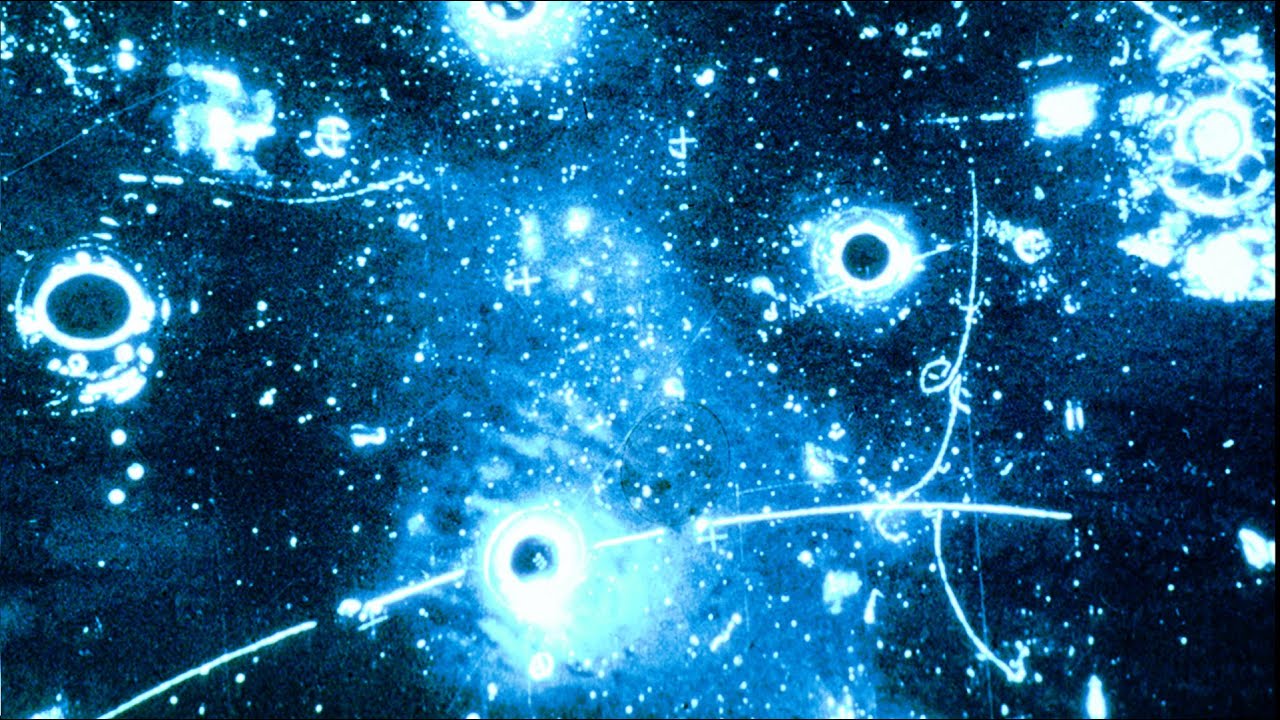
These machines or these experiments are called particle accelerators and they are our most powerful way about -- for learning about our universe's first second.
This is an image of the world's most powerful particle accelerator, the Large Hadron Collider.
So essentially a 17-mile tunnel which goes underground beneath the City of Geneva, Switzerland and into nearby neighboring France.
Around that tunnel powerful magnets accelerate protons to speeds just below the speed of light.
Design operation it reaches a speed of about 99.999997% of the speed of light.
And then those beams of protons are directed head-on into one another inside of these giant gymnasium-sized particle detectors.
These collisions take place around 600 million times every second and sophisticated electronics study all the sorts of particles that come out of these collisions.
And by studying a very, very large number of these collisions at very, very, very high energies or speeds we can learn an enormous amount about the laws of physics as they pertained in that first trillionth of a second or so after the Big Bang.
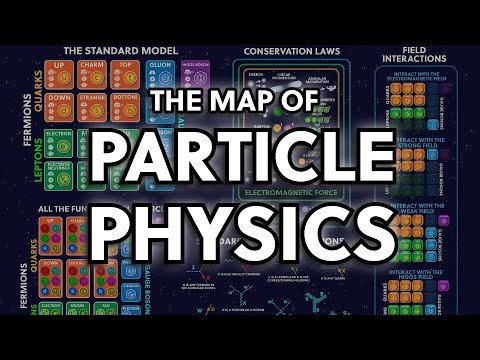
This chart shows all the forms of matter and energy that we'd ever observed or discovered using these particles accelerators.
This includes six types of quarks, the up and down quarks that make up protons and neutrons, but also more exotic forms of quarks, the charm, strange, top, and bottom quarks.
The top quark was discovered here at Fermilab back in 1995, for example.
And also six kinds of leptons including the well-known electron its heavier unstable cousins, the muon and tau, and three very feeble interacting particles called neutrinos.
And then there were the force-carrying particles like the photon and gluon that I've already mentioned and also things like the W and Z boson.
And then there's the most recent addition, the Higgs boson that was discovered at the Large Hadron Collider back in 2012.
Most of these particles are extremely rare in our universe today.
There are not W bosons and top quarks flying around in any serious quantities.
But a trillionth of a second after the Big Bang, the entire universe, every last corner of our universe was filled with a dense soup containing all of these forms of matter.
Electrons at that point were not substantially more common than top quarks or Z bosons or Higgs bosons.
These particles all played instrumental or key pivotal roles in how our universe evolved during that first trillionth of a second.
All right.
So up to this point in the lecture, you might be under the impression that what I'm trying to tell you is that we understand the first trillionth of a second, the second of our universe quite well.
I would love if that were true, but it's just not the case.
Sure we have a great theory, a spectacular theory.
When we combine what we know about Einstein's theory of relativity with what we've learned about quantum or particle physics from particle accelerators, we have a theory that predicts a great deal of what we observe very, very well.
We can explain the detail patterns of light that we observe in the cosmic microwave background, we can observe why the nuclear elements come in the quantities that we find them to be in our universe.
We can also explain things like why and how stars formed, or galaxies formed, the clusters of galaxies form, and why those objects look the way they do in our universe today.
All of these things are explained well by our standard cosmological theory.
But when we look into the first second or so after the Big Bang we don't have this kind of information reliant to find out if the theory we're using is complete or even correct.
Furthermore, in recent years and decades cosmologists have stumbled upon a number of puzzles that they haven't been able to resolve with their standard theory of the early universe.
These puzzles might just be loose ends which will be tied up or resolved in the years or decades ahead with greater observations and measurements or maybe even greater theorizing.
Or maybe they're telling us that we're thinking about the early universe in a substantially incorrect way or incomplete way.
Let me describe these four puzzles and we'll come back to the bigger implications.
The first of the four puzzles I'm talking about has to do with the simple existence of atoms in our universe.
Everything we know about the laws of physics say that for every kind of matter, there must exist a copy that we call antimatter with opposite quantum properties.
So for example, the electron is a negatively charged particle and its antimatter counterpart is something we call a positron, which is a lot like an electron but with a positive electric charge.
These two particles, the electron, and the positron are the same mass, basically all the same features, except for things like electric charge which are reversed.
Similarly, quarks have antiquarks and neutrinos have antineutrinos so on and so forth.
Matter and antimatter are perfect copies of each other in almost every way we can measure.
When cosmologists ponder this they run into a problem quite quickly.
From what we know about matter and antimatter we should have expected the early universe to have contained a perfectly equal amount of matter and antimatter shortly after the Big Bang.
And then as the universe expanded and cooled that matter and antimatter should have destroyed each other.
After all, we know from the laws of physics as we measure them in particle accelerators that you can't create or destroy matter without creating or destroying an equal amount of antimatter.
The fates of these two substances are closely intertwined.
So if that theory was right, if everything we knew was the end of the story, then our early universe should've expanded all the matter and antimatter should've been destroyed and there should be no remaining matter in our universe today.
And that means no atoms, no stars, no planets, no molecules, no life and certainly not us.
So this is obviously not the right answer and we don't know what the resolution is, but it's clear this is telling us things were going on in the first fraction of a second after the Big Bang that we do not currently understand.
The second puzzle also has to do with matter, but not the kind of matter that's made up of atoms.
Instead, we're talking about a different kind of matter, something we don't really know what it is yet, but something that doesn't appreciably radiate reflect or absorb light, something that we call for the lack of a better name, dark matter.
These images of the Galaxy Andromeda or M31 as it's sometimes called, this happens to be the Milky Way's nearest neighbor.
And when you point telescopes at this you can measure where things like the stars and gas and dust and planets and objects in the system are.
We can get a pretty good inventory of the matter in the form of atoms inside of this galaxy.
From that information, we can deduce how fast we think stars should be in orbits around it.
Basically, by looking at where all the atoms are and applying the laws of gravity as we understand them, we should be able to deduce how fast different stars should zip around a galaxy like Andromeda.
And when we do that we get a curve like this, this is called a galactic rotation curve and it basically is saying that as you go farther away from the galactic center these stars should be moving in slower and slower orbits.
This is basically for the same reason that we find Pluto moving more slowly around the Sun than the Earth does.
In the '90s and '70s and '80s however, astronomers actually went out and measured these sorts of rotation curves, people like Vera Rubin and Kent Ford and others and they didn't find what people had expected.
Instead of the predicted curve, they found rotation curves which were flatter and faster than we're expected.
This tells us two things.
First of all, it tells us that most of the matter in these galaxies does not consist of atoms, but of something else, something like I said before we call dark matter.
Secondly, it tells us that the dark matter is not distributed in the same way as atomic matter is.
Instead of being in a relatively compact disc, the dark matter exists in a much more extended halo approximately spherical extending out to much greater distances from the galactic center than the visible components of these galaxies do.
By the mid-1980s it had become clear to most astrophysicists and most particle physicists as well that the dark matter probably doesn't consist of any of the forms of matter we've ever seen, but of some sort of new exotic elementary particle or maybe more than one kind of particle, we're not sure which.
If that's true, then you can begin to calculate how such a population of particles should evolve over the course of our universe's history.
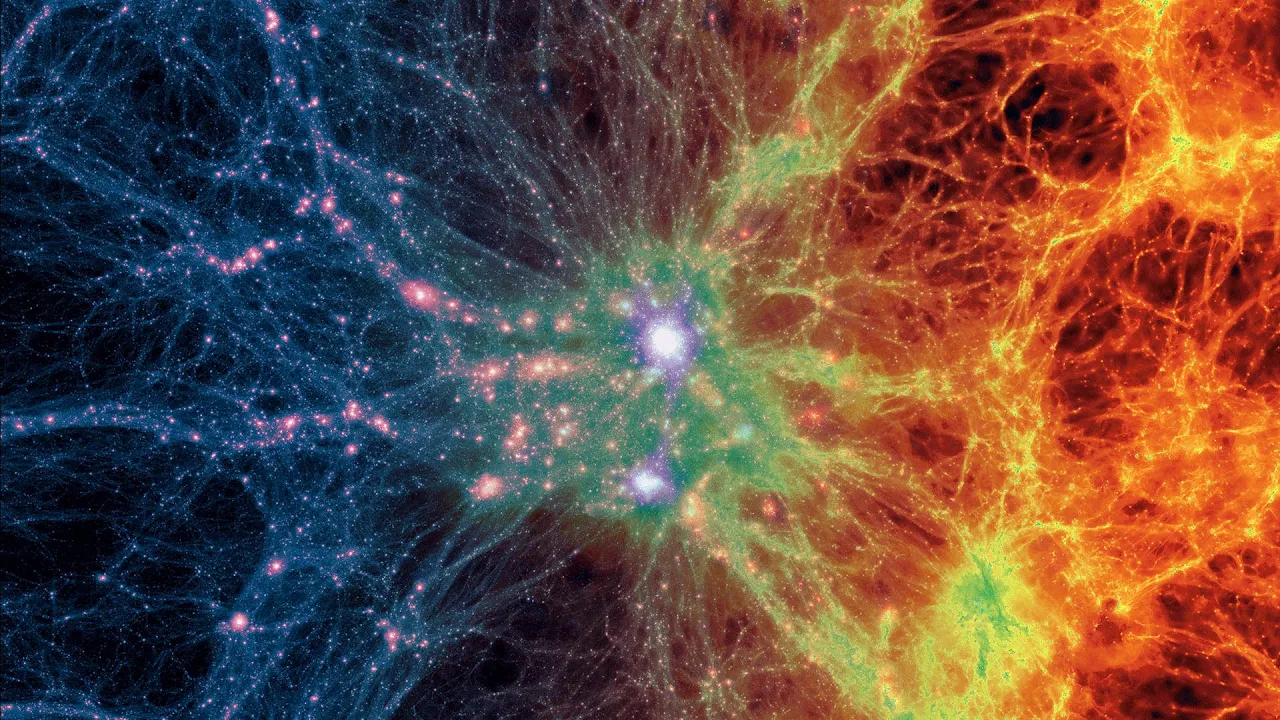
The image you're looking at now is a result of a computer simulation that takes an approximately uniform distribution of dark matter and lets the force of gravity act on that dark matter as the universe expands.
So we can see as time advances in this in this simulation, the gravity tends to hold the clumps of dark matter into each other forming denser and denser objects and eventually you reach the point wherein the bottom right frame you can see there are very, very dense objects filled by giant voids in all their locations.
If you compare this image to the observed distribution of galaxies and galaxy clusters in our universe you find remarkable agreement.
What this tells us is that the dark matter form the scaffolding of large-scale structure of our universe over cosmic history.
In other words, galaxies and clusters of galaxies formed because the dark matter's gravity hold things like atoms together to form the stars and planets and dust and gas that we can see with our eyes.
Dark matter played a pivotal role in the formation of our universe as we know it.
If you asked me 10 years ago what I thought the dark matter was likely to consist of, I would have given you an impassioned and confident-sounding speech about things we call WIMPs, weakly interacting massive particles.
And I would've told you that we understand how these things would if they exist, how they would've been formed in the early universe and how many should have survived those conditions.
And lo and behold the abundances we were -- expected these particles to emerge from the Big Bang with approximately match the amount of dark matter we have in our universe.
That gave me -- us a lot of confidence that dark matter probably did consist of WIMPs.
Further exciting the story is that if dark matter did consist of WIMPs we thought we knew how to go out and build experiments that would detect these particles for the first time allowing us to measure their properties and understand not only the dark matter himself -- itself, but also understand how it may have been formed in the first fraction of a second after the Big Bang.
So we carried out these experiments, we did it very, very well.
In this image you see an underground laboratory in Italy known as Gran Sasso Laboratory where there are several dark matter detectors, including the xenon detector or the DarkSide Experiment, DAMA, CRESST, all of these are dark matter detectors buried deep underground in this laboratory.
These experiments performed as well or better than we could've hoped.
They've improved in sensitivity by more than a factor of 10,000 over the last decade.
It's truly is experimental physics success story and yet they never found any dark matter particles or at least not anything that many of us have become convinced are authentic signals of dark matter.
This is making us rethink not only what dark matter might be made of, but how it might've been formed in the early universe.
Dark matter-s no-show has given us a lot to think about not only in terms of what sort of things exist in our universe, but how they came to exist in our universe in the first place.
The third puzzle I'll mention has to do with how fast our universe has been expanding over its history.
If you take Einstein's theory, general relativity and you make the reasonable-sounding assumption that most of the energy in our universe is in the form of matter, then you find that space should expand in one of three ways.
Either it should expand for a while reach a maximum size and then begin to contract like in the lower curve shown in this image -- at this image.
Or it should expand forever without limit, like in the top curve.
Or if you're just the right amount of matter kind of the Goldilocks scenario, you could have a scenario where the universe expands for a while, and then it kind of plateaus to a maxim size.
Those are kind of the three options, our multiple-choice question had A, B or 3 -- A, B or C. But in the 1990s we built telescopes that for the first time were able to actually find out which of these cases most accurately described our universe and when those measurements were conducted they got an answer which was D, none of the above.
Instead of a universe's -- universe whose expansion rate was slowing down with cosmic time, these astronomers learned that it has been accelerating over the past few billion years.
This was very surprising and it made us rethink a lot of our assumptions about our universe and the energy that it contains.
In particular, the only way we really have to understand this behavior, the fact that our universe is -- its expansion rate has been accelerating is deposit that the very vacuum of space contains energy, something we call dark energy.
Basic idea here is that if I take a cubic meter of space at any time or any place in our universe's history and I take all the forms of matter out of it, all the photons, all the neutrinos, all the atoms, all the dark matter, everything, it would still contain a certain fixed density of energy.
As the universe expands other forms of matter and energy get diluted by the expansion of space, but not this dark energy.
And that means that as history has played out, as cosmic history has played out, dark energy has played an increasingly important role slowly coming to dominate the total energy density of our universe and driving its expansion rate to accelerate.
And fourth but not least that last but not least is the puzzle that cosmologists refer to as cosmic inflation.
If you took the Big Bang theory as it was usually described in the 1970s or 1960s, you could not explain why our universe seem to be so uniform and why the geometry of our universe was what's known as Euclidean, the kind of geometry that you learn about in high school math classes.
There's no reason either of those things should've been true, according to what we knew about the Big Bang theory and cosmology in general, but it was.
We measured it, and as we measured it in subsequent years we found it to be very, very, very accurately true and this poses a big problem for the at least old version of the Big Bang theory.
In the 1980s a bunch of physicists and cosmologists proposed and developed ideas in which shortly after the Big Bang space expanded in a hyper-fast burst, increasing in volume by a factor of 10 to the 75 or more in only 10 of the minus 32 seconds.
We call this burst of expansion a cosmic inflation and it could explain these features that otherwise had been very confusing to us about the Big Bang.
We still don't know for sure that inflation took place, but the theories worked out in the 1980s made a number of very precise predictions or very specific predictions for what we'd had observed in the cosmic microwave background.
And as time has played out and those measurements were conducted we found those predictions to be true.
And this has convinced most cosmologists that something like inflation probably took place shortly after the Big Bang.
But we still don't know exactly why inflation occurred, what drove it to happen or what caused it to end.
One of the things I find most intriguing about inflation is that at least in most of our theories of inflation it never ends.
A piece -- a patch of space begins to expand and in only little bit of that expanding space do -- does inflation end causing a hot sort of dense universe like the one ours was once in to emerge.
The rest of it continues to inflate and as this process goes on more and more of these pocket universes kind of fall out of the process of inflation.
So from this perspective, you would expect a universe underwent inflation at least for a brief period of time would have produced an infinite or nearly infinite number of universes.
From this perspective, it seems that modern cosmology is giving us an argument for why we should expect that our universe is only one of many, a small part of a greater cosmic multiverse.
So let me try to put all this in perspective with a little bit of a lesson I like to refer to from the history of science.
When I'm talking about the state of cosmology and the state of the Big Bang theory today to my colleagues I try to get them to think about whether we're going to resolve these puzzles that I've been talking about for the last 20 minutes or so with small changes.
Or incremental changes to the Big Bang theory as we know it, or are we going to have to replace subsequent parts of the Big Bang theory with something truly different, something we're not currently thinking about.
In other words, are we going to tie up some loose end or are we going to replace the existing cosmological paradigm with something very different?
And to get them to think about this I like to ask them the following question, I like to ask, what do you think it would've been like to have been a physicist in 1904?
The reason I pick 1904 in the story is because it at least in my reading of the history of science, 1904 was the year in which physicists felt the most confident that they truly understood their universe.
In 1904 for 200 years or so the theories laid out by Isaac Newton had just continued to work.
Newtonian physics as a paradigm had explained gravity and the orbits of planets and any number of dynamical systems and it -- when it was applied to later ideas like electricity and magnetism and heat those same principles were found to be successful in any variety of application.
Physicists not only thought that classical -- Newtonian physics had been successful for the past 200 years, had every confidence that it would be successful for the next 200 if not 2,000 additional years.
They thought they had really discovered the key principles to our universe.
Of course, in 1904, they also knew there were a few loose ends that had proven at least resistant to explanation in the Newtonian paradigm.
Let me tell you about a few of those problems.
The first of their problems had to do with the nature of light.
By 1904 physicists knew that light was an electromagnetic wave, but it behaved differently than other waves they knew about.
If I told you that a water wave was moving through the ocean at 50 miles an hour, we would all agree that if you got in a boat and moved at 50 miles an hour in the same direction as a wave you would find the wave to be moving at rest or not moving at all relative to you.
In other words, the speed of a wave depended on your frame of reference.
But when light had been measured in a variety of different speeds -- frames of reference they always measured the same speed.
The speed of light seem to be a universal quantity and no one knew how to explain that, at least not in 1904.
The second problem or puzzle had to do with the orbit of the planet Mercury.
Newtonian physics predicted like all the planets, Mercury should be moving on around in the Sun on an elliptical orbit and the orientation of that ellipse should change slightly from year to year.
So technically speaking, we say it's a perihelion should be processing from year to year, its orientation should change.
And you could calculate the rates of that procession or at least what it should have been.
But throughout the course of the 19th century had become clear that Mercury's rate of procession is a little bit different than what was predicted by Newtonian physics.
Some astronomers posited that maybe there was an additional planet out there that had not been discovered yet, a planet they called Vulcan.
That might have been gently tagging on Mercury perturbing its orbit.
But when they looked for this planet they didn't have any success.
So I think it's fair to say that in 1904, no one had any really good ideas for what was going wrong with the orbit of Mercury.
The third puzzle, which I think is the most remarkable one and how outstanding it should have been, how much it should have been on everybody's mind was that 1904 no physicists or anyone else had any idea where the Sun got its energy from.
The Sun has given off an enormous amount of energy in the form of starlight over billions of years, and there just isn't any kind of physics that was known in 1904 that could produce anything close to this much energy.
Even if the entire Sun had been made of some combustible material like coal or gasoline or TNT or something, it would have run out of energy long, long ago.
In 1904, there was simply no answer to the question of why does the Sun shine?
And then last but not least was the simple fact that physicists in 1904 couldn't build a workable model of the atom.
By 1904, physicists had at least begun to understand some things about the structure of atoms, but if you picture something like this a planetary model where there's a big dense nucleus orbited by planet-like electrons, classical physics tells you those electrons should crash into the nucleus in any fraction of a second.
In other words, atoms should be entirely unstable.
All of the atoms throughout our universe should simply collapse in a picosecond or less if the laws of classical physics were correct.
So in 1904, I think if you had a conversation with a group of well-informed physicists, they would probably tell you, "Sure, these are problems.
But Newtonian physics has worked for so long, if we just think about this harder we measure some things better, we make some more progress on these fronts, we'll find out how to turn Newtonian physics against these problems and provide real tangible solutions."
So that's how it's always been for hundreds of years, they were confident this would happen again and they were wrong.
In 1905, Albert Einstein, a very young Albert Einstein working in the Swiss patent office, proposed solutions to these problems by introducing the theory of relativity and the beginnings of what would become known as quantum physics.
These ideas were not tying up of loose ends, they were tearing down the basic Newtonian concepts of matter, energy and space and time and replacing them with entirely new paradigms of quantum physics and Einstein's vision of relativistic space and time.
So when I think about the state of cosmology, I like to ponder the possibility that 2020 might be the 1904 of cosmology.
It might be that where these loose ends we've been struggling with for so long are telling us something, not just incremental and not just the tying up of loose ends, but instead tell us that we've been thinking about the early universe in substantially incomplete or incorrect ways.
And maybe they're giving us clues that will get us to some sort of greater, more overarching theory.
Of course, I might be wrong, it may be that we discovered what dark matter is, we understand -- we learn how inflation works, we understand why matter was victorious over antimatter, and we understand the nature of dark energy in the years and decades ahead leaving the basic Big Bang picture intact.
But I kind of hope not because it would be a lot more exciting to see something more revolutionary play out in the timescale of my career in physics.
So I'd like to thank the organizers of this lecture series for the opportunity to talk with you tonight.
I'm happy to take some questions in a little bit, but first I'm going to do just a couple of minutes of shameless self-promotion.
If you've enjoyed this talk and want to hear more about the early universe and are puzzles we're facing in modern cosmology, I have this new book out called "At the Edge of Time: Exploring the Mysteries of Our Universe's First Seconds."
You can find that on Amazon or wherever else you buy books.
People seem to like it so I guess I recommend it from that perspective.
And also if you're more of an audio sort of person than a book sort of person, I've recently launched my new podcast with Shalma Wegsman called "Why This Universe?"
And every Monday we put out a 20 or 30 minutes segment on some part of physics that we think is awfully cool and people seem to be having fun with that.
So check that out if you're into that sort of thing.
And at this point, I'll turn it over to the audience and enthusiastically take some of their questions.
Thanks again.
>> Okay. Dan, we've got a large list of really great questions.
>> Awesome.
>> Okay. So I'm going to start with the big one.
My guess is, is you always get -- you know, what was there before the Big Bang?
And I'm going to combine that with another question is, what made the quarks and muons that exist after the trillionth of a second after the Big Bang, that is where did these bits of matter get formed from?
>> So I'm going to answer those questions in kind of reversed order because the second one is a lot easier than the first one.
So the thing is, energy in any form can be converted in principle to energy in any other form.
So whatever you had prior to a trillionth of a second, whatever forms of matter and energy existed to that point they can convert into things like top quarks and muons and taus and Higgs bosons.
In the same way that in the Large Hadron Collider we collide protons together and we make all those things.
These are all the forms of energy that exist and in fact, a trillionth of a second after the Big Bang if I took a quark and I just watch the energy, I trace that energy as it traveled throughout the universe.
What you'd find is in a tiny, tiny, tiny fraction of a trillionth of a second it would be in some form or some other particle and then another and then another and then another.
Energy did not take this form of a single kind of particle for any length of time, everything was fleeting, everything was in flux, everything was volatile.
Now as far as what happened before the Big Bang, this is -- I mean the honest answer is we don't know and we don't even know if it's a well-formed question.
If you take what Stephen Hawking and Roger Penrose and others worked out back in the '60s and '70s, it would seem that there should be no such thing as before the Big Bang.
There really is a beginning to time at what we call the Big Bang and if there was no time and no space prior to that there was certainly nothing there to talk about, nothing to cause the Big Bang.
The Big Bang or the existence of the universe in this sense it has to be a brute fact without cause.
The introduction or addition of cosmic inflation to the Big Bang theory might change that picture a bit.
After all, it's not obvious that inflation ever had a beginning it could have -- it could be just going on forever.
And maybe you can talk about our universe being created when it kind of popped out of the inflating cosmos that preceded it, but it's not obvious to me that inflation ever had to have a start, it may just be an eternally occurring sequence of expanding space.
But I'll go back to the original part of my answer, which is I think it's fair to say we don't really know the answer to this for sure.
>> Okay. This is maybe a clarification question, Dan.
Somebody asked is during this whole time that you are describing the universe was expanding as time is ticking and if so how is time passing and the universe expanding, how are those two things related?
>> So as far as we can tell universe expanding at a smooth and steady rate, that means that if I take any two points in space they are getting a little farther apart from each other as time goes on.
Now we don't notice this in our day-to-day lives because things are so close together here and that means it would expand very, very slowly.
We really only notice the expansion of space when we look out at galaxies and clusters of galaxies beyond the confines of Milky Way.
So it is true that we -- the space expanding everywhere but not in a way that we perceive in part because the force of gravity tends to hold things like the galaxy and the solar system together resisting being pulled apart by the expansion of space.
And as far as how this relates to time, I mean we use time as a tool to measure distances between events and any number of ways.
I think the expansion of space we think about -- we think of time and the context expansion of space the same way that we think about time in terms of orbits of the Earth around the Sun or any other kinds of measure of time that you might have in mind.
>> Okay. Here's a sort of an experimental question.
How do cosmologists measure the relative amounts of elements that exist in today's universe?
Is it in excess that was predicted by -- from primordial nucleogenesis?
How do we actually -- do that measurement?
>> So there are a lot of different ways I think, you know, one could give a whole hour talk on ways that people go by doing it.
But like one of the most common though is that we know different kinds of atoms emit light at different wavelengths or frequencies.
So if we find a big gas of clouds somewhere maybe a really old primordial gas cloud, we point a telescope at it, we measure those specific wavelengths and frequencies, we know that that's coming from say hydrogen or helium or lithium or beryllium.
And we do this in enough different clouds and enough different times and locations in the universe and we can get a pretty good measurement in some cases extremely accurate measurement of how much of these different elements are present in those primordial collections of gas.
>> Okay. Let me ask this.
Is there anti-dark matter?
>> That's a great question.
Again, I'll go to my standard answer to these sorts of hard questions that we don't really know because we don't know what dark matter is.
But I'm confident that dark matter either has anti-dark matter counterpart or dark matter is itself anti-dark matter.
What I mean by that is if I take for example a photon, which doesn't have anything like electric charge or anything like that and I take an anti-photon, they're actually the same thing.
The photon and anti-photon because they don't -- it's like the negative number of zero is still zero, the anti-photon is just a photon.
And it's possible the dark matter could be identical to the anti-dark and dark matter particle and since there really wouldn't be anti-dark matter.
On the other hand, it's entirely possible the dark matter does have some of these properties that you could reverse in which case there could be both dark matter and anti-dark matter in our universe.
>> Okay.
So again, we got a couple of experimental questions.
Why did they bury the labs underground, why the sensors underground?
>> Yeah. So if you're looking for dark matter, you have to build detectors that are extremely sensitive, they have to tell when a single dark matter particle comes and hits one of your atoms.
So there's not a lot of room for noise to be on top of that.
And if we did an experiment like that on the surface of the earth cosmic rays or energetic particles from space would constantly be hitting your detector, giving you false signals of dark matter.
Dark matter, on the other hand, can pass straight through the earth without it knowing it's there and easily reach your underground lab.
The analogy I like to use is if you were -- you know, try to listen for a pin drop, I'd be pretty hard to do in a quiet location.
But trying to look for dark matter on the earth surface is like trying to listen for a pin drop at a Metallica concert, it's the wrong place to do that.
You want to go as deep underground as you can where things are as quiet as possible.
And if dark matter -- if you're lucky enough to have dark matter start hitting your detector, you'll have a chance of detecting it and for what it is.
>> Okay. Here's a general question, Dan.
Is understanding black holes the biggest mystery to understanding our universe currently, if not what is?
>> Well, black holes certainly offer a way to gain insight into many of the most exciting and profound questions in physics.
Probably if you did a survey of physicists today the answer -- the thing that they would say they want to know the most is how general relativity and quantum physics can be merged together into oneself consistent theory.
We call this a theory of everything at the risk of being a little over sweeping, but that's what we call such a theory.
And we don't have any particularly compelling candidates for that at this point.
I mean people have worked a lot in string theory and things but we really don't know if that has anything to do with our universe, it may or may not.
And black holes are one of the ways in which we know the universe uses quantum physics and general activity at the same time.
So if we really could learn -- if we had a black hole that we could study in the laboratory and in detail we could learn things about quantum gravity that would help us build a theory like that.
So yeah, I would argue that black holes are a profound importance and they're one of the avenues we have towards these really big fundamental questions about our universe and how it works.
>> This goes back.
Why isn't the microwave background uniform?
That is the picture you showed was not just all blue.
Why is it not uniform?
>> So I want to point out that it is almost exactly uniform, okay?
So yes, I showed Apache map before, but the hottest and coldest spots on that map are only hotter or colder than the average temperature by about one part in a hundred thousand.
Okay. So extremely uniform in temperature with some tiny variations upward and downward.
And the reason for those fluctuations is that when those atoms are forming 380,000 years after the Big Bang, there were parts of the universe that were slightly more dense and slightly less dense, and those variations in density led to those photons being a little hotter or a little colder on average.
>> Okay. Does Planck's time have anything to do with the first moments of the universe?
>> So when we -- this goes back to the question -- the answer I gave to the question about black holes.
When we take the theory of general relativity and what we know of quantum physics, those two theories seem like they could play together pretty well and remain consistent with each other up to a temperature that we think the universe may have been at, at 10 to the minus 43 seconds after the Big Bang or Planck's time, the Planck time.
We know that these one or both of these theories has to break down at that point.
So if we ever want to understand what Stephen Hawking and Roger Penrose had in mind with the Big Bang singularity something that happened even before inflation, for example, we would need a theory of quantum gravity that would describe the laws of physics as they pertain to that extremely, extremely, extremely early epic of our universe's history.
And at this point we do not have a theory and anyone that tells you what the Big Bang singularity was really like is either misleading you or just speculating a little more freely than I'm willing to.
>> Okay. Why does dark matter -- why is dark matter affected by gravity, but apparently not by light and other interactions?
Does gravity somehow supersede all the other forces and interactions?
>> Yes, we understand gravity in the context of Einstein's theory.
Gravity is something that works on absolutely every form of energy without exception.
There's something called the equivalence principle which is built into it.
And basically what everything boils down to here is when you put any form of energy and space including matter but any kind of energy, it changes the geometry of the space around that point and that curvature of space it leads to the phenomena we know as gravity.
So no matter what dark matter is it should experience gravity the same way as anything else.
Now, when it comes to the other forces we know about in nature including the electromagnetic force, which is what allows you to see something with light.
Not everything experiences that force.
In fact, the only things that experience that force are particles with electric charge.
So an electron or a proton which carries electric charge, these are things that interact with light.
But particles like neutrinos, for example, which do not carry electric charge, do not directly interact with light and this is one of the reasons why neutrinos are so difficult to study and require such enormous detectors like the Doom detector that you saw in the video preceding this lecture.
>> Do we have any other means of finding out the composition and the details of the universe?
But before 380,000 years to your point -- do we have other methods other than the cosmic, you know, the radiation?
But is -- can gravity waves help us here go beyond that point?
>> Yes. So at present, the only tools you really have are the cosmic microwave background and the light element abundances which get us to a few hundred thousand years and a few seconds respectively.
But using gravitational wave detectors, we hope to be able to learn about much earlier times in the future.
So far we do not have the -- we have gravitational wave detectors but not at the level of sensitivity we need to study the universe.
What a gravitational wave is, is literally an oscillation in space and time itself.
A wave propagating through space in which the distances between different points of space oscillate back-and-forth as the wave pass through it.
It's an actual vibration of space and time.
And we have detective gravitational waves from very specific kinds of events where black holes merge into one another or in some cases neutron stars.
And those sorts of compact mergers have led to gravitational wave singles we've been able to detect especially with the series -- the pair of gravitational wave detectors we call LIGO.
Now in the future, we hope to deploy gravitational wave detectors that can detect gravitational waves.
It's a very different frequency ranges and very high sensitivities in space.
And in particular, we have something called the LISA detector we hope to deploy, and then other things after that as well.
And with some of these detectors, it may be possible to detect gravitational waves that were produced in the first fraction of a second after the Big Bang.
Gravitational waves might tell us about certain kinds of base transitions or other events that we currently don't know about, but that may have taken place very early in our universe's history.
>> Can dark matter be related to information content?
As space expands is -- there's more empty space.
Can you say something definite about how a space if it contains no matter?
Is there information there?
I guess this is sort of an entropy question.
>> Yes. So the short answer is any time you have any objects in space and I'm being deliberately vague but that includes particles, or you know, whether they'd be of dark matter or photons or anything else.
And maybe perhaps space itself, in fact, I'm pretty sure space itself.
There is information stored in all that, there's entropy associated with that.
We think black holes have entropy proportional to their surface areas, for example, and we think of black holes just being space and time curved in a particular way.
So yeah, I assume that dark matter whatever it is has information content stored in it and therefore entropy.
There are a number for profound questions related to entropy and cosmology.
Sean Carroll wrote a very nice book discussing some of these problems, in particular, is a question of how our universe wound up in the very specific state it started out in from an entropic perspective shortly after the Big Bang.
And I don't think there are any particularly good answers to this question, yeah.
>> Okay.
Here's sort of a -- here's maybe a little political one here, but here we go.
Several decades ago topological defects such as cosmic strings, domain walls, emerging grand unified theories were very popular, right, superstrings, and so forth.
What is the current status of such phenomenon and could they hold any clues to the resolution of the problems you are discussing as were unsolved?
>> Yeah. So the person asking the question is absolutely right.
When I was in grad school, you know, almost 20 years ago I was kind of not exactly taught as fact.
But I was taught to fully expect that when we figured everything else when the dust settled we would learn that there's a grand unified theory that combines all the known forces of nature into something neat and compact.
And it would include supersymmetry, this theory that is very popular at that time and all -- and dark matter will come out of it and this will come out of it and all these things would form a neat compact puzzle.
But as time has gone on that attitude has changed quite a bit.
Most physicists today I would say go into these questions with a lot more humility, we think, you know, there might be a grand unified theory, there might be supersymmetry but there might not be in -- very likely there's a bunch of stuff along the way that we don't currently understand or aren't envisioning.
I'm somewhere in between personally, I think there's a lot that's very compelling about supersymmetry and a lot that's very compelling about grand unified theories.
And I think it's more likely than not that a lot of that stuff is going to be manifested in nature, but at the same time, I'm not nearly certain about these things as I was in grad school or as my professors were in grad school.
There has been a palpable shift in attitudes on these questions as the datas came in and frankly not confirm some of the predictions of these hypotheses that were so popular at the time.
>> Well, I tell you what, Dan, since we sort of got you talking on -- in a personal way, but let me go farther with a couple of questions here.
What do you think the universe is like?
Is a multiverse or something different?
And then I'm just going to pile it on, so you can expound it for a bit.
What made you want to study cosmology and how does this questioning actually affect the common man?
So there you go, you could pull it out for 20 minutes.
>> All right, right.
So I'm going to take one piece at a time here.
So I'm going to start with -- >> -- Okay.
What's the universe like, a multiverse or something different?
>> Yeah. So I'm not going to say I know there's a multiverse or we prove there's a multiverse or something like that, none of those statements would be responsible and they don't reflect my view.
But I think it should be one's default position that probably is a multiverse.
When I think back at human history and prehistory, I picture a bunch of people living on an island somewhere and they're wondering if there are other islands.
And of course, they think there isn't because all they've ever seen in a given direction is water.
They think of their island as unique, they think of their island as the universe.
Eventually, they either get visited from travelers somewhere else or they travel somewhere else and they learn that they were mistaken and they get used to the idea of their lost lives.
Later, some descendants of theirs perhaps are contemplating the cosmos and they look up at the sky and they see various astronomical bodies, the Sun, the Moon, things they call planets.
And they deduce that all of those things are kind of alike, but the thing they live on the earth is unique, everything moves around them.
The Earth is not only center of the universe but it's made of different stuff and is completely unique.
It is the universe for all intents and purposes.
Of course, people like Copernicus and Galileo come along and show that's not really true and in fact, the Earth is just one of many planets and orbits around the Sun.
After that people like Giordano Bruno start to speculate that maybe those things out there that we call stars are just like the Sun, but a lot farther away.
That was not a very popular idea at the time for that and other positions Bruno was burned alive at the stake.
So you can see why a lot of people might not have proposed that at the time.
But the short story is, they -- over hundreds of years accepted the -- human beings accepted this and learned that even our solar system isn't unique, it's not even special.
As recently as the 1920s, astronomers were still arguing whether the Milky Way was the universe or just one of many, many galaxies that populate our universe.
And we know today there's something like half a trillion galaxies in the observable universe.
So I think the step -- the steps I've just described are -- a natural continuation of those steps would be to say, well is the particular patch of space that we occupy and can observe with our telescopes, is that the only one?
Well, I don't see any reason to think it would be.
If you have one universe that exists they're probably a very, very large number.
All right.
So that's my answer to question one.
Question two, is why do I study cosmology?
I study cosmology because it's the most interesting thing I've ever encountered.
I didn't -- I wasn't the sort of young person who knew I wanted to be a physicist or a scientist from a young age, I had no intention of studying science when I went to university.
And but at some point, I wound up taking one-quarter class of modern physics, where I learned about quantum mechanics for the first time and I learned about the theory of relativity.
And those were the two most exciting things I'd ever learned about anywhere.
And I immediately changed majors and became a good student more or less overnight.
I was a very poor student before learning about those things.
And a very diligent, determined student after finding out those things could -- existed then I could study them.
Since then I've fallen in love with a lot of branches of physics, but none more than cosmology.
Trying to understand what our universe as a whole is like, how it came to be the way it is, what forms of matter and energy can be found in it, and most importantly how the universe began.
These are the questions that still thrilled me to stay and make me feel so lucky to be able to think about and ponder as a profession.
Was there another question, Tom?
I can't remember.
>> No. Okay.
So yeah, I think that covered it.
Well actually the final one was the one that gets asked a lot and I'll throw it to you was, how does all this affect the common man?
>> Oh. Well, it really depends what perspective you take on that question.
If I'm being honest, I am not doing cosmology because it's going to lead to a better mousetrap or any other technological applications.
There are legitimate arguments based on economics and based on technology for why we should fund things -- fundamental science including cosmology.
It does lead to a lot of spinoff technologies that's been demonstrated to be true and it convinces a lot of talented young people to learn a lot of skills that turn out to be very useful in other endeavors.
So there are good practical reasons to do this, that's not why I do it.
I do cosmology because it -- the questions that we raise in cosmology keep me up with excitement at night.
It's the sort of thing that when I'm having a beer with my friends I want to talk about.
No matter how many times I've talked about it before it's the sort of thing I want to talk about because it's exciting and it's thrilling.
And when I look back in the history of humankind, certain moments in intellectual history that I think are the most worth celebrating.
Galileo producing arguments for why the earth is not at the center of the universe or Newton coming up with a unified theory of the thing we call gravity and planetary orbits.
Or James Clerk Maxwell, explaining that magnetic fields are really nothing more than moving electric fields, or name their thing of choice.
All of these things are the sort of things that human beings will be celebrating for as long as they exist on the earth as enormous, you know, landmarks crowning achievements in the history of humankind.
I want to be there when those landmarks get crossed, I want to understand them, I want to bask in the glory of human accomplishment at those moments.
>> Okay. So I'll tell you what, since we brought you in one direction let's add -- here's a couple of sort of straightforward bread and butter.
So how far can a photon be transmitted before it dissipates so much that it can't be detected?
How far can a photon travel before it's undetectable?
>> It's basically limitless.
So those photons that we observe in the cosmic microwave background have been passing through space at nearly straight lines with undergoing next to no interactions for 13.8 billion years.
And if you let them keep going they would still be doing that in another 13.8 billion years or 13.8 trillion years.
The one way in which they are changed substantially as they travel through space is as the universe expands the space expands the wavelengths of those photons expands with it, they get stretched.
And because the energy contained by a photon is inversely proportional to its wavelength that means those photons lose energy as space expands.
So those universe -- those photons when they were created were very energetic and are very, very low energy today, but they're the same photons and they've been traveling with really no intervening interactions to speak of throughout the entirety of cosmic history.
>> Okay. A couple of more and then we'll let you go, Dan.
Where did the top and charm quarks go when the universe moved into its current era?
Where -- you mentioned that they were there in the beginning and they're not there now.
Where did they go?
>> So I also mentioned that any kind of energy can transform into other kinds of energy and in the early universe this was going on a lot.
So prior to a trillionth of a second after the Big Bang, if any two particles collided let's say two photons collided, those two photons might be transformed into a top quark and an antitop quark, or any number of other things.
But that's just one of the many things they might transform into.
As the universe cooled those photons would collide wouldn't on average not have enough energy anymore to make new top quarks and antitop quarks, because top quarks are very heavy and therefore require a lot of energy.
Meanwhile, those top quarks are colliding with antitop quarks and disappearing becoming other forms of energy like photons.
So as the universe expanding cooled, the heaviest things became more rare and eventually very, very scarce.
And slowly the heaviest and second heaviest and third heaviest particles became increasingly rare until we're left with the array of particles that we find in our universe today.
>> Okay. So here we go.
Is the Higgs boson the fundamental unit of matter?
>> Well, the Higgs boson is an extremely important particle in the way that it interacts with other forms of matter and makes those forms of matter behave in the way we observe them to.
In particular, if it weren't for the Higgs boson a lot of the forms of matter and energy in our universe that we know and love would not have any mass.
And that would make them behave very differently.
Like electrons, for example, we believe electrons have mass only because of the way they interact with the field of the Higgs boson, the Higgs field, which permeates all space.
If the Higgs did not exist, electrons would be massless and therefore they would travel at nearly speed of light, they couldn't form things like atoms, our universe would be entirely unrecognizable.
So I don't know if I would use the phrase that the Higgs is the fundamental constituent of matter, form of matter, or something like this.
But it is a fundamental facet of our universe and without it, our universe would look nothing like it does.
>> Okay. Last question, Dan, and then we'll let you go.
And here's one it's sort of a philosophical question.
Should the multiverse idea "bother" us?
That is -- and bother is in quotes, because it may not be possible to detect any other universes and confirm the matter.
And you know, the classic case of, you know, what's a scientific theory if you can't confirm or deny it?
What --?
>> It's a great question.
One that I think very reasonable and intelligent people on both sides have expressed opinions.
So I'm lucky enough to be able to teach a class of the University of Chicago from time to time called Philosophical Problems in Cosmology.
This is one of my favorite ones to bring up.
And we read a bunch of stuff from a lot of smart people arguing both sides of this issue.
My view, however, is that in principle the existence of a multiverse could be a scientific proposition, in that there are things you could potentially measure or observe that would make you think the existence of a multiverse is more or less likely to be true.
That to me is the real definition of a scientific proposition.
Something that some sort of empirical information could have bearing on the likelihood of it being true.
And for example, prior to discovery of dark energy, Nobel laureate named Steve Weinberg wrote a paper saying, "If there were a large multiverse you would naturally expect there to be roughly this amount of dark energy in the universe."
And then about 10 years later we measured it and within a stone's throw anyway, there is the amount of dark energy that Steve Weinberg predicted.
Now, this doesn't prove there's a multiverse, I don't think Weinberg or anyone else would say that.
But that measurement makes me think it's more likely that there's a multiverse than I thought -- would have thought prior to that measurement.
So maybe between this and several other kinds of empirical data that we might collect over the years, decades, centuries, or millennia ahead, we could become increasingly convinced that a multiverse exists, and in that sense that hypothesis is a scientific one.
>> Okay. So again, we'll let you go with that, Dan.
Thank you very much for the wonderful talk.
>> My pleasure.
>> Again, thank you.
>> Goodnight everyone.
Up Next
79:27
Cosmic Redshift: Hubble's Expansion Evidence Explained
@JasonKendallAstronomer
4.1K views•2023-10-12
61:17
First Billion Years of the Universe with the Square Kilometre Array
@iaaudc
121 views•2022-05-26

6:25
Kepler's Laws of Planetary Motion Explained (Educational Astronomy Video)
@Peekaboo_Kidz
404.9K views•2023-02-17
6:10
Gamma-Ray Bursts: Cosmic Snipers Explained | Astronomy
@kurzgesagt
15M views•2016-07-31
Related Study Plans & Knowledge Roadmaps
Structured learning paths in Astronomy
astronomy
Reionization: Pop III Stars, IGM & 21cm Line
01Foundations of Cosmology & the Early Universe
02Population III Stars & Cosmic Dawn
03Physical Mechanisms of Reionization
+ 2 more learning modules
17h5 modules
Explore Roadmap
astronomy
Planetary Rings: Dynamics, Roche & Resonances
01Foundations of Gravity and Orbital Mechanics
02Tidal Forces and the Roche Limit
03Structure, Composition, and Collisions
+ 2 more learning modules
10h5 modules
Explore Roadmap
astronomy
Asteroseismology: Stellar Waves, Ages & Cores
01Foundations of Stellar Astrophysics & Wave Mechanics
02Stellar Oscillation Modes: P-modes and G-modes
03Mathematical Framework of Asteroseismology
+ 2 more learning modules
35h5 modules
Explore Roadmap
astronomy
Adaptive Optics: Physics, Engineering & Control
01Foundations of Wave Optics and Wavefronts
02Atmospheric Turbulence & Optical Distortion
03Wavefront Sensing Technologies
+ 3 more learning modules
35h6 modules
Explore Roadmap