








![드디어 순간이동을 성공 시켜버린 미친 과학자들(143km ㄷㄷ) [양자얽힘 완전판]](https://i.ytimg.com/vi/7VV9qJvz-Js/maxresdefault.jpg)







![Quantum Computing (#3 of 3: Quantum Hardware) [Quantumapalooza 2020 Series] Meetup-lite 20200522](https://i.ytimg.com/vi/5VC_GTP9aqU/sddefault.jpg)
![Building a Quantum Computer with Trapped Ions [QCT20/21, Seminar #09]](https://i.ytimg.com/vi/GkAHI_OeJkE/hqdefault.jpg?sqp=-oaymwEmCOADEOgC8quKqQMa8AEB-AH-DoACuAiKAgwIABABGGUgZShlMA8=&rs=AOn4CLDflov8tJy42RaEPVMoGKDZuqHVHA)

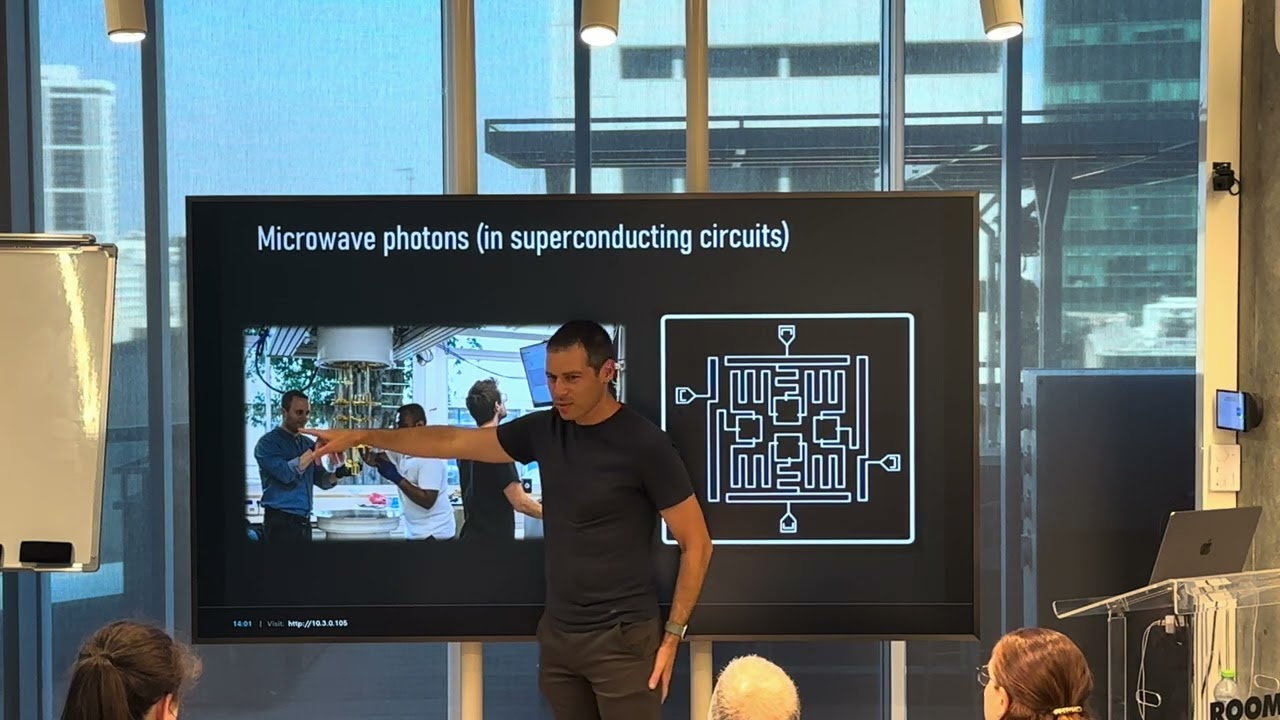
Superconducting qubits leverage quantum mechanics to perform computations impossible for classical computers by utilizing superposition states, where quantum bits (qubits) can exist simultaneously in multiple states unlike classical bits that are strictly 0 or 1; these qubits are physically implemented as electrical oscillators made from superconducting aluminum circuits cooled to near absolute zero, which eliminates quantum errors caused by electron scattering in normal metals, enabling the rich computational complexity of quantum algorithms.
Superconducting Qubits: Build Quantum Computers | QuantumCasts
Added:Fundamental quantum mechanics concepts including superposition, entanglement, and the mathematical representation of a qubit.
Basic principles of superconductivity, specifically Cooper pairs and the behavior of Josephson junctions.
Classical LC circuit theory, as superconducting qubits are fundamentally engineered as anharmonic electronic oscillators.
The basic concept of quantum decoherence and why environmental noise poses a challenge to quantum information.
Advanced quantum error-correcting codes, specifically the Surface Code and its implementation on 2D qubit arrays.
The engineering challenges of scaling up quantum processors, such as dilution refrigerator constraints, wiring, and microwave crosstalk.
Noisy Intermediate-Scale Quantum (NISQ) algorithms, such as the Variational Quantum Eigensolver (VQE), designed to run on near-term hardware.
A comparative study of alternative physical qubit modalities, such as trapped ions, silicon spin qubits, and topological qubits.
66.2K views1.9Klikes10:46Original Release: 2019-02-07
[Music] information is physical written letters are carbon grains on paper spoken words or vibrations of air molecules computer Bitzer electric charge each of these examples shares a common limitation they work under physics that was understood in the 1800s known as classical physics science has progressed since then we've discovered a new set of laws called quantum mechanics here's one of our chips designed to leverage the rules of quantum mechanics to process information in ways impossible on a computer based in classical physics you may have heard that quantum mechanics only applies to microscopic objects like atoms so how does this chip bring out quantum behavior I'm Daniel thank a research scientist working in the Google AI quantum computing lab in this video we'll look at how our quantum bits are made physically I want to explain the fundamental differences between classical and quantum information at the physical level so that you can understand why our quantum bits are made how they are physicists and computer scientists both think in terms of States a physical state could be my position I can be on the left or on the right and physical laws determine how nature goes from one state to another observe if Sergio pushes me my state changes a computer state is the value of its memory bits in computer programs determine how the computer goes from one state to the next for example when you hit the play button youtube's program started manipulating your computer's memory to show this video where physics has physical states and natural laws computer science has memory states and programs think of the state of computer memory as a string of bits for n bits there are 2 to the N possible strings but because we're based in classical physics the state of the computer is just one of these states at each point in time on each step of a classical algorithm we go from one state to the next for example the logic operation shown here takes the state 0 0 0 2 1 1 0 if we were to apply the same operation again we go from 1 1 0 2 0 1 0 compared to classical States quantum states are more rich they can have weight in all possible classical States a situation physicists call superposition each step of a quantum algorithm mixes the states into complex super positions for example starting in 0 0 0 we go to a superposition of 1 0 0 1 0 1 and 1 1 1 then each of those 3 parts of the superpose state branches out to even more states the extra complexity of quantum computers allows them to solve some problems faster than a classical computer ever could we've discussed the computational difference between classical and quantum but how do classical and quantum differ physically how do we bring out quantum mechanics in our chip which is so much bigger than the tiny atoms in which quantum mechanics was first discovered let's take a detailed look at classical bits at the physical level so that we can understand the physical difference between classical and quantum classical computer bits are stored in the presence or absence of charge on a capacitor and a circuit called dynamic Ram or de Ram for short if there's charge it's a logical one and if there's no charge it's a logical zero but there's more going on here our logical 0 & 1 are actually made up of the presence or absence of 300,000 electrons why u so many in principle we could just use the presence or absence of one electron as our logical bed well physical bittern noisy electrons are tiny and light so they jiggle around and leak out of the DRAM if we had only one electron and it were to leak out our bit would change value which is an error by using lots of electrons we're ok if you leak out DRAM circuits periodically check the logical level and replenish missing electrons encoding one logical bit in the state of so many physical bits gives classical information a level of reliability that we take for granted we don't have to think about all those electrons bumping around when we write our programs okay so why can't we just put our DRAM into a quantum superposition of zero and one well suppose we did have that superposition it wouldn't last long as soon as we do the first check to protect against a DRAM error we'd force the bit into either 0 or 1 removing the quantum superposition state in fact that collapse happens even without us checking for errors a single photon interacting with just one of our electrons can carry off information when that happens it's as if the photon observed the quantum state and the state collapses you can think of this as nature observing and thus destroying our quantum states errors like this are unique to quantum information in classical computing you might be upset if somebody peeks at your bits but that peak doesn't completely destroy them note that an error occurs whenever nature observes any one of our physical bits so while we normally stack up more physical bits for redundancy that approach actually makes quantum errors worse that's the main difficulty in quantum computation the fundamental quantum constituents of matter are small and easily subjected to noise but we can't brute force our way around that noise with redundancy because bigger systems are more subject to quantum errors at Google we use a technique that gets the best of both worlds we use circuits with a huge number of electrons but we prevent quantum errors with superconductivity in regular metals like with a conventional DRAM circuit every individual electron does its own thing as electrons move around they can bounce off the positively charged ions of the metal radiating vibrational waves that carry off quantum information about the electrons this hectic bustling cauldron of physical interactions generates a lot of quantum errors and the information gets lost before we can use it however when certain metals are cooled down their electrons joined together in a single unit the individual electrons no longer scatter and the rate of quantum errors drops to almost zero our quantum bits are in fact just electoral oscillators both from aluminium which becomes superconducting when cooled to below 1 degree Kelvin the oscillators store tiny amounts of electrical energy when the oscillator is in the zero state it has zero energy when it's in the 1 state and has a single quantum of energy the two states of the oscillator with zero or one quantum of energy are the logical states of our quantum bit or qubit for short here's a picture of a superconducting qubit along with a circuit diagram the crosses indicate joseph´s and tunnel junctions which are nonlinear superconducting inductors we picked the resonance frequency of our oscillator x' to be about 6 gigahertz which sets the energy difference between the 0 and 1 States that's a low enough frequency that we can build control electronics from readily available commercial parts but also high enough that the ambient thermal energy doesn't scramble the oscillation and introduce errors 6 gigahertz corresponds to 300 millikelvin fortunately refrigerators that get 215 millikelvin are relatively standard commercial products for comparison outer space is about 2.5 Kelvin I think it's cool that the cryostats in our lab are colder than deep space now let's take a minute to make a few comments on how superconducting qubit architecture differs from conventional computers in a conventional computer memory and logic processing are separated into the RAM and CPU when we want to do a computation we first move the data from the RAM to the CPU then the circuits and the CPU do the compute and finally the resulting data is written back to RAM in quantum computing with superconducting qubits we can't afford the errors that would come from moving the data around instead we build a grid of qubits each one connected to its neighbors the qubits stay put and we do logic operations by sending control signals into individual qubits or pairs of qubits now that you have a basic picture of superconducting qubits let's take a look at one of the challenges that we're still working on superconductivity greatly reduces errors but there are still some for example the electrons flowing in the oscillator interact with charged particles in the surroundings leading to errors suppose there were a charged ion inside the metal of our qubit the oscillating energy and the qubit can transfer into that ion causing the qubits logic state to flip thus creating an error improving the qubit fabrication process to reduce these atomic imperfections is a big part of our research over the last several years improvements in micro fabrication techniques have decreased our qubit error rates a lot and we're still improving in this video we focus on the idea that information is physical we discussed the physical incarnation of classical and quantum computer bits we introduced quantum errors and explained why we need superconductivity to eliminate those errors if you'd like to know more you can leave questions in the comment section below it's important to me that you can understand the physical aspects of quantum computation as clearly as possible I'm also pretty active on physics Stack Exchange you can find great questions and answers there too [Music]
Up Next
19:06
A 9-Year-Old Programs a Real Quantum Computer at ETH Zurich
@KaiTheQuantumKid
54.3K views•2025-09-26

12:53
21cm Hyperfine Transition in Neutral Hydrogen: Radio Astronomy Basics
@AaronRobertParsons
12.4K views•2011-10-13

32:32
NMR Spin Physics I: Zeeman Effect, Resonance Condition & Larmor Frequency
@nptel-indianinstituteofsci8064
2.3K views•2024-01-17

27:14
Entropy and the Second Law of Thermodynamics Explained
@veritasium
27.5M views•2023-07-01
Related Study Plans & Knowledge Roadmaps
Structured learning paths in Physics
physics
Nuclear Physics (Decay, Fission & Reactors)
01Atomic Structure and the Binding Force
02Radioactive Decay and Half-Life
03Nuclear Fission Mechanics and Chain Reactions
+ 2 more learning modules
12h5 modules
Explore Roadmap
physics
Soft Matter (Polymers, Colloids & Rheology)
01Foundations of Soft Matter & Thermal Forces
02Polymer Physics and Macromolecules
03Colloids, Surfactants, and Self-Assembly
+ 2 more learning modules
38h5 modules
Explore Roadmap
physics
Analytical Mechanics: Lagrangian & Hamiltonian
01Mathematical Foundations: Calculus of Variations
02From Newtonian Mechanics to Constraint Dynamics
03The Principle of Least Action & Lagrangian Mechanics
+ 3 more learning modules
28h6 modules
Explore Roadmap
physics
General Relativity (Spacetime & Cosmology)
01Foundations of Relativity: Special Relativity
02The Geometry of Spacetime: Equivalence Principle & Curvature
03Einstein's Field Equations: The Mathematics of Gravity
+ 2 more learning modules
55h5 modules
Explore Roadmap