










![ШВИДКІСТЬ СВІТЛА НІХТО НЕ ВИМІРЮВАВ ⚡️ [VERITASIUM]](https://i.ytimg.com/vi/4lXsVJv7YqU/maxresdefault.jpg)







When the speed of light is artificially slowed to near walking speed, relativistic effects like time dilation, length contraction, and Doppler shifting become visible in everyday experiences; time dilation causes moving clocks to run slower relative to stationary observers, length contraction causes objects to appear stretched and rotated rather than squished (due to the Terrell effect), and the Doppler effect causes blue-shifting of approaching light and red-shifting of receding light, with intensity changes based on photon accumulation.
Visualizing Special Relativity: Slowing Light to Walking Speed
Added:The concept of inertial frames of reference and classical Galilean relativity.
Einstein's postulates of Special Relativity, particularly the constancy of the speed of light in a vacuum.
Basic classical kinematics, specifically the mathematical relationships between speed, distance, and time.
The fundamental principles of wave mechanics and the classical Doppler effect.
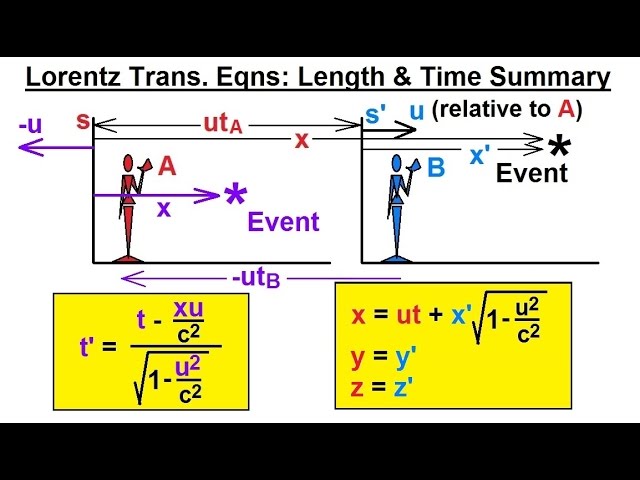
The mathematics of Lorentz Transformations, which provide the equations to calculate time dilation and length contraction.
Minkowski spacetime diagrams to visualize world lines, light cones, and the relativity of simultaneity.
Relativistic mechanics, including how momentum, mass, and energy scale at high velocities, culminating in E=mc².
Real-world empirical evidence for relativity, such as cosmic-ray muon decay observations and GPS satellite time correction.
An introductory transition to General Relativity, analyzing how acceleration and gravity warp the geometry of spacetime.
3M views116.3Klikes12:58Original Release: 2020-08-13
hey everybody today i'm going to be showing you what it would look like if we slowed down the speed limit of the universe to near walking speed so what would it look like if the speed of light it were only about two meters per second well then we would start to see some of the relativistic effects that seem so far-fetched to us in our daily lives i'm going to be using a relativity physics simulator created by mit now in this physics simulator what they did is they slowed down the speed of light so they slowed down the speed limit of the universe to be at near walking speeds and they actually turned it in a game to make it a little bit more interesting what they did is there's these small orbs in the game and as you collect them it slows the speed of light down so at first the speed of light is pretty slow already but as you collect these orbs it gets slower and slower and slower your walking speed stays the same but in this game because the speed of light has been slowed down when we start walking we start to see relativistic effects that include time dilation and length contraction and also doppler shifting okay let's collect these orbs now so in this simulation you can see on the bottom bar here on the left is the number of orbs collected the more i collect the slower the speed of light is going to go on the bottom right hand corner you can see the white needle is the speed of light and then you can see my walking speed on that same dial so what this means is that as i collect more orbs the speed of light is going to slow down more and more and more and my walking speed is going to get closer and closer and closer to it as i walk so finally when i collect the last ore my walking speed is going to be really close to the speed of light so the relativistic effect should be really strong by the end of it so as you start walking through the game one of the first things that you'll notice is that as soon as you start walking you see a color shift happen now this color shift is due to the doppler effect the doppler effect occurs when you're moving relative to the source emitting light so in this village that we're walking around in you'll notice that there's some huts with chimneys there's some cliffs in the background and there's these tall pillars now as we're walking around notice the color shift occurring as soon as we start walking we see this color shift towards the blue spectrum now the reason we see a blue shift when we walk towards the source of light is because as we're walking towards it we're seeing the peaks and valleys of those electromagnetic waves occur more frequently and so it seems as though it's actually a higher frequency so what that means is that normally light that we can't see like infrared light as we walk towards it it gets shifted more towards the red end of the spectrum instead of the infrared part of the spectrum so it moves up in frequency and since it moves up in frequency it becomes visible light to us and so you'll notice on these chimneys and the houses as we walk towards it we can actually see it and similarly any light that's behind us is going to be shifted more towards the red end of the spectrum so anything that was visible like red light is suddenly going to become infrared light that we can't see so if we move backwards things become darker or more red now you can see this a little bit more clearly if i walk sideways instead of forward as i walk sideways you can see the side that i'm moving is blue shifted and the side that i'm walking away from is red shifted now this type of doppler shift we can actually see in real life in fact that's how we know when stars or galaxies are moving towards us or away from us is because they're red shifted or blue shifted and it turns out that pretty much everything we look at around us all the galaxies that we're looking at around us are all red-shifted so it means they're moving away from us and because they're all red-shifted that helped us know that the universe is actually expanding because everything's moving away from everything else okay we're really slowing down the speed of light now so the effects are getting a lot more dramatic as i collect these orbs whoa we got a lot there now the other thing to notice is that as the speed of light slows down more and more and more notice that this effect gets stronger and stronger as we walk the doppler shifting is broader so the invisible light suddenly becomes visible to us and also the effect is stronger the brightness increases that's because as we're walking towards it we're actually hitting more photons along the way than we normally would so basically it increases the intensity as we're walking towards it as opposed to just standing still now in normal life we don't see this effect at all because it doesn't really matter how fast we're walking we're in such a slow speed compared to the speed of light that we don't see the increase in photons but in this simulation the propagation of light is so slow that if we start walking towards it we can really pile up those photons in front of us and so that you can really see this intensity increase as we walk towards it and you can also see the intensity decrease as we walk away from something that's why it just gets darker and dimmer and more red shifted okay now the doppler effect is interesting but now let's get into the really interesting parts time dilation and length contraction so first let's talk about time dilation so when you move closer to the speed of light your time relative to somebody who's not moving decreases so your clock slows down now to understand why your time slows down when you start moving faster think of it this way space and time are always connected if you're completely at rest not moving all of your movement is going through time and not through space so you're at rest but you're still moving forward through time but if you start to move forward through space then that means your movement through time has to decrease so the faster you move through space the slower your movement through time is going to be until eventually if you're moving at the speed of light all of your movement is through space so none of it can be through time so at the speed of light there's absolutely no movement through time now of course this time dilation is only relative to somebody watching you do that movement but you yourself always experience time at the same rate but how it portrays itself to you as the first person view as the person who's walking at close to speed of light speeds is that it seems like you're going faster so you can get more movement through space in a given time now you can see this effect in this way notice in this part of the game there's some evenly spaced orbs so as i collect each orb the speed of light is going to get slower and slower and slower even though my walking speed is going to be the same so what that means is that even though my speed is the same the relativistic effects are going to get stronger and stronger and stronger as i collect each orb and that means also that each orb i'm collecting my time dilation is getting stronger and stronger and stronger even though i'm staying at the same walking speed and so you'll notice that as i collect each one notice the time interval in between collecting them gets shorter and shorter and shorter and what that means is that for me experiencing it it seems like i'm getting to each one faster but the reason that it seems like that is because my time is actually getting slower relative to somebody watching me so i'm able to cover more distance in a given amount of time so that's time dilation effectively as a person who's moving at extreme speeds close to the speed of light what you would experience in terms of time dilation is that you can get from point a to point b seemingly faster than you could normally okay now the other effect here is length contraction now this is something that blew my mind with this simulation it's nothing something that i never really grasped until i did the simulation okay so first remember that when something approaches the speed of light its length contracts so the faster you go the more squished that your length becomes so as you approach the speed speed of light you get more squished so that goes both ways for example if you were on a train going near the speed of light somebody watching that train pass would say that the train were actually shorter than it was and if you were on that train and you were watching some stationary object you would say that that thing was actually shorter so both of you would say that each thing is shorter so as you approach the speed of light things get squished together but here's the interesting point notice in this simulation as i start to walk so as i approach the speed of light things get stretched out now the easiest way to see this is i'm going to turn off the doppler effect collect my last orb so now the speed of light is really close to my walking speed so the relativistic effects are really strong here so notice as i start to walk now notice how far away the cliffs seem like they get so the length gets stretched out but i just told you that when you go closer to the speeds of light length actually contracts now this is a really confusing point and a lot of people have gotten this wrong in the past in fact there was an entire book written on the subject by an author named gamal in 1940 and the book was about a person who they rode their bike through this mystical city and in that city the speed of light was slowed down so much that it was about the speed of a bicycle but in his book he mentioned how as he rode his bicycle all the lengths contracted so everything looked squished together and that would seem like what it should be but here's the interesting point for the most part length contraction does not appear as something being squished but it actually appears as something being stretched out and lengthened and also rotated a little bit even though length contraction is occurring this is not what you would see what you would see is completely different than what you would measure as length and that's because the photons in your line of sight in the direction of your travel are leaving the thing that you're seeing at different points in the past so for example if you're looking at something you see it being stretched out because the photons from the back of it take longer to get there than the front of it and so it actually appears as though the thing is being stretched out and not contracted even though it really is being contracted now this is strange because it completely distorts our view of reality what we're seeing is not what actually is so as you approach the speed of light i had always imagined it that everything becomes squished squished squished together until eventually everything's compact together and you're seeing everything kind of all at once but that's not what it would look like what it would look like is that everything becomes spaghettified out really long the closer you get to the speed of light this more stretched out everything gets in front of you and also the faster it seems like you're getting to each place because your time has slowed down so really what it looks like to approach the speed of light in terms of length contraction and time dilation is that everything gets stretched out and you seem to start going at almost infinite speeds until eventually at the speed of light everything is infinitely stretched out and you're passing it at infinite speeds now what this also means in terms of length contraction is if something were moving in front of you at near speeds of the speed of light you wouldn't actually see it being squished together either in that direction what you would see is that we're actually stretched out and rotated a little bit so for example if a dice flew in front of you at near speeds of light it wouldn't look contracted actually so instead of looking like this it would look like this now even after special relativity first came out it took another 50 or so years until one physicist named james terrell actually came up with the idea of the body looking like it were being rotated and this effect is actually named forum it's a little-known effect called the terrell effect and what it means is that you don't see something contracted when it's going near the speed of light but you actually see it stretched out and rotated and you can see this in the game when i walk right and left it seems like i'm turning so i'm only moving to the right here but it looks like i'm turning i'm not turning at all that's just the apparent rotation due to the terrell effect and notice also that when i move backwards everything seems to come towards me so that's where the length contraction seems to occur but it actually happens when i'm moving backwards away from stuff alright so that is what it would look like if the speed of light were slowed down so what this would mean in this simulation is if you wanted to stay younger longer you'd have to move more so the people who were pretty active in life they would age slower than the people who were pretty sedentary in life and it's funny how close this is to almost our reality but for a different reason and thanks for watching another episode of the action lab i hope you enjoyed this one and if you have any questions let me know in the comments section and i'll try to get to them and check out the actionlab.com if you want to see the action lab experiment boxes and also you can hit the bell and turn on your notifications to be notified when my latest video comes out and thanks for watching and i'll see you next time
Up Next

34:24
Orbital Mechanics Explained: Newton & Kepler's Laws
@TheDocumenteriesTube
515.7K views•2017-12-30

12:53
21cm Hyperfine Transition in Neutral Hydrogen: Radio Astronomy Basics
@AaronRobertParsons
12.4K views•2011-10-13
8:50
Acoustic Levitation Physics: Standing Waves and Pressure Nodes Explained
@TheActionLab
306.5K views•2022-03-11

27:14
Entropy and the Second Law of Thermodynamics Explained
@veritasium
27.5M views•2023-07-01
Related Study Plans & Knowledge Roadmaps
Structured learning paths in Physics
physics
Nuclear Physics (Decay, Fission & Reactors)
01Atomic Structure and the Binding Force
02Radioactive Decay and Half-Life
03Nuclear Fission Mechanics and Chain Reactions
+ 2 more learning modules
12h5 modules
Explore Roadmap
physics
Soft Matter (Polymers, Colloids & Rheology)
01Foundations of Soft Matter & Thermal Forces
02Polymer Physics and Macromolecules
03Colloids, Surfactants, and Self-Assembly
+ 2 more learning modules
38h5 modules
Explore Roadmap
physics
Analytical Mechanics: Lagrangian & Hamiltonian
01Mathematical Foundations: Calculus of Variations
02From Newtonian Mechanics to Constraint Dynamics
03The Principle of Least Action & Lagrangian Mechanics
+ 3 more learning modules
28h6 modules
Explore Roadmap
physics
General Relativity (Spacetime & Cosmology)
01Foundations of Relativity: Special Relativity
02The Geometry of Spacetime: Equivalence Principle & Curvature
03Einstein's Field Equations: The Mathematics of Gravity
+ 2 more learning modules
55h5 modules
Explore Roadmap