






![[11.1] Giải tích 1](https://i.ytimg.com/vi/FvX3nSP9HgI/maxresdefault.jpg)

![41) Kuvvet Serileri Soru Çözüm II [Problem Solving on Power Series II]](https://i.ytimg.com/vi/FKmdLlcWm_Y/maxresdefault.jpg)










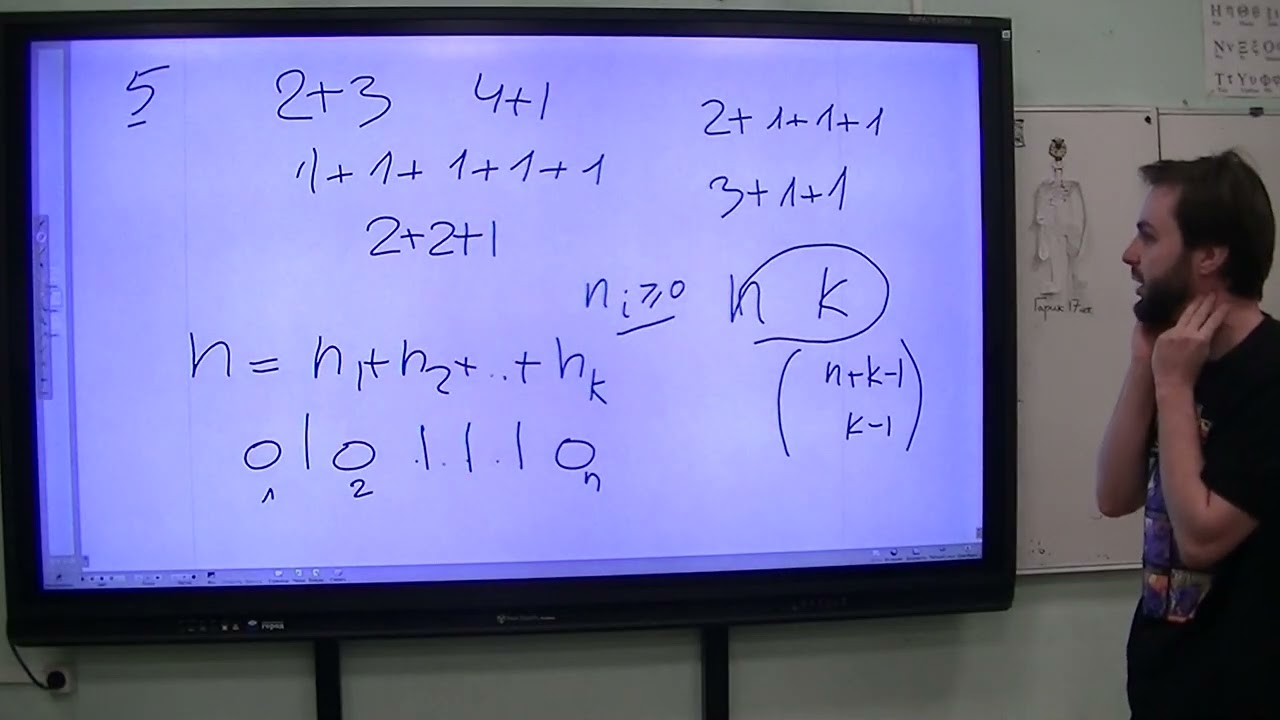
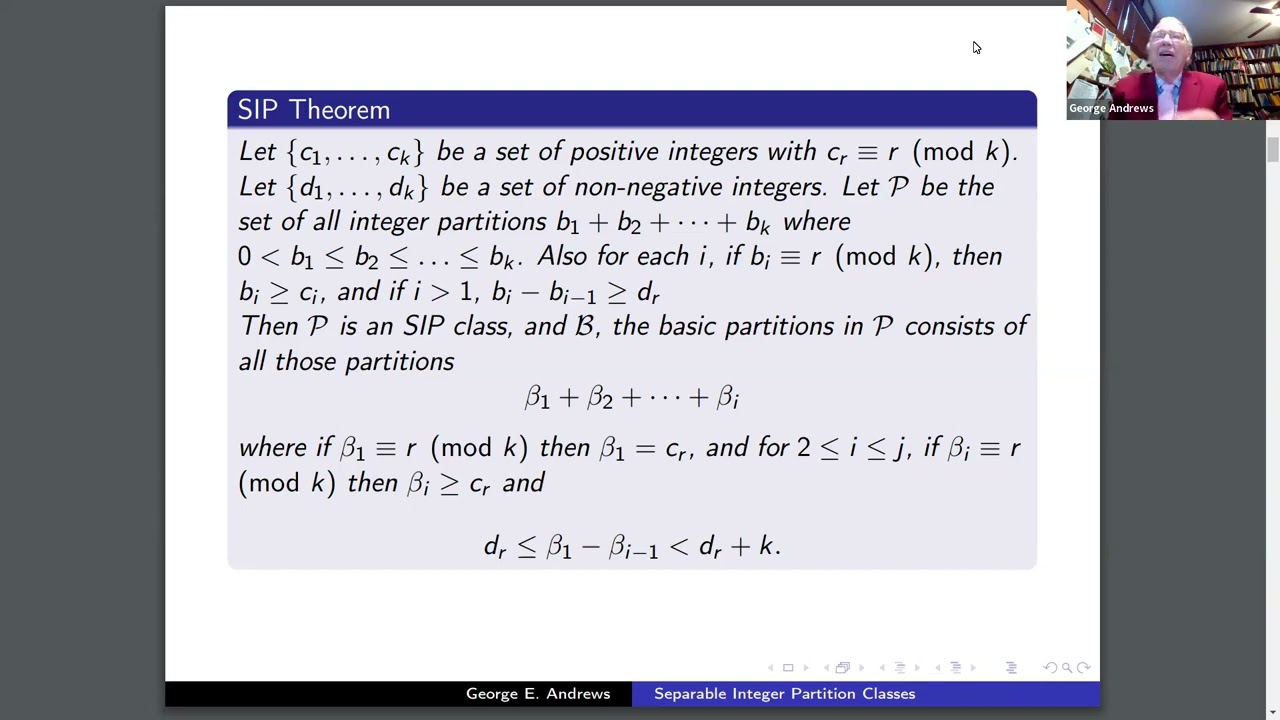



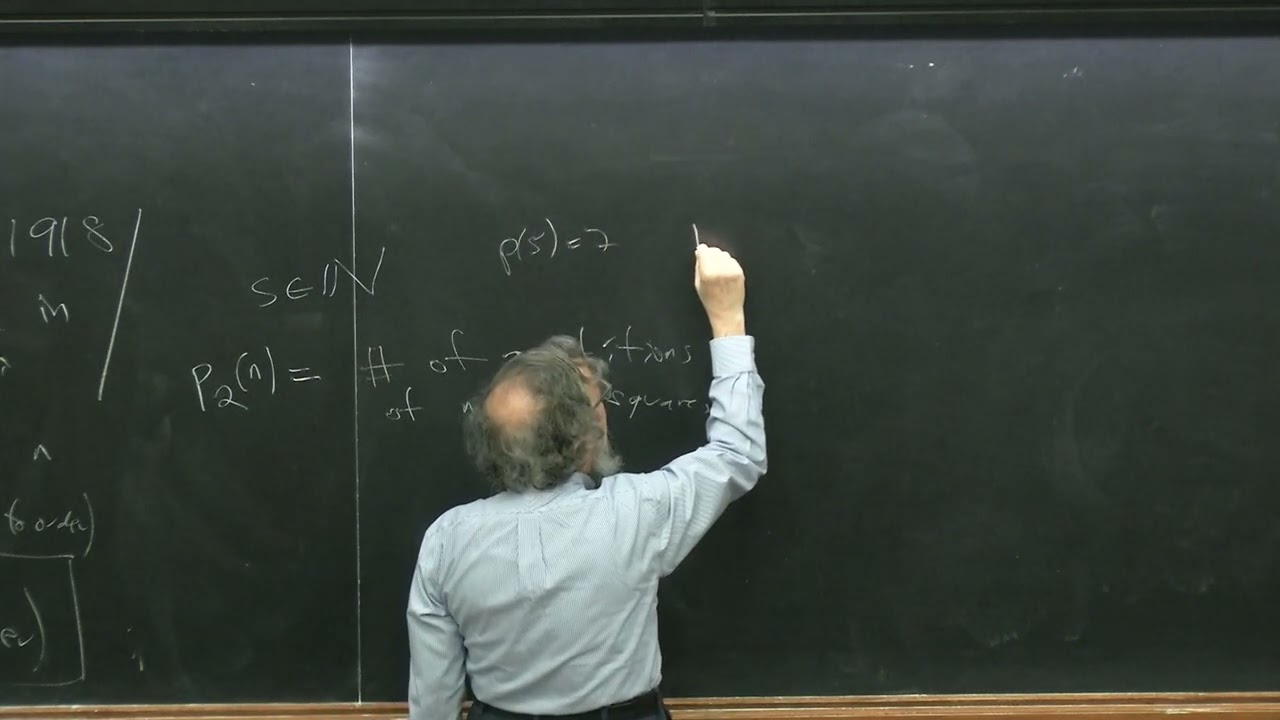





A generating function for integer partitions of n with k or fewer parts is given by the product formula ∏_{i=1}^k 1/(1 - yx^i), where the exponent of y tracks the number of parts and the exponent of x tracks the size of the partition; this is proven by expanding each term as a geometric series and recognizing that the resulting exponents correspond to integer partitions in multiplicative notation. Two additional theorems extend this concept: the infinite product ∏_{i=1}^∞ 1/(1 - yx^i) equals ∑_{n=0}^∞ y^n x^n / [(1 - x)(1 - x^2)...(1 - x^n)], representing all integer partitions sorted by length, and ∏_{i=1}^∞ 1/(1 - x^i) equals ∑_{n=0}^∞ x^{n²} / [(1 - x)(1 - x^2)...(1 - x^n)], representing all integer partitions constructed by starting with an n×n square and adding partitions to the right and top.
Generating Functions for Integer Partitions Explained
Added:so this video gives generating functions for integer partitions of n this is a nice topic so here's our first theorem this is the generating function for all integer partitions of n with k or fewer parts i'm keeping track of the number of parts with the exponent of y and i'm keeping track of the size of the integer partition with powers of x so for example if i had an integer partition of 10 with seven parts that would correspond to a y to the seventh power x to the tenth power in this expression so the theorem is that this generating function which gives me information about integer partitions is given by this expression here now if you haven't seen this notation before this is a capital pi and it means to multiply all these terms together instead of summing them if i wrote a capital sigma so let's prove this theorem the proof really just comes from expanding each term in this product as a geometric series so we see that the generating function we have here expanded as a geometric series so what i'm saying is 1 over 1 minus y x that's the geometric series 1 plus y x to the first power plus y x to the second power and so on the second term the 1 over 1 minus y x squared that's another geometric series but it's a geometric series and y x squared so i get 1 plus y x squared to the first plus yx squared squared and so on and this keeps going until i get the last term in my product which would be expanded as a geometric series 1 plus 1 plus y x to the k power to the first plus y x k power squared and so on so that's the generating function we have and i'm going to think about expanding this multiplying everything out and getting all the terms in the expansion so the terms in the expansion are in this first parenthesis i get to select some power of y x so this first parenthesis gives me some power let's say it's a 1 of y x this second parentheses when i expand everything out will give me a term of the form yx squared to the a2 power and i get everything until the last term which would be some power of y x to the k so this is the terms in the expansion if i simplify this a little bit i get y to the a1 plus a2 plus a3 up to a k exponent and the exponent on x is 1 a 1 plus 2 a 2 all the way up until i get to k a k this really is in disguised form an integer partition in multiplicative notation so this gives me my lambda where i'm going to use the multiplicative notation 1 a 1 times 2 a 2 times 3 a 3 times up to k a k times so using the multiplicative notation for integer partition i see that these exponents and x correspond to each integer partition you give me different exponents a1 a2 a3 i'll give you a different integer partition so this gives me an integer partition in multiplicative notation and how many parts are in the integer partition how many integers are in there well a1 plus a2 plus a3 that's the exponent on y so this is the integer partition and this is the length of the integer partition that actually ends the proof so that's actually the proof of the theorem all i really did was take each term in this product expand as a geometric series and then think about what i get when i multiply terms in those series together i get this kind of expression which corresponds exactly to exponents that have integer or correspond to integer partitions so x is the length of the integer partition and y is the length and x is the size of the integer partition okay so that is a generating function for integer partitions and since i think these kind of products are uncomfortable at first i'd like to do two more theorems playing with this idea so here is a theorem the product i going from 1 to infinity of 1 over 1 minus y x to the i power that's going to equal the sum and going from 0 to infinity y to the n x to the n divided by 1 minus x times 1 minus x squared until i get to 1 minus x to the n power okay so let's prove this now if we weren't in a course on combinatorics or discrete mathematics and you were handed this identity that this infinite product is equal to this infinite sum it may not be instantly apparent that you're having anything to do with integer partitions but if you interpret both sides combinatorially so if you interpret both sides as counting something or understanding integer partitions in some way then the theorem actually becomes easier to prove so this is a technique that can be used in not just discrete mathematics so if i look at the left side it's actually the same expression i have here in our previous theorem with the exception that i have an infinity here instead of a k that would mean that my generating function is for all integer partitions without a restriction on the length so the length could be anything if i have an infinity up here because i'm not going to you know have any this restriction anymore so the left side counts all possible integer partitions where the power of y gives me the length of the integer partition and the power of x gives me the size of the integer partition so i want the right side of the equation to do the same thing i want the right side of the equation to be a generating function for all integer partitions where the power of y gives me the length and the power of x gives me the size so i'm going to do that in the following way so i'm going to consider creating or maybe i'm going to even sort integer partitions by their length and here's what i mean by that you can create any integer partition in the following way you first pick an n so you first pick an n so i'm going to say n is equal to whatever so you pick a value n and say that your integer partition lambda must have n parts so to create any integer partition i'm first going to pick its height it's length it's height if i draw the young diagram in french notation so i have maybe n cells and i'm going to say i'm going to create an integer partition and i want the height to be exactly n after you create an integer partition and you say that the height is n you then have to fill out the rest of it there's a depiction of a integer partition maybe by inserting more cells to the right of this initial first column so to create any integer partition i'm going to create a column of length n where n could be any number and after i create the height of that first column i'm then going to fill out the rest of the integer partition let's call that remaining part lambda that's what this right side actually is doing check it out y to the n power y is the length of the integer partition so if i'm saying that the length is n then i want y to the n power y to the n power x counts the total number of cells in my integer partition if i say that the first column has height n then there has to be n cells in there so this accounts for the length and this accounts for the cells in the first column then if you imagine multiplying by a 1 here this circled part is actually the generating function we have in our original theorem except i'm taking y to be one so i'm not keeping track of the the length of the remaining integer partition i'm saying just give me any integer partition you want as long as the the length is less than or equal to n so this circled part gives me lambda with the length of lambda less than or equal to n which is what i need to fill out everything to the right of the integer partition so that's all i'm actually going to describe here i'm not going to write out all the details in this video hopefully i'm getting the point across though the left side is all integer partitions where y gives me the height and x gives me the number of cells the right side of the equation does the same thing it constructs any integer partition by first sorting by length so you're first going to say how high you want it to be that's the x to the n y to the n terms and after you pick its height you can fill out the rest by slapping an integer partition to the right you just don't want that integer partition to be taller than your first column so you have this restriction you get that generating function from the original theorem let's do one more to finish out this video these are kind of fun so let's do one more theorem that's similar to this so here's a theorem let's see if you can catch what we're doing here so the product i going from 1 to infinity of 1 over 1 minus x to the i is equal to the sum n going from 0 to infinity of x to the n squared times 1 minus x all the way up until i get to 1 minus x to the n 1 minus x until i get to 1 minus x to the n so what do i have on the left the left is my generating function for integer partitions except i guess i'm taking y equals one in this example i'm not too interested about keeping track of the length or the height of the integer partition when i draw the young diagram so this just gives me the generating function for all integer partitions of n right here this side the right side should give me the same thing this hopefully will be a generating function for all possible integer partitions where the power on x gives me the number of cells in my young diagram so here's the proof i'm going to create any integer partition by first drawing the largest square that can fit inside an integer partition so create integer any integer partition this way i don't think i'm going to describe in words what i'm going to do i think i'll on page i think i'll just describe them out loud so here's what i'm going to do first i'm going to create an integer partition by drawing a square of side n so this is going to be an n by n square after you draw this n by n square to the right of the square so in this region here draw any integer partition you want as long as the height is less than or equal to n so you don't want the height to be taller than the height of the square to draw any integer partition you want like that let's call that integer partition lambda so it's similar to what we just did before where i'm putting i'm starting the integer partition with some cells and then i'm putting the rest of the integer partition to the right next put any integer partition you want on the top of this square as long as that integer partition doesn't stick out past the width of the square so put any integer partition you want in this region so let's call that integer partition mu so again the method of construction is to start with an n by n square after you have that square put any integer partition you'd like on the right as long as the length of lambda is less than or equal to n then put any integer partition you want on top as long as the maximum part of mu is less than or equal to n so we want the maximum of mu to be less than or equal to n and as we saw when we discussed integer partitions in our first video that corresponds to the length of the conjugate partition mu prime less than or equal to n any integer partition you like can be created this way and that's exactly what's counted by this sum x to the n squared power that accounts for the n squared cells here then i have 1 over this product as we've seen that gives me an integer partition lambda with less than or equal to n parts and i actually have another one that gives me mu so this gives me my lambda and this gives me my mu and so i'm counting all integer partitions in two different ways these sums have to be exactly the same okay wonderful
Up Next

Generating Functions for Integer Partitions | Number Theory 30
@mathmajor
3.5K views•2022-09-13

Elliptic Curve Cryptography Explained: ECC, ECDSA, ECDH
@PracticalNetworking
28.5K views•2024-10-21
Fourier Series Introduction: The Big Idea Explained
@DrTrefor
387K views•2021-05-03

The Mathematical Impossibility of Accurate World Maps
@Vox
23.3M views•2016-12-02
Related Study Plans & Knowledge Roadmaps
Structured learning paths in Mathematics