






















Proper ballasting of a remotely operated vehicle (ROV) involves adjusting stainless steel weights to achieve neutral buoyancy, where the ROV neither sinks nor floats excessively; this is determined by tossing the ROV nose-down and observing how quickly it rises, with the ideal condition being water lapping over the top of the float block, and adjustments should be made evenly on both sides to maintain balanced trim characteristics.
VideoRay ROV Ballasting: Pre-Dive Weight and Trim Adjustment
Added:Archimedes' Principle and the physics of buoyancy (positive, negative, and neutral buoyancy).
The concept of water density and how environmental factors like salinity (freshwater vs. saltwater) and temperature affect fluid density.
Basic anatomy and operational principles of Remotely Operated Vehicles (ROVs), including thruster layouts and tether effects.
The definitions of 'trim' and 'ballast', and how center of gravity and center of buoyancy interact to affect underwater vehicle stability.
Advanced piloting and maneuverability techniques for ROVs under varying current and hydrodynamic conditions.
Payload integration physics, specifically how adding sensors, cameras, or manipulator arms affects the vehicle's pre-calculated ballast and trim.
The impact of extreme depth and pressure on buoyancy materials, such as the compression of syntactic foam float blocks.
Real-world mission planning, including pre-dive checklists and troubleshooting stabilization issues during active underwater operations.
3.7K views9likes5:05Original Release: 2014-12-05
all right so now we're going to talk a little bit about ballasting the sub we want to get the weight just right in the water we want the saw to be nice and neutrally buoyant so we can fly smoothly through the water if the sub is too light we're going to constantly be fighting it with the vertical motor to keep it down it's too heavy just the opposite so very important pre-dive operation ballasting your sub now you notice in your kit everything is shipped with one of these bags of stainless steel ballast weights you notice they're square so they don't roll off the dock which is a nice feature and we're going to show you real quick how to get the sub and get the trim characteristics right from flying so we mentioned a little bit before on the skid here we have a real quick release feature here so we can add and subtract ballast weights as as necessary now the sub comes from the factory ballasted for fresh water we have fresh water tanks in there so that's that's how we send everything out if you're working in salt water you know we're going to need to add a little bit more weight a little less weight depending on the density of the water so it's a little bit of trial and error to get this just right and we'll show you how to do that here so this is uh ballasted a little bit light on purpose and i want to show you what happens to the sub when you throw it in so basically we want to look down first we want to make sure that there's nothing below us that we're going to crash the sub into right and damage it so it looks like we're nice and clear to go here we're going to give it a nice little toss nose down we want it to sink a little bit and we want to watch how fast it rises all right so that popped up pretty quickly and you can see here we've got quite a bit of the float block sticking out of the water um what we're ideally going for is to get the water just lapping over the top of that of that float block there which is going to give us a nice a nice trim underwater now having a little bit of that block sticking out is going to mean we're a little bit on the positive side and that's that's not a bad thing just a little bit positive is good uh for the fact that and this happens if your tether gets cut on a prop or something you're going to want yourself to come back to the surface so hopefully you can retrieve it so a little bit positive is good this is sticking out way too too far in the water as you can see here we're we're well above we're almost down to the logo of the array text there so i'm going to pull it back out and it's easier to do this upside down you're just going to open that up there's a quick release latch on there and we're going to add weight now we're going to want to do this evenly on both sides uh so we're not we're throwing off the uh the sub on how it's pitching tilting so we're simply just going to add a few weights to the side and the more you do this the better you get at it you'll know how much to add and if you're working in the same spot every time you should only have to do this once it's only when you're moving a different density water so on and so forth so we're going to want to put an equal amount in the front and the back so we're not nose or tail heavy this was purposely done a little bit light so we're going to add them all right let's give that a shot make sure these are latched down now if you're really in a in a rough environment you know it never hurts to put a piece of tape around or something like that to keep these shut but the clamps are pretty solid on them make sure that should hold tight just just fine so again we're going to go nose down and make sure it submerges we're going to watch to see how fast it comes back up all right so that's if it's coming up at all it's coming up extremely slowly so we have a little bit too much weight on it pretty close though so we're just gonna maybe take one or two outside so two out of each side that should be just about right one more time nose down all right that came back up nice and slow we have water just lapping over the top of that and we're just perfect ready to go flying
Up Next
13:27
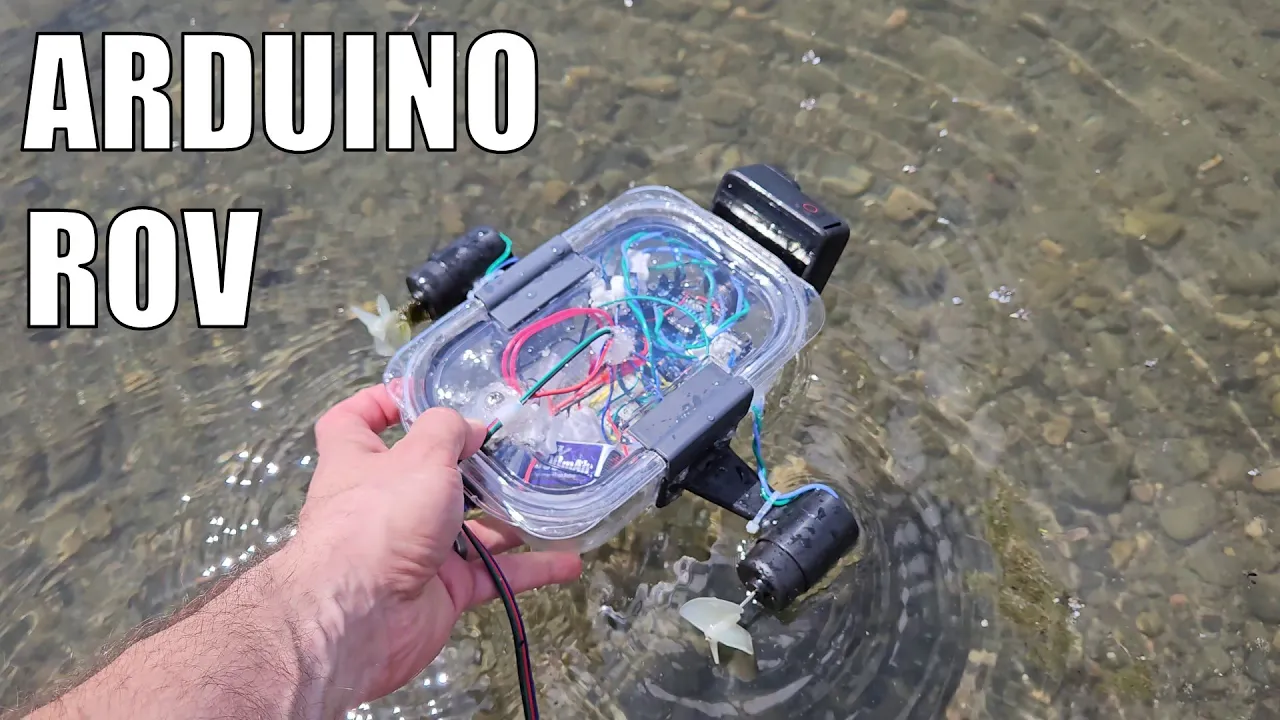
Build an Arduino-Powered Underwater ROV: Engineering Project
@Science.Buddies
98.3K views•2023-05-24

12:54
Triumph of Orthodoxy Icon: Byzantine Art & History Explained
@BenCallan
2.1K views•2024-08-06

9:49
FastAPI vs Flask vs Django: Choosing the Right Python Web Framework
@TechWithTim
302.5K views•2024-05-26

1:42
Game of Thrones Opening Credits: A Cinematic Analysis
@gameofthrones
46.3M views•2011-04-18
Related Study Plans & Knowledge Roadmaps
Structured learning paths in General & Interdisciplinary Studies
general-studies
Elevator Engineering: History, Physics & Cities
01From Hoists to Safety Brakes: The Dawn of Vertical Lift
02Hydraulic vs. Traction: The Engineering Physics of Elevators
03Modern Speed, Safety, and Algorithms
+ 2 more learning modules
12h5 modules
Explore Roadmap
general-studies
Rubber: Material Science, History & Geopolitics
01Origins of Natural Rubber & Mesoamerican History
02The Chemistry of Natural Rubber & Vulcanization
03The Geopolitics of the Rubber Boom & Colonization
+ 2 more learning modules
12h5 modules
Explore Roadmap
general-studies
Containerization: Evolution, Logistics & Trade
01Ancient Trade & Bulk Cargo: Amphorae to Barrels
02The Industrial Revolution & Cardboard Packaging
03The Containerization Revolution: Malcom McLean
+ 2 more learning modules
12h5 modules
Explore Roadmap
general-studies
Textile Tech: Evolution, Labor & Global Impact
01Pre-Industrial Textiles: Handloom & Cottage Industry
02Mechanization: The Spinning Jenny to the Power Loom
03The Factory System & Global Labor Transformation
+ 2 more learning modules
10h5 modules
Explore Roadmap