A central bank is an independent government institution that manages a country's monetary policy by controlling interest rates to stabilize prices—lowering rates to stimulate economic growth when credit becomes cheaper, and raising rates to reduce inflation when prices rise too high; additionally, central banks preserve financial stability by buying and selling foreign currency to influence their own currency's value and serving as a lender of last resort to troubled commercial banks.
Central Banks Explained: Roles and Monetary Policy in Modern Economies
Added:Deep Dive
Basic understanding of inflation, deflation, and how general price levels affect purchasing power.

Ko Cần Giỏi, Vẫn ĐỌC HIỂU TIẾNG ANH 100% | Ước Mơ Đã Thành Sự Thật
421.6K
This section explains deflation as the opposite of inflation. Using the same candy example, the presenter shows how decreasing prices from 1,000 to 500 units means you can buy twice as much with the same money. The presenter explains that deflation means prices decrease while purchasing power increases. The presenter then connects this to the concept of purchasing power - the amount of goods and services you can buy with your money. The presenter emphasizes that understanding both inflation and deflation helps readers understand how price changes affect their financial situation. The presenter notes that these concepts are fundamental to understanding economics and personal finance.
Click to watch →

INSS: INFLAÇÃO, SALÁRIO, REAJUSTE E PODER DE COMPRA
2.8K
Inflation is the continuous rise in prices of goods and services families consume, including food, medications, fuel, and utilities. Deflation is the opposite—when prices decrease. The INPC index measures these price variations for families earning one to five minimum wages. When inflation is high and salaries remain constant, purchasing power decreases, meaning the same money buys fewer goods over time. This creates a fundamental challenge for workers trying to maintain their standard of living.
Click to watch →

PSSSB EXCISE Inspector Gk PYQ 2026 | Patwari & PSSSB Clerk GK/GS SERIES BY DEEPAK BATRA SIR | #23
906
Inflation is a general increase in price levels, reducing money's purchasing power. Deflation is the opposite - a decrease in prices. Types of inflation include: (1) Demand-pull inflation - when demand exceeds supply, (2) Cost-push inflation - when production costs rise, (3) Menu cost inflation - when product sizes decrease while prices stay constant. The Reserve Bank of India targets inflation between 0-4% (2% plus or minus 2%). Understanding these concepts helps analyze economic stability and monetary policy decisions.
Click to watch →

【インフレ/デフレがわかれば人生が変わる】GENERATIONS・小森隼×代ゼミカリスマ講師/「貯蓄と投資」どっちがトクかはこう考えろ/給与明細の金額よりも大事な「本当の賃金」
5K
This segment defines inflation as a continuous increase in overall price levels and deflation as a continuous decrease. The critical concept is purchasing power—the ability of money to buy goods and services. During inflation, purchasing power decreases (e.g., a 100 yen bill buys half as much if prices double). During deflation, purchasing power increases. The segment uses concrete examples like juice prices rising from 105 yen to 714 yen over 20 years to illustrate how inflation erodes money's value over time.
Click to watch →

Inflación para Arruinarte, Deflación para Dormirt
685
This comprehensive section explores the fundamental economic concepts of inflation and deflation. Inflation refers to rising living costs where money becomes less valuable, eroding purchasing power and potentially destroying the middle class. Deflation, conversely, means everything costs less, increasing purchasing power. The video illustrates these concepts through real-world examples: televisions have become dramatically cheaper (from expensive luxury items to 200-300 euro devices), while smartphones have become more expensive. This divergence is explained through economies of scale, where mass production reduces per-unit costs for some products while others incorporate new features that justify higher prices. The section also introduces purchasing power parity, showing how the same income buys more in countries with lower price levels like Thailand or Peru compared to Spain.
Click to watch →
Deep Dive
The fundamental structure of the commercial banking system and the concept of fractional reserve banking.

Is Islamic Banking Really Islamic? (Don't Watch If You Can't Handle the Answer)
28.3K
Fractional reserve banking is the fundamental structure of the global banking system. When a customer deposits money in a bank, the bank keeps only a small percentage (typically 10%) as reserves while lending out the remaining amount (90%) to borrowers. For example, if a customer deposits ₹1 lakh, the bank keeps only ₹10,000 and lends ₹90,000 to another customer. This process creates money out of thin air, as the bank creates new currency that doesn't physically exist. When the borrower deposits this money elsewhere, the cycle repeats, creating even more money. This system allows banks to multiply the actual money supply by approximately 10 times.
Click to watch →

14 02 The Origin of Central Banking
348
Commercial banks take deposits and make loans, forming the basis of modern banking. Fractional reserve lending allows banks to hold only a percentage of deposits as reserves while loaning out the remainder, creating a money multiplier effect. The multiplier equals one divided by the required reserve ratio, determining how much the money supply can expand from high-powered money. Modern high-powered money consists of currency in circulation, vault currency, and federal reserve credit, replacing historical silver dollars as the foundation of monetary systems.
Click to watch →
5.2 - Banks and Balance Sheets
413
The fractional reserve banking system is a fundamental banking model where banks hold only a fraction of deposits as reserves rather than keeping all money on hand. Key concepts include: (1) Required reserve ratio - the percentage banks must hold as reserves; (2) Excess reserves - funds beyond requirements that banks can lend out; (3) Balance sheets showing assets (reserves, loans) and liabilities (deposits). Banks create money by lending excess reserves, which enables economic activity while maintaining liquidity for depositor withdrawals.
Click to watch →

Los retos de la Banca ante la aplicación de Basilea III
325
The fractional reserve banking system is the fundamental mechanism by which banks create money. Banks are legally permitted to create new money from customer deposits, which creates an inherent uncertainty about the proportion between created money and held reserves. This system means that when a depositor withdraws their money, the bank must be able to honor that request at any time. The system operates on the principle that banks can lend out more money than they hold in reserves, which is the basis of modern banking operations. The 100% reserve banking system is an alternative where banks cannot lend out more money than they hold in reserves, eliminating the uncertainty but also the ability to create credit.
Click to watch →

Fractional Reserve System & Evolution of Banking | Money & Banking | GE Sem-3, B.com(H), BA, BSc, DU
59.5K
Fractional reserve banking is a system where banks keep only a fraction of deposited funds as reserves and lend out the remainder. With a 20% reserve ratio, if a customer deposits ₹100, the bank keeps ₹20 as reserves and lends ₹80 to another customer. The bank issues bank notes for the lent amount, which circulates in the economy. This system allows banks to generate income through lending while maintaining enough reserves to meet customer withdrawal demands. It is the foundation of modern banking and enables credit creation, as banks can multiply the money supply through repeated lending cycles.
Click to watch →
Deep Dive
The distinction between fiscal policy (managed by governments through taxation and spending) and monetary policy.

income and employment part-12 राजकोषीय और मौद्रिक विधि @shubhpathshala874
106
Monetary policy is managed by RBI and involves controlling money supply and credit conditions. Fiscal policy is managed by the government and involves managing revenue (taxes) and expenditure. When excess demand exists, monetary policy reduces money supply while fiscal policy decreases expenditure and increases taxes. When deficient demand exists, monetary policy increases money supply while fiscal policy increases expenditure and decreases taxes.
Click to watch →

Economics Ch-27/अर्थशास्त्र पाठ-27
115
The key differences between fiscal policy and monetary policy are: (1) Fiscal policy relates to government revenue and expenditure decisions, while monetary policy relates to money supply and credit conditions, (2) Fiscal policy is determined by the government and finance ministry, while monetary policy is determined by the central bank, (3) Fiscal policy uses tools like taxation and government spending, while monetary policy uses tools like interest rates and reserve ratios, (4) Fiscal policy directly affects aggregate demand through government spending, while monetary policy affects aggregate demand indirectly through money supply and credit conditions.
Click to watch →

財政政策と金融政策の違いって何?【公民用語集】
1.3K
Fiscal policy is government-led economic management through public works and tax adjustments to stimulate employment and consumption, while monetary policy is central bank-led (e.g., Bank of Japan) regulation of interest rates and money supply to control borrowing conditions for businesses and individuals.
Click to watch →

Fiscal policy - most important area in degree level exams
317
Fiscal policy and monetary policy differ in several key aspects: (1) Fiscal policy is implemented by the government through spending and taxation, while monetary policy is controlled by the central bank (RBI) through interest rates and money supply, (2) Fiscal policy has no specific target, while monetary policy targets inflation (typically 2-6%), (3) Fiscal policy affects government budget and side effects, while monetary policy affects money supply and exchange rates.
Click to watch →

2) Monetary and Fiscal Policy
424
Monetary policy is distinguished by its first four letters being 'money' - it deals with interest rates, which are the price of money. Fiscal policy is distinguished by its first four letters being 'fisk' - referring to the Roman emperors' Treasury (the gold chest). Fiscal policy involves two main tools: government spending (money going out of the Treasury) and taxes (money going into the Treasury).
Click to watch →
Deep Dive
An introduction to the business cycle, including the phases of economic expansion, recession, and the role of GDP.

Economics lec 3
840
The business cycle consists of four phases: (1) Expansion - GDP grows at a healthy rate (e.g., 8-10%); (2) Slowdown - GDP growth rate begins to decrease; (3) Recession - negative GDP growth for two consecutive quarters; (4) Recovery - GDP begins growing again after recession. If recession continues severely (e.g., -2%, -5%, -8% for multiple years), it becomes a depression (like the Great Depression of 1929-1930).
Click to watch →

Intro to GDP
199
Business cycles are wave-like patterns showing GDP fluctuations over time. A peak is the highest GDP point before decline; a trough is the lowest point. The cycle phases include: contraction (GDP decreasing from peak to trough), recovery (GDP increasing from trough), and expansion (GDP rising above previous peak). One complete cycle runs from peak to peak. A recession is officially defined as at least six consecutive months of GDP contraction. A depression is an especially severe and prolonged recession, with the Great Depression (1929-1930s) being the only one in U.S. history.
Click to watch →
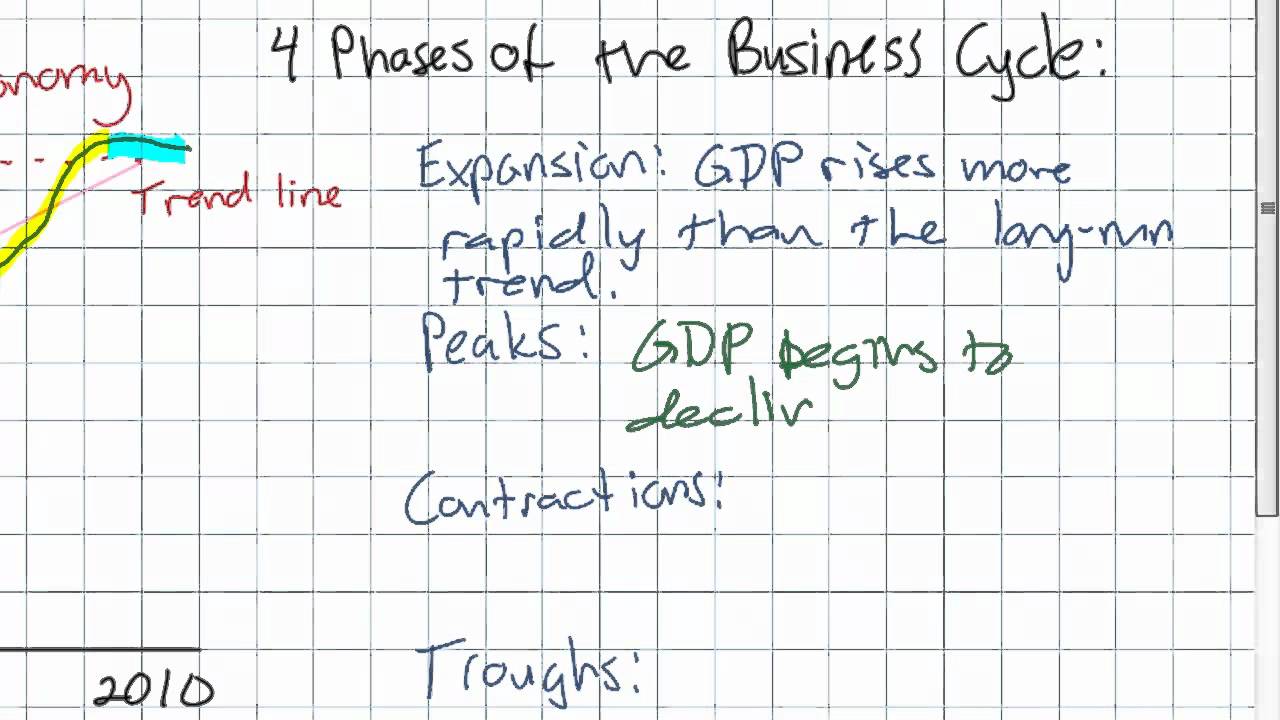
The Business Cycle
143.5K
Any nation's business cycle consists of four distinct phases: (1) Expansion - when GDP increases at a rate faster than the long-run trend; (2) Peak - the highest point where GDP begins to decline; (3) Contraction - when real GDP decreases over time, indicating recession; and (4) Trough - the lowest point where GDP begins to recover and expansion resumes. These phases repeat cyclically over time.
Click to watch →

CFA Level 1 Full Revision series | Episode 1 | THE START
7.2K
The business cycle consists of four recurring phases: (1) Expansion - economic growth with rising GDP, consumption, and production, (2) Peak - maximum economic activity before slowdown, (3) Contraction/Recession - economic decline with falling GDP, consumption, and employment, (4) Trough - minimum economic activity before recovery. These phases repeat periodically, though the timing and severity vary. Understanding the business cycle helps investors make timing decisions and adjust portfolio allocations based on economic conditions.
Click to watch →

What are Business Cycles (Economic Cycles)? | Macroeconomics | From A Business Professor
12.6K
Business cycles consist of four distinct phases tracked using real GDP: (1) Expansion - production increases, employment rises, and incomes grow; (2) Peak - the highest point before decline begins; (3) Recession - production falls, unemployment rises, and incomes decline; (4) Trough - the bottom of the cycle where recovery begins.
Click to watch →
Prerequisite Knowledge
- Concept 01Basic understanding of inflation, deflation, and how general price levels affect purchasing power.
- Concept 02The fundamental structure of the commercial banking system and the concept of fractional reserve banking.
- Concept 03The distinction between fiscal policy (managed by governments through taxation and spending) and monetary policy.
- Concept 04An introduction to the business cycle, including the phases of economic expansion, recession, and the role of GDP.
Subsequent Learning
- Step 01Unconventional monetary policy tools, such as Quantitative Easing (QE), quantitative tightening, and forward guidance.
- Step 02The monetary transmission mechanism, which explains how central bank policy rate changes ripple through commercial banks to influence consumer behavior.
- Step 03Historical case studies of central bank interventions, such as the actions taken during the 2008 Global Financial Crisis and the COVID-19 pandemic.
- Step 04The relationship between domestic monetary policy, exchange rates, and international capital flows in a globalized economy.
Central Bank Roles
Stability's Value
Central Bank Roles
0:00Playing Section
- 1
Central banks manage money flow and set interest rates.
- 2
They adjust rates to control inflation or boost spending.
- 3
They also trade currency and lend to banks in crisis.
The Austrian School of Economics and Free Banking
The Austrian School of Economics presents a fundamental challenge to the necessity and efficacy of central banking. Economists within this tradition, such as Friedrich Hayek and Ludwig von Mises, argue that central banks distort the economy by artificially manipulating interest rates. In a free market, interest rates act as critical signals coordinating savings and investment. When central banks lower rates artificially, they encourage 'malinvestment'—causing businesses to invest in projects not supported by real savings. This creates artificial booms that inevitably lead to economic busts (recessions). Austrian theorists argue that central banks are the primary drivers of the business cycle, price inflation, and currency devaluation. Instead of centralized monetary management, they advocate for 'free banking' or a commodity-backed monetary standard (such as the gold standard), where market forces naturally regulate the money supply and interest rates to ensure genuine, long-term economic stability.
Deep Dive
Unconventional monetary policy tools, such as Quantitative Easing (QE), quantitative tightening, and forward guidance.

Quantitative Easing and the Role of Forward Guidance Featuring speaker Michael P. Dooley
787
This lecture introduces two unconventional monetary policy tools: Quantitative Easing (QE) and Forward Guidance. The speaker argues that both tools are unlikely to be very effective for extended periods. Central banks worldwide, including the Federal Reserve, European Central Bank, Bank of Japan, and Bank of England, face a 'Brave New World' where traditional policy tools have become ineffective. The monetary base represents the liability side of central banks, and before 2008, it showed little variation because the scale of changes was small. Since 2008, central banks have dramatically expanded their balance sheets, with the Fed's balance sheet exceeding three trillion dollars.
Click to watch →

2025 Thomas Laubach Research Conference, Session 4
1.6K
Unconventional monetary policy tools have played a central role since the Global Financial Crisis and were extensively used during the COVID pandemic. The Fed's policy strategy review focuses on evaluating the design, transmission, and effectiveness of these tools. The two most important unconventional monetary policy tools are forward guidance and large-scale asset purchases (QE). Forward guidance is central bank communication regarding the future path of policy or the economy, while asset purchases are asset swaps financed by central bank reserves that change the asset composition of balance sheets.
Click to watch →

Questions Of The day: 1. Monetary policy. 2.NRB Act, 2058 and 3. Unified Directives.
213
Unconventional monetary policy tools are emergency measures used during economic crises. These include: (1) Quantitative Easing - purchasing government securities to inject money into the economy, (2) Forward Guidance - providing commitments about future interest rate policies, and (3) Negative Interest Rate Policy - charging banks for holding deposits to encourage lending and spending during recessions.
Click to watch →
College Fed Challenge Winning Q&A 2020: Dartmouth
2.5K
When federal funds rates reach the zero lower bound, the Fed employs unconventional tools: (1) Quantitative Easing (QE) involves purchasing agency mortgage-backed securities, Treasuries, and corporate credit to push down asset yields and make financial conditions more accommodative; however, balance sheet expansion makes future policy normalization more difficult. (2) Forward Guidance communicates future policy intentions to influence longer-term interest rates through expectations, though excessive guidance creates credibility risks if the Fed must renege. (3) Liquidity Facilities (like TALF, Commercial Paper Funding Facility, and Money Market Liquidity Facility) provide emergency credit support during crises by backing financial markets and ensuring redemption guarantees for investors.
Click to watch →
Janet Yellen, Vice Chair of the Federal Reserve
14.9K
When the federal funds rate is near zero and cannot be reduced further, the Federal Reserve employs two unconventional policy tools: large-scale asset purchases (quantitative easing) and communications about the future course of monetary policy (forward guidance). These tools were employed at the September FOMC meeting to spur job creation and growth.
Click to watch →
Deep Dive
The monetary transmission mechanism, which explains how central bank policy rate changes ripple through commercial banks to influence consumer behavior.

Charles Gave reprend les bases de l'Economie avec vos questions.
162.9K
The policy rate (directeur rate) is the minimum interest rate at which banks can borrow from the central bank. When a central bank raises its policy rate, commercial banks face higher borrowing costs. Since banks cannot lend below their own funding costs, they pass these increases on to consumers and businesses. This creates a ripple effect throughout the economy - higher borrowing costs discourage investment and consumption. The policy rate serves as a signal about monetary conditions; if it rises, banks know that market rates will follow, so they adjust their lending standards accordingly. This mechanism allows central banks to influence economic activity through interest rate policy.
Click to watch →

The transmission mechanism of monetary policy
17.6K
The monetary transmission mechanism describes how central bank rate changes affect aggregate demand, real GDP, and inflation. The central bank sets official rates that influence commercial bank borrowing costs. Market rates charged to borrowers move in the same direction as official rates, with banks maintaining spreads to earn profits. Higher rates reduce borrowing and increase savings, while lower rates have the opposite effect. This directly impacts consumption and investment decisions. Additionally, interest rate changes affect wealth through real estate and stock markets—higher rates reduce housing demand and stock prices, decreasing consumer spending, while lower rates boost asset values and encourage spending.
Click to watch →
Indian Economy - Qualitative Tools of Monetary Policy for UPSC Exams | Lecture 06 | StudyIQ IAS
106.1K
The transmission mechanism explains how monetary policy changes affect the economy. When the Central Bank reduces the repo rate, commercial banks offer lower interest rates to customers. This makes loans cheaper, encouraging borrowing for consumption (cars, laptops) and investment (new businesses). Increased borrowing leads to higher demand for goods and services, stimulating economic growth. The chain is: Repo Rate ↓ → Bank Lending Rates ↓ → Borrowing Increases → Consumption and Investment Increase → Economic Growth. However, transmission may not reach end customers effectively due to banks not passing on rate cuts, people not having bank accounts, financial illiteracy, and competition from alternative investment instruments.
Click to watch →
Monetary Transmission Mechanism, targeting by Central bank || Economics || CFA Level-1
5.5K
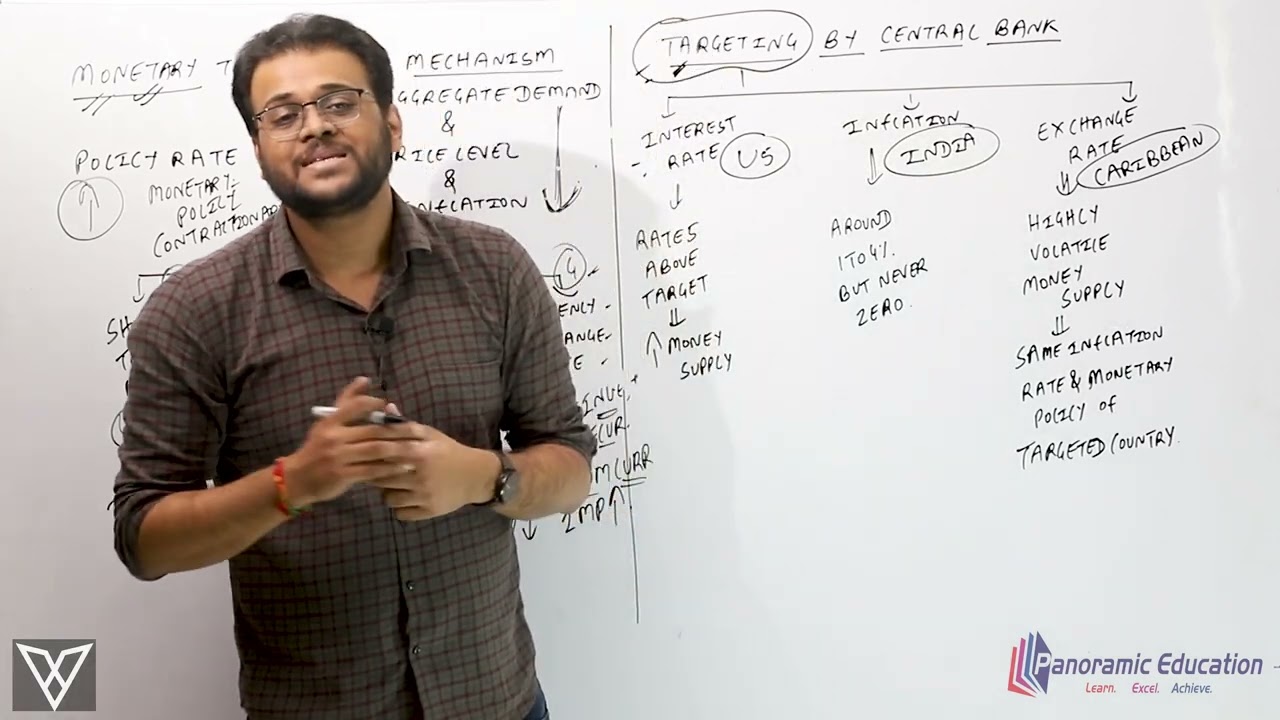
The monetary transmission mechanism explains how changes in central bank policy rates affect price levels and inflation in an economy. When the central bank increases policy rates (such as the repo rate), commercial banks borrow funds at higher interest rates from the central bank, which they then pass on to borrowers at higher lending rates. This makes borrowing more expensive for consumers and businesses, leading them to reduce consumption and investment. As aggregate demand decreases, businesses lower prices to attract customers, resulting in reduced inflation. This inverse relationship between policy rates and price levels is the fundamental principle of monetary transmission.
Click to watch →

Arriva il SALVATAGGIO dei Mercati: la Banca Centrale INIETTA Liquidità (senza usare il QE)
32.2K
Monetary policy transmission operates through a chain: central banks create reserves, commercial banks receive increased liquidity, banks then make more loans, loans create new deposits, and these deposits circulate through the economy. This process only works if banks are willing to lend and borrowers are willing to take loans. If either party is cautious, money remains trapped in the financial system without affecting real economic activity. This mechanism explains how central bank actions ultimately influence consumer spending, business investment, and overall economic growth.
Click to watch →
Deep Dive
Historical case studies of central bank interventions, such as the actions taken during the 2008 Global Financial Crisis and the COVID-19 pandemic.

BCB123 JAMES LAVISH: Where's The Recession?
4K
Central banks have historically intervened during financial crises: (1) 1987 Black Monday—Paul Volcker/Greenspan stepped in to prevent market collapse; (2) 1998 Long-Term Capital Management crisis—Greenspan brokered deals between Goldman Sachs and other banks to save LTCM before it triggered systemic failure; (3) 2008 Financial Crisis—Trillions printed to stabilize markets; (4) 2020 Pandemic—QE and direct stimulus checks. Each time, the Fed intervened to prevent complete market collapse, establishing a pattern of intervention that continues today.
Click to watch →
世界金融規模1000兆ドルの結末
31K
When private sector debt capacity is exhausted, governments and central banks must intervene to prevent economic collapse. They inject massive amounts of money into the market to support the economy. Historical examples include the Federal Reserve's interventions during the 2008 financial crisis and the coordinated global central bank response during the 2020 pandemic.
Click to watch →
The Centrality of Central Banks during the Covid 19 Era: Session 1
290
When the pandemic struck, financial markets seized up with credit spreads widening, the dollar rising, and volatility spiking. Unlike typical risk-off situations, treasury rates rose because even the treasury market ceased functioning. Central banks responded with massive interventions: lowering policy rates, expanding balance sheets, cooperating with treasuries to finance the private sector, and establishing dollar swap agreements. These actions represented an extension of 30-40 years of similar responses starting with the Greenspan put in 1987. By 2008, rates had reached near-zero, forcing experimental tools like quantitative easing. The pandemic response extended support from lender of last resort to market maker of last resort, continuing the pattern of ever-more experimental monetary policy justified under mandates for financial and price stability.
Click to watch →

Bank Capital and Liquidity: The 2008 Global Financial Crisis versus the Covid 19 Pandemic
168
Central banks employed consistent policy responses during both the 2008 financial crisis and the COVID-19 pandemic to cushion economic activity declines. Key measures included lowering interest rates to reduce funding costs, expanding short-term and long-term lending operations to address liquidity issues, implementing quantitative easing (printing money to purchase assets), relaxing bank capital requirements, and creating repo facilities for short-term borrowing. The main objective was to counteract the economic contractions caused by each crisis—freezing financial markets in 2008 and lockdowns in the pandemic—while maintaining financial system stability.
Click to watch →
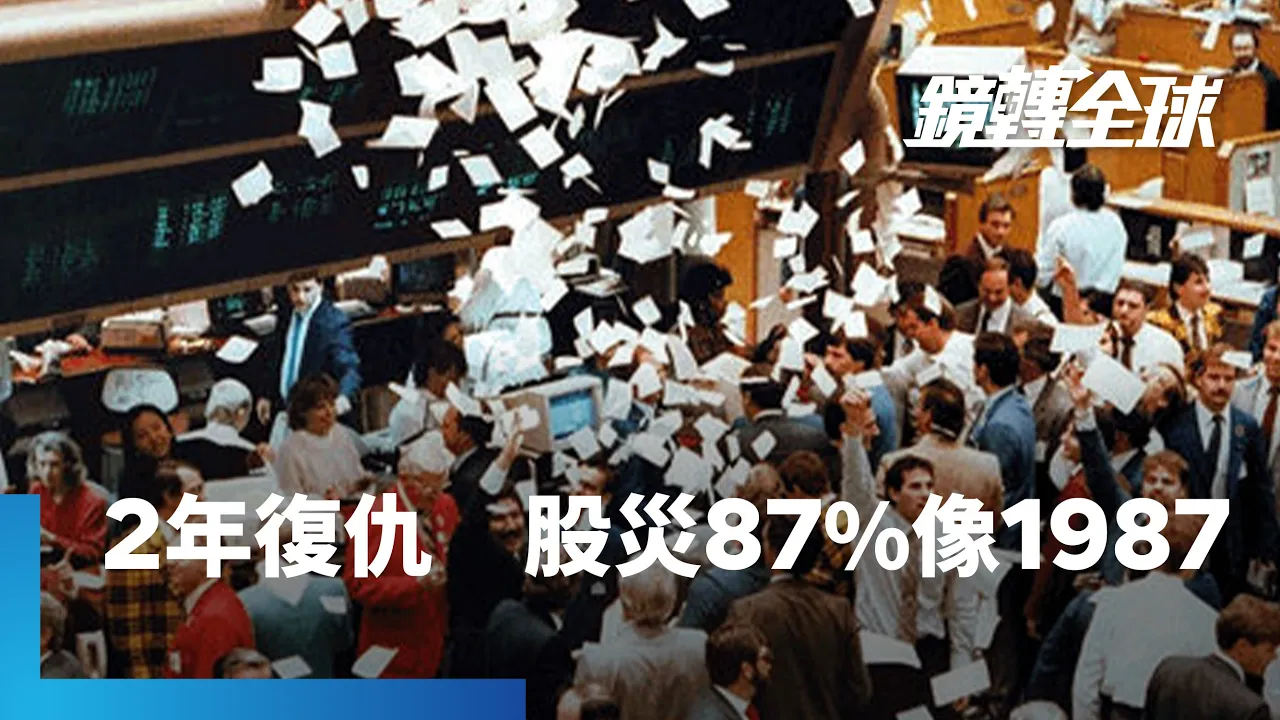
黑色星期一史詩級暴跌有如1987年溫和版 若和當年一樣未破壞金融體系衝擊實體經濟造成衰退反是好事 後來美股在2年內收復失土|鏡轉全球 #鏡新聞
24.5K
This section traces the evolution of central banking responses to extreme market stress. The 2008 financial crisis required emergency rate cuts in January and October as the housing market collapse threatened the financial system. The March 2020 pandemic crisis represented the most aggressive intervention, with the Fed cutting rates from 1.75% to nearly zero in under half a month. These interventions demonstrate escalating responses to increasingly complex crises, showing how central banks have developed tools to address both financial system failures and broader economic emergencies, with the pandemic response representing the most comprehensive emergency monetary policy action in modern history.
Click to watch →
Deep Dive
The relationship between domestic monetary policy, exchange rates, and international capital flows in a globalized economy.
35.000 Tỷ USD Nợ Công: Chiếc Gông Đang Siết Chặt FED Và Đồng USD #fed #usd #nocongmy #laisuat
127
When the US dollar holds the central position of international capital flow, every change in monetary policy is like a force pulling on many economies simultaneously. Not all countries are affected equally, but almost no country can completely stand outside. The first thing affected is capital flow. Money always tends to move to where it believes it will be both safe and profitable. When US monetary policy changes, international capital begins to reassess its destination. Investment decisions that seem to occur only in financial centers quickly spread to markets thousands of kilometers away.
Click to watch →
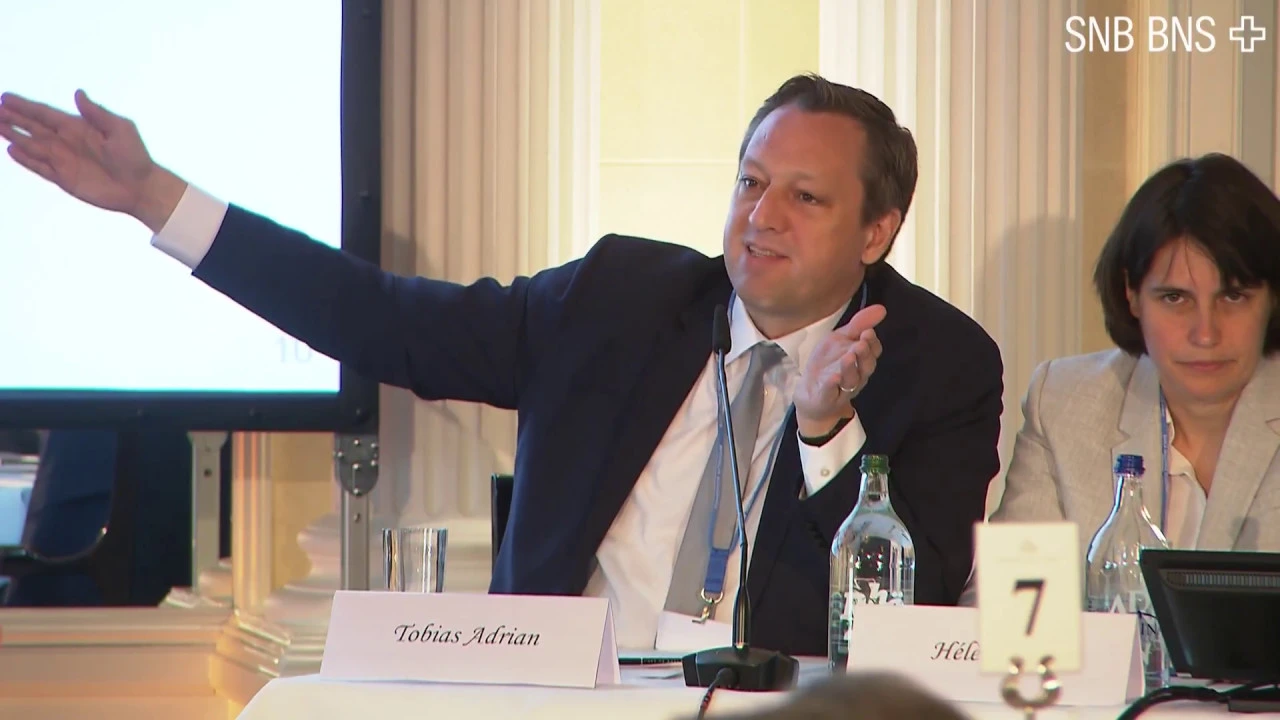
Panel Discussion, 8th High-Level Conference on the International Monetary System, 08.05.2018
1K
Global capital flows are driven by common factors explaining close to 50% of cross-country variation during stress periods. The IMF argues that exchange rate flexibility serves as an important shock absorber by discouraging unhedged foreign exchange borrowing, encouraging hedging instrument development, and reducing dollarization of bank liabilities. Countries with floating exchange rates tend to be less susceptible to financial crises. The IMF maintains an institutional view recommending that countries use domestic monetary policy, sterilized interventions, and temporarily capital flow measures based on specific circumstances. This flexible approach recognizes that no single policy solution works universally.
Click to watch →

FCE UBA | 278 Macroeconomía y Política Económica - La producción, tipo de interés y tipo de cambio
789
Under fixed exchange rates, capital flows determine monetary policy outcomes. When domestic rates exceed foreign rates, capital inflows occur, increasing money supply and forcing the central bank to intervene by selling domestic currency. When domestic rates fall below foreign rates, capital outflows occur, decreasing money supply and forcing the central bank to buy domestic currency. These flows automatically adjust money supply to maintain the fixed rate.
Click to watch →

Economía Abierta. Determinación Renta
237
The balance of payments combines current account (trade in goods/services) and capital account (financial flows). Equilibrium occurs when current account plus autonomous capital flows equal zero—meaning trade imbalances are offset by capital flows. Autonomous capital flows depend on interest rate differentials: capital flows to countries offering higher returns. When domestic interest rates exceed foreign rates, capital inflows; when foreign rates are higher, capital outflows. This creates a mechanism linking monetary policy to international capital movements and exchange rate stability.
Click to watch →

Macro 6.4 - Effect of Changes in Policies and Economic Conditions on the Foreign Exchange Market
10.7K
Interest rate differentials drive international capital flows and currency movements. Lower interest rates cause capital outflows as investors seek higher returns abroad, selling domestic currency and causing depreciation. Higher interest rates attract capital inflows, increasing demand for domestic currency and causing appreciation. Different policy combinations produce consistent outcomes: contractionary fiscal or expansionary monetary policy both lower interest rates and cause depreciation; expansionary fiscal or contractionary monetary policy both raise interest rates and cause appreciation. Understanding these relationships is essential for analyzing how monetary and fiscal policies affect a nation's currency position in the global economy.
Click to watch →
Central Bank Roles
Stability's Value
Central Bank Roles
0:00- 1
Central banks manage money flow and set interest rates.
- 2
They adjust rates to control inflation or boost spending.
- 3
They also trade currency and lend to banks in crisis.
The Austrian School of Economics and Free Banking
The Austrian School of Economics presents a fundamental challenge to the necessity and efficacy of central banking. Economists within this tradition, such as Friedrich Hayek and Ludwig von Mises, argue that central banks distort the economy by artificially manipulating interest rates. In a free market, interest rates act as critical signals coordinating savings and investment. When central banks lower rates artificially, they encourage 'malinvestment'—causing businesses to invest in projects not supported by real savings. This creates artificial booms that inevitably lead to economic busts (recessions). Austrian theorists argue that central banks are the primary drivers of the business cycle, price inflation, and currency devaluation. Instead of centralized monetary management, they advocate for 'free banking' or a commodity-backed monetary standard (such as the gold standard), where market forces naturally regulate the money supply and interest rates to ensure genuine, long-term economic stability.
Basic understanding of inflation, deflation, and how general price levels affect purchasing power.
The fundamental structure of the commercial banking system and the concept of fractional reserve banking.
The distinction between fiscal policy (managed by governments through taxation and spending) and monetary policy.
An introduction to the business cycle, including the phases of economic expansion, recession, and the role of GDP.
Unconventional monetary policy tools, such as Quantitative Easing (QE), quantitative tightening, and forward guidance.
The monetary transmission mechanism, which explains how central bank policy rate changes ripple through commercial banks to influence consumer behavior.
Historical case studies of central bank interventions, such as the actions taken during the 2008 Global Financial Crisis and the COVID-19 pandemic.
The relationship between domestic monetary policy, exchange rates, and international capital flows in a globalized economy.
264.5K views810likes2:23@imfOriginal Release: 2023-03-04
Hi, I'm Alex.
Let's talk about banks.
Specifically… central banks.
Believe it or not, they're really important to our everyday lives.
Central banks manage the flow of money in a country's economy so things don't go haywire.
They're typically part of the government, although they should operate independently.
The specific roles of central banks vary from country to country, but they usually have a few key responsibilities.
Mainly, they're in charge of monetary policy to keep prices stable.
One way they do this is through what's called the interest rate, which is the cost of borrowing money.
Central banks lower interest rates, making credit cheap to boost the economy.
Because when credit to buy things such as homes, food and cars gets cheaper, people tend to buy more.
And who doesn't love that?
But when prices get too high, central banks can raise rates, making money more expensive to borrow.
This can slow growth, but it also brings down prices.
Central banks also buy and sell foreign currency.
They can do this to weaken or support the value of their own currency.
Stability isn't just about keeping prices steady.
That's why central banks also play a key role in preserving financial stability.
For example, if a commercial bank is in trouble, the central bank can give them a loan, but only as a last resort.
Central banks have been using all of these tools to help keep things stable for hundreds of years.
Okay, so why am I telling you this?
Well, whether you're buying bread or a pomegranate, or even starting a business, that stability is important for all of us.
And here at the IMF, a big part of our job is providing policy advice that can help central banks all over the world meet their price and financial stability goals.
Up Next

38:54
Money Demand and Supply: How Interest Rates Are Determined in Macroeconomics
@learnittcom
10.5K views•2012-06-07
5:07
Impact of Yuan in Indo-Russian Trade Amid Sanctions
@WION
261.9K views•2022-07-01
10:33
Behavioral Economics Explained: Rationality, Nudges, and Risk
@crashcourse
1.1M views•2016-03-12

113:18
The Age of Easy Money: Fed & Inflation | Full Documentary
@frontline
21.2M views•2023-03-15
Related Study Plans & Knowledge Roadmaps
Structured learning paths in Economics
economics
Sovereign Debt: Defaults, IMF & Restructuring
01Introduction to Sovereign Debt & Government Bonds
02Debt Sustainability & Credit Ratings
03Anatomy and History of Debt Crises
+ 2 more learning modules
12h5 modules
Explore Roadmap
economics
Market Design: Matching Theory & Gale-Shapley
01Introduction to Market Design and Price-Free Markets
02Two-Sided Matching & The Gale-Shapley Algorithm
03School Choice Systems and Mechanism Design
+ 2 more learning modules
10h5 modules
Explore Roadmap
economics
Impossible Trinity: Forex, Capital & Policy
01Introduction to Monetary Policy and Central Banking
02Exchange Rates and International Capital Flows
03The Mundell-Fleming Model
+ 2 more learning modules
8h5 modules
Explore Roadmap
economics
Healthcare Economics: Market Failures & Systems
01Introduction to Healthcare Markets and Market Failure
02Asymmetric Information and Adverse Selection
03Moral Hazard and Insurance Design
+ 2 more learning modules
12h5 modules
Explore Roadmap