









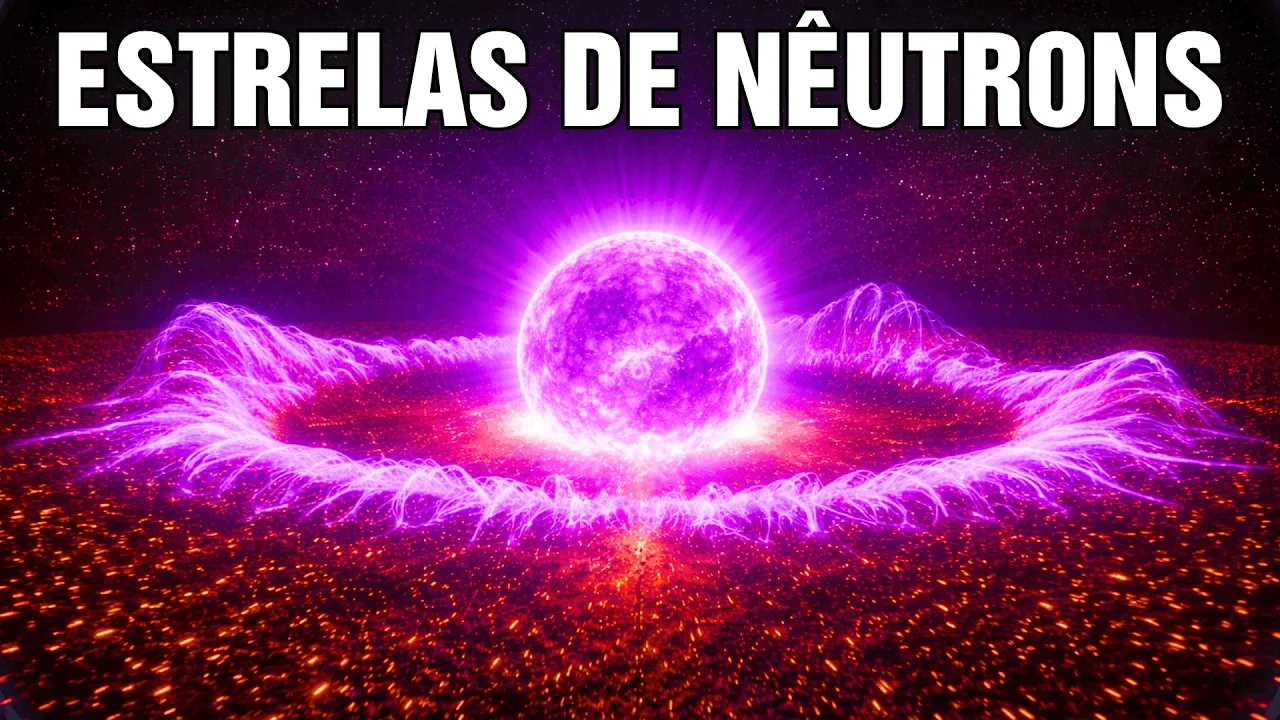






![Estrelas de Nêutrons: da Estrutura Interna às Ondas Gravitacionais [Prof. Dr César Lenzi (ITA)]](https://i.ytimg.com/vi/3P_qK8goZpk/maxresdefault.jpg)

Neutron stars represent the ultimate limit of matter, where gravity's crushing force is counterbalanced by quantum mechanical laws, specifically neutron degeneracy pressure arising from the Pauli exclusion principle. This creates a fragile equilibrium called hydrostatic equilibrium, where the star's matter exists in exotic states including a crystalline iron crust, nuclear pasta structures, a superfluid neutron core, and a superconducting proton network. The Tolman-Oppenheimer-Volkoff limit (approximately 2.1-2.3 solar masses) marks the boundary where this balance fails and collapse into a black hole becomes inevitable.
Neutron Star Interiors: Physics Beyond the Event Horizon
Added:The life cycle of massive stars, specifically core-collapse supernovae and the formation of compact remnants.
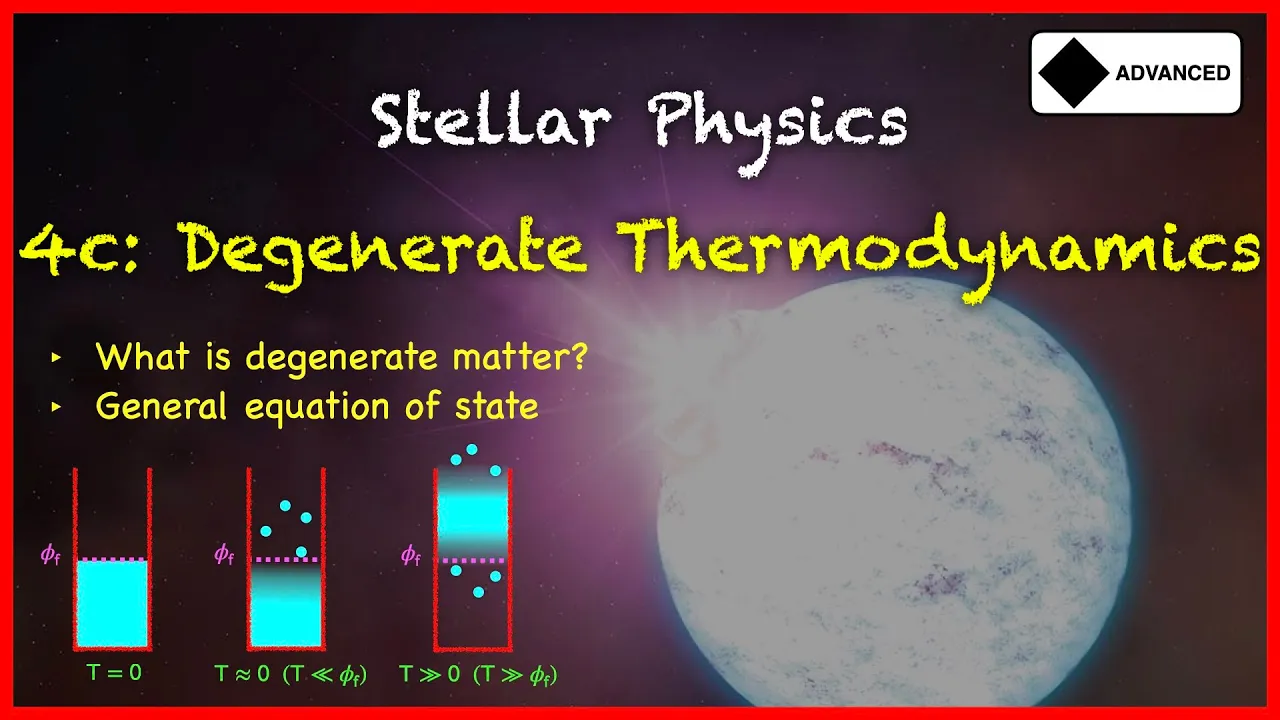
The concept of degeneracy pressure (Fermi-Dirac statistics), which prevents neutron stars from collapsing under their own gravity.
Basic particle physics, including the classification of hadrons, baryons (neutrons and protons), and the quarks that compose them.
The fundamentals of General Relativity, specifically how extreme mass concentrations warp spacetime.
The Tolman-Oppenheimer-Volkoff (TOV) limit, which defines the maximum mass a neutron star can support before collapsing into a black hole.
Equations of State (EOS) for ultra-dense matter, exploring how pressure and density correlate in nuclear physics.
The study of Quark-Gluon Plasma (QGP) and the theoretical existence of strange stars or hybrid stars.
How binary neutron star mergers and gravitational wave astronomy (e.g., LIGO/Virgo detections) are used to constrain neutron star interior models.
1.3K views1.1Klikes1:50:33Original Release: 2025-11-11
What would happen if immortality existed in this vast universe? In the moment when space falls into silence amidst the endless darkness, there are stars that have faded yet still breathe not through light but through gravity. Not through fire, but through memory. A neutron star is proof of the ultimate limit of matter. From the ashes of a giant star, it collapses into a world only a few dozen km wide, but heavier than the sun itself. Inside it, all familiar laws begin to break down. Gravity becomes so strong that atoms melt, turning matter into a sea of neutrons, where quantum laws fight against the very pull of space itself. Each layer of that star from the cold iron crust through the strange nuclear pasta zone to the superfluid core and superconducting region is a journey across the boundary of understanding where dissolution and existence merge into one. In this video, we'll step into that world together, passing over the mirror smooth surface of a faded star, listening to the final heartbeat of matter, and discovering what the universe continues to whisper.
That even in silence there is music, and within decay, life quietly stirs.
[Music] The stars that shine above us seem eternal, but their lives are finite stories. Stories written in light, heat, and gravity. Every massive star, no matter how glorious, carries within it the seed of its own destruction.
When the nuclear fire that holds its heart together, finally dies, gravity takes over. It does not rage or roar. It simply falls. The stars vast body begins to collapse inward, folding layer upon layer into itself until the pressure becomes something beyond imagination.
Somewhere in that collapse, in a space no wider than a heartbeat, atoms themselves begin to break. Protons and electrons, once partners in the dance of creation, are forced together by gravity's unrelenting hand merging into neutrons. The outer shells of the star are blown away in a final exhalation, a supernova that briefly outshines entire galaxies. What remains is small enough to fit within a single city, but heavier than the sun. A neutron star, the densest form of matter that can exist before the universe, admits defeat, and collapses it into a black hole. If you could hold a teaspoon of that matter in your hand, it would weigh more than all the humans who have ever lived combined.
But of course, you could never hold it.
The moment it touched you, you would disintegrate into plasma. Its gravity would pull you apart faster than thought itself. The surface of a neutron star exerts a force 100 billion times stronger than the gravity of Earth. Even mountains cannot exist there. If they do, they are no taller than the width of a human hair. This then is the smoothest surface in the universe. An entire world polished by gravity into absolute perfection.
Scientists describe this equilibrium with quiet ore. The star is dead and yet it stands at the very edge of existence, balancing between stability and oblivion. What keeps it from collapsing further deep inside an invisible law rises to oppose gravity. The parley exclusion principle. It states that no two identical particles can occupy the same quantum state. The neutrons resist being squeezed closer together. And in that resistance, they create an extraordinary counterforce neutron degeneracy pressure. It is not an explosion nor a wall, but a silent push that holds the star steady against its own weight. This fragile balance is called hydrostatic equilibrium. The same cosmic law that once held our sun steady. But here, the stakes are far higher. At the sun's core, the outward pressure comes from nuclear fusion, the burning of hydrogen into helium. In a neutron star, there is no such fire left. The balance is purely quantum, a standoff between gravity and the fundamental structure of matter itself.
Imagine it an entire world that should have already vanished somehow still existing because the universe has not yet found a way to destroy it. Every atom has been stripped, crushed, redefined. Matter as we know it no longer exists. What remains is a new kind of substance, neutroneum. A sea of neutrons packed so tightly that even light hesitates to leave. From afar, this object might appear serene. A small sphere of perfect darkness spinning silently in the vacuum. Yet beneath its surface, forces of unimaginable magnitude are still in motion. Pressure waves echo through layers denser than atomic nuclei. Magnetic fields twist like invisible storms frozen into the stars crust. And at its center, gravity continues to whisper the same command it has always spoken fall. But it cannot, not yet. Something within this dead star still remembers how to resist. It is a battle without sound, fought in absolute stillness. Gravity's endless descent held back by the ghost of quantum law.
Perhaps this is the universe's truest paradox. The remnants of death creating a new form of life. A neutron star is not merely what is left behind. It is the point where existence pauses, where the cosmos hesitates between being and nothingness. In that hesitation lies beauty. And as we begin our descent into its depths, we step across the threshold into a place where the known laws of nature strain, where every heartbeat of the universe slows, and where the silence of a dead star becomes the music of reality itself. Gravity on Earth is a familiar friend, gentle, predictable, a quiet tug that anchors our feet to the ground. But on a neutron star, gravity is not a pull. It is a command. It dictates everything, allowing nothing to escape, not even the idea of shape.
Here, gravity crushes and polishes reality until it is almost featureless.
The entire star, once a flaming sphere millions of km wide, has now collapsed into something barely 20 km across. And yet, its mass greater than the sun's remains. This is the surface of a world that should not exist. If you stood here, if such standing were even possible, your body would be flattened into atoms before a single nerve could fire. Any object released above the ground would reach half the speed of light before striking it. There are no hills, no valleys, no ridges. The tallest mountains rise less than a millimeter, sculpted by forces so immense that even the concept of unevenness becomes absurd. Astronomers call them custal deformations, but perhaps it is more honest to call them wrinkles in the fabric of physics itself.
The neutron stars crust is unlike anything we have ever touched. It is a crystallin latis of atomic nuclei, mostly iron, locked into place by gravity so powerful that it forces matter into an exotic degenerate form.
Here, atoms cannot survive as atoms.
Their electrons are stripped away, captured by protons, and fused into neutrons. What remains is a solid ocean of nuclear matter, a surface so dense that one teaspoon of it weighs billions of tons. It glows faintly with residual heat, a ghost of the supernova that birthed it. The temperature may exceed a million° C, yet it shines mostly in X-rays invisible to human eyes. The radiation that escapes comes from the magnetic poles where the field lines twist into funnels that channel charged particles into violent streams.
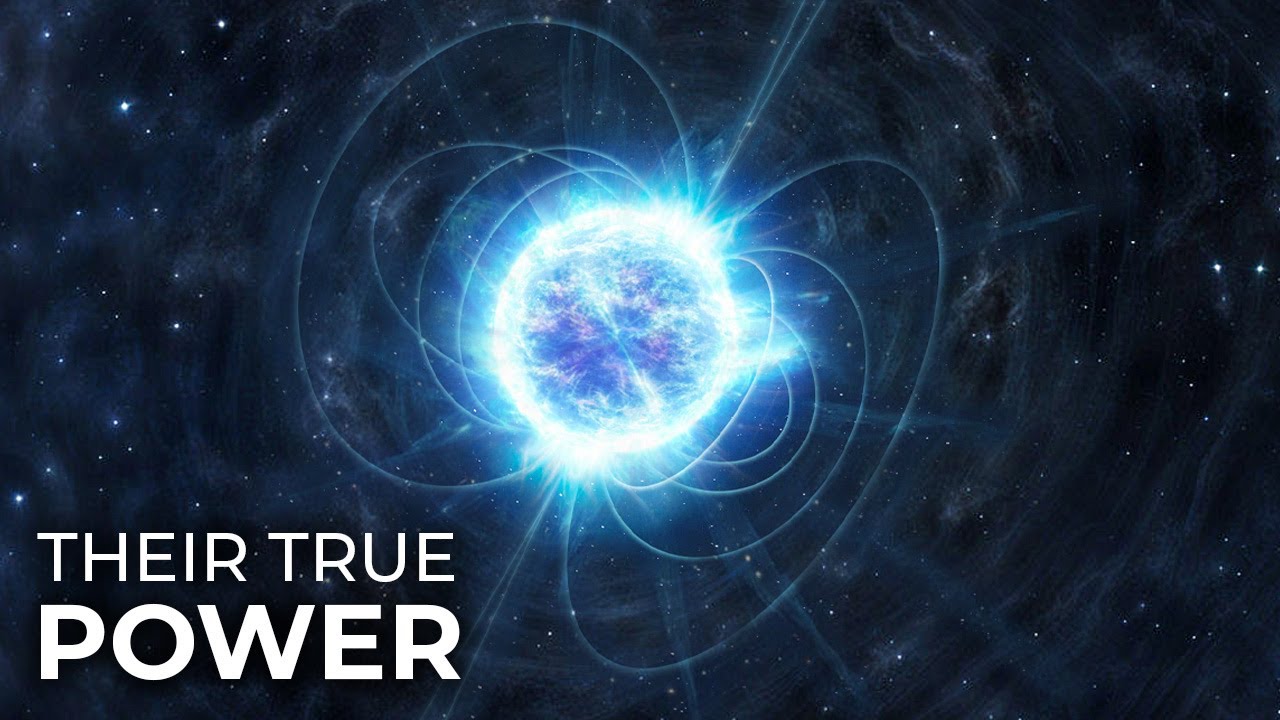
As the neutron star spins, those streams sweep across space like cosmic lighouses. To distant observers, the beams flash rhythmically, and we call these stars pulsars. The magnetic field itself is a mystery as deep as gravity.
The stars magnetic strength can reach a thousand trillion times that of Earth's.
Such power should tear matter apart, yet somehow it remains stable, anchored in a crust only a few cm thick. That field sculpts the space around it, filling the near vacuum with a sea of electrons and posetrons born from pure energy. The magnetosphere becomes a storm of light and antimatter, whirling faster than any hurricane could ever dream. But beneath that storm lies silence. The crust does not tremble. It does not bend. It endures. Physicists describe it as a solid plasma, a contradiction that could only exist here. On Earth, a plasma flows like fire, chaotic and brilliant.
But here, the crushing pressure freezes it into stillness, transforming a sthing of charged particles into something rigid and cold, a frozen flame. If we could somehow descend slowly, protected by impossible technology, we would see the light fade to darkness as the atmosphere thins. The air, if one can call it that, is no more than a breath 10 cm deep, composed mostly of ionized hydrogen and helium. Below it lies a mirror-like surface, its curvature barely perceptible even across kilome.
Every photon that escapes has fought for thousands of years to do so, scattering through layers dense enough to trap light like water traps sound. And somewhere in that quiet perfection, the balance holds. Gravity continues to press inward with unfathomable strength.
But deep within the star, another force resists a pressure born not from heat or motion, but from the rules of existence itself. The poly exclusion principle is not a law of choice or design. It is the universe's simple refusal to repeat itself. No two neutrons may share the same quantum state, and that stubbornness becomes salvation. Billions of trillions of particles all refusing to yield together create an invisible scaffold that props up an entire star.
It is strange to think that what prevents a neutron star from collapsing is not energy or fusion, but identity.
The individuality of particles written into the mathematics of being. Every neutron in its silent defiance contributes to the balance. And so the surface remains smooth beyond comprehension, calm beyond sound. A monument to quantum law standing against the tyranny of gravity. Every structure in the universe, every planet, every star, every cluster of galaxies exists because two forces have agreed for a brief time to disagree. Gravity pulls inward, pressure pushes outward. Between those two ancient wills lies everything we call stability. This fragile negotiation is known as hydrostatic equilibrium. It is not a single equation but a conversation written across the fabric of matter itself. In our sun, this dialogue is harmonious. Gravity presses inward while nuclear fusion in the core pushes outward, releasing enough energy to sustain balance for billions of years. But on a neutron star, the speaker on one side has fallen silent. The fire that once fought gravity has burned out. No fusion remains, no radiation pressure to hold the line. And yet, the star does not collapse. Something else has taken the place of fire. something invisible, colder, but infinitely more stubborn. At the heart of the neutron stars survival is the equation of state, the mathematical heartbeat of matter under impossible conditions. It describes how pressure responds to density, how the universe itself chooses to resist compression. For a neutron star, the EOS determines its fate, how large it is, how massive it can become, whether it will hold or yield to gravity's final demand. A soft equation of state means matter yields easily compressing under pressure until the star shrinks toward the edge of a black hole. A stiff EOS resists collapse, allowing the star to remain larger, more defiant. Somewhere in between lies, the truth and that truth is still unknown. Scientists have spent decades trying to uncover that secret, peering through telescopes modeling atomic interactions, searching for the hidden rhythm that governs this balance. But the answer refuses to be simple. Deep inside, matter behaves in ways no experiment on Earth can reproduce. The densities are too high.
The distances between particles too small. The energy is too vast. At this scale, even the familiar laws of physics begin to blur. If the universe is a tapestry of equilibrium, then a neutron star is the point where the threads begin to fray. Every layer beneath its surface whispers the same question. What keeps existence from folding in on itself? Perhaps the answer lies not in heat or motion, but in the very architecture of the quantum world. The same principle that prevents electrons from falling into an atomic nucleus also prevents an entire star from collapsing into a singularity. It is a quiet defiance, a refusal written into the smallest components of matter. This equilibrium is not eternal. It is not peace. It is tension pure and unending.
Imagine a sphere where every particle is locked in conflict, pressed by gravity, constrained by quantum mechanics. There is no movement yet. The forces are immense. Each neutron pushes back against the weight of all others, and the collective resistance becomes the scaffold that holds the star together.
We often think of stars as symbols of energy, of blazing life. But this one is a monument to endurance. It burns with no flame. It lives with no breath. It exists because the universe itself cannot decide whether to let it die. In that indecision, there is elegance. The neutron star becomes the physical embodiment of a paradox. The smallest large object, the coldest furnace, the calst storm. It is an entire world trapped between two impossible extremes, collapse and persistence. Hydrostatic equilibrium is not just a balance of forces. It is a balance of meaning. The stars continued existence suggests that the cosmos values symmetry more than victory. It does not allow gravity to win outright, nor does it grant matter infinite resistance. It draws a line, a narrow one, where both sides can coexist for a while. And within that narrowness lies everything we know, galaxies, planets, life itself. The same principle that holds a neutron star steady is the same one that allows our hearts to beat our oceans, to rest our atoms, to stay bound. Perhaps the universe does not seek peace. Perhaps it seeks balance.
And nowhere is that balance more precarious, more sacred than inside a neutron star, where the cosmos exhausted from its own contradictions, pauses, and breathes. Long before the first neutron star was ever imagined, a young scientist in colonial India was staring at equations that described how atoms lose their electrons under heat. Megan Saha working in a small room lit only by lamplight was trying to understand why stars shine with different colors. His ionization equation would become one of the quiet pillars of astrophysics, a key to decoding stellar spectra and the first whisper of a deeper truth that the structure of stars can be read through their physics, not just their light.
Saha did not know it then, but his work was the seed of what physicists would later call an equation of state, a mathematical expression describing how matter behaves when pushed to its limits. Every gas, every plasma, every star follows its own EOS. It defines how pressure and density interact, how stability either endures or breaks. For a neutron star, this equation is more than a description. It is a question of existence. To write an equation of state is to translate the whispers of particles into the language of balance.
For the sun, the equation is gentle pressure from fusion temperature and gas density create a stable dialogue. But in the heart of a collapsed star where no atoms remain, the conversation turns strange. Pressure is no longer thermal.
It is degenerate. Born not from heat, but from the laws of quantum exclusion.
In that realm where protons and electrons have fused into neutrons, Saha's elegant ionization formula becomes something else entirely. A ghost of its former self stretched into domains where temperature ceases to have meaning. Matter is now beyond chemistry, beyond the structure of atoms. It becomes a quantum ocean where every ripple carries the memory of the star that once burned. Physicists like Ralph Fowler took Sahar's torch and carried it into darker territories. Fowler's insight into degenerate matter, matter so compressed that quantum principles replace thermal ones, laid the groundwork for understanding white dwarfs. In such stars, electrons are forced so close that their exclusion pressure keeps the entire star from collapsing. But there comes a point when even electrons can no longer bear the weight. When the stars mass exceeds Chandraar's limit, about one four times that of our sun, the electron degeneracy fails and gravity drives the collapse further. The electrons merge with protons to form neutrons. A new kind of star is born once Saha could never have imagined a neutron star held up not by heat, not by electrons, but by the degeneracy of neutrons themselves. The equation of state for such a star is far from settled. Scientists imagine many possibilities, each one a different song played on the same quantum strings. A soft EOS means the star compresses easily, becoming smaller and denser. A stiff EOS resists gravity allowing the star to stay larger for the same mass.
Observations from NASA's nicer telescope from gravitational waves from pulsars like GIF or Replos 66 Tun all are attempts to eavesdrop on this cosmic conversation and find out which tune the universe prefers. Yet the truth remains veiled. Inside a neutron star, the densities exceed those of atomic nuclei.
Neutrons might deform, overlap, even dissolve into their constituent quarks.
Some theorists suggest that strange quarks could appear forming exotic hyperons or even a quark glue on soup.
Each possibility modifies the EOS. Each redefineses how the star resists collapse. It is a puzzle of exquisite tension. The fate of entire stars depending on the tiniest details of subatomic behavior. And so the lineage continues from Sahar's ionized gases to Chandra Secar's white dwarves from Fowlers's equations to the neutron stars of today. Each discovery builds upon the last. each brings us closer to answering a single haunting question. What happens to matter when it can no longer be matter? The equation of state is the universe's attempt to answer that question without words. It is not a constant, not a fixed truth, but a boundary that shifts as our understanding deepens. Perhaps one day we will know it completely. Or perhaps, like Saha, we will only glimpse a fragment enough to realize that even in collapse, the cosmos is still writing poetry in the language of physics.
In the years between two world wars, when science was trying to rebuild its voice from the ashes of chaos, a young physicist named Ralph Fowler began to look at the dying hearts of stars. He was not searching for beauty only for order. His equations described matter compressed beyond recognition, where atoms no longer behaved like gases, but like locked notes in a frozen symphony.
Fowler's insight was simple yet revolutionary. At extreme density, matter no longer obeys classical pressure. it becomes degenerate. The electrons forbidden by the poly exclusion principle from sharing quantum states stack into higher and higher energy levels producing an invisible pressure that resists gravity. This was the first mathematical glimpse of the strange equilibrium that governs stellar death. At Cambridge Fowler's equations found their most brilliant audience, a young Indian student named Subramanyan Chandrakar.
On a long sea voyage from India to England in 1930, Chandra Seekar carried nothing but a notebook and his curiosity. The journey took nearly three weeks long enough for him to calculate how far electron degeneracy could go before gravity inevitably won. His discovery would haunt astrophysics for decades. There exists a limit he found beyond which no white dwarf can survive.
About 1.4 times the mass of the sun.
Beyond that point, collapse is inevitable. That number, the Chandraar limit, marked the boundary between two worlds. One where quantum mechanics holds firm and another where it breaks under gravity's weight. Above that limit, the degenerate pressure of electrons gives way. The star collapses into something darker, denser. The electrons and protons fuse into neutrons, and a new force takes over neutron degeneracy pressure, the final line of resistance before total collapse into a black hole. Fowler and Chandra Sakar never knew how prophetic their work would become.
What began as an exercise in quantum statistics evolved into a cosmic revelation that the smallest rules of the subatomic world dictate the destinies of entire stars. The simple principle that particles cannot occupy the same state turns out to be the universe's ultimate defense against annihilation. And yet even this defense is temporary. The equation of state that defines this balance may hold for millions, even billions of years, but not forever. Gravity is patient. It waits. As the star cools, as it accretes more mass from a binary companion, its pressure slowly rises. The EOS Titans, curves inward. The neutron degeneracy may falter, and if it does, the star will once again fall, this time past the event horizon, where not even light can remain. Still, there is something almost human in this defiance. A star that refuses to die quietly. It collapses.
And yet in collapsing, it finds a new form, a new equilibrium. Just as Fowler's mathematical order found life through Shandra Secar's imagination, the cosmos finds creation in destruction.
Perhaps that is the true music of physics. Not harmony, but tension. Not peace, but persistence. Every neutron star in the sky hums with this silent melody. A quantum symphony composed of unimaginable density, unbroken stillness, and the faint vibration of balance. Each pulse from a distant pulsar is a note from that composition echoing through spaceime, reminding us that order can survive even in death. We often think of physics as cold and exact. But beneath its equations lies a quiet tenderness, a belief that even in collapse, something endures.
Fowler's equations, Chandra Secars limit the unseen hand of quantum law, all are threads in the same grand composition.
And if we listen closely enough in the hum of the cosmos, we might hear it still the faint sound of a star remembering itself. The last whisper before silence. As our descent continues, the silence around us begins to shimmer, not with sound, but with invisible tension. We're entering the outer skin of the neutron star, a region where gravity, magnetism, and radiation interlock like the gears of a machine too vast to comprehend. The vacuum itself hums here alive with electric storms that never end. Every neutron star is wrapped in a magnetosphere, the most powerful magnetic field known in the universe. Even the weakest among them surpasses Earth's magnetic field by a billion times. But the strongest known as magnetars can reach strengths of 10,000 trillion Gaus. At such magnitudes, the field can distort atomic orbitals, flattening atoms into needle-like shapes. Electrons spiral helplessly along the field lines trapped in loops of light. In this magnetic cathedral, matter and energy no longer know where one ends and the other begins. Within this space, the magnetic field becomes a vast particle accelerator. Photons of unimaginable energy crash into each other, producing pairs of matter and antimatter electrons and posetrons that flicker in and out of existence.
The field then whips these particles into opposing currents, separating them into twin rivers of charge. They flow toward the poles, escaping along the magnetic axis in blazing jets that stretch across thousands of kilome. When these jets sweep past Earth, we see the neutron star blink in perfect rhythm.
That is how the cosmos first revealed their presence. Pulses, stars that flash like cosmic metronomes. Each pulse precise to the millisecond is the echo of a rotation so stable that even the best atomic clocks struggle to match it.
The surface beneath this storm is not a landscape, but a boundary thin, fragile, and absolute. It glows faintly with trapped X-rays and gamma radiation shimmering in the magnetic haze. This is where the stars identity begins to blur, where plasma becomes solid and atoms no longer exist as separate entities.
Scientists call it a solid plasma crust.
But that phrase barely captures its stranges. It is as if lightning itself had been frozen midstroke, crystallized into matter. If we could stand here on this impossible surface, our feet would sink into a fog of ionized gas barely 10 cm thick. Above our heads, the magnetosphere would rage with billions of charged particles, moving close to the speed of light. Every spark would curve under magnetic tension, tracing invisible spirals through the thin atmosphere. The air would glow with faint blue white radiation, not from heat, but from pure energy conversion.
This crust, composed mostly of iron nuclei, is the residue of the progenitor stars final act before collapse. In its last moments, when fusion could no longer sustain it, the core forged the heaviest element it could iron. That iron survived the supernova and now forms the frozen skin of the neutron star. But here, iron behaves differently. It has lost all electrons stripped bare by heat and magnetism.
What remains is a lattice of atomic cores pressed so tightly together that even repulsion becomes a kind of structure. This layer is only a meter thick, but it defines the boundary between existence and annihilation.
Beneath it, the pressures rise to billions of tons per cubic cm. Above it, the vacuum of space stretches into silence. The entire crust is balanced on a knife edge between gravity's endless pull and the quantum forces that push back. Every rotation of the star drags the magnetic field lines with it, twisting them slightly out of alignment.
That twist stores energy coiled like tension in a bow string. Sometimes when the strain becomes too great, the crust fractures, a star quake. The release sends a surge of magnetic energy rippling through space bright enough to outshine the galaxy for a fraction of a second. We call it a pulsar glitch, a sudden jump in the stars rhythm. But in truth, it is a heartbeat, a sign that even in this realm of perfect stillness, the star still feels the strain of its own existence. And so the neutron star continues to turn, flashing its steady light into the dark, a cosmic lighthouse reminding us that even the dead can still shine. The closer we drift to the surface, the stranger everything becomes. There is no sharp line where the star ends, and the void begins. only a thin glowing haze that fades into darkness. This is the atmosphere of a neutron star, if one can still call it that. It is not made of air nor gas as we know it, but of pure plasma atoms stripped of every electron left as bare nuclei floating in a sea of radiation.
Unlike Earth's sky, which stretches for hundreds of kilome, this atmosphere is barely a meter thick. The pressure above and below differs by unimaginable orders of magnitude, compressing the gas into something that feels more like liquid light than air. It is hot over 2 million°, but that heat is deceptive. It does not burn. It radiates glowing softly in X-rays that no human eye could ever see. The atoms here, mostly hydrogen and helium, are the faint remnants of interstellar gas captured during the stars life or swept up afterward from the emptiness around it.
Each particle entering this realm finds itself instantly transformed. The magnetic field shreds it. The gravity squeezes it. The temperature tears it apart. Electrons and protons separate and dance in their own spirals along invisible magnetic loops, colliding and annihilating in flashes of energy that vanish as quickly as they appear. The lower we fall, the denser it becomes.
Within just a few centimeters, the pressure is already billions of times greater than anything on Earth. The plasma solidifies not because it cools, but because gravity crushes it into submission. It becomes part of the iron crust below an ultra thin transition where the airy chaos of plasma gives way to the rigid geometry of solid matter.
That crust is unlike any solid in the universe. It is not bound by chemical forces. There are no electrons to share.
Instead, the nuclei themselves form a crystalline grid held together by their mutual repulsion and the relentless squeeze of gravity. This grid is made almost entirely of iron, the last element a dying star can forge before its nuclear fire goes out. The iron survived the explosion that ended its parent stars life and now forms the skin of this dead remnant. But here it has been remade. The atoms are packed so closely that their outer boundaries blur. What was once atomic becomes nuclear, and what was once solid becomes something between crystal and plasma. If we could touch it, it would feel neither hot nor cold, neither rough nor smooth.
Temperature, texture. These words lose meaning here. Every sensation would collapse into the same thing. Pressure, a pressure so immense that it distorts the shape of nuclei themselves, forcing protons and neutrons into patterns unseen anywhere else in nature. Inside the crust, electrons drift freely in a degenerate gas, forming a sea that moves through the crystal latice like sound through metal. This electron se is what prevents the crust from collapsing further. It is a balance born from the poorly exclusion principle, the same invisible law that sustains the entire star. Even crushed under gravity's endless weight quantum rules still whisper no further. And yet deeper down, the rules begin to change. As the pressure rises, electrons gain energy.
Some are forced into atomic nuclei, combining with protons to form neutrons.
This process electron capture marks the beginning of transformation. Iron turns into more exotic neutron-rich elements like zinc 80, which cannot exist anywhere else in the universe. These nuclei stabilized only by the pressure around them would decay in less than a second if freed. Here inside the thin crust of the neutron star, the familiar world of chemistry has ended. We are standing at the frontier where the periodic table itself breaks down, where atoms become unstable ideas, and where matter starts to forget the meaning of individuality. It is a surface both alive and dead, still glowing from the memory of a supernova yet frozen in quantum rigidity.
A place where every atom resists gravity's call, and where the faint hum of the universe's deepest tension continues to echo. As we continue our descent below the iron crust, gravity deepens its hold. Pressure and density rise together, sculpting a new realm of physics, one that no laboratory on Earth can replicate. Here, beneath a crust less than a kilometer thick, the atomic order begins to break down. What once was stable nuclei, iron, nickel, zinc now tremble under the weight of forces that exceed a trillion times the density of Earth's matter. Inside this twilight layer, electrons become restless. Their energy swells to such extremes that they can no longer remain free. They're driven into the hearts of atomic nuclei, fusing with protons to create neutrons in a reaction called electron capture.
The periodic table begins to unravel iron transmutes into heavier neutron-rich isotopes that could never exist elsewhere. Elements like zinc 80 emerge, their lifespans measured not in years or seconds, but in the bare instant before they would disintegrate anywhere else. Yet here, the crushing pressure stabilizes them, holding together what should fall apart. Every few hundred meters deeper, the reactions grow more violent. Each nucleus absorbs electrons and emits nutrinos, ghostlike particles that escape through the solid crust at nearly the speed of light.
These nutrinos carry away energy, cooling the star ever so slightly, even as its inner layers continue to evolve into stranger forms. But then something remarkable happens, a quiet breaking point. As the nuclei become increasingly rich in neutrons, they can no longer hold them all. Some begin to leak. The neutrons seep outward, escaping the confines of the nucleus into the spaces between atoms. This is the neutron drip, the moment when the stars interior ceases to be merely nuclear matter and begins to transform into something else entirely. We do not yet know the exact depth where this begins, though models suggest it occurs around half a kilometer below the surface. At this point, the density is more than a trillion times greater than any matter found on Earth. Our most advanced accelerators cannot reach such conditions. Our equations can only estimate what lies here. But we believe that between the atomic latises, an ocean of free neutrons begins to pull a ghostly invisible sea that seeps through the crystal scaffolding of nuclear matter. The result is a bizarre coexistence nuclei surrounded by a fluid of free neutrons threaded through with a thinning gas of degenerate electrons.
The neutrons firmians like electrons begin to exert their own degeneracy pressure taking on part of the burden of holding the star up against gravity. But they can pack far closer together than electrons before that quantum pressure reacts allowing the stars density to soar even higher. Further down the nuclei themselves begin to blur. Their boundaries dissolve as neutrons outnumber protons 5 to one. The wave functions of these neutrons quantum clouds rather than distinct particles expand until it becomes impossible to say which neutrons belong to which nucleus. At this scale, the very concept of an atom collapses. The matter here is no longer discreet. It is collective a fabric woven from overlapping probabilities. By the time we approach the bottom of this inner crust, the density has reached 100 trillion times that of the Earth. The stars matter now teeters on the edge of total transformation. The once clear structure of atomic nuclei is vanishing. They are beginning to merge, to touch, to melt into each other. Soon they will form continuous shapes, tubes, sheets, tangled threads of matter molded by the competition between nuclear attraction and electrostatic repulsion. That is the threshold of the next realm, the beginning of the nuclear pasta layer. In the fading light of this depth, we leave behind everything familiar atoms, elements, structure. What remains is pressure itself, pure, relentless, and creative. The neutron drip is not a moment of decay, but of genesis. It is the birth of a new kind of matter, a reminder that even in the universe's deepest silence, change is still possible. Deeper still, beyond the crust where neutrons first began to leak, the matter of the neutron star transforms into something no human mind was ever meant to imagine. This is not solid, not liquid, not even plasma. Is something between all of them. and none of them. A realm where matter no longer behaves as substance but as structure. Scientists call it nuclear pasta. Though that simple name hides one of the strangest and most beautiful creations in the universe. At about 1 km beneath the surface, the density exceeds 100 trillion times that of the Earth. Under this crushing weight, the atomic latice of the crust begins to give way. Nuclei are pressed so tightly together that their borders vanish. Protons and neutrons once confined within distinct atomic hearts now merge and separate in a ceaseless struggle. The strong nuclear force which pulls them together battles the electrostatic repulsion that drives the protons apart. Between these waring forces, matter reshapes itself, abandoning the symmetry of spheres for forms that twist, stretch, and fold. In this underground sea, matter learns to improvise. Instead of atoms, we find islands and filaments of dense nuclear material suspended in a liquid of free neutrons. These are the first shapes of the nuclear pasta. Small spheres like floating dumplings known as the noky phase. With increasing pressure, they elongate into strands, long cylindrical structures of protons and neutrons intertwined like cords of glowing fiber.
Go deeper still, and these threads flatten into broad rippling sheets. The lasagna phase. It is as though gravity itself has learned to sculpt art carving geometry out of collapse. At this level, nothing moves quickly. The forces that rule here are unimaginably strong. Yet, the changes they create occur in slow motion, frozen in the deep time of the neutron star. Every structure here is an act of compromise between the push of electric repulsion and the pull of nuclear attraction. The result is a kind of cosmic crystal where matter itself has become a pattern endlessly repeated, endlessly enduring. If we could see it, if human eyes could survive the gravity and the darkness, it would look like a vast coral reef glowing faintly with trapped radiation. Curves and folds extending for kilome frozen in place.
Each one an echo of the forces that made the star. It is hauntingly still, yet beneath that stillness lies tension beyond comprehension. Every strand of nuclear pasta supports pressures that could crush mountains into dust.
Physicists believe this material may be the strongest substance in the universe.
Stronger than diamond, stronger than steel, stronger than anything we have ever created. There are no atomic gaps, no empty spaces, no weak links. Each thread is bound by the same force that holds the heart of every atomic nucleus together.
If a piece of this material could somehow exist outside its star, it would defy all tools, all tests, all comprehension. Its strength may also leave a cosmic fingerprint. As the neutron star spins, these dense filaments and sheets can form tiny irregularities on the surface.
Microscopic mountains only millime high, yet so massive they can bend the fabric of spaceime. Each rotation sends out faint rhythmic ripples, gravitational waves, vibrations traveling through the universe at the speed of light.
Somewhere perhaps right now, those waves are passing through us, undetected, gentle reminders that even in stillness, the universe moves. And so, this strange realm of nuclear pasta is not chaos. It is endurance. It is the universe's answer to gravity's most impossible question. How to keep existing when all structure should fail? Here, matter no longer remembers what it once was. It has only one task to endure. And in that endurance, it becomes something transcendent. The quiet strength of the cosmos made visible, frozen into shapes that no eye will ever see yet, whose presence ripples forever through spaceime. Inside this layer of nuclear pasta, the universe reaches a strange kind of perfection. It is not beauty in the way we understand it. It is symmetry born from pressure, endurance written into geometry. The star no longer burns, yet its matter still performs an intricate choreography. Each thread, each sheet of nuclear material holds an enormous tension between gravity and the forces that refuse to yield. Simulation suggests that this region might hold the strongest material ever conceived by nature. Stronger than any bond on Earth, stronger even than the molecular latises of diamond. To deform it would take pressures that could tear planets apart.
It is as though the very essence of strength has condensed into this final fortress of matter, the last bullwwork before collapse. This strength does not simply exist, it sings. Each time the neutron star spins, it carries with it the uneven weight of its pasta-like interior. Microscopic ridges no taller than a grain of dust shift the stars symmetry ever so slightly. And because gravity itself cannot tolerate a symmetry, those tiny imperfections radiate outward as gravitational waves ripples in spaceime that stretch and compress the fabric of the universe. If we could translate them into sound, these waves would hum at frequencies far below, hearing deep, endless notes that resonate through millions of years. They are the heartbeat of the dead, the low chorus of collapsed stars whispering across eternity. Observatories like Ligo and Virgo listen for them, waiting to catch the soft vibration of a neutron star's skin, the quiet signature of its inner struggle. Inside, these irregularities do not come easily. To move the pasta even slightly requires immense energy. When the stress accumulates faster than the latis can adapt, the crust fractures in an event known as a star quake. In that instant, the magnetic field rearranges, violently releasing bursts of radiation powerful enough to momentarily outshine the entire Milky Way. These explosions, though brief, reveal the hidden tension of the stars core, an echo of the forces shaping the pasta beneath. Yet for all its violence, this is still a form of order. Every crack, every quake, every pulse of radiation is part of the stars long exhale. The way it redistributes stress to remain intact. Even in destruction, there is balance. The nuclear pasta bends but rarely breaks.
When it does, it heals under the weight of gravity's endless hand. Some theorists believe that the arrangement of this matter, its precise layering of sheets and filaments, affects the rotation of the star itself. It may act like a gyroscopic stabilizer, maintaining the rhythm of its spin for millions of years. The pulses we observe blinking across the sky owe their stability perhaps to this deep invisible latis of matter. Each pulse steady as clockwork is anchored by the structure below the slow vibration of nuclear perfection. There is something deeply poetic in this. A star whose light has gone out still radiating its presence through geometry alone. The nuclear pasta in its silence becomes an instrument of the universe. Its structure dictating the song of spaceime. And yet this perfection carries a quiet fragility. The same strength that resists collapse also stores potential energy. If too much mass is added, if the core grows heavier by even a small fraction, gravity will again overpower the degeneracy pressure.
The stars interior will shift once more its equations rewritten. The pasta will melt into a deeper, more chaotic form of matter, a prelude to the quark ocean waiting below. For now, though, it endures. Layer upon layer, it holds the memory of the forces that shaped it. The imprint of attraction, repulsion, balance, and defiance. If you listen long enough, perhaps you can almost hear it. The faint vibration that travels through the crust across the vacuum into the quiet of interstellar space. The slow, patient music of matter, still resonating from a world where physics itself was stretched to its limits, and yet somehow did not break. Beneath the last layers of nuclear pasta, where even geometry is surrendered to gravity, we enter the realm that defines the neutron stars soul, the core. Here, matter is crushed to its ultimate expression. All familiar forms have vanished. There are no atoms, no nuclei, not even the delicate filaments of the pasta that once resisted collapse. What remains is a deep ocean of neutrons so tightly bound that they move as one. This is not a liquid in the usual sense. It does not flow or swirl. It glides a perfect frictionless continuum known as a super fluid. Every neutron within it has paired with another forming subtle alliances called Kooper pairs. A phenomenon known from the quantum world of superconductors.
But here those pairs do not carry electricity. They carry motion itself.
In this vast interior sea, there is no turbulence, no resistance. If set spinning, it could turn forever.
Scientists believe this superfluid may be the purest form of motion in the universe. Unbound, unceasing, immune to decay.
Inside this star, hundreds of trillions of trillions of such pairs drift through each other like ghosts aligning into vast quantum vortices that sustain the stars rotation. Each vortex only nanome wide, but kilome long, is a thread of motion wound around the axis of the neutron star. Together they form an invisible machinery of stability, a cosmic gyroscope held together by quantum law. The presence of super fluidity explains one of the neutron stars strangest behaviors. The sudden unpredictable changes in its rotation known as glitches. For years, astronomers observed pulses spinning with perfect regularity only to experience abrupt jumps in speed as if the star itself had shivered. Within the superfluid heart, the vortices that store angular momentum can sometimes become pinned to the crust above. When the tension grows too great, they break free all at once, transferring their momentum outward. The star twitches, spins faster, then gradually relaxes again. A quantum tremor that shakes an entire world. In these glitches, the star reveals its duality frozen and fluid at once. The crust above is rigid, crystalline, yet beneath it flows a sea that knows no friction. Two opposing states of matter bound together in a harmony only gravity could enforce. It is as if the star has learned to balance stillness and motion, life and death, within the same body. But the core is not made solely of neutrons. A fraction of the remaining protons, perhaps 5%, refuse to vanish entirely. Under these pressures and temperatures, they too undergo transformation, pairing into superconducting states. Within this mixture, magnetic fields no longer simply exist. They become entangled, woven into the flow of supercurrens. The magnetic field lines thread through the superfluid core like luminous ropes, anchoring the stars enormous magnetism and stabilizing its pulse. To imagine this heart is to imagine serenity beyond comprehension. There is no sound, no vibration, only silent motion, eternal and unbroken. Every part of the fluid moves in exact synchrony with every other part governed by quantum coherence that spans kilome. It is matter at its most complete where all individuality dissolves into a single perfect behavior. This perhaps is the universe's answer to chaos not order but harmony. A kind of physical prayer whispered in the dark that even when all structure fails, something within can still find rhythm.
We often describe stars as furnaces as fires. But this heart is cold, colder than any flame. Yet more alive than heat itself. It holds not energy but memory.
The memory of collapse, of resistance, of endurance. Within its superfluid calm, the neutron star does not burn. It remembers. And in that remembrance lies the secret of its survival, a silence so deep it has become motion.
If the neutron stars core is a silent ocean of superfluid motion, then threaded through that ocean is an invisible network, delicate yet unbreakable, a superconducting web woven from the remnants of protons.
Though the star is made almost entirely of neutrons, a small fraction of charged particles still survives in this immense pressure. These protons far too few to change the balance of mass play, a role far greater than their number suggests.
Under such crushing density hundreds of trillions of times greater than any material on Earth, these protons behave in ways no experiment can yet reproduce.
They form pairs just as electrons do in superconductors on Earth, aligning their quantum spins in perfect opposition. The result is not electricity as we know it, but superconductivity on a cosmic scale.
A current that never fades a field that never weakens a perpetual stability inside a world otherwise defined by collapse. This superconducting network interacts intimately with the superfluid neutrons that surround it. Each phase, the fluid and the web depends on the other. The neutrons provide motion without friction. While the protons preserve structure through magnetic memory, the magnetic fields anchored in this core are not abstract lines. They are quantized flux tubes, each carrying a single quantum of magnetic flux.
Imagine billions of these tubes densely packed and aligned with the stars axis piercing through the superfluid interior like luminous threads through a vast invisible fabric. As the neutron star rotates, these flux tubes move with the flow of the superfluid vortices coupling magnetic energy to the rhythm of the stars spin. If the vortices shift, the magnetic threads twist and strain. When the tension snaps, a sudden burst of magnetic energy erupts outward, sometimes breaking through the crust as a violent flare or an electromagnetic storm. In the most extreme cases, this process may explain the magneita, a neutron star whose magnetic field is so powerful that it can deform atomic orbitals and tear matter apart hundreds of kilome away. The presence of superconductivity also helps explain why neutron stars retain their magnetic fields for millions of years. On Earth, even the strongest electromagnet loses its strength once the current dissipates. But here, there is no dissipation, no resistance, no decay.
The stars magnetic field becomes eternal, locked into the structure of the superconductor itself. It is a memory encoded in the fabric of matter, an echo of the original magnetic field the dying star once carried before its collapse. Through this web, the neutron star achieves an almost impossible state. It is both solid and fluid rigid and dynamic stable yet restless. The superfluid neutrons flow around the flux tubes of superconducting protons and together they form a kind of quantum ecosystem. An internal balance where every motion is mirrored, every pulse sustained. This interplay gives rise to one of the most precise rhythms in nature. The pulses spin which can remain stable to within a fraction of a millionth of a second over decades. If we could somehow see inside this core, we would find a world of motion made visible through fields. Magnetic lines winding endlessly carried by rivers of frictionless current tangled with whirlpools of superfluid neutrons. Every interaction is a negotiation between gravity's weight and quantum laws defiance. It is both an act of survival and an act of creation. This superconducting heart also connects to the surface through invisible channels.
The stars outer magnetic field, the one that drives the pulses beams and governs its rotation, originates here in the dense interior where quantum mechanics and astrophysics merge. The visible pulse of a neutron star is not just light. It is the outer voice of this hidden web, the breath of a core that never stops turning. And perhaps that is what gives the neutron star its eerie sense of life. Beneath the silence it hums with constant order currents that never die. Magnetism that never fades, structure that never sleeps. The universe has found in this tiny remnant of a dead star a perfect paradox. A body colder than ice yet filled with motion.
A heart buried in darkness yet glowing with invisible fire. A skeleton of quantum thread still breathing through the magnetism it will never lose. The deeper we go, the stranger the heart becomes. Beneath the vast superconducting web, there is no longer a clear distinction between motion and matter. The forces that once defined the neutron star, the gravity that crushes the pressure that resists, now coexist in a fragile truce mediated by the fluid and the field. Here we have reached the liinal zone, the threshold between order and dissolution. Within this region, the superfluid neutrons and the superconducting protons begin to weave together in unpredictable ways. The vortices of the superfluid long thread-like whirlpools of quantum motion cross paths with the flux tubes of magnetism. Each interaction transfers energy, sometimes gently, sometimes violently. These small exchanges ripple through the entire core, creating minute oscillations that alter the stars rotation by infinite decimal amounts. It is here that the neutron stars hidden pulse memory is stored. Every twist, every quake, every rearrangement of its magnetic field leaves an imprint deep inside this transitional layer. When astronomers detect a puls's subtle irregularities, the faint slowing or sudden glitch in its spin, they're hearing the faint echo of this invisible struggle unfolding a thousand km beneath the surface. The region is not static.
The superfluids vortices slowly migrate, rearranging themselves as the star cools over millions of years. The superconducting flux tubes frozen into place anchor the magnetic field, but their tension accumulates. Occasionally, when enough strain builds a burst of reconnection occurs, a microscopic magnetic avalanche that shakes the entire star from within. The resulting wave of stress may travel outward through the crust, emerging as a magnetia, flare, or a tiny increase in spin rate. Each event is a message from the deep, a whisper from this hidden borderland. Physicists describe the interplay between these components with mathematical precision, but the picture remains poetic in its simplicity. Two opposing forms of perfection lock together, each shaping the other's destiny. The super fluid provides eternal motion. The superconductor provides eternal structure. Without one, the other could not exist. As the temperature continues to fall, the interaction slow. Quantum coherence spreads across larger distances. It is as though the star is freezing, not in the thermal sense, but in its very patterns of movement. Time itself seems to stretch here. Inside the core motions that once took seconds now unfold over millennia. The star is aging, but in slow motion, its memory preserved in quantum order. Deeper still, scientists suspect that the neutrons themselves begin to falter. Pressed beyond their comfort, they may start to dissolve, releasing the quarks hidden inside them.
The boundaries between particles blur, hinting at the existence of something even denser, quark matter. Whether this transition ever truly occurs is uncertain. It lies beyond the reach of current theory, where equations strain to remain meaningful. What we do know is this. The liinal zone marks the beginning of that transformation. It is the first whisper of the next phase, the place where quantum law begins to tremble under gravity's relentless hand.
The super fluid and the superconducting web are the last defenses of structure.
Beyond them lies the unknown. If the neutron star were alive, this would be the place where it dreams half aware, half dissolving. Every layer above still remembers order. Every layer below begins to forget. Between them is the thin space where the universe hesitates.
Here, matter no longer serves physics.
Physics serves matter. The rules bend around it, reluctant to let go. It is in this hesitation that the stars heart continues to beat. Not in heat, not in light, but in quiet persistence, a rhythm that may last for a billion years or end in an instant when the equilibrium finally breaks and the quark sea below awakens. For now, though, it endures a perfect balance between movement and stillness chaos and design the place where a dead star continues to live. We have reached the deepest layers of the neutron stars heart where matter itself begins to forget what it means to exist. All that was stable even in its extremity now trembles. The neutrons that once stood as the final guardians of structure begin to falter under the endless weight. The pressure is no longer measured in billions or trillions. It is beyond count. Every cubic cm here contains more mass than the highest mountain ranges combined. It is here in this uncharted abyss that the breaking of order begins. At these densities hundreds of trillions of times greater than the Earth's core, the forces binding neutrons together are stretched to their limits. The neutrons, once the quiet survivors of atomic collapse, begin to change. They may merge into exotic combinations, creating heavier cousins known as hyperons particles containing strange quarks.
These are not the neutrons and protons of familiar matter, but hybrids born of gravity's pressure and quantum chaos.
They are the first sign that the stars core is no longer purely nuclear. It is evolving into something stranger.
Hyperrons weaken the very balance that sustains the star. Their formation releases energy, but softens the equation of state, the same equation that once held back gravity. With each hyperon formed, the matter becomes more compressible, more fragile, less able to resist collapse. In a sense, the birth of these strange particles is also the beginning of surrender. But the transformation may not end there. Some theories suggest that as compression continues, even hyperons cannot survive.
The distinction between neutron, proton, and messen fades entirely. What remains is a liquid of deconfined quarks, the fundamental components of all hydronic matter flowing freely in a dense plasma of quark gluon energy. This is the same substance that existed in the universe's first micros before atoms, before stars, before time itself found rhythm. In this state, matter no longer behaves like matter. The quarks drift without barriers, exchanging color charges through gluons that bind and release them in an endless exchange. It is not solid nor fluid. It is a quantum storm where the concept of individuality among particles ceases to hold meaning. For the physicist, this is both a revelation and a nightmare. Equations lose their simplicity here. The forces that govern such matter cannot be tested directly.
We glimpse them only in the fleeting collisions inside particle accelerators, where heavy ions smash together to recreate temperatures and densities similar to those inside neutron star cores. Even in those controlled experiments, the quark gluon plasma lasts for less than a trillionth of a second before cooling back into ordinary matter. But inside a neutron star, it could persist for millions of years, stable, silent, hidden. Some call this possibility the quark core hypothesis, a vision of a star with a heart made of primordial soup. Others go further imagining the existence of strange quark matter, a stable form of quark plasma that might resist decay indefinitely. If such matter exists, a neutron star containing it could be something entirely new. A strange star heavier and smaller than any ordinary neutron star.
Its surface composed not of neutrons but of free quarks bound only by the strong force itself. To approach this depth is to approach the limit of knowledge. No telescope, no detector, no laboratory can pierce it. The laws of quantum chromodnamics, our best description of the strong force bend under such gravity. We are left with speculation guided only by indirect signs. subtle gravitational waves, cooling rates, or the flicker of pulses that refuse to spin as models predict. And yet, there is a poetic symmetry in this descent.
The universe, which began as a sea of quarks cooling into matter, may end here in reverse matter collapsing back into its quark origins. The cycle repeats not through destruction, but through return.
In the depths of the neutron star, the boundary between creation and collapse vanishes. The particles that once formed the atoms of life now drift freely again as they did in the dawn of everything.
Perhaps this is how the universe remembers itself by allowing even its densest hearts to dissolve back into the same chaos from which it was born.
The deeper we venture into the neutron stars interior, the more fragile its stability becomes. The same laws that once granted it endurance now start to turn against it. The equation of state.
The silent contract between gravity and pressure begins to weaken. The matter that was once defiant grows weary. The particles that once resisted compression with absolute quantum rigidity now give in ever so slightly to gravity's patience. This change is subtle at first. The neutrons and protons confined within nuclear boundaries begin to deform under the pressure. Inside this vast invisible prison, the strong nuclear force no longer provides a firm wall. It stretches, flexes, softens. The more the core compresses, the easier it becomes for gravity to squeeze it further. The stars internal resistance once its greatest defense becomes its most delicate vulnerability.
Physicists call this process softening of the equation of state. It marks the transition from a world governed by nuclear stiffness to one ruled by quark fluidity. When Hyperon's particles containing strange quarks begin to populate the core, they reduce the overall degeneracy pressure. The matter loses some of its ability to push back.
For every new hyperon that appears, the core yields a little more to gravity. It is a microscopic surrender replicated trillions of times per second. The discovery of these effects did not come from imagination alone. Observations of neutron stars such as JL74 Places 6 to one of the heaviest ever recorded have forced astronomers to question how a star so massive can still remain intact.
If the equation of state were too soft, such a star would collapse into a black hole. But if it were too stiff, the observed mass and radius would not match the data. The truth must lie somewhere in between a fine-tuned balance that may include contributions from strange quarks, super fluid interactions, or even particles we have yet to discover.
The NICE telescope aboard the International Space Station has given humanity its first direct measurements of neutron star sizes with remarkable precision. Through the delicate mapping of X-ray emissions, Nissa revealed that J0740, despite its enormous mass over twice that of the sun, was not as small as earlier theories predicted. The result was unsettling. The star seemed too large for the soft models and too compact for the stiff ones. It sits precisely where theory falters, like a note that doesn't quite fit the harmony.
This paradox ignited new possibilities.
Could there be a hidden ingredient inside the core? something that modifies the equation of state, making it stiff enough to resist total collapse, but soft enough to match the data.
Some physicists propose the influence of dark matter seeping into the star during its formation or over eons of cosmic time. If dark matter particles exist and interact even weakly with ordinary matter, they could alter the stars density profile, giving rise to a hybrid core part, neutron part, quark part unknown. Others reach for the elegance of Bose Einstein condensation, imagining that under extreme compression, pairs of neutrons might behave not as firmians, but as collective Bzans. Such a condensate could create a new form of outward pressure countering gravity's squeeze without breaking the quantum laws that govern the stars interior.
This would make the equation of state effectively stiffer. At high densities, a subtle quantum correction that might explain Jz0740's impossible balance.
Every hypothesis circles the same question. What keeps these monstrous dying suns from collapsing into oblivion? The answer, whatever it is, blurs the line between nuclear physics and cosmology. It reminds us that the heart of a neutron star is not just dense. It is dynamic alive with competing principles. The softening of the equation of state is not a failure.
It is a transformation, a signal that matter is approaching its limit, stretching the fabric of physics itself.
Somewhere beyond this point lies the truth that no telescope can yet see and no theory can yet contain. Perhaps the softness of the core is not weakness but adaptation. Perhaps the universe, even here, is finding a way to continue existing at the edge of destruction, proving once more that endurance is not strength alone, but the art of giving way just enough to survive. At this depth, where temperature and pressure defy imagination, the neutron star becomes a battlefield of theories. The known physics has already stretched itself thin. The familiar laws are still speaking, but their words are starting to lose meaning. What lies beyond this point, what truly exists in the stars center, has become one of the greatest unsolved riddles in modern astrophysics.
Three great families of hypotheses now contend for that throne. Each describes a different version of the same impossible truth. How matter behaves when pushed beyond the boundaries of nuclear strength. The first theory remains the most traditional, the Hyperonrich core. According to this model, gravity's relentless compression forces neutrons to decay into strange particles containing strange quarks. The Hyperons, these heavier cousins of the neutron may populate the core like a dense crystal of exotic matter. But their arrival comes at a price. They reduce the degeneracy pressure making the star more compressible and its equation of state softer. If hyperrons exist in abundance then a neutron star heavier than two solar masses should collapse. Yet stars like J74 plus 6 twintru stand in quiet defiance as though the universe is withholding the full answer. From this paradox arose a second school of thought, the cork gluon plasma core. In this vision, the extreme pressures cause neutrons and protons to dissolve, completely, freeing their constituent quarks and gluons. The result is a core made not of particles, but of pure interaction, a dense continuous medium resembling the first state of the cosmos. In particle colliders on Earth, quark gluon plasma flickers into existence for mere trillionths of a second before cooling back into hadrons. But in the heart of a neutron star, it could persist indefinitely, trapped by gravity's embrace. If this model is correct, the interior of a neutron star is not a solid or a liquid, but a kind of quantum ocean where quarks flow freely and color forces fluctuate without end. Such a plasma would change the stars overall stiffness, potentially explaining how a neutron star could hold enormous mass without shrinking further. It could also account for certain cooling behaviors and the way pulsars lose energy over time. And yet there is a third even more daring hypothesis, one that reimagines the very nature of the star. Some theorists propose that the neutrons within the core do not simply degenerate or dissolve, but pair and condense into a collective state of matter known as a Bose Einstein condensate. In this strange form, particles lose their individuality and behave as a single quantum entity sharing the same wave function. The result could be a star with an interior as fluid as light and as coherent as a single atom. A Bose Einstein neutron star would possess unique properties. The condensate collective behavior might generate an additional outward pressure strong enough to counterbalance gravity at higher masses. This could naturally explain the paradox of J0740's size and weight. Instead of collapsing, the star stabilizes itself through quantum coherence, a harmony of particles moving as one. Some models even suggest that such stars could transition between phases over time, part neutron star, part condensate, part quark sea. Like layers of a cosmic onion, each revealing a different face of the same enigma. And still there are whispers of a fourth possibility half theory and half poem dark matter admix stars. If dark matter particles can accumulate within the core, their gravity could alter the balance, hardening the equation of state enough to explain the high mass stars that confound current models.
Though unproven, the idea unites two mysteries. The unseen matter of the universe and the unseen heart of the densest stars into a single haunting speculation. Each of these theories, Hyperon's quark gluon plasma, Bose Einstein, condensates, and dark matter draws the same conclusion in a different tongue. The true heart of a neutron star is a negotiation between endurance and collapse. It is not one state of matter, but a spectrum of transformations, each born from the same impossible struggle.
And perhaps the truth is not that one of these models is right, but that all of them are each describing a different layer, a different moment, a different fate in the long life of a neutron star.
For now, the mystery remains sealed beneath kilometers of impenetrable matter where light cannot reach and time itself may move differently.
But in that darkness, somewhere between gravity's pull and quantum defiance, the ultimate form of matter waits still holding the final secret of creation.
Theory alone cannot hold the weight of a neutron star. To truly understand what happens within those invisible cores, we must turn to observation to the rare, faint, and fragile clues the universe allows us to see.
Over the last decade, a new era of astrophysics has begun bringing instruments capable of measuring not only light, but the shape of spaceime itself. And in their silent readings, the stars have begun to answer. The first great revelation came from the event known as GW17's U817, the merger of two neutron stars detected both through gravitational waves and light. When the ripples of spaceime reached Earth in 2017, they carried a message older than humanity. The vibrations of two collapsed suns spiraling together. The signal strength and frequency revealed how the stars deformed before collision. How easily their surfaces and cores compressed under the mutual pull of gravity. From those distortions, scientists extracted the first empirical clues about the equation of state. The data told a paradoxical story. It ruled out the softest models, those that predicted stars collapsing too easily, but also excluded the stiffest, which would not allow the measured tidal stretching.
What remained was a narrow middle ground, a cosmos in tension holding its secrets between extremes. Then came NIS, orbiting aboard the International Space Station, turning its X-ray eyes toward isolated pulsars. It measured their pulses, their surface hotspots, their slow rotation, allowing researchers to reconstruct their mass and radius with unprecedented precision. The numbers did not align perfectly with any model. Some stars were smaller than expected, others far larger. The once straight line of theory began to bend, suggesting that perhaps there was no single equation of state, but a family of them, each star carrying its own solution to the cosmic puzzle. As observations multiplied, the mystery deepened. In 2024, astronomers detected three neutron stars unusually cold for their age, 10 to 100 times cooler than theory allowed. Their rapid loss of heat could not be explained by standard neutrino emission. Something inside them was accelerating the cooling process, siphoning energy from their cores faster than expected. These anomalies immediately eliminated many of the previously accepted models. A large portion of proposed EIS curves simply could not account for such rapid temperature decline. One possibility was that exotic particles, perhaps hyperons or deconfined quarks, were allowing additional nutrino processes releasing energy at an unprecedented rate. Another idea pointed towards superfluid vortex decay, a mechanism in which the stars internal vortices release quantum energy during reconfiguration.
Regardless of the mechanism, these cold stars became living evidence that the interiors of neutron stars are not uniform. They may vary dramatically depending on formation history, rotation rate, magnetic field, or even unseen components like dark matter. But perhaps the most sobering realization came not from a measurement, but from a limitation. For every star that fits an existing model, another defies it. Each new observation seems to break one rule while reinforcing another. The deeper we look, the more the line between theory and observation blurs, as though the universe is testing how far our equations can bend before they too collapse. Even so, the data converges on one undeniable truth. There is a limit, a boundary between stability and collapse. Somewhere between 2.0 and 2.3 solar masses lies the threshold beyond which no neutron star can remain whole.
Beyond it, the pressure of degeneracy fails and gravity takes over completely.
The result is silence. the formation of a black hole. The universe in its quiet precision has given us just enough to see the edges of understanding, but not the center. We can weigh the stars, feel their pulse through spaceime, even detect their cooling hearts. But what lies within remains hidden, wrapped in quantum night. Perhaps this is not a failure of knowledge, but an invitation.
For even as our instruments grow sharper, the neutron star continues to whisper that the final answers do not lie in the equations alone, but in the space between certainty and wonder, the same space where every theory is born.
Every star lives by a quiet rule, a balance between what collapses and what resists. For the neutron star that rule has a name, the Tolman Oppenheimer Vulov limit or the tov limit. It is the cosmic boundary between endurance and surrender. The final line beyond which even quantum law cannot stand against gravity. This limit was first imagined in the 1930s when three minds Richard Tolman J, Robert Oppenheimer and George Volkoff combined Einstein's relativity with the physics of degenerate matter.
They calculated that even the strongest degeneracy pressure the same force that holds up a neutron star must eventually yield if the mass becomes too great.
Their early models suggested a maximum of about.7 solar masses, a number that would later prove too low. But the principle they uncovered remains timeless. There exists a point where resistance itself becomes meaningless.
Over the decades, refinements to the equation of state have expanded that boundary. Observations and modern calculations now place the tov limit between 2.1 and 2.3 solar masses and possibly higher for rapidly spinning stars. Rotation can buy time. A faster spin generates centrifugal support, allowing a neutron star to briefly defy gravity's pull. But even this reprieve has a price. As the star loses angular momentum through magnetic breaking and radiation, its momentary grace fades.
Sooner or later, the weight wins. For the stars that approach this boundary, the universe offers only two choices.
The first transformation into something stranger, a quark star, a remnant made not of neutrons, but of deconfined quarks. The second collapse into the event horizon, the silent curtain of a black hole. The first path is rare, almost mythical. If the compression proceeds slowly, allowing quarks to reorganize before the gravitational field overwhelms them, the neutron star may stabilize into a strange quark star.
In this form, the matter achieves a new kind of equilibrium. The quarks freed from confinement but bound collectively by the strong force create a state that may be even more stable than nuclear matter itself. Theoretical models suggest that if two strange stars were ever to collide, they might scatter tiny fragments strangeless into space. These particles, if they exist, could transform ordinary matter on contact converting protons and neutrons into strange quark matter in a chain reaction of cosmic alchemy.
The second path is inevitable for most.
Once the star exceeds the toe threshold, no mechanism remains to resist collapse.
The core contracts under its own weight and within milliseconds, the density becomes infinite or as close to infinity as physics allows. At that instant, the surface vanishes and the neutron star becomes a black hole. The geometry of spaceime folds around it, sealing its interior from the universe forever. What once pulsed with rhythm and radiation becomes absolute silence. For astronomers, each neutron star near the tov limit is a test of the universe's patience. Observations of pulses like PSR J9520607, spinning hundreds of times per second, show that rotation can push this threshold higher, perhaps to 2.35 solar masses or more. These stars live on the edge their fate suspended between two infinities, the infinity of collapse and the infinity of quantum pressure. But the tov limit is not merely a number. It is a moral boundary in the language of physics, the line at which the known universe stops speaking. On one side lies the comprehensible dance of matter and law. On the other, a silence that swallows equations and defies description. To understand the tov limit is to glimpse the fragility of structure itself. It reminds us that every resistance has a limit, that even the strongest fabric of reality must someday fold under its own gravity. And yet within that inevitability lies a quiet beauty that the universe through its extremes writes the story of endurance and surrender in perfect balance. When a neutron star approaches the tov boundary but resists complete collapse. Something extraordinary may occur. Instead of vanishing behind an event horizon, the star underos a second transformation, one far more profound than the first collapse that created it. The neutrons that once filled its core begin to disintegrate, releasing their hidden quarks into a sea of pure subatomic freedom. This is the hypothetical birth of a quark star. In the depths of such an object, the distinction between particle and field disappears. The quarks up, down, and strange move freely, no longer confined within nucleons. The gluon's carriers of the strong force weave an unending web among them, binding without boundaries. What emerges is not chaos but a new order where stability is born not from structure but from motion. This state is known as strange quark matter. A configuration theorized to be the most stable form of matter in the universe.
Unlike the dense crust of a neutron star, a quark star's surface would be radically different. Smooth, metallic, almost liquid in behavior. Its skin could be only a few centimeters thick beneath which lies a sea of quarks so dense that a single teaspoon would outweigh an entire mountain. Some theories suggest that this surface could emit self-generated light glowing faintly from the recombination of quarks at the outermost boundary, giving rise to a spectral radiance unlike any known star. But how does such a transformation begin? Most models suggest it starts with a spark, a single pocket of matter where neutrons collapse into quarks. If the conditions are right, that spark expands rapidly, consuming the entire core in milliseconds. The released binding energy is enormous enough to shake the stars outer layers and perhaps produce one of the most energetic phenomena in the cosmos, a quarknova. A quarknova is not a supernova's echo. It is its evolution. When the neutron stars crust collapses inward toward the newborn quark core, the conversion releases a shock wave that travels outward, ejecting layers of matter into space. Some theorists believe that this process could produce the brightest gammaray burst ever recorded, rivaling the energy of a galaxy condensed into seconds. In the aftermath, what remains is a quark star compact dark and yet paradoxically radiant from within. If two quark stars collide, the consequences could be even more astonishing. The impact may scatter fragments of strange matter, tiny nuggets called strangeletits into interstellar space. Each strange carries within it the potential to transform whatever it touches, converting ordinary matter into strange quark matter through direct contact. It's a haunting concept that the universe may contain seeds of transformation, drifting silently among the stars, each one capable of rewriting the composition of an entire planet atom by atom. Despite its elegance, the quark star remains a theory. No direct observation has confirmed its existence.
Yet, astronomers have found candidates.
Objects too small, too dense, and too hot to be explained by conventional neutron star models. Their emissions do not match the expected thermal patterns.
Their cooling rates are too rapid, their magnetic fields too uniform. Perhaps these are the strange survivors, the secondborn stars, hiding among the pulsers. If confirmed quark stars would bridge the gap between neutron stars and black holes, a middle realm where matter achieves a final stable defiance before succumbing to the infinite. They would mark the universe's last successful negotiation between gravity and quantum mechanics. Beyond them lies only collapse. In this possibility, we see the universe performing its own kind of alchemy. The death of one order gives rise to another stranger and more fundamental. The Quark Star is not a monument to decay. It is a resurrection, a brief equilibrium between destruction and creation. Perhaps in the quiet heart of a galaxy, one such object already exists, glowing faintly in the dark. Not as a warning, but as a reminder that even at the edge of collapse, matter still finds a way to reinvent itself.
Not every neutron star finds redemption in transformation. For most, there comes a moment when the struggle ends. When the forces that have resisted gravity since the dawn of its birth finally yield, no matter how fierce the degeneracy pressure, no matter how complex the exotic states within, there is a point beyond which the star cannot hold. That point is the end of all resistance, the moment of collapse into a black hole. The transition is sudden and absolute. Once the core surpasses the TVO limit, gravity accelerates inward collapse to a velocity no force can oppose. The neutrons that once formed the solid lattice of matter are crushed beyond recognition. Density surges past nuclear limits and time itself begins to distort. To an outside observer, the stars surface slows its light stretching redder and dimmer until it vanishes entirely. Yet to the matter within, everything happens in an instant. Space and time fold, and the star is swallowed by its own gravity. In those final milliseconds, the entire star collapses into a point of infinite density, a singularity.
Around it forms the event horizon, the invisible boundary that marks the edge of physical meaning. Beyond this threshold, not even light can escape.
And so, the story ends, or so it appears. In truth, this is where physics itself begins to unravel. For decades, the black hole has stood as both a triumph and a humiliation for science.
It is a solution to Einstein's equations. yet also their undoing.
Inside its horizon, the geometry of spaceime collapses inward and all descriptions fail. Energy, matter, and information seem to dissolve into nothingness, violating the very principles that built our universe. This is the ultimate paradox, the universe devouring its own laws. Some physicists argue that this collapse may not be absolute. Deep within the horizon, quantum mechanics still whispers its defiance. The uncertainty principle forbids infinite precision. Perhaps at the smallest scales, the singularity is not a point but a quantum foam where spaceime itself fluctuates, vibrating with probabilities instead of certainties.
Others suggest that a plank scale core, a remnant of exotic matter or quantum gravity, could survive hidden forever beyond observation. What we do know is that when a neutron star collapses into a black hole, it takes its secrets with it. All evidence of its internal structure where the hyperonrich quarkbased or bose condensed is erased.
The event horizon does not preserve its biography. It reduces every detail to three properties mass, spin and charge.
This simplicity is almost cruel, a perfect eraser of the complexities that defined its existence. The star that once pulsed with energy and order becomes an object defined only by geometry. Yet in its death, it still speaks. The gravitational waves emitted during its collapse ripple outward, carrying the imprint of its final heartbeat. These signals detected by instruments like LIGO and Virgo are the echoes of that surrender. From them, scientists can trace the exact moment when degeneracy pressure failed when the neutron stars light gave way to silence.
Even in disappearance, the star leaves a signature, a gravitational memory etched into the cosmos. Some theorists imagine that within the black hole, information is not truly destroyed, but encoded on the event horizon itself, a holographic boundary preserving everything that once was. If this idea is true, then the neutron star story is not lost, merely translated into a language we cannot yet read. Its identity would remain not in form, but in pattern imprinted into the curvature of spaceime. In this sense, the black hole is not merely an end, but a transformation of knowledge. The collapse of the star marks the boundary where physics stops describing and starts remembering a region of silence filled with memory, not absence. For the cosmos, such endings are not rare. Every galaxy holds millions of black holes, some born from giants, others from the quiet deaths of neutron stars that crossed their limits. Each one is a monument to the law of inevitability, yet also to the persistence of mystery.
Because even when a star disappears, its gravity still shapes the light of worlds. Millions of years later, it still curves. Time bends space and whispers to the universe that nothing ever truly ends. It merely becomes something we cannot see. At the heart of every collapse lies not just the death of a star, but the confrontation of two empires, quantum mechanics and general relativity. They are the twin pillars of modern physics. Each flawless in its own realm. Each speaking a different language of truth. But inside a dying neutron star at the threshold of a black hole, these two worlds collide and both begin to fail. Einstein's relativity governs the grand stage gravity, spaceime, and curvature. It predicts that mass tells space how to bend and space tells mass how to move. But as the neutron star contracts beyond its own equation of state, the density becomes so immense that spacetime bends into itself. The curvature grows infinite and Einstein's laws so elegant, so consistent, tear under their own precision. The geometry becomes nonsensical.
A zero divided by zero, a silence in the mathematics. Quantum mechanics, on the other hand, reigns over the infinite decimal over particles, probabilities, and uncertainty. It tells us that no quantity can be known with infinite accuracy that fluctuations exist even in the void. But in the heart of a black hole, the uncertainty itself collapses.
The equations of quantum fields require a backdrop of spaceime to operate. And yet here, spaceime ceases to exist as we know it. It's like trying to describe waves without an ocean. The two theories perfect apart, becoming compatible together. Relativity demands smooth continuity. Quantum mechanics demands granular discreetness. Each is complete in isolation, yet their marriage breeds paradoxes.
This is the quantum dilemma. The place where our greatest truths turn against one another. Physicists have spent decades searching for the reconciliation a theory of quantum gravity that can describe both curvature and uncertainty, both the vast and the minute. String theory envisions every particle as a vibrating filament of energy too small to see but large enough to unify forces.
Loop quantum gravity proposes that spaceime itself is quantized woven from loops of plank scale geometry. Others look toward holographic duality, suggesting that everything we perceive in three dimensions may be the projection of a deeper two-dimensional order. And yet, none of these ideas are complete. The black hole and the neutron star remain the universe's final examination, the test that no human theory has yet passed. The equations break down not because they are wrong, but because they are incomplete.
something essential, something beyond our current imagination is still missing from our understanding of reality. This is why neutron stars are more than astrophysical curiosities. They are laboratories where the laws of the cosmos are stretched to the point of fracture. Every pulser glitch, every cooling anomaly, every gravitational wave is a whisper from the edge of unification. Somewhere inside those dense cores, nature already knows the answer that our mathematics cannot yet articulate. Perhaps, as some physicists suggest, relativity is the one that will break first. Its continuity may give way to quantum discreetness to a universe where spacetime itself is granular, composed of indivisible units smaller than any conceivable particle. Others believe it will be quantum mechanics that must yield, replaced by a deeper theory where uncertainty is not fundamental, but emergent, a shadow cast by something more absolute. Whatever the truth, the frontier is not theoretical.
It is physical pulsing right now in the hearts of neutron stars scattered across the galaxy. Each one is a cosmic dialogue between the infinite and the infinite decimal holding steady between laws that no longer agree. If we could listen closely enough not just to their light but to their gravitational voice.
We might hear that conversation, the murmur of relativity, the whisper of quantum mechanics and the silence between them where the next physics waits to be born. And perhaps that silence is the point. The neutron star in its endurance and its surrender teaches us that the universe does not fear contradiction. It requires it.
Creation itself may be the tension between opposing truths, forever unresolved, forever alive. At the very edge of understanding, where the last light bends and time itself fractures, the neutron star stands as the messenger of both worlds. It reminds us that we are not witnessing the end of knowledge, but the beginning of something greater.
A new physics gestating in the dark, waiting for the courage of discovery to bring it into light. And so, beyond the clash of equations and the vanishing of certainty, something remains an unspoken continuity. The universe, it seems, never truly ends its sentences. Where our mathematics stops, reality continues to write in a different script, one composed not of numbers, but of patterns, vibrations, and memory. At the threshold of the quantum dilemma, the neutron star becomes more than an object. It becomes a symbol of nature's persistence. It refuses to collapse quietly into simplicity. It holds its contradictions as if they were part of its essence gravity, trying to erase quantum law, trying to preserve. Between them lies a fragile truce, a balance that no formula has yet captured, but that the star itself continues to perform with flawless precision.
Perhaps this is the most profound lesson it offers, that the universe does not seek harmony through uniformity, but through tension. The neutron star is harmony under strain, a cosmic cord stretched to its breaking point, yet still resonant. Each pulse, each gravitational echo, each whisper of radiation is an act of balance. The sound of two incompatible truths holding hands for a moment longer before they must part. To the observer, this tension manifests as silence. Neutron stars do not scream their paradox. They hum it.
Their existence is quiet, but absolute a presence so dense that it bends everything around it, even time. That silence is not emptiness. It is the stillness of something ongoing, something not yet resolved. It is possible that the unification of physics will not come from invention, but from listening, not from forcing nature into human patterns, but from observing where it chooses to contradict itself and asking why. The neutron star by its very being tells us that truth may not be a single law but a bridge between opposites, a dialogue rather than a conclusion. And there is something hauntingly human in that. Our own understanding too lives in tension between logic and wonder, between what we know and what we feel must be true.
We build theories to explain, but it is our curiosity the same restless energy that drives matter to resist collapse that keeps us from surrendering to ignorance. When the star finally falls when it crosses into the silence of the event horizon, it leaves behind more than gravitational memory. It leaves a challenge to accept that not knowing is part of knowing. That every black hole is not just an end but an invitation to imagine what lies beyond the curtain of comprehension. In this light, the death of a neutron star becomes something almost sacred. It is not a failure of matter but a gesture of continuation. As it collapses, the laws of physics are carried inward, compressed into something smaller, denser, and perhaps wiser. Somewhere inside that unreachable darkness, gravity and quantum mechanics are no longer fighting. They are becoming one. And maybe one day, when we finally understand that union, we will realize that it was never hidden at all.
It has always been here in every neutron stars pulse. In every gravitational whisper, in every photon that curved its way past an unseen mass, the universe has been teaching us all along. What remains is patience. The same patience the cosmos shows when it waits billions of years for a star to be born to die and to rise again in another form. In that patience lies understanding. In that silence perhaps lies the next discovery. Because the neutron stars story does not end with its collapse. It continues through every scientist who listens, every equation written in search of the impossible, every dreamer who stares into the night sky and wonders what happens when the light runs out, but the universe keeps going. Long after the neutron star has vanished from sight, its influence endures, woven invisibly into the structure of space itself. The collapse may erase its light, but not its memory. Spacetime, like a great ocean, never forgets the objects that once moved through it.
Every wave, every ripple that a star once sent across the cosmos continues outward, endlessly diluted, yet never destroyed. In this way, the neutron star does not truly die. It is absorbed into the continuity of the universe. Its gravity becomes part of a larger field.
Its momentum joins the rotation of the galaxy. Its lost radiation is scattered among interstellar clouds that will one day form new suns. The death of one star becomes the seed of countless others.
This cycle of transference of form dissolving but essence enduring feels less like physics and more like a cosmic reincarnation. There is a deep symmetry in this process. The matter that once resisted collapse now fuels the next generation of creation. Perhaps the universe itself is not a story of beginning and end but a series of metamorphoses where every fall becomes a foundation. The neutron star in its silence teaches that permanence is not survival but transformation. What endures is not form but influence. The gravitational field left behind continues to shape its surroundings long after the stars light fades. Gas clouds drift differently. New orbits are drawn.
Future collisions are delayed or hastened. The stars presence echoes through time like a cord that never quite fades, resonating across millions of years. Even black holes, those ultimate destinations of collapse leave gravitational signatures that reveal their ancestry, the fingerprints of the stars they once were. For the universe, memory is geometry. Every bend in spaceime carries the story of what passed through it. The neutron star, once a furnace of quantum defiance, becomes a mark in the curvature, a quiet testament to endurance. In that curvature, we find both gravestone and monument proof that even in obliteration, nothing truly disappears.
And perhaps this principle extends beyond matter. Maybe consciousness itself, whatever it is that allows us to wonder about stars, is another form of memory imprinted in the fabric of existence. When we look at the night sky and feel awe, that emotion is the echo of the same physics that shaped neutron stars pressure against collapse, curiosity against entropy. The same tension that holds a star together also holds our attention. Both are forms of resistance against decay, against silence. In that sense, we and the neutron star are kin. We too are built from the debris of collapse atoms forged in supernovi particles once imprisoned in cores that died long before the earth was born. Every heartbeat, every spark of thought, every flash of understanding is a small echo of that cosmic resilience. We are in a quiet and literal way the consciousness of matter reflecting on its own endurance. So when a neutron star finally crosses into darkness, it does not vanish from the story. It merely changes chapters. The mass it leaves behind may vanish behind an event horizon, but its meaning ripples outward, carried in gravitational waves, starlight, and memory. Each observation we make, each theory we write is another way of retrieving what was lost to pull fragments of comprehension back from the brink of singularity.
The universe remembers itself through us, just as we remember it through wonder. And perhaps that is the true purpose of these impossible stars, to remind us that even when light is gone, the record of existence remains.
Somewhere far beyond the reach of any telescope, the curvature of spaceime still trembles from the weight of a star that no longer exists. That trembling, so faint, so immeasurable, is the last trace of a question written into the universe. A question that began long before humanity had words for it, and that will continue long after we are gone. What remains when everything else falls? Even after the collapse, after the light fades and the last pulse slips beyond detection, the universe continues to breathe, not with lungs or rhythm, but through the subtle expansions and contractions of space itself, the quiet respiration of reality. Somewhere in that invisible tide lies the echo of every neutron star that ever lived. It is easy to imagine that the story of such a star ends with silence. But the truth is gentler. The collapse does not erase. It transforms. Each gravitational wave sent outward is like a sigh carrying the record of a life lived under impossible pressure. Those ripples travel for millions of years, crossing galaxies, brushing through dust, starlight, and time itself. By the moment they reach us, they are so faint they bend reality by less than the width of an atom. But still they arrive, still they speak. In that faint whisper, we're reminded that the universe does not shout its truths. It murmurs them softly, persistently, waiting for us to learn how to listen.
The neutron stars final act, the release of its gravitational breath, becomes a message that outlives it by ages. Each wave is a story without words and memory encoded in the most fundamental fabric of existence. These waves carry no sound, yet they are the closest thing to a heartbeat the cosmos possesses. Their patterns tell us how stars lived and how they died. How they folded under gravity's hand, and how in their surrender they gave shape to everything that followed. Each wave is both abitery and birth certificate, a vibration that announces an ending while making possible a beginning. In this way, the neutron star becomes part of a grand conversation. Its death informs the galaxies. Its ripples sculpt the dark.
The gravity it releases changes the orbits of stars, yet unborn alters the paths of cosmic dust that will one day ignite into new light. The cosmos is recursive. It breathes out creation from every act of collapse. And if we step back far enough, we might realize that we are living inside that breath. Every atom of our bodies, every flicker of thought was once part of that same rhythm. We are not separate from the universe's exhalation. We are made of it. When we look at the sky and feel its stillness, we're not witnessing absence.
We're witnessing the slow inhale before another act of creation. Perhaps this is what the neutron star teaches us in its final moment. That collapse is not defeat, but transformation into influence. Just as a dying wave merges into the ocean that bore it. The stars last breath becomes part of the background hum of existence. The deep low music that fills every corner of spaceime. To listen to that hum is to understand the humility of existence.
The universe has no need for permanence.
It finds beauty in continuation.
The neutron star in its implosion offers a perfect metaphor. Strength that surrenders not because it fails, but because surrender itself is the next form of strength. And so even after its light is gone, the neutron stars presence lingers in the curves of space, in the memory of motion, in the rippling continuum of time. It teaches us that nothing truly stills. It only changes its frequency.
The cosmos does not forget. It recycles memory into matter, turning loss into pattern decay into structure, silence into rhythm. If you close your eyes and listen, not with your ears, but with imagination, you might hear it. The long patient breathing of the universe, the rise and fall of all that was all that will be. The neutron star is gone, yes, but its breath remains woven into the quiet pulse of everything. Because even now, somewhere in the dark between galaxies, the universe exhales. And from that exhalation, a new star begins to form. When all light fades and the final pulse of a dying star disappears into the dark, what remains is not silence, but continuation.
The neutron stars story is not an ending. It is a meditation on endurance, on the ways matter learns to resist oblivion, and on how even collapse can be another form of balance. It begins with fire and ends with weight. A massive star, once bright and radiant, burns until its core exhausts the fuel that holds gravity at bay. When fusion ceases, the inward pull wins. The star folds in upon itself layer after layer until atoms are crushed into neutrons and the familiar world dissolves into density. What remains is impossibly small and impossibly heavy a sphere where the universe itself seems to pause and hold its breath. That breath is gravity's confession. It says, "This is how far I can go before I must change my nature." Inside the neutron star pressure and quantum law form a fragile treaty, each refusing to yield. Space curves. Time slows and matter once soft and fluid turns crystalline, then fluid again, then something stranger still.
Every layer tells a different version of the same story. Survival through transformation. The surface smooth beyond imagination hides mountains no taller than a grain of dust. Beneath it lies a crust dense enough to trap light and magnetic fields strong enough to distort atoms. Deeper still matter reshapes into nuclear pasta. A structure of impossible strength yet endless flexibility. It endures not because it is rigid but because it knows how to bend. Far below that crust motion becomes perfection. Neutrons glide through each other as super fluid rivers, cold, silent, and eternal, while protons form superconducting threads that weave magnetism into permanence.
Inside that stillness lies an elegance beyond comprehension. A form of order so absolute that it hums in gravitational rhythm, echoing through spaceime like a heartbeat beneath the static of the cosmos. And then comes the descent into speculation where theory reaches its last step before silence. The neutrons break apart. Quarks flow freely in a sea of color and charge. The strong force becomes a language of probability rather than boundaries. The equations falter not because they are wrong, but because the world they describe no longer fits their grammar. Here, matter begins to forget itself. It becomes both wave and storm liquid and field truth and paradox. Scientists call it a quark gluon plasma. Poets might call it memory without form. This is the moment where physics begins to dream of something beyond itself. Some stars stop here.
They find a new equilibrium, dense, dark, self-contained. The quarks, newly freed bind again into a different stability, forming a quark star, the rarest of all possibilities, a body of unbound perfection. Others continue to fall, unable to resist the weight of their own gravity. For them, there is no balance left. No resistance, no law strong enough to say no. They collapse completely, folding inward until time itself stops. That is the birth of the black hole. The universe's quiet punctuation mark. A point of infinite density surrounded by silence where information hides and physics bows its head. Yet even there, something lingers.
The memory of the neutron star is not gone. It is encrypted in the curvature in the whisper of gravity and the wave that moves unseen through everything.
The clash between quantum law and relativity reaches its limit here in this dark geometry. Each demands to be right. Neither is wrong. But the neutron star shows us something subtler. That truth can live between opposites. That the universe is not made of answers, but of tension held in exquisite balance.
Every pulse that ever left a neutron star, every gravitational wave it sent rippling through the void is a message in that language of balance. Those waves still travel soft, invisible patient across billions of light years. They pass through planets through dust through us. They are the quiet music of endurance, still playing long after the musician is gone. Even when the star collapses, its influence remains. The space it curved never forgets. The energy it released becomes part of another creation. Its loss is a contribution. Its silence, a new form of resonance. The universe is recursive. It turns endings into origins, collapse into possibility.
Perhaps that is the final lesson hidden inside these dense dark remnants. That the cosmos itself survives through surrender. That even destruction is creative when it gives way to new meaning. The neutron star in all its quiet strength embodies the oldest truth there is. That permanence lies not in resisting change but in participating in it. So when you look into the night sky and see nothing but stillness, remember that it is not empty. It is filled with memory.
The silence you hear is the universe breathing the long exhale of dying stars. The soft inhale of new ones being born. We are part of that breath. Every atom in our blood was once inside a collapsing core. Every thought we have is powered by the ashes of stars that refuse to vanish quietly. And somewhere even now a neutron star spins in the dark, steady and unseen, holding the line between what we know and what we have yet to imagine. It does not need to be witnessed to matter. Its pulse continues one beat for every unanswered question the universe still dares to ask. In that rhythm, all things endure.
In that silence, everything still speaks. And through that endless breath, the universe remembers itself. Close your eyes for a moment. Let the hum of the universe settle around you. Imagine the faint vibration that threads through everything. The deep, low resonance of gravity itself, somewhere far beyond sight. A neutron star is still turning.
Its pulse cuts through the fabric of space like a heartbeat beneath the silence. It is small, unseen, and yet it keeps time for the cosmos. This is where our journey ends, not with a bang, but with understanding. We began at the edge of reality, chasing the breath of a dying star. We descended through layers of pressure and paradox, through equations that stretched to the limit of comprehension, and into the strange calm at the center of collapse. Along the way, we found that the universe is not a machine of certainty. It is a tapestry woven from contradiction.
Every star, every particle, every thought is born from tension held in balance. The neutron star stands as the clearest mirror of that truth. It exists between two impossible infinities, gravity's hunger and quantum laws defiance. It does not choose one. It contains both. It bends space and slows time. Yet, it holds its structure in silence. Its light flickers with the precision of a clock and the fragility of a heartbeat. It is both the corpse of a sun and the promise of something new.
Through it, we have glimpsed how creation and destruction are not opposites but partners. The collapse of matter becomes the foundation of form.
The death of a star gives birth to understanding. In the furnace of impossible density, we saw the same principle that shapes galaxies, that binds atoms, that moves thoughts through the human mind, resistance, and release contraction and expansion, order, and chaos dancing endlessly together. When we look upon the neutron star, we do not just witness physics. We witness patience. The patience of the cosmos to find meaning through change. For billions of years, these remnants have endured without fading, pulsing in the dark long after their parent stars died.
They are reminders that even when light disappears, structure can remain. Even when the known laws fail, something continues to hold. And if we listen carefully enough, we might recognize ourselves in that endurance. We too are made of matter that once burned, collapsed, and was reborn. Every atom in our bodies has survived the violence of creation. Every breath we take carries the memory of stars. The same quantum pressures that hold a neutron star together hold us together, too. though in far gentler ways. In that sense, we're not apart from the cosmos. We are its reflection, thinking and feeling within its dream. When we look up at the night sky, the act of wondering is the universe contemplating itself. The all we feel before the infinite is not a reaction. It is remembrance. The cosmos built us to remember. The neutron star in all its silence teaches that mystery is not a gap in knowledge. It is the heartbeat of existence. The unknown is not darkness but depth. The unanswered question is not failure but fuel. Just as the stars gravity shapes space, our curiosity shapes understanding. The pursuit of knowledge is itself a kind of orbit forever circling, never falling, held steady by wonder. And so, as the story closes, we're left not with certainty, but with stillness. The neutron stars light may fade, but its rhythm remains carried through the invisible medium of spaceime. Its echoes will continue long after our world is gone. Passing through distant galaxies, weaving into new beginnings, whispering to new civilizations that the universe is alive and dreaming. Perhaps that is what the cosmos has always wanted to be known. Not as a place of cold machinery, but as a living poem. Every explosion, every collapse, every pulse is a syllable in its endless verse. The neutron star is one stands a dense, quiet, perfect, and through its silence, the universe speaks most clearly. In the end, this is the truth. The stars have always told us that nothing ever truly disappears. Everything changes form.
Every death becomes a foundation. Every silence carries a hidden rhythm. And somewhere in that rhythm, in that faint vibration running through all things, the story continues. So when you look into the darkness tonight, do not see emptiness. See memory. see potential.
The light may be gone, but the breath remains. The universe is still exhaling, still singing through the void, still dreaming through us. And as you drift towards sleep, let that thought settle like starlight. That you are part of that dream, that you too are made of matter that has endured the impossible.
That the pulse you feel in your chest is the same rhythm that once moved through dying suns. The stars have not vanished.
They have simply changed form, and now they shine from within you.
Up Next

55:12
The Weird Physics of Black Holes: A Nuclear Engineer's Analysis
@tfolsenuclear
282.3K views•2024-05-04

12:53
21cm Hyperfine Transition in Neutral Hydrogen: Radio Astronomy Basics
@AaronRobertParsons
12.4K views•2011-10-13

32:32
NMR Spin Physics I: Zeeman Effect, Resonance Condition & Larmor Frequency
@nptel-indianinstituteofsci8064
2.3K views•2024-01-17

27:14
Entropy and the Second Law of Thermodynamics Explained
@veritasium
27.5M views•2023-07-01
Related Study Plans & Knowledge Roadmaps
Structured learning paths in Physics
physics
Nuclear Physics (Decay, Fission & Reactors)
01Atomic Structure and the Binding Force
02Radioactive Decay and Half-Life
03Nuclear Fission Mechanics and Chain Reactions
+ 2 more learning modules
12h5 modules
Explore Roadmap
physics
Soft Matter (Polymers, Colloids & Rheology)
01Foundations of Soft Matter & Thermal Forces
02Polymer Physics and Macromolecules
03Colloids, Surfactants, and Self-Assembly
+ 2 more learning modules
38h5 modules
Explore Roadmap
physics
Analytical Mechanics: Lagrangian & Hamiltonian
01Mathematical Foundations: Calculus of Variations
02From Newtonian Mechanics to Constraint Dynamics
03The Principle of Least Action & Lagrangian Mechanics
+ 3 more learning modules
28h6 modules
Explore Roadmap
physics
General Relativity (Spacetime & Cosmology)
01Foundations of Relativity: Special Relativity
02The Geometry of Spacetime: Equivalence Principle & Curvature
03Einstein's Field Equations: The Mathematics of Gravity
+ 2 more learning modules
55h5 modules
Explore Roadmap