






























The gut microbiome plays a fundamental role in overall health, with dysbiosis (imbalance of gut bacteria) contributing to chronic conditions like heart disease, diabetes, and autoimmune disorders; effective treatment involves restoring beneficial microbes through targeted probiotics, fermented foods, and prebiotic fibers, while avoiding factors that disrupt the microbiome such as excessive sugar, antibiotics, and processed foods.
Gut Health & Age Reversal: Dr. William Davis on Microbiome Strategies
Added:Introduction to the human microbiome: The ecosystem of microbes living in and on the body and their general role in immune function.
The Gut-Brain Axis: Understanding the bidirectional communication pathways between the gastrointestinal tract and the central nervous system.
Basic distinction between probiotics (live beneficial bacteria) and prebiotics (non-digestible fibers that feed beneficial bacteria).
Concepts of chronic inflammation and dysbiosis, specifically how an imbalance in gut flora can contribute to systemic health issues.
Protocols for identifying and treating Small Intestinal Bacterial Overgrowth (SIBO) and Small Intestinal Fungal Overgrowth (SIFO).
The science of targeted fermentation, such as culturing specific high-potency bacterial strains (e.g., Lactobacillus reuteri) for therapeutic benefits.
The role of short-chain fatty acids (SCFAs) like butyrate in cellular repair, mitochondrial health, and epigenetic age reversal.
Evaluating personalized microbiome testing technologies (such as metagenomic sequencing) to customize dietary and probiotic interventions.
249.7K views6.3Klikes1:28:08Original Release: 2022-02-01
If people say things like, oh no, I can't eat nightshades... eggplant or tomatoes, I can't eat "FODMAPs," I can't eat... anything with fructose, like fruit, I can't eat legumes, oh no, I get bloating gas there.
- The problem is not the food.
The problem is you have "SIBO."
Welcome back to the podcast. How you doing?
Thank you, "Jesse," I'm doing great.
I am as well. I love the new book and, and I have to admit it took a turn that I wasn't expecting from you... Talking all about "SIBO," "SIFO." And if people aren't familiar with these terms, we're going to get deep into them and dysbiosis of the gut.
So... what I'm curious right off the bat is how did you... become fascinated with this topic?
It started with all the success I saw with the "Wheat Belly" program, then the "Undoctored" program.
And I watched people have magnificent successes losing 72 pounds.
Type 2 diabetics becoming non diabetic people with autoimmune diseases, seeing them recede, people with skin rashes seen watching them get relief for the first time in years.
<break time=“2.93s"/> But I also saw this.
Someone would lose 73 pounds, but they say, I'm stuck, I have another 30 to go.
Why? Or I was a type 2 diabetic, my hemoglobin "A1C" was sky high, maybe 12%.
It's now down to 5%, 5.9%, off insulin and all drugs... But I know that the ideal level is 5.0% or less.
Why am I stuck?
Or somebody has some form of autoimmune or neurodegenerative disorder and they say I'm better, but I still have flare ups.
So I asked, well, why? ---- What aren't we doing?
Now even back then... I asked people to do such things as a high potency, multi species, probiotic, fermented foods, prebiotic fibers... But digging deeper into questions surrounding the microbiome show that there was a ton more we could and should do.
And now I'm seeing... people go the full length, getting rid of their high blood sugars, getting rid of their... weight, finally. -- -- But the thing about the microbiome is it's evolving rapidly... But even some of the tools emerging from that experience... are proving to be extremely powerful.
Well, I think before we move forward, let's define the terms here.
"SIFO," which is one I hadn't heard of until reading the book.
"SIBO" I had, but it's not something we've covered deeply on the podcast. So I'm excited to go deep with you today on that. And then dysbiosis, the way I'm seeing it, dysbiosis is kind of -on the spectrum with "SIBO," it being the beginning of something... going awry in the gut.
And then once you have the fungal piece, that's when "SIFO" comes in.
But I'll have you get into more detail there.
Sure.
So let's say you or I take an antibiotic and it kills off a lot of healthy species.
So maybe you took it for a urinary tract infection or upper respiratory infection or whatever, but that antibiotic kills off... many healthy species that you want in your colon.
That's where microbes are supposed to be concentrated, in the colon.
The four to five feet of the colon, way, way down deep.
Well, when you kill off healthy species, it allows unhealthy species to dominate.
"E.
coli," "Salmonella," "Clostridium difficile" all these microbes.
And so that would be called dysbiosis.
We've lost healthy species.
You've allowed unhealthy species to proliferate and dominate.
But it's in the colon, but in a lot of people. And by my estimate, which I think is, by the way, too conservative, by my estimate, 100 million people in the US and easily 10 million in Canada.
And I think it's worse than that.
But conservatively estimated that many people have an additional process where unhealthy microbes.
Yes, have proliferated... out, muscled, healthy species, and then ascended up into the small bowel, 24ft of small bowel, the ileum, jejunum, duodenum, and stomach.
<break time=“2.23s"/> Several things to be aware of the colon is accustomed to having... bacteria there, lots of bacteria.
So it has a very thick, -- powerful two mucus barrier... before microbes hit the intestinal wall.
The small bowel has a much more fragile single layer barrier.
And what that means, when you have 30ft of microbes.
These creatures don't live for decades.
They live for hours, sometimes minutes.
So there's rapid turnover.
Trillions of microbe living and dying. When they die they're breakdown products.
Some of the breakdown products enter the bloodstream.
They breach that thin mucus barrier and enter the bloodstream.
And that's a relatively recently discovered process called endotoxemia.
A very important discovery and validation by Doctor "Patrice Kenny" from Belgium and his group.
But it tells us, that process tells us, "Jesse," how microbes in the "GI" tract... can be experienced as rosacea or psoriasis in the skin or depression or Alzheimer's, dementia in the brain, or is the muscle aches and joint aches of... fibromyalgia or rheumatoid arthritis... In other words, a gastrointestinal process with microbes over proliferated can be experienced as virtually all the diseases known to modern people, not say they caused them... In many instances they do, or that can make it much worse.
And so I would argue that virtually all the common chronic conditions we're all familiar with, hypertension, coronary disease, dementia, autoimmune diseases, neurodegenerative disorders, all have to be redefined, reconsidered in light... of this phenomena. Now, one of the other phenomena that occurs when you kill off healthy bacterial species.
- Whether it's in the colon as dysbiosis, or it's also in the small bowel, "SIBO." It allows the emergence, the proliferation of fungal species.
Also, these are species like "Candida albicans," "Candida glabrata," "Malassezia."
So they're normally.
But when you lose healthy species, they're allowed to proliferate.
And like "SIBO," they can often ascend up into the small bowel... As you point out, "SIFO," small intestinal fungal overgrowth.
We don't have as good handle on the numbers of people this affects, but it's my belief as a lot of people.
Especially people who suffer with recurrent eczema, it's a very common sign of fungal overgrowth, a lot of mood swings caused by that, and odd... craving for sugar, because... fungi love... sugar.
If you had fungi in a petri dish... or a tube and you fed them sugar, you'd see them go berserk... eating the sugar... Well, it's a quirk... of nature, a curiosity of nature, that microbes, fungi that have proliferated in your "GI" tract.
-- Probably send a signal to your brain, somehow eat more sugar.
So sugar cravings seem to be a phenomenon that's especially powerful in people with fungal overgrowth.
So just to get into the nitty gritty, making sure I understand this totally is the difference between dysbiosis and "SIBO," where in dysbiosis, the good microbes are killed.
---- The gut becomes over proliferated with the bad microbes, and then over time... with "SIBO," it goes up and ascends up the digestive tract... So when it ascends like that, my question is, is it just a time thing or what makes it ascend?
That's not been fully worked out.
But there are things that tend to encourage ascent.
- Sometimes it's a matter of the species, some species are more motile.
They have little legs and tails that make them motile... And so that's one factor.
Another factor might be "pH," how tolerant they are to the changes in "pH" as they ascend.
- But it could be something as simple as you go on an all expense paid Mexican vacation where all the booze is paid for, prepaid for, and you just have too many margaritas.
It takes three days of that amount of sugar exposure and you can get "SIBO" just from that.
So it can happen very quickly. - So... you can look at sugars and the things that microbes eat like throwing breadcrumbs out for the ducks.
They'll follow you... So throwing sugar down, pouring sugar down your -- "GI" tract invites their ascent.
Now, there's probably a lot more here, but all those details you can imagine if I said, "Jesse," I'd like to enroll you in a study.
I'm going to give you various things, foods and, or toxins, and I want to see if you get "SIBO." So no one's done that kind of a study, so it's not been well mapped out, but it is clear... that it's incredibly common.
And it's probably a whole list of things that causes this... Things that come to mind that are likely to have... We know they disrupt the microbiome.
We don't know if they're the actual factors in "SIBO," but antibiotics, of course -- most people by age 40... have taken about 30 courses of antibiotics... over their lives... So it's a lot.
The herbicide and pesticide residues in food, the glyphosate... ingredient and "Roundup." The herbicide, "Roundup." Glyphosate is an herbicide, of course, but it's also an antibiotic.
But it's an antibiotic of the worst kind.
<break time=“1.88s"/> "Monsanto" did not know this when they filed their patents for glyphosate as an antibiotic... They didn't realize that it kills off... beneficial species like "Lactobacillus" or "Akkermansia," and it doesn't kill off... unhealthy species like "E.
coli" or "Klebsiella" or "Salmonella." In other words, glyphosate selects for unhealthy species.
And then there's additives in food like emulsifying agents in ice cream... and salad dressings. These are <break time=“2.14s"/> factors like polysorbate 80 or carboxymethylcellulose or carrageenan.
Synthetic sweeteners, aspartame, saccharin, sucralose.
Many drugs do this.
Stomach acid blocking drugs, because you remove the stomach acid barrier ---- to microbes from the... lower bowel.
- Statin, cholesterol drugs.
--- Anti inflammatory drugs like naproxen and ibuprofen.
In other words, "Jesse," there's no shortage... That's just a partial list. There's more.
There's no shortage of things that as modern people, we are exposed to, that... promote this process.
You mentioned there that the mucosal lining of the small intestine is thinner than of the colon. So... is the issue that when these bad microbes die and they are in the small intestine, it's easier for them to pass through that mucus and then get into the bloodstream?
And if that is the case, is that when symptoms start?
Well, it's mostly the entry of breakdown products.
In other words, there are components mostly of their cell walls.
- The most common one is something called lipopolysaccharide, "LPS."
And you can measure that.
Not clinically, it's only a research tool, but you can measure it.
And you can see people who have "SIBO" have very high levels of "LPS" in their bloodstream.
But the point you're talking about that is the actual entry of bacteria themselves.
That has not been well explored.
But it's called translocation... But it's probably a big deal, because what's happening now... is with the more modern techniques of identifying microbes.
The old days, what they did was they take some - body fluid and then plate it on a petri dish and see if anything grew.
Well, the problem with that is... the vast majority of microbes in the human body don't grow in a petri dish.
They're anaerobes, and they die upon contact with oxygen.
And so now with "DNA" methods. -- Many of the studies are uncovering microbes in your brain, in the heart, in the carotid arteries, in the prostate, in the uterus, in the amniotic fluid of a pregnant woman, in the breast.
In other words, there are microbes everywhere.
Well, how'd they get there?
And especially... worrisome when it comes to stool microbes... So one good example is gallstones.
So if you had your gallstones removed and they look at the microbial composition of your stones, they'll find stool species. Species like "E.
coli" and "Citrobacter" that are supposed to be in the stool.
Well, how in the world did they get from the stool in the colon up 24ft to the gallbladder?
Because the gallbladder empties into the duodenum... at the very upper part of the small bowel. Well, how did stool microbes get from a colonial 24ft up to the gallbladder?.. "SIBO," probably, or... some form of translocation.
The issue that you raise, where it penetrates into the bloodstream, that, by the way, is gaining a lot of momentum, this idea that... organisms can become bloodborne.
One of the most important causes of colon cancer... is a microbe... that originates in the mouth.
Well, how did it get from the mouth to the colon?
Swallow.
That would be the natural, logical solution.
No, it gets there by the bloodstream.
When these microbes are tagged in a way, they don't get from... saliva to colon, but they do enter the bloodstream.
So people with gingivitis, for instance, or periodontitis are at very high risk for colon cancer from mouth microbes that enter the bloodstream.
I'm glad we got into that.
I actually meant the "LPS."
I didn't actually state it, but we got into the microbes actually getting into the bloodstream as well. So that's great.
So... since these microbes and the "LPS" can get into the bloodstream, travel throughout the body, and cause such an array of signs and symptoms, how does somebody begin to know if the issues they're experiencing... are coming from "SIBO?"
So there's a number of ways to do it. One, you look for telltale signs that suggest you do indeed have 30ft of over proliferated unhealthy microbes. So one... common sign would be fat... malabsorption.
Look in the toilet and if you see fat droplets or you see the water, where the water meets the porcelain, you see some staining, that's evidence for fat malabsorption... If you have recurrent rashes that don't respond, that's a very good sign, especially eczema.
But other skin rashes also, that's a good sign.
A lot of skin rashes go away, by the way, just with elimination of wheat and grains, as we did in the wheat belly experience.
But the people who have persistent rashes, despite that, that's a real... powerful sign of "SIBO" and also of "SIFO," by the way.
-- -- Wild swings in mood can be another sign.
Failure to lose weight, even when you try do everything right, that's another sign.
Another sign is insulin resistance.
If you have a high blood sugar like 105, 110 or in millimoles like 6 or 7, and yet you've done everything right, that that can be a sign because endotoxemia, the high serum, the "LPS" levels, causes insulin resistance... And then there are conditions that are virtually synonymous with "SIBO," fibromyalgia, probably 100% likelihood you have "SIBO" and you got it really bad.
- People with irritable bowel syndrome in the US alone, that's 60 to 70 million people... So a lot of people.
So there are more people with "IBS" in the states than there are humans in Canada, which is an amazing thing if you think about it.
So the majority of those people have "IBS."
If you have an autoimmune or neurodegenerative disorder, you likely have "SIBO." If you have... any kind of intestinal condition, ulcerative colitis, Crohn's, celiac, -- high likelihood... you have "SIBO."
<break time=“1.94s"/> Sometimes just having any of those conditions is sufficient to take action on it... But there's also a new device called the "AIRE" device.
A-I-R-E, I don't work for them, they don't pay me.
It's just a cool device.
Came out in 2019.
And just as... finger stick glucoses that came out in the mid-1980s was a game changer for diabetes, it's hard to remember, "Jesse," but back then if you had diabetes, all you had was urine dipstick, which was a terrible.
That's why people were having blindness and kidney failure at age 27.
Because they couldn't control their blood sugars because urine dipsticks were so crude.
What if you had a three year old playing in the backyard... and she a type 1 diabetic and she passes out?.. Is her blood sugar 900... and she's going to go into diabetic ketoacidosis and shock in the next few minutes?
Or is her blood sugar 40 and she's going to die of brain damage in next three minutes?
You can imagine, what do you dip the urine?
- So finger stick blood glucoses... were a game changer for the management of diabetes type 1 and type 2... This is the equivalent for management of intestinal health.
It doesn't mean you must get it, it just means it's one of the great options you have.
Another problem we have in US and Canada is the doctors have not kept abreast.
So if you went to I would favor the Canadian system.
I think the US system stinks because it's all bent on profit.
Regardless, if you go to the doctor, either country and you say, hey doc, I think I had "SIBO," the overwhelming majority of doctors will say there's nothing wrong with you.
No, you don't. There's not.
-- I didn't see anything in your colonoscopy... or did you consult Doctor "Google" again?
And so there's unfortunately, there's... a generation behind in this emerging and very robust science... telling us, yeah, there's something very fundamentally wrong with the microbiome.
What that means, it's like nutrition.
You can't count on the doctor to tell you how to eat right.
They don't know, but that's not their business.
Their business, they don't say this, but their business is the business of dispensing pharmaceuticals and procedures.
And in the US more so for the benefit of health care insiders.
It has nothing to do with health.
In fact, I would say this is going to be harsh.
They practice willful ignorance.
If... I can make $4,000 a day putting in stents or just get paid a few hundred dollars to cover my overhead to tell people how to eat properly and get their microbiome back in order, which one are you going to choose?
Well, my colleagues all choose the procedures, the greater revenue return... And so... if there's a new development in the microbiome or nutrition or the power of replacing lost nutrients, they tend not to even... care.
Willful ignorance. What that all means is that you, me, your listeners... have to take it on themselves to do these kinds of things because the doctor is more often not. Not just... failure to help you, but may in fact be an obstructionist or impediment to your success.
That's why I wrote the "Undoctored" book, because I saw that people really did have astounding power to take back their own health.
And the same remains true here.
In the world of the... gut microbiome, you have access to incredibly powerful tools.
Doesn't have to be the "AIRE" device.
Many other things to restore a healthy microbiome and lose weight. Stop the progression of diabetes, get your blood sugar down.
- Reverse numerous health conditions... But you got to take the initiative yourself.
It's an empowering way to look at it and the right way to look at it.
Yeah, and I wrote "Undoctored" because I realized that people were succeeding... in spite of their doctors, not with the assistance... or the benign guidance, but in spite of their doctors.
And the same remains true here.
Let's talk a bit more about conventional ways of handling "SIBO." You talked about colonoscopy being what a conventional doc would use to diagnose it... Are there any other tests different doctors might use to see if "SIBO" is a concern?
Well, first of all, of course, most won't even know what it is.
They'll say, "Jesse," I don't know what you're talking about.
Don't waste my time you're fine, right, Doctor "Google," all that business.
If they are better informed, there's a small minority who are better informed.
Some of the gastroenterologists, for instance, are better informed.
What they'll say, sadly, is this.
Well, first of all, let's do an endoscopy and colonoscopy.
Make sure it's not something serious.
- Good news, "Jesse." You don't have stomach ulcer, don't have stomach cancer, don't have colon cancer.
Goodbye, you say, well, what about my "SIBO" question?
At the very most, the best informed will write you a prescription for rifaximin, which is the conventional antibiotic.
It works about 40 to 60% of the time, but typically unaccompanied by any mention of how you got it, how you can prevent recurrences.
And recurrences are the rule.
So there's not a complete conversation.
They just give you a prescription. Goodbye.
--- But another choice for people is to not take a conventional antibiotic but take an herbal antibiotic. Now, only two herbal antibiotic regimens have any kind of proof of effectiveness.
There's one regimen called "CandiBactin," another one called "FC-Cidal" with "Dysbiocide."
Now, I was skeptical.
These things work because they're concocted in a haphazard way.
But then there was a study that came out from Johns Hopkins that compared those two regimens to rifaximin.
And lo and behold, the two herbal antibiotic regimens were superior to rifaximin.
And the rifaximin failures, of which there are many, the herbal antibiotics were effective.
So there was a time when we were using herbal antibiotics also with pretty good results. - That is... relief of the symptoms, like diarrhea, bloating, irritable bowel syndrome symptoms, rash going away or normalizing breath, hydrogen gas on the "AIRE" device.
-- But more recently, we've been doing something different... Oh, I should mention another way that doctors can prove that you have a "SIBO" is to do "h2" breath testing.
But in a laboratory. It's clunky, it's expensive, costs several hundred... dollars per episode, and often there's a need for several episodes.
So this thing. And once again, I have no relationship with the company except I know the inventor, Doctor "Angus Short." They're good people.
It's about $200 US and you get these discount codes, but you only buy it once and you can use it over and over and over again for you can see whether it's responded. You can... assess for recurrences.
One of the wacky things about "SIBO" is let's say your original symptoms were bloating, diarrhea, and depression, and then you eradicate it, you do a good job, and six months later you have a panic attack that could be recurrent "SIBO." The symptom profile can change because the bacterial species profile can also change and be associated with different symptoms... So the doctor does have access to a test that's very clunky, but is the equivalent of this.
This is a far more modern, elegant way to do it... Unfortunately, most doctors don't even know about "h2" breath testing.
So it's kind of a hassle to get it done.
But one of the things that we've been doing.
- So if I have -- "SIBO."
So 30ft unhealthy microbes turning over rapidly, dumping their breakdown project into the bloodstream... What if I take a commercial probiotic?
Will it get rid of the "SIBO?" No.
It might reduce bloating, might cut back on diarrhea a little bit, but it's not getting rid of the "SIBO." And it shouldn't be a surprise because commercial probiotics are concocted in a very haphazard way.
They're not created for "SIBO" specifically.
In other words, they take one microbe, another just throw them together, call it a commercial probiotic.
So I asked a different set of questions. I asked, what if we chose microbes with characteristics... that would make them more likely to have an effect on "SIBO?"
Let's choose, for instance, microbes that colonize the upper "GI" tract... where "SIBO" occurs.
Let's choose microbes that produce what are called bactericins.
These are natural antibiotics produced by some species effective against a species of "SIBO."
So I chose three.
I chose strain of "Lactobacillus gasseri," I chose my favorite microbe in the world, "Lactobacillus reuteri" and a strain of "bacillus coagulans."
They colonize upper "GI" tract, produce bacteria.
The "gasseri" in particular can produce as many as seven bacteriocin. So it's a bacteriocin powerhouse.
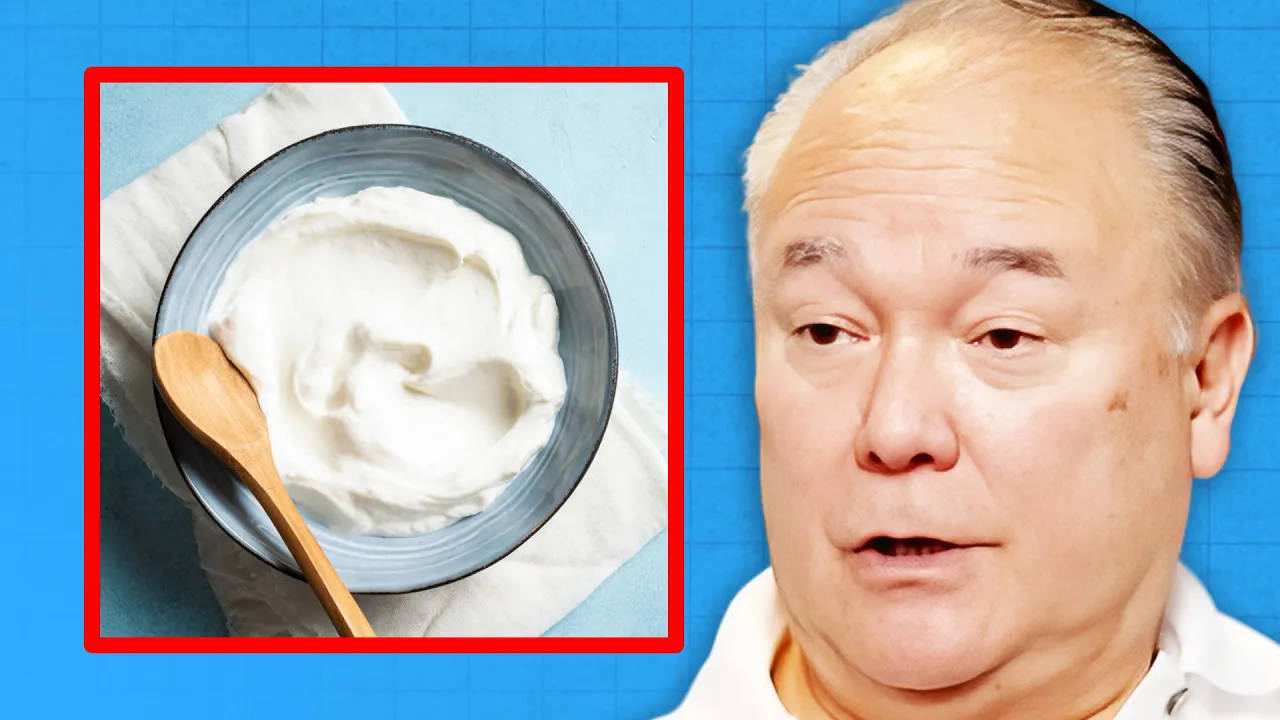
Even the "reuteri," many strains produce up to four bacteriocins... We co ferment them as a yogurt.
And I should mention, it's not the kind of yogurt you get in the store.
You cannot buy these things as yogurt.
We call it yogurt because it looks and smells like yogurt, but it's not yogurt.
But we ferment it for an extended period, because we want really big counts of bacteria.
When you use extended fermentation, unlike commercial fermentation, you get hundreds of billions of counts.
We examined our yogurts with something called flow cytometry, and we're getting around 250, 260 billion bacteria per half cup serving.
So we co ferment these three species... It makes a delicious yogurt, by the way.
And then you consume the yogurt half a cup per day for four weeks.
And so far, it's preliminary, "Jesse," but so far, of the 30 or so people who've done this, 90% have normalized their breath hydrogen gas... So I think... it's a valid and effective way of doing it.
We will look at that more formally down the road... in one of our clinical trials. -- But if I said you needed a frontal lobotomy to do this or to remove your colon, you better be damn certain... you need to have that done... We're talking about making yogurt... so it's such a benign thing. I think that the... barrier to doing this is very low.
Oh, this is definitely really exciting.
And I'm curious, when you're working with somebody with "SIBO" and you're having them make this yogurt, we're going to get into all the details because there's a lot here to break down.
But are they still using the herbs that you mentioned before, that product, "CandiBactin?" Is that part of the protocol, or has this yogurt omitted that step?
- So these are people, "Jesse," who are accomplishing normalization, reversal of "SIBO" without... any antibiotic.
No prescription, no herbal antibiotic, just with the yogurt.
I've got a few microbiologist friends, and one of the friends I was talking to, his name is "Suresh." He runs one of the nation's largest probiotic manufacturers called "BioSource." It's actually 35 minutes from my house, amazingly.
And he tells me that when they clean their vats, their fermentation vats, they'll sometimes use... "Lactobacillus reuteri."
It's so effective in killing off pathogenic microbes.
They actually use it to clean their vats.
I corroborate this with another microbiologist.
Oh, yeah, we use "reuteri" to clean the vats.
That's how potent some of these microbes can be.
So you can see if you just slap dash together a bunch of microbes and call it a probiotic.
Well, no wonder they don't really do that much.
They do have some benefit, but those much more carefully chosen and maybe in time we find even better microbes.
Right now this mix seems to be getting the job done in the majority of people.
And to take this even more granular, you mentioned the three different species.
There's also strains we gotta look at too... I want you to break this down because a lot of probiotics on the market today, they will list off the different species that are in the product, but that's only half the equation.
There's also the strain, so talk more about that.
Excellent point, "Jesse." Exactly right. -- So strain really does matter.
The best example I have is you've got "E.
coli." Your listeners have "E.
coli," I have "E.
coli" in our colons.
Well, what if you ate lettuce contaminated by cow manure with "E.
coli?" Well, you can die of that "E.
coli," you can go into kidney failure and sepsis.
So same species, "E. coli," different strain.
So strain can actually make a life death difference.
Not always, but in some instances.
So you got to pay attention to strain in many situations.
Well, as you point out, a lot of commercial probiotics don't even tell you the strain.
Or they assign a proprietary designation.
They just made it up... A-B-C-1-2-3.
You look up the science.
Well, you can't tell what it is... This is a big problem.
It's causing a lot of confusion in the industry.
And I don't know what the final answer will be, but in general, we want to... pay attention to... the strain.
So one of my favorite strains, bacteria species and strains, is "Lactobacillus reuteri."
So that strain, that bacterial species, has been lost by the great majority of Americans and Canadians, probably 96% of us have lost "reuteri." Even though Indigenous populations and other mammals like your dog... and the chipmunk outside your window in the squirrel, they all have "reuteri" but we've lost it because of antibiotics, herbicides, pesticides, et cetera.
Well, when we replace it.
The evidence is all about the strains called "DSM 17938." So I'm sorry, I don't make these strain designations up, but when you replace that specific strain wonderful things happen.
One of the things it does is "reuteri" colonize the... "GI" tract... and sends a signal through the vagus nerve to the brain... to release oxytocin.
So lots of people know that oxytocin is the hormone of love and empathy.
So people will say, I like my family better.
They don't irritate me as much.
I like my co workers better.
They don't make me as angry as before.
I introduce myself to strangers in line for coffee at "Starbucks."
I desire more connection with other humans.
I understand other people's points of view better... That's the oxytocin.
But then there's all these other non emotional, non social benefits, like a restoration of youthful muscle... and strength.
The ladies love it because it increases dermal collagen.
They start to lose their wrinkles.
It also causes deep sleep.
I'm a chronic insomniac, "Jesse." I've always struggled to sleep... four hours, five hours a night watching TV from two till five, reading books. I now sleep... straight through nine hours. Vivid, colorful dreams.
It preserves bone density.
It turns off appetite.
- In other words, a whole range... And when you think about it, preserves bone density, restoration, youthful muscle and strength.
- Deeper sleep, smoother skin.
Age reversal.
I think so.
And you can see it in people's faces when they get this microbe restored.
And "Jesse," that's one microbe.
That's the power of just one microbe.
Well, let's take this even further.
This is where I wanted to go next... You talked about "reuteri" and how us over here in the west have generally lost that microbe.
How different is our terrain in our gut versus, say, 100,000 years ago, our hunter gatherers?.. Do we have any idea of how much that's changed over the years?
- The best evidence comes from the examination of the microbiomes of... indigenous populations.
Whether it's not so much the Canadian Inuit because they've been changed, by westernization now... But some isolated populations like the Malawi in Eastern Africa or the Maasai in Kenya, or the - - Hadza in Tanzania, or the Yanomami in the Brazilian rainforest, or the Matzas in the highlands of Peru.
These have all had their microbiomes characterized and they have completely different microbiomes.
They have species we don't have.
We have species they don't have.
They have far more... species, much greater diversity, they say.
Now here's the kicker, here's the weird thing.
These are populations separated by vast distances, even different continents, yet all their microbiomes resemble each other very closely... So that's presumed to mean that this is the Stone Age microbiome that we had 100,000 years ago... But we have changed now.
It doesn't mean all those changes are necessarily bad... Maybe some of our changes are adaptations to modern life... But it does open the question, should we restore our microbiome to what they have?
But it would require.
I'm surprised that's not been done commercially yet.
That is to essentially package what they have... those ancient microbiomes and have you take it as as a probiotic. It's not been done yet.
I think we're worked toward that direction, but the differences are so stark... that... it'd be a long journey to do that.
But it does open some... very, very... interesting speculation.
Well, on a personal level, would you say that is our end goal we should be aiming for?
-- Somebody who's looked at the research and is so involved in this, I'm curious on your thoughts.
- I don't know, because if you're a member of the Hadza tribe... and you're in the savannah of Tanzania, you'll be doing things that modern people don't want to do.
You'll kill an animal and in the field you'll tear open its abdomen and you'll eat its intestine, maybe its stomach and pieces of the liver raw.
Well, in other words, that's the best probiotic there is.
--- But I don't think I'm going to do that.
You're likely not going to do that... So there are many practices that they engage in, meaning they have a microbiome that's fashioned, that's molded by their lifestyles that we put... probably... don't want to do.
And then we have also maybe there's some changes in the modern world that are adaptive and not so bad.
One of the crazy things, very interesting observation is we have an abundance of "Bifidobacteria."
- In fact, in children, that is by far the most dominant... species.
Collection of species in their "GI" tracts, they have virtually none. So does that mean we should get rid of all the... "Bifidobacteria?".. Probably not, because they've been also associated with some pretty spectacular benefits... So it's not quite clear they have an abundance of "Prevotella."
-- We have far fewer.
Should we mimic that behavior and get more?
Nobody knows.
- So, a lot of unanswered questions, but you can see how provocative these observations can be.
Yeah, for sure. Well, I guess my question then, if we're even trying to get back to part of that.
We'll take the "reuteri" example, how introducing one species in one strain when our microbiome is so different than it would have been a hundred thousand years ago, how would that... really move the needle?
One of the keys is to try to work to identify and then... restore what are called keystone species.
So if we've lost keystone species, I believe "reuteri" is one of them.
- "Lactobacillus gasseri" is another one.
"Akkermansia muciniphila" is another one... I'm sorry about these names.
"Faecalibacterium prausnitzii" is another one.
These are... microbes so important that their loss means you'll lose many other species.
So I think of it like plankton in the ocean.
So plankton, teensy weensy creatures that fill the ocean, that's what filter feeding organisms like whales and jellyfish feed on.
What happens? And this is happening, by the way, sadly, when there's a marked reduction or disappearance of plankton, well, the whales are going to disappear, the jellyfish are going to disappear, or a lot of other species will disappear.
Same thing here.
When you lose keystone species because you took antibiotics or were exposed to all those other things, you don't lose just that keystone species, you lose many others.
So a good start is to identify and replace, restore those keystone species.
Unfortunately, not all keystone species have been identified, but the list is growing.
And those are mostly the... focus of some of the yogurt and fermentation projects we have.
So sometimes people say, oh, this is overwhelming, all this talk of so many... species.
Well, I tell people. Think of restoration of lost microbes like going to a restaurant.
If you go to a nice fancy restaurant in Toronto and the waitress hands you a menu, do you freak out and say, I can't order all these appetizers, main dishes and desserts?.. No, you pick and choose the dishes you want.
Same thing in the world of microbiome.
If you say, I want smoother skin, deeper sleep and greater strength, cultivate "Lactobacillus reuteri."
If you want a reduction in arthritis pain, cultivate --- "Bacillus coagulans."
If you want to shrink your waist -- and not change your diet, ferment "Lactobacillus gasseri." If you want a healthier child, a newborn baby who's more likely to sleep through the night, take longer naps, have fewer bowel movements, thereby fewer diaper changes.
50% reduction, by the way, cuts it in half and... less colic.
And as an older child has less asthma, less irritable bowel syndrome.
-- Less autoimmune diseases and a higher "IQ," restore "Bifidobacterium infantis."
So you can... approach it that way, choose... the microbe for the effect you want.
And can you also co ferment things.
And by the way, it doesn't have to be yogurt.
Yogurt, dairy just happens to be a very forgiving... fermentation medium, but you can ferment other things. Coconut milk.
Hummus is a very good fermentation vehicle.
- I make something called "Saccharomyces boulardii" cider on my kitchen counter.
It's very easy. It's an effervescent soda.
- And the fermentation reduces most of the sugar, and it's delicious.
And that's a tremendous probiotic.
I should mention, one of the reason why we do this extended fermentation is because we want really high bacterial counts, more than you can get in a probiotic. - And so... the easiest way to illustrate is this kid's riddle.
Remember when we were kids... and somebody asked you, "Jesse," which would you rather have, a million dollars or penny that doubles every day for 30 days?
Of course, most of us, I'll take the million dollars because a penny 2 cents, 4 cents, 8 cents, nowhere.
Not recognizing that it becomes $5.5 million 30 after... days.
But if you looked at the progression, this... sequence of rise in money, the big rise doesn't occur till day 27 or 28... The same phenomenon of doubling... occurs in microbes.
Microbes, of course, don't have sexual reproduction.
They have asexual reproduction.
One microbe becomes two, et cetera, like the pennies.
<break time=“2.25s"/> The real increase in microbial counts, like in "reuteri," that doubles every three hours, occurs at hour 33, hour 34.
We know in commercial yogurt making, they typically ferment for four hours.
There's nothing in the yogurt.
So they add things like gel and gum, xanthan gum, carrageenan, to thicken it up.
We don't have to do that.
We're going to ferment for a long time. 12 doublings.
And you may recall from the flow cytometry, we get 250, 260... -- billion... bacteria per half cup serving... So that's why we follow this extended fermentation.
We go as long as we can.
At some point, you don't get any more doubling.
You get death.
So we did do flow cytometry on yogurts made at 48 hours, and you don't get any further increase after 36 hours, probably from competition for the existing nutrients.
So we talked about how it's a little more complex than just knowing the species.
You need to get the strain right as well.
So for somebody who wants to take this on and start to make the "SIBO" yogurt at home, where do they go about getting the proper species and strains?
So because it's so tedious to tell you that... the strain you want for smoother skin is "Lactobacillus reuteri DSM 17938" or the "ATCC PTA 6475."
Or if you want relief from knee pain from arthritis, you need to get the "Bacillus coagulans GBI-36-086."
It's tedious as heck to tell you this way.
So it's all in the "Super Gut" book I laid out for you.
What species, what strains and where to get them.
We can't get all strains, so I have an advantage.
I get strains from manufacturers.
And here I'll tell you a dirty little secret.
So I originally went on the "Lactobacillus reuteri" bandwagon using these strains from Sweden.
The "BioGaia" "Gastrus," G-A-S-T-R-U-S strains.
That's that "DSM 17938" strain... Because... the "MIT" group that did a lot of elegant work with that microbe, showed us that strain does all these things.
Acceleration of healing, restoration, youthful muscle, all those effects, the social effects.
So we started.
I started with that microbe made yogurt because the tablets are sold to you in tablets for infants, so the microbial counts are so low.
That was my original motivation for making the yogurt, to get these billions and billions of counts... Well, since then, I've got my hands on seven additional strains of "reuteri."
And now this is just my anecdotal experience.
So far, every single one has done the same thing. In fact, I think I have a strand that's even more powerful.
But I can't share with you because I got it from a manufacturer, they give it to me in bulk, and it's not meant for dispensing or for sale.
It will make it to the market eventually.
I'll make sure that in some form. -- But I think... many strains of "reuteri" I do this and may even do it better... than the original string, but that's still to come.
Well, like you mentioned, people have got to get the book to get all the details.
It's very nuanced, but for somebody who does get the book and they find out exactly what they're looking for, somebody who isn't in your position and can connect with the manufacturer, are they able to order these on "Amazon" and have it delivered to their door, or... how complex is it?
Yeah, so I typically talk about, I told you the secret, but... ordinarily I just tell people about the microbes they can get their hands on.
So for instance, that one that they get for their children... is "Bifidobacterium infantis Evc001."
That's the strain designation.
And you can buy it as the "Evivo" product, E-V-I-V-O.
And the people at University of California, "Davis" did a lot of work.
That's the one that cuts bowel movements in half, cuts diaper changes in half, deeper sleep, and healthier children with higher "IQs" later in life.
So that is a commercial product.
You might have to. It's like $79.
It's not cheap, but the magic here... is if you make yogurt out of it, you never have to buy it again... because you can make the next batch from a little bit of the prior batch.
And by the way, that product is sold and they tell you mom should give it to the baby... mixed in breast milk.
Because what this microbe does, "Bifidobacterium infantis," is... 90% of babies don't have it... because they got antibiotics at birth... to reduce beta "Streptococcal" infection... Mom got antibiotics because she had an episiotomy.
- Or mom never had it because she lost because she took antibiotics and other things... in her past.
So the majority of babies don't have this microbe.
Well, you need this microbe to digest the so called human milk oligosaccharides in breast milk.
In other words, it's a curiosity of nature.
Breast milk has something very important for that child's development called human milk oligosaccharides.
Well, without "infantis," it gives the baby diarrhea and it can't digest... the human milk oligarchs.
If you restore "infantis," it dominates the child's microbiome.
90% of all microbes will be "Bifidobacterium infantis."
And now the baby can digest. So it requires the assistance of this species to digest these human milk oligosaccharides of breast milk... Now.
So the company says, mix it with breast milk, feed it to the baby. I'll say... go one step better.
No, no, no, no, no.
How about mom gets it while she's pregnant or even before pregnancy.
She makes yogurt or other fermented food out of it, she eats it, she populates her... birth canal.
Breast tissue, breast milk, saliva, skin.
She populates.
With "infantis," she passes it onto the baby like it's supposed to happen with passage of the birth canal, breastfeeding.
And mom can still give it to the baby directly after birth. But why not do it the right way?
And that way mom also gives the baby "Bifidobacterium infantis" in the context of her overall microbiome.
And one thing I found really interesting while we're on this topic is that if you don't do it, quote, unquote, nature's way.
You mentioned breast milk and through the vagina being born.
It's never really the same when you take these probiotics later in life.
So talk about the difference there.
When you're giving a baby through the mother, the... bacteria on the skin, in the mouth, it's totally different than trying to repopulate those later in life.
You put your finger, "Jesse," on a very fundamental and unanswered question.
Unfortunately, that is, let's say you're 40 years old and you take "Lactobacillus reuteri," our favorite microbe.
Well, it may last in your "GI" tract at big numbers, maybe for five days... and then probably gone within two to three weeks.
Well, why?.. If mom gave it to you, you'd probably have it for decades, if not a lifetime.
What's the difference?
Nobody knows... I think a lot of us speculate, though... it may be due to lack of what are called those keystone species because -- bacteria like humans, they collaborate, they help one another.
One of my friends is Doctor "Raul Cano," who's a microbiologist... in academic microbiology for 40 years... And he's really advanced idea of collaborative guilds or consortia where he does studies like this.
He learns that microbe A produces something that microbe B needs, microbe B produces something microbe C needs.
Microbe C produce something that microbe A needs.
And when they do that, they're more able to proliferate, produce metabolites that benefit you... And so there are communities.
And so when you restore one microbe, it may not be good enough by itself to establish long term.
Now we don't have, unfortunately that science is very early and so we don't know... But I think the probiotic of the future, or maybe the yogurt of the future or the fermented food of the future... will be.
We say, "Jesse," don't just ferment "reuteri."
Ferment "reuteri" with these four other microbes.
And that way, you do it and you're permanently... colonized. But that we're so far away from that.
The closest I know, and I have no relationship with this company, but there's a very teensy weensy company.
They're both the founders of my friends.
It's called "BiotiQuest" B-I-O-T-I-Q-U-E-S-T.
They have a product called "Sugar Shift." They call it "Sugar Shift" because it's a collection of microbes that "Raul Cano" showed.
When you put them together, they reduce blood sugar dramatically.
Probably because two of the species, and sorry about these names, "Leuconostoc mesenteroides" and "Lactobacillus plantarum," they consume sugar... in your "GI" tract. It consumes sucrose and fructose and glucose... and by the way, converts it to mannitol, which is another kind of sugar that humans can't digest.
But it does cross into the brain. And there's very preliminary evidence that mannitol dissolves... the so called alpha-synuclein of Parkinson's disease has yet to be proven and explored, but they're working on it... But the point of all this is that "Sugar Shift" product is the... creation of a guild of microbes that work together and thereby has bigger effects.
So "Jesse," you can see we're still too far away and we can't really say rather get "reuteri," get these... whatever, four, five, six, ten microbes altogether.
Doctor "Davis," at this point, with all the research you've done again, and now you're talking about making all these specific species and strains, I can picture your kitchen counter as this laboratory with all different fermentations happening.
Are you taking a general probiotic at this point to complement... the specific species that you're breeding on your own?
- I'm not because I've been generally disappointed with the quality of current probiotics.
There's a couple that are getting better.
There's one called for instance, "Synbiotic 365," S-Y-N-B-I-O-T-I-C 365.
That includes a few keystone species.
So that's a step in the right direction... But I think one of the most important things people can do is... free... or nearly free, and that's just fermented foods.
So the science is maturing.
There's a husband, wife team out at Stanford, "Erica" and "Justin Sonnenberg." They just published just a few months ago a very important... paper.
They compared the power of frequent consumption of fermented foods.
These are things like kefirs, yogurts, fermented veggies, kimchi, sauerkraut, truly fermented sauerkraut... versus prebiotic fibers.
Both are very important.
Prebiotic fibers are fibers that serve as nutrients to microbes... And hands down, the fermented foods were superior... The curious thing about that study was... when you, let's say I consume kimchi and I thereby get "Leuconostoc mesenteroides" some "pediococcus" species... and maybe some "Lactobacillus brevis."
You'd think those would be the microbes that take up residence.
They're not. Somehow getting exposure to those species in the kimchi opens the door... to a whole bunch of other species.
No one knows how --- or why this happens.
But in other words it's like you invite a couple of friends over for a party.
Next thing you know, you got 200 people who you never met before.
So it's that kind of a thing.
So the most important thing that people can do is and you know what, "Jesse?" This is what our great grandmothers did because they didn't have a refrigerator.
So in 1927, when "Frigidaire" developed... refrigerators that were affordable for home use and developed "Freon" as a refrigerant, most people in North America stop consuming fermented food.
They're better about this in Europe and in Asia.
But most people in North America stop fermenting their food.
And we stop the flow of a very important, crucial source... of microbes that either take up residence in your "GI" tract or cultivate... the presence of healthy microbes of other species.
And is it true that when we consume fermented foods like probiotics, we'd have to do that on a regular basis because those ones don't have that stickiness factor like getting the bacteria from mom at birth as well.
Yes.
So they won't take up residents for most of the time.
I'm generalizing.
Most time more than a few days, sometimes "Leuconostoc," That's in mouthful. I know.
"Leuconostoc mesenteroides," but it's such an important microbe.
It reduces blood sugar, it reduces fatty liver, reduces blood pressure. And by the way, a lot of these microbes make you happier too.
One of the early effects people will experience is vivid dreams. Can I tell you an interesting but kind of embarrassing story?
Please do.
--- Now, this is something your listeners can't do, but in future... So it's worth keeping abreast of this conversation... So we all make "reuteri" yogurt and get that restoration of empathy and affection for people, desire for human contact, and deeper sleep with vivid dreams.
Well, I got a hold of my friend "Suresh."
He's the microbiologist. I got a hold of a super duper high potency "reuteri."
That is many... hundreds of billions per gram... I made yogurt out of it.
Looked, tasted the same. That night I once again had deep sleep, uninterrupted sleep with vivid dreams... But towards the end of the evening, I had this crystal clear, vivid dream like I've never had before... And there was a woman involved, a woman I didn't know, but nice looking woman... I saw her hair, I saw her eyes, I saw her facial features.
She introduced herself, first and last name, which I've never experienced in a dream... And I felt this outpouring of affection, love for this imaginary woman.
Well, I woke up.
The curious thing was those feelings overpowering, intoxicating feelings of affection, love for this imaginary woman continued for many hours into the daylight.
It eventually dissipated, but it made me... what can we turn on... and turn off... love.
- I hadn't been able to recreate that effect.
I don't know what it was exactly.
Was it a combination of oxytocin with dopamine or some other neurotransmitter I had not been able to.
-- I've even taken up to a trillion... of those "reuteri" microbes I hadn't been able to recreate. But I think... I'd like to figure this out.
Wouldn't it be cool?
- I have a friend who's been married for 43 years.
He's still deeply in love with his wife, but his wife has lost the spark.
He says to me, I want that yogurt to give to my wife.
So wouldn't it be cool to have such a thing?
And by the way, if we do experience deeper love and affection... with restoration of "reuteri," does that mean the intensity of love and affection 50, 100 years ago, a thousand years, 10,000... years ago was more intense than it is today?
Interesting question, tough to prove.
Fascinating.
And you mentioned how this is not something you've been able to reproduce.
It sounds like it might be an ongoing thing that you're experimenting with.
But have you noticed just with the other experiments you're doing and changing your gut microbiome so radically, with... all the different fermentations you're doing, yogurt and stuff.
Have you noticed, in a general sense, to a lesser level, feeling that love and connection... day in, day out?
Yes.
So I talk to a lot of people.
I have thousands of people doing these yogurts, including the "reuteri."
Like last night, once a week, I have a meeting with a lot of my followers.
So typically 74, 100 people show up and we talk about these kinds of things.
And so I told them about my little embarrassing, I call it love dream. I said, anybody else have that experience?
And many of them said, not quite like that, but I do have a lot of erotic dreams.
And my libido during waking hours is much stronger.
In fact, I had a number of people say they had to actually back down on the yogurt because their libido was a little bit too out of control.
But many people do indeed report that effect of liking their... spouse better, liking their partner better, liking their family better, and a lot of crying at movies, by the way.
That's fascinating for somebody who has a real need to go on antibiotics and they've listened to our conversation here, they understand how powerful the microbiome is to basically every aspect of health and well being.
What would you say to them?
How do they go about taking that antibiotic for a good reason?
- What can they do in the background to support going through that and afterwards to have the least detrimental impact on their microbiome?
So you're exactly right.
We can only work to minimize our exposure to the factors that disrupt the microbiome.
And so I call that... I liken the microbiome to a garden, you may recall.
So we prepare the soil, get rid of the rocks and the twigs, the weeds, we plant seeds, those are fermented foods and probiotics and the yogurts, et cetera, for other fermented foods... And then we also water and fertilize the garden.
That's prebiotic fibers, polysaccharides, polyphenols.
But you have to start out by minimizing your exposure to things that disrupt the microbiome.
So there's a whole list.
So taking an antibiotic only when truly necessary.
- People will take a lot of antibiotics, the majority of which are not necessary... In other words, if you had an upper viral respiratory infection, you're given an antibiotic just in case it turns into a bacterial infection that's done a lot, or urinary tract infections are treated a little bit too freely.
So a lot of overuse of antibiotics, but there's a time and place for them.
You do need them at times.
- You want to try to choose organic foods to minimize your exposure to herbicides and pesticides.
Of course, no "GMOs."
They're filled with glyphosate, "Bt" toxin and other things.
-- Filter your water, chlorine fluoride.
-- Try to get off all the drugs that disrupt the microbiome, the anti inflammatory drugs, stomach acid blocking.
And by the way, it does help to have a doc who's... familiar with how to do this.
I do discuss ways to do that in the "Super Gut" book, but it does help when you're trying to get off, say 20 years of "Prilosec." It can help to have somebody do a proper assessment... Do you have stomach acid?
Do you have rebound excess acid?
There's some questions to settle before you get off these drugs.
Statin drugs are, in my view, I'm a cardiologist. I think statins are absurd.
I think the data is absurd.
I think the whole premise is absurd. And, and the whole tragedy of statin drugs to reduce cholesterol is that it took everybody's attention off the real causes of heart disease.
And that's, that's a real travesty.
That's why there's been no reduction... Even though statin drugs are used widely, there's been no meaningful reduction cardiovascular risk.
It's because.
if you're causing heart disease but you're treating something that's almost unrelated, well, no surprise. But anyway, so we get off those drugs.
So there's a whole long list.
Go back to real foods that don't have long lists of ingredients that have microbiome disruptive effects like polysorbate 80, et cetera.
So I don't think it's possible, sadly, "Jesse," to completely avoid things that screw up your microbiome.
All we can do is minimize.
I do have a suspicion that there are other factors that are contributing.
I don't know what it is. "EMF," who knows?
I don't know. But I think there's more to this.
-- And factors that we have not yet put our finger on.
What I was getting at, though, I think it was, that's all great information. But... if somebody is going to take an antibiotic, can they up the "reuteri?" We talked about making the yogurt.
Can they make a big batch of that ahead of time, take it a week leading up if it's convenient for them to wait to start the antibiotic?
Can they build up their "reuteri" or a couple of these other different species and strains that you're talking about today, either before, during or after to lessen the effects of those antibiotics?
There are things you can do.
The "reuteri" is not very helpful in that situation... because it's so susceptible to antibiotics, so it will die, and so it doesn't hurt you if you continue to get "reuteri" during a course of antibiotics.
But things that do help.
Let me tell you how to make a cider that's really helpful.
So the best evidence for... minimizing the damage done by antibiotics is to get a fungus called "Saccharomyces boulardii," which is a cousin of "Saccharomyces cerevisiae." And that's the fungus everybody knows about because it's used to make wine and beer and sourdough bread... and to make bread rise.
So there's a relative "Saccharomyces boulardii" that is adapted to the human gastrointestinal tract.
Well, you can buy it... in North America as a product called "Florastor."
And it comes with, once again, low counts of "Saccharomyces." So you can take the capsule and get small counts, or you can make cider... and get much greater counts. It's so easy, it's foolproof.
You need... any... volume.
Could be a quart, could be gallon, whatever, or liters of apple cider.
It can't have any... preservatives in it, so no potassium sorbate, none of that stuff.
Just plain old apples.
And you want the cider, not the juice.
You want that cloudy stuff.
So apple cider.
Empty one capsule of the "Florastor" "Saccharomyces boulardii," cap it lightly.
And then try to keep it at around, if possible, 80 degrees.
You can use your countertop... like a 70, 72 degrees, but you'll get better results at around 80, 85, maybe 90 degrees.
So what I'll do is I'll put it in my oven, put the light on.
Or turn the oven on to any temperature for maybe 45 seconds, just enough to warm the air, and do that for 48 hours.
You have to cap it lightly or vent it every so often because there's so much carbon dioxide produced.
If you cap it tightly, it'll explode.
You can actually watch it at about 24 hours.
You can see it bubbling... That's how vigorous the fermentation process is.
After 48 hours, the sugar, because it starts with a lot of sugar, is reduced dramatically because the microbes consumed it.
And it tastes like apple soda. It's delicious.
And you drink a quarter cup... a few times a day.
And... that is really effective for protecting yourself during a course of antibiotics.
Another species you can get is a bacterial species called "Lactobacillus rhamnosus GG" strain.
And it has to be the "GG" strain because the other strains of "rhamnosus" do not protect you.
It's not as effective as this fungus.
The great thing about the "Saccharomyces boulardii" is... it's not susceptible to antibiotics. So you can take, you can drink your cider or take the capsules during antibiotics, and it'll do its job... because it's unaffected by the antibiotics the "rhamnosus GG" can be diminished by the antibiotic, but it does help.
But that's mostly effective during but more so after... the antibiotic.
That's all really helpful, thank you... And you talked about they're using the oven to regulate the temperature a little bit to get a better ferment.
Reading your book, it sounds like you actually have a different machine though, that you can keep a steady state temperature while you're making your yogurt.
Can you talk about what that is?
Yeah, you don't need that for the cider because the cider is so forgiving... But when you get into the yogurts all the different microbes have different temperature preferences and all that means is they proliferate better at different temperatures and some die at certain temperatures.
So "Lactobacillus reuteri," our favorite, likes human body temperature, so it helps to keep it around 97 to 98 Fahrenheit or around 37 Celsius. <break time=“1.65s"/> There are other species though like "Leuconostoc" likes more towards 80 degrees... What about "Bacillus coagulans?" It likes 115, 122 degrees. So what really helps is if somebody gets into this stuff, it helps to have... a device that allows you to... alter your temperature.
So some yogurt makers are like that.
Some sous vides... are pretty good for that, whether it's a stick sous vide or a basin sous vide... And some "Instant Pots" have a yogurt setting.
Now it always helps if you have a device with a preset temperature.
You want to check the temperature with a thermometer, let it run for a little while, but with a thermometer and see what the temperature is.
Because let's say you have a yogurt maker that's preset to yogurt microbes, which is typically 108 to 114 degrees Fahrenheit.
What would that be 39 or 40, something like that Celius.
And that kills "reuteri."
So that's a common cause for failure. Somebody say, I tried fermenting it in my yogurt maker and all I got was soured milk. So it does help to understand the behavior of your.
But I, in the "Super Gut" book, I list a bunch of brands you can consider... It shouldn't cost you much.
You can get a very nice yogurt maker with adjustable temperature... for $35 US it's not that expensive.
So when you're making the yogurt, the microbes are going to be feeding on the sugar in the milk, if we're using milk.
You talked about other options as well.
Are you putting any other food in while you ferment to give them another supply so they can proliferate quicklier?
Okay, good point.
Good point, "Jesse." Yeah, I learned long ago that if you add a little bit of something, the microbes like to eat.
Most microbes like... prebiotic fiber.
So a common one is raw, unmodified potato starch.
It's inexpensive, it's easy.
A tablespoon per quart or per liter... of whatever you're fermenting I'll use organic half and half.
That's my favorite, by the way.
We reject this idea of using low fat, non fat.
That's nonsense.
Of all the problematic components of dairy, fat is the healthiest.
And ironically, that's the stuff everybody avoids... And milk fat is wonderful... There are problems. There's the whey protein that has an insulin effect.
There's the casein beta "A1" in North America that has... immune effects. There's lactose.
There are issues.
But ironically, it's the fat that's the most... benign component.
So I use organic half and half, which is about 18% fat.
But I add a tablespoon of salt, some prebiotic fiber, could be inulin, could be raw potato starch, and you get a thicker tastier end product... One thing I've not done is compare... microbial counts with and without the prebiotic fiber.
I suspect, though, that the counts are higher with the prebiotic fiber.
- I'm always surprised that commercial yogurt makers don't use a prebiotic fiber because the end product is so much more satisfying.
And what about once you build up your gut microbiome over time and you're trying to... maintain that rather than build that up?
Are you using that same prebiotic fiber, say, in some water or a smoothie on a regular basis to provide additional food for your new microbiome?
Yes, absolutely. So... you wanna, you're feeding the microbes in your yogurt with these prebiotic fiber, but you also wanna feed them in your "GI" tract with these prebiotic fibers.
And these come from things like alliums, onions and garlic and shallots... Legumes... provide the "galacto-oligosaccharide" prebiotic fiber... Black beans, white beans, kidney beans, chickpeas, hummus.
- The polysaccharides and mushrooms are very good.
<break time=“2.73s"/> Because we're trying to mimic the behavior of... primitive people, we sometimes have to resort to some unusual things, like a raw white potato, which most people don't eat.
But you're mimicking the behavior of somebody who lives off the land and digs in the dirt for roots and tubers.
Well, I'm not going to do that.
"Jesse's" not going to do that.
Your listeners aren't going to do that the ground's frozen a lot of the year.
You got things to do.
So... we mimic that behavior by getting things.
We have access to a raw white potato, a green unripe banana, or other sources... for convenience. You can get inulin powder.
"Inulin-FOS" powder.
You can get pectin is another good one... So the skin of apples, the rind of use zest for your citrus fruits that's full of pectin. -- I try to make it a habit, and I suggest everyone do this, of getting a fermented food... and a source of prebiotic fibers and related compounds at every meal.
Because if you do that, you get these big effects.
When you feed bacteria, the good guys start to win... You cultivate very important keystone species like "Akkermansia" or "Faecalibacterium." And those are the keystone guys that... cause other species to proliferate... Now, if somebody's intolerant to either a prebiotic fiber, people say, oh, I can't use that.
Inulin gives me diarrhea gas and anxiety, panic attacks.
Or... I take a probiotic and I get mind fog and diarrhea.
Those are signs of "SIBO."
- And by the way, also, "Jesse," it's important for listeners to know if people say things like, oh, no, I can't eat nightshades... like eggplant or tomatoes. I can't eat "FODMAPs." I can't eat... anything with fructose like fruit.
I can't eat legumes. Oh, no, I get bloating gas that the problem is not the food... The problem is you have "SIBO" and... you will register positive.
Should you confirm with an "AIRE" device, you'll get a high level... on your -- "AIRE" device... So the problem is not the "FODMAPs" or the nightshade.
The problem is your microbiome.
So I hear a lot of people say this.
So I avoid tomatoes and eggplant, and I feel, okay, well, the problem with that is if you have "SIBO" that's unaddressed, you're going to have other problems down the road.
And it could be serious stuff.
It could be... a neurodegenerative disorder like Parkinson's disease or "Lou Gehrig's" disease or dementia or an autoimmune disease like Hashimoto's thyroiditis or lupus, or it could be... an intestinal disease... like ulcerative colitis or diverticular disease or colon cancer.
So it's not a good idea to say, oh, I avoid those foods, I'm fine.
No, you're not fine.
You feel better.
But you haven't addressed the cause of the food intolerance.
But what I'm guessing you would say is early on in the game, when somebody is, they haven't dealt with their "SIBO" yet, they should avoid those foods and probably avoid all prebiotic fiber overt sources... because they haven't cleared out the bad bacteria yet... They don't want to just put food in for those guys as well... I would assume they want to clear those guys out and then put the food in for the good guys.
- Exactly. That's right.
So if you get explosive diarrhea, for instance, or panic attacks every time you consume a... prebiotic fiber or some other food, you're intolerant to.
Exactly right. Remove that food.
Take all the steps remove all other disruptive factors... It could involve a high potency, multi species, probiotic, fermented foods, et cetera... And then several days or weeks in, resume the prebiotic fibers. Because this is the mistake, by the way, a lot of people on a ketogenic diet or carnivorous diets make, they... don't mind their intake of prebiotic fibers... and related things that nourish microbes.
What happens when you do that?.. Let's say you're ketogenic and all you're eating is... fatty meats and green vegetables, et cetera, but no prebiotic fibers.
Well, you're starving microbes, so their populations drop... dramatically.
Some species actually disappear.
But there's one, there's actually several species, but the... primary one is "Akkermansia."
"Akkermansia's" full name is "Akkermansia muciniphila."
Mucus lover.
And so other species die off or diminish.
"Akkermansia" can turn to human mucus for nutrition... and starts to consume your mucus barrier.
And that's a very bad thing... because it causes intestinal inflammation, colitis, endotoxemia, bacterial breakdown products... getting into the bloodstream and leads long term to insulin resistance, type 2 diabetes, fatty liver, high triglycerides. - -- Even diverticular disease and colon cancer.
So you don't want to make mistake of starving your microbes because "Akkermansia" is a good guy.
It supports the mucus barrier, it's keystone... Unless... you deprive it of those prebiotic fibers, and then it, it shows its other face and starts to eat you.
And when it comes to somebody, say they're just on a low carb diet, they're not totally omitting all the food for their microbiome.
How do they know when they've reached an amount of prebiotic fiber that's gonna feed the microbiome that's enough for them?
Is it just subjective and you gotta play with it, or is there a certain rule of thumb or you recommend using supplements, the powder?
Just curious on how you'd go about that for somebody who is, say, low carb.
- It helps at first to be mindful of how much, how many prebiotic fiber grams there are in various foods.
In other words, if you take a teaspoon of inulin... for convenience, put it in your coffee, there's about 4 grams in there.
If you have a raw white potato, let's say half of raw white potato that you chopped finely into your salad, you're getting something like 10 or 11 grams. It helps be mindful.
Maximum effect appears to occur at 20 grams per day.
Now, all those indigenous populations we talked about, many of them get over 100 grams per day.
But it's never been shown that we should do that for benefit.
But it may be the reason, by the way, they have an abundance of species like "Prevotella" because they have such a higher fiber intake.
Prebiotic fiber intake.
But it's never been shown that if you or I or your listeners upped our prebiotic fiber intake to, let's say, 100 grams per day, that we gain some incremental benefit.
I will tell you anecdotally, I've had people say I just relax.
I upped my prebiotic fiber intake to 100 grams per day, and I I felt much stronger and healthier and more energetic, maybe.
Have you ever tried it yourself?
I have not, but I've gotten up to maybe 40, 50, 60, and I can't say I perceive an effect.
Let's come back to the raw potato.
This isn't something I've ever tried to include in my diet.
You gave an example there because I want more examples for myself and for the listeners how we can go about incorporating that into food so we can chop it up fine, put it in a salad... I'm assuming putting it into a smoothie would be another way to get that in without having to endure chewing a raw potato.
- Yeah, you can just chop it coarsely.
You do need a fairly strong blender... and toss it in.
Toss whatever else you want.
Maybe coconut milk and avocado.
a couple of a few berries, whatever you like.
And yeah, it makes a very nice smoothie or shake.
Likewise the green unripe banana.
But it must be green and unripe.
It can't be yellow, it can't be kind of green.
It's gotta be green or else you get a big wallop of... sugar if it's tending towards ripe.
-- Adding inulin powder is an easy way.
You can get "galacto-oligosaccharide" powders, but they're kind of pricey... You can get various mixes nowadays of a mixture of prebiotic fibers.
I think they're kind of pricey.
I think the best way is just to get foods... Eat more asparagus, eat more legumes.
-- Make it a habit of getting garlic and onions and... cloves, leeks, dandelion greens.
There's lots.
If you're mindful of what foods it means... and you keep your refrigerator and cupboard stocked with these things, it becomes easy to make sure it's inclusion. You can include it in every meal.
And I know the research is young and using your yogurt to treat "SIBO" is something you're just the big scheme of things just delving into and you want to do a lot more research... But what was the number you gave earlier?
Was it 90% of people using your yogurt were able to treat and... eliminate their "SIBO?"
Yeah, of a small number, about 30 people... But they've so not just symptom improvement, but normalization of hydrogen gas.
-- So I don't want people to get the impression you must buy one of these things to manage your "SIBO." You don't have to... It does help. In other words, if you blow positive value and then you do... X whether it's "SIBO" yogurt or "Candibactin AR-BR" or whatever you do... And then you test some weeks later and you're negative.
Oh the choice you made worked or... it didn't work or if you have a recurrence.
So it is helpful to have... But you don't have to buy this thing.
People can do this empirically that is based on their best judgment.
I have a lot of people do that also... and still have spectacular results.
And for people who do make a big dietary shift and start incorporating this yogurt on a regular basis.
How common is recurrence?
Is this something that most of us are going to face ebb and flow over the years?
Yeah, recurrences are very... common.
Now no one has the formula for preventing recurrence.
But I'll tell you what I think works.
I think the "Lactobacillus reuteri" works, you may recall. So the "reuteri" is not just a source of oxytocin and smoother skin and deeper sleep and maybe love dreams.
<break time=“1.61s"/> But it also colonizes the upper "GI" tract and produces bacteriocins.
<break time=“2.42s"/> We're thinking about colonizing and protecting the small intestine.
And so "reuteri," I think, has helped a bunch of people because we're not seeing very many recurrences... in people who take the "reuteri" even though in other areas, other programs, etc. There's recurrences all the time.
"Lactobacillus gasseri" may also be... an important species to include to prevent recurrences... and of course, continuing all those other things.
Don't get emulsifying agents in your foods.
Avoid herbicide, pesticide residues and choose organic foods.
Filter your drinking water, minimize antibiotics.
All those things still matter also, because if you go back to those things, it invites your... "SIBO" back.
Now, there are some people who, no matter what they do, continue to have recurrences... It helps to have some kind of formal assessment if you can find a functional medicine diet.
-- What if you were a wheat eater... for the first 40 years of your life and that triggered an autoimmune response against... your stomach and you killed off the parietal cells that produce stomach acid and you no longer have stomach acid?
Well, when you lose stomach acid, whether it's from an autoimmune gastritis... or due to taking stomach acid blocking drugs, you've lost a great barrier to the ascent of stool microbes.
So if you have lost stomach acid, you're going to have recurrent "SIBO" over and over and over.
Really helps to have a doc who can assess that for you.
Check something called serum gastrin. Because... if your gastrin level, it's a hormone, it tells your stomach, make more acid, make more acid.
And if your blood level's high, it means you don't have stomach acid... And then you have to talk about things like betaine hydrochloride, vinegars, carbonated drinks, things that acidify your food, there's no way to restore parietal cells, unfortunately. My point is this.
If you have recurrent "SIBO," no matter what you do, and maybe if you're still taking "reuteri" or "gasseri" and still have recurrences, then it helps to have somebody go through a formal assessment to see if there's something wrong with your "GI" tract that won't respond to these basic natural efforts.
That makes sense... And we started off talking about dysbiosis, "SIBO" and "SIFO" being the three things that we're going to cover.
And throughout a lot of our conversation we've directed towards "SIBO" and making the "SIBO" yogurt and how profound the impact has been on a small number of people using that to treat "SIBO."
I'm curious though, when it comes to somebody that has just dysbiosis, the bacteria haven't begun to -- ascend up the digestive tract or somebody that has "SIFO" fungus entering the picture.
How different is the treatment protocol... for those variations of something similar?
For fungal overgrowth, let's say you've got recurrent eczema, you've got crazy mood swings, and you crave sugar, so pretty common.
Or you performed a stool analysis and they found a lot of candida species in your stool.
So thankfully... the fungal overgrowth is tough to deal with, but the agents tend to be very benign. So we've been doing things like berberine or curcumin, by the way, there's a lot of these herbal preparations and ayurvedic preparations... and polyphenols, all kinds of stuff that for years we've known don't get absorbed.
And so curcumin, for instance, or turmeric.
-- If you take 100 milligrams orally, you poop out over 99 milligrams.
Now, wait a minute.
The evidence is quite clear.
If you take curcumin, it reduces measures of inflammation like C reactive protein.
It reduces... joint pain in knee arthritis. So it works.
-- Several clinical trials, it works... But how does it get to your knee if you don't absorb much of it at all?
Almost zero absorption.
So companies have been working furiously... to force absorption.
They add bioperine or piperine or black pepper or nanoparticle emulsions.
All these manipulations which have not been shown to be more efficacious, by the way, but I would argue quit that.
Don't do that. Get the non absorbed form... so it stays in the "GI" tract, because it's probably working.
Curcumin is known to be an antifungal agent, moderately effective antifungal agent, has some antibacterial effects and it has spectacular effects on rebuilding the intestinal barrier and mucus barrier.
So we'll use things like berberine, curcumin... Non absorbable. And I was skeptical about this also, but essential oils, food sourced essential oils... are very effective.
Cinnamon and oregano are two... common ones.
But there's a very specific way to do this.
You can't take them directly because they're highly caustic, they burn... So there's a way to dilute it.
And this has been very effective for us... But it can take you two months or longer to really cut back in the fungal numbers... But we're talking about relatively inexpensive and relatively benign tools.
There's also something called methanogen overgrowth.
I don't want to overload your listeners, but there's something called methanogen overgrowth.
These are peculiar creatures with... long names like "Methanobrevibacter smithii."
These are microbes that evolutionarily predate bacteria.
-- They're also called extremophiles because you'll find them in the boiling water of geysers or at the bottom of the ocean at extreme pressures or in the Dead Sea with extreme salinity... And scientists speculate that if there's life on Mars or the moon, it's going to be something like archaea because they're so hardy... Well, they also can populate your "GI" tract.
But that science is not well sorted out... There's preliminary evidence that rifaximin may work to do this.
Maybe the "Candibactin" regimen, maybe... I don't.
I cannot argue.
I could not claim that are "SIBO" yogurt has any beneficial effect on... overgrowth of those creatures... So we're still.
Now, the newest version of this device now also measures methane.
And you know what, "Jesse?" If you and I and your listeners, at least some of them... have the now a means to track methane, guess what's going to happen?
We're going to find out ways to deal with it even before the science comes out.
Because some will say, hey, -- I took X and my methane levels normalized in two weeks... Somebody else, I'm gonna try that too.
Before you know it, we've got 30, 40, 50, 100 people who've done it and tells us that's not a trial, it's anecdote, but it's at least a start.
Yeah, very cool.
And I know we gotta part ways, but one thing I think it's important we touch on before we do... is die off reactions... So people that are gonna get in there and start mucking around and... whether it be conventional antibiotics or some of the different natural ways we mentioned, including the "SIBO" yogurt, you get in there and you start killing these microbes and -- there's a good chance you're going to notice some negative response and negative feelings before you start to feel better.
So talk about that a little bit... and talk about the difference... of die off reactions... from conventional ways of treating versus, say, using your yogurt.
Oh yes.
So this effect's been known for about a century, ever since they first started treating syphilis, of all things.
And when that microbe of syphilis, "Treponema," dies, it releases its components and you get sicker.
Fever, chills, sometimes delirium, you can't breathe. Well, thankfully the die often we kill off microbes in the "GI" tract, like let's say "E.
coli" and "Proteus" and "Pseudomonas" and "Klebsiella" are all 30ft.
And we start to kill them off with whatever method we choose, an antibiotic or whatever.
When they die, you'll get a burst of endotoxemia... It can feel like the flu, achy all over, low grade fever, anxiety, panic attacks, suicidal thoughts, depression.
There are ways to kind of subdue the effect.
You can't... not kill them, you got to kill them.
- So ways to subdue it would be reduce the doses when you first start... So let's say you're going to kill off fungi with berberine... and let's say clove oil diluted into, let's say olive oil... Go real low dose to start... so you don't get all that stuff and build it up over time.
That's one way we do it.
Another way to do is take something like activated charcoal.
And there's some other things that bind... some of the "LPS," some of the endotoxin. And... it does help. <break time=“2.26s"/> 500 to 1,000 milligrams of activated charcoal... is quite effective.
-- But it's also interpreted properly when you're getting die off reaction, let's say chills, panic and depression, you know it's working.
You know you're having a positive effect because it seemed that effect seems to be independent of the agent you choose.
In other words, it's not the agent doing it, it's the death of microbes doing it.
And you can actually, if we had access to a blood draw for serum "LPS," you would see there's a big uptick in serum "LPS."
All right, well, that wraps things up.
Doctor "Davis," appreciate you coming back on the show and covering... a relatively untouched topic for the podcast over all these years.
So we went deep, we covered a lot.
I appreciate your knowledge and your passion... And yeah, just thank you.
And "Jesse," thank you for what you're doing... I don't know how aware, I think you are aware of this because we've talked about "Undoctored" before that our access, your access, my access, other book authors on health topics to major media in the US is blocked now because we have the proliferation of $6 billion... per year direct to consumer drug advertising.
So all the big TV stations, cable TV stations and major print media, they won't let us talk on TV anymore or print media.
So... I'm grateful for what you do.
This is how we get... the word out to people who need to hear it.
Not coming from the media, not coming from the doctors.
It's got to come from people like you and me.
Well, thank you for that... And Doctor "Davis," other than people getting a copy of "Super Gut," the new book, how can they connect with you after the show?
So I closed down my "Wheat Belly" blog that had 33 million visits.
Just because things are moving on.
I wanted to consolidate everything.
So now the primary website is... Dr. "Davis," "drdavisinfinitehealth.com."
Everything is going to be linked up in the show notes.
Doctor "Davis," thank you again and I'm sure we'll do this again down the line sometime. Thank you.
Thank you, "Jesse." Anytime. Take care.
Take care.
Up Next
8:49
Ex Vivo Gene Therapy Explained: Process, Vectors & Advantages
@shomusbiologyofficial
41.5K views•2013-09-28

48:47
Graphic Medicine: Comics for Collaborative Healthcare Communication
@nationalpatientadvocate
189 views•2023-12-04

10:28
Neuroanatomy: Central and Peripheral Nervous System Divisions Explained
@AKLECTURES
136.2K views•2014-09-20

3:05
Stages of Labor and Vaginal Birth | Childbirth Animation
@nucleusmedicalmedia
52.1M views•2017-08-18
Related Study Plans & Knowledge Roadmaps
Structured learning paths in Medicine
medicine
Abnormal LFTs: Diagnostic Workup & Pathology
01Liver Anatomy and Basic Physiology
02Introduction to Liver Function Tests (LFTs)
03Hepatocellular vs. Cholestatic Patterns
+ 3 more learning modules
12h6 modules
Explore Roadmap
medicine
Analyzing Blood Smears: RBC, WBC & Platelets
01Introduction to Blood Components & Smear Preparation
02Normal Morphology of Blood Cells
03Erythrocyte Pathologies & Morphological Variants
+ 2 more learning modules
12h5 modules
Explore Roadmap
medicine
Mechanical Ventilation: Waveforms & Alarms
01Anatomy and Physiology of Breathing
02Introduction to Mechanical Ventilation & Core Modes
03Ventilator Settings and Waveform Interpretation
+ 2 more learning modules
12h5 modules
Explore Roadmap
medicine
Neuro Exam: Localization & Stroke Syndromes
01Foundations of Neuroanatomy and Vascular Supply
02The Neurological Examination: Step-by-Step
03Principles of Neurological Localization
+ 3 more learning modules
18h6 modules
Explore Roadmap