






















![[멱급수 전개 (개념 및 예제풀이)] 테일러급수 & 매클로린급수](https://i.ytimg.com/vi/WYicw5Z_vKQ/maxresdefault.jpg)

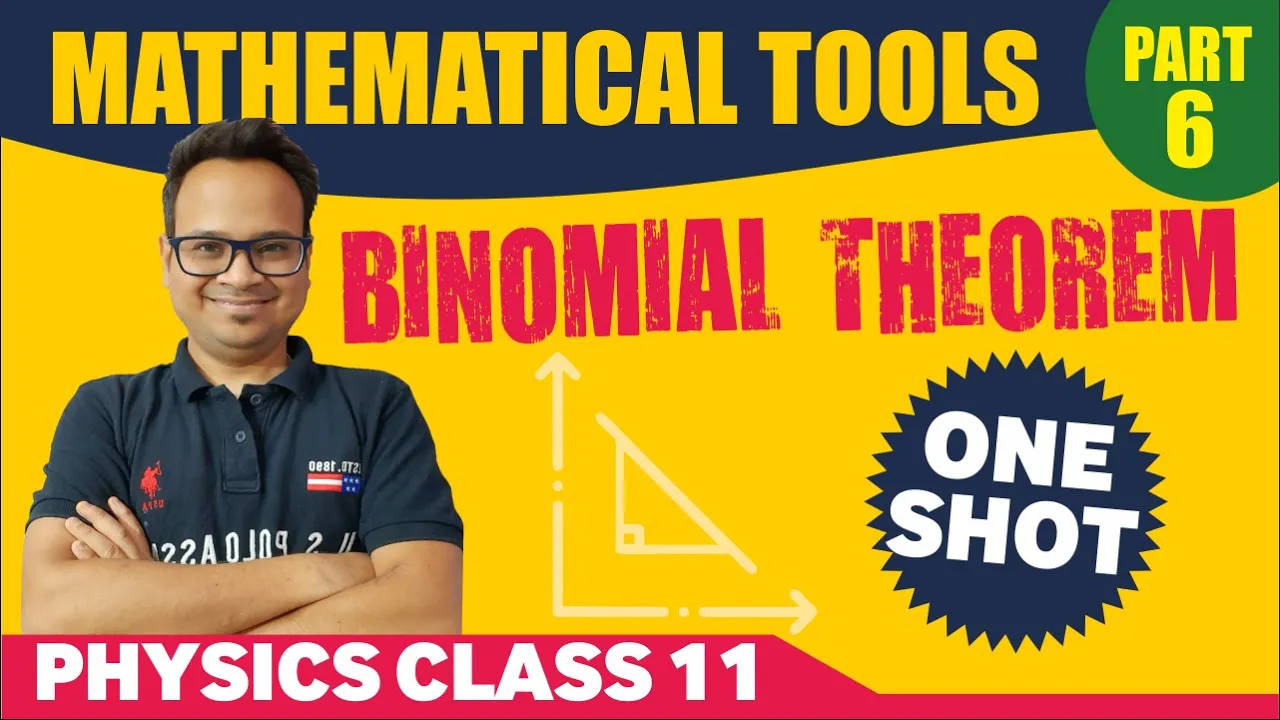




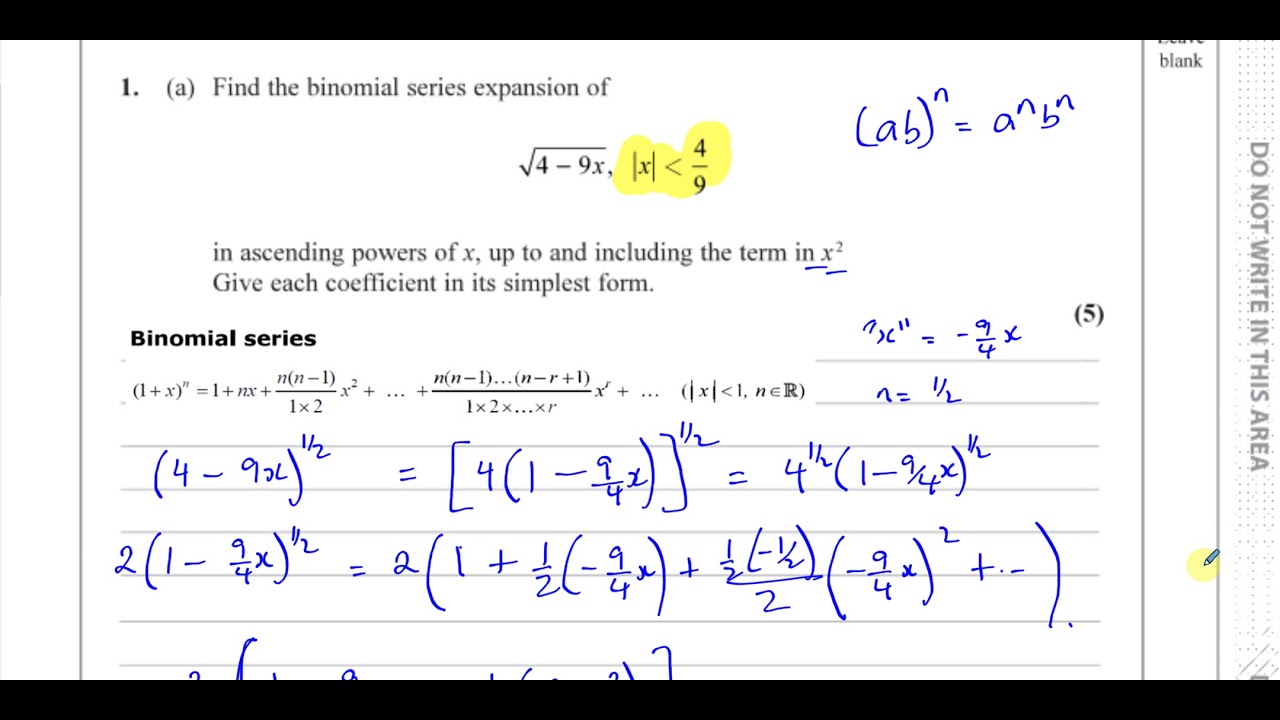
The binomial theorem can be applied to expand expressions with negative and fractional indices by substituting the appropriate values into the general formula (1 + x)^n = 1 + nx + n(n-1)/2! x² + n(n-1)(n-2)/3! x³ + ..., where for (1 - x)^(-1) we substitute n = -1 and x = -x, and for √(1 + 2x) we substitute n = 1/2 and x = 2x, with the expansion valid when the variable term lies between -1 and 1.
Binomial Expansion with Negative and Fractional Indices
Added:The standard Binomial Theorem for positive integer exponents, including Pascal's Triangle and combinatorics notation (n choose r).
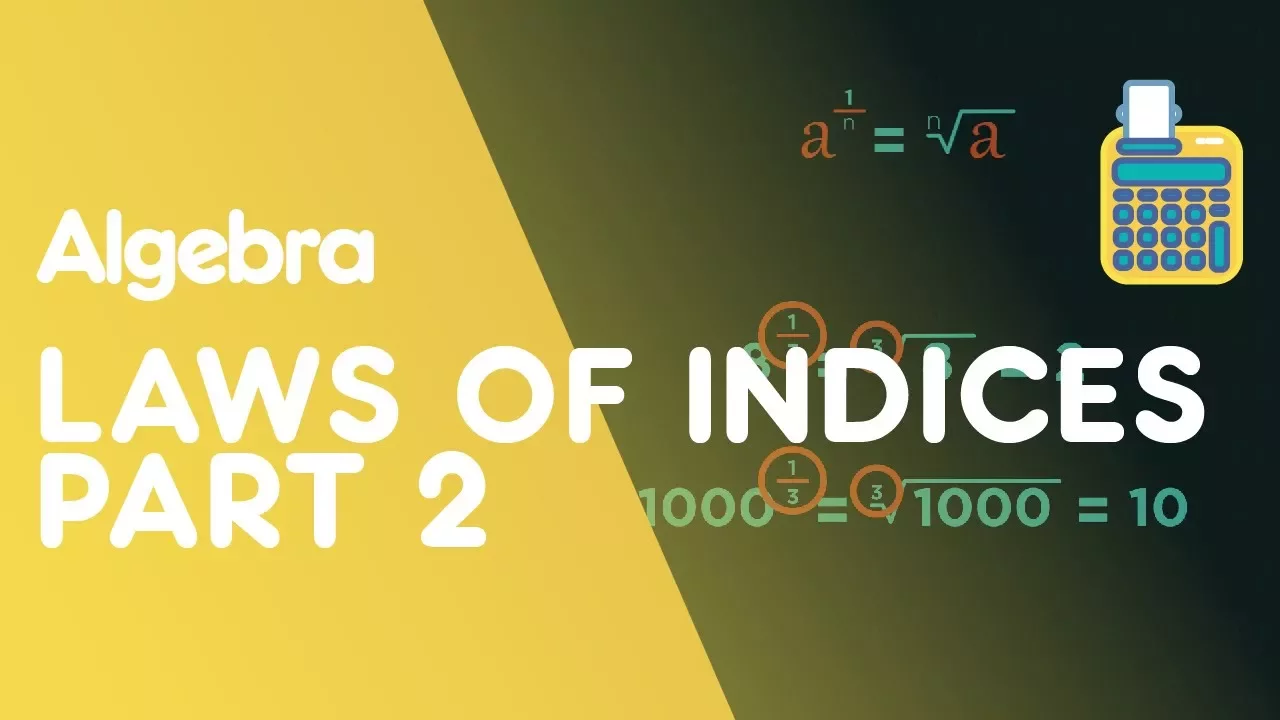
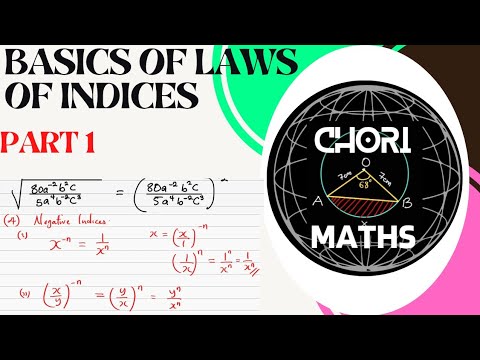
Laws of indices, specifically the definition and manipulation of negative and fractional exponents (e.g., x^-n and x^(1/n)).
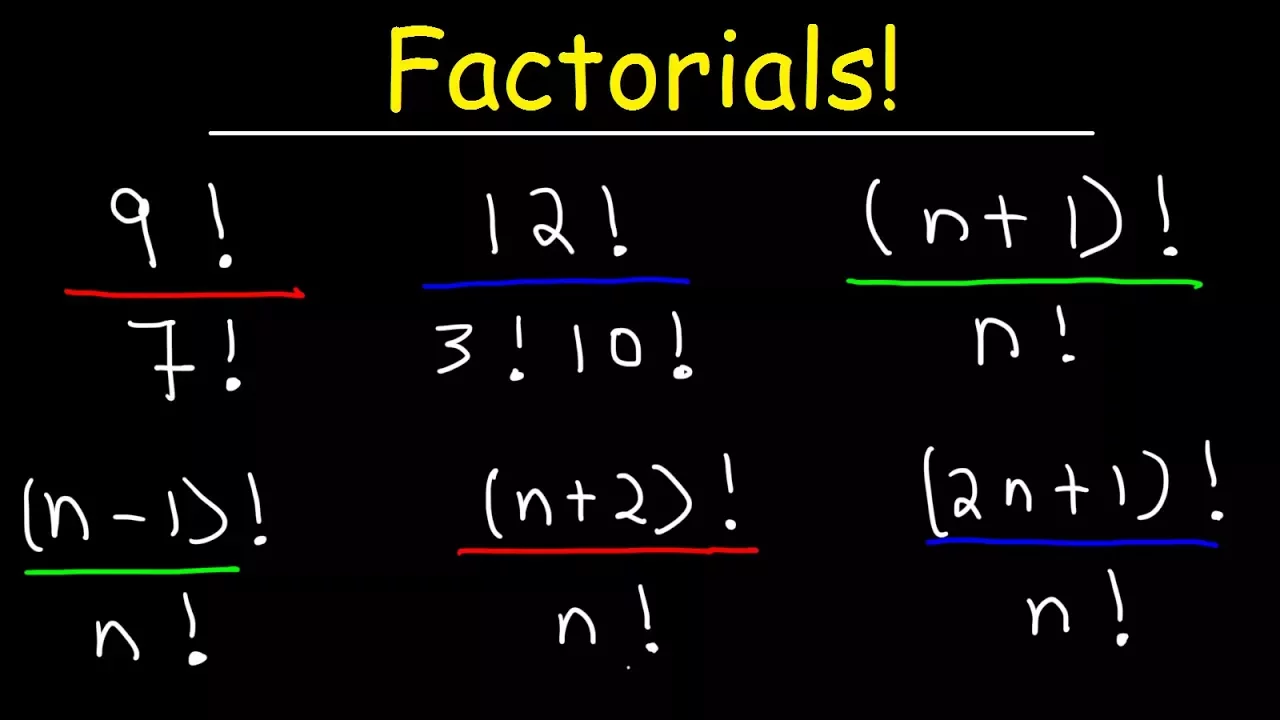
Basic factorial notation and the algebraic simplification of rational expressions.
The concept of an infinite geometric series and the basic idea of mathematical convergence.
Determining the interval of convergence (validity range) for binomial expansions with negative or fractional indices (typically |x| < 1).
Using binomial expansions to approximate numerical roots (e.g., square roots) and reciprocal values to a specified degree of accuracy.
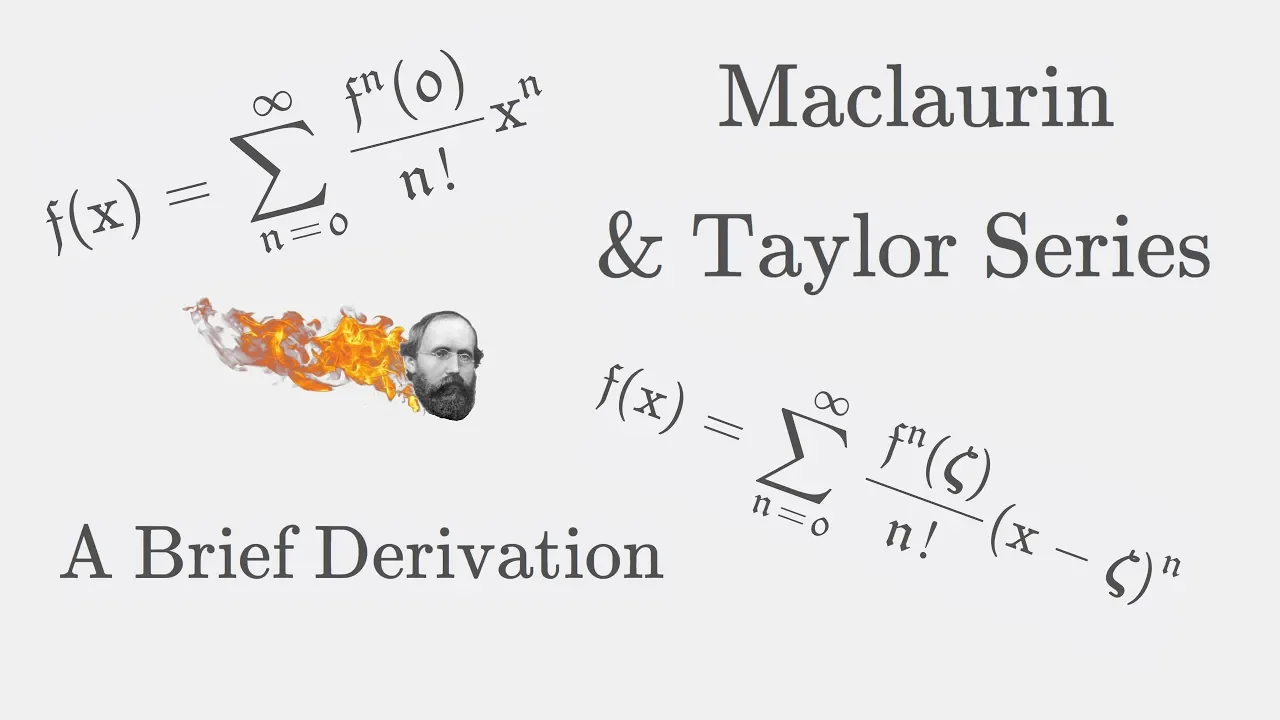
Introduction to Taylor and Maclaurin series, which generalize the expansion of differentiable functions into infinite power series.
Applying binomial approximations to simplify complex equations in physics and engineering, such as relativistic mechanics or wave theory.
53.4K views488likes4:55Original Release: 2017-10-27
expand a 1 over 1 - X and B square root of 1 plus 2x up to including the first 4 terms using the binomial theorem so we've got 1 over X minus 1 minus X is equal to 1 minus X to the minus 1 that's the first thing we need to do and then we can use this idea that 1 plus X to the N is equal to 1 plus NX plus n times n minus 1 over 2 factorial times x squared plus n times n minus 1 times n minus tow 2 divided by 3 factorial X cubed and this carries on forever more cos infinite now if n is equal to minus 1 what we got here and is minus 1 and in this case X will be equivalent to minus X and instead of X we know and you just substitute in minus X we will get 1 minus X to the minus 1 will be 1 plus minus 1 times minus X looking at this bit here we now get minus 1 times minus 2 over 2 factorial times minus X all squared so be careful use of brackets plus minus 1 minus 2 times minus 3 over 3 factorial which is this bit minus X all cubed and carrying on forevermore this gives me the first four terms which is what I want I can stop there so simplify we get 1 minus 1 times minus X gives me plus X now minus 1 times minus 2 is to develop way to gives me 1 and then minus X square just gives me plus x squared so we're plus x squared there 1 x plus x squared we don't like the one in and then but minus 1 times minus 2 times minus 3 which gives me minus 6 we're gonna get another minus sign from this X cubed so that will make that positive 3 factorial 1 times 2 times 3 which is refactor x which is 6 so you can have 6 divided by 6 or so again we're just gonna have plus X cubed and this will carry on now this you've provided that X is between - one and one if we want to do the next one which says the square root of 1 plus 2x we rewrite that in brackets as 1 plus 2x to the 1/2 by no means - so we have two things to the power of 1/2 then using our rule 1 plus X to the N is equal to this it's not too difficult to actually learn we're going to have that n is equal to 1/2 and X is equivalent to 2 X as time so substituting in we have 1 + 2 X to the 1/2 it's equal to 1 plus n which is 1/2 times money X which in this case is going to be 2 X plus 1/2 times a minus 1/2 over 2 factorial times 2 X all squared be careful how you use your brackets next one will be 1/2 times a minus 1/2 times minus 3 over 2 over 3 factorial times my 2 X all cubed there doing this stage at a time so just leave the first bit working this bit 1/2 times minus 1/2 divided by 2 factorial is minus 1/8 2 cubed is 4 so this becomes 4 x squared this is where this times only now with the X then doing 1/2 times minus 1/2 times minus 3 over 2 divided by free fat towards me 1/16 2 cubed is 8 so we get 8x cubed carrying on we're gonna get one 1/2 times r2 is going to be X minus 1/8 times 4 gives me minus 1/2 x squared and then plus 1/16 times 8 gives me plus 1/2 X cubed now it's valid if 2x is between minus 1 and 1 which means that X would have to be between minus 1/2 and 1/2 okay so it's been a video to show you how to expand a fractional index by Lomu index and a negative binomial index using the binomial theorem I hope you understood and I thank you very much for watching just one last thing before we go remember this only works for one plus something when we've got a number in front we'll look at that in the next video I hope this hope you understood
Up Next
7:01
A Brief Introduction to Generating Functions in Probability & Counting
@yyahn
108.4K views•2017-07-02

4:43
Elliptic Curve Cryptography Explained: ECC, ECDSA, ECDH
@PracticalNetworking
28.5K views•2024-10-21
10:44
Fourier Series Introduction: The Big Idea Explained
@DrTrefor
387K views•2021-05-03

6:00
The Mathematical Impossibility of Accurate World Maps
@Vox
23.3M views•2016-12-02
Related Study Plans & Knowledge Roadmaps
Structured learning paths in Mathematics
mathematics
Tensor Calculus: Vectors to Riemann Curvature
01Mathematical Foundations: Linear Algebra & Calculus
02Covectors, Dual Spaces, and Tensor Basics
03The Metric Tensor and Index Gymnastics
+ 2 more learning modules
40h5 modules
Explore Roadmap
mathematics
Gödel's Incompleteness: Logic, Proofs & Limits
01Introduction to Formal Systems & Hilbert's Dream
02Set Theory, Cardinality, and Cantor's Diagonal Argument
03Arithmetization and Gödel Numbering
+ 2 more learning modules
14h5 modules
Explore Roadmap
mathematics
Galois Theory: Fields, Groups & Solvability
01Foundations of Abstract Algebra: Groups & Fields
02Polynomials & Field Extensions
03Splitting Fields & Symmetries
+ 2 more learning modules
24h5 modules
Explore Roadmap
mathematics
Non-Euclidean Geometry: Models & Geodesics
01Euclid's Fifth Postulate and the Birth of New Geometries
02Hyperbolic Space and the Poincaré Disk Model
03Geodesics: Defining Straight Lines in Curved Spaces
+ 2 more learning modules
15h5 modules
Explore Roadmap