
























Melodrama emerged in early 19th century London as a popular theatrical form that combined moral instruction with exciting storytelling, featuring stock characters like villains, heroes, and persecuted heroines, and utilizing musical accompaniment and exaggerated acting to engage audiences; it originated partly as a workaround to the Licensing Act of 1737, which limited serious drama to only two theaters, and later influenced American theater through works like Augustin Daly's 'Under the Gaslight,' which addressed urban anxieties about class and crime while maintaining the genre's characteristic happy endings and sensational scenes.
Melodrama in 19th-Century Theater: Origins & Impact
Added:The social and cultural shifts of the Industrial Revolution, particularly urbanization and the rise of a working-class theater-going audience.
The historical concept of 'stock characters' and theatrical archetypes, such as those originating from Commedia dell'arte.
The transition of Western theater from strict Neoclassicism to Romanticism in the late 18th century.
Basic 19th-century theatrical infrastructure, including the licensing laws (such as the British Licensing Act of 1737) that restricted spoken drama and necessitated musical accompaniment.
The transition from Melodrama to Realism and Naturalism in the late 19th century as a direct artistic reaction against formulaic and moralistic theater.
The direct influence of melodrama's performance styles and 'musical laws' on the birth of early silent cinema and the evolution of modern film scoring.
An analysis of seminal 19th-century melodramatists, such as René-Charles Guilbert de Pixérécourt and Dion Boucicault, and their groundbreaking special effects and staging innovations.
The persistence of melodramatic structures, moral binaries, and archetypes in contemporary media like soap operas, telenovelas, and modern blockbuster films.
227.5K views3.2Klikes12:06Original Release: 2018-09-07
Hey there, I’m Mike Rugnetta.
This is Crash Course, and today we’ll be talking about brave heroes, scheming villains, scorching fires, convulsing earthquakes, spooktacular ghosts, and grave robbing… oh no, sorry that’s just grave-robbing.
Yes, today is all about melodrama, the form that body-slammed nineteenth-century theater and still dominates entertainment culture today.
Melodrama is crude.
It’s exciting.
It’s funny and sad and morally simplistic.
Its endings are satisfying, and the scenery is off the hook.
And, wow, is there a lot of musical accompaniment.
That’s the law.
Literally.
So sit back, grab a meat pie, and try not to get hit by any runaway chariots.
Lights up!
[INTRO MUSIC] Melodrama gets going right at the turn of the nineteenth century, about a decade after the French Revolution and a few decades after the American one.
It borrows from sentimental comedy and bourgeois tragedy, but is way more about showing the audience a good time.
Sometimes that good time includes dogs.
That's right - there’s a whole subgenre of dog melodrama.
What kickstarts melodrama?
Well, cities are getting bigger, faster, which creates a newly urbanized working class.
And that urbanized working class wants to go to the theater!
And what’s more, they want a theater that’s not especially literary, because they’re not especially literate.
What they want... is melodrama.
It’s not high-brow.
High brows, at this time, mostly stick to closet drama... because I guess going out is for the poors?
Regardless, melodrama is an incredibly successful and well-attended form.
Then, AND now.
What do you think ninety percent of Hollywood movies are!?
[[YORICK FLIES IN]] Well yes, I suppose they are bourgeoisie tragedies, but… in a very different sense?
It’s significant that melodrama starts in a period between revolutions, after the eighteenth-century ones but before most of the nineteenth-century ones.
Melodrama has all the emotional fervor of revolutionary art, but it dulls and contains that fervor with comforting moral sentiments.
Basically it’s a conservative form that feels like a radical one - it’s some sound and fury… signifying not much.
As the nineteenth-century playwright Charles Nodier wrote, it reminds people “that even here on earth virtue is never without recompense, crime is never without punishment.” Melodrama begins in France.
The father of melodrama, and the first to introduce dogs, is I’m sorry about this René-Charles Guilbert de Pixerécourt - again I'm very sorry - a guy who describes himself as having “a soul in flames, a tender heart, a fiery imagination, and a proud and independent temperament.” I’m sure his friends were SHOCKED at his melodramatic works.
Anyway - He was minor aristocrat who fled during the Revolution, probably because of an anti-Jacobin play that he wrote.
After returning, he starts writing less controversial plays, including “The Dog of Montarges,” a story of a hound who brings suspicion upon his master’s murderer, and who–at the kings order–fights the killer.
This play makes Goethe so mad that he asks to be dismissed from the theater that stages it.
Pixerecourt may or may not have said that he wrote his plays “for those who cannot read,” but he definitely pioneered the combination of moral instruction and man vs dog trial by combat.
Pixerecourt’s plays are eventually exported to England, and melodrama really takes off.
Blame the Lord Chamberlain.
As you’ll remember from our episode on sentimental drama, the Licensing Act of 1737 means that only two theaters in London are licensed to provide serious drama, with a third in the summer months.
That’s not enough theater!
The people want more theater!
The easiest way to get around the licensing act, and thus stage more performance, is to put on alternatives to spoken drama … alternatives like operas or musicals, or maybe you just take a normal play and stuff it with some incidental music!
That’s what people do, et voila!
Melodrama!
No license required.
Eventually, melodrama becomes so popular that the licensed theaters basically have no choice but to produce it, as well.
Of course, melodrama isn’t just a play with music.
I mean, literally it is.
“Melo” is Greek for music, and “drama,” from the Greek “dran,” is Latin for play.
But melodrama has more to it than that.
These plays tell exciting stories that almost always have a happy ending, where good characters get rewarded and bad characters get punished, and all of the doggos get treats.
Or revenge, as the case may be.
There are six stock characters in melodrama: the mean villain, the sensitive hero, the persecuted heroine, the clown, the faithful friend, and the villain’s accomplice.
Audiences were encouraged to cheer and boo where appropriate, and musical accompaniment helped them out: The contrabass accompanied the villain, the trumpet played for the hero, the flute signaled the heroine, and the clown got stuck with the bassoon.
Because bassoons?
Hilarious.
At certain moments, the actors would pause while music played so that audiences could have a moment to appreciate just how exciting the situation was, and how awesome the actors looked.
These moments, called tableaux, were kind of like the held poses in kabuki.
Acting in melodrama was exaggerated, designed to appeal to the emotions: and it had to be if you were going to make three thousand distractible people listen in an age before microphones.
Early melodrama often borrowed from gothic stories and had strong supernatural elements.
Heroes and heroines were often virtuous working-class types, and the villains were squires and landlords.
That had to feel good for urban workers, stickin’ it to the rentier class right there on stage.
The style became more domestic in the 1820s and 1830s when there was a craze for true-crime melodramas.
And there were all sorts of melo-subgenres, too.
Dog melodramas, of course, but also equestrian dramas, with horses running on treadmills, and nautical dramas and battle dramas and a whole subgenre devoted to grave-digging.
Are we that far away from late Roman theater?
We are not.
Though there’s less nudity, and people don’t actually die on stage.
On purpose.
Melodrama became even more spectacular, with playwrights trying to outdo one another to create “sensation scenes,” moments of plot and stagecraft that would leave the audience gasping.
This is when you get avalanches and erupting volcanoes and exploding steamboats.
Melodrama was an opportunity for set designers to really strut their stuff, and plays called for ruined castles, desolate mountains, frothing waterfalls, prisons, caverns, tombs -- Tombs, Yorick! TOMBS!
But here’s a funny thing about melodrama.
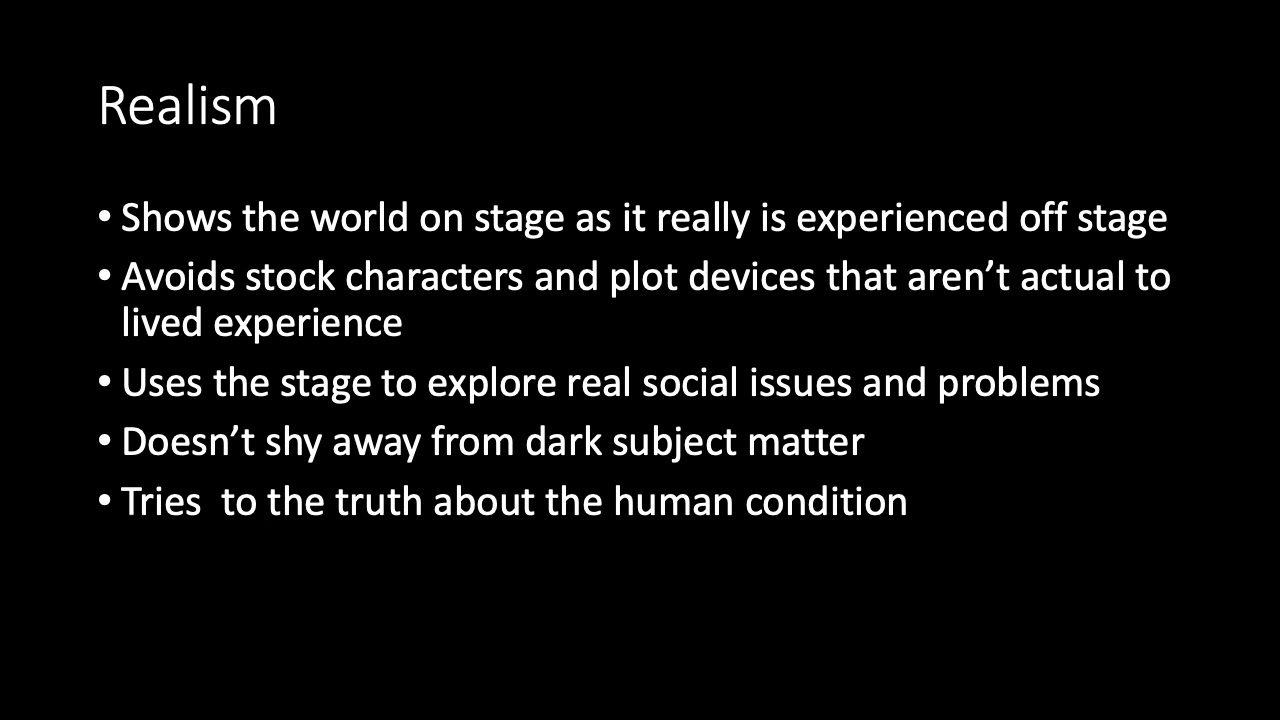
Even though the plays are wildly unrealistic, they’re actually a precursor to realism.
Melodrama demanded an unprecedented level of authenticity from its set designers, because audiences wanted the plays to look as real as possible, even if the stuff that was happening was … well … melodramatic.
So they built and used all kinds of flats, treadmills, and revolves just in case the play called for a rail crash or a chariot race.
This raised the bar for productions of serious drama, too.
Also, the plays themselves dared to show all kinds of people in all kinds of situations.
Because they were written quickly and often mirrored real-life scandals and contemporary novels, they tended to be highly topical.
Yes, they were undergirded by Christian morality and had to end happily, but these were some of the first plays to take on racism, sexism, crime, and urban poverty.
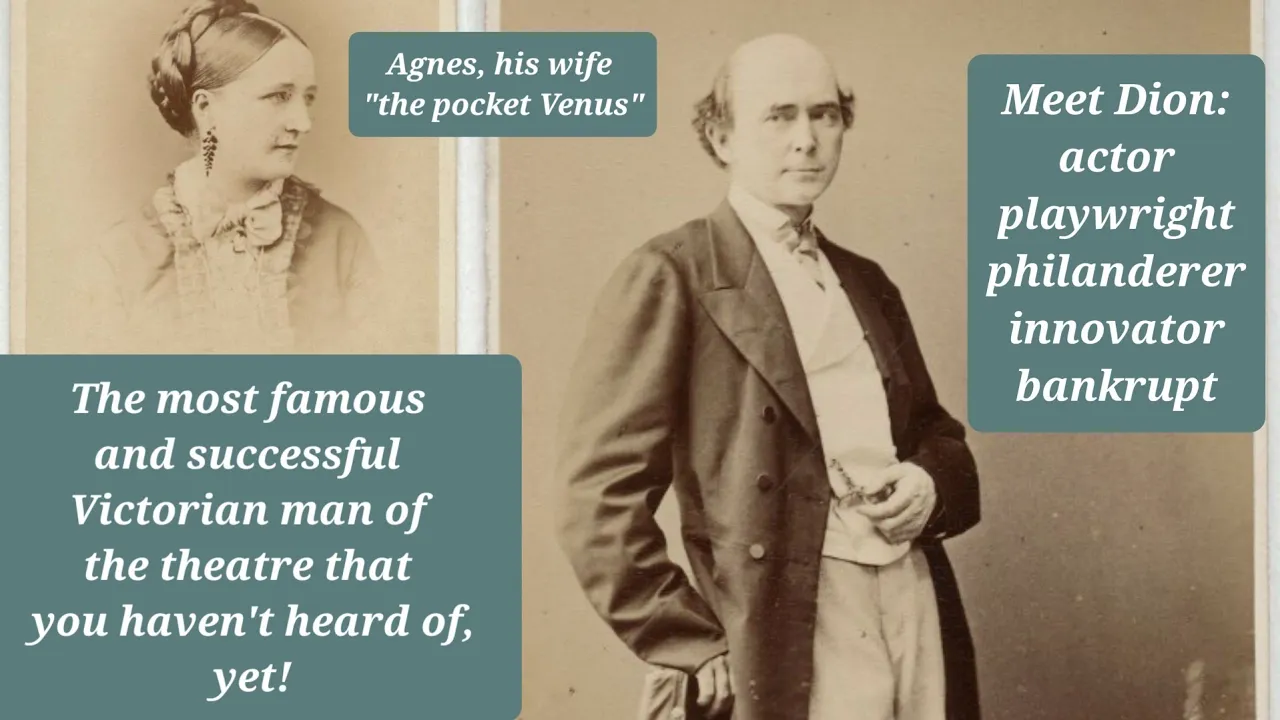
The genre’s MVP is an Irishman named Dionysius Boucicault who churned out melodrama after melodrama and sensation after sensation.
The exploding riverboat?
That was him.
Boucicault wrote quickly, and he wrote topically.
His plays are witty and sentimental and totally spectacular, and he was a savvy businessman.
He franchised his plays, rewriting “The Poor of New York” as “The Poor of London” and “The Poor of Paris.” But he didn’t want other people doing any rewriting, and his lawsuits helped inform the International Copyright Agreement of 1886, because he wanted to make sure he got his royalties.
Did this stop him from stealing from other playwrights, though?
It did not.
Boucicault eventually landed in America, so we’ll be seeing him again in our next episode.
But we’re going to take a sneak peek at American theater now, exploring one of the most popular and iconic melodramas of the nineteenth century, Augustin Daly’s 1867 play “Under the Gaslight.” Daly was a successful theater manager and one of theater’s first directors.
Remember all of those cartoons where they tie some lady to the tracks just as the train is coming?
That starts here!
Take it away, ThoughtBubble: Lovely and pure Laura Courtland is engaged to the dashing Captain Ray Trafford.
But turns out, Laura is adopted and was at one time a child pickpocket.
Instead of being like, “Hey, cool back story,” Captain Trafford is like, “Maybe I need a wife who's not "a daughter of obscurity and crime.’” Laura runs away from home and ends up supporting herself by hand-coloring photographs.
She’s brave and good, so she manages.
But her birth parents, Byke, a criminal, and Judas, a drunk, find her.
Byke drags her to the court, though it’s not really clear why, and the judge agrees that she acknowledge Byke as her father.
Then Byke tries to kidnap Laura and take her to—oh no!—New Jersey.
But Snorkey, a good-hearted, one-armed Civil War veteran, foils Byke’s plans.
Byke retaliates by tying Snorkey to the train tracks.
But Laura hacks her way out of a nearby railway shed, which is conveniently full of axes, and rescues Snorkey just in time.
Cool gender reversal.
Snorkey says, “And these are the women who ain’t to have a vote!” The two of them go off to stop Byke from murdering Laura’s snooty adopted sister, Pearl, and in the last scene we find out that, hey, Laura was switched at birth with Pearl.
So she really is a lady, and now she and Captain Trafford, the guy who ran out on her when he thought she was poor, can get married.
Oh, and old Judas falls off a horse and dies, and Byke is forced to emigrate.
The end!
Thank you, ThoughtBubble.
America is bananas, huh?
And maybe Laura should just choose herself.
Or good old Snorkey!
But this passes for a happy ending.
And underneath all the sensationalism of the play—and obviously there’s a lot—there’s some realism.
Most of the settings here are real, from Delmonico’s famous restaurant in Manhattan to the central courts, to a Hudson River pier.
It’s sort of a travel guide to 1867 New York.
But it also reveals the anxieties of 1867 New Yorkers.
They’re worried about money; they’re worried about class; they’re worried about how close the criminal world was to polite society, and how living in a big city means that all sorts of people gotta jostle up against each other.
And clearly, they also worried about trains.
Thanks for watching.
Try not to let any cow-catchers hit you on the way out.
We’re going to stay in America for the next episode, when we explore how this great big nation got a theater in the first place.
Take that Puritans!
Oh, and it turns out Canada beat us to it.
But did Canada have a theatrical riot that killed more than twenty people and injured a hundred more?
No.
That one’s all ours.
Typical.
Until then… curtain!
Crash Course Theater is produced in association with PBS Digital Studios Head over to their channel to check out some of their shows like BrainCraft.
Braincraft is a show about psychology, neuroscience, and why we act the way we do.
Crash Course Theater is filmed in Indianapolis, Indiana.
It is produced with the help of all of these very nice people.
Our animation team is Thought Cafe.
Crash Course exists thanks to the generous support of our patrons on Patreon.
Patreon is a voluntary subscription service where you can support the content you love through a monthly donation and help keep Crash Course free, for everyone, forever.
Thanks for watching!
Up Next
16:45
Advanced Cinematography: Five Masterclass Scenes Explained
@CineFix
2M views•2016-04-13

23:14
Visual Analysis Essay: How to Analyze Graphic Novels in College Writing
@nataliepleimann5941
1K views•2020-10-14
12:29
Soviet Montage Theory in Film History | Educational Analysis
@crashcourse
560.9K views•2017-06-01

4:00
Evolution of Darth Vader: Anakin Skywalker's Animated Journey Across Star Wars Films
@TellItAnimated
13.4M views•2019-03-30
Related Study Plans & Knowledge Roadmaps
Structured learning paths in Film Analysis
film-analysis
Sensory Cinema: Foley, Haptic Sound & Texture
01Introduction to Film Sound and Foley Artistry
02Micro-Sounds, Textures, and Extreme Amplification
03Haptic Audition and Film Phenomenology
+ 1 more learning modules
12h4 modules
Explore Roadmap
film-analysis
Breaking the Fourth Wall: Mockumentary & Satire
01The Invisible Wall: Basics of Cinematic Illusion
02Looking at the Lens: Direct Address & Character Glances
03The Mockumentary: Satire, Realism, and Complicity
+ 2 more learning modules
12h5 modules
Explore Roadmap
film-analysis
Analyzing the Long Take: Cinema, Space & Ethics
01Foundations of Film Grammar: Montage vs. The Long Take
02Choreography and Mechanics of the Simulated One-Shot
03Phenomenology of Film: Real-Time Spatial Continuity
+ 1 more learning modules
14h4 modules
Explore Roadmap
film-analysis
Anachronistic Music: Period Drama & Subversion
01Foundations of Film Sound and the 'Needle Drop'
02Traditional Authenticity vs. Revisionist History
03The Rise of the Anachronistic Soundtrack
+ 2 more learning modules
12h5 modules
Explore Roadmap