

![11-1. [Solid State Physics] Tight binding model 1](https://i.ytimg.com/vi/Pm6ES4EHy3A/maxresdefault.jpg)







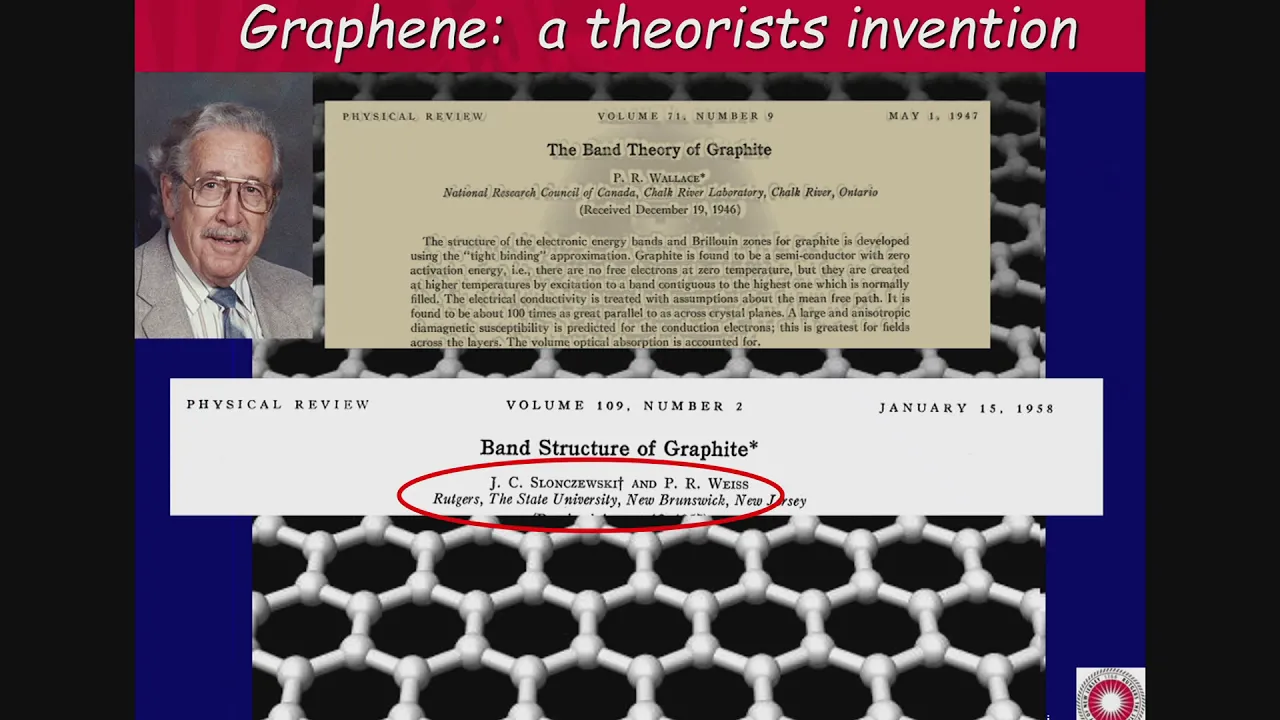




Graphene, a two-dimensional honeycomb sheet of sp² hybridized carbon atoms, exhibits a unique band structure where the π and π* bands touch at six equivalent points called Dirac points (K and K' points) in the first Brillouin zone, making it a perfect semimetal with linear energy dispersion near these points; unlike typical semiconductors which have a band gap, graphene's bands just touch at the Fermi level, meaning it has no gap but also no true Fermi level crossing, and doping can convert it from a semimetal to a metallic conductor.
Band Structure of Graphene: Dirac Points & Semi-Metal Physics
Added:The tight-binding approximation and Bloch's theorem for modeling electrons in a periodic potential.
Basic crystal structures, specifically the 2D hexagonal (honeycomb) lattice and its corresponding reciprocal lattice and Brillouin zone.
Fundamentals of electronic band theory, including conduction and valence bands, Fermi level, and the distinctions between metals, semiconductors, and insulators.
The low-energy effective Hamiltonian of graphene and its description via the 2D relativistic Dirac equation for massless fermions.
Quantum transport phenomena in graphene, such as Klein tunneling and the anomalous integer quantum Hall effect.
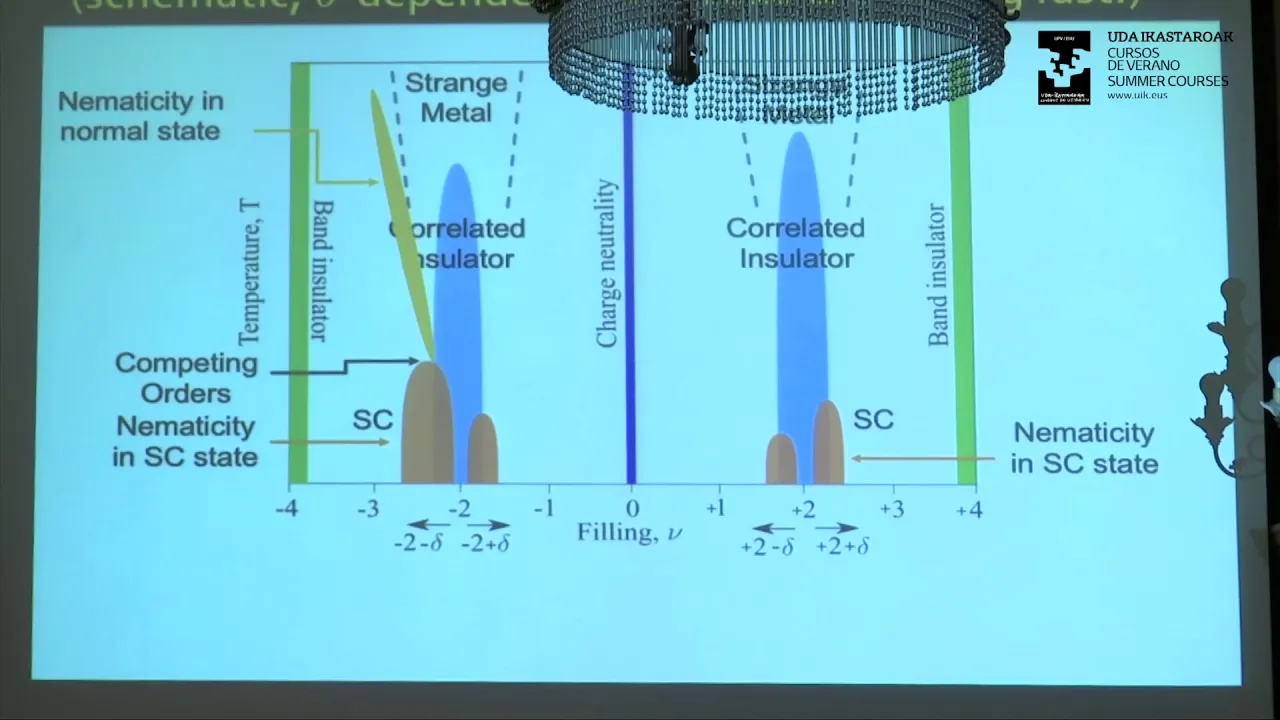
Twistronics and magic-angle twisted bilayer graphene, exploring unconventional superconductivity and correlated electron states.
Other two-dimensional materials (like transition metal dichalcogenides) and the broader physics of topological insulators.
32.9K views719likes15:29Original Release: 2021-02-19
before we leave two-dimensional materials it would be a pity not to talk about what might be the most famous two-dimensional material graphene so one of the things that we're going to encounter to describe the band structure of graphene is that now our unit cell axes are no longer orthogonal right we have a hexagonal lattice so let's start by figuring out how we're going to define the reciprocal space lattice for a hexagonal system so i show here on the left our real space lattice remember that the vectors a and b are equal in length to each other and the angle between them is 120 degrees now let's remind ourselves of the criteria for determining the reciprocal space lattice vectors so the a star vector must be perpendicular to b let's start with that alright so we see that a star is going to go vertically down in our drawing here and the b star vector is going to be perpendicular to a so the b star vector is off at that angle and we see that the reciprocal space lattice vectors make an angle of 60 degrees with respect to one another and if we were to draw the entire lattice of reciprocal space points it would look like this and it still has that hexagonal symmetry to it but the lattice vectors are now pointing in somewhat different directions let's define our first pre-one zone so remember that the first bri-1 zone is the locus of points that are closest to the lattice point at the origin than to any other point so to find that what we're going to do is to draw lines from the origin point to all of the nearest points and then we're going to bisect each of those lines and when we do we get a hexagon all right so the first brewon zone for a two-dimensional hexagonal lattice is a hexagon already this is different than what we had when we were talking about the crystallography of real space lattices right because remember the first debris zone is a wigner site cell and so it's defined in a somewhat different way than a crystallographic unit cell let's look at the magnitude first of the real space lattice vectors so here we're going to use cartesian coordinates when we look at b we see it's a long y and the magnitude of it is just the length of the lattice vector a represents the length of the lattice vector then the a lattice vector also has to have the same length but notice that it is not pointing just in the x direction the vectors are not orthogonal but instead we have basically a 30 60 right triangle here so the length in the x direction is square root of 3 over 2 times a and the length in the y direction is minus one half times a now when we take the dot product of a times a star that's got to be 2 pi and b times b star has to be 2 pi and so that gives us these lattice vectors so these are the cartesian coordinates of them i'll leave it for you to confirm that if you take a dot a star you get 2 pi and if you take b dot b start you get two pi okay now let's talk about the special symmetry points in the first pre-one zone of a two-dimensional hexagonal lattice at the center of the first pre-one zone we have the gamma point where the reciprocal space lattice vectors are zero or the the k vectors we can say are zero then we have this this point here m which exists uh at the center of one of the hexagonal edges of the first pre-one zone right and so that's going to be one-half times the a star vector and no component of b and then we have these two special points k and k prime right that exists at the corners of the hexagon and to get to k we're going to go 1 3 times a star plus 1 3 times b star to get to k prime we're going to go two thirds of a star and then minus one third of b star all right so these are key points that we're going to look at their energies and their crystal orbitals when we analyze the band structure of graphene below i write the cartesian coordinates but for the most part we're not going to pay too much attention to those so everything i've set up to this point is generic for any crystal that has a two-dimensional hexagonal lattice but what do we say specifically about graphene so here's the structure of graphene we see that graphene is this two-dimensional honeycomb or you might think about it as chicken wire right of these fused benzene rings uh the unit cell here contains two carbon atoms uh and they're on the wyckoff site 2b of the plane group p6mm so what about the electronic structure well the atomic orbitals on carbon that we're worried about would be the 2s orbital the 2px the 2py and the 2pz all right there are two carbon atoms in the unit cell so the entire band structure would have eight bands here i'm showing the five lowest energy bands so the three bands that are the lowest at m or at k those are all sigma bands it turns out that at the gamma point the 2s orbital is orthogonal to the 2p orbitals so this crystal orbital down here is only 2s in character and it's bonding and at this point we have two bands that are degenerate that would be the 2px and the 2py band this is a feature we'll see time and time again when we go to the gamma point we'll find a crystal orbital made only from valence shell s orbitals that's bonding and then orthogonal crystal orbitals made from the valence shell p orbitals that are anti-bonding now as it turns out these sigma ions are not really the ones that we're interested in here just like in benzene where the key features of the electronic structure come from the pi overlap the same thing is true of graphene so these two that are labeled pi and pi star those come from the overlap of the 2pz orbital that is the p orbital that is perpendicular to the plane of the graphite sheet okay and that orbital everywhere in the first pre-one zone is orthogonal to the other three so if we want to think about what's happening with these bands we only have to consider the pi overlap between the two pz orbitals right and so that's going to simplify the analysis now up at higher energy we are going to find the anti-bonding sigma bands those are not shown here they're not particularly important for the properties but let's take a closer look now at the pi and pi star bands and see if we can visualize the crystal orbitals at key points in the bri-1 zone so let's start with gamma gamma is always the easiest the fact that we have two bands comes from the fact that we have two pz orbitals in the unit cell one for each carbon atom and so the basis set for each band is going to be the pi bonding molecular orbital for the lower band and then the pi antibonding molecular orbital for the upper band here we're looking down on the lobe of the p orbital that's coming up out of the plane at us you can see that at gamma the interaction between each carbon and its three nearest neighbors is bonding so we have pi bonding interactions everywhere and so this is going to be a bonding orbital it's going to be low in energy that orbital is right here and you can see that it's the lowest energy crystal orbital on the other hand the pi antibonding orbital you can see that each carbon forms anti-bonding pi interactions with its three nearest neighbors so this is the most anti-bonding crystal orbital in the entire first pre-one zone so it comes at a considerably higher energy let's now go to m alright so remembering our reciprocal space lattice vector at m it was one-half times the a-star direction plus zero times the b-star direction so that means in the real space unit cell when we move in the a direction right we're going to change the phase of our orbital every time we move in the a direction but when we move in the b direction we're not going to change the phase of that orbital so if we start with our bonding molecular orbital let's just arbitrarily call a in this direction now if we move one unit cell one direction we change the phase and every time we move a unit cell in that direction we change the phase of the orbitals when we move in the other direction the phase of the orbitals doesn't change so we end up with something where each carbon is forming two pi bonding interactions with its neighbors and one pi antibonding interaction and so the net result is a weakly bonding crystal orbital for the anti-bonding band we're going to change the phase in the same way notice when i'm moving horizontally here i change the phase of the orbital each time i go from one unit cell to the next whereas when i go along the other lattice vector i'm keeping the same phase everywhere this crystal orbital you can see has two anti-bonding interactions and one bonding interaction per carbon so this is a weekly pi antibonding interaction and if we look at the bands at m we can see that there's still a fair energy separation between the two of them all right what about if we go to k when we go to the k point then we have one-third lattice vector in both directions okay so what that means is that as we move through the crystal lattice we're going to change the phase of our orbital once every three unit cells and so this orbital is a lot harder to visualize but the point being if i start here and i move one two three unit cells then i've got the same phase back again if i start here and i move one two three unit cells i've got the same phase back again if you look at this and here i'm only plotting the real part of the waves function right there's actually an imaginary part of the wave function at this k point if you look at it what you should first of all see is that if we start on this carbon atom the three carbon neighbors the coefficient of the pz orbital on those atoms is zero right and so this is a non-bonding orbital and and further if you look at these two you would pretty quickly conclude that the non-bonding nature is true for both the pi and the pi star band so at k these two bands touch precisely okay and if we think about the electron filling here right in a carbon atom four valence electrons so in a unit cell we're going to have eight valence electrons so that's enough to fill up four bands so we can fill all three of these sigma bands and this pi band and we leave the pi star band empty now a couple lectures ago i said you know you could visualize the band structure of a two-dimensional crystal with a three-dimensional plot and here is one such plot for graphene specifically for the pi and the pi star bands and graphene so we can see in this plane here is our first debri one zone now right at the middle of the first b1 zone right that's going to be where kx and ky are both zero that's the gamma point and you see that way down here is the energy of the crystal orbital that comes from the pi band and up here we see the energy of the pi star band at gamma right and there's a large separation between the two of them if we go to k notice that the bands now touch each other right we just said that they become degenerate at k and at k prime which we didn't show we see the same thing so as we move around the periphery of our hexagonal first pre-one zone we find six points where the upper band and the lower band just touch and in the language of the electronic structure of graphene those are called dirac points and so the fact that they just touch first of all that makes graphing a perfect semi-metal right so we talked about metals and semiconductors in a metal the band cuts through a fermi level in a semiconductor there's a gap between the filled and empty bands in a semi-metal a perfect semi-metal the bands just touch so the fermi level is not cutting through a band but on the other hand there's no gap and what that means is if by chemical means or by an electric field we dope graphene we can dope it p-type by taking a few electrons away that's going to lower the fermi level and now the fermi level will cut through these these bands below the this shaded plane if we were to reduce it we are going to add electrons to the conduction band and then the fermi level will move up so any change from the perfect electron count is going to convert graphene from a semi-metal to a metallic conductor the other unique thing about the electronic structure of graphene is that if we were to move away from the dirac points we would see that the energy of the pi star band increases linearly in the wave vector k as we move away from either the k or the k prime points by the same token the energy of the pi band decreases linearly with respect to the wave vector k this is something very special and when we get to chapter 10 we're going to look at the implications of that in a little bit more detail
Up Next

4:02
Quarks and Leptons Explained for Beginners | Fizzics
@fizzicsorg
226.8K views•2014-03-28

12:53
21cm Hyperfine Transition in Neutral Hydrogen: Radio Astronomy Basics
@AaronRobertParsons
12.4K views•2011-10-13

32:32
NMR Spin Physics I: Zeeman Effect, Resonance Condition & Larmor Frequency
@nptel-indianinstituteofsci8064
2.3K views•2024-01-17

27:14
Entropy and the Second Law of Thermodynamics Explained
@veritasium
27.5M views•2023-07-01
Related Study Plans & Knowledge Roadmaps
Structured learning paths in Physics
physics
Nuclear Physics (Decay, Fission & Reactors)
01Atomic Structure and the Binding Force
02Radioactive Decay and Half-Life
03Nuclear Fission Mechanics and Chain Reactions
+ 2 more learning modules
12h5 modules
Explore Roadmap
physics
Soft Matter (Polymers, Colloids & Rheology)
01Foundations of Soft Matter & Thermal Forces
02Polymer Physics and Macromolecules
03Colloids, Surfactants, and Self-Assembly
+ 2 more learning modules
38h5 modules
Explore Roadmap
physics
Analytical Mechanics: Lagrangian & Hamiltonian
01Mathematical Foundations: Calculus of Variations
02From Newtonian Mechanics to Constraint Dynamics
03The Principle of Least Action & Lagrangian Mechanics
+ 3 more learning modules
28h6 modules
Explore Roadmap
physics
General Relativity (Spacetime & Cosmology)
01Foundations of Relativity: Special Relativity
02The Geometry of Spacetime: Equivalence Principle & Curvature
03Einstein's Field Equations: The Mathematics of Gravity
+ 2 more learning modules
55h5 modules
Explore Roadmap