









![Rust VS Go VS TypeScript which back end language is for you with Tai Groot [Podcast #176]](https://i.ytimg.com/vi_webp/yDhCweudqyY/maxresdefault.webp)

![Programming Language with LLVM [1/20] Introduction to LLVM IR and tools](https://i.ytimg.com/vi/Lvc8qx8ukOI/maxresdefault.jpg)


![[SafeCode Live] Принципы статического анализа кода](https://i.ytimg.com/vi/Oz21KwMQWso/maxresdefault.jpg)


A compiler transforms high-level programming code into executable machine code through a multi-stage process: lexical analysis tokenizes the source code into meaningful units; parsing creates an abstract syntax tree representing the program's structure; semantic analysis checks type consistency and variable types; instruction selection converts the AST into an intermediate representation assuming infinite registers; register allocation assigns temporary values to actual machine registers; and finally, code generation produces assembly code that the assembler converts to binary machine instructions.
How Compilers Work: A Graduate-Level Overview of Compiler Design
Added:Familiarity with Automata Theory, including Regular Expressions, Finite State Machines, and Context-Free Grammars (CFG).
Proficiency in high-level programming languages and essential data structures, particularly trees and graphs used in program representation.
A basic understanding of Computer Architecture, CPU registers, assembly language, and memory management (stack vs. heap).
Advanced compiler optimization techniques, such as Static Single Assignment (SSA) form, loop transformations, and dead-code elimination.
Investigation into Just-In-Time (JIT) compilation strategies and runtime environments like the JVM or V8 engine.
Practical application of compiler frontend and backend design using modern frameworks like LLVM or ANTLR.
The study of static program analysis, formal verification, and security vulnerability detection at the compiler level.
25.7K views1.4Klikes3:34Original Release: 2017-04-10
Hey there, I'm Timothy Blumberg. I'm a senior at Duke and I want to explain how compilers work. So, I'm taking a great course on compilers this semester and I've been so incredibly blown away by how fascinating these these these programs are. Uh they're incredibly intricate and they contain a lot of really smart tricks that uh I just find super intellectually stimulating. So, I want to talk about them today and hopefully I can make it not boring. So, what is a compiler? A compiler is a program that takes programs written in a highle language and transforms them into programs that a computer can understand and compute directly.
Uh so here's a highle representation of how compilers really work. Uh so the stages on the left hand side are dependent on the language that you're compiling into. So syntax rules and things like that uh are determined over here. Uh machine dependent stages are over on the right hand side. So this deals with things like uh register allocation, you know, how many registers a machine actually has uh how memory is laid out, all of those problems. So the first stage in compiling is uh taking the program which is really just a list of characters and it chops it into tokens. And so these tokens could be reasoned about a lot more directly.
Instead of uh just this list of of asky characters, we can really have an integer representation of two.
So in the next gauge parsing we take that list of tokens uh and we try to create a syntactic representation of what is being represented by the program. So here we're taking 2 plus two and we're assigning it to a variable vame. So we take these tokens and we can create this abstract syntax tree here.
The next stage is called semantic analysis. So semantic analysis we want to check our abstract syntax tree to make sure uh and figure out what types our various uh variables have and every time that they're used if their types are consistent. So here because two is an integer and two is an integer adding them together that must create an integer and because we're assigning that value to varname we can conclude that varname is of type integer. So therefore later on the program we cannot add it to a string.
The next stage is called instruction selection. So we take our abstract syntax tree and we transform it into another representation that's almost assembly called internal representation.
Internal representation uh we pretend that our machine has infinitely many registers which is not true but it makes things easier during this stage. So this temporary value is a value that needs to live in a register at some point in time uh but we just don't know which register specifically.
So during register allocation we take those temporary values and we assign them we schedule them uh with real registers. So we only have a finite set of registers uh and these values need to live in memory at given numbers of times. So one register will be used many thousands of times during a program uh and assign many different values. So we need to make sure that the right values are never overwritten and are always available at the right times.
Uh then we generate our real assembly and we pass that assembly into our assembler. So an assembler takes in a line of assembly code and just transforms it into the ones and zeros that the machine is expecting uh and can use to do computation. Then we link it uh and we create machine code that can actually be run and do computation. Uh and so it's a crazy long road to go from that high level uh code like Python or Java or C++ but we finally get machine code at the end of the day uh and it runs on your computer. And how complicated this process is and yet how flawlessly it always works. I'm just blown away every time it goes well. So, thanks for watching. Hopefully you enjoyed that.
Up Next
10:49
Memory Leaks in C/C++: Causes, Detection, and Prevention Strategies
@CodeVault
26.8K views•2019-04-05
87:26
Introduction to Secure Multiparty Computation with Yehuda Lindell
@fhe_org
7.7K views•2021-02-04
4:55
HTTP Requests Explained: GET, POST, PUT, DELETE
@codecademy
103.1K views•2021-10-07
19:25
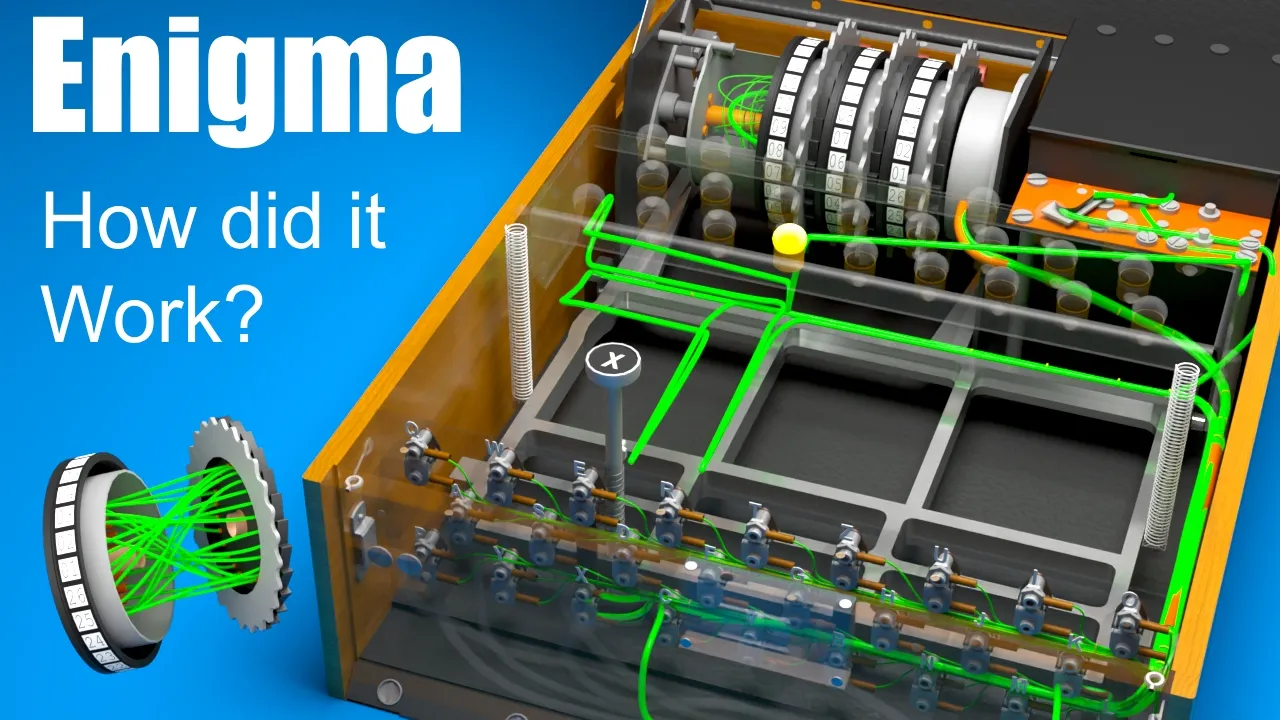
Enigma Machine Mechanics: WWII Encryption Explained
@JaredOwen
13.2M views•2021-12-11
Related Study Plans & Knowledge Roadmaps
Structured learning paths in Computer Science
computer-science
Container Runtimes: Namespaces, Cgroups & Go
01Linux Systems & Go Programming Foundations
02The Core of Isolation: Chroot and Filesystems
03Linux Namespaces: Process Isolation
+ 3 more learning modules
32h6 modules
Explore Roadmap
computer-science
Building a CHIP-8 Emulator: Rust & CPU Basics
01Computer Architecture Foundations (Bits & Bytes)
02Rust Programming for Systems Development
03CHIP-8 Virtual Hardware Specifications
+ 2 more learning modules
32h5 modules
Explore Roadmap
computer-science
Building BitTorrent: Go, P2P & Concurrency
01Go Fundamentals & Concurrency
02Networking Foundations & P2P Architecture
03Bencode Parsing & Torrent Metadata
+ 3 more learning modules
26h6 modules
Explore Roadmap
computer-science
Actor Models (C++ Concurrency & Lock-Free)
01C++ Multi-Threading Foundations
02Thread Pools and Task Scheduling
03Atomics and Lock-Free Queue Design
+ 3 more learning modules
45h6 modules
Explore Roadmap