
















![Развитие памяти. Секретные методики спецслужб. Как развить память и внимание? М. Ли. [Аудиокнига]](https://i.ytimg.com/vi/ledKW9yGkyQ/maxresdefault.jpg)






![MOST IMP. Image Based PYQs in OBGY [NEET PG 2025]](https://i.ytimg.com/vi/xFcupIARyu8/maxresdefault.jpg)


![Crucial One liners for Pediatrics by Dr. Meenakshi Bothra [MUST KNOW] | NEET PG, FMGE & INI-CET](https://i.ytimg.com/vi/6fYhzTpCjeM/maxresdefault.jpg)



![Modo de parto simple podalico a termino [ACOG Committee Opinion #745]](https://i.ytimg.com/vi/FzbFeis48F0/maxresdefault.jpg)
Vaginal breech delivery is a high-risk procedure requiring a systematic approach divided into sequential stages: pelvis delivery with rotation from sacrum transverse to anterior position, leg delivery (footling breech requires cesarean), umbilicus delivery, trunk delivery with minimal tactile stimulation, arm delivery using sweeping maneuvers, and finally head delivery using the Moreau-Smellie-Bowditch maneuver or forceps if needed; critical timeframes include cesarean recommendation if breech not visible within 2 hours of passive stage, or delays exceeding 5 minutes from buttocks to head or 3 minutes from umbilicus to head, with entrapment managed through symphysiotomy, cesarean, or Durin's incisions.
Vaginal Breech Delivery: A Systematic Approach | Obstetrics Guide
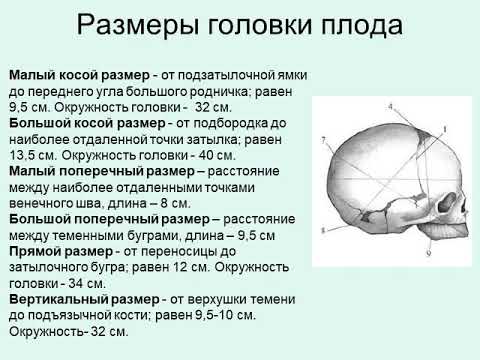
Added:Basic female pelvic anatomy, maternal pelvic planes, and fetal skull landmarks crucial for tracking descent.
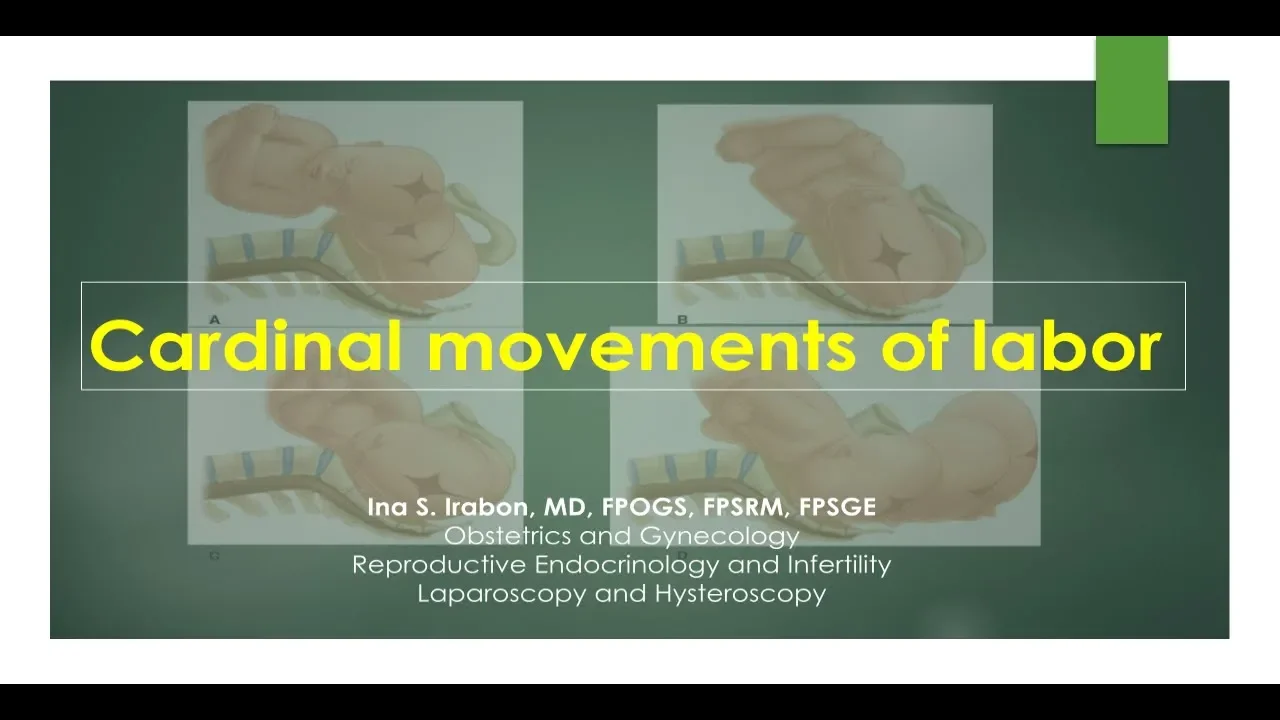
The physiology of normal labor and the cardinal movements of a standard cephalic vaginal delivery.
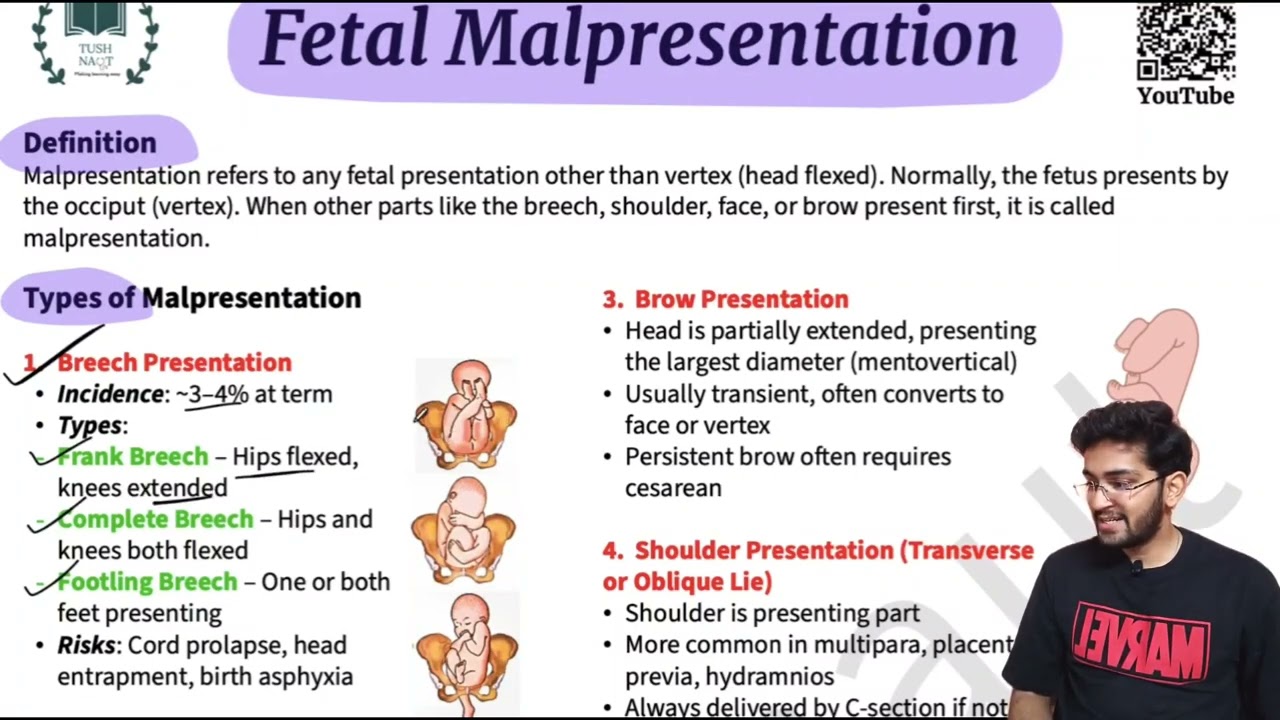
Classification of breech presentations (frank, complete, and footling) and their associated mechanical risks.
Standard selection criteria and contraindications for attempting a planned vaginal breech delivery.
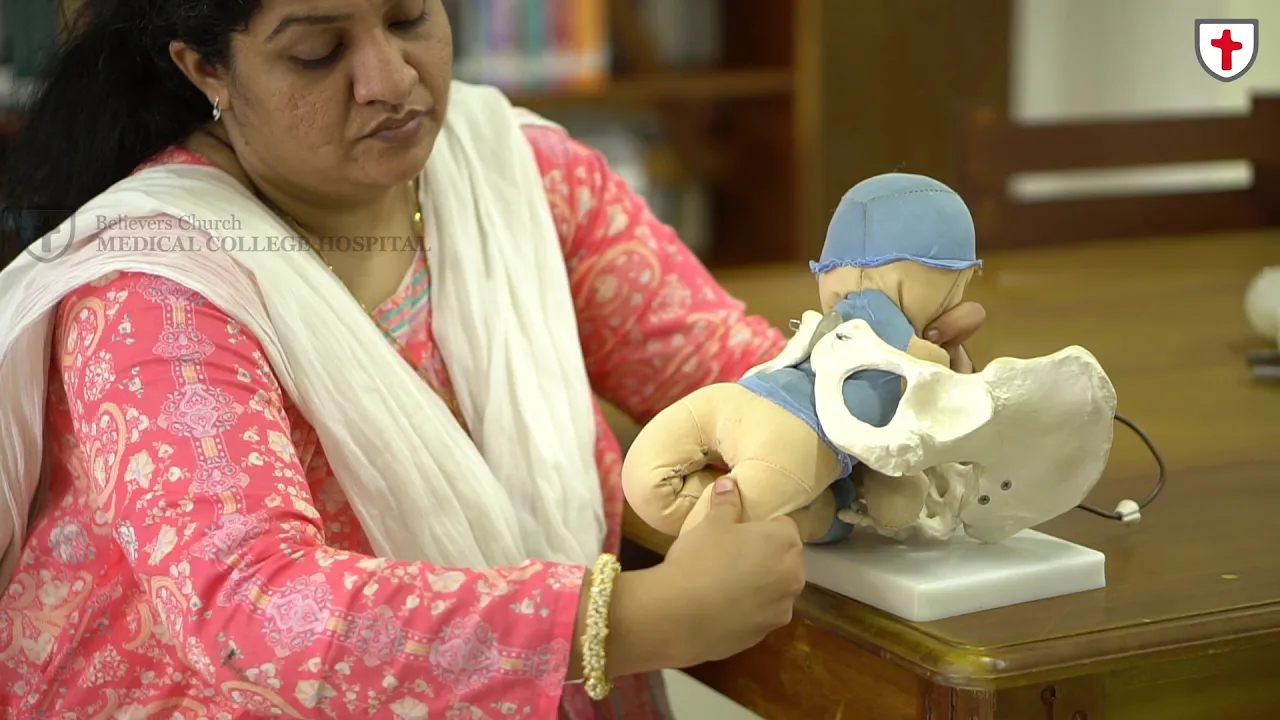
Practical simulation-based training using high-fidelity pelvic models to develop muscle memory and tactile skills.
Advanced management of the entrapped aftercoming head, including the use of Piper forceps or Duhrssen's incisions.
Immediate neonatal resuscitation protocols tailored for infants experiencing birth trauma or hypoxia from breech extraction.
Critical evaluation of historical and current obstetric literature (e.g., the Term Breech Trial) to inform evidence-based clinical guidelines.
391.1K views4.4Klikes11:45Original Release: 2018-05-18
this video will review techniques for vaginal breech delivery it is provided as an educational resource please follow your institutional licensing body and national guidelines vaginal breech delivery is a high-risk procedure that must be performed or directly supervised by a care provider with experience in these techniques a patient a term of the baby in a breech presentation may be managed in three ways external cephalic version vaginal breech delivery or cesarean section this video will only discuss the vaginal breech option for the next few seconds I will post lists of both per recklessness for an attempted vaginal breech delivery and contraindications to attempting a vaginal breech delivery you you can pause the video and write these down at your leisure they are critically important to consider I need to point out that there are variations and recommendations and guidelines regarding this procedure put forth by governing licensing and educational bodies some of these will be highlighted as we proceed they present some options for management but ultimately of course you need to follow the standard of care where you work the systematic approach I will review divides the delivery in sections corresponding to the field structure being delivered first is the pelvis then the legs third is the humble Akos fourth the trunk 50 arms 6 the head and finally we'll discuss entrapment of the after coming in act of pushing is usually delayed until at least after the umbilicus has delivered or if the baby is descending well maybe even delayed further regarding the timeframes of the active and passive stages and when to start pushing there's a lack of clearly stated guidelines except the Royal College in the UK's green top which states if the breech is not visible within two hours of the passive second stage c-section should normally be recommended they go on to state in general intervention to expedite breech birth is required if there's a delay of more than five minutes from delivery of the buttocks to the head or more than three minutes from delivery of the malaika's to the head the SOG see in Canada limits the passive second stage to 90 minutes and the active second stage which is pushing to 60 minutes c-section is recommended if these are exceeded what the pelvis the breech usually presents in a sacrum transverse position like this and will spontaneously rotate into a sacrum anterior position if it does not then you're going to need to grasp the baby by the pelvis no the safe way to do this is you put your thumbs over the SI joints which correspond roughly to the sacral dimples and then you wrap your fingers around the bony pelvis anteriorly like this do not grass by the abdomen that can injure the baby holding the baby in that position thumbs over the SI joints you just rotate it from sacrum transverse to sacrum anterior many recommend that the physician or Midwife should keep their hands off the bridge at this day unless it needs to be rotated to si to the legs legs can present in three ways first is the footling breech on a footling breech you want to go straight to caesarean do not attempt a vaginal breech delivery it is too unsafe complications include things such as prolapse of the umbilical cord second way they can present as a complete breach it's a bit hard to show with this model but the baby's legs are flexed in front of the abdomen like this now this will usually deliver spontaneously but if not you can just reach up under the baby grasp the foot or lower leg and sweep it out and then again reach up under the baby grasp with foot and lower leg and sweep it up like this okay third way the baby may present this is the Frank reach which is like this now in a frank breech the legs are extended in front of the baby and they may deliver spontaneously or you may need to use patterns maneuvering on open orange maneuver you reach up under the baby get your finger into the popliteal fossa and then sweep the leg out laterally so demonstrating on this model fingers up under the baby into the popliteal fossa sweep it laterally the foot may deliver on its own remaining to reach up across the foot and lorn leg and sweep it up and then you do the same on the other side into the popliteal fossa laterally grasp the foot and sweep it up three the humble ICA's guidelines do not agree on whether or not to routinely handle aeon blankest the also course which originates in the USA states but when the humble itis delivers a loop of cord several inches long should be gently pulled down to one prevent tension on the court and to allow monitoring of the fetal heart by palpation of the cord pulse the SOG see in Canada states the operator should consider freeing a loop of cord and on the other hand the Royal College in the UK recommends that care should be taken to avoid handling their local court as this may result in vasospasm given this variation you should follow your guidelines where you work fourth the trunk as with delivery of the umbilicus guidelines vary there's a continuum for nine approach to a more interventional approach the Royal College in the UK recommends that the field trunks should descend spontaneously or with maternal effort and the tactile stimulation of the babies to be minimized because it can result in the baby reflexively extending the arm up beside the head which can lead to a compound presentation or the baby may hyper extend its neck causing a suboptimal presenting diameter to come through the pelvis you also program on the other hand describes two methods of manually assisting delivery of the trunk if needed one you can grasp the pelvis as I showed before thumbs over the SI joints fingers around the bony pelvis you want to give gentle traction downwards in a 45 degree angle like this bringing the baby out they also do recommend they also describe the mob set maneuver which is you again hold the baby in the same way thumbs on the SI joints fingers around the bony pelvis and then you rotate the baby back and forth and through the pelvis fifth the arms the arms may be in three positions they may be in front of the trunk and which case so likely deliver spontaneously they may be standing up beside the head which is your compound presentation or you may have the so called nuchal arm in which the arm is behind the neck when you start to think about delivering the arms as when the inferior border of the scapula has appeared if the arms are extended upwards they can be delivered by passing two fingers over the baby's back and down along the hand wash to the elbow and then sweeping the arm out in front of the baby's chest and then same on the other side been through good now let's say that doesn't work and you have a situation where you try to sweep the arms and they just want to go what do you do so what you want to do is you want to sweep one or use the LOB sub maneuver to move the baby and sweep one shoulder up under the synthesis you can then do the maneuver I showed fingers up over the shoulder and then sweep the arm anteriorly right out you then rotate the baby the other way so that the posterior arm moves up and then do the same with that arm let's say you can't rotate so you're in this position you've got one arm delivered and you can't get the posterior arm to rotate you can then grasp the baby by the feet or the legs bring up like this and do the same maneuver you now have more room to work with in the city or Hollow there's up over the shoulder in front of the humerus sweep your arm in front of the baby's chest and six the head the problem with the breech is that the largest part of the baby the head delivers last and in contrast to a cephalic presentation we unmold it and therefore have a larger diameter remember the base of the skull does not hold once of the the arms of delivered encourage the mother to push until the baby's neck and hairline appear at this point the baby's head will be engaged in the pelvis any attempt to deliver the head before the hair line appears will result in extension of the neck and thus a larger presenting skull diameter I will demonstrate the delivery of the head using the more so smelly beat maneuver which works by flexing the fetal head through the pelvis the baby is placed on the forearm of the operator with the index finger on the main one malar eminence and the middle finger on the other malar eminence you have your assistant giving a suprapubic pressure your other hand goes over the baby's back index finger over one shoulder ring finger over the other and middle finger over the occiput the middle finger gives flexing pressure you get a flexing pressure from your system and you also move your arms in an arc which flexes the baby through the pelvis let's see just to show the finger positions so one finger on one male or eminence one finger on the other one do not put the finger in the mouth that can fracture the jar dislocate it and then the other hand is like this okay so let's say you've attempted that for three minutes and it doesn't work what do you do so you're going to need to go to the forceps you're going to use a set of papers now Keeling's won't work if you don't have papers wrap the baby in a towel and have your assistant now you do the forceps application as you normally would so this is your key lens so take my left for step in my left hand to the left side a little turtle pelvis right get your get your assistant to hold it for in a horizontal position right forcep right hand right side on the turtle pelvis thank you walk and then you deliver in an art like this let's say that doesn't work and you have entrapment of the after coming head what do you do three options first option to symphysiotomy you put local in above the synthesis one one hand in two fingers to move the urethra to the side as you cut down through the cartilage with a scalpel get about half to a third of the way through and it'll just pop up and giving you more room second thing you can do is the cesarean section so you move the baby back up into the uterus and do a cesarean now if the cause of your entrapment is that the cervix is not fully dilated you can try Durin's incisions now under since incisions I think what you do is you place ring forceps on it parents side by side at two o'clock six o'clock and ten o'clock you then these should be about three to four centimeters in you then make a cut of between the two ring forceps of the three location and this should open up and give them more room it is important to have the reinforce epsilon is remember you're creating a cervical laceration which could bleed rather heavily
Up Next

23:48
NRP 8th Edition: Initial Steps of Neonatal Resuscitation Made Easy
@TalaTalksNICU
59.6K views•2024-12-09

48:47
Graphic Medicine: Comics for Collaborative Healthcare Communication
@nationalpatientadvocate
189 views•2023-12-04

10:28
Neuroanatomy: Central and Peripheral Nervous System Divisions Explained
@AKLECTURES
136.2K views•2014-09-20
3:05
Stages of Labor and Vaginal Birth | Childbirth Animation
@nucleusmedicalmedia
52.1M views•2017-08-18
Related Study Plans & Knowledge Roadmaps
Structured learning paths in Medicine
medicine
Abnormal LFTs: Diagnostic Workup & Pathology
01Liver Anatomy and Basic Physiology
02Introduction to Liver Function Tests (LFTs)
03Hepatocellular vs. Cholestatic Patterns
+ 3 more learning modules
12h6 modules
Explore Roadmap
medicine
Analyzing Blood Smears: RBC, WBC & Platelets
01Introduction to Blood Components & Smear Preparation
02Normal Morphology of Blood Cells
03Erythrocyte Pathologies & Morphological Variants
+ 2 more learning modules
12h5 modules
Explore Roadmap
medicine
Mechanical Ventilation: Waveforms & Alarms
01Anatomy and Physiology of Breathing
02Introduction to Mechanical Ventilation & Core Modes
03Ventilator Settings and Waveform Interpretation
+ 2 more learning modules
12h5 modules
Explore Roadmap
medicine
Neuro Exam: Localization & Stroke Syndromes
01Foundations of Neuroanatomy and Vascular Supply
02The Neurological Examination: Step-by-Step
03Principles of Neurological Localization
+ 3 more learning modules
18h6 modules
Explore Roadmap