












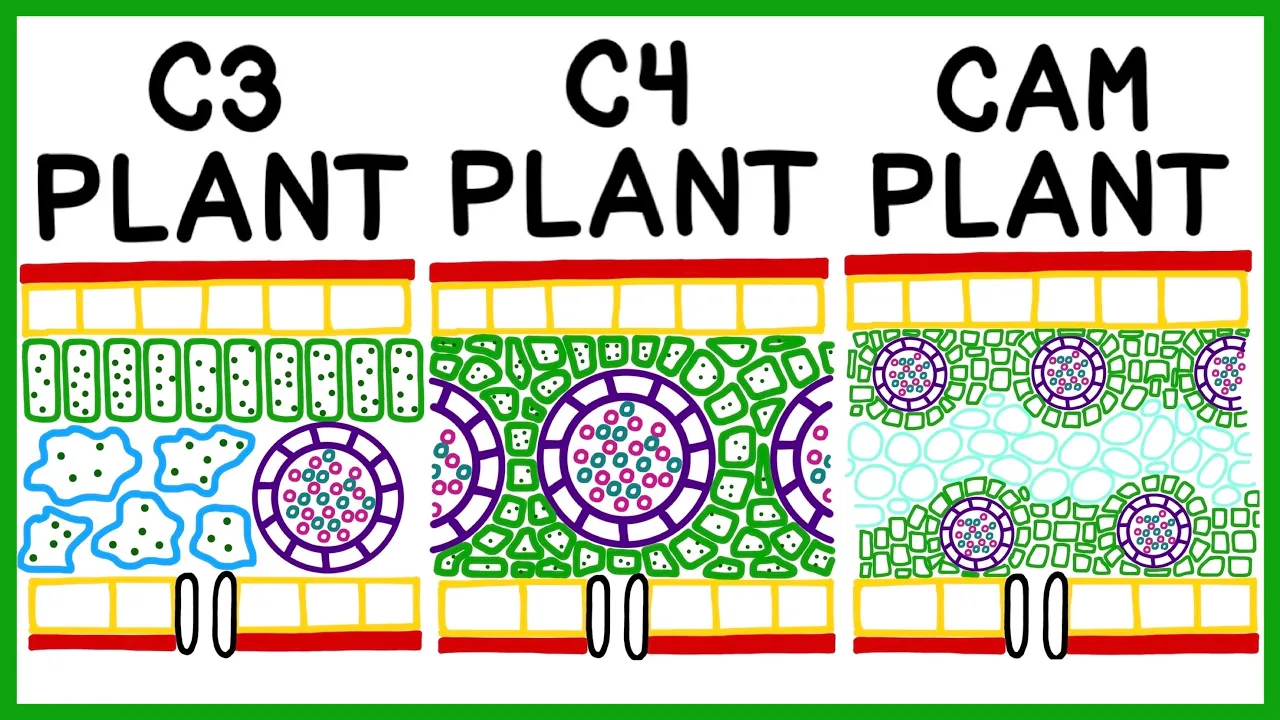
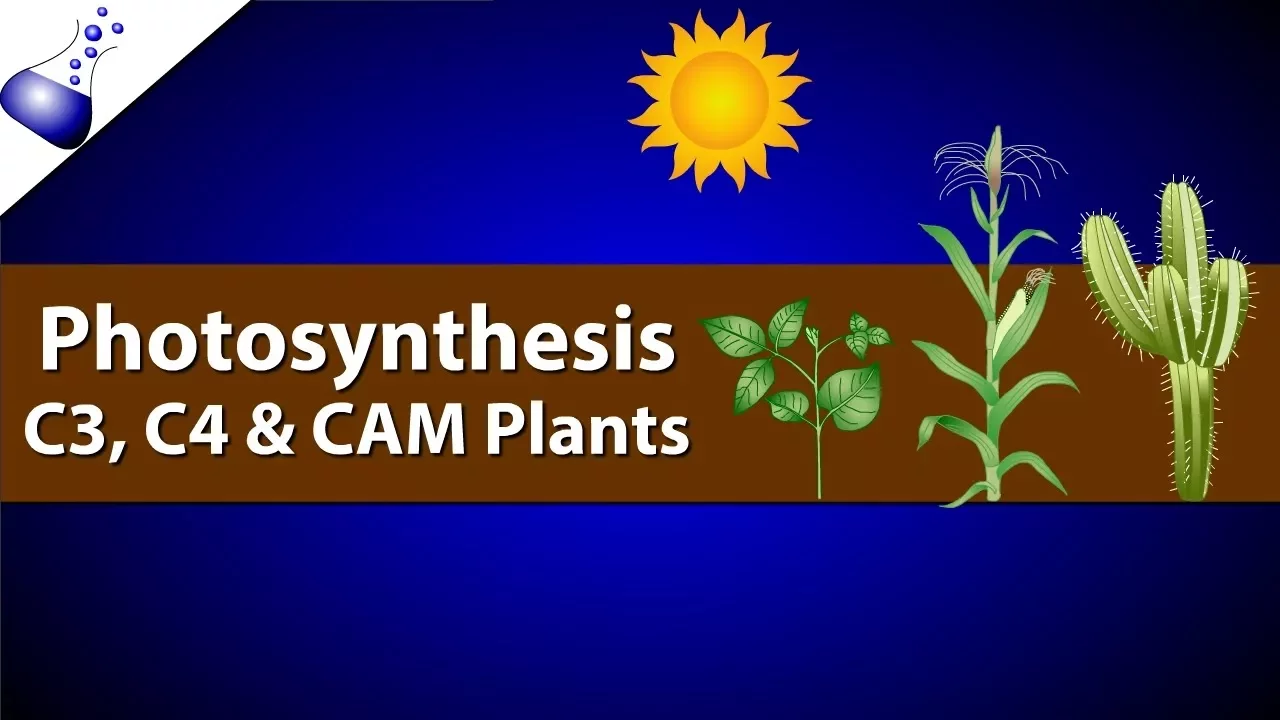








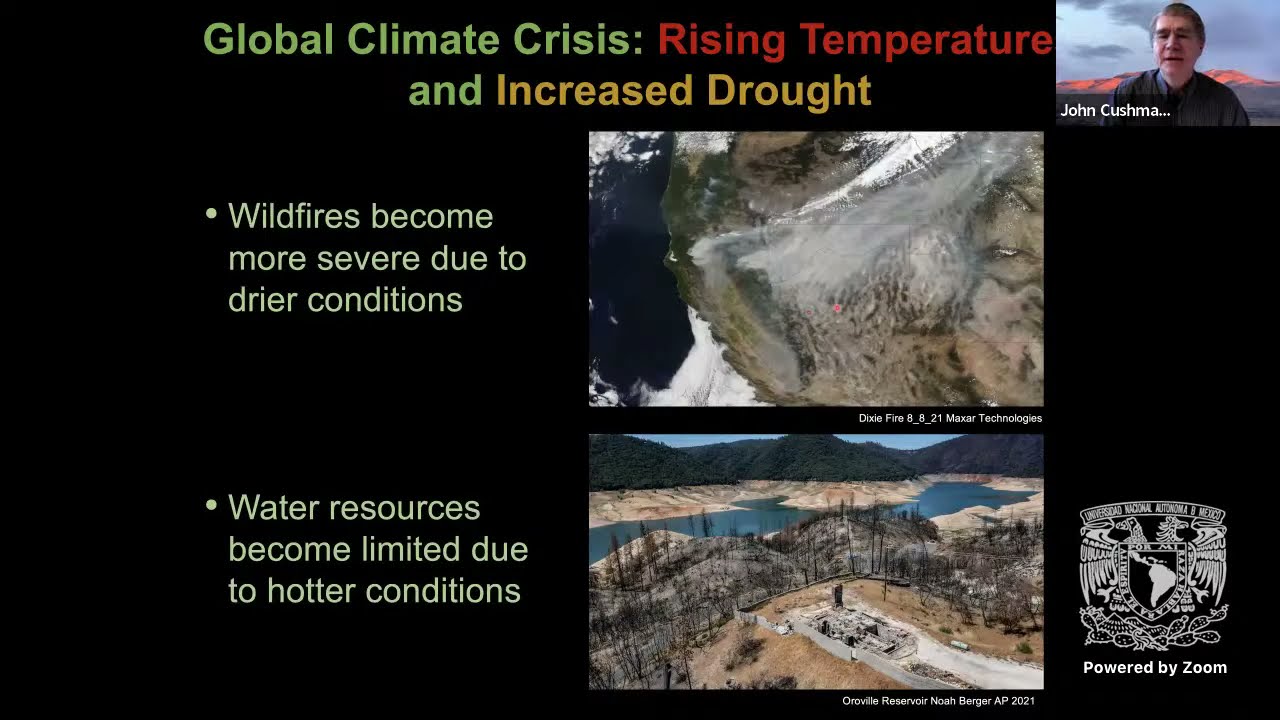


CAM (Crassulacean Acid Metabolism) plants have evolved a unique photosynthetic adaptation where they fix carbon dioxide at night when their stomata are open, storing it as malate in vacuoles, and then release this stored carbon during the day for the Calvin cycle, allowing them to minimize water loss in arid environments while still performing efficient photosynthesis.
CAM Plants Explained: Crassulacean Acid Metabolism Photosynthesis
Added:Standard C3 photosynthesis, including the distinction between the light-dependent reactions and the Calvin Cycle (light-independent reactions).
Plant anatomy and transpiration, specifically how stomata and guard cells regulate gas exchange ($CO_2$ and $O_2$) and water loss.
The role and limitations of the enzyme RuBisCO, particularly its tendency to trigger wasteful photorespiration in hot, dry conditions.
Basic chemical concepts of carbon fixation and the nature of organic acids like malic acid.
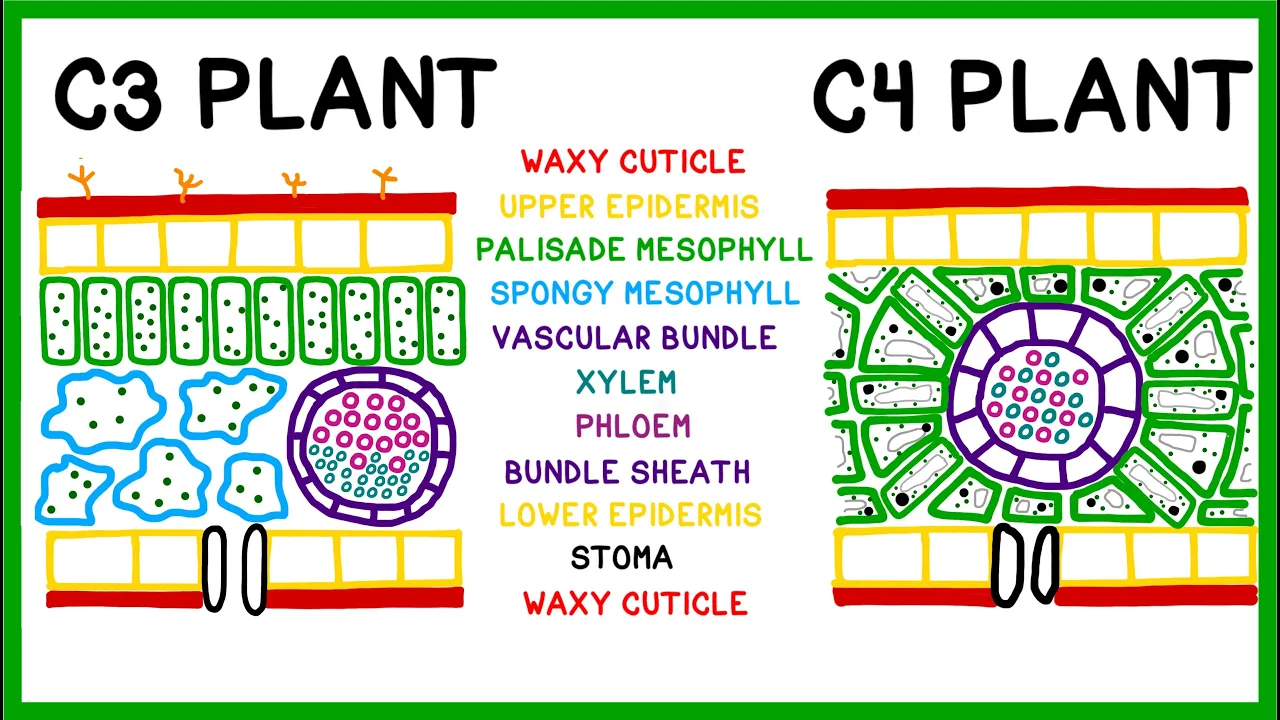
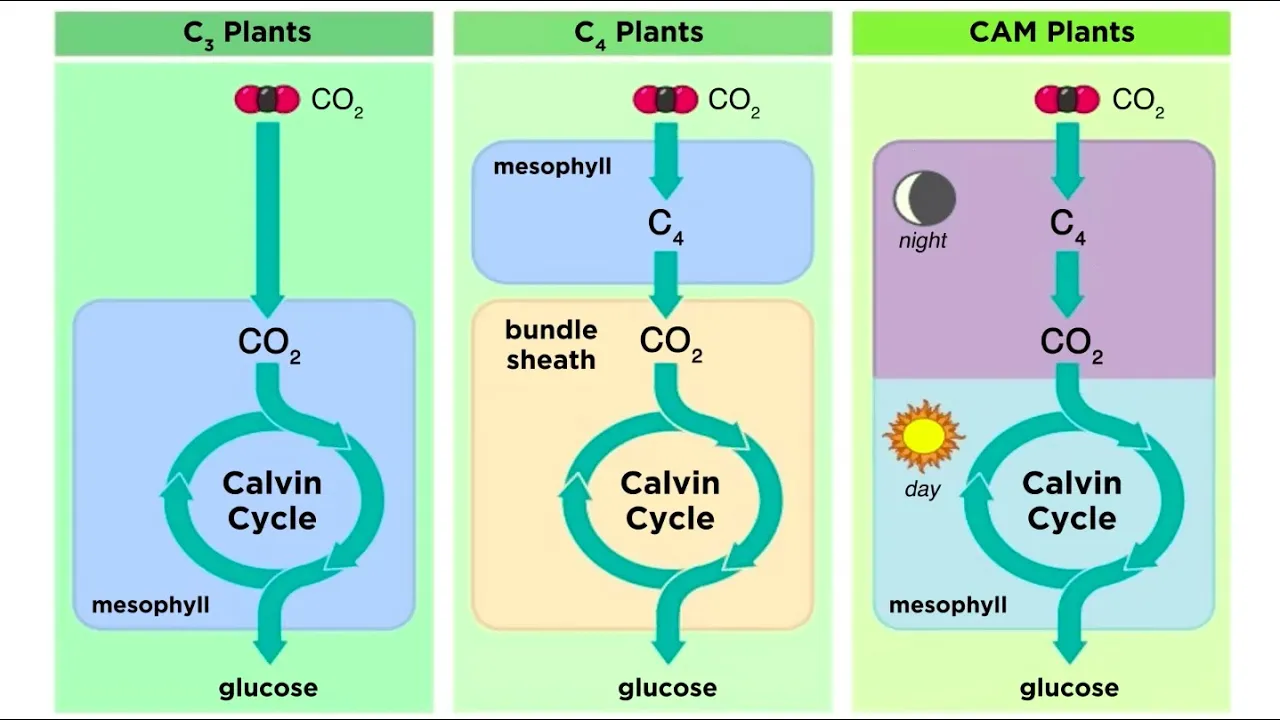
A comparative analysis of C3, C4, and CAM pathways, focusing on the spatial versus temporal separation of carbon fixation.
The evolutionary biology of CAM plants, exploring how convergent evolution adapted species like cacti, pineapples, and agaves to arid ecosystems.
The energetic and metabolic costs (ATP/NADPH requirements) associated with running the CAM pathway compared to C3 and C4 photosynthesis.
Agricultural biotechnology and synthetic biology applications, such as transferring CAM pathways into C3 crops to improve drought resilience.
309.6K views1.4Klikes8:36Original Release: 2010-02-05
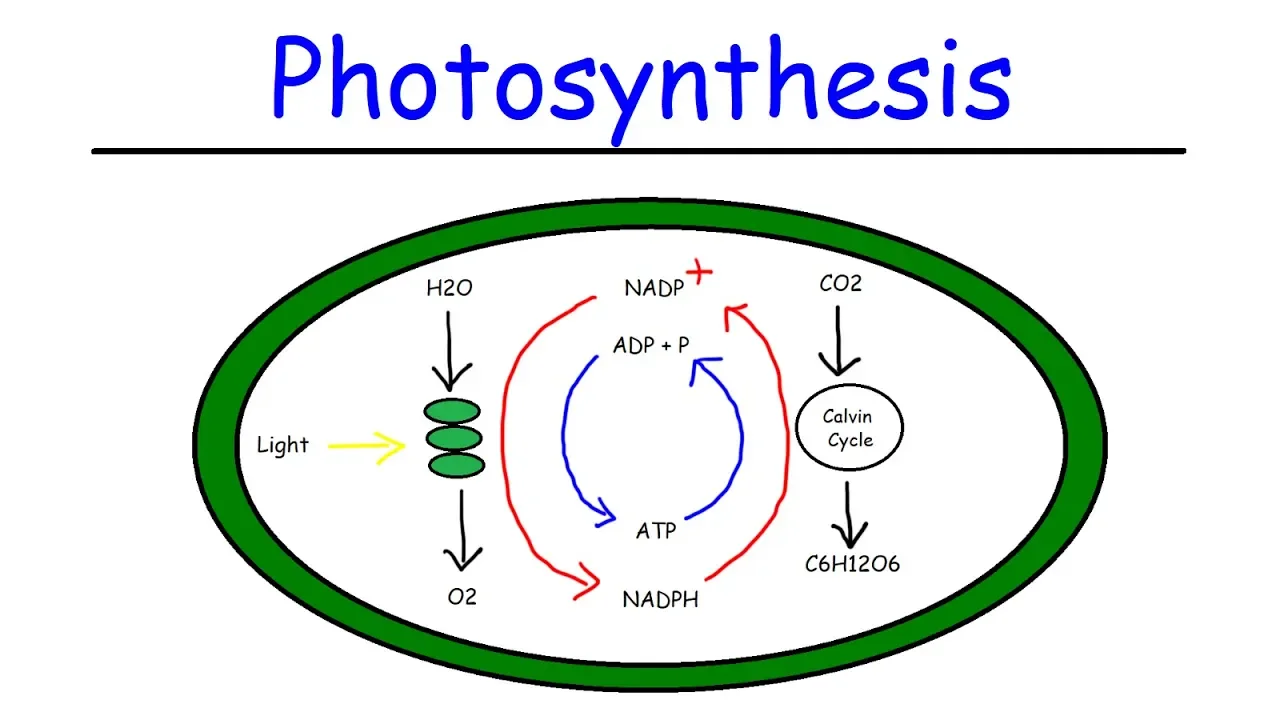
A couple of videos ago, we saw that in classic C-3 photosynthesis-- and once again it's called C-3 because the first time that carbon dioxide is fixed, it's fixed into a 3-carbon molecule.
But we saw the problem with C-3 photosynthesis is that the enzyme that does the carbon fixation, it can also react with oxygen.
And when oxygen essentially reacts with ribulose biphosphate instead of your carbon, you get an unproductive reaction.
Not only is it unproductive, it'll actually suck up your ATP and your NADPH and you'll go nowhere.
So every now and then, when oxygen bonds here instead of a carbon dioxide, you get nothing produced, net.
Everything becomes less efficient.
And so in the last video, we saw that some plants have evolved a way to get around this.
And what they do is, they fix their carbon on the outside, on cells that are actually exposed to the air.
And then once they fix the carbon they actually fix it into a 4-carbon molecule, into oxaloacetate And then that gets turned into malate Then they pump the malate deeper within the leaf, where you aren't exposed to oxygen.
And then they take the carbon dioxide off the malate, and this is where they actually perform the Calvin cycle.
And even though you do have your rubiscos still there, your rubisco isn't going to have-- the photorespiration is not going to occur.
Because it only has access to carbon dioxide.
It does not have access to this oxygen out here.
Now that's a very efficient way of producing sugars.
And that's why some of the plants that we associate with being very strong sugar, or even ethanol producers, all perform C-4 photosynthesis.
Corn, sugarcane, and crab grass.
And these are all very, very efficient sugar producers.
Because they don't have to worry too much about photorespiration.
Now some plants have a slightly different problem.
They're not so worried about the efficiency of the process.
They're more worried about losing water.
And you can imagine what plants these are.
These are plants that are in the desert.
Because these stomata, these pores that are on the leaves, they let in air, but they can also let out water.
I mean, if I'm in the rainforest, I don't care about that.
But if I'm in the middle of the desert, I don't want to let out water vapor through my stomata.
So the ideal situation is, I would want my stomata closed during the daytime.
This is what I want.
So I want-- if I'm in the desert, let me make this clear.
If I'm in the desert I want stomata closed during the day.
For obvious reasons.
I don't want all my water to vaporize out of these holes in my leaves.
But at the same time, the problem is that photosynthesis can only occur during the daytime.
And that includes the dark reactions.
Remember, I've said multiple times, the dark reactions are badly named.
They're more the light independent reactions.
But they both occur simultaneously-- the light independent and light dependent-- and only during the daytime.
And if your stomata is closed, you need to perform photosynthesis, especially the Calvin cycle, you need CO2.
So how can you get around this?
If I want to close my stomata during the day, but I need CO2 during the day, how can I solve this problem?
And what desert plants, or many desert plants, have evolved to do, essentially does photosynthesis, but instead of fixing the carbon in outer cells and then pushing it in to inner cells and then performing the Calvin cycle, instead of outer and inner cells, they do it at the nighttime and in the daytime.
So in CAM plants-- and these are called CAM plants because, I could tell you what it stands for.
It stands for crassulacean acid metabolism.
And that's because it was first observed in that species of plants, the crassulacean plant.
But these are just called, you could call it CAM photosynthesis or CAM plants.
They're essentially a subset of C-4 plants.
But instead of performing C-4 photosynthesis, kind of an outside cells and inside cells, they do it at the nighttime and the day.
And what they do is, at night they keep their stomata open.
And they perform, and they're able to fix-- and everything occurs in the mesophyll cells and the CAM cells, in the CAM plants.
So at nighttime, when they're not afraid of losing water-- let's say this is a mesophyll cell right here-- my stomata is open.
Let's say that this is my stomata right there.
And so it lets in carbon dioxide.
I'm not worried about losing water vapor.
It's night time right now.
So carbon dioxide comes in here.
And then it fixes the carbon dioxide.
It fixes it the exact same way that the C-4 plants do.
So you have your CO2 come in.
You have your PEP.
It's all facilitated by PEP carboxylase That's the enzyme.
That can only fix CO2, that can only react with CO2, not with oxygen.
And then that is used to produce-- and we saw it here in our CAM-4 diagram in the last video, that is to used to produce malate.
A 4-carbon molecule.
And then the malate-- and then this is what's key-- the malate get stored in other organelles in the cell.
In the vacuoles, which are, you can kind of view them as large storage containers in the cell.
So I drew this as the whole cell.
I mean, this is actually all occurring in your chloroplast.
But you can imagine your cell having a big storage center where the malate gets stored at night.
And you can view malate as almost a carbon dioxide store.
Because later on we can access the malate and get the carbon dioxide.
And that's exactly what these CAM plants are going to do.
So this is nighttime.
Then the sun comes up.
So now we're in the daytime.
This desert plant, well maybe it's a cactus, it doesn't want to lose its water vapor.
So it closes its stomata.
This particular stoma now is closed.
It's now closed.
And you say, oh boy, how is it going to perform photosynthesis?
Well, it can perform photosynthesis in that very same cell.
Because it stored up all of this malate at night.
And so now the malate can be pumped out of the vacuoles into the stroma of our chloroplast. And then you can have pyruvate break off.
But the more important thing is you have CO2 break off.
So you have a ready supply of CO2.
And now we can perform our standard Calvin cycle.
And in an environment only with CO2, our stomata is closed, so we're ready to go.
Our CO2 reacts with ribulose bisphosphate It is catalyzed by rubisco It's the whole Calvin cycle and we produced our sugar.
So this is kind of a neat adaptation.
In these high, very efficient sugar-producing plants that aren't worried about water, they perform carbon fixation on things that are exposed to the air and then they pump kind of a stored version of the carbon deeper into the leaf to actually perform the Calvin cycle so that it's not lossy, so that photorespiration doesn't occur.
Because down here you have no oxygen.
The desert plants benefit from that property as well, but their whole concern is, I don't want to keep my stomata open in the daytime.
So what I do is, I fix my carbon at night.
But I use the exact same process.
I use PEP carboxylase And I store my carbon dioxide at night.
And in the daytime, I can actually-- when my light-dependant reactions are occurring, they're producing my ATP and my NADH I can also perform my dark reactions in the daytime.
As I said, the dark reactions always occur in the daytime.
Or my light-independent reactions.
Because even though my stomata is closed, I have a store of carbon dioxide in the form of malate.
Up Next
13:30
CAM Plants Explained: Photosynthesis in Higher Plants | NEET Botany
@NeelaBakoreTutorials
225.5K views•2016-07-25

50:12
Bacterial Communication: Quorum Sensing and Biofilm Formation Explained
@JHUAAP
12.6K views•2011-06-28
5:10
Mendelian Genetics: Alleles, Genotypes & Punnett Squares
@khanacademymedicine
648.4K views•2014-06-16

7:08
Bacteriophages: Earth's Deadliest Killers and Future Antibiotics
@kurzgesagt
34.6M views•2018-05-13
Related Study Plans & Knowledge Roadmaps
Structured learning paths in Biology
biology
RNAi: Biogenesis, RISC & Gene Silencing
01Molecular Biology Foundations: DNA to Protein
02Introduction to RNA Interference (RNAi)
03Molecular Biogenesis of miRNA and siRNA
+ 2 more learning modules
10h5 modules
Explore Roadmap
biology
Mycorrhizae: Signaling, Biophysics & Ecology
01Foundations of Mycorrhizal Symbiosis
02Molecular Signaling and Root Colonization
03Biophysics and Bioenergetics of Nutrient Exchange
+ 1 more learning modules
11h4 modules
Explore Roadmap
biology
Circadian Clocks: TTFL, SCN & Periphery
01Foundations of Molecular Biology & Gene Expression
02Introduction to Chronobiology and Actograms
03The Core TTFL: Molecular Architecture of the Clock
+ 3 more learning modules
14h6 modules
Explore Roadmap
biology
Population Genetics: Math, Drift & Selection
01Genetic & Probability Foundations
02The Hardy-Weinberg Principle and Baseline Models
03Mathematical Modeling of Natural Selection
+ 3 more learning modules
18h6 modules
Explore Roadmap