

























Flow is an optimal state of consciousness where attention becomes so focused on a task that everything else disappears, merging action and awareness while eliminating self-consciousness and causing time dilation; this state amplifies both mental and physical performance by up to 500%, releases five potent neurochemicals (norepinephrine, dopamine, anandamide, endorphins, and serotonin), and can be cultivated through three key triggers: deep embodiment (sensorimotor engagement), rich environments (stimulating complexity), and high consequences (immediate feedback loops), making it the source code of intrinsic motivation that significantly impacts productivity, creativity, and learning.
Flow Science: Unlocking Ultimate Human Performance | Steven Kotler
Added:The foundational psychological concept of the 'Flow State' as defined by Mihaly Csikszentmihalyi, particularly the challenge-to-skills balance.
Basic neurobiology, specifically the role of key neurotransmitters (such as dopamine, norepinephrine, endorphins, and anandamide) in human motivation and focus.
An introductory understanding of electroencephalography (EEG) brainwave states, specifically the distinctions between Beta, Alpha, Theta, and Gamma waves.
Fundamental concepts of cognitive load theory and how the human brain processes attention and filters sensory information.
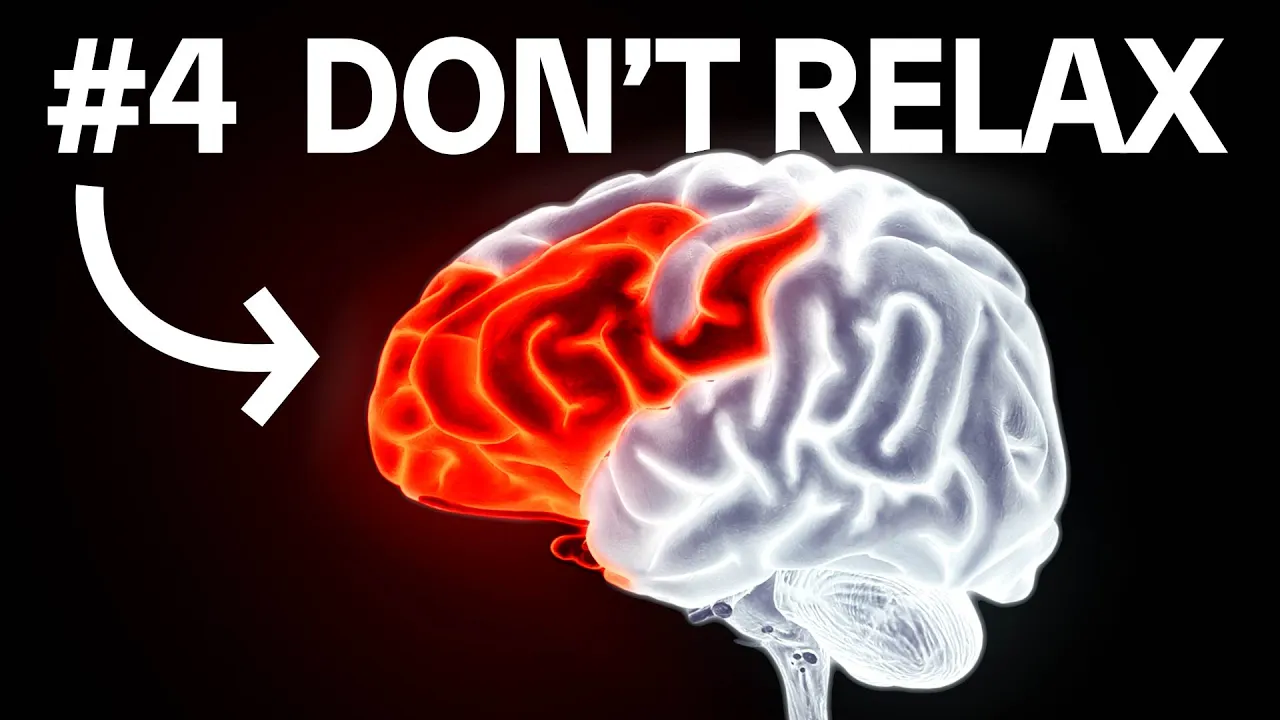
The neurological phenomenon of 'transient hypofrontality' and how the temporary downregulation of the prefrontal cortex enables peak performance.
The four stages of the 'Flow Cycle' (struggle, release, flow, and recovery) and the physiological protocols required for sustainable flow state training.
The science of 'Flow Triggers' (environmental, psychological, creative, and social) and how to systematically engineer environments to induce individual flow.
The dynamics of 'Group Flow' and how collective flow states can be applied to optimize teamwork, collaborative problem-solving, and organizational psychology.
The dark side of flow, including the neurobiology of flow addiction and the risks of burnout or reckless behavior associated with chasing high-dopamine states.
702.6K views8.4Klikes1:10:24Original Release: 2014-05-06
MALE SPEAKER: I'm really happy to welcome our two guests and my friends here today, Steven Kotler and Jamie Wheal.
As you know, wellness, optimum living have been big topics at Google for a while.
And they are complex issues.
I know my colleagues wrestle with these issues a lot, trying to figure out solutions.
And today, what they will be presenting and what we'll learn more about, flow, I think is a big part of this complex puzzle.
And so I want to give you a little bit of background with both of these folks before we get started.
So Steven is a "New York Times" best-selling author.
He's an award-winning journalist and co-founder of the Flow Genome Project.
And he has many books, including "Abundance."
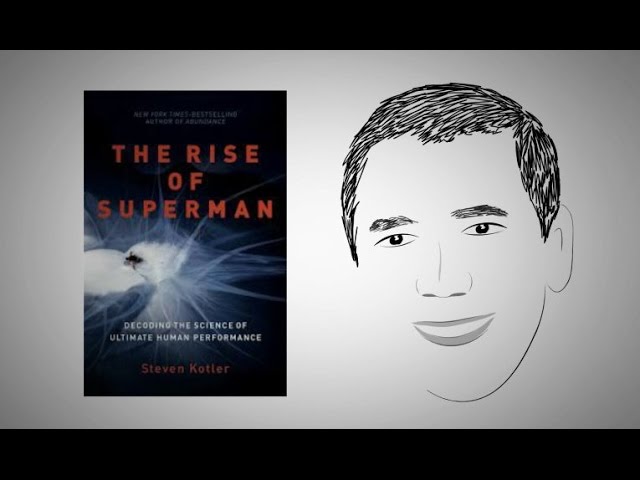
And his new book, "The Rise of Superman" will be the focus on today.
His books have been translated in many different languages.
Articles have appeared in more than 70 publications, including "New Times Magazine," "Atlantic Monthly," "Wired," and "Forbes."
Jamie Wheal is the executive director of the Flow Genome Project.
And he's a leading expert in neurosemantics of ultimate human performance.
And he works with Fortune 100 companies, leading business schools, Young Presidents' Organization, an also Red Bull, with their world-class athletes.
So with that, I'm going to turn it over to Steven.
[APPLAUSE] STEVEN KOTLER: Hello.
Thank you guys for coming out.
I very much appreciate you being here.
I want to kind of just orientate you a little bit to what we're going to do.
I'm going to kind of give you an introduction to flow and start breaking down some of the neurobiology, how it works under the hood and giving you kind of the broad spectrum of importance.
And then Jamie's is going to take over and he's going to talk about practical applications about how you can get more flow into your lives.
As a way to kind of begin, I want to tell you kind of where I began with this, which was when I was 30 years old, I got Lyme disease.
And I spent the better portion of three years in bed.
If you don't know what Lyme disease is like, imagine the worst flea you've ever had, crossed with paranoid schizophrenia.
So by the end of it, the doctors had pulled me off medicines.
My stomach lining was bleeding out.
There was nothing else anybody else anybody could do for me.
And I was functional, 5% to 10% of the time.
My mind was totally shut down.
My body was in so much pain, I could barely walk.
I was hallucinating.
My short-term memory was gone.
My long-term memory was gone.
It was all gone.
And at this point, I was going to kill myself out of practicality.
The only thing I was going to be from here on forward was a burden to my friends and my family.
And it was really a question of when and not if at that point.
And in the middle of all this kind of negative thinking, a friend of mine showed up at my house and demanded we go surfing.
And it was a ridiculous request.
First of all, it had been about five years since I had surfed at that point.
And the last time I had surfed, I had nearly drowned in a big way of accident in Indonesia and wanted nothing to do with surfing.
And as I said, I could barely walk across the room.
And she was a pain in my ass.
She wouldn't leave and wouldn't leave.
And kept badgering me and kept badgering me.
And after finally about three hours of this, I was like, what the hell, let's go surfing.
What is the worst that can happen?
And they she kind of walked me to their car.
And they put me in their car and they drove me to Sunset Beach in Los Angeles.
And if you know anything about surfing in Los Angeles, you know that Sunset Beach is just about the wimpiest beginner wave in the entire world.
And it was summer.
And the water was warm and the tide was low.
And the waves were crap, like maybe two feet high.
And no one was out.
And they walked me out to the break, literally by my elbows and kind of helped me out there.
They gave me a board the size of Cadillac.
And the bigger the board, the easier it is to surf.
This was enormous.
And I was out there about 30 seconds when a wave came.
And I'm not quite sure what happened, muscle memory took over, whatever.
The wave came.
I spun the board around.
I paddled a couple times and I popped up.
And I popped up into a completely different dimension.
My senses were incredibly incredibly, incredibly acute, I was clear headed for the first time in years.
I felt like I had panoramic vision.
And time had dilated.
It had slowed down.
So that freeze-frame effect, if you've ever been in a car crash, that was my experience.
And the most incredible thing was I felt great.
I mean I felt alive, that thrum of possibility.
And it was the first time in about three years that I had felt it.
And that wave felt so good, I caught four more in a row.
And after that fifth wave, I was disassembled.
I was gone.
They had to carry me to the car.
They put me in the car.
They drove me home.
They had to put me into bed.
And people actually had to come and bring me food because for 14 days, I couldn't walk again.
So I couldn't make it 50 feet away to my kitchen to make a meal.
And on the 15th day, which was the day that I could walk again, I got back in my car and I went back to the ocean and I did it again.
And again, I had this kind of crazy, quasi-mystical experience.
And again, it felt great.
And the cycle kept repeating itself.
And over about six months' time, when the only thing I was doing different was surfing, I went from about 10% functionality to about 80% functionality.
So my first question was what the hell is going on?
Because surfing is not a cure for chronic autoimmune conditions, first of all.
Second of all, I'm a science writer by training.
I'm a rational materialist.
And I don't have mystical experiences.
And I certainly don't have them in the waves while surfing.
The whole thing seemed ludicrous.
Lyme is only fatal if it enters your brain.
And I was pretty certain that the reason I was having these quasi-mystical experiences out in the waves was because I was dying.
So where all this started for me was a giant quest to figure out what the hell was going on with me.
What I discovered was this altered state of consciousness I was experiencing had a name, flow states.
Now, you may know this by other names, being in the zone, runner's high.
If you happen to be a beatnik jazz musician, then you're in the pocket.
If you're a stand-up comic, it's called the forever box.
The lingo goes on, and on, and on.
The term researchers prefer is flow.
And they prefer this term for a reason.
It's actually a technical term.
And we'll come back to why in a second.
But in flow, what happens is attention becomes so focused on the task at hand that everything else disappears.
Your sense of action or awareness merge together.
So the doer and the beer become one.
A sense of self, our sense of self-consciousness disappear completely.
Time dilates.
So that means it slows down like I mentioned.
You can that freeze-frame effect, like in a car crash.
Sometimes it speeds up.
And five hours will go by in like five minutes.
And throughout all aspects of performance, mental and physical go through the roof.
I'm not going to dwell too much on it.
I'm just going to kind of explain it.
And we're going to go on to a lot of things.
But I want to talk about why flow actually healed me from Lyme disease, just so you guys understand what was going on.
We're going to talk later about the neurochemicals involved in flow.
All of them significantly jack up the immune system.
More importantly, they reset the nervous system back towards zero.
So they calm you down.
An autoimmune condition is essentially a haywire nervous system.
So the fact that periodic flow states were calming my system back down is allowing me to form new neural nets.
Neural nets that didn't lead immediately back to illness.
And this is what kind of gave me a toehold and possibility to get better.
What I also discovered when I was researching flow and learning all this stuff is that the exact same state that helped me get from seriously subpar back to normal was helping a lot of other people go from normal up to superman.
Another thing that I learned very quickly on is that I really was not the first person to come to this conclusion.
Flow science dates back about 150 years, to the early 1870s.
By the turn of the century, Harvard psychologist and philosopher William James was looking at the state.
And he was the first person to figure out that the brain can radically alter consciousness to improve performance.
More importantly was the work of one of James' students, Walter Bradford for Cannon, who was a great physiologist.
Bradford Cannon discovered the fight or flight response.
And in doing so, he kind of give us our first window into where this accelerated performance might be coming from.
This was a very, very big deal.
Before that moment in time, performance enhancement was essentially a gift from the gods.
You want a better time in 100-yard dash, Hermes can help.
You want to write a better poem, talk to the muses.
But Walter Bradford Cannon turned a gift from the gods into standard biology.
He give us our very first toehold into the mystery.
In 1940s, psychologist Abraham Maslow picked up on this thread.
He discovered that flow was a commonality among all successful people.
And then in the 1960s and '70s, the real revolution began, a guy named Mihaly Csikszentmihalyi, who is then the chairman of the University of Chicago psychology department.
Csikszentmihalyi sort of-- well, Maslow discovered the state in successful people.
Csikszentmihalyi got curious about kind of everybody else in the world.
So he made what is now considered one of the largest global psychological studies ever.
He went around the world, asking people about the times in their life when I felt their best and they performed their best.
And it was a huge group.
He started out talking to experts.
He talked to expert rock climbers, ballet dancers, artists, surgeons.
It didn't matter.
They all said same thing.
They felt their best.
And they performed their best in the state he termed flow.
Then he blew it out to everybody else.
And by everybody else, I really mean everybody else.
He talked to Navajo sheepherders.
He talked to Italian grape farmers.
He talked to elderly Korean women.
He talked to Japanese teenage motorcycle gang members.
He talked to Detroit assembly line workers.
Everybody he talked to told him the same thing.
They felt their best, they performed their best when they were in the state of flow.
Csikszentmihalyi also came up with the term "flow."
One of the reasons was when he was talking to all these people and they describing this state, they always said, well, I'm using my skills to the utmost.
I'm pushing myself as far as I possibly can.
But it feels effortless.
When I'm in this state, every decision, every action leads seamlessly, fluidly to the next.
In other words, flow felt flowy.
The other major finding that came out of this, as I hinted at a second ago, flow is ubiquitous.
It shows up everywhere, in anyone, anywhere, provided certain initial conditions are met.
What this means is that everybody from jazz musicians in Algeria, to software designers in Mumbai, to coders here in Silicon Valley are using flow to massively accelerate performance.
And it is a considerable bit of acceleration.
Flow amplifies all of our physical skills.
So in this state, we are better.
We are faster.
We are stronger.
We are more dexterous.
And we are more agile.
So our brains.
Flow jacks up information processing.
So when we're in the state, our senses are actually taking in more information per second.
We're processing it more deeply.
So that is using more parts of our brain at once.
And while there's a lot of debate about this, it does appear that we are processing it more quickly.
And it's not just information processing that is getting jacked up.
Pattern recognition, future prediction, basically all the fundamental neuronal processes in the brain are amplified by flow.
As a result of this, scientists now believe flow sits at the heart of every athletic championship.
So almost every gold medal that has ever been won.
But it also accounts for significant, significant progress in the arts and major scientific breakthroughs.
In business, McKinsey did a 10-year study.
They found that top executives report being five times more productive in flow than out of flow.
So you got to stop and think about that.
Normally, I have to explain to most audiences that five times is actually a 500% increase.
I'm guessing you guys got it.
But what that means is you can go to work on Monday, spend Monday in flow, take Tuesday through Friday off, and get as much done as your steady-state peers.
So it is a huge, huge, huge amplification.
And that 500% increase may sound ridiculous until you consider action-and-adventure sport athletes.
So one of things McKinsey discovered is that average people, average workers, spend less than 5% of their work life in flow.
One place where this is definitely not true is in action-and adventure sports.
Action-and-adventure sport athletes, for reasons that Jamie is going to get into later, have essentially become the best flow hackers on Earth.
And this has happened over about the past 25 years.
And there are reasons for it.
And we'll talk about them later.
But I want to tell you what this has produced.
It has produced near exponential growth in what's termed ultimate human performance, which is performance when life or limb is on the line.
Nothing like this has ever happened before.
Sports progression, it's slow.
It's steady.
It's governed by the laws of evolution.
At no point in history does it quintuple in a decade.
Yet this is exactly what's been happening in surfing, skiing, snowboarding, rock climbing, mountain biking, et cetera, all the action and adventure sports.
I'll give you a couple of examples.
Surfing is a great one.
This is a thousand-year-old sport.
From 400 AD to 1996, the biggest wave anybody has ever surfed is 25 feet.
Above that, it's believed impossible.
Scientists don't think it's possible.
Surfers don't think it's possible.
Today, we're pushing into 100-foot waves.
In snowboarding, in 1992, the biggest gap jump that anybody had ever cleared is 40 feet.
Now, 40 feet is a big jump to clear on a snowboard.
Today, as you can tell from this image, snowboarders are pushing into 230, 240 foot jumps.
So near exponential growth in ultimate human performance.
The better news, at the same time all this is going on, they solved a couple of problems.
For a long time, one of the big problems in flow research was the subject of state.
How the hell do know if your research subjects are in flow?
The good news about action adventure sport athletes, sort of, is that the level of progression has advanced so much in recent years that if people are not in flow on their performing, they're ending up in the hospital or dead.
So this gives you a hard research set to work with.
It's a hard data set.
If they lived through the experience, we know they're in flow.
Simultaneously, combined with this-- flow science, as I said, goes back to 150 years.
Most people are really aware of the first 130 years, which is when we figured out the psychology of the state.
And we got really good at the psychology of the state.
What's happened since 1990ish is that our neurobiology has gotten very good.
Our brain imaging technology has gotten very good.
EEG has gotten a lot better.
And for the very first time in history, we can look under the hood and we can figure out what's going on in flow.
One of the first things that we discovered is there's-- the old idea about ultimate human performance was based on what's called the 10% brain myth.
It was actually a misinterpretation of William James.
But it's the idea-- and I'm sure you're all familiar with it-- that most of us only use 10% of our brain.
For ultimate performance, a/k/a flow, it has to be all of our brain firing on all of our cylinders.
That was the idea.
It turns out that's exactly backwards.
What's happening in flow is the brain isn't becoming hyperactive.
It's actually starting to deactivate.
So this is happening for a number of reasons.
The simple reason is it's an inefficiency exchange.
The brain is a giant energy hog.
It's 2% of our mass.
It uses 20% of our energy.
So one of the fundamental rules of the brain is how do I can conserve energy?
So conscious processing is very slow and it's extremely energy expensive.
Subconscious processing, on the other hand, is very, very quick and it's very, very energy efficient.
So what's happening in flow is we are trading conscious processing for subconscious processing.
As this is happening, huge swatches of the brain are being shut off.
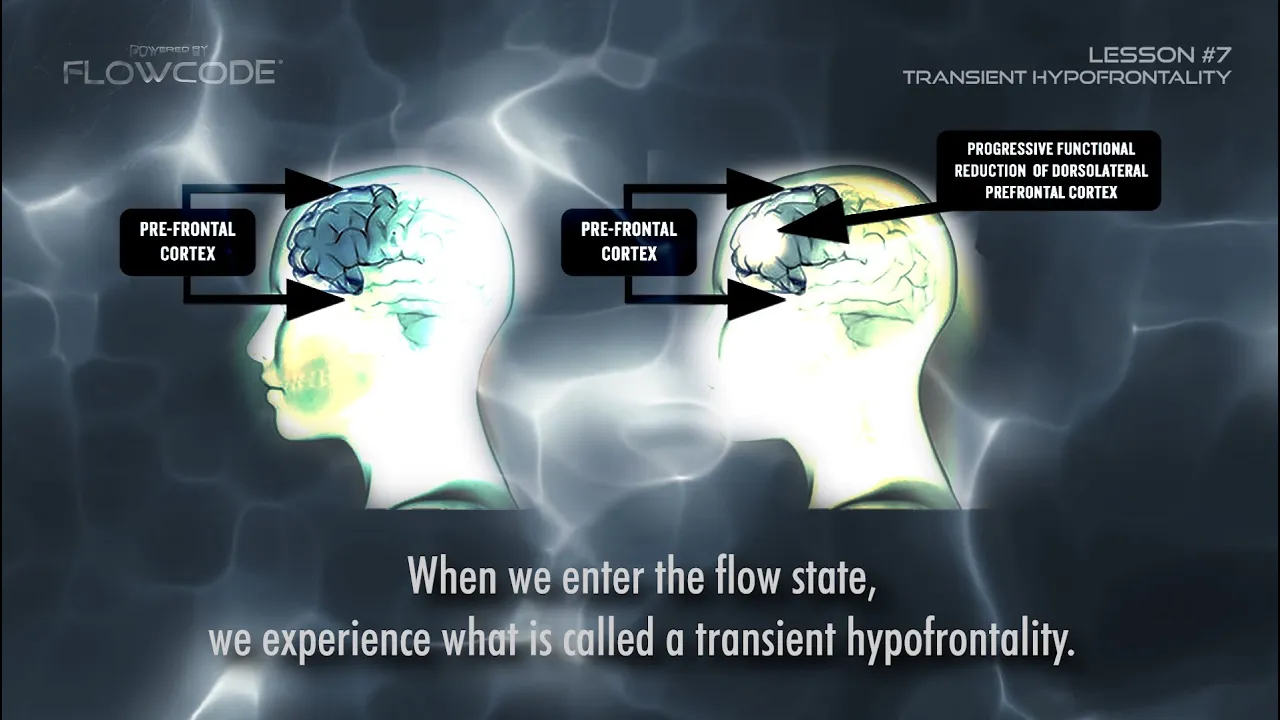
The technical term for this is "transient," meaning temporary, "hypofrontality," hypo, H-Y-P-O, it's the opposite of hyper.
It means to deactivate, to slow down, to shut off.
Frontality refers to the prefrontal cortex, the part of your brain that's back here, that houses all of your higher cognitive functions.
So why does time dilate in a flow state?
Why does it speed up or slow down?
Because time, as Baylor neuroscientist David Eagleman figured out, is calculated all over the brain, especially all over the prefrontal cortex.
As parts of it start to wink out, we can no longer separate past, from present, from future.
So we're plunged into what researchers call the "deep now."
To give you another example of what goes on in flow, another portion of the brain that goes off-- we talked earlier about how self and self-consciousness disappears.
Why does self-consciousness disappear in flow?
Because a portion of the brain known as the dorsal lateral prefrontal cortex, which sort of is responsible for self monitoring and impulse control, shuts down.
So self-monitoring, that's your inner critic, your inner Woody Allen.
That's that nagging, defeatist voice that's always on in your head.
In flow, it's turned off.
When it turns off, we experience this as liberation.
We are literally free from ourselves.
Creativity goes up.
Risk taking goes up.
Performance goes up.
We are much more open to experience.
So what we've just been talking about is neuroanatomy, where in the brain something is taking place.
If you really want to kind of map an experience in the brain, you have to talk about neuroanatomy, where in the brain it's taking place, neurochemistry, and neuroelectricity, which are the two ways the brain sends signals.
I'm going to talk a little about neurochemistry.
Then Jamie's going to pick it up and talk a little bit about neuroelectricity.
In flow, we get five of the most potent neurochemicals the brain can possibly produce.
So all of these are performance enhancing neurochemicals.
Norepinephrine and dopamine enhance focus.
They tighten focus.
They drive us more into the now.
It also speeds up muscle reaction time.
They lower signal to noise ratios in the brain also so we have more pattern recognition.
Anandamide is a pain reliever.
But it also speeds up or increases lateral thinking, thinking outside the box.
So pattern recognition is defined as the linking of similar ideas together.
Lateral thinking is the linking of disparate ideas together.
That goes up in flow.
Endorphins, very, very potent painkillers and very, very powerful social bonding chemicals.
And serotonin keeps us calm throughout.
That's the chemical at the heart of the Prozac revolution.
So the thing you need to know about all of these neurochemicals, besides the fact that they up performance, is how they impact motivation.
So for those of you who don't know much about neurochemistry and drugs, all of these chemicals are incredibly potent reward chemicals.
Let's talk about dopamine for a second.
Cocaine is widely considered the most addictive substance on Earth.
When someone snorts cocaine, all that actually happens is dopamine floods into their brain and then the brains blocks its re-uptake.
So the substance is in your brain for longer.
Norepinephrine-- let me go back-- norepinephrine is speed or Ritalin.
Anandamide is the same psychoactive that's inside of marijuana, THC.
Endorphins are opiates.
And just to give you an example, there are about 20 different endorphins in the brain and the body.
The most common one is 100 times more potent than medical morphine.
And serotonin is essentially MDMA.
The point here is that when all five of these chemicals flood into your brain, it produces an extremely, extremely, extremely addictive experience.
Flow is arguably the most addictive experience on Earth because it's probably the only time, or the only time that we know of, when all five of these chemicals get flooded into your brain at once.
Researchers don't like the word "addictive."
It has very negative connotations.
So they prefer "autotelic," which means an end in itself.
What this basically means is that once an experience starts producing flow, we will go extraordinarily far out of our way to get more of it.
Which is why researchers talk about flow as the source code of intrinsic motivation.
So why does this apply in daily living?
One reason is, as a recent Gallup survey pointed out, 71% of American workers are disengaged or actively disengaged on the job.
The other 29% have jobs that produce flow.
So we really know what the solution is to this problem.
The other thing I want to talk about, flow doesn't just amp up motivation.
It also massively jacks up creativity.
It's hard to put numbers on this.
We did a kind of a loose study at the Flow Genome Project.
And I say loosen loose and preliminary.
And people reported a 7x improvement in creativity.
To give you another example of this, an Australian study-- it's a neat study-- they took 40 people.
They give everybody a really tricky brain teaser to solve.
Nobody could solve it.
They induced flow artificially using transcranial stimulation.
They literally took an electric pulse and knocked out the prefrontal cortex and basically induced transient hypofrontality.
23 people solved the problem in record time.
So creativity goes massively through there.
Again, this comes down to neurochemistry.
So creativity as a skill is usually, not always, but usually recombinatory.
It's the product of a novel idea bumping into an old thought to create something startling new.
So if you want to increase creativity, you have to increase all of those things.
Well, norepinephrine and dopamine, they tighten focus.
The brain is taking in more information for a second.
So it's heightening our access to novelty, which is on the front end of the creativity equation.
Because they lower signal to noise ratios in the brain, they are also upping pattern recognition, so our ability to link ideas together.
And then anandamide is increasing lateral thinking or our ability to link disparate ideas together.
So literally the state of flow surrounds creativity.
And what's really interesting here is creativity, as most of you I'm sure are aware, is a quality that's really, really desirable.
IBM did a global survey.
I think it was 1,500 CEOs.
Of the quality most necessary in a CEO today, creativity was the number one answer.
Yet how to teach creativity?
How do we teach people to be more creative, a big problem.
Teresa Amabile at Harvard did a study where she discovered that not only are people more creative in the state of flow, but that heightened creativity actually outlasts the state by a couple of days.
Which suggests-- and more work needs to be done-- but it suggests that the state of flow actually trains the brain to be more creative.
The other things these neurochemicals do is they exist to kind of tag experiences.
So a quick shorthand for learning and memory, the more neurochemicals that show up during experience, the greater chance that experience moves from short-term holding into long-term storage.
Neurochemicals are essentially a big tag on experience.
It says, important, save for later.
So flow is a gigantic dump of potent neurochemicals.
So this has a radical impact on learning.
In studies run by the US military by DARPA in advanced brain monitoring, which is a team in Carlsbad, California, they again induced flow artificially, two different ways.
They used transcranial direct stimulation and they also used neural feedback.
And they found that snipers in flow learned an average of 230% faster than normal.
They then repeated this same study with novices, nonmilitary personnel.
And they found that the time it took to get from novice to expert by artificially inducing flow could be cut in half.
So what this tells us is that Malcolm Gladwell's famous 10,000 hours to mastery, flow cuts them in half.
So this is where I'm going to stop with learning, and creativity, and motivation because I think those are three big categories that apply in everybody's life.
As a way of kind of transitioning into Jamie, what I want to say is what has also come out of all this research is not just what's going on in flow.
And because we've had these athletes as a data set, we can figure out what they are doing to get into flow so successfully and we can work backwards.
And we can apply this knowledge across all domains in societies.
So what we've discovered is that flow states have triggers.
These are preconditions that lead to more flow.
I'm going to turn it over and let Jamie talk about this and why they're so important.
JAMIE WHEAL: Thank you.
[APPLAUSE] So about 2,000 years ago, there was this epic, "Old Testament" rap battle between Rabbi Hillel and the pharisees.
And the pharisees challenged him.
They said, OK, Rabbi Hillel, you think you're a hot shot.
Can you stand on one leg and recite all of scripture?
And he said yes, I can.
And he did it.
And he stood on one leg.
And he said do unto others as you would have them do unto you.
The rest of scripture is mere commentary.
And here at Google, it's your guys' world to be organizing the world's information.
And while that is ambitious and noble, you guys know, too, that it's the insights we gain, it's not simply the data we gather, that makes a difference.
And where we are today is truly drowning in information and just as we always have been, starving for motivation.
We know better.
We know we're supposed to eat real foods, mostly plants, not too much.
We know we're supposed to do work that matters.
We know we're supposed to practice gratitude.
We know that meditation is supposed to be amazing if we ever get around to it and can sit still long enough.
We know all this stuff.
But if you just-- a quick glance at the stats behind me.
Look at the toll.
We are less healthy.
We are more obese.
There's higher workplace injuries.
There's dollar values attached to this stuff.
Lifetime fitness, arguably the kind of access to embodiment and wellness for like the suburban masses, 75% attrition rate.
And that's an internal statistic.
75% of the people that say yes, I want you to take my $150 a month, I want the outcome, never show up again.
And most chillingly, a study at Harvard conducted-- that, hey, when you are faced with a chronic lifestyle disease, diabetes, heart disease, smoking chronic stress, and your doctor says, hey, look, here's the deal.
You really have to change your ways and if you don't, it might kill you.
This is what we're left with.
Seven out of eight of us would rather die than change.
Mind boggling.
So back to these guys.
[INAUDIBLE] is not just kind of noodling around on the sides.
They actually have a full-bore research project.
It is global.
It is interdisciplinary.
It's called the Quantified Warriors.
So forget you're kind of Quantified Self meet-ups here in the Valley.
These guys are building these supersoldiers of 2030.
And what they're doing is sort of alternately fascinating and horrifying, depending on your point of view.
But there's something really interesting that's been going on.
And Steven talked a little bit about there's a 150 years of research.
The last 10 to 20 years has been getting super-interesting.
And if I was in your seats, I'd be saying, OK, this sounds OK, cool.
But how come I don't know about it?
If it was really all that, we'd know about it right now.
And there's actually a problem.
There's a reason why we don't have this as shared working knowledge.
Which is really how do we take information and translate it into motivation?
Because as Steven said, flow is autotelic.
Flow has this massive neurochemical dump.
It encodes and rewards us to do more of it.
And if we could unlock that, intrinsic human motivation, what's possible next?
Because these guys, the Special Operations forces, Yale is working with Delta Force and the Rangers, and Red Bull is working with the Coronado SEAL Team Six, these guys are getting way into the fine details.
But they are explicitly disincented to share this knowledge.
One of them wants to stay a step ahead of the bad guys.
And the other guys want to step up on the podium.
So what they've been learning has not been shared yet.
And certainly part of our mission is to actually take this extreme, the folks who risk their lives for a living, and bring it more into the mainstream.
Bring it to impact entrepreneurs.
Bring it to communities of innovation where we can harness the same rocket fuel.
So to go back and just kind of shake out three of the more practical takeaways of what-- if you remember nothing else from today, please think through these ones.
Number one is what we were just talking about.
Flow is the source code of intrinsic motivation reinforced with the most potent neurochemical set we have access to.
Next, it shortens learning.
Which means either I get to spend a lot more time on the couch or I can actually go further in my domains of inquiry.
I can learn more.
What happens to human progression when we can double its efficacy?
And lastly, again Mihaly Csikszentmihalyi, the godfather of flow, did a 10-year global study.
And one of the additional benefits was that the people who have the most flow in their lives are in fact the happiest.
So as far as the bottom line in optimal psychology, that is the "so what" at the end of it.
So to go back to these action sports athletes as a case study because they've been kind of a fringe population.
People don't pay much attention to them.
The notion ski bum and surf bum aren't exactly warm embraces of people who have dedicated their lives in these domains.
But they really have come up with three very good and transferable ways for all of us to get more flow in our life.
And the three re deep embodiment.
When they are doing things, they are feeling the forces of gravity.
So their proprioceptive sense, like where are my limbs in space, my vestibular sense, where is my inner ear in relationship to my hips, compression, weightlessness, rotation, all of these things are giving very strong sensory motor inputs into our body and brain.
And as Steven was mentioning, cells that fire together, wire together and we create richer and more robust neural networks.
So we've some fascinating studies.
They did a sort of human life-sized Frogger experiment with college athletes versus just frat boys and sorority girls.
And they said, OK, who's going to do better at this life-size Frogger game and who would you put your money on?
Well, the athletes and the athletes won.
But not for the reasons we would think.
They didn't win because they had faster reaction time.
They didn't win because they could-- explosive box jumps.
They won because they could process complex multivariable equations faster and then act on that information.
So the notion of the dumb jock was also absolutely wrong.
And in comparison-- so this goes back to the sort of ancient Shaolin temple-- mastery and control of body yielding mastery and control of mind.
So you go from basically going on a dial-up modem-- I'm just a brain on a stick, disembodied, disconnected, only perceiving and receiving information through one data feed-- into broadband or even satellite.
I am now picking up all channels available to me as a sensing cognition machine.
And those neuron nets are now fired and wired together.
Next, rich environments.
Think about the difference in a surfer or a skier, big mountain skier, any of these things, between just playing ping-pong.
And every day that ping-pong table is exactly the same.
And my paddle is.
And the ball bounces the same way.
It all works.
And I can kind of check out.
But in a situation where the environment is so rich it's overwhelming and stimulating, it actually sort of can knock out my waking sense of self and forces me to pay explicit, acute attention because if I don't, I get knocked down.
And lastly, high consequences, which I just kind of foreshadowed.
In fact, Oscar Wilde I think famously said, there's nothing like the prospect of being hung in the morning to clear one's mind.
So immediate high consequences have this wonderful effect, which is very hard in this day and age.
We're always elsewhere and elsewhen.
I'm thinking about tomorrow.
I'm on my phones.
I'm pitching this.
I'm posting that.
Like high consequences bring me back into the incontrovertible now.
It is the only place that flow can happen.
And if I get out of it, if I drift, I get spanked.
And it hurts and I learn.
Now, think about how much of our learning and experiences these days are disconnected from those kind of tight feedback loops.
So let's translate this to your guys' world a little bit because that's the beauty.
And this would just be kind of a curiosity if it didn't matter to us as well.
So think about rich environments.
You guys are obviously in one.
The cross pollination-- a lot of the sort of cutting edge organizational design of workplaces, whether it's at Pixar with the atrium and the serendipitous meetings.
Whether it's your guys' cafeterias and restaurants, with the lines and the management and all of your commons areas explicitly designed to create novel, changing environments, high consequences.
I mean obviously, next door Facebook's got the shit fast, break stuff, lean and agile design and development.
The entrepreneurial mentalities that you guys have where failure is expected because if you're not failing, you're not learning as rapidly as you might.
And deep embodiment, I mean it's no mistake I think that you guys here at Google, with founders who were both Montessori children-- which in the flow research is the most flow-prone educational method in the world, with sensorial, manipulative children sweeping and cutting and actually using body and brain simultaneously, as well as the founders' passion for all things action sports and adventure, the DNA of this place is pretty much set up to be about an optimal an environment for cultivating this as anywhere you could think of.
So Steven described the five neurochemicals and described the neuroanatomy a little bit.
But let's put this in motion.
Let's actually put this in time, through time as we might experience it.
Because what this is, what we're calling the flow genome matrix, which is literally what's the genome?
What are the core components?
How do they work.
And if we have that knowledge, what can we do with it?
And just so you guys kind of track the research, the lineage behind this model, this comes largely out of Herbert Benson's work at Harvard, as well as Dr. Lesley Sherlinis, who is the sort of mad scientist, EEG guy behind a lot of the SEAL team and Red Bull work that we just mentioned earlier.
But let's just take a look at this process because the first thing to dispel is that flow is a state.
So it comes and it goes.
It's not an ever on kind of thing.
But it's not like a light switch.
It's not just, it's on and I'm in it, or it's off and I'm someplace else.
It's a cycle.
And it has at least four distinct stages.
So if we take a look at how those progress, the first-- whether you're a more of a fan of M. Scott Peck and "The Road Less Traveled" or Buddha and his Noble Truths, either way, life's a bitch.
Life is struggle.
And that's how it starts.
And we start by being in over our heads.
We start by finding ourselves in a situation or a condition-- and this could be late night code delivery.
This could be some new, big business problem.
It could be relational, whatever it is.
And we start out of our depth.
And we end up with a bit of a sort of angel and a devil dialogue on our shoulder.
So our prefrontal cortex that houses our executive function, what we normally think as me and the thing we've been rewarded in school and rewarded in work for being smart and controlled and precise and delivering things on time, we try and solve it full frontal assault.
But the problem is bigger than that.
It's bigger than our capabilities.
So we start toggling back to kind of our primitive sense of self, our amygdala, and is this a fight or flight situation?
Do I need to pull the rip cord?
And meanwhile, my brain waves are in quite rapid beta.
This is me trying to solve binary problems and this may not be one.
And then I start getting cortisol and I start getting adrenaline in my system.
And I'm really starting to get jacked.
And it's either I'm going to collapse at this point, right, it's going to be a fetal position or-- or has anybody ever like put on boxing gloves at the gym or tried to do something like that and then you get like Mike Tyson?
You say everybody's got a plan until they get hit?
Have you guys ever experienced an adrenalized response where your knees are wobbly?
Or even if it's just like cop lights in the car behind you and it drives by.
And it just pools in your legs and you're like grrh.
And you still feel like you need to like puke on the side of the road.
That's the adrenaline response.
So that'll take most of us out.
Unless, either through just sheer fatigue, or dumb luck, or knowing that there's this actually loop on then, I get into the next phase, which is the relaxation response.
And typically, and sort of pro tip, when they did the research with the darker snipers, as well as Olympic archers and everybody else, the way they got into this, the way they made that shift was focusing on breath.
So tip of the hat to all your guys' meditation practices.
Focus on breath, lower your respiratory rate.
And you start approaching equilibrium.
Nitrous oxide enters the bloodstream and flushes away the fight or flight chemicals, flushes away the cortisol, flushes away the norepinephrine.
And then brings in the dopamine, the endorphins, and the anandamide.
At that point, my brain waves go from faster beta into a slower alpha wave.
And I'm right there on the doorstep of the flow state.
I move into the flow state.
And again, there are four gradations.
I mean you can have what Steven had, which was this sort of spontaneous, healing, quasi-mystical experience, like, ah, man, I'm one with everything.
Or you could just have it, hey, all the lights were green and I got to work five minutes early.
How's it going?
So the point here is that if you go into the deeper flow state, you don't just hang out in that alpha where I'm resourceful, I've got insights.
I actually move into an even deeper, slower state known as theta.
And typically, that's one that only shows up in lifetime meditators.
Any of the studies at Madison on Tibetan meditators, that's what you would see those guys be able to get into way more often than us.
And the other time is kind of in that threshold between waking and sleeping.
So if you've ever been lying on the couch and you're watching TV-- "West Wing" used to do this to us all the time, just soporific, grrh.
But in that moment before you're unconscious, you're in a hypnogogic state.
And it's so deeply relaxed, most of us just miss it.
We just go to sleep.
We nod off.
But if you've got discipline and training, you can actually stay there and be alert and aware.
And there and only there can come these lightning bolts of gamma.
And that becomes these gestalt integrations.
That become sort of your chocolate and my peanut butter and yee-haw, we got some Reese's.
It becomes those moments of massive lateral integration that absolutely change the game.
And finally-- and this is a critical stage that most of us forget about.
We just don't-- oops, I just did that.
There we go.
Most of us forget about the recovery phase.
But I'm sure you guys have come across all this stuff within the learning theory, which is that when we think we're learning, we're not really learning.
When we're doing stuff, all we're doing is collecting data.
And that most of our pattern consolidation and actually annexing of new skills is happening as we sleep, and specifically when we sleep, in delta waves.
So by no means are we just have camping out for the week after a flow state in delta.
We wanted to highlight that a lot of that integration, a lot of my level up to what's possible for me now occurs in the delta frequencies of deep sleep.
So that in a nutshell is the cycle.
And think about what this means?
Because now that we know this we can hack it.
And what's so interesting and exciting about that is that think about the entire there sort of human development track, including mindfulness, including optimal psychology, including tons of the wonderful stuff that's both present inside this organization and kind of happening more and more in the world, most of it is trying to get our waking, conscious selves, our egos, to go quiet, back to Steven's slide with our inner Woody Allen.
But that's a real tar baby experience.
Because if I'm reading a book on how to get rid of the very part of me that's reading the book, it's kind of like hiding your own Easter eggs.
It's pernicious.
It's sticky.
And the more I struggle with it, the stucker I get.
That's why you see so many uptight baby boomers at Esalen.
I mean it's one of those situations.
I'm trying so hard that I cannot actually decouple from the thing I'm trying to release.
So what this lets you do is back into it.
Don't worry about who you are now and trying to change it.
Just optimize your bio, neuro self system and then see what your subjective inner experience is.
And that's potentially game changing and that's kind of right where we are on the verge of these days.
So I want to leave you guys with Steven, on just kind of a sense of the direction of things, where things are going next.
And then we'd love to invite your questions or queries and potentially just have a conversation of what's possible.
Thank you very much guys.
[APPLAUSE] STEVEN KOTLER: So two things.
Jamie gave you a look, high consequence, deep embodiment, rich environment.
These are three flow triggers.
There are, we believe, 17 total flow triggers.
There are these three environmental triggers.
They're external triggers.
There are three internal triggers.
These are psychological triggers.
There are 10 social triggers.
There is a shared version of a the flow state, a collective version known as group flow.
There are 10 triggers that bring that on.
And as far as we know, there is one creative trigger.
There is also the flow cycle, which we just broke down.
So the flow cycle sort of functions as a map for the experience.
And the triggers tell you what to do, where you are in that map.
The really important thing and the thing that I want to leave you with is that we are at the very, very front edge of this research.
We have a pretty solid understanding of the psychology of flow.
We understand the neurobiology.
What we don't know is huge.
We don't know, for example, the order of the cascade.
Neural chemicals proceed.
Neuroanatomical changes proceed.
Brain waves, we don't know.
Nobody has a clue.
And the physiological questions, right?
We've got mind.
We've got brain.
But what's actually going on in the body, we're at the front, front edge of that revolution.
We're just starting to answer those questions.
And we're not going to really get all this done until we have what we're calling a heat map of flow which maps the psychology onto the neurobiology, onto the physiology.
And the reason I'm telling you all this is we know from the McKinsey study that top executives are five times more productive in flow.
We know that action-and-adventure sports athletes have produced near exponential growth in ultimate human performance.
But we are just asked getting started.
If you talk to a lot of people in this world and ask them what percent of our capabilities do you think we've actually used, even with all this kind of flow hacking stuff that we're doing, the answer you get is 1%, 2%, 3%, 4% 5%.
I've never actually heard anybody give an answer above 5%.
Which is to say we are at the very front end of this revolution.
The near exponential growth in ultimate human performance showing up in action-and-adventure sports may not be the endpoint.
It may be the starting point for possibility.
So that's where I want to leave you guys.
And then we'll open it up.
We'll take questions.
We'll have a discussion, whatever you want.
But thank you so much for listening.
[APPLAUSE] AUDIENCE: So thanks a lot for the talk.
I'm a snow boarder, a kite surfer, a motorcycler.
And now I realize why I like those things so much.
I guess it was pretty evident.
But there was also research that showed that people who ride motorcycles regularly kind of live longer.
[INAUDIBLE] Your research-- STEVEN KOTLER: It definitely-- I mean it certainly jives with what we know about flow and the immune system.
But I would just assume that most who ride motorcycles actually probably die younger.
AUDIENCE: That's OK.
Accidents aside, yes.
But what I wanted to ask is generally like in the computer world-- or we also have several courses at Google here that claim that if you overclock your processor, the lifespan decreases.
And what you claiming with your research or some of the research you mentioned is that it actually improves various aspects and creates long-term positive effects.
Is that true?
STEVEN KOTLER: Flow?
AUDIENCE: Yeah.
Yeah.
Having more flow in your life, which means overclocking your processor.
And you mentioned about the release state and the importance of that.
And I think we have several courses.
And [INAUDIBLE] and that talk about that and how important it is to take breaks and stuff like that and so on.
But what I'm interested in is let's say I find a way to induce more flow in my life.
Is it actually going to also produce like long term-- or am I going to die early, like Steve Jobs?
STEVEN KOTLER: OK.
So there's two kind of answers to this question.
The first is that the research shows that the people with the most flow in their lives are quote, unquote "the happiest people on Earth."
That is something of a misnomer.
So flow always, always, always, always includes kind of pushing yourself to the utmost.
You're rising to the challenge.
One of the psychological triggers is known as the challenge/skills ratio.
So all of these flow triggers that we talk about, high consequence, deep embodiment, et cetera, flow follows focus.
So all of these flow triggers are ways of driving attention to the now.
So one of the ways we know we pay the most attention when the skills we bring to the task are slightly less than the challenge at hand.
It's known as the challenge/skills ratio.
Flow exists when we are stretching, but not snapping.
You are constantly rising to meet your challenge.
The studies show that flow correlates directly to life satisfaction.
You get more meaning.
You get more purpose.
Happiness is fleeting.
It's in the moment.
It's I feel really good right now.
That may not always be the case with flow because rising to challenges are difficult.
It's uncomfortable.
I always say that people who get really good at flow hacking, get really, really good at being uncomfortable.
The other thing I wanted to say to kind of go back this is-- and I want to talk about why this is not self-help.
And it's not self-help for a couple of reasons.
On the positive side, self-help is about 5% increase, 10% increase.
It's about three things I can tell you today that you can start doing tomorrow and your life is going to get better.
Flow is not like that at all.
It is not 5%.
It's not 10%.
It is a step function-worth of change.
It is a big shift forward.
But it comes at a price.
Flow is dangerous.
These neurochemicals are very addictive.
So you're playing with fundamentally addictive neurochemistry.
Flow always requires what we call an escalating ladder of risk.
You're going to keep taking greater and greater chances, pushing yourself farther, and farther, and farther.
That can get dangerous as well.
And you're also playing with very fundamental human motivations, autonomy, mastery, and purpose, which is sort of what passion looks like under the hood.
These are all big flow triggers.
These all show up in flow.
They all produce more flow.
You don't get to play with addictive neurochemistry and these kind of fundamental human motivations without danger.
People find themselves-- they join a startup.
They get into lots of flow.
Startups are great at producing flow for a lot of different reasons.
A lot of the flow triggers are kind of concentrated in startups.
And then the startup phase ends and they're sort of locked out of flow.
There is a depression that can come from this.
If you get a lot of flow in your life and some day are locked out, you can get very, very, very deeply depressed.
JAMIE WHEAL: Just to speak specifically to your overclocking the processor piece as well, which is that the action sports athletes, when the swell is breaking for [INAUDIBLE] in Maui, like they all sit and do nothing.
It's kind of almost a hunter/gather style.
We sit around, we tell stories, we talk shit, and then something big and crazy happens.
We go and do it.
And then the swell has come.
The big storm has gone.
And I have a natural downtime.
And so that's my life as an action sports athlete cultivating flow.
But what's my life in your guys' world as knowledge workers cultivating flow?
I do it.
I crush the project.
I come up with a novel solution.
What happens to me then?
I get promoted.
And so the pressure in our controlled environments to continue to do it and to continue to tap and to go back.
And now, I'm just revving at a higher level.
And I've got all kinds of obligations and commitments to do this on command, I think is real.
And that-- which we don't have up now, but back to that recovery phase-- becomes vital to ensure that I'm fully replenishing that very expensive state I've just produced.
That I'm annexing the information and that I'm stably integrating it into my both psychology and physiology.
AUDIENCE: And the question is, for example, all these sport or energy drinks can boost your adrenalin and stuff.
It looks like it doesn't go really well with flow.
Like you can't release because your body is like filled with chemicals that actually boost you up.
And so, for example, Red Bull and all these pro athletes, how does it go together?
STEVEN KOTLER: It's a tricky question.
And part of the answer is we don't know.
But one of the things that it does appear is that at the front end of the flow state, you've got cortisol rising, that norepinephrine rising.
If there's too much of that stuff-- and a lot of these energy drinks flood the body with more of these chemicals-- it does appear that that can block the relaxation response.
So essentially what's happening when you go from kind of the heightened focus and the struggle phase into the relaxation sometimes, that's when the switch from conscious to subconscious processing is taking place.
Norepinephrine sort of, when you have too much of it, it functions sort of like OCD.
You can't let go.
You're holding on to the problem and you're thinking it, you're thinking it, and you're thinking it.
And that could absolutely block the release state.
It could block the rest of the flow state.
That said, there's caffeine.
There's a whole bunch of other things in Red Bull.
You can say that Red Bull is a flow precursor in some cases.
It can be a flow blocker.
It's very individual.
And neurochemistry appears to be individual.
All of our receptors, our receptors for these neurochemicals are essentially coded genetically, how receptive they are.
So it really could differ at an individual level.
And we just don't now.
JAMIE WHEAL: And on the healthy side, if you really are looking for something like what might I take or do, the most interesting stuff-- and I just down at Red Bull on Friday and was talking with a Ph.D.
candidate specializing into this, which is-- nitric oxide, we talked about, right, was the neurotransmitter that prompts you go from struggle to release.
The best exogenous form of it is high concentrate beet juice.
It's high nitrate.
Most pro-endurance athletes in the world are using it.
It sort of debuted in between Beijing and maybe even London as far as the Olympic stuff.
And there's a company, James Smith, which we have no affiliation with.
But they're out of England.
They're royal insignia stuff.
And they do the both high nitrate, measured in joule shots, as well as placebo ones.
So all the academic community globally uses them.
So two or three hours after ingestion of high nitrate beet juice, it can transform into nitric oxide.
And that's potentially, as far as healthy.
And actually has some mechanical impact on this.
It's probably one of the best things to look at.
AUDIENCE: Sorry.
I don't want to talk too much.
And omega-3 might have some positive influence on like getting into flow.
Is it like research some behind it?
JAMIE WHEAL: What might?
AUDIENCE: Omega-3.
JAMIE WHEAL: That's a mixed bag, man.
I mean in the last six months, there's been a fair amount of sort of not so positive stuff on omega-3's, and just questions on prostate cancer in men, and various other sort of ancillary things.
That said, the chief physician for the Coronado SEAL teams gave a presentation specifically on the role of fish oils and high-grade fish oils, on depression, on physiological recovery, on sort of stability of mental states, all kinds of things.
And their evidence, at least with the data sets they were working with, was overwhelmingly positive.
So I don't know right now.
And I kind of wish I did because I like that certainty.
AUDIENCE: So you mentioned the researcher who had done a lot of work on the brain waves and then with your diagram.
Can you tell us a little bit more about him or her and how they came up with their research, et cetera?
STEVEN KOTLER: Yeah, Dr. Leslie Sherlin.
He is probably the world's leading researcher on kind of the brain waves, neuroelectricity of high performance.
He-- five years ago, six years, I don't know when they actually started the project-- he teamed up with Red Bull.
So there was at guy Red Bull, whose name is Andy Walshe, a friend of ours, who's the head of high performance.
His job is to take the best athletes in the world and make them better.
He teamed up with Leslie and they built essentially a neuroscience skunkworks.
So the problem with EEG has been noise.
So I can put an EEG on your head and I can look at brain waves.
But if you yawn, if you blink, all that stuff is going to register as static, as noise.
It's going obscure the signal.
So motion, which is if you want to look at action-and-adventure sport athletes, it's a real problem.
And we've only recently gotten to the point that our algorithms can actually filter out the noise of motion.
So Leslie has developed what they call Brain Sport.
It's a wireless, portable EEG.
And I think they've looked at 5,000 athletes.
They've compared the top 1% athletes, the elite of the elite, with the top 5%, with the top 20%.
And just kind of looked at them across the board.
So that's where a lot of this research came from.
JAMIE WHEAL: Yeah.
And actually just to finish on that, the interesting thing they found was there was not a default MO.
There wasn't a consistent pattern.
It wasn't like the action-and-sports athletes all performed like Tibetan monks or something like that.
But what they realized was it was almost like the shock absorber on a motorcycle.
It was resilience and the ability to-- they could come into the flow state from a bunch of different locations, depending on sports-specific, genealogy, training, whatever.
But it was their resilience and their adaptiveness that distinguished the elite from even the advanced right below them.
AUDIENCE: A quick question on audio stimuli.
I know there are software programs, CDs out there, that can supposedly bring your mind down to these different wave patterns.
Have you done any research on that?
If those things actually work or if they can help advance the flow?
STEVEN KOTLER: I'm going to let Jaime talk about this in a second.
But there's one thing I really want to say because it's a pet peeve.
It makes me crazy.
There are a lot of companies out there who are, hey, this produces flow.
And its single correlate research.
It's we can get your brain waves to alpha-theta.
Or there's some data that says cardiac coherence produces flow, and blah, blah.
So there's a lot of companies, a lot of widgets, and a lot of things that trigger one of these things.
Flow is a huge cascade.
It's a full body/brain reaction.
There is nothing out there that produces-- except some of the work that we're doing at the Flow Genome Project.
And we're not there yet.
But we're sure trying to map it.
But most everything's that's out there is a single correlate thing.
So we've got music that can drive your brain waves towards alpha, towards alpha-theta.
That's great.
That's neat.
It's going to produce parts of this experience.
But it is a full-on, deep flow experience with a full neurochemical dump?
No.
There's nothing that says that it can happen.
And there's not any evidence of it.
So these single correlate fixes, they're getting at it.
They're moving in the right direction.
But the truth claims make me pretty nervous.
JAMIE WHEAL: Yeah.
And simply from the research I've seen, bineural beats, which is what you'll see a lot of those.
And they stagger themselves slightly and it's supposed to entrain your brain.
I haven't seen a lot of corroborating research to actually support all of those truth claims.
The stuff that has had a little bit stronger evidence based on backing is isochronic brain wave entrainment.
And the nice thing about it is you don't have to have headphones on.
You can actually just listen to it.
But even beyond that-- I mean there's a reason that the whole electronic scene has blown up so hugely in the last five to 10 years.
There's a reason, Burning Man culture, all of those bits and pieces, is that very high fidelity, loud, cleanly separated sounds absolutely have a psychodynamic effect.
And you can take that to West Africa.
I mean there's ancient traditions on that.
So even without the fancy technology under the hood that someone may be selling you, clearly music has a powerful psychosomatic effect.
AUDIENCE: How do the sympathetic and parasympathetic nervous systems come into play in all this?
JAMIE WHEAL: Well, can you go ahead and just take another couple of steps into that and give us a-- AUDIENCE: Yeah.
So specifically in the struggle, release, recovery-- or sorry, struggle, release, flow recovery phases you showed earlier, the struggle phase kind of reminded me of what I had heard very anecdotally and unscientifically about the sympathetic nervous system.
And then the alpha waves kind of reminded me of the parasympathetic nervous system.
And I was wondering if that's true?
JAMIE WHEAL: Yeah.
I mean the short answer is don't know.
And I think it's the tracking-- I mean being able to track the neurotransmitters in a live human, right, tricky, as well as to be able to have multivariable sensing.
So just to give you guys an understanding, like where is the marketplace?
Where's the cutting edge?
So we mentioned that darker, Quantified Warrior project.
They love the Red Bull guys because the Red Bull guys are just trying real stuff with people.
They're actually out there with their athletes and trying to get them better.
Where government and military projects are much more kind of-- just the way they move, and innovate, and think is just distinct.
And so they love the Red Bull guys because they're trying stuff.
We go to the Red Bull guys and we're talking with the scientists.
And we're like, hey, have you put this together with that?
Well, what about these three things?
And even those guys, bless their hearts, aren't actually doing an integrated, multivariable metrics and management.
So the short answer is we don't know yet.
And I would picture that those are the kind of fascinating questions that hopefully in the next five years or so we'll be starting to help facilitate those conversations and those [INAUDIBLE].
AUDIENCE: Is the fight or flight response, would that be an example or symptom of that struggle phase?
STEVEN KOTLER: So the fight or flight is.
It's one example.
It's one extreme example.
But when you talk to the action-and adventure sport athletes about it, what they will tell you is that they ride the heightened focus of the fight or flight response in the flow.
They sort of get into the gap before actually the fear becomes an emotion.
They see it kind of rising and they just ride that focus into flow and block that response.
Flow is flowy because its choice is wide open.
One of the reasons you can make almost picture-perfect decision making is because you have lots of options.
You're taking in more information, et cetera, et cetera.
In the fight or flight response, your options are fight, flight, or flee.
It's totally the opposite.
So you are right, it is totally the opposite.
But you can ride one into the other.
JAMIE WHEAL: So the first thing is, yeah, anyone in their right mind should be afraid when you're rolling the dice on 16 feet per second per second.
So natural and healthy.
And then the question is, is it back to Steven's point about the challenge and skills?
Is it enough out of my comfort zone that I am nowhere else?
In fact, I have a friend who is the CEO of a big company.
He says I don't like road biking because when I'm on the road, I'm still in my day.
I love that trail that we ride because I am nowhere else for the three minutes it takes to get down it.
And so the beauty is can I find that place where I'm nowhere else, but not in the hospital?
[LAUGHTER] STEVEN KOTLER: Most people have had tons of flow experiences.
You probably have them almost on a daily basis and you don't actually realize it.
And here's why.
Flow exists on a spectrum.
It like any emotion, like anger, right?
You can be a little irate or you can be homicidally murderous.
So there's micro-flow when action and awareness start to mere, maybe time starts to dilate, and you're paying attention to the [INAUDIBLE].
Macro-flow, where you get all of the various conditions of flow at once.
If you've ever lost yourself in a great conversation, the whole afternoon disappears.
If you've ever gotten so sucked into a work project that nothing else seems to matter for a little while, those are all micro-flow experiences.
They're on the same spectrum leading up to these giant, deep flow experiences.
So, as I said, there are 17 flow triggers.
The more flow triggers that get packed into an event, the greater the chance you're going to move into a really like truly deep flow experience rather than a micro-flow experience.
But we have these micro-flow experiences.
We recognize deep flow.
We know it immediately, time dilated or something.
Like you're like, oh, my god, I'm in that state.
But what we miss is that we're in micro-flow all the time.
And if you actually can start watching for it, you can start extending it and deepening it.
You can play with it and really start to utilize it.
STEVEN KOTLER: By the way, when they do flow studies, as a manager, one of the most common flow experiences among middle managers in conversation at work.
Why?
Work usually involves money.
So it's high consequence.
It's a higher consequence environment.
And then you start looking at the social triggers, group flow.
Work conversations tend to drive them.
You don't have them in casual conversations at home when you're hanging out with your friends.
But work conversations tend to produce this more often.
AUDIENCE: Yeah.
Can you tell us a bit more about the flow dojo?
And is there a physical space that exists?
What are you doing there?
When do you plan to do with the dojo?
JAMIE WHEAL: What I'll do is I'll just describe it to you.
But yes, I mean our answer really is what would it be like to sort of combine a Montessori-prepared environment, but for grown-ups, and exploratory style, interactive, sort of exhibits in installations?
But instead of for science, have it be for embodied cognition, with a sprinkling of X-games.
So you have fun, safe ways to give people the sensorimotor inputs that these athletes typically use themselves and then put a layer of quantified self on top of it.
So giant geodesic dome playground training centers, whereby we can all train our games.
We can all burn and fuse additional neural pathways.
And we can put ourselves into that nonseeking state of hyperperformance.
And ultimately back to the drowning in information, starving for motivation.
At least our assessment of most developmental technologies-- there's so much great stuff out there.
Most of us fail in long-term practice.
So if we can go back to that autotelic piece and harness flow states in service of whatever my goals in life and work are, but ultimately even the following of well-worn lineage paths in the wisdom traditions or whatever else is up, if we can do that, it's something pretty amazing.
And certainly communities with you guys, places like this where there's such sort of high-value human capital, the ability to optimize that, both in the moment and longitudinally, feels really useful.
It feels like a way to help impact it.
STEVEN KOTLER: Let me add two quick things to that.
One, the more flow you have, the more flow you have.
So this all about attention.
You're training the brain go into the flow.
So you can train the brain on the ski slope to go into flow.
It's going to bleed into your work at the office.
You're going to find yourself getting to flow more easily.
If you can learn how to do this one area, it transfers over.
And I want to just kind of give you an ephemeral look at the flow dojo.
I want to give you just kind of like this is the gear, this is what we're doing, this is what it looks like.
One of things we have-- and there's lots and lots of toys-- but one thing is we have is a 20-foot looping surf swing.
So you stand on a surfboard.
Your feet are strapped in.
Your writs are strapped in.
And you can be upside down, 25 feet off the ground or pulling 3 and 1/2 gees at the bottom of the loop.
So you've got high consequence, novelty, unpredictability, and complexity, our rich environment, lots of those things as well.
All of those flow triggers are there.
So we've got that.
Simultaneously, you are wearing Leslie Sherline and the Brain Sport helmet, the EEG helmet.
So we know flow exists near alpha-theta.
So the entire giant surf swing is lined in LED lights.
So it is real-time neurofeedback.
So you're wearing this thing.
You're pulling all these flow triggers.
But you can also drive your brain.
If you are in alpha-theta, it glows red.
If you are in beta, it's blue.
So you have real-time neurofeedback.
And to solve the mystery-- because our real goal-- well, one of our real goals is to really advance flow science and culture-- you are wired head to toe with all the quantified self, data-gathering stuff.
So not only are we using these flow triggers and neurofeedback to drive you into flow, we are data capturing along the way.
And I hate the term "big data."
I don't think it means anything.
But hopefully, this allow us to take a big data approach to flow, which hasn't been done before.
Csikszentmihalyi did it at psychological level.
Nobody has done it at the neurobiological level.
And that's what this is about.
AUDIENCE: Have you considered looking into the personalization aspect of flow?
Because I'm not sure that everybody experiences flow in the same way.
I mean not for the same activities.
For example, some people this you studied are like athletes.
But-- I don't know.
I mean there are scientists who think that differently, et cetera.
There's all this research about personality types, et cetera.
The Gallup organization itself, to solve their problem of 71% of engagement, developed their own system, which is called StrengthsFinder.
STEVEN KOTLER: Yeah.
Sure.
AUDIENCE: And I think people who use their talents according to them are a kind of like in the flow states because they are using their talents.
JAMIE WHEAL: Yes.
Exactly.
So what is my typology?
What kind of a person am I and what is my unique signature and entry points?
Absolutely.
We've actually been doing, again, a very preliminary, but intriguing initial flow profile.
And we've had several thousand folks take it just in the last three or four weeks.
And interestingly-- the categories we had was hard-charger, so the classic action sports profile we just described and most of what you just described; a deep thinker, someone a little bit more introspective, potentially doing coding or creative work; one more socially oriented; and then potentially one more sort of--- the quintessential kind of [? Loewe Haas?] personality types, sort of the yoga, meditation, et cetera.
And 50% of the respondents were deep thinkers.
They actually found themselves more introverted, quiet, reflective avenues into flow.
And again, to Steven's point, what we anticipate-- I mean I would be stunned if it didn't show up this way-- is that there is no such thing as a monolithic flow state, as we really get into it.
There will be kind of a scatter plot on a heat map.
And it will depend on the person, it will depend on the environment, and it will depend on the tasks at hand, how exactly they get in there, which cascade they trigger and to what extent.
And we will see probably areas of clustering.
But probably a much broader, complex equation than we first talk about.
STEVEN KOTLER: And the one thing I want to add is we talk about the action-and-adventure sports athletes as this great example of flow hacking.
But we're in Silicon Valley.
The three things that built this Valley are network design, circuit design, and software design pretty much.
And you can't do any of those things well, really, really well, without flow.
Coding and flow goes hand in hand.
The research goes all the back.
The same thing with all those categories.
So if you're looking for a nonathletic example of what happens when groups of people start getting into flow on a regular basis, Silicon Valley is not a bad place to start.
MALE SPEAKER: Big hand for Steven and Jamie.
Thank you.
STEVEN KOTLER: Thanks guys.
[APPLAUSE]
Up Next
8:21
Achieving Peak Performance: Understanding Flow State in Sports
@ProductivityGame
97.6K views•2016-08-20

68:32
Cognitive Skills for Differentiated Instruction | Teacher PD
@BrainWareLearning
631 views•2017-12-17

62:26
Thinking, Fast and Slow: Daniel Kahneman on Decision-Making Science
@talksatgoogle
2.1M views•2011-11-11

6:40
The Nocebo Effect: How Beliefs Can Cause Real Harm
@CGPGrey
10.4M views•2013-12-23
Related Study Plans & Knowledge Roadmaps
Structured learning paths in Psychology
psychology
Neuroscience of Creativity: Networks & Training
01Foundations of Creative Cognition
02The Cognitive Neuroscience of Insight & Fixation
03The Triple Network Model of Creativity
+ 1 more learning modules
15h4 modules
Explore Roadmap
psychology
Imposter Syndrome: Etiology & CBT Framework
01Defining the Imposter Phenomenon
02Socio-Developmental Etiologies
03CBT Fundamentals & Thought Distortions
+ 2 more learning modules
15h5 modules
Explore Roadmap
psychology
Adult ADHD: Executive Dysfunction & Scaffolding
01Neurobiology of the ADHD Brain
02The Core Triad of Executive Deficits
03Executive Dysfunction and Emotional Regulation
+ 2 more learning modules
12h5 modules
Explore Roadmap
psychology
Loneliness: Evolution, Neurobiology & CBT
01Evolutionary Origins of Human Connection and Loneliness
02The Neurobiology and Physiology of Chronic Loneliness
03Maladaptive Social Cognition: The Psychological Loop
+ 2 more learning modules
12h5 modules
Explore Roadmap