




















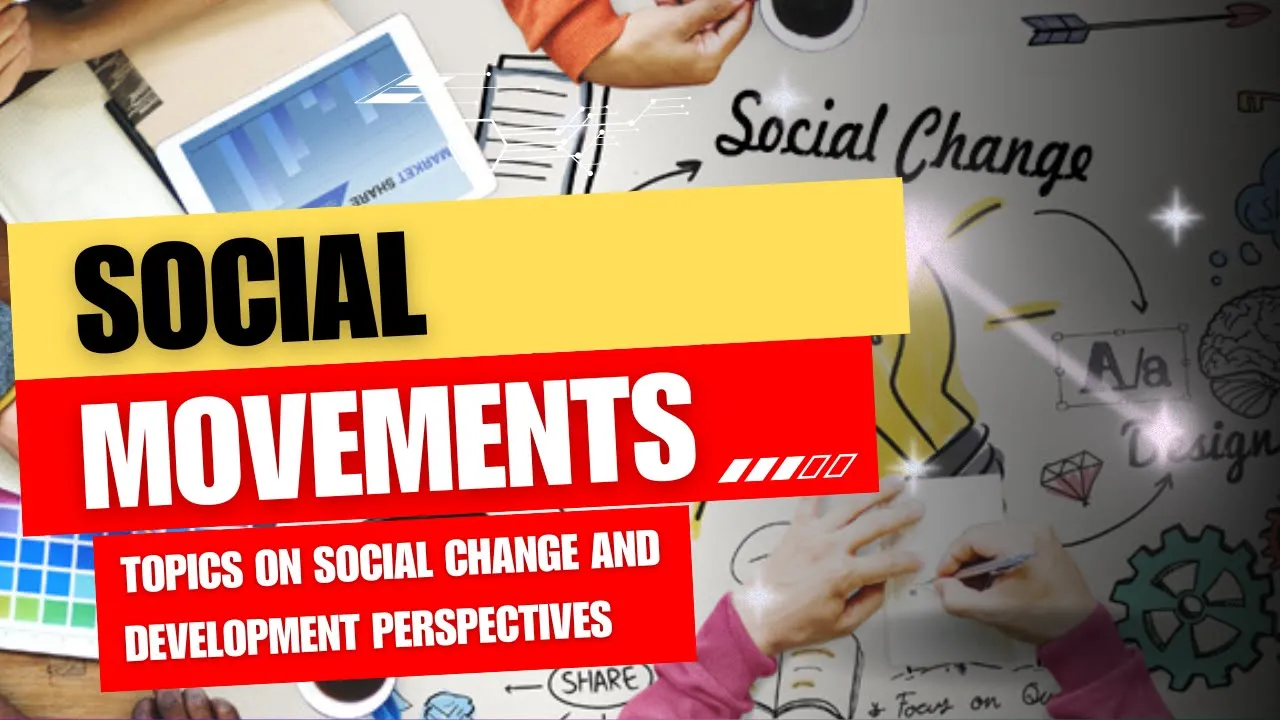



Social movements are organized groups that drive societal change through collective action, requiring organization, leadership, and resources rather than merely shared ideas; key theoretical frameworks include relative deprivation theory (which identifies three necessary conditions: perceived injustice, belief in deserving better, and feeling conventional methods are ineffective), resource mobilization theory (which emphasizes the importance of financial resources, materials, political influence, media access, and charismatic leadership), and rational choice theory (which views individual participation as a calculated decision based on perceived benefits); regardless of success or failure, social movements ultimately become absorbed into the dominant culture they sought to change, leaving lasting marks on society.
Social Movements: Theories & Impact (MCAT Psychology/Sociology) - Khan Academy
Added:Voiceover: Social movements are instrumental to changing the path of a society.
When a group of people comes together with a shared idea, they can create lasting effects by encouraging change in their society or by resisting it, both of which will shape the future of their society.
But a social movement is not just a group of people with an idea.
If that were the case, every little group with a novel idea would be starting a social movement.
No, social movements need organization, leadership, and resources if they ever hope to gain momentum and make an impact.
There are different types of social movements depending on their goal.
Activist movements are focused on changing some aspect of society, while regressive or reactionary movements are actively trying to resist change.
So, you can generally see how a social movement will form.
You get a group with a strong, shared idea that has the resources and leadership to survive and they can make a difference in one way or another.
Specifically though, it is not well defined.
There are several theories as to how and why social movements form.
One of these is called mass society theory.
Early in the study of social movements people were sceptical of the motivations of those involved in social movements.
They were seen as dysfunctional, irrational, and dangerous, and that people would only join because the social movement provided a sense of community and refuge from the meaninglessness of life on one zone.
This view point was strong during the 20th century, the time of Nazism, fascism, and Stalinism, which were social movements that result in the destruction of millions of lives.
But this theory did not persist through the century.
By the '60's, scholars took a more open look at social movements, especially after the civil rights movement, which certainly did not arise simply to satisfy a psychological need for involvement.
More recently, a few main theories have been developed.
One is the relative deprivation theory, which focuses on the actions of groups who are oppressed or deprived of rights that other people in their society enjoy.
So, if you look at the civil rights movement from this viewpoint, it is obviously a response to the inequality and oppression experienced by people of color in the U.S.
But what is interesting about social movements is that it isn't always the people who are the worst off who join up.
More important is how people perceive their situation.
Someone just scraping by can be happy as a clam because they made their dream of owning their own little corner bistro into a reality and then a person making 100,000 a year is frustrated because they don't feel like they're respected by their company.
So, what you have to look at is the relative deprivation, the feeling of discrepancy between legitimate expectations and the reality of the present.
But, that's not enough on its own.
People must feel like they deserve better and they must think that they cannot be helped my conventional means.
According to relative deprivation theory those three things are necessary for a social movement to form, a relative deprivation, a feeling of deserving better, and to believe that conventional methods are useless to help.
But there are criticisms to this theory.
Even people who don't feel deprived will chose to join a social movement.
They join because they want to address a perceived injustice that they may not even suffer from themselves.
It can be too risky for the most oppressed people to join a social movement because they may not have the resources to participate, they cannot take time off work to promote the idea.
Even so, there are exceptions, as always.
Under Cesar Chavez, migrant farm workers united to gain rights and job security.
Another issue with the relative deprivation theory is that sometimes, even when all three factors are present, no social movement is created.
OK so, it has some problems but it's a start at least.
Another theory, resource mobilization theory, looks at the social movements from a different angle.
Instead of looking at the deprivation of the people, the resource mobilization approach focuses on the factors that help or hinder a social movement.
You know, practical constraints like access to resources.
Even the seemingly simple act of gathering together a group of people with a shared idea is not allowed everywhere.
It takes more than an idea to start a social movement.
You need money, materials, political influence, access to media.
More than that, a social movement needs a strong organizational base to recruit members and then to unite them on a single idea.
A good, charismatic figure is necessary to lead the group and focus the thoughts of members and the oppressed on the objective, to convince them to organize.
Again, looking at the civil rights movement, Martin Luther King Jr. stood as a beacon to the people of color who were oppressed.
He knew how to speak to a crowd and unite them in a single idea and how to gain the support he needed for the social movement to succeed.
Then you have the rational choice theory which proposes that people compare pros and cons of different courses of action and chose the one that they think is best for themselves.
The choices and the actions of individuals who are trying to do the best for themselves shape the pattern of behavior in society.
But there are a lot of assumptions for rational choice theory to work.
You have to assume that all actions can be listed in order of preference and that all preferences are transient.
That means that let's say I like apples better than pears and I like pears better than bananas.
If that's transient then that means I have to like apples better than bananas.
It also assumes that a person has full knowledge of what will happen as a result of an action and that a person has the cognitive ability to weigh different actions.
These are a lot of assumptions, which are rarely all true.
Social movements can even affect people not actively involved in them.
Social movements can cause collective behavior like panics, where widespread, unreasoning fear causes people to act hastily, and crazes, which are like fads where something gets incredibly popular for a short period of time, like the latest craze in music or dieting.
This past year the anti-vaccine movement has created a panic that has resulted in outbreaks of diseases that were once eradicated from the developed world.
Now that we have a couple movements to toss around, it might be interesting to look at what happens to a social movement from beginning to either success or failure in the end.
In the beginning, the universe was created.
This has made a lot of people very angry and has been widely regarded as a bad move.
Wait a minute.
Sorry, that's the wrong story.
Social movements, right.
Those begin with a few ideas shared by a few.
Then, you have the incipient stage when the public begins to take notice of a situation that they consider to be a problem.
At this point, people begin to organize, to coalesce into an organized group and raise up a general stink.
A social movement's greatest achievement will be to either succeed in changing its host society, or else it will have to adapt.
What is interesting about social movements is that in the end, they become a part of the bureaucracy they were trying to change.
A successful social movement eventually gets absorbed into the existing institutions when it has achieved its desired changes.
Our entire culture and society is formed from past social movements, both those that have succeeded and those that have failed.
Even failure social movements leave a mark on their society.
The social movement Martin Luther began against the Catholic church resulted in Protestantism.
His name sake, Martin Luther King Jr., fronted a social movement against segregation, leading to the civil rights movement.
Even Nazism left its lasting mark on world politics.
In their time, each of these social movements seemed radical, far fetched, extreme.
Now, we accept Protestantism as a founded religion and we don't think twice about the right every person has to freedom and equality.
I wonder what social movements of today will become accepted thought in the future?
So, in the end, the social movement eventually declines.
If it succeeded, it has been incorporated into the dominant culture.
It if failed, it isn't active anymore, but you can still see the marks it left on society by its passing.
Up Next

Social Structures & Moral Luck | Philosophy of Human Nature
@YaleCourses
27.4K views•2012-04-05
Contemporary Sociological Theory: Micro, Macro, Integrative
@NaSESYNC
45.7K views•2016-02-17

How to Analyze Conversations Scientifically | Elizabeth Stokoe | TEDx
@TEDx
1M views•2014-12-04
What is Sociology? The Sociological Perspective Explained
@crashcourse
4.6M views•2017-03-13
Related Study Plans & Knowledge Roadmaps
Structured learning paths in Sociology