























Corals, despite being survivors of 250 million years and two mass extinctions, are currently experiencing unprecedented rates of environmental change (11 times faster than the last major ice age recovery) that threaten their survival through ocean acidification and warming. However, corals can respond to climate change through two mechanisms: acclimation (physiological adjustment within an organism's lifetime, occurring within years) and adaptation (genetic changes over generations, occurring over many years). Research at Ofu Island in American Samoa demonstrates that corals from warmer reef pools develop greater heat resistance than those from cooler pools, with approximately 100 genes differing between warm and cool pool corals. This genetic variation provides a reservoir for adaptation, potentially giving corals additional time to survive climate change, though these responses have limits.
Ocean Species and Climate Change: Coral Reef Responses | HHMI BioInteractive
Added:[music plays] [ANNOUNCER:] Welcome to HHMI's 2014 Holiday Lectures on Science.
[music plays] This year's lectures, "Biodiversity in the Age of Humans," will be given by three of the world's leading experts in the study of biodiversity and conservation biology.
Dr. Anthony Barnosky, of the University of California, Berkley; Dr. Elizabeth Hadly, of Stanford University; and Dr. Stephen Palumbi, also of Stanford University.
The fifth lecture is titled "Ocean Species Respond to Climate Change."
And now, Dr. Stephen Palumbi.
[applause] [PALUMBI:] Welcome back.
Thanks for coming back.
I'm going to talk about climate change in the oceans.
And when we think about climate change it's a global issue.
Liz and Tony have talked a lot about it a lot, and there's features of climate change in the ocean and on land that are pretty much the same, particularly at the borders of the ocean and the land where rising sea level and increased storms increasingly mean that our coastlines are pummeled by waves and the destruction of large storms like Hurricane Sandy.
And that is something that we can understand from both sides, the terrestrial and the ocean side.
Well there are a couple things about climate change that are really different in the ocean.
And probably the most important one is ocean acidification.
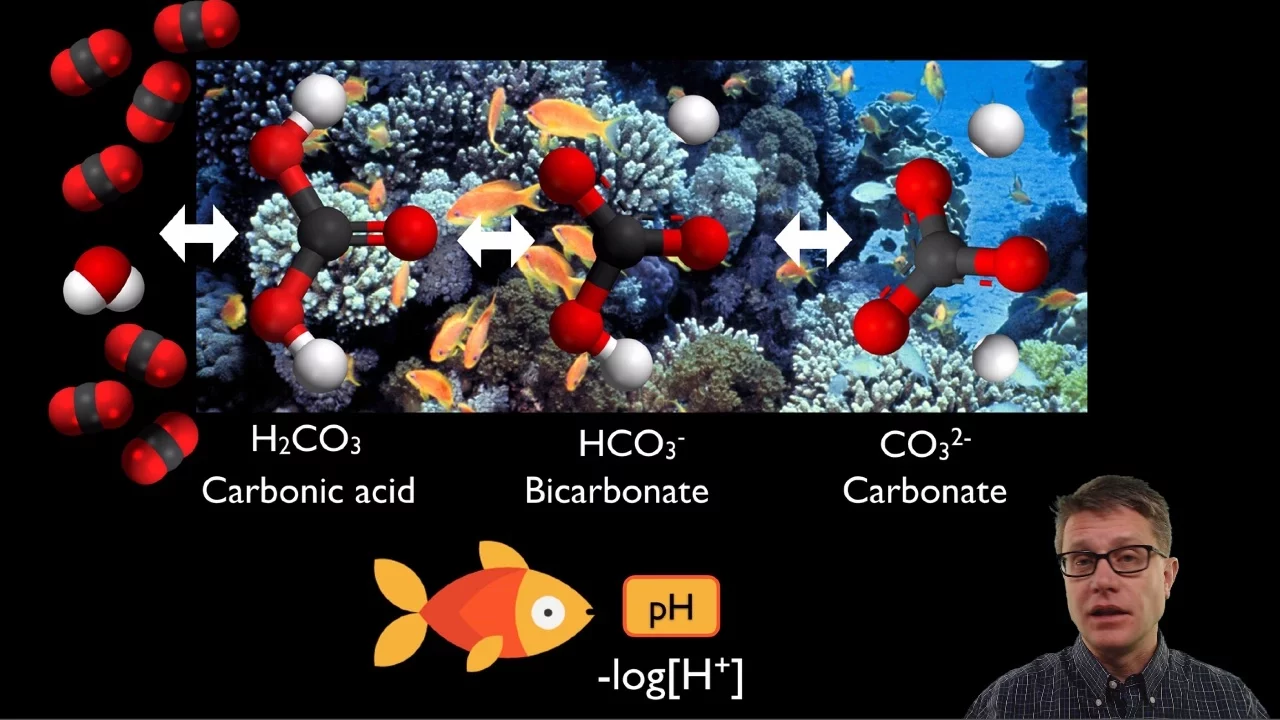
Now ocean acidification comes about because as we pump CO2 into the atmosphere, then that dissolves back into the ocean and makes carbonic acid.
That carbonic acid increases the acidity of the ocean and affects marine life.
Now I've just dropped here a piece of coral in vinegar.
Now vinegar is 100,000 times more acidic than the ocean will ever be and these corals are bubbling because the acid and the calcium carbonate are interacting to release CO2.
That is not going to happen in the future oceans because this is vinegar, but the principle is the same.
That, as the acidity of the ocean goes up, and it's increased 26% over the last couple decades, those shells--the skeletons of corals, the shells of gastropods--are harder to make and easier to dissolve.
And so that changes the way ocean life lives and our entire ocean.
Now I mentioned in the last lecture that it's the biggest biological habitat known in the universe and we're changing its basic chemistry.
Not only are shells harder to make, but actually nervous systems are harder to work.
Some really interesting research out of Australia has shown that when fish are subjected to very high levels of CO2 in the water, it changes the pH and it changes the way their nervous systems function.
They no longer evaluate the risk of predators correctly and so they leave themselves out to predation risk to a much higher degree.
Their growth rate suffers, the growth rate of many marine species suffer when acidification becomes more and more and more of a problem.
The other major threat, the fourth major threat of climate change in the oceans is warming.
Similar to on land, but what I'm going to talk to you about is how that affects particular ocean species.
This is a map from earlier this month of the Pacific.
Now the red and the dark red colors are areas of the Pacific that are a degree or two warmer than expected for this time of year, temperature anomalies.
Now those areas are washing across the Pacific.
About a week ago I was on the big island of Hawaii, which is that little spot right down there, and what we were seeing there was coral bleaching, that is we were seeing the reaction of corals to this warm water in ways that are very detrimental to the reefs themselves.
So we've got good satellite maps of what's happening out there in terms of the temperature of the ocean and what I'm going to talk to you a bit about is how species respond to that and then what we know about how they might actually survive it or not in the future.
I'm going to talk to you a lot about corals and I'm going to talk to you about how they interact with the climate and I'm going to sort of present them in at first a little bit of a sort of paleontological way, like Tony said, because in a lot of ways corals have been major survivors in our planet.
They were born as a group of organisms about 250 million years ago.
They have survived two mass extinctions, they have been major players of the oceans of the planet for most of that 250 million years.
So from that standpoint they seem like survivors, they're good at mass extinctions, they're good at all kinds of environmental change, but when we turn around we see that in fact a lot of the things that we do on our planet right now seem to be killing them.
Loss of coral cover over the last couple of decades is up to about 40%, and that's because of sedimentation kills corals, pollution kills corals, overfishing kills corals because algae grew up all over the corals, acidification slows down their growth and the temperature of the water when it goes up causes corals to bleach and die.
So here's the conundrum, they're survivors, they live through a quarter of a billion years, and they're dying now every time we do something.
What is that? How can they be so strong and so wimpy at the same time?
Well you can boil that down into a couple of different hypotheses about what might be going on, and here's two that seem to be the strong ones.
Maybe, even though they've lived a quarter of a billion years, what we're doing on the planet now is on an unprecedented scale and rate of environmental change, they just cannot handle.
Or maybe corals have really unknown abilities to survive and deal with strong environmental change that we don't know about yet that they've used to survive cataclysm's even though right now we see their numbers dropping.
So I'm going to go through these two and look at them.
It turns out they're both true.
And the fact that it's such an unprecedented rate of change is really directed our research over the last 10 years to look for how corals are reacting.
The example that we're going to use is the rate of change, Tony talked about the rate of extinction and I'm going to talk about the rate of temperature change.
What's shown here on the left-hand side is the last 150,000 years.
In particular I want you to focus on the last 20,000 years ago or so.
This is the recovery from a major ice age, the temperatures in the world increased by about 7 degrees Centigrade, so what's the rate of temperature increase in this really strong recovery from an ice age?
We draw the line, 7 degrees over 10,000 years is.07 degrees Centigrade per century.
How does that compare with the increase in temperature that we're seeing now in the world?
That's the right-hand graph that's the increase in global average temperatures in the oceans over the last 100 years or so.
We draw the same kind of line and it's.8 degrees in a century.
That's 11 times higher than that, which means that as we are changing the world, not only are we increasing the temperature, but we're doing it at 11 times the rate that occurred even if we pick one of the biggest changes of temperature in the recent history of life.
So we are having a really big impact on the world.
It may be unprecedented.
And let's go to the next question and say well okay how do corals then react when these changes happen?
I've mentioned bleaching a couple of times. What is that?
A coral animal is a skeleton with a tissue layer on top of it.
The tissue layer is generally tan or brown, but it's not because of the coral.
It's tan or brown because corals have an internal cellular symbiont, an dinoflagellate alga called Symbiodinium, and heating causes the Symbiodinium to be expelled from the corals and what you see is the transparent tissue of the coral with the white skeleton underneath, that's coral bleaching.
Well it turns out that understanding that involves an incredible integration of remote sensing in the world, ecology, the cell biology of corals, even the molecular biology of photosynthesis.
And what I want to do is take you on a little tour of that now just to see how this works.
Now corals are small animals, but they build structure that you could actually see from space.
And as we zoom in we see the reefs where I work on a little island called Ofu in America Samoa, the ridge there, the edge is the coral reef and as we zoom in we see what those reefs are.
Now the reefs are made of individual coral colonies like we see now.
That coral then is actually made up of a whole series of small polyps they're called.
This is a colonial organism, and the polyps themselves have all the structures that an animal needs.
It has a mouth, it has tentacles, it has gonads, it can live, it can reproduce, it can grow.
They're in a colony of genetically identical polyps.
Now the color on these tentacles, like I said, is not the color of the coral itself, it's the color of the symbiont, and as the focus racks in and out a little bit here, then what we see is that we can just see the little globules of the symbiont.
Well let's take a closer look.
We'll go into a tentacle and see those.
These cells, the symbionts, are not just floating around, they're actually inside the coral cells.
Corals are simple, they just have two cells layers: an epidermis and a gastrodermis inside.
The symbionts are inside the gastrodermis, and you can see it there.
Now this is a life form called a dinoflagellate.
It has chloroplasts because it's photosynthetic, but it has very odd-shaped chloroplasts like these yellow structures here.
We're going to zoom in to the chloroplast itself because that's where the damage happens during bleaching.
What do chloroplasts have in them?
They have membranes called thylakoid membranes.
Those membranes hold the proteins called the photosystems that then capture light energy and turn it into chemical energy.
It's the molecules that capture all of the sunlight that we get on the planet to make the food that we eat.
The rain of photons down here hits these photosystems and they gather them up.
Now if the temperature goes up and if the light goes up, then they freak out.
There's too much energy, the photosystems break and they no longer can function the way they do, but the rain of photon keeps going, the energy is still there, and as a consequence that energy is now turned into making reactive oxygen molecules Those are damaging to cells, so it damages the inside of the symbiont, it damages the inside of the coral cell and they spit the symbiont out.
That spitting of the symbiont out by one coral cell isn't bad, but if the entire colony does it, then that's coral bleaching.
What you can see here is simulated of the spitting out of these symbionts and the gradual whitening of this particular part of this particular coral colony.
Well when that happens across an entire colony, then the coral turns from its normal tan color into a white color.
What difference does that make?
The symbiont provides 75-80% of the energy the coral needs to survive and without that energy, it can't make a skeleton and it can't live very long.
So as a consequence a lot of the corals that bleach eventually die, then that destroys the reef in a very severe bleaching event, then many corals on a reef will succumb and take decades to recover.
Well we were interested in this process, we were interested in how corals might actually not just be affected by this, but also how we might work with different systems to try to find out what corals can do to circumvent some of these problems, or that anything they could do to survive better in the case of bleaching conditions.
We found a place to do that, which is in Ofu Island, in American Samoa, because it's one of the best laboratories for coral science that we've been able to find.
[PALUMBI (in video):] Ofu Island and the lagoon behind the reef here is one of the best coral laboratories in the world.
Because the best low tides are often during the middle of the day, these back reef lagoons heat up to an extraordinary degree for a coral reef.
They heat up to 32, 33, 34° centigrade.
That's above the temperature in which most corals will bleach and die, yet these lagoons are full of thriving, growing corals of many, many species.
So the question is how do these corals do it?
How do they live in such warm temperatures?
Because the theory is those temperatures should kill corals.
[PALUMBI:] So how do we do that, how do we work with the corals in places like American Samoa to try to understand how they're related to bleaching and heat resistance?
So this is the lab that we've built in America Samoa.
It may not look like much, but it's actually an incredibly important facility for us because we've been able to standardize the heat stress that we can apply to corals.
We can provide them with a mimic of the kinds of heat they'll get actually on an Ofu coral reef and see how they react.
So these tanks actually have heaters and chillers in them, they have lights, they have flow-through water system, they're controlled by that laptop on the right-hand side, and we can use those little tanks to mimic what these corals will see during a very strong bleaching day out there in Ofu.
What do we see? We see this.
We see corals that come out of the same tank looking very different.
The coral on your left is bleached.
It's lost most of its symbionts.
The coral on the right though is not bleached.
It came out of the same tank, it got the same heat, it's the same species.
The only difference is that, the coral on your left was living in a very cool part of the reef, but the coral on the right, same species, was living in a warmer part of the reef.
So we know from this that different corals react differently to the same bleaching temperatures.
Some bleach like they're predicted to, but some are resistant to that.
So the question that we really began to ask is how do they do that?
How do corals become resistant to bleaching?
Does it happen quickly?
Can all corals do that?
That's why Ofu has been a really important research site for this.
How would you find that out?
Well the way we approached that was by transplanting them.
Corals are really effectively great experimental animals because you can break them and you can transplant them to different parts of the reef.
These are just some corals that have been living on a different part of the reef for about two, three years.
The numbers there is the number of the colony.
We know where it's from, we can transplant them.
So the way this experiment works is that well we find a coral on the reef, we number it and tag it and measure its temperature, we take it, break it in two, and then we transfer one part to the warmer part of the reef.
We transfer the other part to a cooler pool in the same reef, let them grow for a couple of years, monitor them, take pictures of them, keep track of how they're doing, and then we put them back in the coral stress tank.
We then look to see for the same coral that has been living for a couple years in different environments how that affects their bleaching resistance.
And this graph here shows that the coral in this one colony named colony AH02 that was living in the warmer pool, that colony has a much higher resistance to bleaching than the exact same genetic colony that was living for two years in the cooler pool.
That's the blue bar there. We can do that a lot.
These are all different colonies of the same species from different parts of the reef, and every time we move them into the warmer pool they gain heat resistance, and every time we move them to the cooler pool they lose heat resistance.
It means that in fact they can acquire this trait, heat resistance, at least to some extent.
Well what is that called?
That's actually called acclimation.
So two responses to changing environments that most organisms and populations have are acclimation.
That's the adjustment of an individual's physiology to new conditions.
Now, we can do that.
For example Liz was telling you that if you move to Denver you'd have 83% of the oxygen available to you than if you lived at sea level.
And if we do that not only would we breathe a little heavily, but we'll start making more hemoglobin in our red blood cells.
That's an acclimation to high elevation.
Well the reaction that corals have to temperature is an acclimation, their physiology is changing.
But there's another way that populations can respond, that's normal Darwinian evolution or adaptation.
That's natural selection for the individuals that have the right genes for new conditions.
So these two things acclimation and adaptation are pretty common in the biological world.
We've just shown you that acclimation can happen in corals and it happens quickly, within at least a couple of years, maybe faster, within an organism's life span.
Adaptation also happens we think in corals, but happens a little bit more slowly.
It has to happen over generations.
Well how can we look at whether adaptation is happening if we don't have generations of coral life in order to do those studies?
The way we do that is because I'm a geneticist, we look at the genes that these corals have, we look at the genes that the corals have living in different environments, and given new sequencing technologies we can actually sequence most of the protein coding genes of each of these individual corals and look across about 25,000 genes for those that relate to temperature.
And we do that, we find genes that are related to temperature.
This is just one of them.
And what it shows is that individual corals living at warmer temperatures, that is time above 31 degrees here on the Y axis, those corals tend to have a particular allele, that's called B here, at a gene, whereas corals that live in the cooler parts of the reef tend to have an A allele at the same gene.
A and B allele is just different versions, different DNA sequences at the same gene, doing the same sort of thing.
But what it tells us is that the individual corals in this particular genetic locus are different depending upon the temperature they live in.
There are about 100 genes like this in corals, and they distinguish the corals living in the warmer pools in Ofu from the corals living in the cooler pools in Ofu.
A map shows that, these dots are individual corals placed on the reef that's there.
We know their GPS coordinates, we've tagged them, we know what temperatures they have seen every six minutes over the last three years.
And the cool pool corals also and these warm pool corals we know which alleles they have at each of these 100 loci.
And what I'm showing you here is that most of the cool pool corals don't have many of the warm pool alleles, some have some.
The warm pool corals tend to have a lot more of the warm alleles at these genes than the cool pool ones.
So this shows that genetically, although these corals are pretty similar to one another, they'd never be called different species because of these genetic differences, there are about 100 genes at which they differ.
Right now we're trying to chase down what those genes are and how they might act to provide heat resistance.
We also can tell that these, the whole population here has the genetic reservoir and in order to be able to adapt.
Liz was talking a little bit about this for tigers where those reservoirs may not occur in places that have high bottlenecks, but in this case in these corals they do occur.
What are the implications of this kind of work for corals and for climate change, because this is just one species in one place?
It tells us that these corals can become more resistant to climate change through acclimation and they can adapt.
We know though that this ability is limited.
They can't acclimate forever, they can't acclimate to 100 degrees.
What the limits are and when those corals will reach those limits is something we don't know right now.
It's an active area of research.
What we can say is that although climate change is coming and heat is going up, these corals can respond.
That's good news, they can respond.
It's not going to give us forever.
It's not going to solve the problem.
It might however give us a little extra time to solve the problem.
It might give us a couple extra decades say before ocean warming gets to the point where the ability to acclimate is exhausted or the ability to adapt is exhausted.
What we tried to think about for that is not that this solves our problem, but that it gives us a little extra time.
Another way to think about it is we should not waste that time because we have a little bit more time than we thought.
I showed you this picture before because there are some things you can do in the ocean to try to help the health of the ocean and help the life of the ocean.
This is an example of a marine protected area that has allowed these fish to grow large and play a different role in the community, that role is tourism here.
Now those big fish, the bumphead wrasse you can also find not only in the Great Barrier Reef, but on menus, and in seafood restaurants, particularly the lips of a bumphead wrasse you can find at very high end seafood restaurants.
They're very expensive, about $200 for the lips, that's $100 for each lip.
But the value of that fish to tourism is vastly higher because people come to take pictures of this individual fish.
It hangs out on one spot on the Great Barrier Reef and people know where it is.
They come to take pictures.
So the estimated value of this fish to that local economy is over $2,000 a year just for people coming to take its picture.
So the economy of protecting parts of the ocean is actually a lot better sometimes than the economy of using it.
What about our little island and our little corals?
Well this is the runway on Ofu Island.
It's a very short runway and not many planes can land on it.
I'm actually, from this picture I'm flying in the only plane in the Samoan archipelago that can land on that runway.
The people that live there would like the runway to be a little bit longer so more planes could land and their tourism base could go up.
So where do you think in the Pacific Ocean, the Pacific's most heat-resistant corals live?
Just guess.
You know the answer.
It's right there.
Any extension of this runway in that direction will wipe out these corals.
Now they're resistant to heat, but they are not resistant to bulldozers.
So one of the ways we can use this research is to say all right, these are areas because they are climate resistant might be good candidates for protection of these reefs.
Maybe we should protect those reefs in the future because they have the genes in order to live longer under future conditions.
The second thing we could think about doing is whether or not if we had those corals we could transplant them to other reefs close by, maybe just around the corner that are not heat resistant in order to build heat-resistant reefs into the future.
We don't know if we can do that.
We've just started that experiment now.
I want to show you a little bit of that.
These are some coral nurseries that we just put out in America Samoa this last August.
Half of these corals are from the warm pool that are heat resistant, half of these corals are from the cooler part of the reef that are not heat resistant.
We've taken over the mountain to the other side of the island and put them down there in order to be able to see whether or not they're going to grow into heat resistant corals.
We've had great help from a local Samoan construction team that built those cement pads for us and then helped us put them out there.
And the idea here is to simply see when we grow corals from these different pools in a different spot, whether they bring their heat resistance with them.
We're going to go back over the next couple of months and test these corals in their nursery state to see if they still are heat resistant.
Because of the balance in acclimation and adaptation we know they're going to lose some of their heat resistance, but we think they're going to retain about half of it.
That's our prediction Well what I've tried to do is show you a lot about the oceans, the kinds of threats they're under, the kinds of creatures that are out there, and the sorts of ways they are responding to climate change.
We also have to respond to climate change, the call here, and I'm going to repeat what Tony said, this is the century of choice.
This is where we can choose whether or not the oceans are going to basically move along with us into the future or dramatically change in the future and then drop all the services that they provide.
For me I just took that picture a month ago along the coast of Kona.
I would love for you to be able to take a picture like that in the future and let's just try to make it work that way. Thanks.
[applause] Questions? Yeah.
[STUDENT:] Are temperature-tolerant genes dominant or recessive and could changing climate affect the phenotype, make it so that the tolerant ones are expressed?
[PALUMBI:] Great question. So are they dominant or recessive?
They're what's called co-dominant, at least in the cases that we know about.
So that if you have two warm- adapted alleles, you're twice as warm adapted as if you just had one.
And if the environment changes, then what else changes is another question?
And what we find happening is when the environment gets a little warmer then actually the expression of genes changes, not just the physiology, but we can trace the physiological acclimation down to the genes that get turned on and off.
And what's really cool is that some of the alleles that are warm adapted actually are just expressed at a higher level than other genes.
And so we're beginning now to look at the wiring of all that and learn how the molecular biology of gene expression actually translates into the fitness of corals and future reefs.
That's just one of the ways that I think that marine biology and molecular biology and all of these different realms really work together.
One more question.
[STUDENT:] How can we educate people about the benefit of ecotourism versus poaching and killing these animals for profit?
[PALUMBI:] The question is how do we educate people about those benefits?
Actually it's pretty easy, you just show them the numbers because these are people locally who are gaining those values and when they see the numbers, then they say oh well let's not kill them, let's just leave them there.
So that's it for questions right now.
Thank you so much.
[applause]
Up Next

Reef Aquarium Algae Management: Nitrate & Phosphate Control
@Redseafish
57.4K views•2012-01-09
Bacterial Communication: Quorum Sensing and Biofilm Formation Explained
@JHUAAP
12.6K views•2011-06-28

Keystone Species & Trophic Cascades Explained | Ecology
@biointeractive
1.3M views•2016-05-03
Bacteriophages: Earth's Deadliest Killers and Future Antibiotics
@kurzgesagt
34.6M views•2018-05-13
Related Study Plans & Knowledge Roadmaps
Structured learning paths in Biology