


















In the Fisher-Gray model with forward-looking investment, monetary policy can affect output through expectations rather than just current actions. When policymakers make promises about future policy (e.g., increasing money supply tomorrow based on today's shock), people adjust their behavior today (e.g., investing now because they expect higher prices tomorrow). However, this creates a time inconsistency problem: policymakers may want to break their promises when the time comes to fulfill them, because keeping promises destabilizes the economy. This trade-off between making believable promises to influence current behavior and maintaining credibility to keep those promises is a fundamental challenge in macroeconomic policy.
Fisher-Gray Model & Time Inconsistency in Monetary Policy
Added:Understanding of the short-run trade-off between inflation and unemployment, traditionally represented by the Phillips Curve.
The concept of Rational Expectations, specifically how forward-looking economic agents form expectations about future inflation and policy.
The role of nominal rigidities, such as wage indexation and long-term labor contracts, in enabling monetary policy to have real effects on aggregate output.
Basic game theory concepts, particularly Nash equilibrium and the distinction between commitment (rules) versus discretion in policy-making.
The Barro-Gordon Model, which formalizes the game-theoretic interaction between a central bank and the public regarding inflation bias.
Institutional solutions to time inconsistency, such as establishing Central Bank Independence and appointing a 'conservative' central banker (Rogoff's model).
Modern commitment devices and communication strategies in monetary policy, including explicit inflation targeting and forward guidance.
The integration of time inconsistency and optimal policy design into contemporary New Keynesian Dynamic Stochastic General Equilibrium (DSGE) models.
212 views1likes46:58Original Release: 2024-04-19
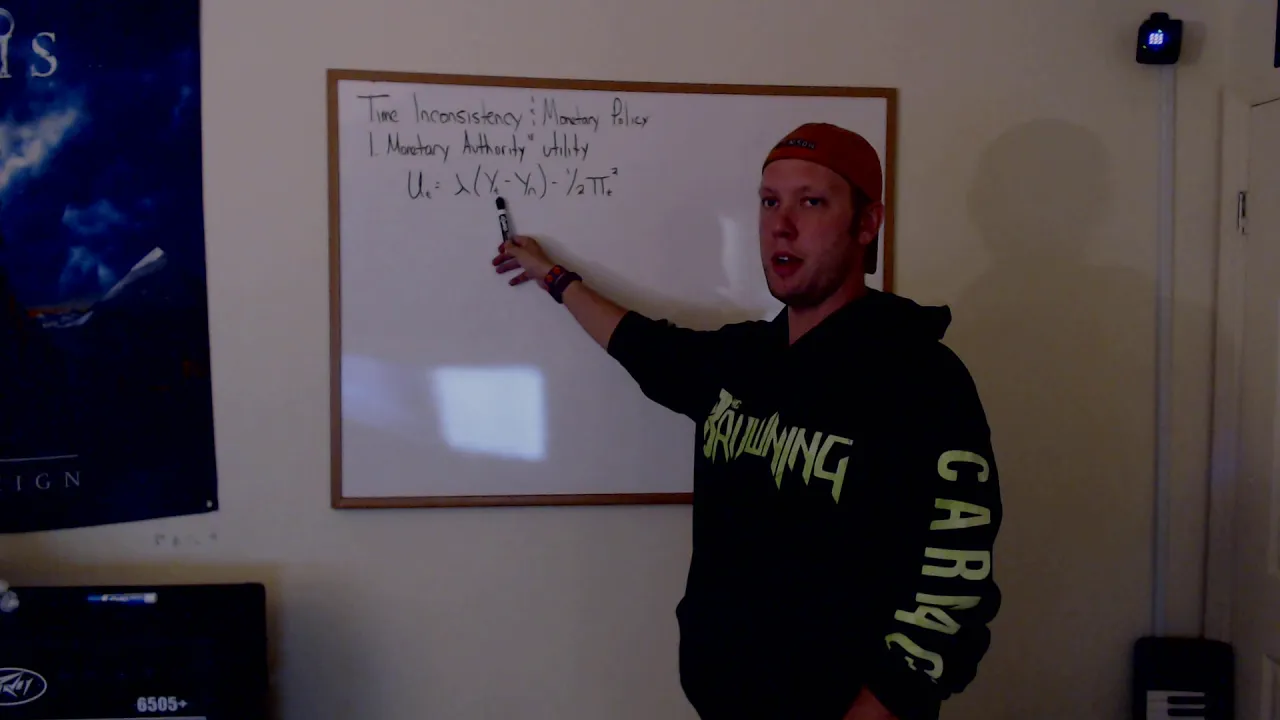
okay everybody here we are and sadly if it's not one thing it's two things as my old boss used to say I yeah this thing isn't working computer's working now this thing isn't working it's going to be something right it's always going to be something so what does it mean means we go back to writing things by hand like losers losers well not you guys mostly just me um but we have one option which might be helpful which is we can have our equations up here on the other slide way down at the end okay and here's where you we are so this thank God is intended to be the last day of Fisher gray we will move on to other things um we'll move on to International economics in particular in case you're wondering um but we got one more thing to learn and we're doing this complicated unpleasant Mankey model that we hate um I don't know about you yeah I'm assuming you hate it maybe you love it I don't know but this particular version of the model where we have if you look at the equation at the top we've got these forward looking that the Theta 2 PT Plus one given T this is investment right this is they looking forward if prices are going to go up they would like to invest now if prices are going to go down they would like to not invest now right or maybe it could be consumption as well a similar sort of thing um now that added a lot of mess right and we found R1 and R2 for our guess and we know how these things work so that's where we're at okay that's where we're at and in particular look at at this uh this is sorry this one here I need to fix that it should not be pt+ one given T it should be t pt+ one given T minus PT that whole Theta 2 term on the top so this one at the bottom right I can't point to because technology um that one the left hand side should be TP pt+ one given T minus PT itself is that so that's where we are and now we're wondering can we affect output okay now I will say to you that you will not be asked to do anything as algebra algebraically Miserable as this one and the reason for that is not that you can't like you just it's the same thing just more like way more right um it means though for like a a homework or um or an exam question it becomes did you make an algebra error rather than did you understand what you're doing and we're really looking for do you understand what you're doing not do you make a a sign error or you know or something right that it's not a math class you need math but it's not a math class we're not looking for now obviously it's better if you do your algebra correctly but if you give enough algebra to anyone in a stressful time limited environment they're going to make a mistake somewhere along the line and that is not useful in a test environment it's not useful as a thing to stress about in your life either um but I do want to show you this because it gives us a new story right um and you can see the messiness um and that messiness is one of the things that we're going to learn out of this that are nice simp clean model you might not believe it but it was simple and clean and nice is now all of a sudden Mankey and unpleasant when we've added this term and that manness and unpleasantness is going to have an economic interpretation which we're going to come back to in a little bit okay so it's it's not the math is actually telling us that there's some messiness going on and we'll be able to see that in a minute okay so what we want to do is we want to find what YT minus y bar is given this and can we see stuff over on the left hand side we can okay that's that's one plus of this technology we can have them side by side glorious glorious that's beautiful okay so we just need to plug these things in to our little equation there yeah good luck with that um let's do it let's do it so what is if I can find a pen always nicer two pens of different col colors ever so slightly different colors so what do we get we get um YT minus y bar and I'm going to do everything in terms of R to begin with because once we bring in what RS are life is hard right so let's let's do everything just in terms of r at the beginning so YT minus y bar is going to be equal to Theta 1 times whatever this over here PT minus PT given T minus one is which we know that's going to be R1 * e right and then it's going to be plus let me put this in parentheses so it makes it a little clearer parentheses times p t + 1 given T minus PT which is that whole thing down on the sort of right hand corner lower right hand corner so that's going to be what R2 minus R1 e t minus R2 e t minus one so there you go okay so that's what it is and we have what R1 and R2 is we just plug all those things in and let the Glorious happenings happening um let me put all the ET terms together all the ET minus one terms together so in particular we've got an ET term here we got an ET term there so YT minus y bar is equal to Theta 1 R1 ET plus Theta 2 R2 minus Theta 1 R1 all that times ET that's combining all the ET terms and multiplying this bit out and then it's going to be minus R2 Theta 2 e minus1 right those are ET terms there's e minus one terms we put them all together and now we can if we're so inclined and meristic we can can write what those are um this is probably easier to write this way do I have a minus problem it should be okay one all's not canel out yeah I'm wondering do I have a problem Theta 1 R1 do I have minus this should be Theta 2 R1 because it's coming from here right Theta 2 R R2 right that looks right right does it match yeah there there now it's matching so we get Theta 1 minus Theta 2 R1 plus Theta 2 R2 Epsilon T minus R2 Theta 2 Epsilon tus1 you can see there's loads of places that go wrong in algebra right loads um but there we go we got the thing okay now I'm just going to plug in what R1 and R2 is and I'm not going to do a whole lot of simplifying because life is hard enough right it's truly hard enough but but if we were like really doing this and we were writing a paper with it we really analyzing it we'd simplify it this way we' simplify it that way and see what interpretation we can get but we're just going to put down what R1 and R2 are in here so I get YT minus y bar is equal to whole bunch of stuff times ET so we're going to have Theta 1us Theta 2 * R1 and R1 is a whole unpleasant thing which is see I have it do I have it written down there yeah well let's see if I write it down the same way that would be nice 1 minus Theta 2 minus Theta 2 plus Theta 2 gamma lots of different ways to write this of course over 1 minus theeta 2 1 + Theta 1 minus Theta 2 all that time e t minus Theta 2 * R2 which is just going to be plus Theta 2 gamma over 1us Theta 2 on T minus one right yeah there we go so we've solved it now we could simplify we could screw around with it to our heart's content oh yeah R2 R2 is ah over here oh in the first yes you are so right you are so right plus Theta 2 and R2 is minus gamma over 1 - Theta 2 all of that goes in there as well absolutely thank you okay simple we're not going to do it we're not going to do it but what are we looking for we are looking to see whether the policy variable has any effect on output well we can see it all over the place right we got policy variable is gamma there it is there it is there it is it's all over this unpleasant thing right so monetary policy is going to affect output and it's going to affect output through Epsilon T it's also going to affect output through Epsilon T minus1 and remember in this model if we hadn't had that Theta 2 bit the part with the forward-looking investment stuff if we just had YT minus y bar is Theta 1 times the price prediction error right the the standard wage thing there would be no effect of policy on output right because the the central bank doesn't have any Superior information to people when they're setting their wages so the the central bank will be able to affect prices by increasing the money supply but it will not be able to affect output because no one's going to be surprised by their behavior because they're using the same information that everyone had when they set their wages but now that we have this second term in the YT minus y bar equation now that we have that now we have investment being forward-looking or consumption being forward-looking all of a sudden we can affect output and in like a really complicated messy unpleasant kind of way like it's not straightforward the way it has been up until now it's showing up here it's showing up there all of a sudden ET matters all of a sudden ET minus one matters neither one of these mattered before now they both matter what the heck right no like what it's not the same as what we had before it is a new reason why policy can affect output that we didn't have without this term okay okay what do I want to talk about this so we can do a couple of thought experiments so this is our our conclusion but let's let's think of examples okay so these are just thought experiments this is the conclusion this is this is the solution but we want to understand it as best we can without spending the rest of our life trying to simplify it in five different ways but we can think about some extreme cases and this is the usual thing in economics right we have this equation this is the general thing but let's think about some extreme cases and see if we can learn anything from them so one extreme cases we we could have is if Theta 2 was equal to zero right is the investors just aren't important right that's the the model we had before but we can see that what we get we get YT minus y bar is equal to what well if Theta 2 is equal to zero we get Theta 1 times this is all one 1us Theta 2 over 1 plus Theta 1 e t right that's just putting setting in here all the Theta 2 is equal to zero and then plus 0 e t minus1 gamma is not there so if that second term in our assumed equation was Zero then policy would have no effect on output it's just what we had before but it's seeing that look this it's really coming from this sta too this fact that investment affects output another um another thought experiment we could do if we can get everything in problematic now let's make this page one let's get this at the top like so H2 and our next example we'll have Theta 2 is not equal to zero so we're in the general case again but gamma is equal to zero then what do we get we get YT minus y bar is equal to Theta 1us Theta 2times 1us Theta 2 2 O over 1us Theta 2 1 + Theta 1us Theta 2 all times e t right so here we have no policy response at all or we just let that monetary policy be totally passive ET minus one doesn't affect output at all yesterday's shock does not affect output okay yesterday's shock affecting output is coming only because we have a policy that we're doing we're being have it active monetary policy and on and this how well today's shock is going to affect output in a complicated unpleasant way but it's going to affect output right and why does it affect output just to to to get an idea well if if we have a shock today that means today's prices are high right we have a shock today we have high prices that means that our expected future increase in prices is small right if on the right hand side very top left hand corner if the PT goes up this PT Plus one given T minus PT that goes down right and so if I have a shock through this Theta 2 term that's going to decrease output okay but if I have a shock today that's going to affect prices that's going to affect it's going to affect today's prices through the wages as well right so the whole thing is unpleasant and messy but importantly when Theta 2 when gamma is zero when policy has is not active at all we just say we leave the money supply the same there's a complicated model I don't want to mess with it life is hard let's just let's just like don't screw anything up keep money supply the same then today's shock is going to affect output complicated unpleasant way um yesterday's shock won't and there we are but when we start playing around with with with gamma we have gamma that's different from zero then all of a sudden yesterday's shock starts to matter and it can affect tomorrow's shock right right so one thing we could do if we wanted to is we could set gamma to totally get rid of this shock right so another example of the ET shock we could do that just saying okay what gamma makes this thing equal to zero that would be 1 - Theta 2 + Theta 2 gamma equal to Zer right if we could do that then this whole oh we also have this one over here I know it's more complicated than that let me not do the math for it let me not do the math for it I forgot about this term yeah it it's messy enough that we don't want to do it it's a distraction um but we could we could pick a Theta 2 we could pick a gamma so that that whole thing is reasonably close to zero can we get zero probably we can get zero yeah we could get zero pick it so that it's equal to zero and then that's lovely we have no shock we've totally stabilized the contemporaneous shock but we're obviously going to screw up the shock from before so if we're passive in our money supply yesterday's shock won't matter but today's shock will if we're really active in our money supply right to get rid of today's shock we're going to destabilize things in terms of yesterday shock so we have a trade-off between the two we cannot fully stabilize output because it's it's affected by yesterday shock and and today's shock um and we have to balance those two things out to stabilize it as much as reasonably possible okay so why why why what's going on here so let's look look there's a slide and everything and maybe maybe just maybe I can get so I can point at this thing okay can it work yeah sort of pointing not quite okay well we'll Point as well as we can right so what do we got um let's let's get this Ah that's why so even with rational expectations and no Superior information we are able to can affect output right and why is this happening it's not because like if we do nothing then the current shock affects output we can change that and we're doing that not because our money supply is is really going to our money supply is based on yesterday's information right ET minus one but that means tomorrow's money supply is going to be based on today's information right so all of this term up here all of that term at the top this one here right all of that ET term is coming because we're making promises right we're we're making promises that in the future we're going to increase the money supply people see today's shock they see it's high and we promis them that we are going to increase tomorrow's money supply based on today's shock so now they know they see today's shock is high they know that we're going to increase money supply tomorrow and they can build it in so we're making promises to them about about how our money supply is going to behave and so then if we're increasing the money supply that means prices are going to go up tomorrow which means it's worth investing now so that promise that prices are going to go up can cause people to invest now so they see the current conditions they see the the ET shock we can't do anything about that but we can say based on today's shock tomorrow I will increase the money supply and so they'll say tomorrow prices are going to be high therefore I should invest now okay so it's these promises of future policy action that are getting getting out getting money money supply to affect output not the action itself but the the future action the promises of the future action however we have this thing and I can't Point here life is so hard we can't point over here oh I can point like physically like the oldfashioned way oh life is good over here we have let me get rid of this we have this thing right if we start making those promises that is set gamma different from zero if we start doing that we're destabilizing output today right because we're trading these off and and that's because when tomorrow comes like think we made this promise I'm going to increase the money supply I did that so that people would invest now okay yay they invested now then I get to tomorrow well maybe I want to increase the money supply maybe I don't but I can't if I'm going to keep my promise which the model assumes then I'm going to be increasing the money supply then whether I want to or not and that's why we get this destabilizing bit here as we try to stabilize this we destabilize that because yes we can get people to do things by making promises to them but we're not always going to want to keep those promises and our promises are based on yesterday's days shocks and getting people to do things are based on well we're going to do things based on today's shock right so this bit here is keeping our old promises and this bit here is the effect we can get by making promises so and this is so we get this tension between these two things we try to keep our old promises we're going to destabilize things but making promises can get people to do stuff today and this turns out is a General problem in macroeconomics um and this this problem is called time inconsistency it's not just actually a problem in macroeconomics it's a problem in life um the way it was explained to me was by my my old Professor well he was old probably my age and and also um he was a former Professor right way back back in the day he's trying to explain timeing consistency and he has this problem that his daughter just got into Stanford University now we were going to San Francisco State so we had no sympathy sympathy for that poxy daughter but anyway she's go she got into Stanford and good for her anyway so he he's kind of bragging about his daughter and but he has this problem Stanford's very very expensive right and so what he wants is he wants his daughter to work in the summer to help pay a little tiny bit of that at least to show like some kind of gratitude for the sacrifice anyway so this is what he wants and so he says to her I will pay for you to go to Stanford if you during the summer right perfectly reasonable and then of course what does she do she doesn't work during the summer she Goofs off she has a good time like loads of draw I don't know what she did she's doing whatever she's doing she's living her life but she's not working and what does he do he pays for Stanford because like first of all that was a very small amount and secondly you're not going to give up your your daughter's chance of going to Stanford just cuz she's an idiot for one summer right it's fine and so this is a Time inconsistent problem in inconsistency problem right the idea is if you can make a believable promise then you can influence people's behavior right if I promise you 10 million euros next year that's going to and you believe me I fool you but like if you believe that I'm going to give you 10 million euros next year that's going to change your behavior today right um and so if I can make a believable promise that will change your behavior and here our believable promise was next term I'm going to increase the money supply or decrease the money supply and if you buy that that I'm I'm making this promise and you think I am going to increase the money supply that means prices are going to go up and you're going to invest if you believe that I'm going to give you 10 million EUR next year you're going to go on a big vacation and and you're not going to work and and all that stuff right if I tell you um so if it's a believable promise it's going to influence your current actions of course Dan ventel my old Professor his problem was his daughter didn't believe him because she yeah it's kind of a promise it's kind of a threat you know it's a threat to say if I don't work you're not going to send me to Stanford well it's a lie everyone knows it's a lie and so it didn't affect their behavior um poor Dan right so if we can make a believable promise it can influence people's actions however when it comes time to fulfill even if fulfill is spelled incorrectly if it comes time to fulfill the promise um it can sometimes not be a good idea to do so like you might not want to right and that's what we're getting over over here right this promise of gamma that the promise that we're going to base tomorrow's price tomorrow's money supply and therefore tomorrow's prices on today's shock that can get people to invest or cut back investment depending on whether we want to get invested higher or lower right but we get this it ends up destabilizing the promises the these are the promises that we're trying to keep from last time right and so there's the trade-off between the two and of course in in in my professor's problem it was not optimal to follow through on his his promise not optimal clearly you know if if she did it it would have been fine but the fact that she didn't do the the the work meant that it wasn't op to to fulfill that promise um and so then we have this whole problem about how believable are promises and we know that expectations are crucial Central to macroeconomics right investment consumption all depend on people's expectations of the future people's wage contracts short-term contracts for other inputs all of these things depends on people's expectations of the future and all of it can have major effects on output in fact probably the biggest most most influential thing about where do business Cycles come from is based on expectations right and so we need to deal with expectations and then people we need to say well what are people's expectations of policy because we think policy can affect output and people's expectations are important they need to form expectations not only of the world but also about what we're going to do right and that involves two components it involves what we're actually going to do and how well they can predict what we're going to do and are we going to follow through on that right and here in this model we've always had promises being entirely believable right we say this is the rule we're going to follow this Rule and we're assuming that throughout okay um but in fact now we see that there are times when maybe it wouldn't be what we would like to do is we would like to say tomorrow's tomorrow's money supply is going to depend on today's shock and we would also at the same time like to say forget about yesterday's shock we're going to ignore that right we're not going to but but if we do that if we ignore yesterday's shock then they won't believe our promises for tomorrow's shock and so the believability of these things is a real problem and this also is a problem not getting me in the shot so this is why we've been doing rational expectations right it says that we we have to sort of have a rule and because we need to have a systematic way about saying how do they predict policy well they must base it on our actions in some way um but of course in real life it's messier than that um now because of the these things it's always tempting to say well like there there's a lot of good reason why policy makers should lie to people like suppose we're in in a recession and things are bad but what we want to say regardless of what we actually think is tomorrow everything is going to be great so start spending now right because if they start spending now that's going to take us out of the recession right same we say tomorrow we're going to increase the money supply that's great we've made the promise if people buy it if they buy if they believe what we say that can affect output now right but if we're in the habit of saying everything's going to be great tomorrow even when we know for sure that it's not going to be well people are going to think we're liars and they just W we'll ignore everything we say so there's this tradeoff between sort of a a one-time benefit of doing doing something versus creating a reputation for being believable right and these days the the trend in in macroeconomics and certainly in monetary policy fiscal policy involves politicians more so it's it's less clear but in in monetary policy is to try to get a reputation for being believable and there's a number of reasons for this one one their policy can have these effects like now we can stabilize these shocks we can play around with investment because people believe us when we say we're going to do something and so that's helpful um and also there's this trouble like if they don't know what they're we're going to do like if we have a reputation for lying or you know shading the truth or just not being being clear um then people are still going to have expectations of our Behavior like it's not like we can stop them from from trying to figure out what we're doing they're going to do that right but then we're not believable or we don't communicate with people then they can make up any old thing in their head that they want right because they they have to figure out what policy makers are going to do well they could do this they could who knows what they're going to do we can come up with any goofy thing and that itself can destabilize the economy right we all think just of our some guy wrote on a Blog somewhere uh money supply is going down they're going going to raise the interest rate and we all think ah recession is coming and then all of a sudden we stop spending and indeed recession comes okay and if they there's if they come out and say no no no we're not going to do that if they have a reputation for not being trustworthy for for saying all kinds of goofy stuff then we're going to ignore them and we're going to go into recession right because if they're not being consistent if they're not being being forthright with what they're doing we can have any expectations of what they're doing what whatever and that itself can destabilize the economy right so we say you know this before when we started with the Keynesian model we said look if I think there's going to be a recession next year I think I might lose my job I'm going to stop spending and that expectation can cause a recession in and of itself okay that's still possible we can't can't solve that problem entirely but now there's a whole another reason I might take I I think you know everything's going to be fine next year except I think the central bank's going to be a goofball and it's going to to increase interest rates okay and now I have a whole another reason to to send the economy into a tail spin and so the trend in in policy makers these days for the last 20 years or so maybe 25 30 years for a while like it's been growing and it's becoming stronger is to say we have to communicate clearly with people what we're doing in kind of a this is our general approach to what we're doing this is what we intend to do this is what we intend to do in three months so you'll you'll see statements of of the sort like the central bank is raising the interest rates by two basis points and we are intending if things continue on to raise it a further three basis points in six months we're going to raise the interest rate now and we're going to raise the interest rate again in 6 months they're trying to communicate a promise so that we take behavioral action now and for the central bank this is particularly important um because without believable promises it takes ages for their actions actually to have an effect right we can say okay the Central Bank say wants to raise the interest rate right and so it has to cut back on the money supply right so what do they need to cut back on the money supply they need to sell something they're selling government bonds they're taking in the money they earning it and then through the miracle of the money multiplier that has a much bigger effect right and so they can change the money supply by quite a lot and that can affect interest rates however we say yeah yeah yeah it's done except it's not really that whole process takes forever right so what do they do they they sell these government bonds they burn the money now Banks find themselves in a shortfall they don't have enough Reserves because all that money went out to buy these government bonds so now they have to raise reserves how do they do that well when people pay back their loans they just keep the money and they don't loan it out again right and then there's less money in the money supply and it goes through multiple rounds of this but all of that takes time it's not like they instantly readjusted the reserves right it takes time for people to pay back their loans that's going to affect the next round of loans that's going to affect the amount of money people have right now we cut back on our loans that means that people don't have money that they otherwise would and therefore etc etc there's a whole multiple rounds of this thing all of that takes time right and so in practice if if sort of the principles version of how money supply works if that was all that was going on the mon monetary policy would be really really slow right not maybe as slow as fiscal policy I made a big song and dance last year about how slow fiscal policy was but pretty slow just the same right because this money multiplier would take ages to happen because it involves Banking and multiple rounds of borrowing and lending right and each round is going to take time there's actually somebody who has to borrow the money they have to be evaluated they need their credit score they need to fill out a form and that multiple rounds going to take ages right um and so you could think okay we're going to change the money supply but that that changing the money supply is going to take 6 months a year to actually happen in full okay a large chunk of it would happen in 6 months but that 6 months where the interest rates didn't change because we didn't really fully change the money supply therefore investment didn't really change and therefore output wasn't affected right and the investment itself is going to take time and so all of that means that we're going to be very slow okay but if we can make believable promises and people believe these promises if if we've developed a reputation for trust TR that when we say we're going to do things if nothing comes up in the meantime we actually do do those things then we can say we can go out on the steps and say we intend to raise interest rates by 2% oh my God that's huge they're going to raise interest rates by 2% and then all of a sudden we haven't done anything yet and this whole money supply thing is going to take a while but people realize if they believe us that we are going to raise interest rates by 2% and in fact interest rates will go up pretty dramatically right away okay so if we're believable if they know what we're doing and they they trust that what we're doing we can make these statements and that will affect interest rates right away and therefore we can have an immediate effect on things or a much quicker effect on things okay and so there these days they go to Great Lengths to be believable they're not always are you know they're humans and and but they they try to communicate what they're doing much more clearly for just the reasons that we've seen here so this brings us to the tailor Rule and the tailor rule is sort of the Baseline Way That central banks have been operating for the last 20 years or so now no Central Bank actually follows the Taylor rule literally but they all are have some variation you know they don't tell us how they're deviating but all the talk is in terms of the tayor rule and I want to point this out can I point not really that's sort of point because this is very similar to what we saw in the Fisher gray model it's not exactly the same but it's very similar and that's not an accident the Taylor rule came out of these sorts of models right so it's it's this sort of thing and it's saying hey won't do the money Supply but we'll we'll Target interest rates you say what interest rate should we have and we know that if we control the money supply we can control the the interest rate so what interest rate should we have okay and this is saying the real interest rate that is okay this pointing thing is problematic for it T minus Pi T man ah because I'm over on this gotcha okay there we go who knows why so it T minus Pi T right that's we subtract the pi so in the interest rate minus inflation that's the real interest rate so how much do firms actually pay in real terms when they borrow that's equal to some Target real interest rate our star and then we're going to vary the interest rate based on on how far we are off from an inflation Target that's iar and how far we are off from an output Target and the output Target is just you know potential output okay and so when the the when when output is high we are going to raise the interest rate in this linear way and when output is low we're going to lower the interest rate to try to get investment going okay when inflation is high we are going to raise the interest rate again that's cutting back on the money supply right so we raise the interest rate we're cutting back on the money supply and that reduces inflationary pressure this is the idea um the important thing for us is first of all it's it's hugely influential and this is kind of the Baseline that where they start their discussion from in central banks these days um but also the fact that it's talked about so much and it's the Baseline and and all of that has very much a flavor of what we are doing in monetary policy you can think of those out a as gamma right gamma on the pi gamma on the AY these are how we're going to respond to shocks how we're going to respond when output is too high and we're giving people not exactly but pretty close we're communicating this rule to people and people know they they observe our behavior and they try to figure out how how closely we're adhering to this and if we do this year in year out we get a reputation for doing this and therefore our promises become believable and therefore we can we can affect output when when we want to right okay now we can throw it all away any time by renting on our PR promises and being unpredictable and if there's not a good reason for that people won't believe us in the future what does this mean so you think for example we're going on like this more or less okay in the early 2000 and then the Great Recession hit and the whole world economy went into the toilet and they they said well we're not following the old rule we're going to do some special stuff and that didn't really ruin people's reputations the way you thought it would because this is clearly for normal times it's not for exceptional craziness and so people say it's fine and people they didn't seem to lose a lot of of credibility from that but if on any random year output is down a little bit and you start say let me just increase the money supply more than I kind of implied that I would then your future implications aren't really believable anymore right so it's always a fine line between this time and consistency problem about you know building a rep reputation for being trustworthy and predictable versus what I can get out of it now if I Rena my P past promises okay this is a theme throughout macro economics is particularly important in in Central Banking and these days Central bankers are trying not maybe to the best of their ability but they're trying very much to be predictable and semi-transparent in the sense that they make announcements about what what interest rates what the money supply is going to be in the future and largely but not always more or less keep those promises so they get a reputation when they say interest rates are going up people believe that and and raise the interest rates so and again even if if the central bank I want to emphasize this one more even if they're not actually following a rule right or even if they don't communicate a rule we will try to figure out how they're behaving so it's not like they cannot have a rule right they can say they don't have a rule and their rule might be flip a coin every Tuesday but flipping a coin every Tuesday is a rule so that they they are going to be second guest right and so it seems better to be predictable so that those second guesses have some basis in reality and stability rather than those second guesses being any old random thing that could possibly happen Okay so how are we doing okay so this is this is perfect this is the end of Fisher gray that's all we got um you will have another practice problem for Fisher gray um but because you have to be able to do it and all that but we are going to start International economics next time so okay have a good weekend 30
Up Next

96:28
Gold Standard Debate | Ebeling vs. Barsky Economic Analysis
@LibertyInOurTime
1.4K views•2012-03-19
5:07
Impact of Yuan in Indo-Russian Trade Amid Sanctions
@WION
261.9K views•2022-07-01
10:33
Behavioral Economics Explained: Rationality, Nudges, and Risk
@crashcourse
1.1M views•2016-03-12

113:18
The Age of Easy Money: Fed & Inflation | Full Documentary
@frontline
21.2M views•2023-03-15
Related Study Plans & Knowledge Roadmaps
Structured learning paths in Economics
economics
Sovereign Debt: Defaults, IMF & Restructuring
01Introduction to Sovereign Debt & Government Bonds
02Debt Sustainability & Credit Ratings
03Anatomy and History of Debt Crises
+ 2 more learning modules
12h5 modules
Explore Roadmap
economics
Market Design: Matching Theory & Gale-Shapley
01Introduction to Market Design and Price-Free Markets
02Two-Sided Matching & The Gale-Shapley Algorithm
03School Choice Systems and Mechanism Design
+ 2 more learning modules
10h5 modules
Explore Roadmap
economics
Impossible Trinity: Forex, Capital & Policy
01Introduction to Monetary Policy and Central Banking
02Exchange Rates and International Capital Flows
03The Mundell-Fleming Model
+ 2 more learning modules
8h5 modules
Explore Roadmap
economics
Healthcare Economics: Market Failures & Systems
01Introduction to Healthcare Markets and Market Failure
02Asymmetric Information and Adverse Selection
03Moral Hazard and Insurance Design
+ 2 more learning modules
12h5 modules
Explore Roadmap