Atmospheric Chemistry: Cycles, Aerosols & Smog
Learning Goal: Students will master the core principles of atmospheric chemistry, including the thermodynamic and physical structure of Earth's atmosphere, the kinetics of photolysis and radical-driven oxidation, the biogeochemical cycling of greenhouse gases, the formation and catalytic destruction of stratospheric ozone, the chemical pathways of tropospheric smog and acid rain, aerosol nucleation and cloud droplet activation, and modern air quality monitoring and mitigation technologies.
- Prerequisites: General college-level chemistry (thermodynamics, chemical kinetics, and basic molecular structure).
- Estimated Study Time: 18 Hours
Module 1: Structure and Composition of the Atmosphere
Module Overview
This module establishes the physical framework of the atmosphere. You will study how Earth's atmosphere is organized into distinct vertical layers—the troposphere, stratosphere, mesosphere, and thermosphere—governed by unique temperature profiles and pressure gradients. You will explore physical chemistry concepts such as hydrostatic balance, the barometric law, and the dry adiabatic lapse rate, which collectively dictate how gases behave and transport vertically.
Recommended Videos
Why this video
This video provides a highly visual breakdown of the structural boundaries of our atmosphere (tropopause, stratopause, and mesopause). It introduces the physical rationale for why temperature decreases with altitude in the troposphere (due to surface heating) but increases in the stratosphere (due to solar UV absorption by ozone), establishing the structural backdrop for all subsequent chemical modules.
Why this video
Presented by a leading atmospheric scientist, this academic clip introduces the quantitative relationships of the atmosphere's vertical profile. It specifically details the adiabatic lapse rate (6–7 K/km) that regulates air parcel buoyancy, thermal inversions, and vertical mixing within the troposphere.
Why this video
This concise video highlights the exponential drop in atmospheric pressure with height, illustrating why 80% of the atmospheric mass is compressed tightly within the troposphere. It provides immediate visual intuition for barometric pressure profiles.
Knowledge Checkpoint
- Sketch the temperature profile of the atmosphere from 0 to 100 km, correctly labeling the troposphere, stratosphere, mesosphere, thermosphere, tropopause, stratopause, and mesopause.
- Explain why the stratospheric temperature gradient is positive (warming with height) while the tropospheric gradient is negative (cooling with height).
- Calculate the pressure at an altitude of 12 km using the barometric law, assuming a scale height of 8 km.
- Define the adiabatic lapse rate and describe how a temperature inversion suppresses vertical air mixing.
Module 2: Fundamentals of Atmospheric Chemical Reactions
Module Overview
This module explores atmospheric kinetics and photochemistry. You will study how incoming solar radiation initiates chemical transformations via photolysis, and how the highly reactive hydroxyl () radical acts as the "detergent of the atmosphere."
                      hν (λ < 310 nm)
        O3 ─────────────────────────────> O2 + O(¹D)
                                             │
                                             │ + H2O
                                             ▼
                                          2 •OH (Atmospheric Detergent)
We will explicitly address the tropospheric lifetime and the detailed radical cycle initiation/termination involving and radicals.
Missing Video Deep-Dive: Tropospheric Radical Cycling & Lifetimes
Because online introductory videos often overlook the rigorous kinetics of the radical cycle, read the following formulation carefully: Tropospheric oxidation is dominated by a catalytic loop. The cycle is initiated by the photolysis of ozone by shortwave UV radiation (): A small fraction of these excited oxygen atoms () escape collisional quenching with or and react with water vapor to yield hydroxyl radicals: The radical has an incredibly short lifetime (typically ) due to its high reactivity. It oxidizes carbon monoxide () or methane (), propagating the radical cycle by yielding hydroperoxyl () or alkylperoxyl () radicals: In a clean atmosphere, termination occurs via radical-radical self-reactions: In a polluted atmosphere containing nitrogen oxides (), propagation dominates as reacts with to regenerate : Termination in high- environments occurs primarily through the formation of nitric acid:
Recommended Videos
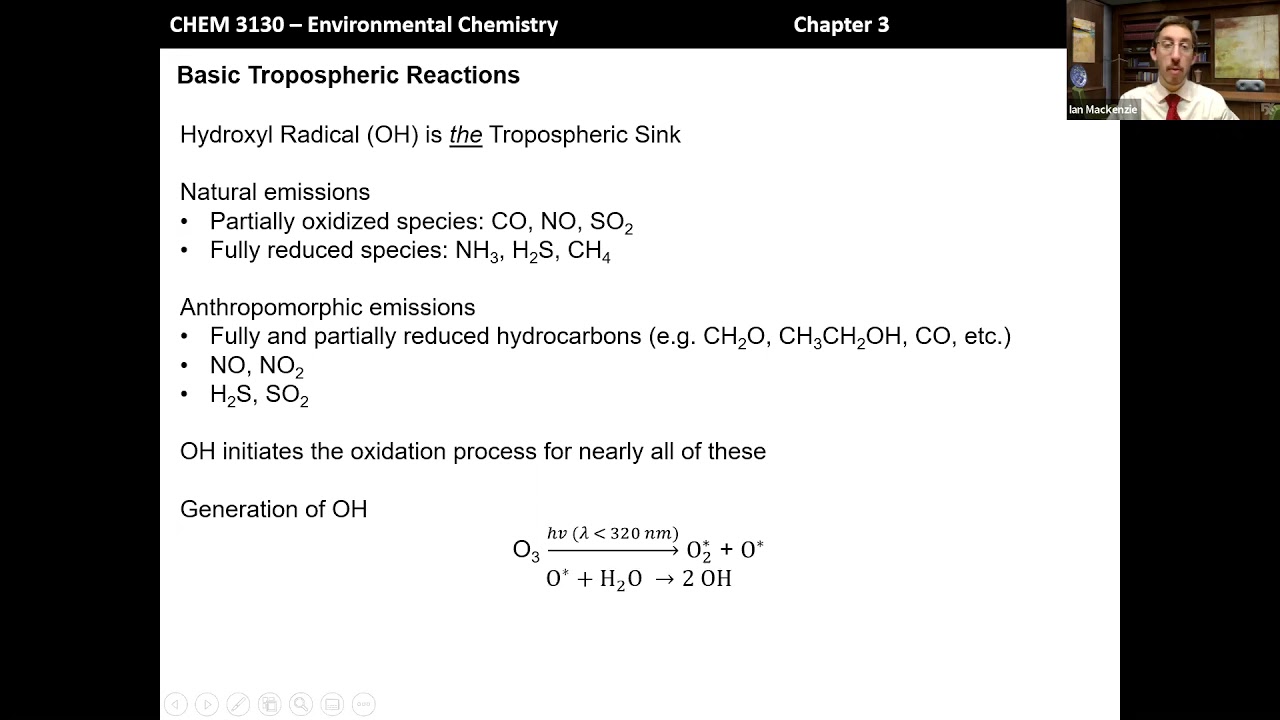
Why this video
This academic video introduces the oxidative role of the hydroxyl () radical in the troposphere. It details how the radical acts as a critical chemical sink, initiating the breakdown of volatile organic compounds and methane.
Why this video
This lecture provides the thermodynamic framework for atmospheric sinks. It explains how chemical lifetimes are determined by steady-state kinetics and the absolute abundance of primary oxidants (like and radicals).
Why this video
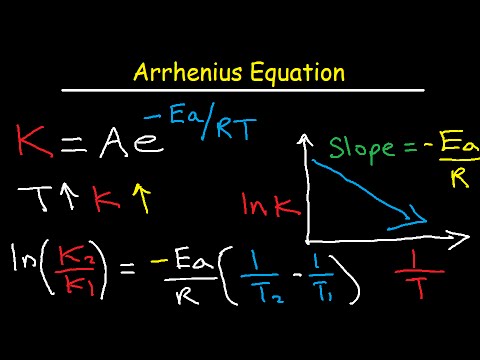
Atmospheric reaction rates are highly sensitive to the extreme temperatures of the upper layers. This tutorial introduces the Arrhenius equation (), which is vital for calculating temperature-dependent rate constants in the upper troposphere and stratosphere.
Knowledge Checkpoint
- Write the step-by-step chemical equations for the formation of the radical from ozone photolysis in the presence of water vapor.
- Contrast radical propagation with radical termination in high- vs. low- atmospheric environments.
- Calculate the tropospheric lifetime of a volatile organic compound with a pseudo-first-order rate constant of at a steady-state concentration of .
- Explain how a third-body molecule (, such as or ) stabilizes termination reactions by carrying away excess vibrational energy.
Module 3: Biogeochemical Cycles and Greenhouse Gases
Module Overview
This module explores how carbon, nitrogen, and water cycle through the biosphere, lithosphere, and atmosphere. You will examine how greenhouse gases alter Earth’s radiative balance.
We will explicitly target the chemical physics gap: molecular vibration and infrared absorption physics behind different greenhouse gases.
Missing Video Deep-Dive: Molecular Vibrations & IR Absorption
To fully grasp greenhouse warming, we must look at the quantum mechanical selection rules of molecules: Not all gases are greenhouse gases. Earth’s primary atmospheric constituents, (98%) and , are homonuclear diatomic molecules. When they undergo symmetric stretching vibrations, their centers of positive and negative charge remain perfectly coincident. Because there is no change in the molecular dipole moment () during vibration (), quantum mechanics forbids these transitions from interacting with infrared (IR) photons.
\text{N}\equiv\text{N} \quad &\xrightarrow{\text{Stretch}} \quad \text{N}\equiv\text{N} \quad (\Delta\mu = 0, \text{IR Inactive}) \\ \text{O}=\text{C}=\text{O} \quad &\xrightarrow{\text{Asymmetric Stretch}} \quad \overset{\delta-}{\text{O}}=\overset{\delta+}{\text{C}}\cdots\overset{\delta-}{\text{O}} \quad (\Delta\mu \neq 0, \text{IR Active}) \end{aligned}$$ Conversely, greenhouse molecules ($\text{CO}_2$, $\text{H}_2\text{O}$, $\text{CH}_4$, $\text{N}_2\text{O}$) are polyatomic. - $\text{CO}_2$ is linear. Its symmetric stretch is IR-inactive. However, its *asymmetric stretch* and *bending modes* (at $15 \ \mu\text{m}$) distort the symmetry, creating a transient electric dipole moment. This allows the molecule to absorb Earth's thermal infrared emission (centered near $10 \ \mu\text{m}$). - $\text{H}_2\text{O}$ is bent in its ground state, possessing a permanent dipole moment. Virtually all its vibrational modes (stretching and bending) alter its dipole, making it an exceptionally strong absorber across a wide IR spectrum. ### Recommended Videos ```video {"t":"https://i.ytimg.com/vi/aLuSi_6Ol8M/maxresdefault.jpg","u":"https://www.youtube.com/watch?v=aLuSi_6Ol8M","n":"The Global Carbon Cycle: Crash Course Chemistry #46","c":"@crashcourse","d":"03:37","v":"1,323,664","s":""} ``` #### Why this video This video explains the global carbon cycle, mapping out carbon sinks (oceans, rock formations, biomass) and carbon sources (respiration, combustion). It shows how human activity bypasses slow natural cycles, rapidly transferring geologically sequestered carbon into the active atmospheric pool. --- ```video {"t":"https://i.ytimg.com/vi/6UWfBJIkkzw/maxresdefault.jpg","u":"https://www.youtube.com/watch?v=6UWfBJIkkzw","n":"Climate, Energy, Our World, Our Future featuring Rick Knight (STEM talk)","c":"@MVLibrary","d":"03:07","v":"190","s":""} ``` #### Why this video This talk explains why diatomic nitrogen ($\text{N}_2$) and oxygen ($\text{O}_2$) are transparent to infrared radiation, while asymmetrical or triatomic gases act as greenhouse gases. It is an excellent introduction to the molecular physics of climate change. --- ```video {"t":"https://i.ytimg.com/vi/Pon48PtrbrA/maxresdefault.jpg","u":"https://www.youtube.com/watch?v=Pon48PtrbrA","n":"CBSE l Class 9 l Science l Chapter 14 l Natural Resources l Nitrogen Cycle l Carbon Cycle l","c":"@epaathshaala2072","d":"23:24","v":"117,606","s":""} ``` #### Why this video This long-form video provides a rigorous breakdown of the biochemical transformations of the nitrogen cycle, detailing nitrogen fixation, nitrification, and denitrification. It explains how chemical changes in soil microbial processes directly impact the atmospheric release of nitrous oxide ($\text{N}_2\text{O}$), a potent greenhouse gas. ### Knowledge Checkpoint - [ ] Explain why homonuclear diatomic molecules like $\text{N}_2$ and $\text{O}_2$ do not absorb infrared radiation, referencing the molecular dipole moment. - [ ] Draw the vibrational bending and stretching modes of carbon dioxide ($\text{CO}_2$) and identify which modes are IR-active. - [ ] Detail the main pathways of the global nitrogen cycle, showing how agricultural fertilizers lead to elevated atmospheric emissions of $\text{N}_2\text{O}$. - [ ] Define "radiative forcing" and explain how the structural absorption bands of greenhouse gases dictate their Global Warming Potential (GWP). --- ## Module 4: Stratospheric Ozone: Formation and Depletion ### Module Overview This module explores stratospheric chemistry. You will study how the ozone layer naturally forms and breaks down via the Chapman cycle. Next, you will examine the anthropogenic catalysts—chlorofluorocarbons (CFCs)—that disrupt this cycle, and the unique polar stratospheric cloud chemistry that leads to the annual Antarctic ozone hole. NATURAL CHAPMAN CYCLE CFC-CATALYZED DESTRUCTION O2 + hν ──> O + O CF2Cl2 + hν ──> •CF2Cl + •Cl O + O2 + M ──> O3 + M •Cl + O3 ──> •ClO + O2 O3 + hν ──> O2 + O •ClO + O ──> •Cl + O2 ───────────────────────────── Net: O3 + O ──> 2 O2 (Catalyzed) ### Recommended Videos ```video {"t":"https://i.ytimg.com/vi/X6sRenqM9Ig/sddefault.jpg","u":"https://www.youtube.com/watch?v=X6sRenqM9Ig","n":"Stratospheric Ozone - Chapman Cycle","c":"@everydaychemistrySMC","d":"09:29","v":"10,258","s":""} ``` #### Why this video This academic video explains the Chapman Cycle. It presents the four balanced reactions that maintain a steady-state ozone concentration in the stratosphere and details how solar UV radiation wavelengths govern these cycles. --- ```video {"t":"https://i.ytimg.com/vi_webp/T5Hh70pZTM4/maxresdefault.webp","u":"https://www.youtube.com/watch?v=T5Hh70pZTM4","n":"AQA 3.3 Halogenoalkanes REVISION","c":"@AlleryChemistry","d":"03:32","v":"148,897","s":""} ``` #### Why this video This video explains the free radical substitution mechanism behind CFC-induced ozone depletion. It focuses on initiation via UV photolysis, propagation (chlorine radical attacking ozone to form chlorine monoxide), and catalytic regeneration, showing how a single chlorine radical can destroy thousands of ozone molecules. --- ```video {"t":"https://i.ytimg.com/vi/IV3dnLzthDA/maxresdefault.jpg","u":"https://www.youtube.com/watch?v=IV3dnLzthDA","n":"The Man Who Accidentally Killed The Most People In History","c":"@veritasium","d":"00:50","v":"41,686,619","s":""} ``` #### Why this video This video details the history of Thomas Midgley Jr., the inventor of CFCs. It explains the molecular properties that made CFCs ideal for commercial refrigeration—such as their chemical inertness—and how this exact stability allowed them to rise into the stratosphere intact. ### Knowledge Checkpoint - [ ] Write the four chemical equations that constitute the Chapman Cycle, indicating the relative energy/wavelength requirements of the photons ($h\nu$) involved. - [ ] Write the propagation step of ozone destruction by chlorine radicals ($\text{Cl}^\bullet$) and show how the catalyst is regenerated. - [ ] Explain why the "ozone hole" forms specifically over Antarctica during the polar spring, referencing polar stratospheric clouds (PSCs) and the reservoir species $\text{ClONO}_2$ and $\text{HCl}$. - [ ] Contrast the ecological and physical consequences of UV-A, UV-B, and UV-C solar radiation reaching Earth's surface. --- ## Module 5: Tropospheric Pollution and Photochemical Smog ### Module Overview This module explores tropospheric pollution. While ozone in the stratosphere acts as a shield against UV radiation, ground-level ozone is a toxic secondary pollutant. You will study how photochemical smog is formed through complex chemical interactions between nitrogen oxides ($\text{NO}_x$), volatile organic compounds (VOCs), and sunlight. You will also examine the chemical reactions that convert sulfur dioxide ($\text{SO}_2$) and nitrogen oxides into sulfuric and nitric acids, resulting in acid rain. NO2 + hν (λ < 420 nm) ──> NO + O O + O2 + M ──> O3 (Ground level) With VOCs: VOCs + •OH ──> •RO2 •RO2 + NO ──> NO2 + products (Prevents O3 destruction) ### Recommended Videos ```video {"t":"https://i.ytimg.com/vi_webp/CWsGwtiiSio/maxresdefault.webp","u":"https://www.youtube.com/watch?v=CWsGwtiiSio","n":"Photochemical Smog (Animation)","c":"@KINETICSCHOOL","d":"08:20","v":"133,430","s":""} ``` #### Why this video This animated video provides a step-by-step breakdown of photochemical smog. It shows how nitrogen dioxide ($\text{NO}_2$) photolyzes to produce ground-level ozone, and how VOCs disrupt the natural $\text{NO}_x$ cycle by consuming nitric oxide ($\text{NO}$). This prevents the destruction of ozone and leads to its toxic accumulation. --- ```video {"t":"https://i.ytimg.com/vi/Nf8cuvl62Vc/maxresdefault.jpg","u":"https://www.youtube.com/watch?v=Nf8cuvl62Vc","n":"Acid Rain | Environmental Chemistry | Chemistry | FuseSchool","c":"@fuseschool","d":"05:36","v":"786,763","s":""} ``` #### Why this video This video explains the chemistry of acid rain. It details how industrial sulfur dioxide ($\text{SO}_2$) emissions and high-temperature automotive nitrogen oxide ($\text{NO}_x$) emissions oxidize in the atmosphere to produce sulfuric acid ($\text{H}_2\text{SO}_4$) and nitric acid ($\text{HNO}_3$). --- ```video {"t":"https://i.ytimg.com/vi_webp/hDVcl6IcPlU/maxresdefault.webp","u":"https://www.youtube.com/watch?v=hDVcl6IcPlU","n":"Americans Thought Smog Was an Enemy Attack | WheelHouse","c":"@Donut","d":"10:22","v":"691,147","s":""} ``` #### Why this video This historical documentary covers the 1943 Los Angeles smog crisis. It tracks the work of Dr. Arie Haagen-Smit, who discovered that smog was not caused by coal dust, but by sunlight reacting with unburned hydrocarbons and nitrogen oxides from local gasoline combustion. ### Knowledge Checkpoint - [ ] Explain why ground-level ozone concentration peaks in the mid-to-late afternoon, referencing the daily patterns of $\text{NO}_x$ emissions and solar flux. - [ ] Write the reaction mechanism illustrating how alkylperoxyl ($\text{RO}_2$) radicals oxidize $\text{NO}$ to $\text{NO}_2$, and explain how this leads to ground-level ozone accumulation. - [ ] Show the chemical equations for the gas-phase and aqueous-phase oxidation of sulfur dioxide ($\text{SO}_2$) to sulfuric acid ($\text{H}_2\text{SO}_4$). - [ ] Define the threshold pH of acid rain and outline its physical impact on forest soils and aquatic systems. --- ## Module 6: Aerosol Dynamics and Cloud Physics ### Module Overview This module explores atmospheric particulate matter. You will study how gas-phase chemical precursors transform into suspended solid and liquid particles (aerosols), how these particles grow, and how they interact with radiation and clouds. Here, we will explicitly address the gap regarding **aerosol nucleation thermodynamics, size distributions ($\text{PM}_{2.5}$ vs. $\text{PM}_{10}$), and cloud droplet activation**. #### Missing Video Deep-Dive: Aerosol Physics & CCN Activation *To close the gaps on physical aerosol dynamics, master these core concepts:* 1. **Aerosol Size Distributions**: Atmospheric particles are divided into three modes based on their size and physical origin: - *Nucleation Mode ($< 0.1 \ \mu\text{m}$)*: Formed by the condensation of gas molecules. High in concentration but carries minimal total mass. - *Accumulation Mode ($0.1 \ \mu\text{m} - 2.5 \ \mu\text{m}$)*: Formed by coagulation and condensation growth. These particles have low deposition velocities, meaning they remain in the atmosphere for days to weeks. This range defines $\text{PM}_{2.5}$. - *Coarse Mode ($> 2.5 \ \mu\text{m}$)*: Formed by mechanical processes (such as windblown dust or sea spray). These particles deposit rapidly out of the atmosphere. This range, combined with smaller particles, defines $\text{PM}_{10}$. AEROSOL MASS DISTRIBUTION MODE CURVES Nucleation Mode Accumulation Mode (PM2.5) Coarse Mode (PM10) (< 0.1 μm) (0.1 - 2.5 μm) (> 2.5 μm) ▲ ▲ ▲ │ ┌─┐ │ ┌───┐ │ ┌───┐ │ ─┘ └─ │ ─┘ └─ │ ─┘ └─ └───────────► └──────────► └──────────► Gas-to-particle Coagulation / Mechanical condensation condensation soil & salt 2. **Thermodynamics of Nucleation**: New particle formation begins with homogeneous or heterogeneous nucleation. Homogeneous nucleation of sulfuric acid and water occurs when local gas concentrations exceed saturation levels. Heterogeneous nucleation occurs when gas-phase precursors condense onto existing solid surfaces. This process is thermodynamically favored because it lowers the activation energy barrier for phase transition. 3. **Köhler Theory & CCN Activation**: To grow into a cloud droplet, an aerosol particle must act as a Cloud Condensation Nucleus (CCN). The critical supersaturation required for activation is governed by Köhler Theory, which balances two competing physical forces: - *The Kelvin Effect*: Curve-induced surface tension increases water vapor pressure, resisting droplet growth. This effect dominates at very small droplet sizes. - *The Raoult Effect*: Dissolved chemical solutes lower the water vapor pressure, favoring droplet growth. This effect dominates as the droplet grows. ### Recommended Videos ```video {"t":"https://i.ytimg.com/vi/KI29iTev-Ng/hqdefault.jpg?v=5fbf4255","u":"https://www.youtube.com/watch?v=KI29iTev-Ng","n":"Atmospheric Chemistry and Air Pollution Brew What We Breathe","c":"@IISERMohaliOfficialChannel","d":"03:47","v":"2,485","s":""} ``` #### Why this video This video explains the physical properties of particulate matter, focusing on $\text{PM}_{2.5}$. It details how these small particles enter the human respiratory system and cross the blood-brain barrier, illustrating the physical link between aerosol size and toxicity. --- ```video {"t":"https://i.ytimg.com/vi/8pxs6E0j0w8/hqdefault.jpg","u":"https://www.youtube.com/watch?v=8pxs6E0j0w8","n":"Aerosol optical properties calculated from size distribution measurements","c":"@americanassociationforaero1245","d":"10:53","v":"417","s":""} ``` #### Why this video This engineering lecture covers aerosol optical properties. It details how particle size distributions affect the scattering coefficient, asymmetry parameter, and single-scattering albedo. These properties dictate whether an aerosol layer will cool Earth by scattering light back to space, or warm it by absorbing solar radiation. --- ```video {"t":"https://i.ytimg.com/vi/Ndp_RIc5xvY/maxresdefault.jpg","u":"https://www.youtube.com/watch?v=Ndp_RIc5xvY","n":"4 - J. Chen: Investigation of Aerosol-Cloud Interactions Using Cloud Parcel Models and Observations","c":"@iccpiamas5382","d":"04:09","v":"243","s":""} ``` #### Why this video This academic talk covers cloud microphysics. It introduces the Twomey effect (first indirect effect), explaining how a higher concentration of anthropogenic aerosols leads to a larger number of smaller cloud droplets. This increases cloud albedo and reflects more solar radiation back into space. ### Knowledge Checkpoint - [ ] Classify atmospheric particles into nucleation, accumulation, and coarse modes based on size and physical source. - [ ] Explain how Köhler theory uses the Kelvin and Raoult effects to determine the critical supersaturation needed for an aerosol to activate into a cloud droplet. - [ ] Define the difference between direct radiative forcing by aerosols (scattering/absorption) and indirect radiative forcing (the Twomey effect on clouds). - [ ] Explain why the accumulation mode is the most long-lived aerosol fraction in the atmosphere. --- ## Module 7: Air Quality Monitoring and Mitigation Strategies ### Module Overview This final module bridges science and engineering. You will study how we can control and mitigate air pollution. On the mitigation side, you will examine the physical and chemical processes behind modern emissions control technologies, such as automotive catalytic converters and industrial electrostatic precipitators. On the monitoring side, we will explicitly address **satellite remote sensing technologies (such as TROPOMI) used for mapping global air pollution**, comparing space-borne measurements with ground-level validation networks. SATELLITE SPECTROSCOPY (e.g., TROPOMI) ┌────────────────────────────────────────┐ │ Detects backscattered solar radiation. │ │ Resolves absorption spectra of NO2, │ │ SO2, O3, and aerosol column density. │ └───────────────────┬────────────────────┘ │ Global coverage ▼ ┌────────────────────────────────────────┐ │ Verify satellite retrieval algorithms │ │ and measure real-life human exposure. │ └───────────────────▲────────────────────┘ │ Local accuracy GROUND-LEVEL MONITORING NETWORKS ### Recommended Videos ```video {"t":"https://i.ytimg.com/vi_webp/lJiznlz5buc/maxresdefault.webp","u":"https://www.youtube.com/watch?v=lJiznlz5buc","n":"Catalytic Converter: How It Works | Science Garage","c":"@Donut","d":"05:23","v":"1,930,878","s":""} ``` #### Why this video This video explains the chemistry of automotive catalytic converters. It details how precious metal catalysts (platinum, palladium, and rhodium) reduce nitrogen oxides into harmless $\text{N}_2$ and $\text{O}_2$, while oxidizing carbon monoxide and unburned hydrocarbons into $\text{CO}_2$ and water. --- ```video {"t":"https://i.ytimg.com/vi_webp/Aytf6ARcs8s/maxresdefault.webp","u":"https://www.youtube.com/watch?v=Aytf6ARcs8s","n":"Catalytic converters are simple, but getting them to work is not","c":"@TechnologyConnections","d":"41:46","v":"1,458,720","s":""} ``` #### Why this video This deep-dive video explores how automotive computers maintain the exact stoichiometry required for catalytic converters to work. It explains how upstream and downstream oxygen sensors monitor exhaust gas composition, ensuring the engine alternates precisely between rich and lean fuel mixtures to maximize emissions reduction. --- ```video {"t":"https://i.ytimg.com/vi/WrTazlDsYyg/sddefault.jpg","u":"https://www.youtube.com/watch?v=WrTazlDsYyg","n":"Monitoring Ozone from the Ground and Space: 2025 Ozone Garden Summer Webinar Series","c":"@ncar_ucar_education","d":"04:33","v":"100","s":""} ``` #### Why this video This video covers satellite remote sensing of tropospheric composition. It explains how UV-visible spectrometers in space measure column densities of pollutants, and highlights why validating these satellite retrievals against ground networks is critical. --- ```video {"t":"https://i.ytimg.com/vi/gceDBoiBq_w/maxresdefault.jpg","u":"https://www.youtube.com/watch?v=gceDBoiBq_w","n":"Air Pollution Control Technologies","c":"@DrFALone","d":"14:40","v":"205","s":""} ``` #### Why this video This lecture covers industrial emissions control. It explains how electrostatic precipitators use high-voltage corona discharges to charge suspended particles, and how wet and dry scrubbers capture acidic gases like sulfur dioxide. --- ```video {"t":"https://i.ytimg.com/vi_webp/4eMYffr1Mmg/maxresdefault.webp","u":"https://www.youtube.com/watch?v=4eMYffr1Mmg","n":"Measuring air pollutants at the ground level","c":"@icimod","d":"00:43","v":"238","s":""} ``` #### Why this video This short video explains why ground-level monitoring stations are necessary to validate satellite data, correct for cloud cover interference, and measure the real pollutant levels humans breathe at ground level. ### Knowledge Checkpoint - [ ] Explain the dual-bed catalytic chemistry that reduces $\text{NO}_x$ emissions while simultaneously oxidizing carbon monoxide and hydrocarbons. - [ ] Describe how a closed-loop engine control system uses oxygen sensors to maintain a stoichiometric air-to-fuel ratio near 14.7:1. - [ ] Outline the physics of satellite spectroscopy (such as TROPOMI), explaining how backscattered solar radiation is used to determine tropospheric $\text{NO}_2$ column density. - [ ] Compare the advantages and disadvantages of satellite remote sensing (large coverage) and ground-level monitoring networks (local accuracy). --- ## Course Map ```mermaid graph TD M1[Module 1: Structure & Composition] --> M2[Module 2: Atmospheric Reaction Kinetics] M2 --> M3[Module 3: Biogeochemical Cycles & GHG Mechanics] M2 --> M4[Module 4: Stratospheric Ozone Chapman Cycle] M2 --> M5[Module 5: Tropospheric Pollution & Smog] M1 --> M6[Module 6: Aerosols & Cloud Physics] M2 --> M6 M5 --> M7[Module 7: Air Quality Monitoring & Mitigation] M6 --> M7 style M1 fill:#f9f,stroke:#333,stroke-width:2px style M2 fill:#bbf,stroke:#333,stroke-width:2px style M7 fill:#bfb,stroke:#333,stroke-width:2px ``` --- ## Key People Index * **Dr. Robert McLaren (York University)**: A prominent atmospheric chemist focused on gas-phase kinetics, boundary layer dynamics, and active tropospheric monitoring. * **Dr. Arie Haagen-Smit**: The chemical pioneer who discovered that ground-level ozone and photochemical smog in Los Angeles were generated by reactions between vehicle exhaust and sunlight. * **Thomas Midgley Jr.**: The American industrial chemist who developed tetraethyllead gasoline additives and discovered chlorofluorocarbons (CFCs), which were later linked to the depletion of the ozone layer. * **Mario Molina & F. Sherwood Rowland**: Renowned physical chemists awarded the 1995 Nobel Prize in Chemistry for proving that CFCs catalytically destroy stratospheric ozone. * **Dr. Aparajeo Chattopadhyay**: An environmental physical chemist specializing in atmospheric lifetimes, kinetics, and the global carbon cycle. --- ## Final Self-Assessment - [ ] I can sketch the physical layers of Earth's atmosphere, complete with their distinct vertical temperature gradients and pressure profiles. - [ ] I can write the photochemical pathways showing how the hydroxyl ($\text{OH}$) radical is produced in the troposphere. - [ ] I can write the full catalytic cycle of $\text{OH}$ and $\text{HO}_2$ radicals in high-$\text{NO}_x$ environments and explain how these reactions terminate. - [ ] I can explain why triatomic molecules absorb infrared radiation and write down their specific vibrational modes, while explaining why diatomic oxygen and nitrogen do not. - [ ] I can write the chemical steps of the Chapman Cycle and show how CFCs catalytically destroy stratospheric ozone. - [ ] I can detail the chemical steps that lead to the Antarctic Ozone Hole, explaining the roles of polar stratospheric clouds and polar vortex dynamics. - [ ] I can outline the photochemical smog cycle, showing how VOCs and $\text{NO}_x$ interact with sunlight to generate ground-level ozone. - [ ] I can write the chemical equations for the formation of sulfuric and nitric acid in the atmosphere. - [ ] I can classify atmospheric aerosols into nucleation, accumulation, and coarse modes based on size and physical source. - [ ] I can explain Köhler theory, balancing the Raoult (solute) and Kelvin (surface tension) effects to show how aerosols activate into cloud droplets. - [ ] I can explain the dual-bed catalyst chemistry inside a catalytic converter and describe how oxygen sensors maintain stoichiometry. - [ ] I can compare how satellites measure global pollution column densities using spectroscopy with how ground-level stations validate these observations.