








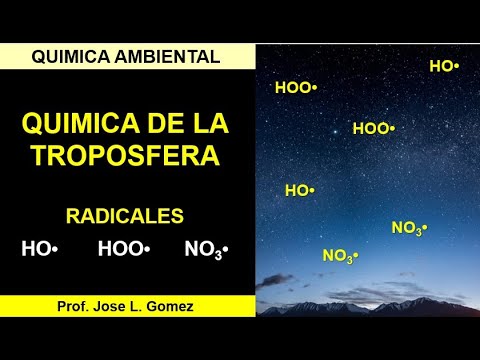







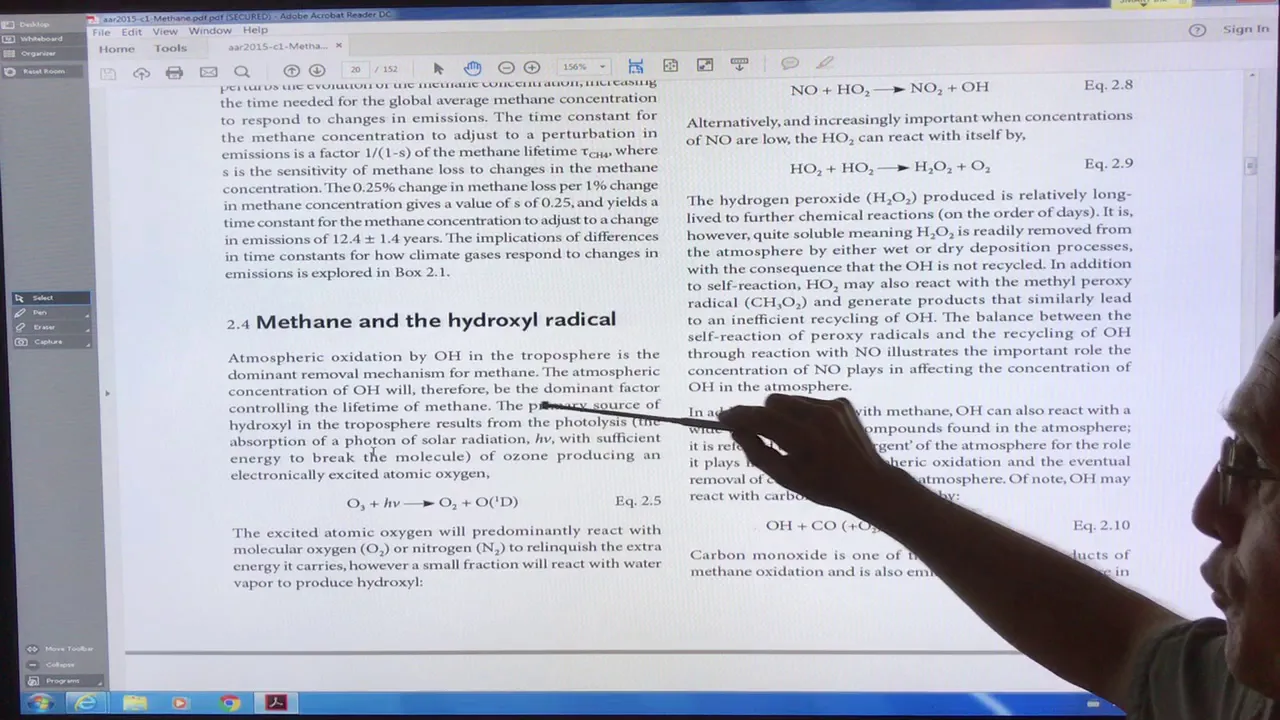
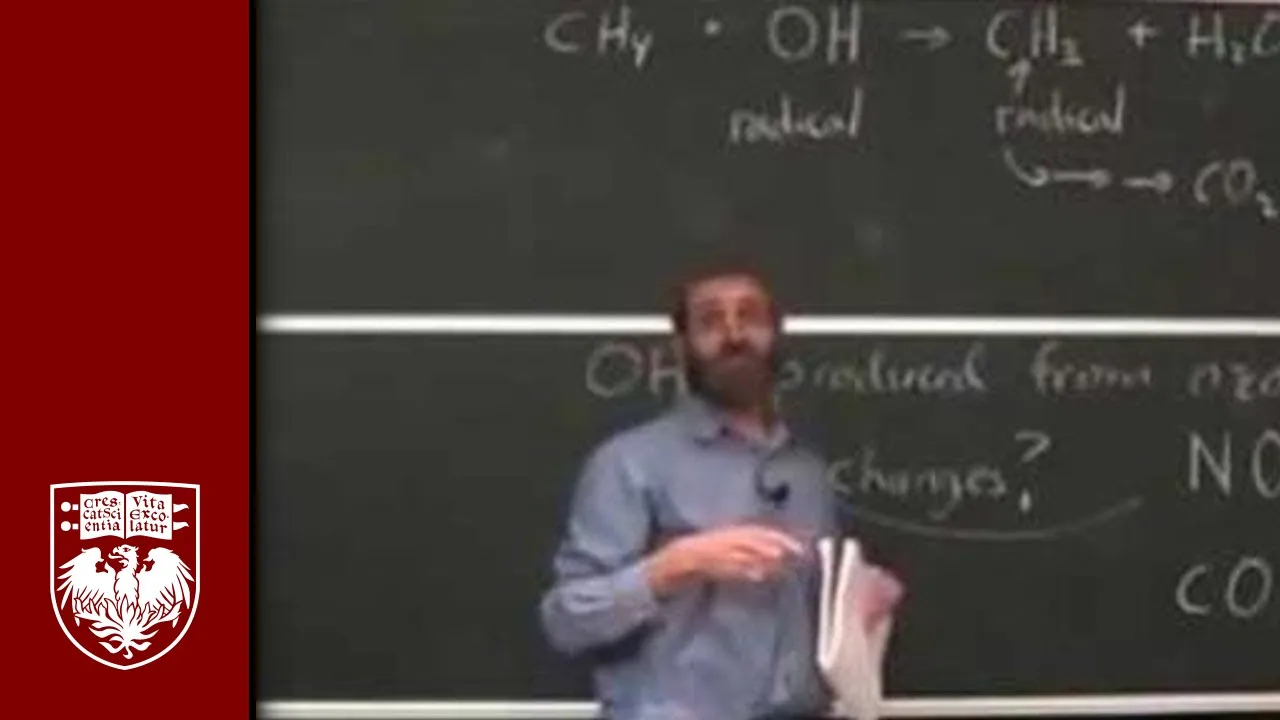




The hydroxyl radical (OH) is the primary oxidizing agent in the troposphere, initiating oxidation reactions for both natural emissions (CO, NO, SO2, NH3, H2S, CH4) and anthropogenic emissions (hydrocarbons, NOx, SOx) through addition to multiple bonds or hydrogen atom abstraction, with its formation occurring when excited oxygen atoms from ozone photolysis react with water molecules, despite its extremely low concentration (~10^-9 molecules/cm³) and short lifetime (~1 second).
Tropospheric Chemistry: Hydroxyl Radical Reactions Intro
Added:Structure and layers of the Earth's atmosphere, specifically the physical and chemical characteristics of the troposphere.
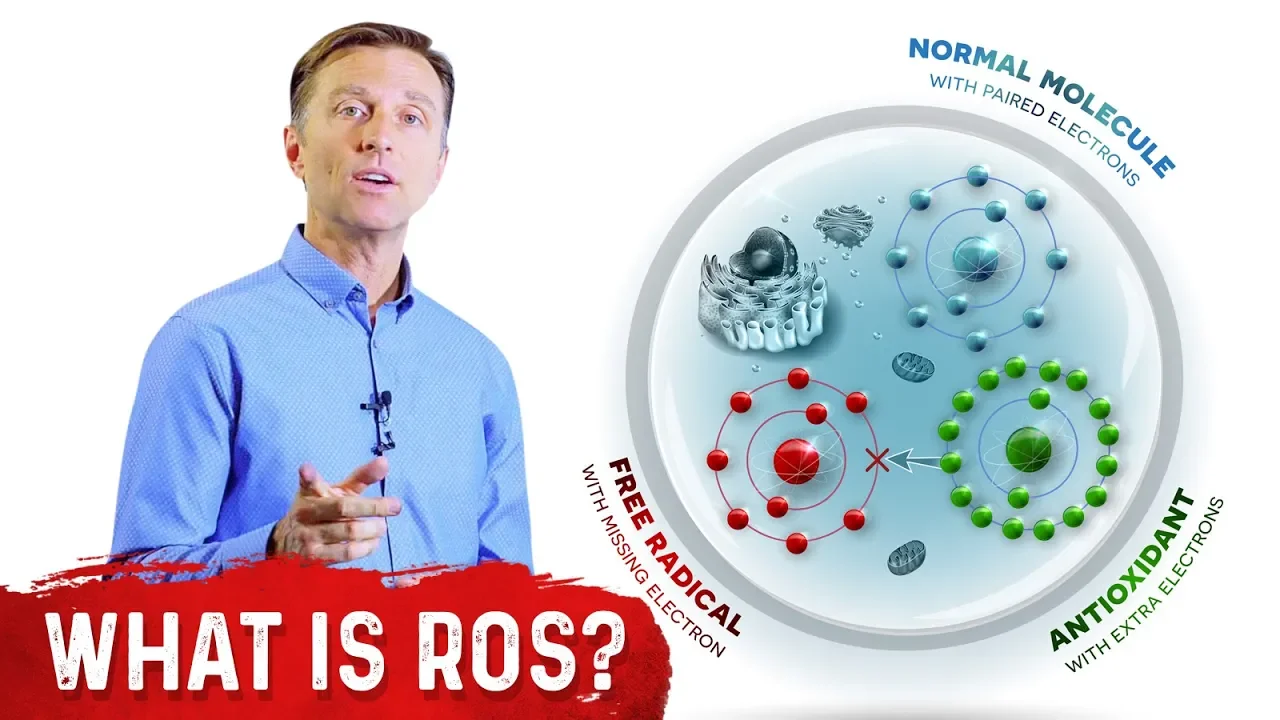
The concept of free radicals, including their electronic structure, unpaired valence electrons, and high chemical reactivity.
Fundamental principles of chemical kinetics, reaction pathways, and oxidation-reduction (redox) chemistry.
Basic chemical properties and environmental sources of common atmospheric trace gases such as carbon monoxide (CO), nitrogen dioxide (NO2), and sulfur dioxide (SO2).
The photochemical pathways and mechanisms responsible for the generation of hydroxyl radicals (OH) in the lower atmosphere.
The role of OH radicals in initiating the oxidation of volatile organic compounds (VOCs) and their contribution to photochemical smog and ground-level ozone formation.
How the oxidation products of SO2 and NO2 react further with water to form sulfuric and nitric acids, leading to acid deposition (acid rain).
The concept of 'atmospheric lifetime' and how hydroxyl radical concentrations regulate the sink mechanisms for greenhouse gases like methane (CH4).
Global atmospheric chemistry models that assess the overall 'cleansing capacity' or oxidizing capacity of the Earth's atmosphere.
627 views9likes11:28Original Release: 2021-09-20
okay now that we've got some concentration units out of the way we dive into the real meat of the atmospheric reactions at ground level the thing that i cannot stress enough is that hydroxyl radical that oh species with an unpaired electron on oxygen is the tropospheric sink the vast majority of all of the oxidation reactions that occur in the troposphere revolve around this species and so if we're talking about oxidation reactions well what species exactly are getting oxidized well it's helpful to mention that there are both natural emissions and anthropomorphic conditions of a number of species that then undergo oxidation in the atmosphere and under on the natural emissions there are a number of partially oxidized species so refer back to the uh appendix video for a little bit more clarification on partially oxidized and fully oxidized or fully reduced species but here this is a as an example we've got carbon monoxide we've got nitric oxide or sulfur dioxide is partially oxidized species and then there's also a number of fully reduced species that are also knitted into the troposphere and those include things like ammonia or hydrogen sulfide or methane there's natural sources for all of those gases but then in addition what we spend a lot of time talking about are those anthropomorphic emissions things that come from human activity and a lot of it comes from burning things fire processes or particularly uh automobile traffic or transportation is where many of these emissions come from and there's the emission of fully and partially reduced hydrocarbons so um things like formaldehyde ethanol carbon monoxide many other hydrocarbons in various forms of oxidation and then also nitric oxide and nitrogen dioxide are both common emissions as well as sulfur containing compounds like hydrogen sulfide and sulfur dioxide and the really important thing to stress is that all of these reactions all of these partially oxidized species undergo oxidation in primarily the troposphere and that are either removed or or fully oxidized entirely up to uh for example co2 would be the fully oxidized form of carbon there but it's the oh radical is the hydroxyl radical that initiates the process of oxidation for nearly all of the even though it exists in extraordinary low concentrations the oxidation events don't begin with reaction with diatomic oxygen because the activation energy barrier for that reaction is too high but oh itself the activation barrier for reaction with many of these is quite low and it is the species that initiates these oxidation processes now where does oh radical come from in the troposphere well it actually comes from at the very beginning trace amounts of ozone that exist in the troposphere and there's a number of sources of those we'll get to that later but remember that trope that ozone can be broken down by uvb light to generate an excited o2 molecule and an excited oxygen atom and so if there's some uvb light which there is and particularly if we've got ozone destruction occurring in the stratosphere we're going to have more uvb light but essentially the key point here is that we get a trace amount of this that generates then a trace amount of that excited oxygen atom shown here and that excited oxygen atom reacts with water to form two hydroxyl radicals and this reaction might remember from the story last week uh we we've done some enthalpy calculations to show that this reaction is unfavorable if the if the oxygen atom is not in its excited state but it is favorable if the oxygen atom is in an excited state also it's important to point out that the concentration of water is much higher in the troposphere that is in the stratosphere and so the likelihood of that excited state oxygen atom finding water molecules much higher in the troposphere than in the stratosphere but this is where those hydroxyl radicals initially come from and we can look at the concentrations i mentioned they were very low they're on the order in the troposphere of about 10.9 times 10 to the minus fifth molecules per cubic centimeter or to put that in kind of a ppx scale that's less than one part per trillion that's about point zero four three five parts per trillion uh here in the troposphere in the stratosphere a hydroxyl radical also exists in the stratosphere the concentration is a bit lower and that may surprise you at first since you'd probably expect there to be a much higher concentration of these excited state oxygen atoms due to more ozone being photolyzed and dissociated in the stratosphere however remember that the concentration of water molecules is uh extremely low in the stratosphere and so as a net we end up with a lower overall concentration of hydroxyl radical in the stratosphere about 1.1 times 10 minus 5th molecules per cubic centimeter or 0.00439 parts per trillion now the average lifetime of that hydroxyl radical is about one second in the troposphere it's a very reactive species and as we'll see it can react with a number of molecules and so it's quickly consumed after it is formed but as we'll see it's it's eventually reformed so what reactions can hydroxyl radical undergo well there's a couple if it if it bumps into a species that contains multiple bonds so a double or triple bond providing that that species is stable and generally we will get addition of the radical to that bond so you will essentially just add the oh into onto that molecule and you will break one of the multiple bonds of the double bond you probably go down to a single bond or if it's a triple bond you go down to a double bond that's sort of illustrated here where reaction of hydroxyl radical with carbon monoxide you add to the carbon and end up breaking one of these triple bonds to leave you with a double bond and now i had now i have indicated with a little dot here that carbon in this resulting molecule has a radical on it a radical is simply a term for an unpaired electron and so carbon now has an unpaired electron its valence is not filled it would only have seven valence electrons around it additionally we can have the um addition of the hydroxyl radical here to a carbon-carbon double bond to generate it simply adds to one of the carbons and then you end up with the radical the free radical on the other carbon and then we could also have it add to say sulfur dioxide where normally the sulfur has two double bonds to the two oxygens and you add and end up with an unpaired electron on sulfur in this case now in addition to these addition reactions we can also have abstraction so if a species contains a hydrogen but it doesn't have any double bonds then most likely we are going to get h atom abstraction so the o h radical will come and pull a hydrogen and that hydrogen will take one electron from its bond from that bond and bring it with it so what we see here for example if we react hydroxyl radical with ethane the oh comes and simply plucks off a hydrogen atom with its electron going with it and that leaves then on a unpaired electron on the ethane so now it's an ethyl radical and we've formed water we can also do this with nh bonds or sh bonds to pluck off those and leave you with nitrogen or sulfur centered radicals and water but we do not see this occur if you try to react hydroxyl radical with hf this reaction does not occur and given some of the conversation that we've had from class early this week on monday when we talked about bond strengths you might be able to rationalize what is going on here why we see this reaction being favorable for chnh or sh bonds but not for hf and that comes from uh looking at the bond strengths so the bond strengths of the of the new bonds that we form has to be greater than the bonds than the sum of the bond strengths that we break in order for this reaction to be exothermic or favorable so here if i look at uh in this top reaction here i'm breaking a ch bond which is about 411 kilojoules per mole but i'm forming an oh oh bond so that's 459 kilojoules per mole so in this uh reaction the way that we draw our enthalpy is bonds broken minus spawns formed and so 411 minus 459 is going to leave you with a negative number and so this reaction will be exothermic you would see a similar trend for the nh bond so that's 386 so that's a weaker bond than the oh bond that we form same with the sh that's a weaker bond than the oh bond that we form but not the fh bond the fh bond is a stronger bond and thus it's not favorable to break that bond to form a weaker oh bond and so that reaction is endothermic actually quite a bit by more than 100 kilojoules per mole and so that reaction there does not work so in the next video we'll talk about some of the subsequent reactions that occur after you've done these initial reactions with o-h either addition or hydrogen atom abstraction you
Up Next
95:54
Atmospheric Chemistry Lecture 2: Air Pollution and Health
@IIEScom
2.1K views•2019-03-19
83:56
Biocatalysis and Catalysis in Islatravir Synthesis | Merck Webinar
@SCIwheresciencemeetsbusiness
675 views•2020-10-08
10:06
1H NMR: Determining Number of Peaks from Structure
@MSJChem
59.2K views•2017-04-06

17:31
Edible Water Bottles: A DIY Guide to Sodium Alginate Spherification
@ryan
10.5M views•2019-06-21
Related Study Plans & Knowledge Roadmaps
Structured learning paths in Chemistry
chemistry
Nuclear Chemistry: Decay, Meds & Fuel Cycle
01Introduction to Nuclear Structure and Radioactivity
02Decay Dynamics and Kinetics
03Radiation Interaction and Detection
+ 2 more learning modules
24h5 modules
Explore Roadmap
chemistry
Supramolecular Chemistry: Forces & Machines
01Foundations of Chemical Bonding and Intermolecular Forces
02Introduction to Host-Guest Chemistry
03Thermodynamics and Dynamics of Self-Assembly
+ 2 more learning modules
16h5 modules
Explore Roadmap
chemistry
Photochemistry: Excited States & Reactions
01Foundations of Light-Matter Interactions
02Molecular Orbitals and Electronic States
03Photophysical Processes and Jablonski Diagrams
+ 2 more learning modules
18h5 modules
Explore Roadmap
chemistry
Coordination Chemistry: Bonding & Properties
01Introduction to Transition Metals and Ligands
02Crystal Field Theory (CFT) and Geometry
03Magnetic Behavior and Spin States
+ 2 more learning modules
14h5 modules
Explore Roadmap