











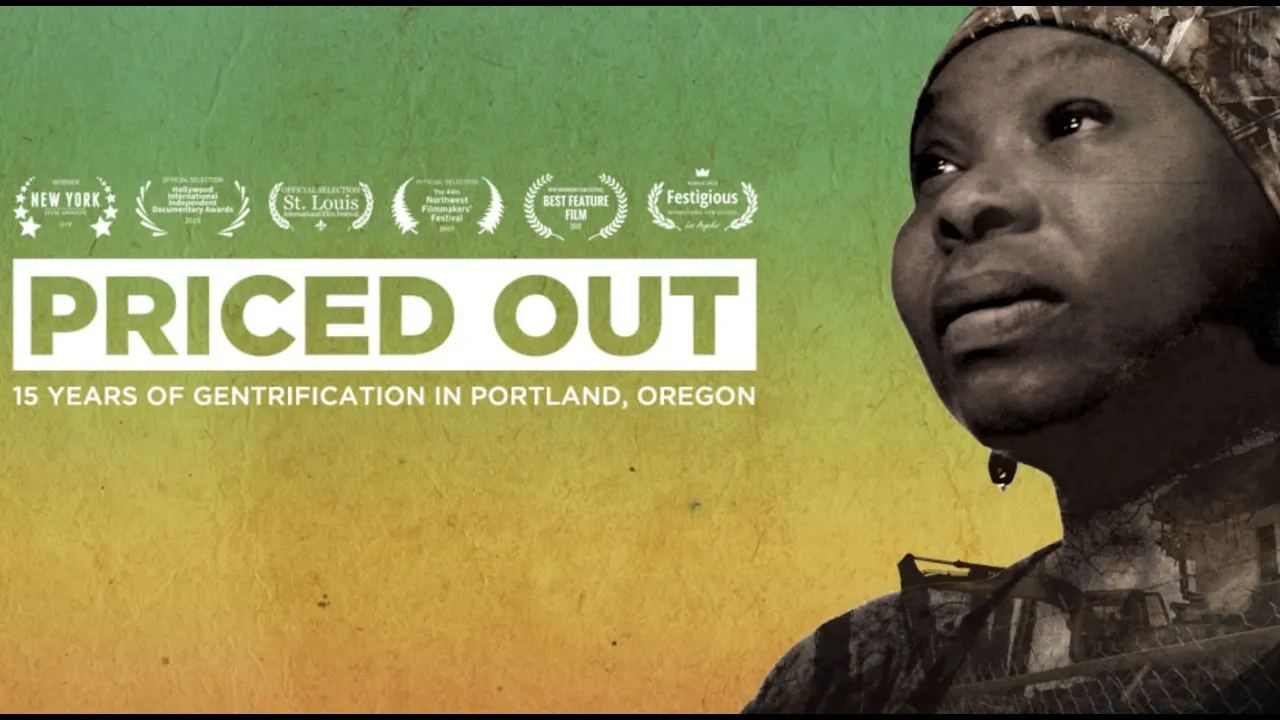
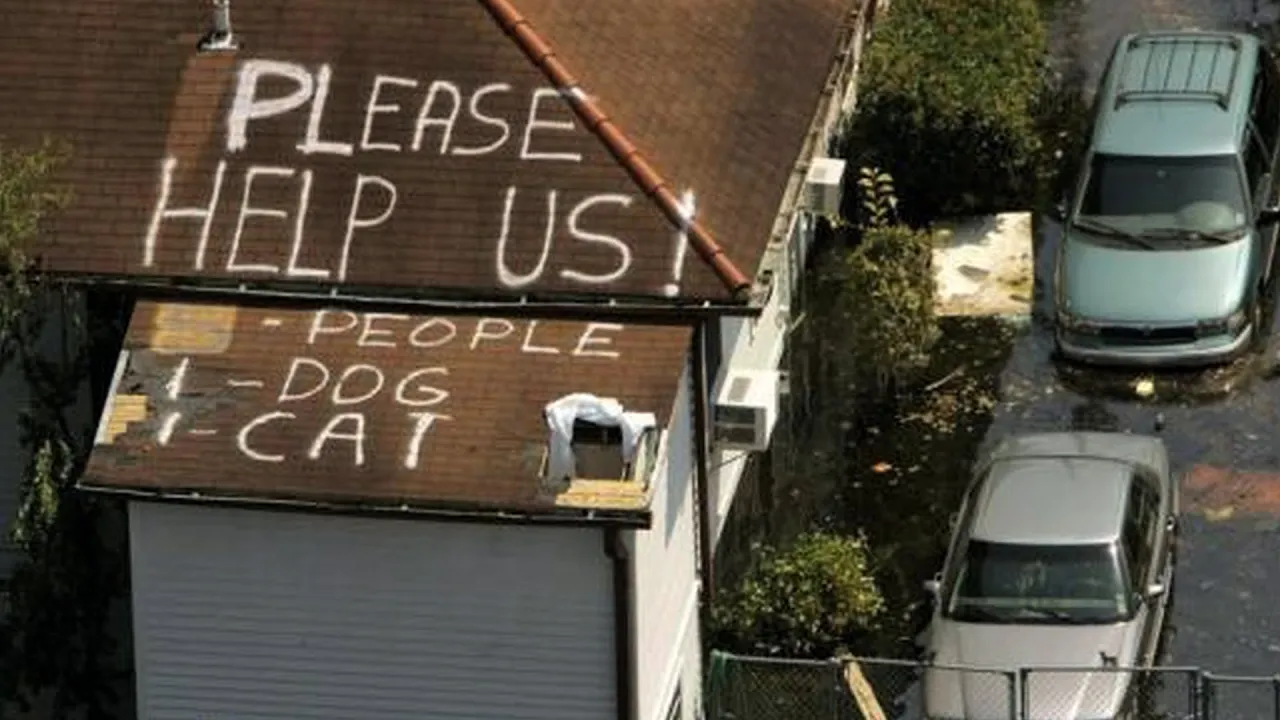


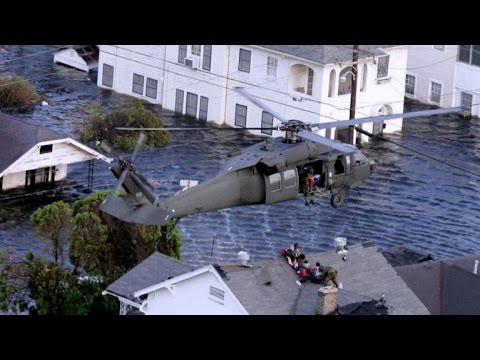


Hurricane Harvey exposed and exacerbated existing patterns of environmental racism and economic inequality in Houston, where low-income communities and communities of color—particularly Black and Latino populations—are disproportionately located in flood-prone areas with inadequate infrastructure, limited access to insurance due to historical redlining, and higher concentrations of industrial pollution. These communities face greater challenges in disaster recovery because they lack the resources and social capital needed to navigate bureaucratic aid systems, hire contractors, and rebuild quickly. Effective disaster recovery requires equitable resource distribution, community-led planning, and investment in infrastructure that protects all residents, rather than allowing 'rebuilding redlining' that prioritizes affluent areas while leaving marginalized communities behind.
Environmental Justice After Hurricane Harvey: Dr. Robert Bullard Interview
Added:AMY GOODMAN: As Congress resumes and begins debate on how to distribute billions of dollars in aid to Houston and the Texas Gulf Coast, we return to Houston to look at who stands to profit from the relief effort, and who may not.
AMY GOODMAN: This is Democracy Now!, democracynow.org, The War and Peace Report.
I’m Amy Goodman.
We’re in the home of Professor Robert Bullard, who teaches at Texas Southern University.
He used to be the dean at the Barbara Jordan-Mickey Leland School of Public Affairs at TSU, yes, considered the father of environmental justice, deals with the issue of environmental racism, and that’s what we’re going to be talking about today, in the aftermath of this hurricane turned storm, Harvey—who it’s affected the most, whose communities will be rebuilt.
It’s great to be with you, to get to meet you personally in your home, Professor Bullard.
Can you describe what happened to you here at home?
You thought you were going to be flooded.
ROBERT BULLARD: Well, you know, I had been monitoring the storm.
I had been watching TV and getting very little sleep.
And then we were informed that we had to—we had a mandatory evacuation.
And I heeded that call, and I tried to move as much of my belongings from downstairs upstairs.
And, actually, I used muscles that I hadn’t used before, in that process.
And so, I evacuated on Tuesday and was able to call a friend and was able to take my, you know, little bag over and stay until this morning.
I came back this morning.
AMY GOODMAN: So, in fact, your home didn’t flood.
ROBERT BULLARD: No, no, we didn’t flood.
The water came up to on the streets around, surrounding streets, and some water came on the street, came up to the curb.
But it did not flood.
And it was, you know, kind of a challenge getting out of the subdivision to get over to my friend’s house, but I was able to maneuver and avoid the water and drive my car, you know, in a way that I was not driving into water.
But it was a challenge, but nothing like what other people have experienced.
AMY GOODMAN: You have written so much about and been so deeply involved in issues of environmental racism, environmental justice.
Do you see the issue of environmental racism—and I’m going to ask you to define it first—playing out here in Houston around this storm?
ROBERT BULLARD: Well, I think when we look at the color of vulnerability and we look at which communities are actually at greatest risk from disasters and floods like this, historically, it’s been low-income communities and communities of color, communities that live in low-lying areas that are areas that are very prone to flooding.
And it’s very difficult to get insurance, not just flood insurance, but regular insurance, because of redlining.
So, what Harvey has done is to expose those inequalities that existed before the storm.
And, you know, disasters like this widen and exacerbate inequality.
And so, the communities that are most at risk from not having, you know, the kinds of infrastructure in those areas, in terms of flood protection, in terms of trying to get out, in terms of transportation, etc., I mean, it played out, you know, up close and personal.
And I think as we start to see some of the demographics in terms of communities that will take longer to return, will take longer to get their houses back in order, longer to get their communities and infrastructure back in order, this is not rocket science.
And those communities that—and individuals, households, that don’t have that cushion to ward off that kind of disruption, it’s always much more difficult for them to return.
And I don’t see this any different in Houston.
And what we have to do is guard against building and rebuilding on that inequity.
AMY GOODMAN: We just did a toxic tour of Houston.
We were over in Baytown, next to the ExxonMobil refinery.
I think it’s something like the second-largest refinery in the country.
Right by it, people flooded out.
And you’ve got two—many different aspects of this crisis, but one is the contract workers who work at ExxonMobil.
They just lose their jobs when the refinery shuts down.
And they also get flooded.
And the question is: Who will get help, and who won’t?
But that issue—for example, while the Republican Texas congressional delegation largely voted against vast help for the Northeast during Superstorm Sandy, clearly, Texas will get billions of dollars for FEMA and to rebuild overall.
How do—how is it determined who gets support and who doesn’t?
ROBERT BULLARD: Well, you know, the way it works is, those individuals in those communities, those families and households that have the resources and the wherewithal to maneuver through this maze of bureaucracies, of filing information online and getting access to the different organizations that can assist and support, getting, you know, the FEMA grants and the SBA loans and all those things—it’s not rocket science, but it’s not easy to do that.
And if you have individuals who are used to getting online and getting access to information and processing that, they have a head start.
You know, there are lots of households right now that are actually hiring contractors, that have already gutted their houses and that have already signed individuals on to fix up and remodel and bring their houses back to life.
And it’s not any mystery as to which communities that will somehow be the last to do that.
And these are the same communities that didn’t have access to loans, in terms of neighborhood loans, because of redlining.
And what we have to guard against is this rebuilding redlining that somehow allows more affluent communities to access the system, get their communities back in order, and those who are left behind, somehow, those areas will be the last to come back.
So it has to be an equitable recovery, equitable development, and to make sure that those families that somehow may—you know, who’s to say that one community should be built or rebuilt, not be rebuilt?
And those are policy decisions.
And if money is not invested in those areas, and if infrastructure is not invested in those areas—and many of the areas in many of the communities in Houston do not have the infrastructure to protect them from man-made disasters in terms of the flooding, the lack of infrastructure in terms of the protection.
You know, a lot of our neighborhoods just have open drainage ditches, gulleys and just very minimum kinds of protection, and so it floods, you know, routinely.
And so, we’re talking about this biblical flood.
And so, you can see how not only will they get washed out in terms of their homes, they’ll get washed out in terms of their income.
AMY GOODMAN: This is the 30th anniversary of the publication of your book Invisible Houston: The Black Experience in Boom and Bust.
Talk about Invisible Houston.
ROBERT BULLARD: Invisible Houston, that I wrote 30 years ago, there’s a huge population that is still invisible.
Houston’s demographics, you know, a lot of people like to say we are one of the most diverse, ethnically and racially, cities in the country.
We’re the fourth-largest city in the country.
We are racially and ethnically diverse.
But when it comes to economics and when it comes to power and decision-making, it stops.
And so, when we talk about this whole question of how invisible—how can we make invisible communities visible, those communities that have been inundated—before the storm—by pollution, environmental degradation, living on the fenceline with very dangerous kinds of hostilities?
And when a storm like this happens, it exposes those vulnerabilities.
I mean, you have all this pollution, you know, all of this oil and chemical plants and that kind of pollution that’s now exposed in the water.
And when the floodwater recedes, it’s going to leave residue.
It’s going to leave all kinds of stuff on the school grounds, on the playgrounds and on people’s yards.
And so, how are we—how are we going to deal with that, those sediments that’s left?
And we need testing done.
We have to make sure it is safe, all the mold.
We learned from Katrina that people want to get back in their homes, and that, in some cases, they are rushing to get back without the proper protection.
And with the mold in those homes and people getting sick, we have to make sure that we provide equal protection and equal access to resources to make sure that we do it right.
AMY GOODMAN: How do you do that?
ROBERT BULLARD: Well, it means that we have to have strong community-based organizations on the ground with the capacity to assist and support families and households that can get things right, that can pressure and apply the points of saying, "Well, we need to make sure that just because you don’t have a car, just because you don’t have a big bank account doesn’t mean that you should not be safe, that your community should not come back and that you should not have the same level of protection and the same level of importance as if you were a middle-class white neighborhood."
That is—that’s what we have to ensure.
Houston is very segregated along racial and economic lines.
And this flood has really shown that.
If you look at ZIP codes, you can map where that vulnerability is.
You can also map how resources have been allocated and distributed over the last 50 years.
And so, what we have to do is we have to map the resources that come to this region, come to this area.
And we can show, and we can actually fight for, to make sure that the resources that flow do not somehow flow in a way that somehow leaves those invisible communities—and, in this case, I wrote Invisible Houston in '87.
Invisible Houston, when I wrote it then, was black Houston.
But we're talking about a very diverse Houston today.
And the Latino population is almost 50 percent.
So, when you talk about the invisibility and you talk about where those—where the population lives, you talk about not only a disaster in terms of the flooding, you talk about a disaster in terms of the environment, the pollution, the health threats, the potential for the kinds of impacts that we will see, you know, years to come.
And the most vulnerable in our society is children, and we have to make sure that we protect our children, our vulnerable population.
AMY GOODMAN: The fact that President Trump came to the area twice but is a proud climate change denier, what does that mean to you?
And how does that fit into this whole issue of climate justice, in this country, really, and around the world?
ROBERT BULLARD: Well, you know, the— AMY GOODMAN: And your governor, as well, Governor Greg Abbott.
ROBERT BULLARD: Yes, yes.
We’re in a state of denial called Texas.
And the fact is that just because, you know, individuals deny the fact that climate change is real, that’s almost like saying, "I don’t believe in gravity."
But the fact is the fact is.
We are experiencing some very—these storms are getting more—the fact that— AMY GOODMAN: Intense?
ROBERT BULLARD: Intense.
And Houston has flooded in the last three years.
We’ve had some very intense flooding.
AMY GOODMAN: And frequent.
ROBERT BULLARD: And frequent.
So, when we talk about what’s going on, even if you don’t believe in climate change, we have to make sure that our infrastructure, our city is built in a way that is resilient.
And even if you take climate change off the table, the fact that something is going on that is creating a tremendous vulnerability for not just poor people—because when poor people were getting flooded, there was no concern.
But now, because when you do not protect the most vulnerable population, you put everybody at risk.
We learned that in New Orleans after Katrina.
And so, we have to make sure that we protect the most vulnerable population and rebuild with the idea that we’re rebuilding with resilience.
We cannot just, you know, make Houston like it was.
Like it was was very unequal.
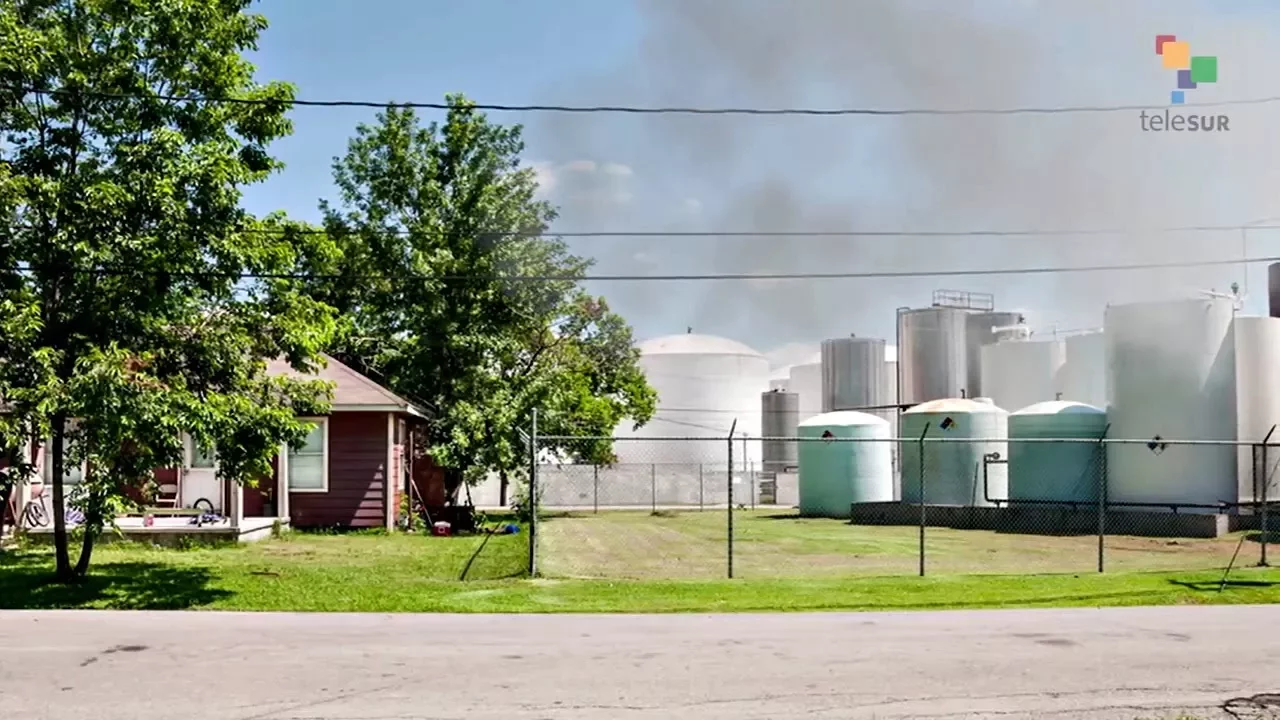
And those populations that lived, for example, on those fencelines with those chemical companies, people say, "Well, what’s happening at the chemical company that burnt and exploded?
They say it’s safe.
The chemical company says it’s safe.
The EPA says it’s safe.
But I’d like to know: Where does the CEO of that company live?
If it’s so safe—you know what I’m saying?—how about him pack up and camp out next door?"
The problem is, individuals making decisions oftentimes don’t have to deal with the kinds of issues that fenceline communities have to deal with, even when we’re not talking about flooding.
We’re talking about the flooding of pollution and chemicals on communities.
And people don’t ask for—to be polluted.
It’s without their consent.
AMY GOODMAN: One hundred percent of all city-owned landfills are in black communities, even though the African-American community makes something—up like what?
Twenty-five of the population here?
ROBERT BULLARD: Black and brown community populations have borne the burden, even when the population was majority white.
So, we have to really talk about environmental justice.
We have to talk about environmental racism and call it out when it exists.
We can’t just run from it and act as if somehow "Kumbaya, we’re all going to get along."
Yeah, this storm has brought out the best of Houstonians, but we just can’t cover that up, this history, this legacy of unequal protection, of unequal access to resources.
We are an area that—we’re a city that’s over 600 square miles, and we have lots of ZIP codes.
But all ZIP codes are not created equal.
And the idea that somehow we can not address the economic inequality and the racial equality as we recover, those things need to be—need to be made plain and upfront and just acknowledged.
Nobody’s talking about let stop anything.
Let’s acknowledge that we have to be very careful that somehow we don’t further disadvantage communities that had been marginalized because of structural discrimination.
AMY GOODMAN: So, Hurricane/Storm Harvey hit on the 12th anniversary of Katrina.
What worked in rebuilding New Orleans, and what didn’t, 12 years later?
This is the 12th anniversary.
ROBERT BULLARD: Yeah, I think the idea of communities, residents, community-based organizations, non-governmental organizations coming together, working together, working with government, but it being led and driven by communities deciding—not somebody parachuting in and coming up with these grandiose designs and saying, "Well, this is the footprint that New Orleans is going to be."
And to some extent, the mistakes or the lessons that we can learn is that local, community-driven, where you have involvement, where you have the whole idea of rebuilding, needs to be democratized.
Those communities, people need to decide what it is that they want and what they can live with.
And I think the idea that—how the money and the funds get spent also needs to be democratized.
You can’t have a top-down situation where shovel-ready projects oftentimes mean processes—projects that have gone through a very discriminatory, unequal process, and those with power get their projects on top.
And those who try to get projects later on end up saying—understanding that, well, the money’s gone, or your project is way down the road.
I think that we have to, you know, learn from Katrina and Sandy, but I know Houston is different, so we have to make sure that we use the uniqueness of our city to make sure that we do it right.
And there are lots of groups on the ground and lots of individuals that are willing and ready to do the partnerships to work on these issues over the long haul.
This will not be a one-year project in terms of bringing Houston back.
We know that.
You know, New Orleans was only a half-million people and very compact in terms of its size.
Houston is over 600 square miles, and it’s 2.3 million people.
It’s a lot of people in a big area, so you’re talking about a big city, and so—with very diverse populations.
So, it’s going to be much more complex, and it will involve lots more thinking and envisioning and lots more work to make it right.
AMY GOODMAN: You said you were drafted into the environmental justice movement right here in Houston decades ago.
What happened?
ROBERT BULLARD: Yeah.
Yeah, I started—my first job out of graduate school in 1976 was at Texas Southern University in 1976.
I was a young, untenured professor in sociology in 1976.
And two years out of graduate school, I was asked to collect data for a lawsuit, by my wife, who had filed a lawsuit suing the city of Houston, Harris County and the state of Texas.
And I worked for a state university, so my wife actually sued my employer.
And so I had 10 students in my graduate class.
We collected data for a lawsuit, Bean v. Southwestern Waste Management Corporation.
That was the first lawsuit in the country that was challenging environmental discrimination using a civil rights law.
And it was basically challenging the location of a municipal landfill that was being proposed in a black, middle-class, suburban neighborhood in Houston.
Nothing out in that northeast Houston neighborhood except trees, houses and black people—not a likely place for a landfill.
And I collected data for that lawsuit, and we wrote studies.
And that’s how I, you know, started working on this.
And five out of five of the city-owned landfills were located in black neighborhoods.
Six out of eight of the city-owed incinerators were located in black neighborhoods.
And three out of four of the privately owned landfills were located in black neighborhoods.
Eighty-two percent of all the waste garbage dumped in Houston, from 1930s up 'til 1978, were dumped in black neighborhoods.
And blacks only made up 25 percent of the population.
For me, that was eye-opening.
That's what sent me on my way.
AMY GOODMAN: So, what happened in that original lawsuit?
ROBERT BULLARD: Well, the lawsuit, you now, was filed in 1979 and went to court in 1985.
And we could not prove intentional discrimination, even though the facts and the statistics were overwhelming.
We had maps and charts.
This is long before, you know, GIS and iPhones and iPads.
We did all the data work by hand.
But we actually showed that the pattern was irrefutable.
But we couldn’t prove intentional discrimination.
It’s hard to prove intentional discrimination when people are not saying, "Well, we did it to the black people because that’s where the landfills go."
But unofficially, we were able to document, even without zoning, African Americans, basically from the ’30s up ’til 1978, basically was the dumping grounds, unofficially dumping grounds.
And as the population has changed and shifted, you know, black and brown communities bear the brunt of environmental pollution.
You talk about the east side of Houston.
I mean, that’s basically the area that’s unofficially zoned for industrial pollution, even without zoning.
Everybody knows that.
And so, when we talk about this whole question of your ZIP code can be the best predictor of health and well-being, you lay out the ZIP codes, the dirtiest ZIP codes, the most polluted ZIP codes, we know where they are.
They’re on the east side.
We know where the industries are.
We know the communities that are fencelined, that live close to, next to, contiguous with.
And when you talk about all of the potential health threats and the potential damage not just damage to property and the tax base in terms of people’s houses, lowering the property values, but you’re also talking about schools and playgrounds that are located so close, you would say, "Who would do this?"
And the idea of environmental justice and environmental racism and the fact that communities of color are disproportionately impacted by these things, not just in Houston, but that’s a national trend—and what we say—people are saying no.
Communities have a right to say no, and they have a right to equal protection under the law, and they have a right not to have their children go to school or play on playgrounds that’s not impacted by pollution.
AMY GOODMAN: According to a Texas Monthly article, according to the Union of Concerned Scientists report, the airborne concentration of 1,3-butadiene, which causes cancer and a host of neurological issues, is more than 150 times greater in Manchester and Harrisburg in East Houston than in places like West Oaks and Eldridge, relatively different neighborhoods of Houston’s west side.
ROBERT BULLARD: Well, what you’re seeing in that kind of analysis is basically certain neighborhoods are unofficially zoned for it, even though we don’t have zoning, unofficially zoned for the things that other people don’t want.
And the fact that we have environmental segregation, we have what I call "outdoor apartheid."
This is basically that those areas, those geographic and spacial neighborhoods, that somehow are considered compatible with these types of facilities.
And we know that the impacts of living close to, with these emissions or with explosion or accidents or releases that may come from flooding, like Harvey—I mean, we know which communities are impacted.
And that’s the justice question.
And when we talk about how will we rebuild, how will we recover and how will we redevelop, those are questions that we have to answer in a way that’s acceptable in terms of these legacy residuals of pollution on neighborhoods that have really just borne the burden for all of these years.
AMY GOODMAN: So, how do you deal with industry, so powerful here in the Petro Metro?
I mean, this is the heart of the fossil fuel industry.
You have city-led initiatives consistently challenged by the Business Coalition for Clean Air, which is an industry lobbying group that represents ExxonMobil and other companies.
Last year, it convinced the Texas Supreme Court to strike down Houston’s Clean Air Ordinance, which was adopted during Mayor White’s administration?
ROBERT BULLARD: That’s basically overruling home rule.
It’s basically saying that, you know, the fourth-largest city in this country, that took the initiative in saying we want to have clean air and we want to be more sustainable in how we do business—and again, you have to understand that there is no level playing field in Texas when it comes to the chemical industry, the petrochemical industry.
You know, there are equals—there are equals, and there are equals.
And the fact is that there is no level playing field.
The communities that have been suffering for all of these years really don’t have a voice.
They are still invisible, and they are still underprotected.
And as I said before, the most vulnerable population that we’re talking about is children.
And if people don’t get angry or somehow concerned about children going to school or playing on playgrounds that’s on the fenceline with companies that’s pumping out dangerous chemicals and creating lots of environmental hazards—you know, you have to understand what kind of person would somehow just turn the other way, or governmental entity that would turn the other way, and say, "Oh, it’s about regulation.
We need fewer regulations.
And because the companies have to be competitive globally, and therefore the community that’s on the fenceline basically is a sacrifice zone."
And what we say in the environmental justice community, we say no to our communities being sacrifice zones.
AMY GOODMAN: What is the role of historically black colleges and universities, like TSU, like Texas Southern University, when it comes to environmental justice?
ROBERT BULLARD: Well, you know, historically black colleges and universities have always produced students and leaders that have fought for justice, and whether it’s the civil rights movement, peace and justice movement, etc. And the environmental justice movement is no different.
The climate justice movement is no different.
And what some colleagues and I, Dr. Beverly Wright in the Deep South Center for Environmental Justice in New Orleans—we decided that we will start to pull our historically black colleges and universities together, because many of our schools are located in the heart of these toxic sacrifice zones, and many of our students come from these universities.
And so, we’re saying we have developed this collaborative, this consortium of HBCUs, to work on environmental issues, climate issues, energy, housing, transportation and other issues, food security.
And we’re saying that we’re going to provide a new generation of leaders to work on these issues and form partnerships with other organizations and groups.
Just in January, our consortium was funded, you know, with a grant from the Kellogg Foundation to pull these meetings together, to pull our organizations together and to do the kinds of things that impact the most vulnerable—children and families.
And so, what we’re saying is that our institutions have to be leaders.
We can’t follow, because if we follow, our institutions will go under.
Our institutions go under in terms of economically, but also we’ll go under in terms of rising tides, water—you know, being flooded out, being basically not competitive in terms of what we can do in terms of sustainability.
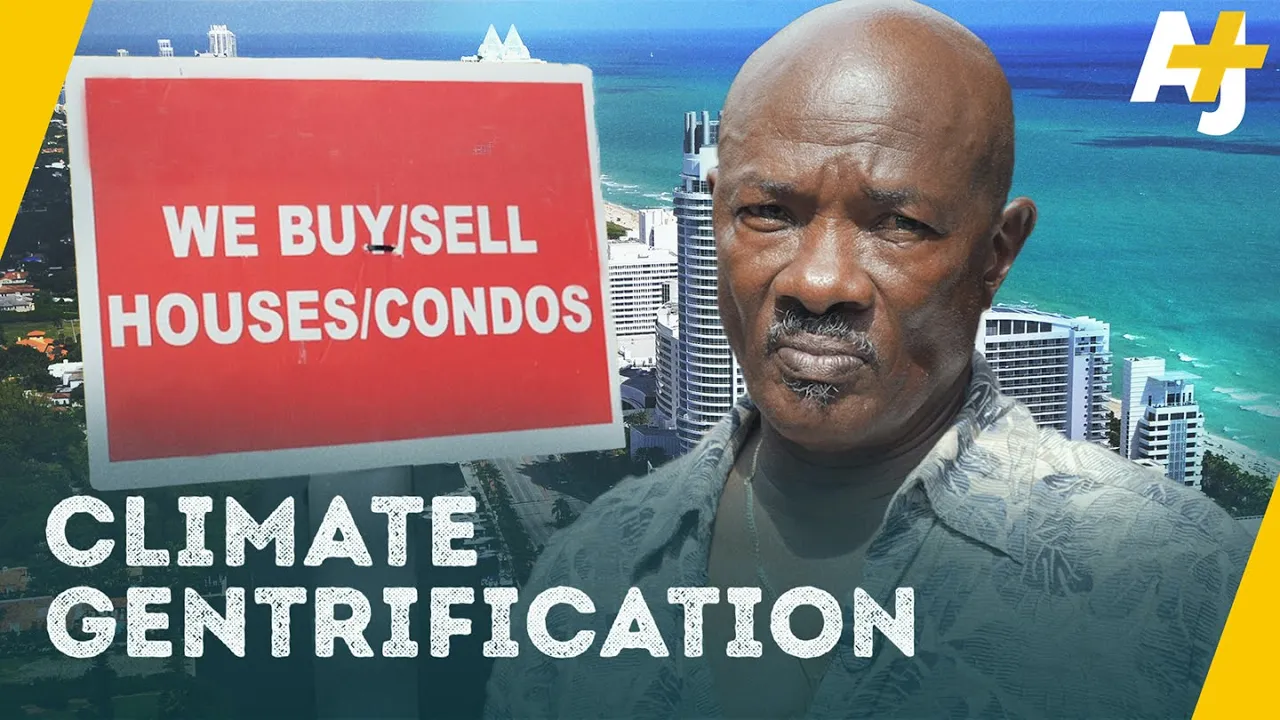
AMY GOODMAN: Can you make a connection between environmental justice, environmental racism, and gentrification?
What many talk about is overdevelopment here in Houston.
ROBERT BULLARD: Yeah.
When we talk about this whole idea of building healthy, sustainable, just communities, that whole idea is to address the historic nature of, as communities become greener, more sustainable, and oftentimes when they start developing their resilience plans, oftentimes those communities, if they are in urban core areas, neighborhoods, etc., they oftentimes push out low-income communities, people, and push out people of color.
And what we’re saying is that our communities, communities of color, want to be sustainable, want to be resilient.
They want to be healthy and livable.
And it should not somehow be something that’s relegated to white middle-class suburban or urban core.
The gentrification that oftentimes occurs in many of our communities, it occurs at the—I guess, the detriment of communities that have historically lived in those areas.
And as you see those areas start to come back, you start to see all kinds of services and parks and green space and grocery stores, those kinds of things.
But we have to say that we want to make sure that we redevelop and we develop our communities in a way that minimizes displacement of incumbent residents, and also ensure that those residents who want to remain in those older neighborhoods that are undergoing transformation, that they can.
And those who want to leave, by choice, can leave.
And it means that when tax dollars are being used, we have to make sure and ensure that tax dollars are not being used to subsidize those kinds of structural discrimination that somehow people will say, "Well, we didn’t mean to do that.
We didn’t know.
These are the unintended kinds of consequences."
But as I said before, if you think about and calculate out when poor people compete against people with money, you can almost bet on who’s going to win.
And so, this is—so, we want to create winners in those various income groups, and so that we have communities that are multi-income and multi-ethnic, and create communities that’s livable and not just these yuppie playgrounds that somehow have put up fences and walls, and people who used to live there have to get a pass to drive through or walk through.
AMY GOODMAN: So how do you fix that now, after the storm, after Harvey?
You wrote a book, Wrong Complexion for Protection: How the Government Responds to Disaster, Endangers African American Communities.
How, specifically, with Mayor Turner here in Houston, do you think this can be turned around right now, where this, somehow, horrific as it is, could be an opportunity to challenge the patterns you describe?
ROBERT BULLARD: I think we have an excellent opportunity to address some of the legacy issues of institutional redlining and neighborhoods that have been allowed to decline and areas that have somehow been invisible.
I think this is a great opportunity to plan for a complete community and a complete revitalization, a complete recovery, and that the old way of doing things, I think we need to throw it out the window or put it in the trash bin.
And the idea that we can bring our diverse city to the table, with diverse stakeholders, diverse individuals that are in the room— AMY GOODMAN: What should be the first step?
ROBERT BULLARD: Which should be the first step.
It should not be a top-down.
I mean, we need to take stock of the fact that Houston is very diverse.
And there are lots of layers of that diversity.
And so, we need to make sure—we need to use our institutions, our community-based organizations, our non-governmental organizations, our faith-based organizations, to plan for and get the input, so that we can do it right.
Again, it would be very easy to turn this over to planners and say, "Plan it.
Go in the room.
Come back with this nice"— AMY GOODMAN: Or who’s getting the billions now?
Red Cross, for example— ROBERT BULLARD: Yes, yes.
AMY GOODMAN: —which is not exactly a local, community-based organization.
ROBERT BULLARD: Well, we have to—yes, there are issues there.
And so we have to—we talk about new kinds of models that I think, over the last, you know, 12, 15 years, that we’re learning from the things that didn’t work.
And those things that worked, we need to model them.
We need to scale them up.
And, you know, the idea of bringing community leaders and faith leaders and community-based organizations and institutions that have lots of expertise in the process of working with communities, and a lot of times, you know, communities that have historically worked with—for example, our historically black colleges.
I mean, we have a long-standing relationship with communities and neighborhoods and areas that somehow have been forgotten, left behind or invisible.
And so, it makes a whole lot of sense that we should be in the room, at the table, working with those communities.
When the money comes down, we should be able to talk about, "Let’s follow the dollars and make sure that the dollars don’t get lost somehow or diverted to pet projects that have nothing to do with bringing those communities back."
We learned from New Orleans that, in some cases, money was diverted to areas that didn’t flood.
Areas that was most in need somehow had to wait the longest to get the money, to get the flood protection, to get the—to start building resilience.
We should learn from those mistakes and not just act as somehow that we don’t have any understanding of how politics works or how disaster capitalism works.
We know how it works.
And so, what we have to do is make— AMY GOODMAN: Explain what you mean by "disaster capitalism."
ROBERT BULLARD: Well, you’re talking about how money comes to areas after major disasters.
And billions come flow in, and then you have all kinds of organizations and individuals parachuting in, raking up the money, I mean, when the local groups that have been working on these issues for years and years and years somehow get bypassed, get left behind.
And so, the idea of contracts that are already being pushed out, and no-bid contracts, you know—what do you call it?—exceptions being made in terms of environmental exceptions.
So you get a variant, or you get something that’s basically, "Well, we’re going to—that rule is not going to apply, because this is extraordinary circumstances, and so you get a waiver."
I mean, we have to watch everything that’s going on when it comes to how money is being spent and how the city is being—how plans are being made as to which areas are going to come back first and which areas are somehow going to say, "Well, you’re going to have to wait, because you got so much damage, it’s going to be hard for you to have a shovel-ready project."
And so, not having a shovel-ready project, because you have been, you know, flooded under or because a lot of the people— AMY GOODMAN: Because you’ve been devastated.
ROBERT BULLARD: You’ve been devastated.
And your—not just your family, but also your social network, your organizations have been destroyed.
And so, new organizations parachute in and generally grab the money, because they’re up and running, they got all that infrastructure in place.
And next thing you know, you got people applying for grants.
And what—I’m not saying that’s going to happen.
What I’m saying is that community organizations, institutions, that have been doing this work in the city for many, many years, they need to be funded.
They need to have—they need capacity to staff up and to start doing the kind of work, because they have the trust and because they have the experience and because they are here, they are local.
That needs to happen.
AMY GOODMAN: We’re speaking in the Petro Metro.
I mean, this is heart of, the epicenter of, the fossil fuel industry.
Republican legislators, congressmembers, the governor lobbied hard to deregulate the industry.
It’s more powerful here than ever.
How do you take that on?
What is the role of these industries now in determining who has and who doesn’t have, not to mention who has clean air and who doesn’t?
ROBERT BULLARD: Yeah, well, you know, we are in the belly of the beast, and that’s—you know, we can’t deny that.
But because of those facts doesn’t mean that we have to basically resign ourselves that we should take less, we should have less.
What we have to do is keep fighting and keep presenting our case that clean air is good business sense, having a city that’s rebuilt and redeveloped and redesigned in a way that will shore up and that will minimize the future floods and the future impacts of hurricanes.
And we will have more hurricanes.
We will have more floods.
But the thing is, how do we—how do we build, rebuild in a way that will make our city more resilient?
How will we basically incorporate a model that is inclusive and to develop strategies to lift all of the boats, to lift all of the communities, and not just the ones that somehow have resources and bank accounts to get their things back in order and go about their business as if the city is open for business, is normal?
No, there are people that will be in temporary housing for months, and in some cases, many months.
And so, neighborhoods that will be—that will have the yellow tape around them for many months.
Some communities will bounce back quicker.
We cannot leave any community behind.
We have to bring all our communities back up to a level, not just where they were, because if you bring them back—many of our communities back to where they were, that’s the inequity that has been perpetuated for decades and probably centuries.
AMY GOODMAN: So, you were dean of the Barbara Jordan-Mickey Leland School of Public Affairs at Texas Southern University for a number of years.
What do you think these icons, these two congresspeople, Barbara Jordan and Mickey Leland, would do now?
ROBERT BULLARD: Well, these two icons, they would be out there fighting.
They would be out there resisting.
They would be out there talking and doing, and out there basically saying and pushing and pressuring to make sure that justice and equity and fairness become the centerpiece of any rebuilding program or any recovery program, and making sure, when the money comes down to Houston—and the money will come down—we have to make sure that it flows in a way that does not perpetuate or exacerbate or continue the inequality that existed before the storm.
Now, that’s the challenge that we have to address.
AMY GOODMAN: Do you think it’s possible to make invisible Houston visible?
ROBERT BULLARD: I do.
I do think it is possible, and I think that it’s necessary.
You know, this is not a sprint, this is a marathon.
This is going to be many years of working on this to get it to the level that we’re talking about.
We’re not just talking about, you know, band-aids.
We’re talking about a total reforming the way that resources are spent and the way that communities get lifted up in terms of priorities.
Now, that’s going to be a challenge because there are still forces that want to do what’s easy.
And there are still forces that don’t acknowledge the inequality in our society or inequality in our city.
And so we have to—we have to continue to challenge that.
We’re not, you know, every day, 24/7, saying we’re going to be adversarial.
We’re talking about fighting for justice, fighting for the vulnerable population, fighting for children.
You know, I can’t think of anybody who’s not for having children being protected.
You know, who’s going to stand up and say, "I’m for poisoning children"?
I don’t—that’s not, you know, PC.
AMY GOODMAN: Well, that’s really interesting, because in the midst of this hurricane and its aftermath, you have two major anti-immigrant issues: SB 4, which a judge just postponed in the middle of the hurricane, and then you have DACA, all through this weekend, President Trump deciding whether or not young people in this country who were not born here but came here at an early age—we’re talking 800,000 in the country, maybe 80,000 here in Houston—will be able to continue to with—to work and live here legally.
What about that?
And also when it comes to immigrants, who will rebuild this city, when so many are afraid of coming out of the shadows, afraid that they could be arrested, even afraid of going to convention center or to come out anywhere, to leave their homes when they were being flooded, afraid that perhaps they would be picked up and deported?
ROBERT BULLARD: Yeah, yeah.
This is the invisibility that becomes so, I guess, detrimental to our society, when it’s, in some circles, become acceptable for populations to be placed at risk or to somehow be denied basic human rights.
And the idea that a family, because it’s afraid to come out, afraid to go to the convention center, afraid to somehow voice their whole conditions, that that’s life-threatening, that, to me, does not signal what’s good in this country.
We have to do—we are better than that.
And I think a lot of this is tied to this whole idea of trying to score political points or trying to somehow give the idea that there has to be the bogeyman or an other to somehow bash.
And I’m hoping that this city will rise above that.
And as I said before, you know, you look at demographics of this city, and you can’t get around the fact that a huge—almost half of the population in this city is Latino.
And when you talk about flexing muscles, I mean, that population and its allies will need to flex muscle when it comes to what happens to those communities that have large numbers of undocumented residents in these areas.
And so, the fact is that no community or no population or no family deserves to go under and not have some type of assistance.
That is inhumane.
And I would hope that, you know, in America, that we would be much more humane than to just turn our heads and look for whether or not you’ve got a card that says you are a U.S. citizen.
I mean, let’s be real.
We have to be compassionate, because this flood has devastated this city.
Some hurt more than others.
But we just can’t turn our heads and say we are not going to be sensitive and humane.
That’s not—that’s not American, I don’t think.
AMY GOODMAN: So, the storm and the recovery takes place in the era of Trump.
What is your assessment of President Trump?
ROBERT BULLARD: Well, he is the president.
And I’m hoping that our society will basically start to, you know, come together and agree that there are certain principles and certain, I guess, beliefs that this country has stood for for many years.
And at some point, I think people are going to have to say that we have to come together.
And the way that we’ve been torn apart, I don’t think we can last very long with that.
AMY GOODMAN: Well, Newsweek has named Professor Robert Bullard one of 13 environmental leaders of the century.
The Grio named him one of 100 black history makers in the making.
And Planet Harmony called him one of 10 African-American green heroes.
It’s been a pleasure speaking to you here today.
And I’m very glad we could be sitting here in the first floor of your home without our feet in water.
ROBERT BULLARD: My pleasure.
Up Next
Vulnerability of Elements Exposed to Specific Hazards | DRRR Lesson
@judyannnasuli9948
24.4K views•2020-10-28

Life in Biosphere 2: Sustainable Ecosystems & Human Survival
@TED
334.9K views•2009-06-16
Microplastics Everywhere: How Plastic Impacts Our Lives
@TEDx
100.9K views•2018-05-08
Ice Stupa Artificial Glaciers: Solving Ladakh's Water Crisis
@SonamWangchuk66
3.2M views•2015-05-03
Related Study Plans & Knowledge Roadmaps
Structured learning paths in Environmental Science