













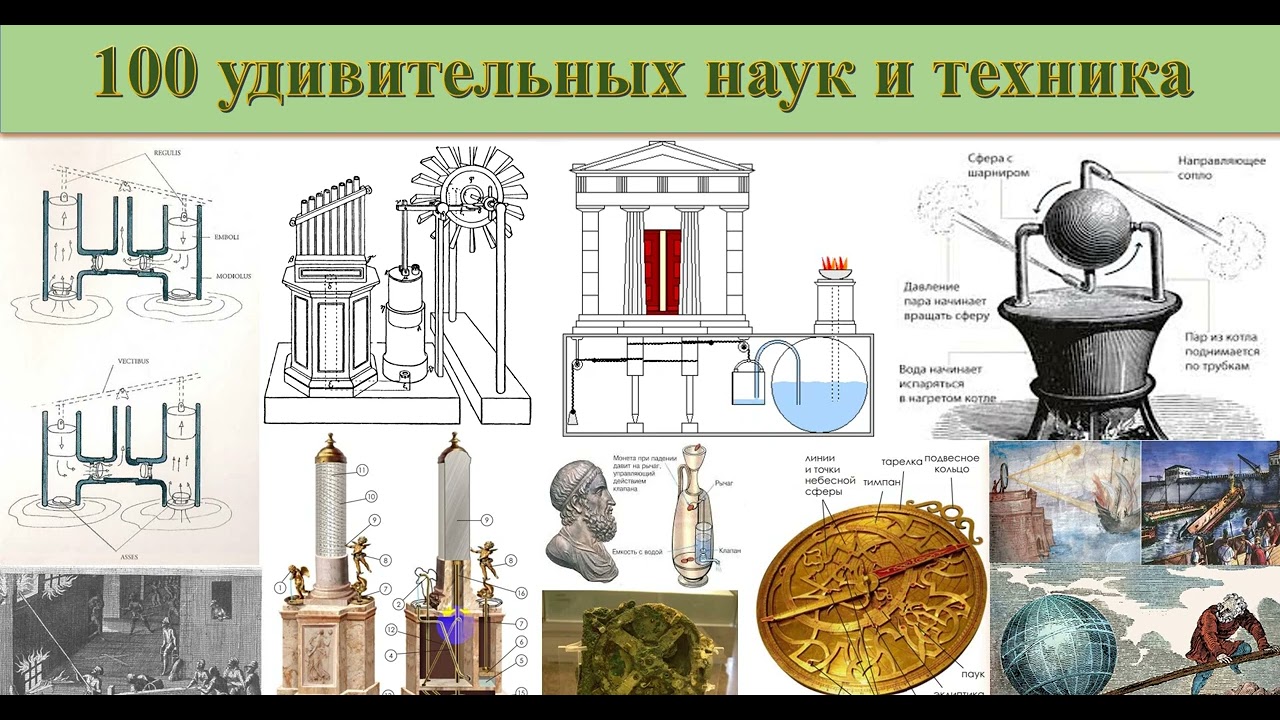













Ancient civilizations developed remarkably advanced technologies that rivaled or even exceeded modern capabilities, including Plato's water clock with alarm (427 BC), Zhang Heng's seismoscope (132 AD), Heron of Alexandria's automated doors and steam engine (1st century AD), Viking sun compasses and sunstones for navigation, the Antikythera mechanism (an ancient computer with 37 gears), Egyptian binary arithmetic, and Persian yakhchals (ancient refrigeration systems). These innovations demonstrate that ancient engineers solved complex problems using ingenious mechanical principles long before similar technologies became common in the modern era.
Ancient Technologies and Inventions That Were Ahead of Their Time
Added:A general timeline of major ancient civilizations, specifically the Hellenistic period, ancient Rome, ancient Egypt, and ancient China.
Fundamental concepts of physics and mechanics, including simple machines (gears, pulleys, levers) and basic fluid dynamics (hydraulics and pneumatics).
The concept of historical preservation and transmission, including how technological knowledge was lost, recorded, or translated across different cultures.
The socio-economic factors, such as the reliance on slave labor and lack of advanced metallurgy, that prevented ancient inventions (like the steam engine) from initiating an early industrial revolution.
A deep-dive study into specific ancient marvels, such as the Antikythera Mechanism, Heron of Alexandria's automata, and Ctesibius's water clocks.
The principles of Experimental Archaeology, exploring how modern scholars physically reconstruct and test ancient devices to understand their manufacturing processes.
Historiography of science and technology, specifically examining the 'linear progress' narrative and why some technologies disappear and are reinvented centuries later.
2M views26.4Klikes27:13Original Release: 2021-07-09
- [Narrator] In our modern world, it's easy to think we've got technology all figured out.
But while we've come along leaps and bounds over the centuries, our ancient ancestors were surprisingly much further ahead technology-wise than we generally assume.
From ancient automatic doors to 2,000-year-old computers, stay tuned for some truly amazing ancient technologies that were way ahead of their time.
(upbeat music) Archaic alarms.
Whether it's on your phone or a good old-fashioned clock, we all dread our early morning wake up alarm.
But as much as you might hate it, you can't deny it's useful.
Many of our ancient ancestors had to rely on first light or the caw of the local rooster to wake them up.
But what if you need to get up earlier than all those natural wake up calls?
Well, surprisingly, the idea for an awakening device can be traced back as far as 427 BC.
This nifty piece of tech takes us back to the day of ancient Greek philosopher Plato.
Now, what with laying the foundations for many of our ideas about modern society and philosophy, Plato had a pretty tight schedule.
So to make sure he was always up on time to share his ideas with his students, he's recorded as having possessed a large water clock with an alarm signal that rang out when it was time to rise.
But hang on. Rewind.
What exactly is a water clock anyhow?
Was it some kind of Greek prank involving waking someone with a soaking from an icy bucket of water?
I mean, that would definitely work, right?
Well, not quite.
You see, in ancient Greece, clocks weren't actually a new thing.
Though they didn't look anything like the ones we see today.
Water clocks like Plato's drew inspiration from an even earlier invention of the ancient Egyptians who are thought to have had timekeeping devices from as early as 1417 BC.
Crazy, right?
Back then water clocks were stone vessels with sloping sides that allowed water to drip at a constant rate from a small hole at the base with markings that allowed the user to keep track of time as the water level lowered.
In Plato's ancient Greece, their version of the water clock was called a clepsydra, derived from the Greek meaning water thief.
Unfortunately, specific details of the actual alarm function on Plato's device is unclear.
Aside from it emitting a sound like a whistling kettle. (kettle whistles) However, there is documentation about a different alarm clock invented by another Greek inventor, Ctesibius, in around 250 BC.
Building on the ancient Egyptians' water clocks, Ctesibius's version was fitted with a gear-operated pointer and added an elaborate alarm system that caused pebbles to drop into a ringing gong device at preset times.
If only it had had a snooze button.
It worked in much the same way as an hourglass does, but with water instead of sand.
Water would flow from a source through a small precisely measured hole into a larger vessel with a buoyant rod floating in it.
As the water level in the larger vessel rose, so did the rod, which pushed a pointer along a time indicator at a constant hourly pace.
The Romans later built upon this by incorporating a clock face, marked with Roman numerals, which resembled our modern clocks more closely.
At specified times, the hands of Ctesibius's design would push a pebble onto a bell or gong, (gong ringing) functioning as a much gentler alarm than say this.
(alarm beeping) Does anyone else feel like modern alarm tones come straight from the depths of hell?
But alarm sounds aside, Ctesibius's genius invention wasn't fully appreciated as anything more than a novelty until around 1,800 years later, when the mechanical alarm clocks we recognize today were invented.
Considering the principles behind Ctesibius's alarm clocks were still fundamentally similar to those of modern alarms, it's pretty surprising it took a couple millennia for the world to catch on.
Either way, the next time your alarm gives you a rude awakening, you know who to thank.
Or not.
If the fascinating capabilities of ancient folk like Ctesibius excite you as much as they do me. boy, do I have a treat for you!
Today's video sponsor, Curiosity Stream, is a streaming platform with thousands of incredible, expertly picked documentaries and nonfiction TV shows on topics ranging from ancient engineering to nature, science, tech, food, travel, and more.
This enormous collection of award-winning exclusives and originals are ready to stream any time, anywhere.
Available on any device, you can bring philosophy to your phone or stream super smart TV on your smart TV.
But here's the best part, using my code, BeAmazed, you can sign up for an entire year for only 14.99.
You heard that right. A year.
So do your brain the favor and subscribe to Curiosity Stream today.
All done? Great.
Now back to some mind-blowing ancient tech.
Early earthquake detector.
Earthquakes can be nothing short of terrifying.
Thankfully though, with today's modern technology, we're able to detect them in advance from thousands of miles away with the use of some nifty little gadgets known as seismometers.
Modern technology allows us to harness the use of electronic sensors, amplifiers, and recording devices to measure the shaking of the earth during an earthquake, giving us incredibly useful pre-warning systems.
While this kind of early detection technology might seem like an ultra modern invention, amazingly, ingenious methods of detecting earthquakes have been around a very long time indeed.
In the year 132 AD, Zhang Heng presented the world's first seismoscope to the Han court of China.
A brilliant astronomer, engineer, and mathematician, Heng was concerned about the destructive nature of earthquakes, having heard stories about one quake so powerful it diverted the courses of three rivers in 780 BC.
So clearly, detecting an earthquake early was a useful thing to allow some preparation.
But how would such sorcery work?
Well, seismographs are essentially super sensitive tools for measuring the motions of the ground during earthquakes and can be effected by even the slightest movement or sound.
So even modern versions, like the seismometer at the Black Forest Observatory in Germany, need super isolated, quiet places to function effectively.
But how did Zhang Heng achieved this kind of measurement without any electric tools?
Well, Heng's instrument was a large bronze jar, about six feet in diameter, surrounded by eight bronze dragon heads, each representing a direction of the compass.
Hanging above, eight open-mouthed bronze frogs at the base of the vessel.
If an earthquake were to strike, a highly sensitive pendulum inside the device would be disturbed, knocking a small, delicately suspended copper ball out of the mouth of one of the dragons.
This would land in the frog's mouth below, indicating the corresponding direction the disturbance came from, as far as hundreds of miles away.
Heng's invention must've seemed like sorcery at the time.
And even now, it's amazing to think how such a precise device could have existed almost 2,000 years ago.
These days, we're still using Heng's base principles.
Albeit, upgraded a little.
Our top seismologists now use quantum computers and AI that can detect the location and magnitude of an earthquake by measuring waves of energy traveling through the Earth's geological layers.
But in Heng's time, the precision of his instrument was arguably just as impressive as high-tech computers are today.
In the years following Heng's death, his miraculous machine was sadly lost.
But thankfully replicas still exist, though none have ever been able to fully replicate the original's reported accuracy.
Still, I'm not sure I'd wanna be there to see a fully accurate one in action.
(gentle music) Divine automation.
Gods and goddesses were a source of total fascination for people of the ancient Greek culture.
And everyone wanted to see godly miracles with their own eyes.
In the famous Greco-Egyptian city of Alexandria during the 1st century AD, this wish was about to be granted.
But it wasn't exactly the gods who were behind it.
You see, one of the most impressive inventors of the period was Heron of Alexandria.
A Greco-Egyptian mathematician and engineer, now considered to be one of the greatest inventors of all time.
He came up with some pretty wacky innovations that many at the time believed to be the work of real magic.
In one such invention, simply named machine 37, the magic created was, in fact, the first version of what we now refer to as automated doors.
Looking for a way to add a little wow factor to their prayer hour, priests of the city employed Heron to spice up their temple doors.
Heron's idea was a door opening feat of engineering brilliance.
Priests would light fires on altars positioned by the closed temple doors, initiating a secret chain of events just underneath the feet of the expectant congregation.
Concealed brass pots were suspended under the burning altars, part filled with water and connected via pipes to other containers, which acted as counterweights to a pulley system.
As the fires grew hotter, the air pressure inside the brass pots would increase, forcing the water through the pipes and into the counterweight containers.
These containers would slowly descend under the increasing weight of the water, dragging the pulley ropes and slowly, but surely, opening the doors in front of a wowed crowd.
All of this was topped off (trumpets tooting) with the sounding of a fanfare, as some of the elaborate system's compressed air was automatically blown through a trumpet as the doors opened.
While the process could be rather slow, it was enough to mesmerize audiences of Alexandria.
And Heron's status as a miracle worker saw him install similar automatic doors in numerous temples and city gates.
Ultimately, however, Heron's contemporaries decided it was easier and more time and cost-effective to open the door using human hands and his miraculous devices fell out of favor.
Astoundingly, it wasn't until almost 2,000 years later in 1931 that humanity rediscovered the magic of automatic doors.
This new take on Heron's forgotten invention began in a Connecticut restaurant, using an electrical optical sensor to automatically open motorized doors for waiters juggling trays of food and drink.
Since this pivotal re-invention, the automatic door has become a staple of people's everyday life and is definitely here to stay.
It's pretty neat to think that, while we tend to electricity is responsible for making automated technology possible, inventors like Heron prove that this isn't exactly true.
Still, you have to wonder what kind of amazing stuff Heron would have come up with if he'd had access to some electrical wires, a soldering iron, and a circuit board.
My money's on laser-blasting jet pack mech suits.
Primitive pathfinders.
Nowadays, we're lucky enough to have directions to just about anywhere at the tip of our fingers with apps like Google Maps.
It's pretty crazy to imagine how much work went into navigation, even just a few decades ago, let alone in ancient times.
But few people realize that even before the basic seeming encompasses we recognize today, the sea voyaging Vikings were masters of direction-finding tools.
The Vikings were very capable sailors and dominated the seas of Northern Europe from around 800 AD to the 11th century.
Their ships were highly advanced, compared to other parts of the world at the time.
The Viking long ships were fast, durable, and capable of navigating both choppy seas and shallow rivers.
But even with the best boats, they still needed to be able to master the art of navigation.
So how did they do it?
Well, in 1948, an ancient Viking relic was discovered just off the western shore of a Greenland fjord, known as Uunartoq, that seemed to answer that question.
The artifact itself, which became known as the Uunartoq disc, was a fragment of a wooden circle with angular notches carved around the perimeter and a hole in the center.
And back when it was still in use, it's thought that the complete artifact looked something like this.
Despite its unusual appearance, the device is believed to be an early non-magnetic equivalent of a compass.
This ancient version being known as a sun compass.
The sun compass had a central pin that cast a shadow in sunlight, as well as different carved lines for usage at different parts of the year, as the sun's path across the sky varied.
When the disc was held flat, the point at which the pin's shadow intersected the corresponding line for that part of the year could be used to determine which direction was north.
At high noon, north always occurred with a perfectly straight shadow at right angles to the center of the lines.
At any point before or after noon, the point at which the pin's shadow touched the line could still be used to find north.
This is because, when the disc was held correctly, the central point of the carved lines always pointed north, relative to the point where the shadow touched the line.
With due north calculated, it was simply a matter of plotting a course.
The direction of which could be marked with a thicker, secondary pin.
But what about when the weather was cloudy or foggy?
And when there was no sun to help direct them?
Well, Danish archeologist, Thorkild Ramskou, suggests Vikings used, of all things, crystals to find the sun in the sky.
Known as Viking sunstones, scientists now believe that these navigating devices were made from an Iceland spar, a transparent crystal made of calcite with some pretty impressive properties.
Due to a phenomenon called the birefringence, Iceland spar splits up rays of light that pass through it into two beams.
This causes a double image to appear when looking through the crystal.
And the brightness of each image depends on the crystal's orientation relative to the light source.
Fascinatingly, marking the crystal with a dark dot, perhaps using charcoal, a Viking would have been able to move the spar in front of their eye across the sky until parts of the double image were of equal brightness.
When both images were equally bright, it meant the crystal was pointing in the direction of the sun.
Using this, they could then work out where the shadow would be cast on their sun compass and extrapolate that info to work out which way was north.
If the Vikings were clever enough to use these materials for navigation, you can see why they were so intimidating to simple European village folk.
Well, aside from the huge swords, burly beards, and love of pillaging, that is.
Relic computers.
As strange as it sounds, parts of the ocean are overflowing with information about human history.
One discovery of the oceanic variety, however, is so mind blowing that some believe only aliens could be responsible.
In 1901, a team of archeologists diving off the coast of the Greek island of Antikythera stumbled upon an ancient shipwreck containing an incredible unique artifact that would stump scientists for decades.
The Antikythera mechanism.
While the eight-inch hunk of bronze found in the wreck looked like any other piece of rubble you'd find in a shipyard, scientists knew from the first glance that there was way more to this mystery machine.
Over the past few decades, experts have begun to crack the code to this mysterious relic, with some expressing genuine shock that the type of technology inside the mechanism existed over 2,000 years ago, when it was made.
The extremely intricate machine contains 37 gears of varying sizes and shapes with teeth edges cut extremely precisely.
These gears are thought to have worked together in a series of semi-automated processes with such complexity that experts have dubbed the find the world's first computer.
So what exactly did the Antikythera mechanism do?
Well after many, many years and many, many different expert opinions, it's been determined that this so-called computer was able to perform tasks like tracking the calendar, predicting solar eclipses, and determining the time between the Olympic Games.
Using the myriad of gears and the switches, the hand-powered device functioned somewhat similarly to a mechanical model of the solar system, only with many more variables.
The user could use a lever to wind the mechanism backward and forward, allowing it to describe the movement of the heavens, including the irregular path of the moon.
This level of mechanical complexity really blew experts out of the water.
Especially given the fact that mechanisms of similar sophistication weren't developed again until the mid 1300s AD.
This gap of technological development has led some to conclude that the Antikythera mechanism must have been dropped off by aliens.
But come on, guys, have a little faith in humanity.
Over 2,000 years before the first MacBook, it's incredible to think that the ancient Greeks were producing machines that could accurately predict future outcomes based on simple inputted commands.
But the Greeks weren't the only ones who touched on aspects of the computer age several millennia before it came into full swing.
It turns out the ancient Egyptians were unknowingly developing aspects of computer code with their number calculation system.
Egyptian mathematicians carried out their multiplications through a system that kept things simple by only involving doubling, having, addition, and subtraction, with no decimal places.
Intriguingly, the algorithms Egyptians followed in this method, revolving everything around the powers of two, are essentially identical to those used in binary arithmetic, which is the system modern digital computers use to process numbers and tasks.
While ancient Egyptians were likely only attempting to calculate things like how much grain their customers owed them, rather than trying to code a new Egyptian computer program, they were unwittingly laying the foundations of a system that spawned the computer age we live in today.
Steam power.
We often associate steam power with the Industrial Revolution of the 18th and 19th centuries.
But few people realized it was actually being utilized way back by our old pal, Heron of Alexandria.
It's true.
That Greco-Egyptian genius is responsible for another technology that later transformed the world, the steam engine.
Heron's notes dating back to the 1st century AD, described something he referred to as an aeolipile, or wind ball.
This strange contraption featured a sealed cauldron of water that was mounted over a heat source, with sealed pipes, leading to a central brass sphere on an axis.
While the central water container was heated, steam would build up inside, increasing pressure within the contraption.
Two cleverly positioned funnels let the steam hiss out of the ball, acting as propellers and moving the ball around and around.
While the potential implications of being able to convert heat into automated movement were massive, yet again, Heron's ideas were treated as little more than a party trick.
The aeolipile was deemed a mere curiosity.
And with no one taking the interest to develop it into something useful, it took all the way until the 18th century for the first commercial steam engine to come into use.
This engine, invented by Thomas Newcomen, worked on very similar principles to Heron's ancient original.
And, after its invention, triggered the revolutionary developments of factories, steam engine trains, and steamboats, isn't it crazy that we had the knowledge to kickstart the Industrial Revolution 2,000 years ago?
Just think of what the world would look like today had Heron's idea been picked up, instead of sitting there, collecting dust.
And, on that thought, do you think there's any technology today that we aren't using to its full potential?
Let me know in the comments.
Vending machines.
(gentle music) These days, you can get pretty much anything from vending machines, from snacks and soda to umbrellas and even mashed potato.
In our technological age, it's hard to imagine how a vending machine could possibly have existed in ancient society.
But hold onto your loose change because, unbelievably they did.
Picture this, we're in 1st century Roman Egypt and there's a problem brewing at the local temple.
You see, back then, people were expected to pay coin to the temple for their fill of holy water for use in prayer and worship.
Only it turned out that people were taking a lot more than their fair share they paid for.
To combat this, a holy solution was needed.
Enter our boy, Heron of Alexandria, again, with an invention that allowed the constant, fair, and, most importantly, paid usage of holy water, which happens to be credited as the very first coin-operated vending machine.
So how did it work?
When arriving for prayer, patrons would deposit a coin into a slot on Heron's creation, which looked like an unassuming piece of pottery from the outside.
Once in the contraption, the coin fell onto a pan attached to a lever.
The coin's weight moved the lever, which, in turn, opened a valve, allowing water to flow out until the coin naturally slid off into a collection pot.
With the coin's weight no longer present, a counterweight snapped the lever back into place, reclosing the valve and stopping the water.
Pretty nifty, huh?
Despite the ingenuity on show, the concept of the vending machine didn't really take off for many, many more centuries.
And the first modern vending machines didn't arrive 'til the late 1880s.
Even then, mechanisms similar to Heron's were still used until the onset of electrical power spawned the candy-packed, brightly-lit versions we know today.
So the next time you feel the urge to grab some chips from the machine, just remember what a sacred experience it really is.
Relic refrigerators.
The kitchen mainstays that are refrigerators as we know them have only come into existence over the past 100 years.
You might assume that, before this convenience, people had no other choice but to turn to other methods to preserve food, such as curing and drying meats to prolong its edibility.
But astoundingly, some ancient engineers were able to master the technique of storing ice.
And, of all places, right at the heart of the Middle Eastern desert.
The ancient Persians were one of the first civilizations to invent a large-scale chiller, doing so by around 400 BC.
These enormous structures, known as yakhchals or ice pits, could be used not only to store ice, but to make it too, by taking advantage of the low humidity and cool nighttime climate of desert land positioned at high altitude.
Water and ice, some of which was occasionally brought in from surrounding mountains, were stored in underground container space, which would freeze overnight as the desert temperature dropped below freezing.
Once the water was frozen, it would be cut up into blocks so that water could easily be transported out of the yakhchal for drinking and other purposes.
This ancient precursor of the modern refrigerator had a conical structure, which guided hot air upwards and outside through openings at the top.
Meanwhile, wind catchers, some of which were amazing looking structures in their own right, were placed on either side of the structure to allow cool air to continually pass into the dome and down into the water and ice storage space.
All of this clever cooling was further enhanced by the low humidity of the desert, which encouraged evaporation of the stored water, which, in turn, caused a cooling effect of its own.
Yakhchals were made from a mixture of clay, sand, ash, goat hair, and lime, forming an incredible waterproof insulator.
Meaning, even in the hot sun, any temperature increase within the dome was minimal.
It's pretty amazing to think that effective refrigeration could be produced using such surprisingly simple methods.
Yakhchals have even been suggested as a sustainable alternative to modern refrigerators in Iraq and other Asian communities.
With all of us trying to cut back our carbon footprints, it seems that obvious solutions are staring us in the face.
Sometimes, it seems, it's just a matter of looking back to the geniuses of the distant past for answers.
What other amazing ancient technologies do you know about?
Are there any technologies used today that you think are ahead of our time?
Let me know in the comment section below.
Thanks for watching. (upbeat music)
Up Next

187:08
Solar Science for Kids: Sun Power, Space & More
@ScholasticAfterSchool
140.8K views•2024-04-07

26:22
Walking in the City: Urban Rituals and the Flâneur in Contemporary India
@PSBTIndia
1.9K views•2016-08-02

9:49
FastAPI vs Flask vs Django: Choosing the Right Python Web Framework
@TechWithTim
302.5K views•2024-05-26

1:42
Game of Thrones Opening Credits: A Cinematic Analysis
@gameofthrones
46.3M views•2011-04-18
Related Study Plans & Knowledge Roadmaps
Structured learning paths in General & Interdisciplinary Studies
general-studies
Artificial Light: History, Tech & Human Impact
01The Pre-Electric Era: Fire, Oil, and Gas Lighting
02The Incandescent Revolution and Grid Electrification
03Gas Discharge and Fluorescent Illumination
+ 3 more learning modules
14h6 modules
Explore Roadmap
general-studies
Elevator Engineering: History, Physics & Cities
01From Hoists to Safety Brakes: The Dawn of Vertical Lift
02Hydraulic vs. Traction: The Engineering Physics of Elevators
03Modern Speed, Safety, and Algorithms
+ 2 more learning modules
12h5 modules
Explore Roadmap
general-studies
Rubber: Material Science, History & Geopolitics
01Origins of Natural Rubber & Mesoamerican History
02The Chemistry of Natural Rubber & Vulcanization
03The Geopolitics of the Rubber Boom & Colonization
+ 2 more learning modules
12h5 modules
Explore Roadmap
general-studies
Containerization: Evolution, Logistics & Trade
01Ancient Trade & Bulk Cargo: Amphorae to Barrels
02The Industrial Revolution & Cardboard Packaging
03The Containerization Revolution: Malcom McLean
+ 2 more learning modules
12h5 modules
Explore Roadmap