










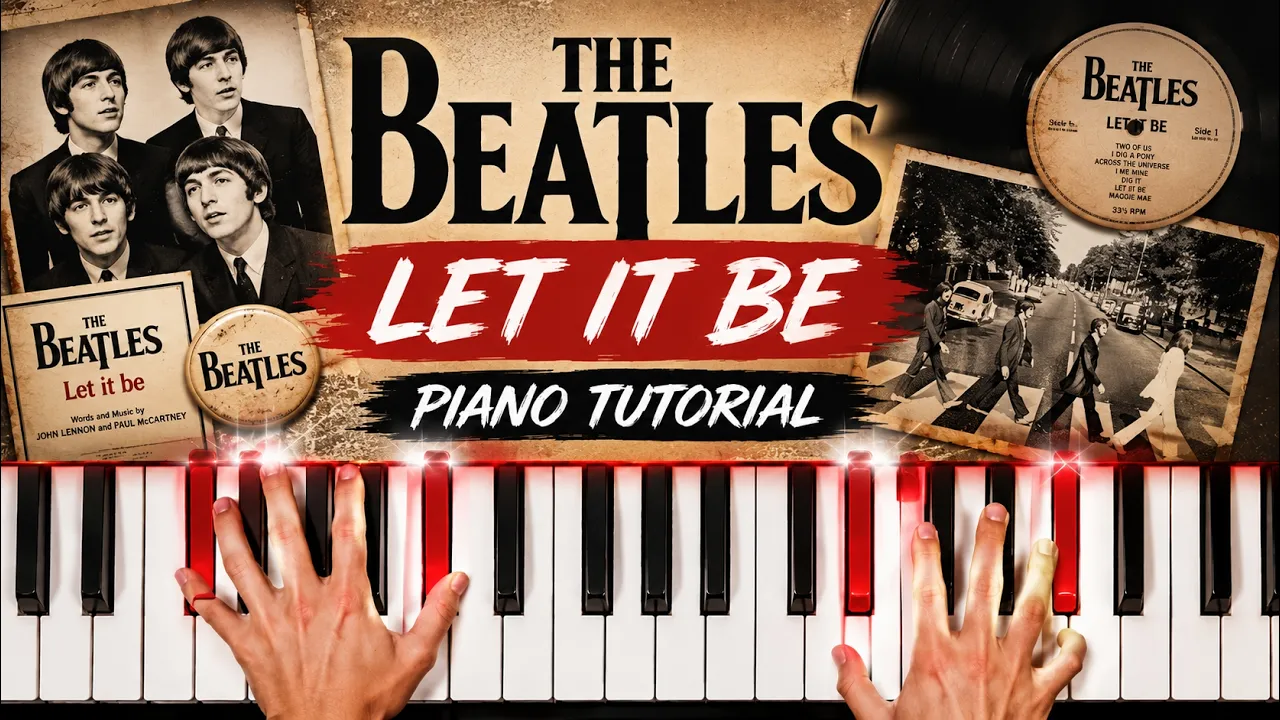










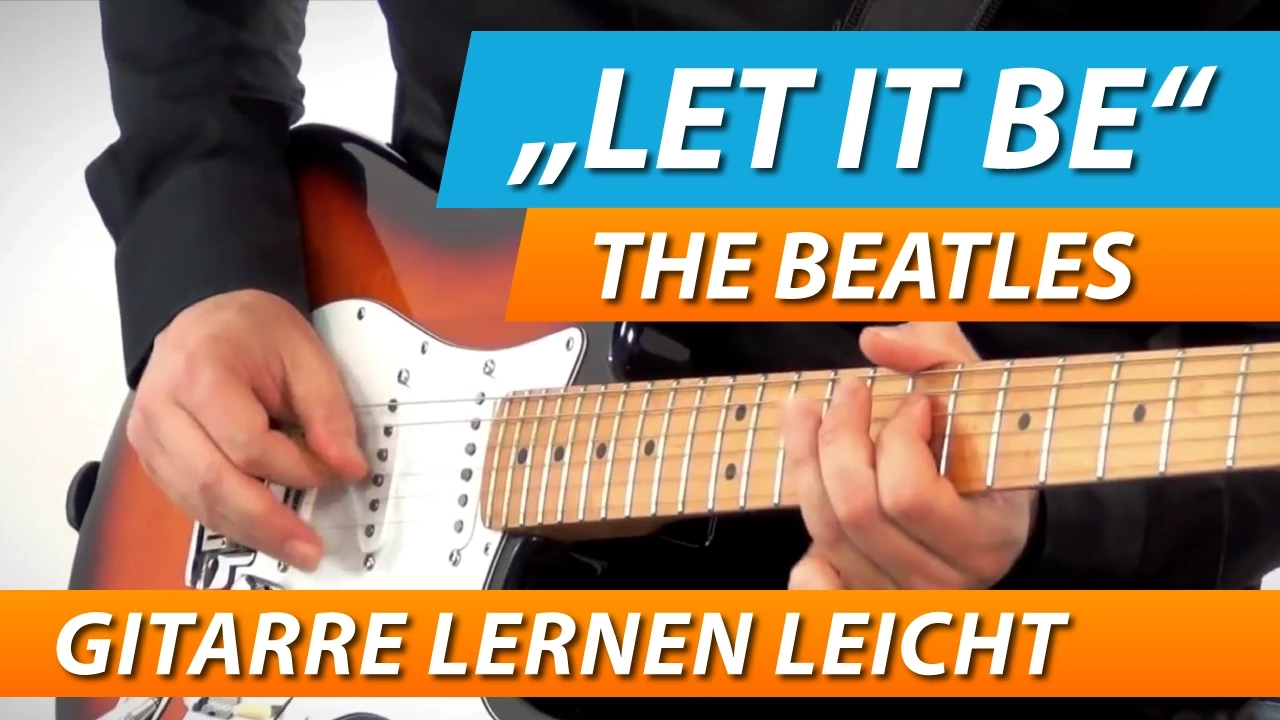
This tutorial teaches how to play "Let It Be" by The Beatles on piano using chord progressions, starting with basic single-note bass chords (C, G, A minor, F major seven) for beginners and progressing to intermediate techniques including passing tones, walking bass lines, and octave playing; the core progression moves through C-G-A minor-F major seven, with variations like adding F-sharp passing tones between chords and using inversions to create a fuller, more authentic Beatles-style sound.
Let It Be Piano Tutorial: Chord Accompaniment in 3 Levels
Added:Basic keyboard geography, including identifying white and black keys and their corresponding note names (A through G).
The fundamental construction of major and minor triads (root, third, and fifth notes).
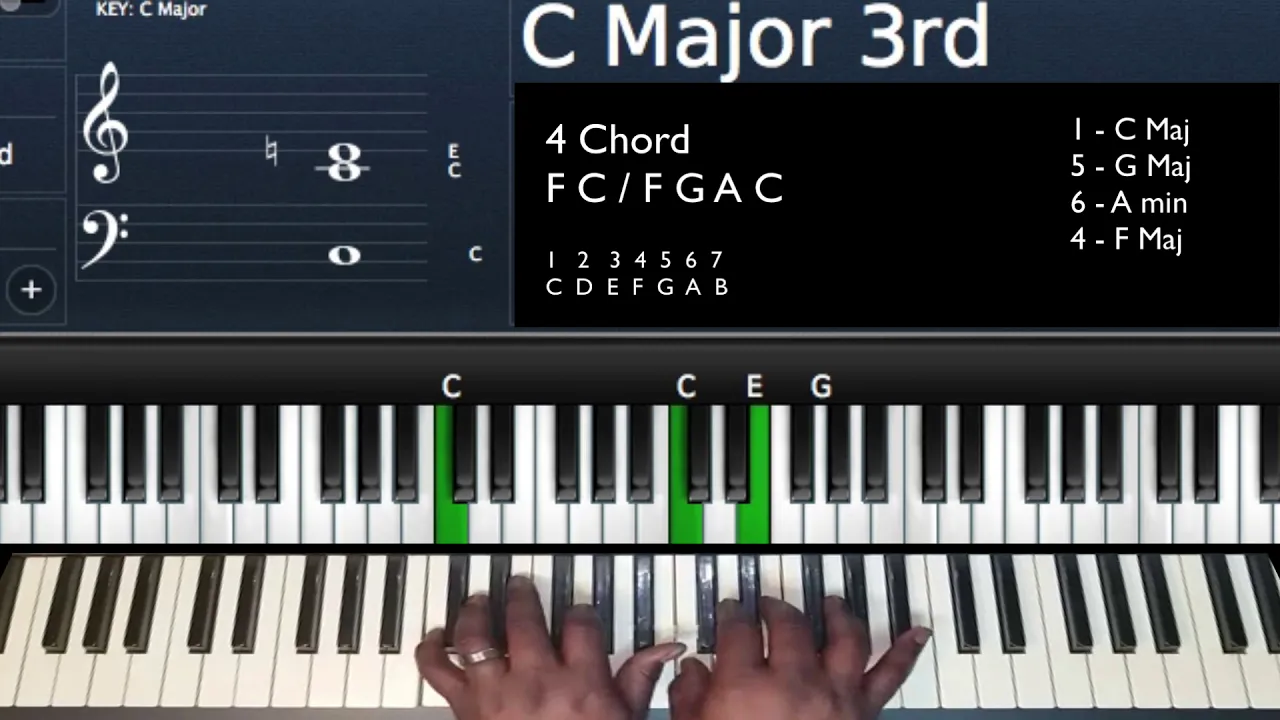
Familiarity with the C major scale and its primary diatonic chords (C major, G major, A minor, and F major).
Basic rhythm and time signature concepts, specifically how to count and maintain a steady 4/4 time signature.
Integrating the vocal melody of 'Let It Be' into the right-hand accompaniment while maintaining the chordal structure.
Exploring advanced chord extensions and embellishments, such as adding sus4, add9, or major 7th tones to the progression.
Applying the 3-level accompaniment framework to other famous pop/rock songs that use the same I-V-vi-IV chord progression.
Developing basic improvisation techniques using the C major pentatonic scale to create melodic fills between chord changes.
Transposing the 'Let It Be' chord progression into different keys to build keyboard fluency and transpose skills.
295.6K views6.2Klikes23:46Original Release: 2022-04-17
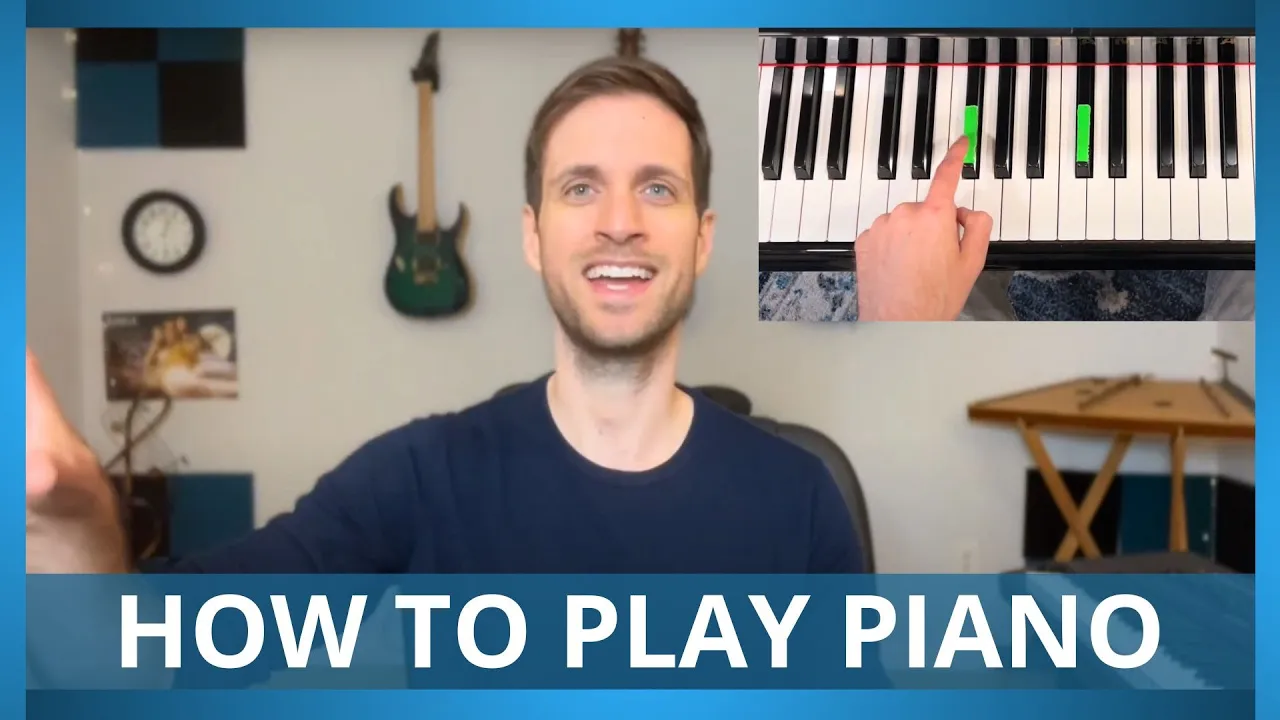
[Music] hey it's nate and today we're gonna do a piano tutorial for let it be by the beatles this is a really special one for me it was the first song i learned with chords on piano uh my dad taught it to me when i was probably eight or nine it was also the first song i ever performed live i sang it in the middle school talent show in 7th grade with my band immature youth [Music] i posted the whole thing if you want to check it out we'll start with the foundation in a way you'll be able to play even if you're a beginner but it'll still sound satisfying and then we'll build on that in a few layers to get it to the point where it really sounds like the beatles recording let's just jump in [Music] we'll start off with the chords for the intro and the verse and i put a link to a chords and lyrics chart down in the description i recommend getting that that'll help you follow along and see where the chords line up with the words you sing here's how i have the chords notated for the intro and you're going to play the same thing in the verses as well now just at first let's simplify it slightly so for the c major chord we've got a c an e and a g in the right hand we'll just do a c in the left hand so we're just playing single bass notes on the root the note the chord is named after after that we're going to go down to a g major chord and it's going to be g b and d once again just hitting a g in the left hand nice and low so it feels powerful we're going to step up to an a minor chord still all white keys so a in the left hand and that's gonna be a c and e in the right hand now for the f major seven conveniently you can just keep that a minor chord going in the right hand and just change to an f bass note that kind of gives you the f major seven chord sound but you only have to play three notes in the right hand let's stick on this one line for a sec we're in four four times so every measure gets four counts it's a pretty fast four four time we're thinking one two three four one two three four one two three four one two three four and i'm gonna do half note hits with my right hand so each chord in the right hand lasts for two counts so it's gonna be like one two three four one two three four one two three four one two three four just holding the left hand base notes but doing two hits per measure in the right hand you can already start hearing the song in there when i find myself in times of trouble mother mary comes to me now if we do the next line just keeping it simple just the basic chords here we've got c c then g g again and then you can just go down to an f here f a c f two and then you can go down to this c we're gonna do the in a minute but if you just wanna keep it super simple you could just do f two c two i'm gonna add a second layer of difficulty here here's where it really starts to sound like the song between the c and the g we're gonna add a little passing tone we're gonna do an f sharp so the black key there and we're gonna do it we need to think about eighth notes so that space between the counts one and two and three and four and we're gonna do one two three four and one so just right before you go to that g um on the recording paul sometimes hits an f instead f you can do what sounds better to you i originally learned it with the f sharp um and that's what i'm used to so i'm just gonna do it that way every time i think paul changes it up so we got one two three four and one two three four one two three four um so between the a minor and the f major seven we're gonna do a little passing walk down in the left hand on the g so you see in the chord chart it says a minor over g there um and that's on beat four one two three four and i'm just hitting the right hand chord an additional time there to just sync up with the left hand walking down so there's a little bit more rhythm happening in that measure one two three four one two three four so that's the final variation there it's the f6 so here's the f major seven that's the seventh and then we're stepping it down to the sixth and that's on the second half of that measure one two three four i'm gonna do that all one more time one two three four and one two three four one two three four one two three four sounds like let it be side note if you're doing this and it doesn't sound as smooth as what you hear here it might be because i am using the pedal i'm pressing down the sustain pedal the whole time except doing a quick little lift every time the chord changes lift lift so for the second line it starts the same way and then for that f to the c notice there's the little asterisks there that's because something fancy happens it's gonna sound like this now what's happening there is pretty simple it can be a little tricky to execute though in the left hand we're walking down from an f to a c so it's f e d c and the timing on that is one two three four one two three four in the right hand we're also just gonna be stepping down but from a down to e and i like to start it on my fourth finger here that way you end up on your thumb and it just kind of feels nice and even so in my left hand i'm starting on my second finger right hand i'm starting on my fourth finger f and a one two three four one two three four i promise it'll feel easy once you get the hang of it but if it's tripping you up just go really really slow keep the hand separate at first and just kind of map it out take your time it'll click so i'm just gonna play through the intro and the first verse with the piano arrangement as we have it so far when i find myself in times of trouble mother mary comes to me speaking words of wisdom let it be and in my hour of darkness she is standing right in front of me speaking words of wisdom let it be let it be and then we would be going to the chorus all right now i'm going to add one more layer to that piano part this will be the more intermediate one although this really blurry lines between beginner intermediate and advanced anyway main difference here is we're going to be approaching the left hand with octaves and adding a little bit more rhythm so once you're doing more than one note at the same time in your left hand it opens up some possibility for rhythm so we've been playing on beats one and three with the right hand with the left hand you're also going to be playing on beats two and four just being kind of loose with it going back and forth you know sometimes paul does it with the high first and then the low sometimes the low and then the high um he switches it up he probably played it different every time he ever played the song um i'm mostly i'm gonna do high first because it's what comes more naturally to me so it's gonna look kind of like one two three four and that one i'm just gonna do the single bass note with the second finger that flow is really nice to get your thumb on the g4 one two three four one two three four one two three four so notice after the a octaves i just step down single fingers one two three four one two three four and i was kind of keeping that rhythm going by hitting the single f on beat two and four one two three four just makes the rhythm feel like it's moving a little bit more one two [Music] and we can do this part the same way a couple final details i'll mention here dynamically he does something really cool where he actually kind of accents it on beat three so not on the downbeat of the measure like one two three four like that chord really pops out one two three four and one two three especially on the c at the beginning one variation you could do at the end of the first line is instead of doing the two f's and then going back to the c you could do and then do the high octave and then the low one he does that pretty often in the recording it sounds good final thing i'll mention is throughout the song when things are ever kind of waiting like at the end of two three four and you're kind of holding and ready for the next thing he'll just go like two three four um as the song gets more intense he actually does like one two and three and four and um so you can just kind of hit extra rhythms where you want and if it feels like i'm being really loosey-goosey with this it's because you know he played a different every time uh it would be such a long video if i tried to tell you note for note how the beatles recording you hear on the album uh was played and it would just be a waste of time because um the next time he played it it was different so i just want to give you the tools to play around with it the way he always was so now i'll play through the intro and first verse with these editions when i find myself in times of trouble mother mary comes to me speaking words of wisdom let it be and in my hour of darkness she is standing right in front of me speaking words of wisdom let it be let it be all right it's time for the chorus knowing what you now know learning the chorus will be easy i'm gonna strip it back down to level one it starts with the a minor so a c e we're doing it in the verse let it be let it be this is uh c over g so we're stepping down to g in the left hand in the right hand we're gonna do g c and e so this is a c major chord right we just took the g and brought it down here but you can more just think of it as you're doing the a minor chord and then you just step the bottom note down then we've got a f let it be we're going to do an inversion on it so i step down to the f root here for the bass note but in the right hand we're going to do a c and f so it's just an inversion on an f major chord and then we've got let it be back to c and then the second line of the chorus is the same as the second line of the intro and verse whisper words of wisdom let it be so here's the chorus with the level one piano part let it be let it be let it be let it be whisper words of wisdom let it be and the level two would just be adding some of those octaves and rhythms in the left hand let it be let it be let it be let it be whisper words of wisdom let it be okay we're in good shape here the only other section is the interlude section which also happens in the outro that's the part's really fun it's a lot of stepping down in harmony between the hands does the same rhythm we've done at the second line of all the other sections so far that one two three four one but it loops into itself like one two three four one two three four the left hand is going to be stepping from f to f with one little caveat which is that the b is flat we do the black key b flat instead of the b so it's gonna look like this one two three four one two three four one two three four there's a million ways you could do this you could just do one finger one two three four one two three four one two three four if you've taken piano lessons and have done scales and have the muscle memory for crossing your thumb under that is a good thing to do here cross there and you probably are hearing it's not complete right there's a jump from the f down to a c to finish it off so f to f b flat instead of b and then c [Music] in the right hand very similar idea but we're going from a down to a and we're not doing the b flat for that one we're going to do the b for that one very tricky those beetles for the fingering i'll probably go five four three two one cross third finger over three two one and that's where the jump happens um the a jumps down to a e for that final moment there notice that's a c major chord well we don't have the g yet but that's the harmony that's happening there if you kind of fleshed it out take your time with your hands separate to get the muscle memory and get a sense of which fingers you're using because if you're tripping up one hand at a time you're really going to trip up when you put them together so get used to it first but it's gonna sound like this and on the beetles recording that's where that organ comes in it kind of does the same thing again but it's nice and high satisfying i'm just gonna take it up an octave and do [Music] and that takes us into the guitar solo section which is just like a verse in terms of the piano part but maybe you've got a friend that can do the guitar solo over it but if not i think the piano part is engaging enough to just let it go around for one instrumental pass with the piano being the sole focus and the outro that ends the song is just one time through that in the lower octave although on that final hit i'm gonna do just the full c chord probably just so it feels a little bit more like it's landed in a thick solid place hey guys real quick just want to say if you are enjoying this piano lesson and you want to get better at taking these simple chord progressions and turning them into more interesting recognizable piano parts you might like my course piano chord breakthroughs where i walk through lots of tricks for doing that the kind of tricks where well if paul mccartney didn't know any of these tricks the piano part on the let it be recording might have been like i put links down in the description check it out quickly one more layer of potential details if you came here thirsty to make it sound as much like the way paul mccartney plays it as possible a lot of that comes along with the those sections now he doesn't do that exactly i think that is a very satisfying way to play it that is not too hard on the recording in the intro instead of that he goes so actually the left hand is just hanging out on the root the f and the c and the harmony is happening in the right hand the top part of the right hand well kind of holding down that c and then the verses he inverts it so the a starts on the bottom you're doing it kind of like that it's like speaking of inversions there's a lot of inversions that i was not doing that happen on the recording at least the first couple passes of the piano part at the beginning he's not doing that root position c major chord he's doing it inverted down once with the e is the highest note and then also an inversion of this g with the g is the highest b d g he actually does this inversion of the g a lot throughout doesn't sound that much better to me he doesn't do it every time so i didn't want to make it too complicated for the main part of the tutorial and on the chorus again you can switch up the inversions we've got this part we're already doing that inversion for the f but you might want to do this inversion of the c and then of course you can do that inversion of the g with a high g and then maybe you're going to be doing the but i'm not even gonna sweat doing those variations in my cover um i'm gonna focus on singing and finally for the interlude like when you go up high with the organ there's a little more harmony and rhythm going on on the recording it's like so again just like the intro putting both notes of the harmony in the right hand while kind of staying steady on a c here and doing this little rhythm this back and forth thing one two and three and four and and then hitting like an inversion of c here one two and hitting an inversion of b flat here with the thumb going to have and then once you get to the g's just kind of hitting that inversion and holding it and then down to c anyway i didn't want to leave anything out on this tutorial because this song is important to me but i don't think that these advanced parts are super important to the song all right thank you for watching this far i'm going to do a full cover now so you can see how all the different parts that we just learned fit together in a full performance of the song i'm mostly going to be playing with the level 2 piano part if you enjoyed this consider the prospects of subscribing um hit that little weird bell thing next to it so you know when i come out with new videos like it give it a like and let me know in the comments what song you want to hear next alright here's my version of let it be [Music] when i find myself in times [Music] and in my hour of darkness she is standing right in front of me speaking words of wisdom let it be let it be let it be let it be let it be whisper words of wisdom let it be and when the brokenhearted [Music] let it be for though they may be parted there is still a chance that they will see there will be an answer let it be let it be let it be [Music] let it be let it let it be let it be [Music] so [Music] [Music] let it be let it be and when the night is [Music] let it be i wake up to the sound of music [Music] let it be [Music] let it be let it be let it be there will be an answer let it be let it be let it be let it be [Music] let it be [Music] you
Up Next
6:46
Drops of Jupiter Piano Tutorial: Learn Intro & Verse (Train)
@HDpiano
845.7K views•2014-01-05

12:54
Triumph of Orthodoxy Icon: Byzantine Art & History Explained
@BenCallan
2.1K views•2024-08-06

9:49
FastAPI vs Flask vs Django: Choosing the Right Python Web Framework
@TechWithTim
302.5K views•2024-05-26

1:42
Game of Thrones Opening Credits: A Cinematic Analysis
@gameofthrones
46.3M views•2011-04-18
Related Study Plans & Knowledge Roadmaps
Structured learning paths in General & Interdisciplinary Studies
general-studies
Elevator Engineering: History, Physics & Cities
01From Hoists to Safety Brakes: The Dawn of Vertical Lift
02Hydraulic vs. Traction: The Engineering Physics of Elevators
03Modern Speed, Safety, and Algorithms
+ 2 more learning modules
12h5 modules
Explore Roadmap
general-studies
Rubber: Material Science, History & Geopolitics
01Origins of Natural Rubber & Mesoamerican History
02The Chemistry of Natural Rubber & Vulcanization
03The Geopolitics of the Rubber Boom & Colonization
+ 2 more learning modules
12h5 modules
Explore Roadmap
general-studies
Containerization: Evolution, Logistics & Trade
01Ancient Trade & Bulk Cargo: Amphorae to Barrels
02The Industrial Revolution & Cardboard Packaging
03The Containerization Revolution: Malcom McLean
+ 2 more learning modules
12h5 modules
Explore Roadmap
general-studies
Textile Tech: Evolution, Labor & Global Impact
01Pre-Industrial Textiles: Handloom & Cottage Industry
02Mechanization: The Spinning Jenny to the Power Loom
03The Factory System & Global Labor Transformation
+ 2 more learning modules
10h5 modules
Explore Roadmap