






















![24-1. [고체물리학] 결정장과 얀텔러 웨곡](https://i.ytimg.com/vi/QynB7BKVCW4/maxresdefault.jpg)

Ligand field theory extends crystal field theory by incorporating molecular orbital principles, where metal s, p, and d orbitals (totaling 9 valence orbitals) overlap with ligand orbitals to form 15 molecular orbitals (6 bonding, 6 antibonding, 3 nonbonding), enabling more accurate predictions of transition metal complex properties; the Jahn-Teller effect describes how octahedral transition metal complexes distort geometrically to eliminate degeneracy in unequally occupied d-orbitals, occurring when orbitals are not symmetrically filled (such as in d⁴ high-spin, d⁷ low-spin, or d⁹ configurations), resulting in tetragonal distortion that either compresses or elongates along the z-axis depending on which orbitals are stabilized.
Ligand Field Theory & The Jahn-Teller Effect Explained
Added:Fundamental concepts of Crystal Field Theory (CFT), including d-orbital splitting patterns in octahedral and tetrahedral coordination geometries.
Basic Molecular Orbital (MO) theory, specifically the concepts of bonding, antibonding, and non-bonding molecular orbitals.
Transition metal electron configurations, including how to determine metal oxidation states and calculate d-electron counts.
Introduction to chemical symmetry and group theory, particularly the meaning of symmetry labels such as t2g and eg.
Interpretation of transition metal electronic spectra using Orgel and Tanabe-Sugano diagrams.
The thermodynamic and kinetic consequences of Jahn-Teller distortions, such as its effect on ligand substitution rates and complex lability.
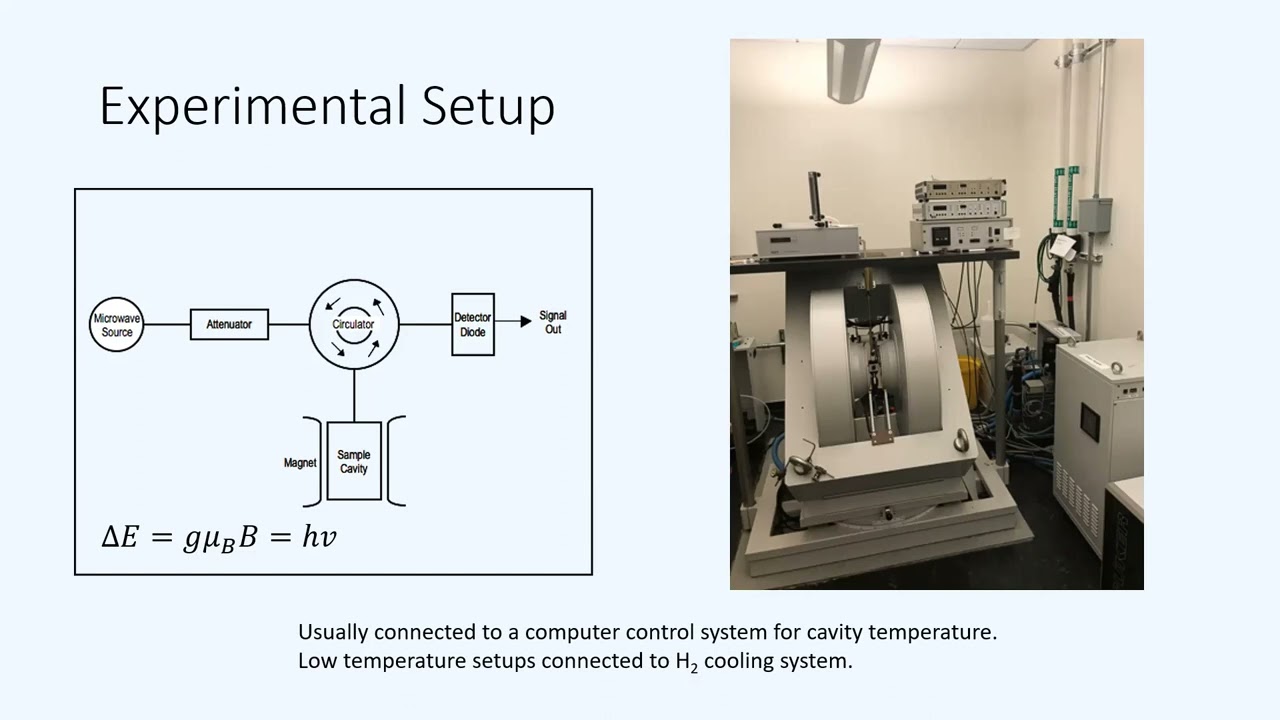
Advanced characterization techniques like Electron Paramagnetic Resonance (EPR) spectroscopy, which is highly sensitive to Jahn-Teller active systems.
The distinction between static, dynamic, and cooperative Jahn-Teller effects in solid-state materials, such as perovskites exhibiting colossal magnetoresistance.
137.5K views2.7Klikes7:45Original Release: 2022-12-07
By now we have become somewhat familiar with transition metal complexes, but before examining the reactions they can participate in, we need to discuss a few more of their properties. First let us recall some of the theories we know regarding chemical bonding and molecular geometry.
Way back at the beginning of general chemistry we learned about VSEPR theory, and the repulsion between electron clouds that determines the geometries of simple molecules.
We also discussed crystal field theory, and the complications that arise when looking at transition metal complexes which utilize d orbitals. We saw that the five d orbitals in a given energy level are no longer degenerate when coordinating to ligands, because some of these orbitals sit on axes which accommodate the metal-ligand bonds, whereas some orbitals sit between these axes. So we introduced the concept of t2g orbitals, which are the lower-energy dxy, dxz, and dyz orbitals, and the higher-energy eg orbitals, which are the dx2-y2 and dz2 orbitals, and we called the energy between them the crystal field splitting energy.
Now we have to build on this understanding of bonding in transition metal complexes by supplementing with another theory called ligand field theory, which can be thought of as somewhat of an extension of crystal field theory. Ligand field theory is based on molecular orbital theory, and it is a bit more successful in predicting certain properties of transition metal complexes, such as certain data gathered from spectral analysis.
This model deals with the s, p, and d orbitals that are possessed by a metal for a given shell, which gives a total of 9 valence orbitals for the metal. These are the orbitals that will participate in bonding interactions with ligands. Let’s say we are looking at 4s, 4p, and 3d orbitals, such as with the cobalt center in this complex with six ammonia ligands and a 3+ charge.
According to this model, we have six degenerate ligand orbitals that house the electrons involved in the metal-ligand bonds, and when the 9 orbitals from the metal overlap with these 6 orbitals from the ligands, 15 molecular orbitals will be produced. Six of these are bonding orbitals, which are all of a lower energy than the original atomic orbitals, six are antibonding, which are of a higher energy than the original atomic orbitals, and the remaining three are nonbonding orbitals, which have the same energy as the 3d orbitals on the metal.
The molecular orbitals are populated precisely as we would expect, from lowest energy and moving upwards, which in this case leaves us with all of the bonding orbitals full, as well as the nonbonding, and the antibonding are all empty. This results in a very stable octahedral complex, where metal-ligand bonding occurs due to the overlap of these atomic orbitals, which accounts for covalent bonding. Ligand field theory also describes the manner in which these d orbitals are affected differently by different sets of ligands, and can have their energies raised or lowered depending on the strength of their interaction with the ligands.
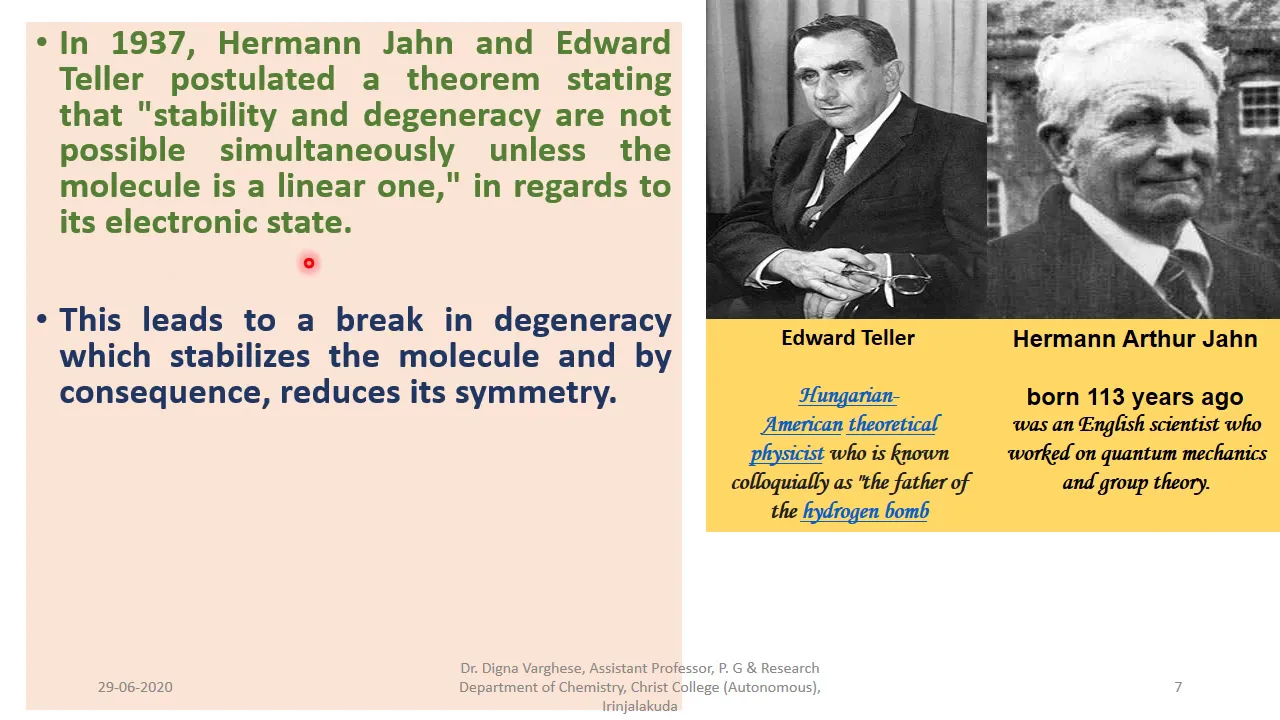
There is much more that we could discuss regarding ligand field theory, but let’s return to crystal field theory and discuss a particular ramification that will be of interest to us in learning about transition metal complexes. The Jahn-Teller effect, also known as Jahn-Teller distortion, is a phenomenon which describes the way that nonlinear molecules, and in particular transition metal complexes, may distort their geometry in order to remove the degeneracy of unequally occupied orbitals in order to lower the overall energy of the complex. In other words, this is something that will happen when the d orbitals are not filled in a symmetrical manner.
Taking a typical octahedral complex, we recall that the d orbitals are split up into the lower-energy t2g orbitals and the higher energy eg orbitals. If electrons are arranged in these orbitals in a symmetrical manner, with one or both of these sets of orbitals either half full or completely full, the Jahn-Teller effect will not be observed. In any other case, it will. So high spin d4, low spin d7 or d9, these will be common situations that elicit the Jahn-Teller effect.
Let us now understand precisely what kind of distortion will occur. Take for example an octahedral copper complex with a 2+ charge. This will have 9 electrons distributed around these d orbitals, with the t2g orbitals completely full, while the eg orbitals will be one full and the other half full. These eg orbitals are degenerate as shown, but the Jahn-Teller effect predicts that the complex will distort in such a way that the degeneracy is eliminated, which we call tetragonal distortion. When this happens, between the dx2-y2 and dz2 orbitals, one will become higher energy than the other, and they will end up the same distance away from the original orbital in energy, in either direction. The same goes for the other three orbitals, where the dxy will no longer be the same energy as the dxz and dyz. One set will be higher-energy and the other set will be lower-energy, compared with the original energies, and the distance to the dxy will be twice the distance to the others, because of the 1 to 2 ratio. As a result of this activity the complex will either stretch or compress along the z axis. If the asymmetry is in the t2g orbitals, the effect is weak. If in the eg orbitals, the effect is strong.
Here are some examples so we can get a better understanding. First, a d4 high spin complex.
For these orbitals down here, there is no net energy change. But for the ones up here, this lone electron will become lower in energy as it moves to the dx2-y2 orbital.
This stabilization produces a tetragonal compression, so the metal-ligand bonds along the z axis will compress. If instead the dz2 orbital is the lower-energy orbital for a d4 high spin complex, we will get the same stabilization but we will observe tetragonal elongation, where these bonds will stretch instead of compress, due to the shape and orientation of the dz2 orbital. Compare these to a d5 high spin complex, where now all the orbitals are half full, so when distributed amongst the new orbitals there is actually no net energy change and therefore no distortion.
The Jahn-Teller effect will be something to keep in mind when considering the geometry and properties of transition metal complexes. Now let’s move on to our next topic in the series.
Up Next
15:53
Ligand Field Theory & Spectrochemical Series Explained
@profadam
36.4K views•2022-01-02

83:56
Biocatalysis and Catalysis in Islatravir Synthesis | Merck Webinar
@SCIwheresciencemeetsbusiness
675 views•2020-10-08
10:54
Intermolecular Forces and Boiling Points Explained | Chemistry
@ProfessorDaveExplains
2.7M views•2015-11-05

17:31
Edible Water Bottles: A DIY Guide to Sodium Alginate Spherification
@ryan
10.5M views•2019-06-21
Related Study Plans & Knowledge Roadmaps
Structured learning paths in Chemistry
chemistry
Nuclear Chemistry: Decay, Meds & Fuel Cycle
01Introduction to Nuclear Structure and Radioactivity
02Decay Dynamics and Kinetics
03Radiation Interaction and Detection
+ 2 more learning modules
24h5 modules
Explore Roadmap
chemistry
Supramolecular Chemistry: Forces & Machines
01Foundations of Chemical Bonding and Intermolecular Forces
02Introduction to Host-Guest Chemistry
03Thermodynamics and Dynamics of Self-Assembly
+ 2 more learning modules
16h5 modules
Explore Roadmap
chemistry
Photochemistry: Excited States & Reactions
01Foundations of Light-Matter Interactions
02Molecular Orbitals and Electronic States
03Photophysical Processes and Jablonski Diagrams
+ 2 more learning modules
18h5 modules
Explore Roadmap
chemistry
Coordination Chemistry: Bonding & Properties
01Introduction to Transition Metals and Ligands
02Crystal Field Theory (CFT) and Geometry
03Magnetic Behavior and Spin States
+ 2 more learning modules
14h5 modules
Explore Roadmap