


















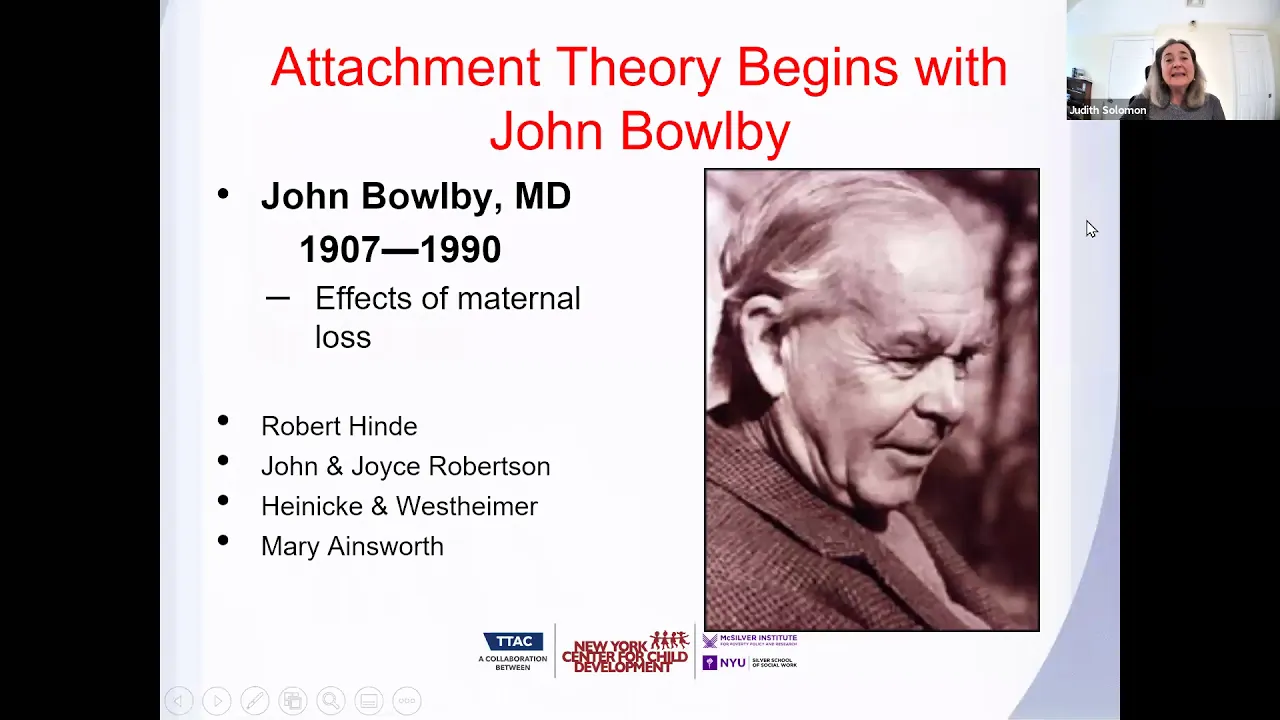

Attachment-informed psychotherapy proposes that attachment theory serves as a unifying meta-framework underlying all psychotherapeutic approaches, explaining how the therapeutic relationship, explanatory frameworks, and change-promoting mechanisms work together to facilitate healing. This perspective emphasizes that effective psychotherapy creates a secure base for clients, enabling them to develop mentalizing capacities—the ability to understand their own and others' mental states—which allows for emotional regulation and psychological growth. The therapeutic relationship requires therapists to engage in 'triple listening': creating a safe space, listening to themselves (countertransference), and listening to how they are being received by the client. This approach recognizes that attachment patterns established in early development shape how individuals relate to therapists and process emotional experiences throughout their lives.
John Bowlby's Attachment Theory in Psychotherapy Explained
Added:[Music] so I'm going to talk about attachment because that's what it's Neal Neal's asked me to talk about and that's been my main kind of intellectual interest and home if you like over the last 30 30 to 40 years and I'm going to try and talk about why I think attachment is important for clinicians I gather that we as a group are had a mixture of professional clinicians of one sort or another psychologists psychology students and even people who just are interested in the world of psychology and even their own inner world so I hope to loom innate all three of those areas now I'm going to start with the dodo-bird verdict because that's also one of my kind of founding principles of my work as a psychotherapist is everyone in the room familiar with the dodo bird verdict right okay well you need to know two things of course you need to know your Alice in Wonderland and you also need your Lester to know your Lester Lebowski paper of 1972 or 74 I think it was well Lester Lebowski was a leading psychotherapy researcher and he wrote a very influential paper which is still 50 years on seen as as a landmark paper in which he described what he calls the dodo-bird verdict in psychotherapy now if you remember those of you who do remember that Alice in Wonderland will remember that Alice she goes she falls asleep so the whole book of course is a dream it's also a kind of satire on Victorian values she goes falls falls falls down the rabbit hole and at the bottom she arrives at what appears to be some kind of weird race going on and people are running and running in all directions round and round and round and suddenly the extinct dodo bird blows a whistle and Alice being a good Victorian little girl thinks has got to be winners and losers zero-sum person like some politicians are today and she says well who's won to which the dodo bird replies everyone has one and all shall have prizes and Lester debofsky took this up in that he was looking at can we really show that any one form of psychotherapy is more effective than any other and of course you have what's known as the allegiance effect so if you're a CBT therapist all your research shows that CBT is the superior treatment if you're a psychoanalytic psychotherapist you show that all your treatment for psychoanalytic psychotherapy is superior if you're a systemic therapy etc I don't need to elaborate on that but actually the evidence is very flimsy the fact is that psychotherapy is an effective treatment it's about the same as antidepressant they say you're suffering from depression if you go to see mild to moderate depression let's say you go to see a GP and the GP might refer to a psychiatrist who might prescribe antidepressants or might refer you to a psychotherapist who might offer you a course of psychotherapy about 60 to 70 percent of you in that group are going to get better about 10 15 percent are going to stay more or less the same and about 10 percent are going to get worse so we just need to remind ourselves that psychotherapy although it is effective is not universally effective but nor are other treatments the difference between psychotherapy outcomes and physical treatment such as antidepressants is that people once their psychotherapy stops continue to get better they improve if you follow them up a year later they're better whereas those taking antidepressants tend to either say the same or get worse once they stop that a depressant so there is an argument rather against the dodo-bird verdict now the reason I mentioned that is because we're going to be talking today about what I call my colleague areata Slade by the way I'm just going to plug my book a bit harder than I couldn't really fault Neel in any way at all but he didn't quite plug my latest book as much as I'd like him to have done so let me tell you neil started off he told me as a businessman I think is a very good businessman as well as a very good psychologist a rather rare combination actually but there are four four copies of my book so there's a kind of scarcity value so if anyone wants a copy and there's a I wrote with area - Slade and if you want it sign - bring it to me in the in the break how do I get on to that yes I'm going to be talking about attachment informed psychotherapy which is a phrase that Arrieta stage and I devised and the idea is that attachment informed psychotherapy is a meta form of therapy in other words as we know there are something like 500 different varieties of psychotherapy and attachment informed psychotherapy in my view and in our view is actually the sort of underlying mechanism which is produced the effectiveness of all the different psychotherapies and that's what I'm going to be trying to explore today now we do have what I call the Esperanto problem if you remember Esperanto Esperanto was developed in the 1920s I think it was and the idea was we're all in Europe and this is kind of long way apart I'm not going to mention the B word well I am I'm going to mention it once and I mention it because I discovered the other day that I've got to my horror something in common with Michael Gove I've got one thing in common with I don't believe in experts but I do believe in expertise which is a very different thing and I think what attachment or inform psychotherapy is about is what is the expertise of psychotherapists but of course psychotherapy does suffer from the expert syndrome though the laying on of hands the apostolic succession as Michael Ballack called it the idea that there are goos up there who have the answers and if we go to them they will solve all our problems and if we're training a psychotherapist if they train us we will then become magic therapists ourselves so in that sense I do not believe in experts and nor did John Bowlby as I'll explain in a while anyway going back to the Esperanto problem the Esperanto problem essentially is that the idea was well let's develop a common language a meta language if you like for Europe well of course the point is it's never really caught on we haven't got a meta language we all learn our mother tongue and it's a little bit like that for psychotherapists if you want to train as a psychotherapist you to choose a modality whether it's like analytical CBT or systemic etc or group analytic but at the same time in a way you need to recognize that the grammar that you use is a common grammar that will be you'll find in all that I'm saying that attachment is a meta perspective for all psychotherapists a deep grammar for psychotherapists and I would say it's a bridge from everyday caring to muta to therapeutic listening I'm going to say something a little bit about expertise I'll say it now because I'm going to repeat it again so what is the expertise of the psychotherapists as opposed to expertness I believe in our elaborate on this it's a specific and particular form of listening I will elaborate on that later probably after the break so if you adopt this meta perspective if you're a common factors psychotherapist as I am if you believe in the dodo-bird verdict you've got to find well what are the common factors that all psychotherapists share and one way of thinking about this is to say well they fall under three main headings the therapeutic relationship some kind of explanatory framework for understanding the problems that our clients bring to us and some mechanism for promoting change and I'm going to say something about each of those in relation to attachment theory so let's go straight into attachment attachment has two great two grandparents a grandparent nomber one is Sigmund Freud John Bowlby trained as a psychoanalyst in the 1930s our 20s and 30s and he was quite dissatisfied with the with two aspects of psycho psychoanalysis as he encountered it one is that it wasn't really a scientific theory that it relied on ride on authority rather than on evidence and in particular he felt that there was a downplaying of the role of the environment and an overemphasis as it were on internal on inner fantasy as the basis for neurosis so although he was trained as a psychoanalyst although he remained in a way loyal to psychoanalysis he was also very trusted in how do we actually study human development and he realized that ethology there was a new science that had been developed by Konrad Lorenz and Niko Tinbergen in the nineteen thirties forties fifties and this essentially was a way of looking at the natural world the living world looking at animals in their natural environment so it wasn't the kind of psychology that was about studying rats and mazes it was going out and Robert hind was a great friend of Bobby and contributed to attachment theory once told me his PhD consisted in 1950 all summer and then someone handed him a tape recorder pointed it at a wood and said go and understand bird saw and that was in a way the basis of ethology in other words ethology is studying animals in their natural habitat so Bobby said well why don't we study children in that natural habitat why do we base all our theories on what happens in the consulting-room so he brought a scientific angle as it were into the world of psychoanalysis and the point about this picture and I love the picture anyway is that it contains the essence of attachment because what Konrad Lorenz discovered was that when these geese are born they will follow and take as their attachment figure any object or creature that moves so he separated little Gosling's on their first day of birth from their mother and pretended himself to be a mother goose whereupon they became imprinted on him to use his word and therefore the attachment relationship was established and he did this in all sorts of ways he even did it with a cardboard box I believe on the end of a piece of string he pull it along and the Gosling's would take the cardboard box as their mother so Bobby immediately thought is something similar going on in the world of humans so there is john doe beam that says those his dates now I was in a bit sad in a way again I've got his the second disappointment with Neil but everything else about Neil is wonderful and that he talked about John Bowlby as it were as the founding father of attachment theory actually there are two founders two attachment theory John Bowlby and Mary Ainsworth and Marian's worth is of equal importance and it's a very interesting marriage actually because Bobby was a Brit he was a psychiatrist he was kind of theory at issue wasn't really an experimentalist Mary Ainsworth was originally Canadian but lived in cat in America for most of her life she was in a psychologist and she was a absolutely passionate experimentalist and it was a kind of marriage made in heaven because together they created the edifice that is attachment theory and all the research that's flowed from attachment theory was done either by Mary Ainsworth herself or by her PhD students or her PhD students PhD students so all the big names really in psycho in attachment theory are mostly North American and they are Mary Ainsworth responsible so we do need to think that actually attachment theory is the byproduct I don't need a byproduct a bilateral product of John Bowlby and Mary Ainsworth a man and a woman so I'm now going to say a little bit about attachment hearing well let's just go back to my three features of the Meza perspective on psychotherapy or the three common factors in psychotherapy the attachment relationship the theoretical framework and producing change promoting change I'm going to say how does attachment theory theorize relationships and I'll say that about that these are just some headings I won't go through them one way of just reminding oneself about the attachment like dynamic I living in the rural area is to go into a field with sheep and their lambs in the spring and the moment you go into that field all the Lambs will rush back they've been playing quite happily away from their mothers they'll rush to their mothers and that illustrates beautifully the attachment dynamic under conditions of threat then the attachment dynamic is triggered in parents and children and it brings those parents and children to close proximity and therefore protects the vulnerable infant from any potential threat now this is a hugely important idea for Bobby and his collaborators when they were theorizing attachment they had the idea that if we think about what they call the environment of evolutionary adaptation we think about early man in the old by gorge which in what is now Kenya or Ethiopia where an incredibly vulnerable species were not particularly strong we can't run particularly fast we haven't got very big claws or teeth we've only got two things we've got brains and we've got each other now the reason or the fact that we've got brains means that we have to be born in a very very immature state to get that big brain through the birth canal and it also means that we're going to have a long period of huge dependency and vulnerability those little lands are up and running within half an hour of birth well it takes us a year even to get up right therefore so that's number one the big brain we can think and number two we've got each other but we need an evolutionary devised mechanism for us as we were to protect our vulnerable offspring and that is the attachment dynamic so when those little babies on the old vie gorge surrounded by predators they sense threat they vocalize and that activates the attachment dynamic in the caregiver now this is as that four fundamental concept of attachment theory and it applies throughout the lifecycle if you start thinking I may be anticipating some of my slides we've moved on a little bit with expanded the idea of the attachment dynamic from simply a form of protection as although we do live in a in a potentially threatening environment although of course that's hugely exaggerated these days and London as Steven Pinker has shown is a far far safer place to live in today than it was a hundred years ago or 150 years ago but we still see it as rather threatening and of course there are motorcars and there are sort of violent there is violence about so we've but we need to expand the concept of attachment to include effect regulation if you think about a baby crying in the night that baby is in distress a six-month-old your baby and there's speaking very much from experience because I've been staying with my grandchildren this weekend that baby then in a not particularly sound approved house and so that baby will activate the caregiver mum or dad will then have to drag themselves out of bed and go to that baby now that baby doesn't know what it is that's causing his or her distress the caregiver then has to work this out is my as my child too hot too cold had a bad dream neither nappy change need some food needs turning over etc so the the mother's brain is yoked in as it were by the baby's brain and together they work out what's wrong that baby's effect is being regulated by the mother and there's a kind of conversation going on between them because if let's say the mum changes the baby's nappy and the baby still crying then the mum may think oh well I hadn't quite got that right or the baby's saying you haven't quite got that right what I need is a feed something of that sort so there's a kind of conversation going on a mutual affect regulation so we have to think that's a function of attachment as having these two worlds attached as having these two functions one protection from threat actually both extended that so he said the attachment dynamic is triggered by separation threat and illness or exhaustion so the baby who is tar dogs like eel will kind stop playing go and sit on mom or dad's lap and snuggle up that kind of thing so there's the attachment dynamic but we now extend that that attachment is necessary because it helps us to regulate our effect and that as I shall explain in a minute helps us to understand what our effects are and that process may be compromised in the kinds of patients who come for psychotherapy and a huge part of the work that psychotherapists do can be seen in terms of effect regulation let's go back a few slides now so there's the attachment dynamic ah now the question is well and what kinds is an attachment relationship is a relationship with a friend or a teacher or an acquaintance an attachment relationship well my saw rubric here is I used to say to my patients let's say you'll run over by the proverbial London bus you end up in hospital who is the first person you will ring or contact and that will give you a key or clue to who who is their primary secure base of a primary attachment figure so it's very rare I mean there will be situations where one will bring an acquaintance or a friend but it's much more likely that you're going to ring your father your mother your boyfriend your girlfriend your husband your wife possibly a sibling the only though the major exception to this I think is military buddies so that soldiers in war make and take their comrades as their attachment figures and it's because that's where their security and safety lies and the question and it's one I think that it is interesting to discuss and think about it is whether or not a therapist becomes an attachment figure for a patient but it's certainly true that the attachment dynamic operates in consulting and this is quite an issue that I think therapists don't often or sometimes don't do grasp going to see a therapist is an incredibly anxiety provoking phenomenon and especially in the early stages and when you first come into the room with your therapist you're on a stage of it's like panic therefore I always say no interpretations in the first five minutes and the same applies at the end of the session because when you're going you're then in a way returning to a state of threat you haven't got somebody there to regulate your effect to keep you safe therefore I also kind of say no interpretations in the last five minutes because an interpretation will fall on deaf ears if someone is in a state of the attachment dynamic the attachment dynamic has to be seen in terms of as it were a kind of an alternative to exploration on the one hand were exploring the world trying to throw a little lamb or trying to find out where the good glasses as it were but if somebody comes into that field who might attack you then you rush back to your secure base and you stop thinking even about that grass as it were that's going to be good and the same applies to Isis applies to us as humans and I want to just add one more point to this which is it's not all negative these Oh No well perhaps I'll just expand on this because I said that the attachment dynamic applies throughout the lifecycle now we all think were terribly grown-up and we're sitting here and we don't need any secure basis or attachment figures but let's suppose actually now I didn't say this but let's suppose the fire alarm goes off or there's an explosion outside and Malet Street and we have to leave the building and we let go of course in a very orderly fashion what's the first thing we'll do when we come out of that of this building I would guess most of us will put our hands in our pockets and ring our husband our wife our girlfriend or boyfriend her mom our dad our parrot our begonia or whatever our attachment figure happens to be so the attachment biodynamic is there in late night fall and that also I think applies to positive experiences so it isn't just negative so if you at last discover you're pregnant or you finally pass that exam or we've got your driving test you've passed a driving test or something like that you will immediately want to tell something I want to share it with someone and again that will be the clue or the cue to the secure base figure your attachment figures so actually now I come to think of it in retrospect when I was asking patients who suppose first and first person you would bring when you come out of the when you wake up in hospital they could have been who's the first person you bring if you suddenly get the job he's been applying for something of that sort so all this is about the attachment relationship in the consulting-room which is the sort of silicone on it's the precondition of effective therapy you have as it were there has to be a kind of trusting relationship build-up to in therapist and patient which can has the contours and the aspects of the attachment relationship now another thing about attachment is that it's very specific I'm sure there are people in this room have got who have had five year-olds starting at school coming up to Christmas and they will write they might do a Christmas card for their mom or dad and it'll always say for the best mom in the world or the best dad in the world well that of course objectively cannot be the case because there can only be one best and of the world if you adopt a utilitarian approach but of course it's absolutely true because of the specificity and this is a rather cynical way of putting that by George Bernard Shaw who had a rather sort of dodgy marital history actually he was turned on by one person that he proposed to and he literally the very next day I think rang somebody else and proposed to her so feeding now one of the things that those of you have done psychology degrees or even psychology a level or even just read the papers occasionally will remember those rather pathetic pictures of little rhesus monkeys clinging to why mums but this was a very important study that they'll be built a lot on and what the the these are studies done in the 1960s and the question was what bonds a baby monkey to its mother is it food or is it something else and so the experimenter created a set up where there was a war mother with a kind of bottle sticking out and a tarry nappy mother with no bottle sticking out and he Harry Harlow who did these experiments then observed what direction did that little baby the rhesus monkeys go to and surprise surprise they go to the tarrant nappy mother they go to something soft that they can cuddle rather than rushing straight for the food now they'll be built allotted on this because in the world of psychoanalysis the breasts was seen as as it were the most important communicative relationship with the baby because it provided milk and what Bobbi was saying was know what is equally important is the relationship of the mother the holding there cuddling the playfulness the eye gaze etc so what is it that Bond's or mothers and babies together work and fathers and babies together and what is it that underpins the attachment relationship we were we now know that there's a neuro endocrine aspect to us most of you probably heard of oxytocin which is of course released at the moment of birth but there is bio behavioral synchrony there's a kind of to and fro levels of oxytocin that go on in the early weeks and months of life which create this attachment bond and bio behavioral synchrony starts at birth and then already described this idea of effect Co regulation and the point and the research shows that if children who've had this experience of biobehavioral synchrony who have had this experience of accurate emotional Co regulation they begin to be able to regulate and cope with our own feelings and by the time they preschool or get into school this is manifest in terms of social competence so the attachment relationship has a bearing on psychological health and if we think about the clients that come to us in therapy these are people who almost certainly have had some kind of compromise in this attachment relationship now important point that Bobi picked up on was the idea that we're set from an early stage on developmental pathways and if you have a secure attachment a developmental pathway then sadly one has to say that good things lead to better things and bad things lead to worse things so that is bringing us in the direction of secure attachment versus the various patterns of insecure attachment and these can be thought of in terms of developmental pathways and Mary Ainsworth it was who devised a test for this which has now been used in hundreds and thousands of actually over thousands of times to study the relationship between infants and their caregivers around aged one in a variety of social economic and ethnically diverse situations and the essence of the setup which Mary Ainsworth devised is what's known as the strange situation now what is the strange situation the strange situation a caregiver and child are invited to some kind of laboratory to an office where there's an experimenter who's a friendly person and in this office there are a couple of chairs and lots of toys on the floor and the baby sits on mums lap initially because the attachment dynamic is triggered by simply arriving in a strange situation and then the baby will probably get down start playing with the toys the child is then subjected to stress and the stress which for a one-year-old is quite large the caregiver goes out of the room for three minutes now if you're in a strange room you've never been in before and your caregiver goes out of the room for three minutes this is pretty threatening this activates the caregiving dynamic and the child will stop playing so they move away from exploration into the attachment dynamic and then eventually the caregiver and mom or dad comes back into the room and in a secure attachment the child will have expressed quite a lot of distress of anger you know will cry wail will say if they could say why the hell were you dumping me with this horrible person in the strange room and the caregiver will pick the child up and soothe the child and within a few minutes that rupture will have been repaired they'll say it's alright mommy's back now I was just going to the loo I'm fine the child will get off the lap and start playing again that is the secure attachment dynamic a rupture and a repair and exploration takes over and healthy protests what Mary Ainsworth discovered was that actually there are a number of different patterns that one sees in the strange situation which have long term developmental consequences so those children who show that secure attachment pattern age one are going to be far more socially competent aged five when they go to school than their counterparts who show different patterns of insecure attachment by the way dads can do it just as well as mums they just do it in a slightly different way and so they don't do this kind of soothing and rocking quite so well they might use distraction then I might sort of pick the child up throw them up catch them so look at that there's a nice ball over there or something of that sort but it works the child's distress is us waged and there is turn to exploratory play now there are various patterns of insecure attachment which Mary Ainsworth defined but they can be seen basically there are three basic patterns and two of them a kind of contradict a kind of an opposite ends of a pole so at one end you have the what's known as the avoidant all the later in life the dismissive pattern or the hypo activating pattern so these are children who don't show much distress because they as it were have learned that it's not a good idea to show distress to your caregiver because they may reject you and you need that caregiver you need to stay near that caregiver so those children are to some extent inhibited in their exploratory play and they're inhibited in their affective expression and at the same time they do show very high levels of distress in terms of their distress hormones and their heart rate and they're sweaty so these are children who as it were have quite difficult feelings which they suppress and the other end of the spectrum are the children who cannot be soothed who make a massive fuss but they are not swage dand those are called the hyper activating and or the anxiously attached pattern and these correlate to some extent with developmental pathways so the the caregivers who keep their children in a bit of a distance tend to have the I tend to have the dismissing pattern or the avoidant pattern or the hyperactive ageing pattern and the caregivers who have somewhat inconsistent one thing they're intruding on the child's player the next minute they don't seem to be there at all they're the ones who tend to have children who show this hyper activating and slit action pattern because if you've got a caregiver who's attention you cannot grab then it's quite a good idea to make a lot of fuss so that they as it were had no choice but to keep an eye on you and protect you so one of the findings of attachment theory is that we can classify these developmental pathways that people find themselves on they have long-term consequences and they relate to patterns of handling in infancy another important finding in this attached were still in the attachment world is aware the stage one is that researchers have found that in the first six months all serve life caregivers and children periods throughout the day several periods at throughout the day where there is intense mutual gaze and gurgling Watson who started this said there are two features of this intense mutual gaze one of them was what they call contingency and the other was what they called marking our contingency means that the caregiver the mom or dad waits for the child to make the first move and marking means then the MA caregiver as it were mirrors or marks or feeds back to the child whatever it is that first move was so let's the chat say dad upsets dad Kazu I'm a dad and a ground out of grip and that almost picks up the child and says or we are feeling a bit miserable today aren't we so the child is very slightly down in the mouth and the caregiver using motherese this high-pitched tone that parents use when they're talking to babies because babies are much better at hearing high pitches than low pitches exaggerate sit and that exaggeration is a message to the child you are seeing your own effect mirrored in my face and in my voice so the child then as it were can begin to understand and in project and have as it were a representation of their own feelings so we go from Co regulation of ethics to the beginnings of self regulation of effect in the context of a site of the parent-child relationship now it seems to me that psychotherapists do something very similar or certainly second oolitic psychotherapist like myself do something very similar with our clients the client comes in they're probably feeling a little bit threatened or stressed and we therapists we just wait and we see whatever it is that the client brings we might have to encourage them a little bit I just say more well what sort of week was it or something of that sort and then we so we wait in this and then our response is a response to whatever it is that the client brings and we then kind of underline it we mark it we say something like wow was quite a week wasn't it mmm goodness let's hear a bit more about that so this process of a that regulation is integral to the attachment relationship that's what I'm saying and this fits in with Donald Winnicott the psychoanalyst who really had this extraordinary capacity for intuitively understanding all this stuff although he was no scientist and just from his intuitive and knowledge of children so he realized that this process this mirroring process can be compromised so if the caregiver mum dad and also therapist is stressed depressed intoxicated drugged their capacity for mirroring will be compromised so the child then won't be seeing his or her feelings in the caregivers face you'll be seeing the caregivers feelings and this is an interesting issue because this of course is one of the things which brings one of our jobs as it were as therapists is to be able to repeat or to carry out this effect regulation but in a way one of the things which may have brought us into the world of psychotherapy is that we as children may have as it were become quite experts at reading our caregivers minds so there's a little bit of a paradox in there I like to give this picture of Francis Bacon famous one of the best of Famer analyst wonderful painters of the 20th century but a very very disturbed man it's an alcoholic on sex or a very unhappy person eventually died of drink he's raking on trip ditches but he was also keen on these very distorted facial images and my idea is that this may be as it were what happens in the developmental history of someone who whose caregiver has been depressed or stressed or intoxicated and he of course was able to use the canvas as it was a blank space of the canvas to explore these feelings our clients use the blank space in the canvas of to explore Winnicott picked up on this idea that in these kinds of situations the child may as it were adapt to whatever it is the caregiver wants them to be feeling that's the kind of picture that he developed there this is an important statement I'm going to read it I'd now that slide is illustrating Bowlby's original idea that we need attachment because we live in this very threatening environment but I'm arguing and I have a hug you that actually we extend this matter affect regulation I'm just going to give an example of ethic regulation as it were in everyday life this is a videotape that you can find on YouTube and it's a fascinating little study if you want to if you want to elicit the attachment dynamic in four month year-olds you can't do the strange situation you can't leave a four month year old on their own for three minutes so what you do where you develop what's known is the strain is still face paradigm so you put mom and baby side by side and you say to the mom at summer and they're talking to each other or communicating with each other and you say to the mom okay when I give the sign I want you to freeze your face for one minute and that acts as a kind of threat to the child now what you'll see if you look this up on YouTube it just looked I pins as still face paradigm what you'll see is this delightful little baby who's communicating nineteen to the Dozen with mum regresses he can't understand why she's not responding to him and the less he understands the more his posture becomes like a newborn baby and the more his vocalizations go from these quite complex vocalizations to kind of high-pitched screaming so where all the time in this highly interactive affective state with our caregivers and this is a similar study and we babies in their moms were videotaped and mothers were then classified as securely or in securely attached and what was fine was that um in securely attached moms are pretty good when their babies are happy but when their babies are unhappy then they tend to be rather rejecting so the study shows that insecure mothers don't really find it easy to regulate their children's negative affect and there may be this may this is a funny little slide but it just shows that negative effect is far more important than positive I think because negative effect can lead to death whereas positive effect may need to just slight unhappiness so in other words we're far more sensitive to poisonous substances on our tongues and we are too sweet substances because if you don't eat for a day you'll survive but if you eat poisoning that's the end of you so we need to be highly sensitive and have ways of regulating negative affect and of course are we psychiatrist and psychotherapist spend a lot of time regulating our patients and our clients negative effect and we need to be able as it were to cope with the fact that our patients are going to hate us from time to time so openness to negative emotion is crucial security providing parents and they're not just good at regulating their children's negative affect they also are able as it were to celebrate their specialness and therapists tend to be a little bit coy about talking about saying nice things to their clients and probably not to tell their supervisors about them but actually of course good therapists do say nice things to their clients the sort of thing that I would probably want to say something well getting that job sounds excellent and they must really believe in you but I suppose we need to think about whether you're not just doing all this to please me or your mom something of that sort I'm going to go on right so the next sort of section two of my talk is what kind of explanatory framework do we offer to understand the difficulties that psychotherapy clients bring to therapists because every therapy has either implicitly or explicitly an explanatory framework but I've touched a little bit on that already this idea of secure and insecure developmental pathways and their long-term consequences it's interesting to think about diagnosis because in a way saying well with this is insecure attachment is a kind of diagnostic statement and diagnosis is a kind of quite an ambivalent kind of phenomenon isn't it on one hand a diagnosis and if you've got tummy ache and the doctor sort of you think my goodness you know I must have bowel cancer or something and the doctor says no you've just got irritable bowel don't worry about it that's hugely reassuring so in other words we go from uncertainty into some kind of sense of being able to understand what's going on on the other hand of course a diagnosis can be a kind of distancing phenomenon it obviates thought it reifies closed down and freshness and creativity so we have to kind of tread a path between these two citizen Carib disease as it were now I'm going to say a bit about D I mentioned the two main forms of insecure attachment that we see in the general population I mean in this room about 60 or 65 percent of us will probably be securely attached about 20% of our secluding me probably are somewhat avoidant and about 12 to 15 percent of us will be anxiously attached when it comes to and a very small percentage of us for under five percent will be what was described by one of Mary Ainsworth PhD students probably her most famous PhD student that's to say Mary main as disorganized attachment what is disorganized attachment well there are some children who when put in the strange situation behave in very bizarre ways and the thing about it insecure attachment that I've described so far as they're quite organized you know you either just suppress your emotions or you hype them up a bit but you're still related to your caregiver there's a disorganized child will perhaps go to the corner of the room what backwards and forwards put their head over their hands bang their head slightly against the wall behave in slightly bizarre ways and when the caregiver returns no kind of connection seems to be made the point about disorganized attachment or is that it's very rare in or relatively uncommon in Norman clinical populations but it's very very cool it's much more common than the other two patterns if you look at socioeconomically stressed families single-parent families families where there's a history of mental illness and a history of drug addiction where there's been abuse physical or sexual or neglect which we have to remember neglect is probably the most psychopathological producing form of a pathological childcare so disorganized attachment we need to know about it because our difficult clients will come into therapy and most likely as infants and small children to have experienced disorganized attachment and disorganized attachment is really a kind of way of saying how do I survive in this world if I hadn't got a caregiver that I can turn to and these are this little picture is a kind of metaphor and what I'm trying to show you here is how difficult it is working with people who have had an experience of disorganized attachment because when they come into therapy rather like that little kangaroo Joey who's born in birth canal but then in this incredibly vulnerable state has to crawl all the way up the mums tummy and into the pouch where then development can continue our clients with disorganized attachment in a way have to do something similar they have to learn to trust us before they can begin as it were to enter into a world where they're not just doing their best to survive and nothing much else and remember that we in the end what we do with our clients well it's kind of nonverbal because we're creating a safe space a warm secure non interrupted regular predictable environment although actually in the current NHS with desking this is far less Shore and that's a in my opinion incredibly important didn't problem but Rio also in the end we've got to use words and so we've got to think about disorganized attachment and the impact of disorganized attachment and how our very difficult clients are going to find it massively difficult to trust us and we're also going to have to think about what kinds of conversations we have with our patients now mary mainly is famous for two things in the world of attachment research first of all identifying disorganized attachment and also for something called the adult attachment interview now the adult attachment interview was devised by mary mane and it's simply really a what I would call a psychotherapy assessment interview that's tape recorded and you talk to an individual about their developmental history about their mom and dad and you ask tell me a bit about the mom and dad give me some adjectives that will describe give me five adjectives or describe your mom or dad and you then also ask about loss separation former etc now what Mary main was interested in was not so much what had happened to individuals but the way in which they talk about what's happened to them and this is a massively important message I think for psychotherapist as psychotherapists we sometimes home in much too much on what happened to our clients and not nearly enough on how whatever it is that's happened to our clients has been processed because after all all sorts of horrible things things happen to all sorts of us that don't necessarily lead to us developing psychological illness or needing psychotherapy I mean psycho Handley if you live in a psychoanalytic world you kind of think that you cannot possibly be a healthy individual Ness and had about five years of five times a week psychoanalysis but actually most people out there in the normal world don't have any kind of psychotherapy yet they may have had all kinds of cool but they've because possibly they've had secured attached and they've been able to cope with that call where they've been able inform as it were to look after themselves anyway now remains said let's think about how people talk about their experiences so if someone sort of says tell me about your childhood literacy well it's just a normal childhood nothing special can't remember anything much before I was about nine how is your mother knows you're just a normal mom oh can you give you an example of how she not really and she was just a normal month now that sounds okay but actually that illustrates dismissive attachment that's illustrates dismissiveness this is an individual who as it were can't bring to mind their actual experience and who cannot bring to mind the affective aspects of their experience and who can't share that experience and that and therefore move in the direction of co-regulation with a therapist so mary may classified people not in terms of what had happened to them a lot in terms of the amount of trauma that experienced but how they process that trauma and as revealed in their language and she drew on a philosopher called the Grice it's not really important but she had this idea that there are certain kinds of language which actually had this capacity to be fresh innovative to the point relevant and she called those Grice's Maxim's and those led to her being able to classify these adult attachment interviews as either secure autonomous who had all his features dismissing preoccupied or unresolved and these as it were mapped onto the strange situation patterns that I'm describing earlier of secure attachment insecure avoidant insecure anxious and disorganized now let's come into this consulting room these are the kinds of things that therapy say to their clients all certainly the kinds of things that I used to try and say to my clients hang on a minute I can't quite visualize that pendant so if you this let's have this dismissing client who may present let's say or will be referred to psychotherapist because they have somatic symptoms of No there's no physical basis for it or they may experience depression or something of that sort and these are the misc dismisses of individuals have had notes experience of effect co-regulation they haven't been able to process their negative effect so either therapies will be working quite hard thinking this is a dismissive client I've got to get them somehow to be able to bring feelings to life in the consulting room I can't quite visualize that can you clarify can we have a story let's have a story about your mum you say she was a normal mom okay you're coming back from school your age five or seven tell us what happens next so we're all the time trying to create this granularity all the Devils in the detail aspect which is a characteristic of secure attachment or you might say how in a minute you're going much too fast and they just say that all over again so all the time were trying as it were to create a vivid and fresh experience in the consulting room we're shaping the clients narratives now we can think about speech therefore in a bit constrain 'inside you've got nietzsche so i can mention that can shine after me vicki and stein said listen language isn't just commute a conveying information it's also an action the usual example that's given here is a meeting by the way one of the wonderful things about being more or less retired is that i never have to go to meetings anymore but what the example it's usually given of a speech at act is at the end of a meeting the chairperson says ok let's leave it till next week or something like that now that isn't just conveying information it's also an action so people immediately then pick up their papers start chatting in an informal way to the next door neighbor etc so languages of speak we have to think of language as speech acts and it was that concern it had this idea and attachment research is now looking at what kinds of conversations go on in psychotherapy sessions in relation to the attachment status of the client and what is found is that these securely attached individuals in psychotherapy are able to have a kind of make something new with their client with their therapists whereas the insecurely attached individuals 10 as it were to try and maintain the status quo to keep things just as they were or if we think that our job as therapists is to create novelty then that's as it were the challenge that we have to face and one that's presented to us as attachment therapists so that illustrates that point now let's move on to another attachment a related attachment concept that's emerged in the last 20 years or so and this is this idea of mint mentalizing I have some who come across the term mentalizing before I'm sure you have yes and there is now a an actual school of psychotherapy called MBT mentalization based therapy now it all goes back to a study carried out by a mirror man hard steel Peter Fonda he in the 1990s early 1990s they took mothers pregnant for the first time and their husbands or partners and they gave them the adult attachment interview and they then followed these couples up when their baby was born and they then did the strange situation classified their infants in the strange situation when they're about 1 years old so it was a study that took about two years and surprise surprise what they find was that parents who were securely attached tend to have infants who are securely attached parents who in securely attached tend to have infants who are in securely attached so it shows a kind of transgenerational transmission of attachment patterns but the important point from our discussion now about this study was they then took a subgroup of parents who had had very traumatic upbringing so they'd had loss of parent divorce separation etc in a childhood and they then developed on the Aral detachment interview a subscale which they called reflexive function now reflexive function is the capacity as it were to think about your own thinking and to reflect on your experience so in the laughs attachment interview you sort of say tell us a bit about your mum and they say well my mum you know we had quite a difficult childhood our dad left when we were nine mom had to go out to work she was really stressed at times it must have been really difficult for her coping with us kids and not really having enough money and dad you know it's showing up every now and then that's reflexive function that person was score highly on the flexor function because that is someone who was able to put him or herself into the shoes of another individual now what this I think hugely important study showed was that if you take parents who've had trauma in their childhood who have high scores on reflexive function their infants are going to be securely attached whereas those that score low on reflexive function tend to transmit the insecurities to their children so therefore met the capacity to what's now called mental eyes because reflexive function is kind of morphed into the term mentalization mentalization is as it were a resilience factor it's something that enables you to navigate and to survive torment and difficulty in your life so we can then begin to think that we're a whole lot of research has flown from this but we can now begin to think that the capacity to mentalize is something that we're trying to instill in our clients my friend Angela Bateman and who was one of the cofounders of MB team at metallization based therapy says we use this capacity they will use this phenomenon in therapy because in therapy all kinds of things happen that our ideal client might come in and say hey you stopped the session five minutes early last week and you never said a word about it then the therapist would say right well if I did I really owe you an apology and I owe you five minutes and I'll give it back to at some point but let's just start to think about this let's think about what was going in the session at that stage what you were saying old I was saying so this is thinking about thinking and that's one of the jobs that we as therapists do and it's one that's really come through the hole attachment developmental and experimental world my definition of mentalizing is to see oneself from the outside and to see others from the inside it's a kind of phenomenon of slow thinking and mentalizing is a hugely important phenomenon and it relates to secure attachment so there are all kinds of experiments that have been done one study that Elizabeth means did she actually doesn't use the term mentalizing she calls it mind mindedness which is actually rather a good phrase I think but she videotapes or audio tapes infants with their small children with their parents and she then shows these videotapes or audio tapes to the parents and ask the parents to comment on them so then I and the parent might say oh dear is being a bits of rough there and I told kidded bloody well shut up or something that's an example of mentalizing the mother is able to think about herself thinking and those parents tend to have securely attached infants interesting recent research by harden Marion steel so 30 years on they're still using this concept they've done a very good study in the Bronx with at-risk families they usually single-parent mothers often from ethnic minorities and they did an intervention study where they mothers got either treatment as usual which was actually quite good treatment the treatment as usual was a health visitor coming months a week and helping the mum versus a form of mentalizing therapy where the mothers were videotaped with their infants and they were in a group setting look at themselves interacting with their infants and learn as it were to see what they do that's really good so the therapists are very group on here oh that was such a sensitive response that you brought out there so and that fosters this kind of sensitivity and it fosters and the capacity for mentalizing and that in turn fosters the capacity for secure attachment in the infants and this concept of sensitivity is one that Mary Ainsworth developed right back in the 1960s and 70s the idea what is the crucial feature of a secure relationship its sensitivity what we call sensitivity will sensitivity now as it were we see in terms of capacity for mentalizing yes this is the Stelios mentioning ok let's have a bit of slightly light relief does anyone know what that is it's a head louse good quite off it's interesting sometimes people have no idea what it is now the why am i showing of that well the poet Robbie Burns wrote a famous poem ode to the lives Robbie Burns was a kind of them some of the me2 movement would not prove off I suspect he saw this beautiful girl with wonderful hair and was immediately attracted to her and then he noticed that it was a headless quarreling unbeknownst to her on the top of her head and so he read these wonderful lines I'm not going to try and do it in Scottish I would some power the gift he give us to see ourselves as others see us it would for many a blunder free us and foolish notion well that to me summarizes everything in psychotherapy is all about because it's about mentalizing and another aspect of mentalizing yes this I mentioned listening right at the beginning of my talk a little anecdote here I move from uch to North Devon in the 1980s it was and worked in a district General Hospital there was a new psychiatric unit which attracted me to it and I had quite a nice office and I one of the surgeons who used to be who like no surgeons considered socotra stupid the lowest of the low kind of inferior for medical life only for people who are completely dim or incompetent or very very mad choose to be psychiatrists he had come to my office to discuss a patient a mutual patient and he was horrified he you've got a wonderful office here or something like that and all I've got his son little cubbyhole where I got a share with all the other surgeons in the secretary so I said to him John he became a friend in the end this is my operation theatre and that has led me to think about what is the expertise going back to the unmentionable mg what is the expertise of the psychotherapist or psychiatrist well I think the expertise is what I call triple listening now people tend to dismiss like a therapy psychiatry they say well yeah what you're doing it's listening to people where everybody listens to people well my answer to that is what is a surgeon doing we can all sell on a shirt button but they're probably very few of us that can report repair a ruptured aorta and it's a little bit the same with the work that psychotherapists do and it's what I call triple listening and it really flows from the idea of mentalizing and attachment so what did we do well the first thing we do is we create a safe space now that safe space I would even say a sacred space is a physical space so it's got to be a space that feels warm uninterruptible I'm just repeating what I said earlier a safe where a space where that the client can feel safe to reveal themselves to have a kind of conversation they would have nobody else in their life even their loved ones but there's also a space inside the therapists we have to create a space inside ourselves in which we are totally focused on the client and our own preoccupations and worries and issues can be as it were kept outside for the 15 minute period so on the one hand as it were we empty ourselves of our narcissism our preconceptions and our judgments it's a quite an interesting issue there do you have to be sort of psychologically incredibly healthy to be a psychiatry or a psychotherapist well obviously not and speaking from personal experience but you have to be able to put all that away so that you can focus on your client so that's as it were one component of the listening we have to create a listening space secondly we have to be able to listen to ourselves listening that's what's known technically in psychoanalysis as the countertransference so while you're listening to the client you will have all kinds of thoughts actually it's happening right now during the course of this morning you'll be thinking about things completely irrelevant what am I going to do when I get home I usually give the example I had a client who was nearing the end of therapy and he was the lot my last patient of the day and while I was listening to him I suddenly thought oh my god I must remember to get at that bottle of milk that my wife asked me to bring home that was me listening and then I thought why am I suddenly thinking about that and then I thought over of course the milk of therapy is not going to be available for this client quite much longer because we then you've got three more sessions to go so that enabled me as it were to turn me listening to myself listening in to an intervention and say listen I think we haven't really focused on what is going to be like when this therapy comes to an end and may it be great you won't have to pay me anymore you can get on with your life but on the other hand there may be some vital ingredient that's missing so we create a listening space we listen to ourselves listening and then the third component is we have to be able to listen to ourselves being listened to so when I say that to the cloud I then have to watch and listen and observe how he or she is reacting to whatever it is that I've said so that is all to do really with a kind of mentalizing so it's the capacity to put ourselves in our clients shoes but also as it were so that well we have to be able to mentalize ourselves what is it that I'm thinking about this what's coming to my mind in relation to this cloud and what is the relevance of it to this client so that's kind of mentalizing from the inside and we then have to think how is the client reacting to whatever it is that I'm saying another way of thinking about this mentalizing from the attachment point of view is what I call playing the intimacy game and up now again I'm sure there are people in this room who have tried to teach a card game to friends or children now how do you teach someone to play a card game well you don't just hand them the rules of the game and say we'll just read that and then we'll be able to play what you do is you do a few rounds as it were with the hands face up so they can see what's in your hand you can see what's in their hand now if we think about mentalizing we never however there are various moments in your life when perhaps another person is completely transparent when you're madly in love with them and this might be a newborn baby or it might be a potential partner but most of the time we don't really know we can never be absolutely certain what's going on in another person's mind and a lot of our conversation is really about exploring that and trying as it were to say something which will then trigger something they will say which will then enable us to know better what it whatever it is that they're thinking and we're doing this especially in the psychotherapy setting but in the psychotherapy setting in a way we're saying our clients aren't very good at mentalizing we've got to teach them to play the mentalizing game and how are we going to do it we're going to put our heart cards on the table and we're going to ask them to put their cards on the table now Freud said the fundamental rule of psychoanalysis which we have to explain to our clients is to say anything or everything that comes into your mind however irrelevant irrelevant embarrassing it may see and however personal it may see so we really want to know if our clients think we're idiots or stupid or madly in love with us or feel we should be sat and referred to the General Medical Council whatever it happens to be and similarly in a way we put our cards on the table not explicitly so it wouldn't have said to my client oh by the way I just remembered that I've got to get some milk on we're but in a way I was putting my cards on the table because I was using my countertransference I was using my mentalizing capacity to help that plant the way I like to think about it now because I've sort of gone in a neuroscience direction in last few years is to think that what we do when we mentalize what we do in therapy and what babies do with their mothers and how we think about the attachments here attachment relationship is to think of it in terms of borrowed brains and here's a lovely little study that was done a lot so little by Jim Coan in Ireland a few years back he put an advertisement in the local paper asking for happily married couples to come to his lab and to engage in the research project and they'll be a small fee about 150 people applied he then produced a questionnaire and he weeded out the really very happily married couples after safe a bit of fun my wife and I did this and we would not have been included in the study and he then created a paradigm in which I didn't was the wife but the poor old wife was put in an fMRI scanner and she was told you will receive a very mild electric shock to your left leg at some point in the next 20 seconds and he did it under three conditions holding her husband's hand holding a stranger's hand and no hand-holding at all and then he looked in the fMRI scanner at these stress part of the brain that HPA access the hypothalamic-pituitary-adrenal axis and saw to what extent that was lit out in other words was increased blood supply to it and surprise surprise when you're holding your happily married partner's hand then the stress level is far lower so you are in a sense if you're on your own you're having to do all the work for yourself and you've no idea how painful that shock is going to be or what the impact is going to be or as if you're holding the hand of somebody you trust then you think well there prefrontal cortex they're thinking part of their brain will be able to deal with and in our joint brain collaboratively cope with the stressful situation now again that's really a kind of neuroscience version of the effect regulation I was telling you about about the borrowed brain Jim Cohen was actually a bit worried that the sort of outright religious fundamentalist would cut him onto this and say well there was he marriages the answer to everything so he did the same study with same-sex couples and find actually an even greater positive finding this leads us onto this whole question of trust and this is where there's a kind of evolution and the put the colors of the protagonist of this really is my friend and colleague Peter fauna he started this study that I told you about in the 1990s with the pregnant parents moved on to mentalizing and he's now move on to this concept of epistemic trust so if we say well attachment the attachment relationship is going to protect you it's going to help you to understand yourself it's going to help them to be able to regulate your affect it's going to be there for when you need it that means that we and you need a borrowed brain to do so how do you trust the person who you are as it were investing all this in and that is a crucial issue and we need to think about how this happens so insecure attachment we have this concept as it were of extensive communication so the paradigm here is there's a frog in a bucket and there's a mom and a two three-year-old and that pop frog is gay bark bark bark and that child is simultaneously wants to explore that sound but doesn't know whether that Bob brought comes from something that might harm them therefore the child looks to the mother non-verbally says is it alright for me to explore that bucket and the mother was as it were verbally or non-verbally say it's okay darling just go and have a look so we're all the time as it were using others to help us explore the universe which we find ourselves in and our therapists we'll be doing that all the time will be as it was subjected by our clients to this question can you can we trust you or are you someone I mean okay but all your qualifications but what does that mean can we trust I mean actually there's a really important point in psychotherapy in my opinion that qualifications probably rule out rules out that someone is actively dangerous but it doesn't tell you whether that person is going to work for you it's something that only you and maybe your friends and your partners can help you I went to see this therapist that something about them just didn't make me it didn't feel quite right well that's something you need to listen to it's something you might bring to the next session with that therapist or it might make you go find somebody else so we've got this idea that epistemic trust is this somebody we can trust are you someone I can rely on me to make me feel safe so where have we got to we're talking about the diagnostic framework now one of the things about therapists is that on the one hand they as it were provide the safe space there are attachment figures but they also retain a degree of anonymity they retain agree and agree I would say of ambiguity I like to quote the art critic and Gombrich delight lie somewhere between boredom and confusion so you want somebody who you know makes you feel safe but is also going to challenge you there's something about ambiguity which grabs our attention if you think about psychoanalysts and psychotherapists generally Jean la plage the French psychoanalyst said an psychoanalyst is an enigmatic signifier in other words there's something inherently slightly enigmatic about the therapists who don't lay all the cards on the table to go back to that metaphor and yet at the same time you have to be a reliable so your kind of person so it's a interesting role and I think if we go right back to the beginning of my talk and saying is the therapist an attachment figure well in one sense they are but in another sense they're not because if they're not then that then creates opportunities for you to explore yourself in your feelings and there's an interesting study again that's come out in from the Donaghey lab where three or four year-olds are shown pictures like this and they asked what is that a cat or is it a squirrel as it were and the more securely attached you are the more likely you are to be able to say well I don't really know but I think it's a most I think it's mostly a cat and the secure attachment if there's a mother there says no no that's a squirrel darling the three or four year old will say it's been climbed to say that the three or four year old securely attached child as it was got a mind of their own they're able to evaluate the trustworthiness of the other and that after all again is the kind of thing that we're trying to do in therapy so let's move on to our final section in the next last ten minutes of my talk will be delighted to hear what about change promotion so we've had the attachment relationship we've had this kind of diagnostic framework and emphasized the importance of disorganized attachment and the kinds of conversations that we have with our clients how do we promote change from an attachment point of view I mentioned the borrowed brain so we're trying to help our patients move from self-sufficiency to the social brain the borrowed brain and we're up against a difficulty which Isle astray today and guru Joey because the more sort of used to fending for yourself and soothing yourself you are the harder it is for you to trust your therapist and this is hugely important from a therapist point of view because they have to see that the way the client handles you is as it were a manifestation of their attachment history the way I like to think about this is that we have to enter into the clients world so we have to as we're communicate with the client in whatever way they do communicate but then we somehow got to pull them in a new direction there have to be mutated moments we have to have surprise we have to think about as I said pressing the ball the pause button and working out what is going on because without that the psychic reorganization which is the hallmark of successful fake psychotherapy cannot occur and here is a very interesting attachment study from Meredosia which is I think in need of replication which illustrates this point to some extent so what Mary Dozier did was she took therapists and their clients and and they weren't actually psychotherapy therapists but they were mental health professionals with their clients and she did the adult attachment interview on both of them so she classified both client and therapist in the secure insecure spectrum and she then looked at outcome and what she found was that where the pattern of insecure attachment corresponding between therapist and patient the outcome was less good than when there was a contradiction or a discrepancy if you like so let's take the avoidant client if you've got an avoidant client with an avoidant therapist then the avoidant client may turn up late for third sessions missed sessions or even drop out the avoidant therapist will then say oh well my patients sacked me I'll move on to the next client in other words they reinforce their clients attachment pattern and whereas the secure therapist all the therapists who attachment pattern is in the opposite direction and the more anxious direction will follow up the client ring them up say why did you you know you missed the session last week are you alright would you like to squeeze you in sometime late of the week if they consider they turn up five let minutes later for sessions we'll tackle that and say I think we really need to know about what happens in that fight missing five minutes and so on so those contradictory or anomaly related therapy patient matches lead to good outcomes if we go in the opposite direction if we have a very anxious client with a very anxious therapist the client may sort of want to run over their session and a therapist say well they were just getting to something really interesting at the end of the session I couldn't just stop it there I had to go on for another ten minutes and then they rang me up in the middle of the week and said can I have another session I have to squeeze them in somewhere again those kinds of client therapies match produce less good outcomes so we as attachment informed therapy on the one hand we're thinking about creating a secure attachment relationship but on the other hand we're also thinking as it were of a more challenging boundary setting aspect and it's that discrepancy which is going to need to change so we need to just remind ourselves that attachment is not just about cuddling and holding we go back to our one-year-old or one and a half year old and they're playing in a room and there's a electric plug in it and the child gravitates to the electric plug the secure therapist sorry the secure caregiver will be quite happy to say nope you're not to go there that is an aspect of therapy of fostering and security and that capacity in among therapists as it were to look at boundaries to challenge is just as important as providing this secure environment so good therapy accepts but then gradually confines defenses and we might say our job is to surprise our clients I'll just give you one tiny little example so mister from several years ago there was a my patient was a depressed man he was about 56 he was rather alive kill a person and he came in sort of and said in a very deadpan rather a feckless way but something about me I this is what I call Groucho Marx ISM you know I've never join a club that would have me as this member he said wherever I am that's exactly where I don't want to be and I intuitively how does a wave of sadness come over me this man I mean I knew his history it had an appalling developmental history as a child I simply said I find myself feeling really sad that you're so out of touch with your feelings and he suddenly burst into tears and then when the tears subsided he started laughing at himself and then he said I just want to be let be now what was going on in that well I think we have to think about his initial statement as a speech act he was kind of saying I don't want to be in this womb he was pushing me right away and I was offering my brain in this case as it were he was the one that was the thinking person and I was using the affective part of my brain my amygdala if you like as it were to offer him a link between his pushing me away and this feeling of sadness and so that was me listening to myself listening that was the countertransference and then I kind of reflected his sadness back but I didn't just reflect it back in a straightforward way I sort of owned my science side to it I held his hand as it well as in the Jim Coan experiment and he was able to release the negative effect which I say is so important in terms of an attachment informed approach to psychotherapy so when Mullis at the end of our talk and I'm just going to end up with a couple of slides so that's a disorganized child I would say that someone who's had to cope with trauma on his or her own who gaana can scream that has not been heard who's got a scream that hasn't been offered to a borrowed brain that would then help to inter personalize it and to regulate it and to turn it into feelings and our job is to move our help try and help move our clients from that posture to that that's the end of my talk I just wondered I don't know about anybody else at that last example I didn't quite get it all and if you would go over it again okay right I think what I was trying to illustrate here is this concept of a borrowed brain and the whole context of what I'm saying is in the context of attachment so what is the role of the attachment relationship and what's the role of the attachment relationship in psychotherapy and I think I've said well I feel that attachment as as it were moved if we go back to Bobi in the 1950s woman's devising it from this idea of attachment is a protection against threat it's moved then on to the idea of attachment as effect regulation or Co regulation and now we're in the world of neuroscience and were in the world of a borrowed brain and the brain and this is incredibly simplistic but it's kind of Gumbel got a kind of thinking part the dorsal lateral prefrontal cortex and it's got a feeling part which starts with the body but then transmits itself to the amygdala and the amygdala is where the oxytocin operates it's where the noradrenaline operates where the dopamine operates so the amygdala is rather like the Freudian heed and I'm saying that what we do in psychotherapy most of the time actually is our clients bring their effects to us their feelings to us but those effects haven't been regulated any more than that crying babies effects hadn't been regulated and we they borrow our prefrontal cortex to start to regulate and understand those feelings in the example I gave it was act the other way around so the client comes in with a affect less intellectual formulation where wherever I am that's exactly where I don't want to be and rather than giving a complex interpretation of that and linking it up with childhood experience I simply use my amygdala my listening to myself listening response which was I felt an overwhelming wave of sadness so I lent him my sadness which he could then link up with that feeling and that then released the sadness in him which enabled me to flip back into a more cognitive prefrontal cortex mode and that was this little vignette that was trying as it were to show how we have moved along this spectrum in attachment from protection from predation through ethic co-regulation to a neuroscience model now does that answer I hope that answers a little bit and I'm sorry I didn't explain it properly in the talk hi thank you for the talk so my question is about mentalizing and you did mention that a mentalizing when parents mentalize this affects how they relate to their children so my question is how does how does actually occurs and can you elaborate on that because it's not obvious to me how mentalizing game results the secure attachment from the parent to the child in subsequent generation and is there some sort of funnier off of cognitive abilities when it comes to mentalize them because metal izing it seems to me is not a very easy skill to master and to actually apply so very good very good question and thank you for it well I think first things we need to differentiate is explicit and implicit mentalizing and implicitness enter lysing we do all the time and the example I like to give maybe it's not a good one but if you live in a time as probably those people here do and you're walking down the street it's a busy crowd Street it's very unusual that people bump into each other and when they very occasionally do you get this funny thing where someone goes right and then the other person goes right and then someone goes left and the other one goes left rather than the usual thing of that I think implicitly we are reading the other people's brains and working out what their trajectory or trajectory of walking is and adjusting ours so that we don't bump into each other that's implicit mentalizing it's only when things go wrong as in that bumping bumping example that we have to move to exquisite mentalizing because although we make just laugh at each other in urn and move on but you might even say oh I'm really sorry or something of that sort so you're moving in the direction of more explicitly saying I thought you were going to go left you thought I was going to go right and that's why this little and pass has happened so we've got implicit mentalizing explicit mentalizing now I would say there's no correlation whatsoever between verbal ability and implicit mentalizing the maybe correlation although the research actually is not particularly convincing here there may be some and I think it mary mains original studies there was no correlation whatsoever between reflexes between the capacity to mentalize and/or the reflexive so in this sorry in the fauna ghee Steele study between the capacities evangelized and IQ so it's just seen as a protective factor so when was when Mara when Elizabeth amines is studying the mind mindedness of mothers she's just sort of asking him ordinary questions you know what do you think little johnny was doing when he was pushing that little train along and then he threw it across the room and then she might say yeah well I think he was a bit hungry really you know he usually has his lunch about 12 o'clock and I had to delay it this this this day and maybe he was a bit upset about that or we just felt hungry that's that mother reading the child's mind in a very intuitive long intellectual way but I mean in a way it's not answering your question so there is or what means found was that the caregivers who were good at doing that tended to have children who were securely attached whereas the caregivers who said oh I don't know he's just a little bugger he's always throwing his toys around that would be a non mentalizing response and would tend to be associated with tend to be associated with insecure attachment I mean there are all sorts of issues that I haven't raised I mean the maybe there are certain circumstances in which as it were there may be a jolly good idea not to mentalize I mean I usually give the example you know if a lion suddenly walked into this room about to eat me I'm not gonna say well I know what's going on in Lions Lions mound so if you use the car namond slow and fast thinking paradigm mentalizing is slow thinking but we need fast thinking in certain situations and the last thing we need to do is to mentalize well if you are a highly stressed individual the living living in very difficult socio-economic circumstances or the husband was beating you or something of that sort then actually you're sort of mentalizing time will be reduced to a minimum so we have to think of it in a way in a contextual fashion and again I think that's something that's hugely important about Bowlby was that he was always looking at the social context and it hadn't said very much about that but he was always talking the social context of difficulties his original sort of most famous paper was called fortifier 44 juvenile thieves and he was forever art known after that as alley bomb alley Bowlby and the 44 thieves but the study that he did there was essentially to show that these delinquent boys who were caught for thieving came up before the courts had the vast majority of them and had had traumatic events and childhood death of parent divorce separation that sort of thing so he was saying the environment determines our psychological States and our behaviors and that was quite heretic in the world of psychoanalysis at the time because that was seen the theives psychopathology would have been seen in terms of internal hatred and envy or something of that sort so all on reason I bought that heat I'm just going that to Bobi was to say that we need to think about these things in a kind of contextual way and that so-called insecure attachment may be highly appropriate in certain environmental circumstances in fact I don't really like the term insecure attachment because it has a negative connotation or as it is purely descriptive in fact I think I heard you say but I'm not positive that securely attached people would would find just like a therapy easier at least in the beginning in which case is that what she said make a point in which case how does one deal with people who find it very difficult the first session and maybe go through five or six therapists and then give up despite the fact that they probably needy and and would benefit hugely from it well then a lovely question I think three points I'll make not an answer to it one is I think I had a slide which I call the inverse care law this was actually based on a GP Julian Tudor Hart who in registered a very seminal paper called the inverse care nor about general practice and what he essentially said and what he was observing him this was a way back was that if you want the people who have access to really good medical care are those who need it the least so the standard of general practice in some leafy suburbs is pretty high the standard of general practice in inner-city environments where there's far more illness mental and physical and tends to be very low and it's a kind of joke because it's the ingot of course it's the inverse-square law which Newton devised to explain gravity but he calls it the inverse can or and in a way it applies to the world of psychotherapy because there's a kind of paradox which is that the more psychologically unwell you are the more you need therapy the less easy it is to benefit from therapy and conversely you know to reasonably psychologically healthy you're gonna do pretty well and I do think we have to have a bit of a sort of triage approach in other words we need to think well as some people who are kind of going to be okay or anyway and they can probably benefit from I apt all benefit from relatively short term therapy there are others who probably however hard we try with standard psychotherapy are not going to do that well and then certainly when I was working as the sketchiest I had a whole group of patients who I offered what I call supportive psychotherapy which is completely unending open-ended rather something like half an hour session once a fortnight for the next I think my record was 23 years so and then in the middle was a group of people who are going to find therapy difficult but who can really benefit from it and who are in securely attached and that's going to manifest itself in all kinds of difficult ways in the therapy particularly in the early stages and our job as therapists is to move in what is termed it in the attachment literature earned security I consider myself to be earned a secure thanks to my analyst and my wife but earned security is as it were moving from a rather insecure pattern towards more security and it can happen in the context of therapy but you need to be able to anticipate all the difficulties that will occur and that's one of the great things for instance about mental ization based therapy which is designed particularly for people with borderline personality disorder many of whom would have been would have been classified as disorganized as infants and builds into MBT is the idea that the early stages of therapy are going to be really difficult and things are going to go wrong and the clients are going to drop out and not turn up and come late and and suddenly start throwing things around in the consulting-room and that kind of thing which enables me to tell a tiny little anecdote about a colleague of mine who had had a previous life as a head and she had one of these very difficult clients in her in the early stages and she had as with many therapists - lots of a bookshelf in her room and the clinic got up and said something like you're completely useless a hand up all those stupid books out of your bookshelf and throw them all over floor and she suddenly found herself in head teacher mode saying you most certainly will not and that was a little bit like the mom saying to the two-year-old when approaching the light socket nope have I answered your point I'm not sure thank you I was looking back to when you were saying that under threat we turned to a person or thing we feel attached to I got the impression through the conversation and discussion you were having that depending on the kind of threat it might change what we're attached to because our attachment will depend on the particular threat that we have do you have any comment around that if something I'm threatened that would I would then turn to a mother for another kind of thing I might turn to something else well that's really interesting point and I think I'm not going to exactly answer it but it sort of came up in the discussion in the break so funny noise going which is one of the early findings from Mary Ainsworth was that if you do the strange situation with infants and measure their attachment pattern with their dad and with their mum they don't necessarily correlate so you can be securely attached to mom and in securely attached a dad or vice versa and this was used as a very strong argument against those who claim that the horrid classification had nothing to do with the environment and nothing to do with the context and was a purely genetic temperamental factor because clearly if it's a matter of temperament in the infant then you're going to have the same attachment pattern with your both parents whereas if it's contextual then you're going to have a different attachment pattern so I think your question is a very interesting one I mean I might sort of experience whether it's my life experience or my clinical experience would be slightly against that and it's an interesting issue because to me the attachment thing is the person whom you trust most of all let's put it that way and whatever the threat is you know whether it's but I suppose you might I don't know say you're threatened with bankruptcy or you're threatened with your wife walking out on you or your child haveth life-threatening illness I suppose one could imagine there will be different people you would turn to in those circumstances so think of raising a very interesting issue and one that I'm not aware has been particularly explored in the in the attachment literature so but I I can't sort of answer your point but it's a very interesting one thank you very nice to hear from your voice what I've been studying my might both be ABC through your books and I realized that attachment theory is moved with the times and embraced neuroscience after regulation etc has it done a similar thing in relation to feminist critique and queer theory according to which a bulb in attachment theory has reinforced the patriarchal family and has pushed back mother into the kitchen because so we can have you know very regulated babies and so forth great question I'll make two responses to it one just to reinforce what you say there was a huge feminist reactional backlash against bobbies ideas but in the 1960s the leader of this really was Margaret Mead the anthropologist who said Morris exactly what you've just said which is that I you know just trying to confine mothers into the kitchen and it just reinforces a kind of patriarchal picture of things I think the answer to that I think comes from Sarah her daddy's work have you're familiar with this but it's I don't hope you don't mind me quoting Hillary Clinton the title of her book it takes a village but it takes a village is the African saying it takes a village to raise a child and I think what Merritt Margaret Mead said was actually and not in anthropologically and if you look across the globe then children are actually brought up by a collective and that collective isn't predominantly but not exclusively female but it's mom grandparents older siblings cousins and Michael Tomasello makes a big emphasis on this that one of the extraordinary and unique features of our species over the human primates is this collaborative chowk childcare so actually children are brought up collectively and that of course in the sort of contemporary world would include and we do know that I think 50% of grandmothers are involved in their children's care you know in the UK but it's not grandfather's mark but we have to include child minders and Chatham nurseries and so on in this it takes a village so but that's still on the feminine female side so we moved away from this exclusive preoccupation of mother and child and show that mother is as it were the apex of a hierarchy of attachment figures which may be relevant to our friends point here if we look at more very recent research that my friend and colleague Ruth Feldman has done in Israel she now is looking at single-parent dads she's looking at single sex male child-rearing couples so she's looking in a way at the modern family and what's completely fascinating because she's essentially a neuroscientist is that the endocrinology is the same in dad so when you have a dad as the primary caregiver his oxytocin levels go up just like with mums and the biobehavioral synchrony in which the baby's oxytocin levels mirror those of the caregiver and the caregivers mare as those that the baby is also found in these primary caregiving dads so I think they're still as it were a gender deficit in the research and I still think that the attachment Theory does and you may have noticed it in the way I was talking even does tend to think of attachment in terms of mothers and babies but there is the beginnings of a movement in the opposite direction and it's a very interesting issue in the world of psychoanalysis as well because of course Freud really was primarily interested in fathers and sons and the whole ITA's complex is really all about fathers and sons and then the second half of the 20th century when Melanie Klein and Anna Freud of dominant figures we moved and dad's kind of disappeared in a way from the psychoanalytic model so I think there's a constant sort of dialectic and debate to be had in this area and I can't say more than that especially as it's 12 o'clock [Applause] [Music]
Up Next

Attachment Theory Explained: Bowlby & Ainsworth Overview
@Counsellingtutor1
328.7K views•2011-10-27

Cognitive Skills for Differentiated Instruction | Teacher PD
@BrainWareLearning
631 views•2017-12-17

Deb Dana on Polyvagal Theory for Treating Trauma
@TheWeekendUniversity
212.4K views•2020-11-28

The Nocebo Effect: How Beliefs Can Cause Real Harm
@CGPGrey
10.4M views•2013-12-23
Related Study Plans & Knowledge Roadmaps
Structured learning paths in Psychology