







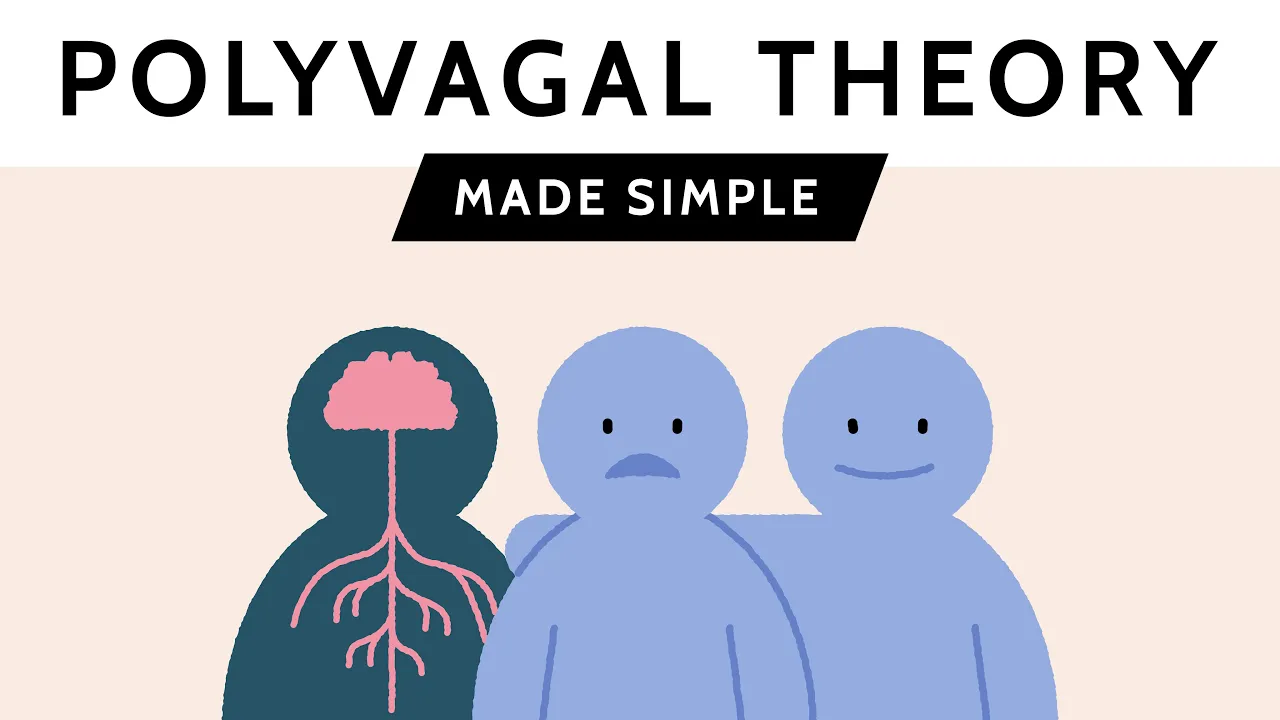












Polyvagal Theory explains that the autonomic nervous system operates through three hierarchical states—ventral vagal (safety and connection), sympathetic (mobilization/fight-or-flight), and dorsal vagal (immobilization/shutdown)—with trauma disrupting the natural tendency toward connection; healing involves learning to recognize and return to the ventral vagal state through practices like identifying personal 'anchors' (people, places, activities that bring safety cues) and developing awareness of neuroceptive cues of safety and danger.
Deb Dana on Polyvagal Theory for Treating Trauma
Added:Basic anatomy of the Autonomic Nervous System (ANS), specifically the traditional division between the sympathetic and parasympathetic nervous systems.
Fundamental concepts of psychological trauma, including how the brain and body reflexively react to chronic stress and perceived threat.
An introductory overview of Stephen Porges' Polyvagal Theory and its evolutionary framework of the human nervous system.
The concept of 'neuroception,' which refers to the nervous system's subconscious evaluation of safety, danger, and life threat.
Practical application of autonomic mapping, learning how to guide clients in identifying and tracking their own physiological states.
The clinical practice of co-regulation, specifically how a therapist can use their own nervous system to project safety and stabilize a dysregulated client.
Integrating Polyvagal principles with other established somatic and trauma-informed therapies, such as Somatic Experiencing or Internal Family Systems (IFS).
Designing state-specific clinical interventions to assist clients in transitioning out of survival states (fight/flight/collapse) and back into a state of social engagement.
212.4K views3.8Klikes1:54:53Original Release: 2020-11-28
[Music] [Music] okay everyone welcome to our second session today on polyvagal theory and trauma from deb donna so um deb is a clinician and consultant who specializes in working with complex trauma she's a consultant to the traumatic stress research consortium in the kinsey institute clinical advisor to care on clinics and an advisor to unite she developed the rhythm of regulation clinical training series and lectured internationally on ways polyvagal theory informs work with trauma survivors deb is the author of poly polyvagal theory and therapy polyvagal exercises for safety and connection co-editor of clinical applications of the polyvagal theory and creator of the polyvagal flip chart for more information on dev's work please see www.rhythmofregulation.com so deb it's a delight to have you here with us today whenever you're ready just get started and really looking forward to this i will get started this is lovely and it's lovely to be with all of you good good afternoon it's good morning for me but good afternoon to most of you i think so let's let's dive in and let's start with this very first um quote the tick not han quote earth will be safe when we feel in us enough safety and if we're going to really explore today how the nervous system is going to help us feel safe find safety create pathways of connection so the autonomic nervous system is the platform for our lived experience it really is the heart of our daily living experience excuse me it's our internal surveillance system that's at work all the time listening to what's happening in our worlds and it's this lovely biological resource that we all have inside us and we want to make sure we understand this piece that the nervous system is the common denominator in our human experience and it's organized in basically the same way and then it's shaped individually by our experience so we're going to both understand the broad organization and you're going to get an experience of befriending your own particular patterns and the nervous system is really where our stories begin this this lovely figure on the right the autonomic state then gets fed up to the brain where we create a story so even though we think that our brains are the ones that are leading the way that they're creating our stories what in fact is happening is the nervous system is sending energy and information up the pathways to the brain and then the brain is taking that information and making a story to try and make sense of what it's receiving from the body so let's see where we go next so here the three organizing principles of polyvagal theory and this is the um easiest way to think about polyvagal theory and some of you may be very familiar with polyvagal theory and some of you may be new to it and somewhere in between so anyway we'll just do these three organizing principles which i think is the way for us to understand how our nervous system is organized and how we're navigating daily living because of these three principles so the first is co-regulation and co-regulation is what we call a biological imperative meaning that we don't survive as humans without another human to co-regulate with neuroception which is detection without awareness is the way our nervous system takes in information without the thinking parts of our brain being involved and then hierarchy which are these three predictable pathways of response that we travel ventral vehicles sympathetic and dorsal we're going to take each of one of these individually and look at them and really get to know them so co-regulation let's start there so we have these two experiences going on all the time we have a drive to survive and a longing to connect and sometimes they work in concert with each other so that our longing to connect and our drive to survive are helping us move forward into approach interconnection into creating these deep wonderful relationships that that we navigate with and oftentimes this longing to connect and the drive to survive are operating to come into connection with someone but we can't quite do it right instead we end up being anxious or argumentative or running away or disconnecting and just disappearing from the relationship and that's when our drive to survive is getting these cues of danger that say don't connect don't connect those are built in to our nervous systems through our um past experiences and then we travel these familiar pathways so you might begin to think you know am i in a moment where my longing to connect and my drive to survive are coming in the same direction or is this experience of my so wanting to reach out to this person and come into connection and yet something stops me and that's your drive to survive so here is a quote stephen porges is the developer of polyvagal theory and a dear friend and colleague this is his quote trauma is a chronic disruption of connectedness i think that's a really lovely way to think about trauma it's very simple it's very clear and if we're looking at trauma through the lens of the autonomic nervous system this is the experience in a nutshell chronic disruption of connectedness and our trauma stories are carried in these states of dysregulation our nervous system dysregulation so we're going to play around with how do we stay in connection and how do we begin to create pathways of protection where we have pathways of well how do we create pathways of connection sorry where we now have pathways of protection we are in an ongoing autonomic conversation right this conversation is happening every micro moment we are alive and it's happening between us and ourselves between us and others between us and the world around us and between us and spirit so in this moment your nervous system is in those four streams of conversation your nervous system and my nervous system are beginning to get to know each other we're having an autonomic conversation where your system is looking for cues of safety in danger and my system is sending hopefully accuses safety towards you although it may be sending cues of danger there may be something in my voice in my appearance in my movements even in my environment here and back that's a cue of danger to you so i'm taking a moment just to settle in and really anchor in my vengeful and send you a welcome i'm looking at you to send you this welcome into this exploration we're going to go on and see if your nervous system receives that so my nervous system is looking for cues of safety and it's interesting to do that when i'm looking at slides and seeing my own um image right and not hearing from you or seeing seeing you so i will look forward to hearing from you um when we get to the chat so we are continuously broadcasting and receiving we are always downloading and uploading information and our work is to stay tuned into this conversation so we have to learn how to do that and then learn how to stay tuned in turning toward this autonomic conversation that's going on so when we send cues of safety we also send an invitation to come into connection i love that that image that sculpture you know to to involve right connecting when we receive cues of safety we feel an autonomic welcome and we feel safe to move into connection and to come into co-regulation with another being i think co-regulation a back and forth and ebb and flow of of being with right won't cues of danger or we'll receive an autonomic warning from another nervous system when our nervous system takes in that oh there's a there's a warning being sent to me our reactivity increases and our adaptive survival responses are reinforced so that drive to survive is reinforced when we receive these warnings autonomic nervous system warnings i don't have to say anything no words needed for me to send a queue of danger out into the world so here we have this beautiful image of what is the social engagement system and these are five cranial nerves that you see coming together in the brain stem and they control our eyes ears voice face and head movements this is your nervous system this is cranial nerve 10 which is the circuit that's going to the heart in that picture that's connecting with these facial nerves these other cranial nerves that allow us to have eye gaze and listen and our voice to send messages and our face to move our head to move this is the social engagement system let's just take that in for a moment that beautiful image all lit up this is a a human being who is ready to come into connection is sending cues of safety and looking out into the world for cues of safety we send messages with our eyes and um i'm in the united states where um wearing face coverings and face masks has become almost um universally required and it's interesting to see what happens when we wander through the world with a face mask so all this is covered right and yet here is where our nervous system is looking for those cues it's around the eyes so yes the mouth is is important to have it gives other signs but if you look at someone behind a mask you can see the smile behind the mask or you can see that the warning behind the mask because it's coming from the eyes so i want you just to look for a moment just take in the eyes and just notice where your nervous system takes you does it feel invited to connect or a warning of danger we'll go back a minute to that one and just leave us there for a while and just notice what did happen in your nervous system when you saw eyes from other humans from other mammals just notice that and your brain likely tried to make up a story pretty quickly but your nervous system was really sending the information to your brain so then we have our ears this other part of our social engagement system i love this quote the ear collects the spiraling energy from the cosmos i love that spiral with all those frequencies that make it up this is what our ears are doing all the time they're listening for sounds of welcome or cues of danger right i'm going to talk just for a moment about ssp which is um steve portis's musical auditory intervention it's five hours of music that has been specifically remastered to calm your nervous system and enhance this beautiful social engagement system that that we just saw in action because listening is dependent on the nervous system it's dependent on our state and it influences whether we are feeling safe to connect or in a survival response where we need to disconnect and listening provides opportunities to exercise these neural circuits the neural circuits that support both our physical and our mental health because our nervous system is the foundation of both of those both our physical and our emotional well-being is based in our nervous system's ability to be flexible so the music in this ssp efficiently conveys cues of safety so if you're interested in learning more you can go to the um their their website and if you decide you want to take the training there's a code for you but let's move on to prosody which is the music of the voice right the music of the voice the patterns of rhythm and sound frequency duration intensity is what your nervous system is listening to and it's going to listen to my tone of voice the intonation of my voice before it takes in any information that i might be sharing because what my prosody is doing is my prosody is sending a message about what is underneath the words so it reveals the underlying intent of my words so again i'm just going to see is my voice welcoming you into connection so what we know about voice is that a monotone voice is an automatic autonomic cue of danger so i'm going to talk in a monotone voice just for a moment and let you see where your nervous system goes and just notice what happened was there a disconnect was there a confusion in the nervous system where it happened inside your system i know what happens inside mine when i speak in a monotone voice and it feels very restrictive very confining and i begin to disconnect from what i'm doing so interesting for you to notice what happens right and then there's there's also there there are tones of voice that that can just feel um disregulating to our nervous system it can have a familiar frequency to something in our past and we cannot understand quite why we are disconnecting but it can be because of that familiarity of the nervous system from something in the past so that's prosody and i love the research around what we call vocal bursts these are the non-language sounds that we use to communicate ah right you you get the you know what i'm trying to say by a local first right and the research tells us that these non-language ways of connecting are understood across cultures and across species right we talk to our cats dogs horses cows in this way right and that they're understood with a high degree of accuracy so when we don't know what to say we can use a vocal burst because sometimes words are difficult to find the right work is difficult to find i know as a as a clinician i sometimes struggle to find i wonder what the right word to say i know what i want to say i need to find the right word to communicate that to my client and i found a vocal burst does that beautifully the same is true with my you know my friends the people i live with and love sometimes the vocal birth is just the right thing and you will notice now that you know what vocal bursts are that as you go through the world we use them all the time so begin to tune into those vocal bursts and finally we get to head movement and just you know notice these interesting creatures who are nodding turning their heads tilting their heads so a straight unmoving head is an autonomic view of danger so if i taught the entire webinar today this way without ever moving my head i'm going to do that for a moment and just notice what happens where is your nervous system taking you as i speak to you with still atrocity but i'm not moving my head and then i'm going to invite you for a minute to try that on for size so try speaking to me even though i can't hear you talk to me from all without moving your head and just notice what happens inside and while you're playing with an unmoving head now speak to me also in a monotone voice so monotone voice and unmoving head and notice what happens and then keep your head straight don't move your head but add porosity back to your voice and notice what happens and then finally let your head move in whatever way it wants usually that there's a gentle tilt that wants to come in sometimes it's a back and forth to shake it out but just notice what happens now when you have porosity and your head is moving right i'm a right side tilter you know you can kind of notice for yourself you can go back to an unmoving head and invite your head to move and do it do i tilt left do i tilt right no research on that i'm just always curious about it to see where people or people go right or left and some people say well i can go either so here are the elements of the social engagement system that are at work in every moment sending cues out into the world our eyes our voice our head turning and tilting this is the way we send a message out into the world whether we're saying oh i'm available and ready to connect i'm a safe presence in the world or stay away i'm warning you i am not in a place where i can connect right now so i'm sending that i'm also looking for that so that was co-regulation where i start the first organizing principle and before we move to neuroception i just wanted to say that co-regulation is where we begin when we enter the world right we need another being to help us we don't survive without being connected to another human being our longing when we come into the world is to be met by a welcoming regulated energy that the person whose arms we are in is is welcoming he's sending those cues of safety right that doesn't happen for all of us right and and so if we don't land in a system with a person or people who we can co-regulate with who send those keys of welcome who predictably show up for us in that way then we have to learn to self-regulate before we really should be doing that right the trajectory is we co-regulate and then we self-regulate from our place of safety so if you think about your own world you think you know were there people who i safely could co-regulate with who i learned how to send and receive cues of safety or was my world you know filled with people who sent warning or were there some of each most of us have some of each and again we don't need to be in that co-regulating relationship all of the time you know the research tells us that about 30 of the time we're in that place of feeling that they're welcome all the time right it's that the other 70 of the time we are with someone who recognizes there's been a misattunement what we call a rupture and they come and they make a repair they reconnect they then send a cue of safety they send an autonomic welcome all right so understanding co-regulation and the essential need to be connected with others and again that that is a lifetime need but we are wired for connection we need that connection from the moment we enter the world well before we enter the world even in the womb we need that connection and then until we die we need that connection so here let's go to the second organizing principle which is neuroception and this is the way the nervous system takes in information without us being aware of it without conscious awareness so as we begin to explore befriending our nervous systems today one of the things we're doing is we are making the implicit experience that's going on inside our nervous system all the time and we're bringing it into explicit awareness so neuroception is this wonderful word that steve portes created to describe the way the nervous system takes in information because the only word that came close was perception right and perception involves the cortex involves your brain and while the nervous system connects with cortex at its heart it's a subcortical part of our um anatomy right it it starts in the brain stem and it goes down and then it connects with the nerves in the face when we saw for the social engagement system and it does have some projections to cortex for prefrontal but when it's taking in information it's working below those levels and so he developed the word neuroception which i absolutely love neuro for nervous system and exception for the way we perceive so neuroexception and neuroception is responding to cues of safety and danger and easiest way to think is inside outside between so it's listening inside your body it's listening outside in the environment and it's listening between your system and other systems so between people and this is going on micro movement to micro moment all the time we're alive neurosceptic is happening so i'm going to invite you to take an autonomic adventure for a moment and tune in to your neuroception so if you can just invite your brain for the next eight ten slides to to take a back seat and let your nervous system sort of take you on a journey first your brain's going to come in very quickly to make a story but let's just start by inviting the nervous system to just looking at the slides and just noticing welcome or warning approach hmm so take a moment and just notice for yourself where did your neuroception take you where did you go and you know some of those slides um bring a very varied response in in the viewer right and i try to put in slides that would bring up different experiences for people i won't mention the slide of a single teddy bear and what i get from people when when i'm in trainings is it either brings up a well-loved and a longing to connect or an abandoned forelorn and a desire to get away from that image the the blue door image brings up a variety of experiences because it can feel inviting of curiosity inviting a possibility or it can feel sort of a forewarning of something unpredictable unexpected right and i try to mix them up because what i wanted you to have for an experience was different nervous system approach avoid welcome worn some neutral even and in the warning kind of experience of you know mobilizing getting out of here or anger or that immobilizing disconnecting and then the experience of feeling oh i could just relax in that image because that's really what's happening for us every moment of the day where we're taking in information in these ways and those were just images think of what happens when you have all of the sensory information that's coming at you so the lesson here is that we can tune into what happens in our own nervous system and that really is our responsibility to tune into our own nervous system and we can't assume what's happening in another nervous system so if you happen to be watching this with another person with you you ask them you might find oh they had a very different experience right so the the you know the invitation when we're looking through the polyvagal lens through the lens of the nervous system is to know oh here's what happened for me how did that land in your system what happened for your nervous system experience right and if we really want to stay true to um the lens of the nervous system you know we use that kind of language you don't say well how did you feel about that or what did you think about that because again thinking feeling is is another level up i want to stay right here at the embodied nervous system experience where did that land in your system and as we map your system a bit later in this this webinar and that's the question we keep going back to where did that take you on your map right so that's the that's the experience of neuroception and here's what happens we sometimes have what we call a neuroseptic match and when neuroception you know sort of matches what's happening in the world the nervous system activates the stage it brings the energy that's necessary to manage this experience and sometimes narrowception is one of safety and connection and that's just right and it brings us the energy to move forward engage connect communicate cooperate collaborate all those lovely things right and sometimes the neuroception is one that it feels a bit unsafe at the moment or there's something a bit not okay in my environment and then neuroception is going to activate the state that allows me to take the survival response needed sometimes a fight response is exactly the right response sometimes an act of escape is the right response and sometimes that um disappearing disconnecting is the right response so again it's not always that we simply want to be in this welcome sometimes the situation calls for an adaptive revival response so that's the match and then we have this mismatch that often happens right with a neuroseptic mismatch we have an inability to calm our defense systems more actually in a safe environment so it may be concretely safe but my nervous system may get a neurosception of danger right and then it will activate my habitual protective response pattern right this hyper-visual and alarmed experience and you might think about your own experience do you wander through the world more often in this hyper-vigilant alarmed place and if so is it an accurate experience of neuroception and it's interesting because at this moment in the world neuroception is taking in cues of danger all over the place and for many people in many environments and many experiences that is an accurate neuroception there are a lot of accused of danger and sometimes because we're getting so bombarded by accused of danger we actually are in a safe environment but our nervous system can't calm down the neuroception can't find the cues of safety right and we are um we humans have a negativity bias we're built that way built for survival so that our nervous system pays more attention to accused of danger than cause of safety so an equally intense queue of safety gets less attention from the nervous system than the queue of danger just the way we are built right helped us survive this still helping us survive i imagine but what it means is we often miss the cues of safety that are actually in our environment so that's one mismatch the other mismatch is when we can't activate our defense systems when we are actually in a risk environment so our neurosuction doesn't give us the accurate signals of danger right and this response is this this dulled unaware going through the world not really here in that protective cocoon right but it means that i'm i'm at risk because i can't activate my defense systems i don't get the cues of danger that then would activate my defense i also think this is a high risk taking um folks who who just don't get the accurate cues of the intensity of danger there is in that high risk activity they're doing so again think about the way you're moving through the world and perhaps you're more on this i'm sort of in a in a protective space not not really taking in the cues and you know our systems are overwhelmed at the moment and you know staying in that hyper-vigilant place for such a long time is really challenging and draining and then we may go to this dulled unaware as a as a respite from the hepa vigilant or again we're going to map this in the second part of the program this morning but just think about where you are and how you move through these mismatches right and then what do we do when there is a mismatch you know how do we work with neuroreception is really the question because neuroception is simply a biological experience that is happening in your body your nervous system is doing this all the time we can't work with narrowception directly we have to bring perception to neuroception so that's the first step we bring perception we turn toward our nervous system and we tune in we bring our active awareness to it and then the next step is to bring what i call discernment we have to move into discernment to decide you know is is what my neuroception is giving me needed so the question i use is in this moment in this place with this person or these people is this response needed okay so that's really the question because it's going to take in those hues of safety and danger right it brings us into the present moment and the environment we're in and the people or the person we're in connection with and then it asks the question is this response or this intensity of response needed right remember it doesn't ask is it appropriate because the autonomic nervous system doesn't work that way it doesn't work with moral meaning or motivation it simply works with survival right we humans add the the story that's the brain adding the story about motivation or meaning and oftentimes moral meaning around people's behaviors and their responses you think about that that's what happens about you know our own responses if we are in a response we begin to have this make meaning of it right and judge it and self-criticism and that's your brain not your nervous system your nervous system is simply responding so the question is in this moment in this place with this person or these people is this response needed so i'm going to invite you to think of a time recently when you had a response that felt somewhat out of balance to the situation right and that's the cube we're looking for if something feels a bit too much or not enough for the situation there's an imbalance between my nervous system response and what's going on then i want to look at this through this question of discernment right because what happens is some familiar cue from our past has come alive in the present and has brought this intensity of response if we think about trauma for a moment this is how trauma activates in the moment right there's a familiar flavor of something and our nervous system feels that senses that tiny flavor of a past traumatic um neuroceptive experience and then it lights up in the present moment so discernment is one way to begin to turn towards that and think this is this a trauma story that has come to life because something either inside my body in the environment around me or between me and another nervous system has come alive so this guiding question that we use is in this moment does your neuroception sense me as a restorative resource or a threat right that's the question we're asking whenever we're with another human being when we're working as as some therapists when we're working as as clinicians or any kind of helping professional this is the question we are asking am i sending the cues of safety out into the world to this other human being that they need so that they sense me as a restorative resource or have i moved into the category of threat and again i always intend to show up as a restorative resource and i can feel it when i'm in that connection with another person and i can feel it when i have moved out of that place and have become no longer a friend but now a foe i'm no longer a resource i'm now a challenge or a threat and then my work is to bring input explicit awareness to that and ask the question so what just happened right if boy it felt in my nervous system like we just disconnected for a moment i wonder what happened what were the cues of danger that came in so i'm going to invite you for a moment to do this simple practice with me and we're going to start with and i'm going to ask you just to identify one cue a safety one queue of danger it may be easy to identify more but let's just start with one and then see where we go so we're gonna start with the inside so at this moment inside your body can you identify one cue of safety and one queue of danger inside your body just listening in what's acute safety and what's a cue of teacher and then we're going to invite us to move into the environment so at this moment in the in the environment just around you your immediate environment can you identify one queue of safety and one queue of danger and then we're going to expand the environment out from your immediate environment one step out whatever that is for you whether it's outside the room you're in outside the building you're in out into your community or neighborhood one step out and what's a queue of safety and a queue of danger and then let's take the global step out and step out into your your country or even the global connection what's one key of safety and one queue of danger in that large space that large environment all right and then let's work our way back here to this environment and let's come into the sense of a cue safety and a queue of danger in your connection with others it may be in your connection with me one cue safety one queue of danger and maybe in your connection with someone else in in the space you're in right now in your sunday space you can just think of someone in your world and just think what's the cue safety nervous system to nervous system and that connection and what's a cuba teacher so you're beginning to get to tune into your nervous system through neuroception and then this is the guiding question we're asking all the time am i am i being perceived as a resource or a threat am i sending out cues of welcome or signals of warning all right we will stop there for a moment and we've got just a couple of minutes before we take take our break and i just want to settle in for a moment we took a whirlwind tour through the first two organizing principles of polyvagal theory of co-regulation this biological imperative to be in connection with another safe regulating person and then neuroception and if we put those together we understand that neuroception is driving our connection right so if i'm putting a sign of welcome if i'm sending neuroseptic cues of safety out into the world and you're receiving those then we can come into safe co-regulation right so these two weave together beautifully and form the foundation for relationship right and as we go into the next module we're going to begin to map our system and understand um how we can know where am i in acute safety or queue of danger but right now we're just going to stop going and just notice right where are you are you feeling connected or are you feeling some flavor of danger and again this work is to tune into your nervous system and then let your nervous system inform the story your brain is creating all right so we are um going to dive into um the hierarchy the autonomic hierarchy next and so i'm going to wait and do that as we come back from your five-minute break to do whatever you need to do to be able to come back and dive in from a place of feeling welcomed and ready to learn about the autonomic hierarchy look through the chat while i was having my five minute break and i i will um respond to the to the one question that felt important at this moment to respond to around um co-regulation and connection with people for whom people have been dangerous by people who are suffering from complex trauma and what i will say is oftentimes pets are one of the first places of co-regulation because it's another mammalian system our dogs are cats our horses a way to co-regulate we also co-regulate in nature which is an interesting experience not with a with a nervous system but with the natural world um so yes and when i'm working with clients i am that missing experience for them i am the um safe co-regulating energy that connects with them and they can dip into that connection and it really often is dipping in just a little dip in and feeling and back and dipping in and feeling and come back so um it is a biological imperative and as you know therapists drama therapists or people living with people who are suffering from complex trauma we are the regulating energy the regulating system that offers that um what bruce ecker would call a disconfirming experience to them you know steve would call it a you know a different um challenging their neural expectation because their neural expectation is the nervous system expectation is that people are not safe to co-regulate with so we're offering a different neural expectation for them to begin to take in and then i also noticed the um adverse childhood experiences the aces were referenced in the in the chat and aces are um i think being used um pretty regularly in many places now i know primary care physicians are using as a screening tool and what i want us to think about through the lens of the nervous system through the lens of polybagel bagel theories that aces is step one um but we need to put step two in to then um use use the aces in a way that's that's helpful to direct our um our understanding because step two is not what happened but what was your nervous system's response to what happened right so when you're using ace um yes there's a ton of evidence that links a certain number of aces to certain um physical and mental health experiences and you really want to want to look at so you had these three aces what was your nervous system response because it can be that someone has you know one ace their score is one or two and they are um incredibly compromised they're they struggle in their daily living and another person may have three or four and um be very regulated and move through the world from that place of flexibility it's the nervous system response so let's go on now to this evolutionary timeline let's let's get to know the nervous system and the three states so here are these three distinct pathways each working in service of survival and we want to remember that term in service of survival right no matter what state i'm in my nervous system has enacted that response to assure my survival so about 500 million years ago the dorsal vagal system um emerged right in our phylogenetic history not in our you know it wasn't a um one of our mammalian ancestors but in our phylogenetic history 500 million years ago this first part of the parasympathetic nervous system emerged and it helps us in nowadays immobilize and disconnect right so back then this was the system you know if you think about an ancient tortoise which also was not the 500 million year ago um creature that we're talking about this was actually some sort of a boneless fish but if you think about the ancient tortoise it sort of wanders its way slowly through the world right this is your dorsal vagal system wandering slowly through the world and when you get a neuroseption of life threat go into your shell become invisible become immobile right that's dorsal and then about 400 million years ago the sympathetic nervous system came into being right this was actually in another other kind of fish right and because evolution is so incredibly creative we don't throw out dorsal we simply build sympathetic on top of it and sympathetic is a system of mobilization right it's known as fight and flight we want to call it mobilization because it brings us this energy to do all sorts of things that are wonderful and needed and in a survival response it brings us the fight and flight energy and then about 200 million years ago as you see this other part of the parasympathetic nervous system ventral bagel came into being built on top of sympathetic endorphin and this is the part that makes us uniquely human right we can be safe and socially connect communicate and when we think about connection through this branch of our nervous system we think about those four streams of connection we think about connect to self or you know as as you're going to learn in the ifs presentation connect themselves all of the parts inside of me connect to other connect to the world around us and connect to spirit that is what this ventral vagal experience brings us all right so let's put that on the hierarchy because that timeline the order in which those systems came into being create this hierarchy of response and polyvagal theory lets us know that we respond in these this particular order because of that predictability it makes it a lovely way to navigate our own paths through the world and to help our clients understand where they are and what has to happen to come home to ventral and i call ventral our home because i believe that our nervous systems inherently know how to get there and long to be there and those pathways may have been covered up through experience but they're there and our job is to uncover and keep traveling those pathways so that they get well worn and those pathways of connection begin to be the ones we travel more often than our pathways have protection so here we are the ventral is the top of the hierarchy a system of safety and connection whereas steve says we have access to health growth and restoration those three lovely experiences down one level of the hierarchy is sympathetic a system of mobilization where our protection is through action some kind of action and then bottom of the hierarchy dorsal a system of immobilization where our protection is through disappearing so just take a brief tour through these systems this is the vagus the parasympathetic is mainly made up of the vagus nerve and there's that lovely image it's an old ancient wood carving of the vagus not anatomically correct exactly but beautiful right you get the feeling of the wandering aspect of this nerve and so from the base of from the brain stem at the base of your head in your medulla that's where this starts and then it travels down through your lungs your heart your diaphragm your stomach and then as we saw it connects upward to form the social engagement system with the nerves in the neck throat eyes and ears so it actually forms a biological face heart connection and if we think about how the ventral and the dorsal aspects of the vagus are divided the division happens mainly at the diaphragm and so from the diaphragm up supra diaphragmatic is ventral and this is where our nervous system helps us come into healthy homeostasis safe engaged connect communicate and from the diaphragm down sub diaphragmatic is dorsal and when dorsal is doing its everyday normal non-reactive role it has healthy regulation of our digestive system that's what it does so as long as it's just doing its everyday function it's helping our digestion work beautifully it's when it's called on when it's enlisted as a survival response that we move out of awareness out of connection into collapse right our digestion is impacted certainly and we have this sense of no longer being here sympathetic nervous system is a spinal nervous system so whereas the parasympathetic is cranial nerves coming out of the base of your skull sympathetic nervous system is spinal nervous system comes out of the middle part of your spinal cord or the sympathetic chain that runs down next to your spinal cord thoracic and lumbar regions right so if you just for a moment reach one hand gently down from your back and the other hand gently up from your waist in the back between your two hands is pretty much the territory of where sympathetic exits thoracic and lumbar and its job everyday non-reactive role is to regulate breath and heart rhythms you know it helps pump blood it helps it helps us bring it has this mobilizing energy so that we can move through the world in all sorts of ways that's its regular role we need sympathetic energy that's why we call it the mobilization system and when it's enlisted for an adaptive survival response it brings us that energy of fight flight so what do we do with that and here's how i envision this and here's what we're going to work with now so that you can begin to befriend your own nervous system we put those three states on the autonomic ladder right ventral is at the top and you can see the ventral um figure there is delighted with the world right can see all sorts of things safely anchored up there at the top of the ladder neuroception is one of safety social engaged connected through those four streams of connection sympathetic we move down to the middle of the ladder you can see the fighting flight that happens there neurosception is one of danger mobilized action taking and then this little person at the bottom of the ladder and dorsal the neuroception is one of life threat right remember neurosception is simply the way nervous system is taking in and so we call it a reception of life threat because it's overwhelming whereas the neuro reception of danger and sympathetic gives us action taking doing this overwhelming queue of danger which we call life threat we now go into shutdown or collapse we're immobile okay so here's the autonomic ladder so let's think what are the emergent properties that come from each of these states so from a state of protection either sympathetic mobilization or dorsal disconnection survival is the only goal and while most things in the nervous system in our body even in the way we do therapy most things are both and experiences this isn't either or so when we go into one of these protective states adaptive survival responses close our system to connection and to change so we can no longer connect and no longer engage in the change process it's only from a state of connection that we can be in this process of change health growth and restoration social engagement can happen only when we're in a state of connection so when we move out of connection into protection we also leave social engagement so here are the emergent properties of ventral and emergent properties are those properties that are supported research nourished by a state okay so what is nourished possible from ventral is this we can co-regulate and self-regulate right we connect to self others the world and spirit you can see this really is a place of both the end ventral is a place of both hand we tune into the moment and tune out distractions we're both resourced in our own being and resourceful in the ways we move through the world we can reach out for support and we can offer support we have both compassion and self-compassion we explore options this is where hope lives in a ventral vehicle state we are flexible we're resilient in this place and the stories that happen here have a flavor of possibility okay so that's ventral top of the hierarchy take in all those emergent properties and when we move to sympathetic all of those properties that were supported from ventral are no longer available to us and instead we're here we have a sense of unease impending danger we're now mobilized for fighting flight active aggression or active escape we're alarmed or hyper vigilant and let's think for a moment about alarm because alarmed is an interesting experience and there is a subtle difference between being alarmed and being alert alert is an emergent property eventual right alert is i can pay attention to everything that's going on around me and be here present doing it alarmed is when i've gone to sympathetic i'm now in an adaptive survival response and when i leave ventral to go to sympathetic or dorsal my prefrontal cortex does not come along for the ride so my prefrontal is now no longer with me helping me the way it does when i'm alert so here we're alarmed we're looking and listening for danger and we miss and misread signs of safety right there's this sense of separation that happens here we move from connection to being cut off from others and in fact we're in ventral i want to be connected to the world and to people and sympathetic people now become dangerous right so we disconnect from self others the world and spirit and we enter into a story that the world is unsafe and the people in it are dangerous to me okay here are the properties of sympathetic this is what is available to us when our biology has taken us into this state so now let's go to dorsal the bottom of the ladder the earliest state this early survival state where our body enters conservation mode everything slows down digestion starts heart rate slows breath changes the blood flow and the oxygenation of blood to our brain changes so our state becomes one that is numb foggy a flavor of dissociation right dorsal is actually the doorway to dissociation we're collapsed we're disconnected from everything we're disconnected from others from the world and from ourselves my clients describe it to me as this sense of feeling untethered and floating we're alone lost abandoned unreachable they tell me that it feels like i'm lost alone in a place where no one will ever find me i get that over and over with my clients hopeless we disappear right some flavor of disappearing and it simply may be that i've taken that step back i'm not quite so present here i'm going through the motions but i'm not really here or i'm going through the motion to have the energy to care right safety and hope feel unreachable because if you think about it i have to climb all the way up to the top of that ladder right in order to reach safety in order to find hope again so the flavors of story that come here are stories of despair and i like the latter because as we're going to see when we map there are all sorts of flavors of these states you know which is why the rungs on the ladder we go from rung to run and feel the different flavors but there's some flavor of giving up despair can't that happens here in dorsal so this is an image i encourage people to do art creations of their states and this was a pastel of a colleague's dorsal experience i'll just let you take it in for a moment you can feel that dorsal experience perhaps i think it's a beautiful representation i also love it because she said please use it you are welcome to use it but please don't use my name which to me is that dorsal experience right that's the dorsal experience i don't want i'm not seen don't see me and here this is my thought about sympathetic it's the power the unleashed uncontrollable power of this wave that's what it feels like to me and then here is a lovely creation of a ventral experience one of my students who created this it's made of all out of natural materials i'll just let you take that in for a minute it's just really lovely you can feel the ventral in my system you see how it lands in your system so now having this basic understanding of these three states and the three discrete states at the moment is where we start because when we begin to befriend we want to know what does ventral sympathetic endorsement feel like well how it happens for me in my system so you have this this handout you have this this map this is the personal profile now and i'm going to invite you to get it out it's going to take you through it so that you begin to get to know your nervous system that beginning introduction in this particular way and if you don't have the map printed with you just get a piece of paper would be great divided into thirds you can draw a ladder on the left so we're going to start in sympathetic and then we're going to go to dorsal and then we're going to end in ventral because one of the only rules really around doing this kind of exploration doing any kind of polyvagal approach to therapy is whatever we do we always want to bring the system into a ventral experience to end so my my motto is always end in ventral so even in this mapping today we're going to do that and you'll feel your system begin to come alive in these states as we do it so we're going to start in sympathetic and i'm going to invite you to first connect with your sympathetic nervous system and ask your sympathetic nervous system if you were going to do this mapping color what color would it want you to use for sympathetic and again your brain might say one thing immediately but check in just check in with your body move down from your brain and see what color the sympathetic nervous system want to be and just write that color in the margin of your map when i do this with with clients i usually have markers and nowadays because nobody's together i invite clients to have markers but this morning we'll just mark it in the margin and now what i'm going to do is i'm going to invite you to think of a time recently and that you felt some of that sympathetic mobilization right this is not the the energy that allows you to to show up and move through your day with with passion and joy and energy this is the survival energy the neuroception is one of danger and it's taken you to a place of feeling endangered and fight or flight is coming up for you overwhelming too much energy flooding your system and bring just enough of that into your mind and body so you get a flavor of it and then begin to write in the middle portion of your map what's happening in your body what are some of your things your thinking what are some of the things you do and what are some of the things you feel so behavior feelings body beliefs and just write in that middle part of your map in the sympathetic section and i would invite you to write whatever you hear from your nervous system don't edit what you put on your map you know in the beginning we want to really listen to what the messages are we're getting you might think about sleep how has your sleep changed how's your relationship with food impacted here and sympathetic and how is any use of substances or or behaviors you know compulsive or addictive behaviors impacted here and we want to really broaden that category to be anything that is you know pulls you in that way um recently it's been netflix binging for me so that's a sympathetically charged just need need the next episode right it's that quality of being driven that happens here it's sympathetic so just take another moment and let your system help you fill out this middle part and then i'm going to invite you to fill in two sentences from this sympathetically mobilized survival state any kind of site can be a sigh of frustration that interrupts it can be a sign of of relief or a sigh of contentment enforceable we have a desire of despair the research on thine tells us that the sigh is a resetter of the system both of our psychology and our our nervous system so just a brief psy can interrupt and help us find a moment an anchor back to ventral for a moment because now we're going to dive to dorsal together okay let's go to dorsal and a dorsal we just want to dip a toe in his dorsal can be very powerful in its pull so we want to go to dorsal the bottom part of the map bottom of the ladder and first ask your nervous system what color is dorsal what color and now that you have your color we're just going to dip a toe into that experience of feeling not enough energy in your system to to run your system a sense of um disconnect a flavor of shutdown or numbing not care going through the motions when you begin to feel that in your mind and body just enough begin to write in the bottom part of your mouth what happens here what happens in your body what do you think what do you feel what do you do and again while you're here think about sleep think about your relationship with food and think about your use of substances or behaviors how do they change here in dorsal and then we are going to do those same two sentences here in dorsal from this place of untethered floating a bit not here the world is and i am just feeling those two sentences the world is and i am give you another minute to fill in some dorsal information this map is an information gathering experience all right so now remember we have to find our way from dorsal through sympathetic to ventral and the experience of moving up the ladder through sympathetic is one of not mobilized fight and flight but this is where we just use some of that energy some of the mobilizing energy but not fight and flight so we need to organize the energy we need to contain it in some ways so i'm going to invite us to just have a bit of a stretch as you as you stretch and use your extension stencils you bring a little ventral and then we used to touch fingers for the people next to us but you know we can have a self-touch right to begin to bring a bit of that ventral and then again a breath and a long exhalation brings ventral so and then let's connect through our social engagement systems i will send a welcoming smile to you my eyes are welcoming you let's find our way back to metro and now from this place in ventral where we're back here present in our world ask your ventral system what color is this what color would you use to create this top part of your map all right and so we're going to do the same here except for fentral we're going to bring it fully alive in our system so what i'd like you to do is just think of a time when you felt that sense of ventral and ventral there are so many flavors of ventral it can be a true passionate joy enjoyment of this moment in time it can be a very quiet at ease relaxed moment it can simply be a i have enough safety to move through the world feeling okay right i get that from my clients about oh yeah it's okay i'm okay enough right this is the safe enough place the neuroception here is one of safety so find a moment that brings that alive for you and when you do let it really fill you right whereas in sympathetic or dorsal we just dip the toe and eventually we're going to really let it fill you feel your system filling with this energy of regulation this energy of connection and when you feel filled begin to write in the top part of your map what happens here what happens in your body what do you think what do you feel what do you do here and the lovely thing about doing the ventral portion of the map is you only need a micro moment of ventral to map it so it's not this long extended experience of being anchored here that we need and recently that's been difficult to come by for many of us but a micro moment brings it alive your nervous system knows this place and again here what happens in with your sleep with your relationship with food and any use of substances or behaviors how does it change human ventral and those two sentences i am and the world is fill them in from ventral how does ventral inform those sentences the world is and i am so this is a map you can return to as you get more information but for this moment i'm going to invite you to now turn towards those rectangular boxes running down the right-hand side and again if you're making your own map you can just write in three boxes on the right-hand side these are for you to name your state and the way your state would like to be recognized ventral sympathetic and dorsal are are the biological um scientific names and i think it's important for us to know those and i know that for many people ventral sympathetic dorsal are not the user friendly labels or in other ways their states want to be known so again in those boxes on the right-hand side just invite your states to share with you how they want to be called the other day it was a weather theme so it was sunny stormy foggy someone was using energy it was um it was calm chaotic confused so whatever works for your system and this really is a honoring how your nervous system is saying this this is what i'd like to be called all right so as we're gonna kind of look at this map in total one of the ways to start and get the real flavor of your three states is to look at those three sentences i am in the world is in each in each of the three places and just notice how different you feel about yourself and the world when you're in ventral sympathetic endorsement just really feel what happens because that's your that's your brain story that changes so dramatically as you change state and here here's a composite map of many of the people i've worked with and if we look in in dorsal i am unlovable invisible lost and alone and the world is cold empty uninhabitable and your i am in the world is statements or you know have some flavor of this um hopeless helpless disconnect floating and then if we move up to sympathetic i am crazy toxic the world is unfriendly scary exploding and your sentences have some flavor of this sense of being there's too much overwhelming out of control it's chaotic we're in that anger or anxiety place we're confrontational we're ready to run right and then finally coming up to the top of the hierarchy in ventral i am okay that's the one i hear often for my clients and simply i am okay right that's great that's that anchor in ventral i am okay the world is welcoming filled with opportunity some flavor right curiosity is an emergent property eventually i love that's what i look for most often with my clients is a bit of curiosity when they go huh and there there's that vocal burst aha that that lets me know there's a bit of curiosity a bit of ventral just came into their system right and then there are lots of flavors of ventral so you can be passionate or at ease right you can be you know playful joyful you know mobilized in that wonderfully energetic way or quiet calm okay so look at your map and just notice you know how you fit on any of these okay so this is what we do with the map now is this notice and name practice so i'm going to invite you right now to notice where are you on your map right now and name the state either the name that your state told you or ventral sympathetic dorsal name the state and then turn toward that experience for just a moment with a bit of curiosity just for a moment and listen to what the store the state wants you to know just for a moment and now come on back and we want it to be that quick and simple of practice in the beginning because what happens when we turn toward and bring a bit of curiosity again curiosity is a ventral experience so we're bringing a bit of ventral turning toward an experience that might be sympathetic or dorsal to listen for just a moment to the story the state wants us to know and we do it just for 10 15 20 seconds and come back and it's the coming back that is the essential experience because what happens for many of us and certainly for our trauma survivor clients is when they listen to a state or get pulled to the energy of that state they get pulled in and stuck there right so the the experience of flexibility or well-being is not that we're always in ventral it's that we can find our way back to ventral so if we look at this lovely art map by my colleague david keyvil we're not always in the top canopy there in the ventral canopy of the tree we move to the sympathetic limbs and then underground to the dorsal but we can find our way back and then this comic strip you know this is this experience of ventral through sympathetic to dorsal trees are often the way people represent their states their hierarchy when they do an art map and i'd encourage you all to create an art map it's a beautiful way of getting to know your nervous system differently from the bladder map the ladder map is a more left hemisphere biased experience this is a more right hemisphere biased experience as you can see the sympathetic in the middle the dorsal underground and finally ending in ventral and then this one i love the the dorsal unplugged right not the perfect experience of dorsal unplugged moving up through sympathetic or this alarm going on right and then up to ventral so what we know is that without a ventral vagal anchor you know without a system that they can't use the regulating influence of our ventral vagus we have health challenges our relationships are in distress and we suffer in our daily experience so what i'd like to do as we're getting ready to end this is do this ventral bagel anchor practice so we're going to identify the predictable who what where and when of your ventral system okay so again if you have paper and and can write on it it's a lovely way to begin to to identify and remember your anchors let's start with who so who is a person in your world who when you are around them or when you think about them your ventral system feels welcome you feel that welcome you feel safe to engage who is a person and again for many people from people have been dangerous the who may be a pet in the beginning as a clinician i take the responsibility to show up as a who for my client and i'm very willing to be their who as we're creating more regulation to find a who for your system and after we get good at who the who can be um a spiritual being who can be someone who was alive is no longer alive but still brings you that sense of welcome can be someone who you don't know but also brings you that welcome but as a first starting place i'd like you to find a who that is a living breathing nervous system that you can connect with so then we'll move to what what is some simple practice you can do some simple thing you can do that when you do it predictably gives you a micro moment of ventral predictably feel safe and welcoming again this is not a large practice this is a tiny moment so for me um you know i live in maine and my back windows look out onto woods and so a what for me is to simply look out the back window and as i do it right now we have a beautiful um it's morning beautiful blue sky i'm seeing the tops of trees and the trees are blowing because it's windy out so that's a that's a a what for me a ventral bagel or what for me so what is something you do short little something you can predictably do so then let's move to where where is a place in your world where when you are there or remember being there if you can no longer go there at the moment brings you that ventral vagal sense of oh yes safe welcome where is a place again i live near the near the ocean and so my where is by the ocean and up until recently i've been unable to go to my where because my my ocean my particular stretch of ocean has been closed to people so but now i can go back to my where my nervous system is very happy about that so where is aware for you and then finally a when when is a time time of day day of the week time a year time when something happens when you feel that predictable anchoring eventually i tell people i'm a morning person an early morning person so that that is a win for me that getting up first thing before the world wakes up and i'm by myself in this moment it's a ventral win an anchoring win for me so again if you found one who on what one where and one when that's a great starting point this is what i do with my clients we do this together and we find one of each and then you create a practice of turning to these when you notice that you're either not anchored in ventral or you're moving out of ventral so that comes back to the question where are you on your map and if oh i'm not in ventral i can grab an anchor to help me return there or if i notice one i'm on the verge of leaving ventral grab an anchor right we can also use these to deepen our capacity to be in control right i can i can bring my who to mind and i can just simply be with that experience for a bit of time and deepens that connection so ventral vehicle anchors are a lovely way to start to resource your nervous system right to help you have more capacity to come back to ventral because remember we are not um unhealthy either physically or psychologically unhealthy simply because we leave ventral it's when we leave and get stuck in one of those adaptive survival states that we suffer so flexibility of being able to come back finding our way back home to ventral is really makes for a resilient system so flexible system is a resilient system a resilient system is one that's filled with flexibility so these anchors are a way for us to do that right when we're in the rigid and stuck end of this continuum they're more accused of danger than cues of safety right and the safety danger equation is the easiest way i think of to think about it when there are more queues of safety than danger we're ready for connection new stories emerge change is possible and we experience both physical and psychological well-being more cues of safety than danger we can anchor and ventral right more accused of danger than safety the opposite happens a survival response activates either sympathetic or dorsal and we get stuck in the story that comes from that state our system is closed to change and we suffer from physical disease and psychological disease right so through the lens of the nervous system this is the equation we're working with and we need to rebalance this equation to be able to come back into ventral and i do it simply by i usually put it on a piece of paper with my clients right we look for cues of safety and danger in the categories of embodied environmental and relationships and the cues of safety have to outweigh the cues of danger right and it's important for us to look for both cues of safety and accused of danger because remember it's a both end right we need to reduce or resolve cues of danger and actively experience cues of safety to change that equation so we create a story of safety by listening to our nervous system safety is not a cognitive experience safety is an embodied one right and we create this story of safety by connecting with our autonomic nervous system by listening there so i'm going to leave you with this with benevolence benevolence is the active ongoing intentional use of ventral vagal energy in service of healing this is what we do with our anchor and ventral we can then use it in service of healing our own and others i'm just going to take you through this this benevolence meditation and then we'll transition into q a but join me here for a moment close your eyes or simply soften your gaze find the place inside your body where you sense the stirring of ventral vagal energy this may be your heart your chest your face behind your eyes or somewhere else unique to your system feel the place where your energy of kindness is born and settle into that space for just a moment join in the flow of ventral vagal energy as it moves throughout your body maybe there's a sense of warmth spreading perhaps your heart feels as if it's expanding or your chest feels full there might be a tingling in your eyes or a tightness in your throat take a moment to get to know your own personal experience of this ventral vagal flow stop and savor this state and now imagine actively using this energy in the service of healing feel the power of this state to hold another person another system in care and compassion visualize the many ways you can actively use this state to shape the world maybe you're holding a loved one in your stream of ventral vagal energy to ease their suffering or perhaps you're the person with an enlivened ventral vagal system in the midst of dysregulation take a moment to recognize the people in your life and the places in your world that are in need of your ventral vehicle presence imagine moving into those connections from your state of ventral vagal abundance through the active ongoing intentional offering of ventral vagal energy you are a beacon of kindness generosity goodness compassion friendship and common humanity create an intention to beam benevolence so now we can make our transition to question and answer if you bring your questions i would love to connect and have some time to answer your questions hi hey oh it's nice to see your face my system is going oh here's a person that i can um so that was a really interesting talk thank you so much for for sharing that with us um so we've collected some of the questions from the participants that we just like to ask you now okay beautiful so the first one is from from donna and donna has asked what are the typical safety cues that somebody should transit uh transmit to somebody else so that the cues that we are sending through our nervous system are are these cues of um okay i have to be regulated so i have to be in my ventral in order to be a cue of safety for anybody in the world so my responsibility is to know my system to know how to come home to ventral and then as i am in ventral i am then sending that energy out into the world and i can send it through my eyes i can make sure that my eyes are are welcoming i can send it through my voice i can send it through gentle movements right they're all these these ways and then when we're working specifically with another person we we get to know what are the cues of safety that your nervous system takes in so you know as we came back into connection cues the safety you're sending to me are this lovely smile on your face right that that was a cue of safety and the fact that there was a voice right and then if you listen in your nervous system what are the keys of safety that you get from my system well it's things like your tone of voice and your movements and your body language as well i suppose right right and so these are all the ways we're sending and we can only send like if i was sympathetically anxious and i was happy in that survival stage i couldn't send you keys to safety because i'm dysregulated so our responsibility is to be regulated and then offer that regulation to the people around us fantastic okay so next question is from alexandra and alexander has asked since traumatized people don't tend to be focused on sending out accused of safety to others and may not be able to what is to be done if there's no one in their environment who is willing or able to help them co-regulate i know and that is often a struggle that we um find with our clients especially our promise provider clients and so many of them are alone have people they'll have regulated beings around them so again we are that regulated being for the amount of time and i i will say that for many clients coming into a co-regulating safe relationship is unfamiliar and is experienced in the beginning as a queue of danger right so if if you were not used to being held in a co-regulating safe relationship you would come there for a moment i had a client would do this and i'd say oh i think we just ended in ventral together and she'd say and it's too weird i can't stay here i know so we just dip in and say of course you can't your nervous system doesn't know this experience and it's our job to keep introducing it to this moment of safe co-regulation we would do that over and over and you know i use a lot of humor in my work and so i would often say oh i think we're there again you know and sooner or later she would say oh i think we're there you know in a whole way but yes and so in the beginning you know these you really are that person for for your client you know we are that person for for people in our lives right who don't have other co-regulating safe you know nervous systems be in contact with this is often why many of my clients have a pet because a pet can be that co-regulating mammalian nervous system you know your your pet lizard doesn't really count right but your dog or cat yes because they they bring you that that co-regulated connection so what i would say to alexandria is you know in the beginning we're very we're very patient and we're looking for for micro moments and we're bringing them into explicit awareness and even doing that can be a cue of danger so we're counting on the connection the therapeutic connection we have to do that and then we're beginning as our client's nervous system begins to reshape a bit they begin to look out into the world and and look for other nervous systems that feel safe to be around in a new way and so often times it i'm encouraging that and saying so tell me did you run into another nervous system that felt different and felt interesting to you and that's really where i go different and interesting not better or safer but different than interesting is usually where i start very interesting yeah um so the next one here is from jan and jan has asked how about the attraction of danger sometimes to some people for example in romantic or sexual connections like in these cases danger not safety attracts connection what are your thoughts on that yeah so so let let's talk for a minute about this um concept that i didn't put in today's session because it is so complicated and yet it speaks to this which it which is this um one circuit it's a ventral circuit called the vagal break and the vagal break is a circuit that runs from your medulla to your sinoatrial node of your heart which is the heart's pacemaker okay and its job is to allow in sympathetic mobilizing energy but keep us out of fight and flight okay because if we go to fight and flight remember prefrontal doesn't go and all those emergent properties are now lost to us what i think happens for um you know in you know sexual relationships romantic relationships and adventures we go on and all of these things our vagal break is is releasing so that we're feeling a lot of that sympathetic excited mobilizing passionate energy but we're still under the umbrella of ventral so we're not in a survival response because then we can take it in and enjoy it and and use it and experience it from being there doing it and you know it's interesting because i do think that in in a in a sexual experience all three states have to be be working and they have to be working in a relationship and i what i would say is as long as the states are in a relationship which means that there's enough ventral you know i i would think of ventral as the umbrella and sympathetic and dorsal are safely under the umbrella as long as you have that umbrella your states are all communicating and cooperating and that brings the richness to experience and to a sexual experience you need that you need all three states it's when the umbrella closes or blows away right when ventral's no longer there and we're simply in a sympathetically fueled experience that um then i think it does i think the flavor of danger overwhelms and it becomes dangerous rather than the danger that is excitement there's a line there there's a continuum there um and you know they're i think we all have a different need for that sympathetic um flavor of danger you know depending on how our states are how we were organized growing up right i think for someone so let's talk about this for a minute we all have a home inventor right that's that's where we all know how to be long to be our nervous system wants to be home and and then we all have a home away from home right and when we did our maps and i'll invite the you know participants today to look at your map and think where's your home away from home is it sympathetic or dorsal which is your home which would be the place that you find yourself more frequently is more familiar so my home away from home is doors that's and i joke i say that even though i know we go down the ladder i say i take the express elevator i do not spend a lot of time in sympathetic so the person who's asking about pathetic danger and the excitement is like my nervous system goes i don't know that place right i'm i'm the dorsal but for somebody who's home away from home it's sympathetic they're gonna want that flavor of danger much more than my system's going to want and they're going to ride that edge of the vagal break you know being being released almost to the edge being able to really feel that that danger in a way that that is um still under the management of ventral does that make sense it does and it sort of makes me think about like why we're so attracted to like horror movies or thriller movies and roller coasters and these things it's because we get to experience these states take simultaneously you know and you get to experience them um safely while you're safely sitting on your couch and yet you you really are there right you know it's interesting music has a similar um impact on our nervous system music allows us to be with sympathetic rage or anger in a way that that that is safe and also feels good right dorsal music that brings us to dorsal allows us to be in that despairing hopeless place in a way that that we can actually enjoy it's called the paradoxical effect of music because we actually can enjoy you know being in that despairing place we can sing along with a person who is you know totally despairing and we can be there and feel it so yeah it's it's interesting to to enjoy our states in these ways yeah 100 i'm just curious to ask this myself actually is there any link between gratitude and the ventral vegas state has that been studied at all yes gratitude um compassion gratitude elevation these are all linked to the nervous system and linked to the ventral and compassion is you you cannot be compassionate you cannot be self-compassionate unless you're anchored and ventral it is biologically impossible you cannot have gratitude or be grateful unless you have an anchor and ventral so when somebody you know we look at people and say they are so ungrateful right if we looked at them we could say well their biology will not allow them to be grateful it's not that they don't be their biology won't support that you know you have no compassion their biology won't support it yes there's a lot of research and gratitude um is and compassion are our experiences that can build right we can we can become more passionate more more grateful interesting gratitude is like a one-on-one you know you do something and i'm grateful to you it's this relational experience there's this other experience called elevation which is i witness somebody doing a good deed or i see a good deed or i see something that moves me and i am told to want to do a good deed in return but not to you like if i witnessed you doing a good deed and i was pulled in that that way i would then want to offer it somewhere else so it's that pay it forward and they're all nervous system driven it's fascinating very cool very good okay so the next question is from anastasia and anastasia asks is it possible to be in more than one state at once even if it is an element of each or frequently interchanging well um what i'm going to say is we we we have um three blended states that we at least so far can identify um one is the is a free state and we didn't talk about freeze even though it's so typical in our trauma survivor clients because they're really two freezes um there's a freeze that is a combination sympathetic dorsal and that's the freeze that's that deer in the headlights experience where i just rigid like this but i can't move because my sympathetic is on high but my dorsal is keeping me immobile right and then we have the freeze that's a pure dorsal immobilization where i can't move because i have no energy in my system so that's a blend play is a blend play is a blend of sympathetic uh sympathetic ventral right bagel break release come back we're we're we're highly active and then we're back back that's play play is lovely and you know when you know when sympathetic is overwhelmed ventral when play turns from fun to fear when somebody starts crying right you look at this with little kids they're having a lovely time rough and tumble play and then the next minute somebody's crying and somebody's screaming right sympathetic is overwhelming and the other blend is stillness which is ventral and dorsal working together because dorsal takes me into immobilization the ventral takes the springs to safety so i can become safely still so those are blends that we know are happening at the same time the other thing that i would say to anastasia is it's not so much that they're happening together but we have foreground backgrounds so if you think for a moment what's in your foreground right now what state are you mainly in right now and then when you have that just look in the background what states in the background so for me usually ventrals in the foreground i usually have a flavor of dorsal in the background because it's such a home away from home for me it's so familiar this is usually a flavor and it can it can do this right it can be like more dorsal less dorsal but ventrals in the foreground i don't think we actually are together in like ventral sympathetic doors dorsal because although we can have aspects of an experience i was doing a map with someone the other day they were mapping a specific experience and all three states were alive in it but not at the same time if you really get down to the granularity of it you're going through one one one one one you're very quickly going through them so i think that's what i would say cool cool um whenever you're trying to get yourself in a ventral vegas state how do you how do you do that so you know it's interesting for me i have several ways that that are predictably regulating predictably bring me there and i have ways that that are more or less active because sometimes when i want to get to to ventral i don't have a lot of energy to do it that's when i go to music right and i have um a playlist and i have done this with all my clients it's one of the exercises in my book is to create a musical playlist and a play and i have a pure ventral playlist so i can just push that when i just want ventral and then i have a playlist that's shuffled so that i can go through all my states so just pushing a button is like that's kind of the easiest thing to do one of the other things i do um to to get there is um again i think i think sound is is a good way for me so i have audio books i turn on an audio book listen to a voice that i'm loving and get pulled into the story that's an easy way to get back to central i have a cat who predictably brings me to ventura no matter what and then nature and again for me you know i can simply i really can't just look out the back window there's always something going on in the woods there which is easy for me um the ocean is my ventral um deep experience and so i can just bring up a memory of walking at the beach or being by the beach i have um beach stones you know on windowsills all around my house i can just pick up a blue stone so again when you're looking for a way to get there you want to look for ways that are simple and easy that don't you don't have to do this great big long practice i have a couple of friends that that we have an agreement they're they're part of my you know micro community my poly legal micro community i can just send an emoji and they know what that means they'll send back the emoji that says you know here with you feel you what do you need right it's so easy so look for easy things um very cool and are there any breathing patterns that are helpful into yeah yeah i will talk about breathing for a minute and i it's great to to say that because breath is both um an activator and a i was breathing and we lost each other i was i was saying that um breath isn't is the direct route for changing autonomic state and so play around with breath practices and we want to be careful because as we change our breath breathing rhythms and estate changes it can be very disregulating for clients it can be just regulating for us so the one that i teach and use is signing because it is and we can side together i have a an underlying health condition so when i go to breath practices it can feel a bit dangerous for my nervous system so we just want to be careful but boy there are some brilliant people who have created breath practices out there so yes i would explore those fantastic any in particular that you'd recommend um you know i i just do the very simple when you understand that a longer exhalation than inhalation brings more ventral then you can play around with those sorts of practices um there are so many out there that the pranayama practices out of the yoga traditions are all regulating you know and sometimes we need more energy not not calming energy so like the breath of fire the breath of joy these are all lovely ways to bring your nervous system what it needs in that moment brilliant okay so just really one more question here um let's see we've got one from okay alexandra is it possible to be autistic autistic or have asperger's if you have a good natural procedure and cues of co-regulation sometimes oh somewhere on the spectrum um you know that's a great question i'm not sure i can intelligently answer that it's fascinating to think um you know i have worked with people who will tell me they're on the spectrum it's like huh let's figure out what particular qualities of that you are you know identifying because you know you have a lot of prostate in your voice and it feels like we're doing this back and forth and yet they you know will identify that so i'm i'm not sure how to answer that but it is a great question to think about with a client you know to say so let's explore that let's explore the qualities of nervous system activation and connection and see where you fall on that spectrum yeah brilliant well deb it's been an absolute pleasure to talk to you and thank you so much for for sharing some of your knowledge and wisdom with us today um i know your website's rhythm of regulation.com is that right yes and have you got any trainings coming up that people might be interested in getting involved with anything on their writing um probably probably do they're all on the website um it's interesting because everything's sort of in flux now moving online and and things are changing so go to the website and and see um what happens i'm i'm just about to post a a free 50-minute training video that people can can you know go back to and and see and there are a lot of um free resources on the website so start there and see my book study group just finished and it's available now as an archive if you want to go through chapter by chapter the the book that the polyvagal theory and therapy that's kind of a fun place to start but go to the website explore see what you find brilliant well i've been reading the book polyvagal theory and therapy and it's it's fascinating it's accessible so highly recommend that as well remember the student today so yeah we'll let you thank you so much and lovely
Up Next
76:09
Somatic Experiencing: Stored Trauma & Body Healing with Peter Levine
@ChasingConsciousnessPodcast
6.8K views•2024-04-14

68:32
Cognitive Skills for Differentiated Instruction | Teacher PD
@BrainWareLearning
631 views•2017-12-17
104:36
Evolutionary Psychology Explained by Diana Fleischman, PhD
@TheWeekendUniversity
143.8K views•2019-08-18

6:40
The Nocebo Effect: How Beliefs Can Cause Real Harm
@CGPGrey
10.4M views•2013-12-23
Related Study Plans & Knowledge Roadmaps
Structured learning paths in Psychology
psychology
Neuroscience of Creativity: Networks & Training
01Foundations of Creative Cognition
02The Cognitive Neuroscience of Insight & Fixation
03The Triple Network Model of Creativity
+ 1 more learning modules
15h4 modules
Explore Roadmap
psychology
Imposter Syndrome: Etiology & CBT Framework
01Defining the Imposter Phenomenon
02Socio-Developmental Etiologies
03CBT Fundamentals & Thought Distortions
+ 2 more learning modules
15h5 modules
Explore Roadmap
psychology
Adult ADHD: Executive Dysfunction & Scaffolding
01Neurobiology of the ADHD Brain
02The Core Triad of Executive Deficits
03Executive Dysfunction and Emotional Regulation
+ 2 more learning modules
12h5 modules
Explore Roadmap
psychology
Loneliness: Evolution, Neurobiology & CBT
01Evolutionary Origins of Human Connection and Loneliness
02The Neurobiology and Physiology of Chronic Loneliness
03Maladaptive Social Cognition: The Psychological Loop
+ 2 more learning modules
12h5 modules
Explore Roadmap