![[ भाग 1, अनुच्छेद 1 - 4 ] [ भाग 2, अनुच्छेद 5 - 11 ] | samvidhan ke bhag aur anuched | polity gk](https://i.ytimg.com/vi/hub0nHH0UBQ/maxresdefault.jpg)


















Citizenship in India has evolved through three interconnected dimensions—legal status, rights and entitlements, and identity—over a century of contestation, revealing how universalist and group-differentiated approaches to citizenship have struggled for supremacy, with contemporary tensions between birth-based and descent-based principles, and between civic solidarity and fragmented identity claims, demonstrating that citizenship is not a static legal category but a dynamic political project shaped by historical, social, and economic forces.
Citizenship in India: Status, Rights, and Identity
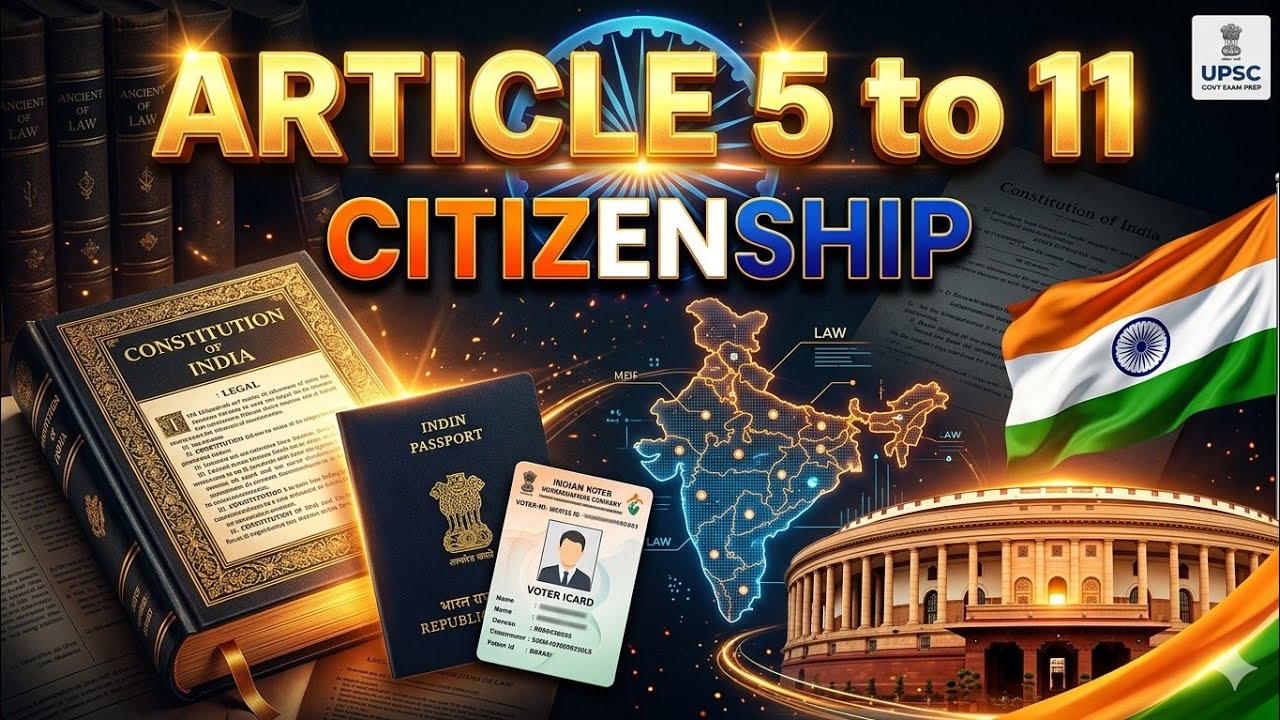
Added:Basic understanding of the Indian Constitution, specifically Part II (Articles 5-11) governing citizenship at the commencement of the republic.
Fundamental political theory concepts of citizenship, including T.H. Marshall's triad of civil, political, and social rights.
The historical context of the Partition of India in 1947 and its immediate impact on migration, displacement, and border control.
The distinction between legal citizenship status ('jus soli' or birthright citizenship vs. 'jus sanguinis' or citizenship by descent).
In-depth analysis of the Citizenship Amendment Act (CAA) 2019 and the controversies surrounding the National Register of Citizens (NRC).
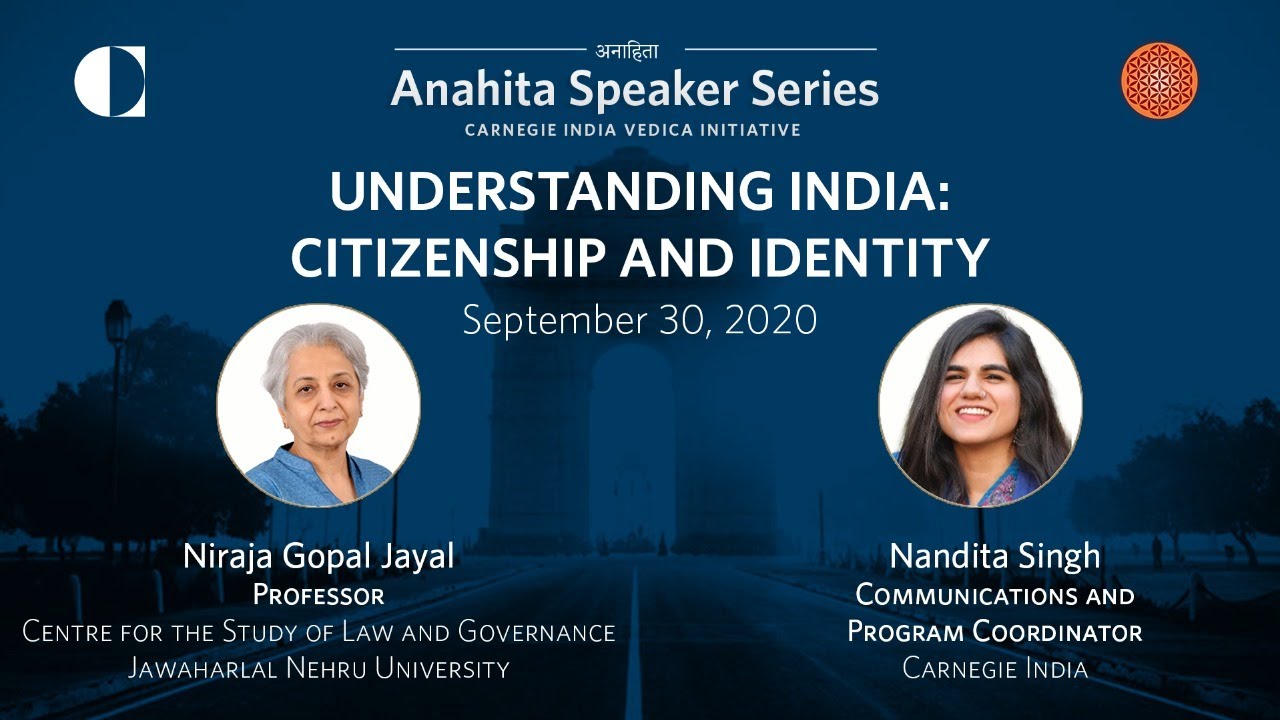
Exploration of Niraja Gopal Jayal’s seminal book 'Citizenship and its Discontents' to examine the evolution of civic versus ethnic nationalism in India.
Comparative study of citizenship laws and debates in other post-colonial South Asian nations like Pakistan and Bangladesh.
The critical examination of statelessness, refugee rights, and the intersection of national security with universal human rights in the global south.
2K views37likes1:03:25Original Release: 2013-12-04
to this talk uh on a terrific book citizenship and its discontent by professor gile who's going to talk about the book and its argument for 20 to 25 minutes i'll make a brief comment afterwards and then we'll open it up to a more general discussion so professor thank you very much thank you to the south asia institute for the invitation to mother khosla who has just entered the room for initiating the idea and to all who are present thank you for being here so this book is um an account of a century of disagreement over the idea of the indian citizen which is in my view the defining aspiration of modern india but also its most contested political idea and the book presents the story of indian citizenship is one that straddles the 20th century it shows how the dominant idea of citizenship is forged in the first half of the 20th century finds embodiment in the constitutional settlement at the exact mid point of that century and is simultaneously unravelled and strengthened in its second half now my usage thus far probably suggests that there was only one idea of citizenship at work but the whole point of this exercise has been precisely the opposite to highlight the plural and contending narratives across this vast span of time and on every dimension or at least three important dimensions of this complex idea in some areas in fact the contestations of the first half of the 20th century have proved to be so enduring that there are strong and striking similarities uh in the debates and some of the arguments that are marshaled across this entire period so the book is structured around the three core dimensions of citizenship as i identify them citizenship as legal status as rights and entitlements and as identity and obviously these there are others but these are to my mind the core dimensions and they obviously do not exist in self-contained uh hermetically sealed silos there are important intersections between them and the book remarks on some of these intersections though that obviously is a task that can be taken much further each of these three themes status rights and identity is further considered in three historical phases with a chapter devoted to each phase one to the late colonial period one to the period of the constitutional settlement and one to the post independence period now obviously this is not a history of everything about the idea and the practice of citizenship but it's a selective treatment of particular moments and issues the constitutional settlement of 1950 is treated as central to the defining of the new idea of of the indian citizen but the book underscores uh perhaps exaggerates but certainly underscores the fragility of this compact which is in my view often and easily unsettled in a sense every major debate on citizenship the world over is currently being enacted in india in ways that are frequently contrary in argumentative terms as they call into question uh the presumptions of many of these debates take citizenship as legal status something we tend to take for granted and that political theorists have begun to interrogate this taken for grantedness only in the last 10 years or so particularly starting with linda bosniak's work across the world a greater hybridization of legal citizenship is occurring even countries which historically adopted the ethnic descent based model of citizenship like germany are now moving towards a more inclusive territorial birth-based model or at least incorporating elements of it in india however we see a movement in reverse from a more inclusive principle of legal citizenship articulated in the constitution to a less inclusive conception from a usoli or birth based to an increasingly if covertly your sanguiness or descent based principle and the book shows how the tension between these two principles has been present if dormant since the founding of the republic and how the laws the rules and the jurisprudence on citizenship have come to be increasingly inflected by religious difference so the laws of citizenship have been amended in the 1980s in response to the illegal migration within quotes illegal migration of several million bangladeshi muslims across the eastern border the modification of the usoli conception by elements of your sanguines which is seen in this amendment is also reflected in a more recent and curious enthusiasm displayed by successive indian governments over the last decade or so to accord a form of weak dual citizenship to the wealthy indian diaspora it is evident also though less enthusiastically in the state's response to the in-migration of hindus from pakistan in the west i conducted field work amongst these communities of migrants on the western border in jaisalmer and jodhpur in rajasthan mostly dalits and adivasis who migrated from pakistan through the 1990s and have been seeking citizenship and it was striking that even as the government has inscribed their religious identity into the rules not the act not the citizenship act itself but the rules that are appended to it these people themselves repudiate all arguments of blood and belonging what they understand by citizenship has little to do with identity or affect it is almost entirely about the social rights to which in their view citizenship holds the key from electricity connections to admission to government schools for their children from caste certificates to access to subsidized food that's what citizenship means to them that in their view is what citizenship is for and the fact that the migrants in western india interpret citizenship in terms of rights echoes of course the historical association of citizenship with rights and that is the subject of the second part of this book where i track the troubled career of social and economic rights which i will henceforth refer to as sers despite a fairly early articulation of such rights from the 1920s onwards with the congress party pledging its commitment as many of you may be aware to an impressive range of economic rights as early as 1931.
however the attempt to give them constitutional basis failed and sers were placed in a section of the constitution that is unenforceable in the courts in the early decades after independence such rights remained aspirational and unattainable also because the social product was small minuscule in fact it is oddly enough in the context of neoliberal economic policy that social rights have received a phillip with an explosion of rights in the last seven eight years rights to information to work to education and most recently to food security as recently as a week ago food security though this is not a right now though the impetus for these enactments of social and economic rights came from a combination of judicial activism and civil society mobilization the old arguments about the cost of social rights first heard in the constituent assembly are once again being rehearsed but i'll return to this in a bit more importantly and even ironically the language of rights has emerged in the context of weakened class politics and become more strident as the state and capital become more rapacious even audaciously rapacious both separately and in partnership further the moment of state acknowledgement that the nation can actually afford to help the poor coincides with the moment when the responsibility for social assistance has already been diffused among a multiplicity of agencies often non-state agencies it is not at all clear what rights to public goods can mean in a policy context where the principles of the new public management reigns supreme and public services are variously commodified outsourced and delivered by the seductively labeled public-private partnerships so the central questions about the content of these new social rights remain are they universal are they constitutional are the constitutional guarantees and and the legal guarantees adequate for their realization is weak state capacity a real challenge to their implementation and is the goal of social policy now any different than it was before is it now to actually mitigate social inequality or does it remain that of simply alleviating the more extreme manifestations of poverty the third and arguably most politically contentious aspect of the citizenship question in india is its project of balancing the multiplicity and the diversity of cultural identities caste language tribe religion and so on with the civic identity universalist and group differentiated conceptions of citizenship have struggled for supremacy in india for more than a century and this is a very difficult contest because both these conceptions have indisputably a deep moral appeal as we're all aware universalism affirms the equality of all citizens recognizes no gradations of citizenship and within the framework of liberal neutrality adopts different blind policies strategies of group differentiated citizenship or gdc are widely acknowledged as a normatively satisfactory solution for this concern that what is masquerading as universalism is actually a covert way of promoting the dominant culture the dominant race the dominant religion whatever in a society and many years ago iris marion young's powerfully formulated this principle persuading us that group differentiated rights are a way of addressing oppression which he defined as encompassing exploitation marginalization powerlessness cultural imperialism and vulnerability to violence motivated by hatred and fear but in india as elsewhere it is almost exclusively claims based in cultural identity rather than other forms of exploitation or other forms of powerlessness and so on that have presented themselves as candidates for such rights in fact indian political discourse in indian policy discourse has added to the repertoire of young's justifications a new if somewhat fuzzy concept that of backwardness india was probably the first country in the world to have experimented as far back as the 1880s with policies that are today described as affirmative action or positive discrimination through the late colonial period a variety of claims were articulated for gdc in the form of separate electorates and quotas underwriting this was a view which was shared by the colonial state and also by important sections of its subjects a view of indian society as a community of communities citizenship came to be viewed as properly mediated by the community rather than as an unmediated relationship between the citizen and the state or the individual citizen and the state the congress party is a spousal of a universal conception of citizenship in the nationalist era was a determined attempt at constructing a modern state in which this could be an unmediated relationship within the framework of a nation which would be defined as a civic community and could as such accommodate diversity in the late colonial period the challenges there were many challenges to this inclusionary universalist conception and they were not just many but also diverse ranging from of sort of universalism espoused by the uh by the hindu nationalists which was an exclusionary type of universalism to multiple other claims to group differentiated citizenship whether as antidotes to religious majoritarianism or to caste discrimination and so on and many of these have actually endured into the postcolonial period in one form or another and are often justified in almost identical terms as before in this book i explore the idea of backwardness in relation to two groups to whom it is most typically applied the scheduled tribes and the so-called other backward classes even as backwardness has acquired ever greater validation as a criterion of gdc these categories as administrative constructs remain bedevilled by definitional ambiguities which increasingly uh tend to fuel conflicts over citizenship the multiplication of demands for instance for sub-quotas for particularly disadvantaged groups such as the most backward castes or mbcs within already entitled beneficiary groups represent a continuing challenge which is officially met by programs to recount the population such as the revival of the caste census which we had abandoned in 1931 now whether this can lead to a better calibration of the project of social justice or in fact prevent it from becoming hostage to dominant and politically powerful groups remains an open question so universal citizenship was the default notion of citizenship under the constitution with group differentiated citizenship presented as a temporary exception necessitated by the legitimate demands of social justice over time however and in a curious throwback to the colonial to the late colonial era inverting the constitutional principle group differentiated citizenship now appears to have become the dominant mode of citizenship serving to revive and reinforce the colonial argument that indian society is little more than a community of communities this was the argument that the colonial state gave against the possibility of an indian citizenship it was an argument that nationalists resented at the time but today the popular acceptance of the idea that it is appropriate for citizenship to be mediated by community sits well with intellectual suspicion of civic identity as a dubious legacy of modernity and nationalism the problem remains a variant of the one that the philosopher rousseau identified when he said we have physicists geometricians chemists astronomers poets musicians and painters and plenty but we have no longer a citizen among us the idea of citizenship typically characterizes the relationship between citizen and state but also that amongst and between citizens in contemporary india both of these are unstable relationships and i will close with a few words about each of these the relationship between the citizen as a rights holder and the state as the guarantor of rights is far from straightforward amid the celebration about the new slew of rights legislation the troubling question remains what does it mean for a citizen to hold a right that sanctifies a claim on the state when the responsibility for the actual provision of what it takes for that right to be realized lies elsewhere as the provider of the good that that right guarantees is frequently no longer the state but a variety of non-state agencies an unintended consequence of independent india's attempts at providing inclusive citizenship through positive discrimination has been the marking of citizens in particular ways as beneficiaries labeled objects of special provision scheduled cars sharing tribes and so on to which was added an additional set of markers in the 1990s to help better target people for programs of poverty reduction and these were groups marked be below poverty line or bpl which yielded another category of those who were not below poverty line apl or above poverty line and a third category for those who were even lower than below poverty line that is anthodea or the destitute both sets of markers whether you know the schedule schedule tribe kind or the bpl apl kind were intended to render citizens uh legible to use james scott's words for the better implementation by the state of its policies of inclusion and both have ironically perhaps unintentionally tended to entrench exclusion so the access of members of these groups to the substantive attributes of the real citizen is through these markers however their citizenship is rendered qualitatively different from arguably even inferior to the real citizenship of the unmarked citizen when services for the poor such as public health and public education become as they inevitably do poor services they too are stigmatized as inferior but as we saw in relation to the doctrine of backwardness the greater the backwardness the greater the entitlements that flow from it there are ways in which inferiority can actually be valorized and even sanitized of all negative connotations as far as the other relationship is concerned between and among citizens themselves the expansion of rights has been simultaneously celebrated and resisted the middle classes recently empowered by the economic reforms do not display and have had a civic solidarity that has to underwrite redistributed initiatives that are entailed by social moreover in an atmosphere where competing identity claims cover a very large part of the surface area of everyday politics there is some anxiety about the fragmentation and the fragility of the civic project and the fear that the possibility of articulating the shared common purpose for the poverty for the political community as a whole may be an aspiration that is unattainable on the one hand there is a creeping majoritarian impulse um reflected in the laws and rules of citizenship there are other creeping majority and impulses as well as we all know uh on the horizon uh but i'm just referring to the ones in the rules and laws of citizenship on the other there is the reluctance of the political class to take ownership for the idea of a civic community because such an idea does not seem to have any apparent electoral constituency it is not clear whether a civic community which transcends and escapes boxes and labels is any longer even even an appealing social goal in intellectual circles of course the post-national imagination precludes such an appeal in any case so the combination of social intolerance and weak civic solidarity seem to signal an erosion of the constitutional vision of citizenship recent citizens mobilizations on issues of corruption sexual violence legal reform have generated some optimism about the performative aspects of indian citizenship i don't deal with it in this book but these these campaigns admittedly do signal a new um citizen engagement amongst social groups which were up until now not politically active or politically engaged but i find it difficult to detect in them to see in them the seeds of a substantive social transformation which would require on the one hand sensitivity to the diversity and the plurality of indian society but also to poverty and inequality as challenges to a political community of equal citizens well uh thank you um this was obviously a terrific summary of the book and presentation of its major themes as i said in my introduction i think this is a really terrific book i want to note that i come to these comments as a dilettante about both citizenship ideas and indian constitutionalism when i say dilettante i mean i don't mean that i don't know anything about it but that i've read superficially and have had some thoughts about each of these topics but with nowhere near the sophistication that someone who was a student of either field citizenship studies or indian political and constitutional arrangements would have the book is rich along very many dimensions and i'm going to talk briefly say something about two of them before turning to an embarrassingly narrow approach uh that i i generated by my own concerns as a lawyer um and then i'll conclude with a question uh about something that uh occurs early in the book and but was not i think part of the main presentation um so the first observation about the richness of the book is that it's a detailed account of how in a real-world setting citizenship is disaggregated that there are uh that for any this is overstated but for any individual in the society there are chunks of citizenship that are associated with different other citizens in the society so there is a universalist strain uh there's a group differentiated citizenship strain there's access to social and economic rights and those are going to be allocated differently with respect to with large numbers of individuals um so and just the explication of this disaggregation seems to me extremely valuable second the account shows how citizenship is non-linear in a couple of senses one is that there there's that with respect to particular aspects at least one can identify changes that don't have the effect of sort of being a ratchet so that you know the quality of citizenship goes up in some sense and then then does not retrogress the the language of retrogression is a little tricky here but the account of the development and changes in the valence of citizenship by birth versus citizenship by blood you sanguinous is an example of this and not so incidentally shows a combination of two features one how the how the developments in this are affected by political circumstances uh i describe them as political the the such as the cross-border migration from bangladesh or a series of case studies where people sort of in some sense end up on the wrong side of the line when partition occurs although defining wrong is precisely what's at issue in this case but there's another there's also another dimension of the the non-linearity and this is that early in the book there's a discussion or in some ways an organizing theme in the book of t.h marshall's categories of civil political and social rights and it's reasonably clear that for marshall or at least in the way marshall has been assimilated into scholarly discourse that categorization was as i've put it linear and historical that is people started out with no rights then they got civil rights and then they got political rights and then they got social rights and at the end everybody has all of these categories um i think in in several uh ways the book shows that this linear progression just doesn't occur i think the most dramatic example the most striking example is the ethnographic discussion about rajasthan where the sa the third category at least in marshall's conceptualization social rights just displaces the second political category the political um category is just not of interest to the uh people in rajasthan okay so that's that's an indication of some of the things that i find really quite exciting about the book my narrow lawyer's concern deals with the development of social and economic rights and i think here's how i would in a very caricatured kind of way recast this story uh in india um early on the rights are social and economic rights are set out as directive principles of its social policy in the uni it's public policy in the irish constitution and social policy in the indian one and these are understood as being probably not subject to judicial enforcement although it's a matter of technical interest to me that in the irish constitution the provision says these are not to be justiciable in any court whereas the indian provision doesn't say that uh so okay um so let's start but it starts out with a notion that these are aspirational uh and their concerns about on the one hand the aspirations will be meaningless without any kind of enforcement on the other that enforcement would be intrusive well meaningless in two senses one without any enforcement but also in a uh the context of a a poor society uh and then any enforcement would be intrusive both in terms of affecting state budgets and uh interfering with the sort of ordinary modes of political uh political decision making now what happened over the decades the book describes the story of what happened in india but what happened over the decade decades were two developments in what i think of as the technology of governance the first is pretty simple and uh probably was there sort of nascently at the outset the the concern about drains on state budgets god got described or got inscribed in constitutional documents by a formulation that take by words that take various forms but in the south african constitution it's within available resources so now once you have the idea that these are rights but they are to be guaranteed within available resources you can start thinking of them as at least potentially justiciable where the court would be sensitive both to the right and to the available resources part so that's a conceptual development the second second development was a real innovation which is the development of what i've called weak forms of judicial review these forms involve sort of interactions iterated interactions between the courts and the legislatures and once you develop that kind of idea again judicial enforcement of social and economic rights the concern about judicial enforcement as interfering with state budgets and so on is reduced it doesn't go away but it's reduced in a way that allows the courts to be more uh more active in these areas and i would note incidentally that it's a matter of i think it's a matter of current scholarly scholars who think about these things probably ought to be examining the ways in which these iterated interactive forms of review could be coordinated with things like privatization and outsourcing of government processes government um um to lock your powers uh it's it's not it's not obvious at the outset that outsourcing and the like would be incompatible with enforcement of social and economic rights at least in this iterated interactive kind of model um now there are uh limitations on on this model uh which are worth noting again from uh one is not from a lawyer's point of view one that these things work uh under uh certain kinds of conditions uh degree of competence in the the policy makers and a willingness in to engage in the interactions um and they are undermined by uh corruption and so these techniques have to you have to think about how these techniques will fit into the larger system and the final point is this all forms of judicial enforcement of rights are can be understood only in connection with the constitution's amendment rules just the crude version is if you have a if you have a constitution that is difficult to amend then when the courts say something it's basically you're stuck with it as a constitutional rule india has notoriously it's not the easiest in the world but it's a notoriously easy amendment process and how that process is going to interact with judicial enforcement is quite interesting in the area of social and economic rights in the area of of uh reservations and quotas the interaction has been uh quite straightforward the courts say things and the parliament responds by amending the constitution to deny what the court just said um whether that will occur or to the degree which occur with respect to social and economic rights is interesting um the story about food security and the right to work is that the legislatures have been pushed along uh by the courts um okay so that that's my substantive comment the the it is relatively narrow the question i want to pose and this is gives you an opportunity to talk beyond the allotted time on something that you didn't talk about is is this early in the book you talk about the idea of citizenship regimes and for the basic notion is that there are these three categories and there are these three periods and if you look at how each category is treated in each period and then assemble them you get the regime for that period and uh you talk about that early in the book and then it more or less disappears from the book and so i i would like to i mean i have my own reaction to that but i would like you to talk about the idea of citizen regimes as you deal with it in the book yeah yeah no i think a few minutes of response and then people can be thinking of questions and thank you for those very rich comments is this on is it on now right okay thank you so let me start with the earlier comments you made which are fantastic there um you know about the weak forms of judicial review and the iterated interaction between courts and legislatures i have yet to read your book on it i've just picked it up but um i mean i'll be thinking in terms of recasting this is issue as one of us as a sort of separation of powers question um because there have been some arguments made not by me but by others about how the court is only is is interfering too little rather than too much uh with the executive slash legislation a parliamentary form of government as you know it's harder to make that distinction and it's interfering too little in the sense that it simply holds the executive to account for what the executive had has said it will do but not actually done rather than pushing open and pricing open those spaces a little more to in fact do the kinds of things that to some extent have been attempted through the right to food orders the interim orders uh though not actually accomplished in the uh the the uh the legislation that we now have which is far from a right to food uh as we know it's just a you know food security uh act uh so so is this really a separation of past question is it a question of what it is right and proper how much it is right and proper for for courts to do um uh especially given the point you raised at the very almost at the very end which was really interesting which is about the amendment procedure i hadn't thought of that that the amendment procedure and the fact that courts and uh on many issues such as the shahbanu judgment the divorce for muslim women and so on on those sorts of issues the legislature has regularly and in fact with reservations and quotas has regularly over uh uh has has regularly made enactments which in fact override what the judiciary has pronounced so so uh so i i need to understand this a little better the uh second point that you made which was about um how outsourcing and so on public goods could be compatible with social and economic rights in that model uh raises to my mind only one question which is that of accountability who is accountable uh to whom who are if citizens have a right on the state is that right transferable are there mechanisms of accountability that make it possible for the delivery of those services to be delivered in a way that includes and encompasses some principle of accountability to citizens uh to whom these services are to be provided so what would the sort of the mechanism or the chain of accountability look like in that sort of model so it's not just a question of getting outcomes uh of delivery but it's also a question of being of somebody being accountable so who in that scenario would be accountable uh is is of course the question that remains um as far as citizenship regimes are concerned yes i mean that is a very important point um and i'm afraid i did let go of it a bit um and i have not i guess it was fatigue more than anything else by the end of by the end of the book uh but it is something to which i uh propose to return i haven't done so yet but it is something to which i propose to return but you had some comments on it and i would be very grateful for them uh well just two things uh on my this my comments on social and economic rights i i do think there are two observations about that one i do think that the idea of these weak forms of review is an effort to dissipate concerns about separation of powers um and second um i had it is within these forms actually in any form of review it is possible to construct your legal doctrine so as to provide account a judicial doctrine independent of what the policymakers do a judicial doctrine that does provide for a judicial form of accountability in outsourcing it's a complicated argument and some courts sort of have seen it but it's not uh i was i think it's clearly right but it's not something that's been deeply embedded in sort of constitutional interpretations around the world on the citizenship regimes actually uh you know i don't want to press you on this uh partly because i'm not sure that it's right actually that the notion that there is some sort of coherence among the three categories at any particular period seems to me in some tension with the overall idea of disaggregation um maybe it's just that's what happened to be what was going on in the sort of non-linear development of each of these categories um so i'm sort of skeptical about the idea of it and i thought you were early on as well but yeah i just sort of let it go as you rightly said and i forgot all about it till this minute okay so now uh questions or comments yes we're going to link petercats and sign from cornell could i link in that very question i haven't read the book but i skimped the introduction i listened to to the comments i find the concept of citizenship regime very attractive and i'm asking whether in fact you have an evolutionary argument built into it and i'll reject that but i come back to it because of the title of the book so in one way it's trainers from status to contract right the third category for your third period identity plays itself out whenever state is in contact interact in a certain way so i read the setup of the book as a three by three three time periods three concepts in which you privilege status for the first period writes for the second and identity for the third but you're not in fact equating them you're just playing them down for presentational purposes arguing the first period they have status but of course rights and identity play into it in the third period they had identity but of course status and rights play into that in the second period as well that conception of citizenship regime could then travel to europe to the united states latin america asia other parts of asia africa because the configuration would be different but the building blocks would be identical so i know the european discussion somewhat in america has gotten somewhat and i think you're building your building blocks are not distinctly indian but the configuration might be okay so i like that idea because it takes you takes the analytics of the book and it makes them travel now ending up on the rights and giving it a loyally and poor inflected interpretation makes this seem very western if you look at the debates in china that's not where they are it's not about human rights the debate there is about human dignity so the subtype that the application of freud in fact invokes a civilizational argument cast and citizenship terms which is universalist and that undercuts the structure the basic structure of the argument so what's striking to me is that you you can in fact engage directly without any inhibition based on contract theory and constitutional theory that would be very different if you were in korea japan on china so in this sense india is not asia india somewhere inflected towards the west but also part of asia and arguing with freud that there is a civilization in this case citizenship universalism lurking strikes me as implausible we have a language now the world by which we can disagree this is a huge advance forward but to cast it in terms of this is the language of rights we'll make india parochial justice the west is thank you peter that's an open question um during the bike outweighs the um is it all now um the last point you made about well first of all i mean is asia not a construct as well whose idea of asia anyway and what does it encompass so that is itself a construct i don't think the point here is to to place not for me at any rate is to place india in asia or anywhere else in the west or maybe just broadly the non-west um so but that's that's that's neither here nor there um on the question of the building blocks there was one other comment in between which i seem to forgotten and this business is switching on and off is it off again sorry yeah sorry peter if you just remind me what the second one was no no no i i wanted to answer that um it was about rights yeah so about dignity and china and india yeah so uh you know i mean dignity is very much a part of uh the indian discourse as well uh ideas of dignity humiliation and so on are very much and are very much aligned to ideas of discrimination and they do fall broadly speaking within the identity section of the book so it's not that that it's one or the other they are both present simultaneously which in fact goes back to professor tuschner's earlier comment about non-linearity uh or in fact about this aggregation so so i don't see a problem there in accommodating both the idea of rights as well as the idea of dignity as different types of claims to different types of citizenship or different aspects of citizenship i don't see that problem as far as the building blocks in the and the three by three table you gave us um actually i would not argue that any one of these three dimensions is dominant in each of the three periods uh the um the status aspect is for obvious reasons not so important in the first period the late colonial period but both the rights and the identity aspects are and in the post-independence period all three of them are simultaneously in play uh i would not put each one of these into a particular period in in that kind of three by three box just one one comment on to the extent that anyone is interested in exploring the difference between china and india with the notion of uh dignity at work there's a very large literature in comparative constitutional law about comparative us and european notions of dignity i don't want to say that there's any conclusions in them but if that issue is to be explored and particularly if india is somehow to be associated with a western kind of orientation that literature probably needs to be engaged again with the observation that it's not clear that there is a given the differences between the u.s and europe that there is a western approach to it uh yes and i haven't been able to i haven't been able to book it but i'm i'm material citizenship situation is very different in different parts of the country and do you see that as sort of resulting from different ideological and different trajectories the way that the ship has developed or different cities regimes if you want and and then i was also sort of i wanted to just follow up a little bit on the discussion about enforcement of rights in the context of i was thinking it what you said reminded me of on the one hand horizontal application of rights as we've seen in the solution context and then on the other hand the way in which for instance the plug-in constitutional court has imported for self-rights in the context of private health providers but with a constitutional uh guarantee so i was just i was just curious about sort of how is that the type of mechanisms that you know that your nation could be sort of also writing first okay um hi siri i'm sorry i didn't the question of regions is important obviously on both the social rights front as well as the identities front it is it's only the uh the legal status thing which has a uh almost entirely exclusively national uh framework though there are exceptions in the regions and so you have you know the politics in assam around the immigration issue of bangladeshis and so on similarly rajasthan and legal exceptions are made from time to time but other than that the other two issues are do translate locally and differently ah there's no question about that i obviously haven't done that in this book at all but uh but i mean i think on the social rights front uh or the social welfare front if you like rather than rights uh it has been a combination of some initially populist policies in some states which have then triggered political mobilization around social welfare and better delivery so some states are better at delivering public services some states have invented for instance tamilnadu invented the idea of the midday meal scheme um you know so which then was taken up by the national government in order to keep children in school that was not the original reason for it but but so you know these are locally translated very differently and politics and political mobilization i would say are very important factors there as far as identities are concerned they too translate locally though you can also see regional patterns uh sort of up bihar for instance you know one sort of formation at more or less proximate moments in time and you do see regional patterns but yes there are state-level conflicts uh for instance the issue of sub-quotas translates very differently between um nagaland on the one hand and andhra pradesh on the other so but the fact that there are demands for sub quotas in many states is is common to them almost all of them is common to all of them and that's why you have state backward classes commissions which actually arbitrate these demands and these claims uh based on identity and try and figure out which one is uh is a valid claim and which one is not and then calibrate the policy accordingly or admit more people to the quota etc but but but that in a sense is a is is a shared feature that most states exhibit uh even though the actual form in which it translates regionally and locally may differ from one to the other and just just briefly yeah yes i the doctrine i was in mind was the heart uh effect doctrine and in in the book that uh was referred to i have a little section on how that works out okay we have a couple more questions and then we'll probably have to break so made towards the end of um presentation which i find quite striking you said that um the dominant mode of citizenship in india today has shifted from the universalist model to the group differentiated model and that in many ways this harkens back to the colonial period when the notion of communitarian indians was used to deny the right to self-determination right um so in the colonial period there is this hierarchy that's established between the ability to embody a form of civic universalism which was not extended indians and the sort of communitarian mentality of indians now i don't i don't actually see what's happening here today as a return to that model in fact what i see is that this group differentiated model of citizenship actually sets up a more dialectical relationship between sort of communitarian particularism and civic universalism right where it's precisely through claims on the basis of their rights that civic universalism has been made more substantive right and that the parameters of the civic universe when universalism has actually been expanded including groups so i wonder if you could uh comment on whether you see these things as actually opposed or in kind of a more dialectical relationship yeah yeah exactly i mean i i started out by saying that both principles have a deep moral appeal i think the question is that of balance uh and there is a need to strike a balance between the civic universalist and the particularistic uh differentiated so you know there are group differentiated citizenship has ah tremendous value and moral appeal both and it is important social justice cannot be accomplished without it clearly however it is uh what i have tried to argue here is that there are dangers of the balance being shifted so far in the direction of group differentiatedness that you actually lose the idea of the civic altogether where does the idea of the civic reside at all if all his particularity uh you know where might the idea of a civic community exist and i i see few signs of that and i see signs of the balance shifting uh waiting down weighing down on the other side of group differentiatedness with a very thin notion of the civic remaining that's that's my concern but uh but you'll have to read the book to be able to uh you know so i i i obviously do not reject the idea of group differentiated rights i mean i welcome them but on the other hand i think it is important that a balance be struck in a polity otherwise you can't have a political community and and i think we are in danger of of over balancing the boat in a certain in a certain direction and this has to be the last question i'm afraid oh i'm married that's on the government department of cornell well i think my questions follow very much along this incredibly nuanced dialectic that you do bring out in the book and yet mark just made a you know has commented about the linearity part i mean he made it more as a comment than a question so my i want to draw up on this linearity issue but really as a question and it's a question in two parts and one is that you do offer a bottom line which is that there is a dis a sort of demotion of civic solidarity and universalism and that is the bottom line after this very complex and um in the area analysis but i really wonder about that i mean if you know if i hark back to vociferous tendencies are there just so many periods in indian history where you could post independence indian history where you could say this this um pull away from the civic universalism was so rampant so that's that's sort of my question is how how do we know that there really is this shift away or shift downwards and the second part of the question is if we were to look for universalism or civic solidarity where would we most expect to find it i mean if we have a sort of hunch that that there's a possibility of it where where would you expect to find it i mean i i think of it as sort of the neruvian elite universal solidarity that will not ever return in the same form so where would one of the past and that's you know that has disbursed and has been negan but where would we now expect to find it the second part of the question is really tough i i have to think about that but the first part of the question yes i mean i agree with you that there were there were phases in indian post-independence history when uh fisa paris tendencies were evident in terms of regional demands and so on of you know not quite secession but in some cases also great autonomy and succession those remain by the way they haven't gone away but i think the ones that i'm concerned about more are those which are cast along non-regional lines uh cast being one of them but the really interesting polarity or the really interesting dynamic that i see emerging now is between on the one hand this sort of fragmentation which is evident by the way in election patterns among other things because what are national elections today but an aggregation of state level election verdicts they are people are voting not on a national register that is evident from all the election studies that we read today right the people are not voting in a national register necessarily they're always voting even in a parliamentary election voting on a regional register and voting for parties yes i mean so to the extent that national level elections are an aggregation of state level verdicts that is one area where one might be able to look to answer the you know possibly the second question though i'm not a 100 certain where else one could one could look to answer that ah but but the um sorry i lost track of the fisa paris tendencies thing so so there are these other forms uh they don't necessarily have to take the forms of demands for regional autonomy though those exist kashmir manipur these are these remain difficult areas and their claims remain exactly where they were you know 10 years ago or more but sorry once again i've lost uh whatever's the um sorry mary i've actually forgotten what i was just going to say no the uh the physics no no no i want to come back to give me a minute uh the fisa paris tendencies uh that you yeah so so the the really the running thing that i see is that on the one hand you have uh the possibility of a return to hindu majoritarian politics and on the other hand you have the sort of fragmentation along lines of caste and so on and what worries me is the possibility that the religious majoritarian consolidation might be what is uh what is uh marshalled and commandeered to trump this other caste-based fragmentation and that's the worry that i see going forward i mean i don't know if this makes sense to you but but if there is a possibility of a right-wing majoritarian hindu majoritarian polity appearing that could become a powerful argument and an alarming argument for trumping all the other forms of fragmentation that we are seeing so that's a scenario that i worry about okay i'm afraid we have to conclude this session i want to thank professor gile for coming and for giving such a stimulating talk and i personally want to thank the south asia institute for inviting me to share this discussion because it prodded me to read the book which the odds are i would not have done otherwise and i it's a it's a terrific book and i commend it all to you thank you very much you
Up Next
61:04
Justice Chandrachud & Tom Ginsburg on Saving Constitutionalism
@UChicago
48.9K views•2019-10-22

24:30
BRICS Pay and de-dollarization: A New Financial Order Emerges? | 55 chars
@DannyHaiphongYT
164.6K views•2024-10-22

7:33
Government Surveillance Methods: 10 Ways You May Be Watched
@BeAmazed
1.6M views•2017-04-09
10:19
Explaining the Saudi-Iranian Proxy Conflict in the Middle East
@Vox
18.2M views•2017-07-17
Related Study Plans & Knowledge Roadmaps
Structured learning paths in Political Science
political-science
Economic Statecraft: Sanctions & Chokepoints
01Foundations of Geoeconomics and Economic Statecraft
02The Mechanics of Weaponized Interdependence
03International Sanctions: Types, Implementation, and Efficacy
+ 2 more learning modules
12h5 modules
Explore Roadmap
political-science
Central Bank Independence: Politics & Policy
01Foundations of Central Banking and Monetary Policy
02The Time Inconsistency Problem & Inflation Bias
03The Delegation Model and Designing Independence
+ 2 more learning modules
12h5 modules
Explore Roadmap
political-science
Consociationalism: Power-Sharing & Stability
01Democratic Dilemmas in Divided Societies
02Introduction to Consociational Democracy
03The Four Pillars of Consociational Design
+ 2 more learning modules
12h5 modules
Explore Roadmap
political-science
Rebel Governance: Legitimacy, Economy & State
01Foundations of Rebel Governance and Statehood
02Establishing Political Legitimacy and the Rebel Social Contract
03Wartime Economies and Rebel Resource Management
+ 2 more learning modules
14h5 modules
Explore Roadmap