






![SACANI RESPONDE [TUDO SOBRE GALÁXIAS COM FELIPE HIME] - Ciência Sem Fim #271](https://i.ytimg.com/vi/aYQ8s_eznrg/maxresdefault.jpg)















![[CONFÉRENCE] "Euclid et le côté noir de l'Univers..." par Françoise Combes](https://i.ytimg.com/vi/IlTqqMwweC4/maxresdefault.jpg)
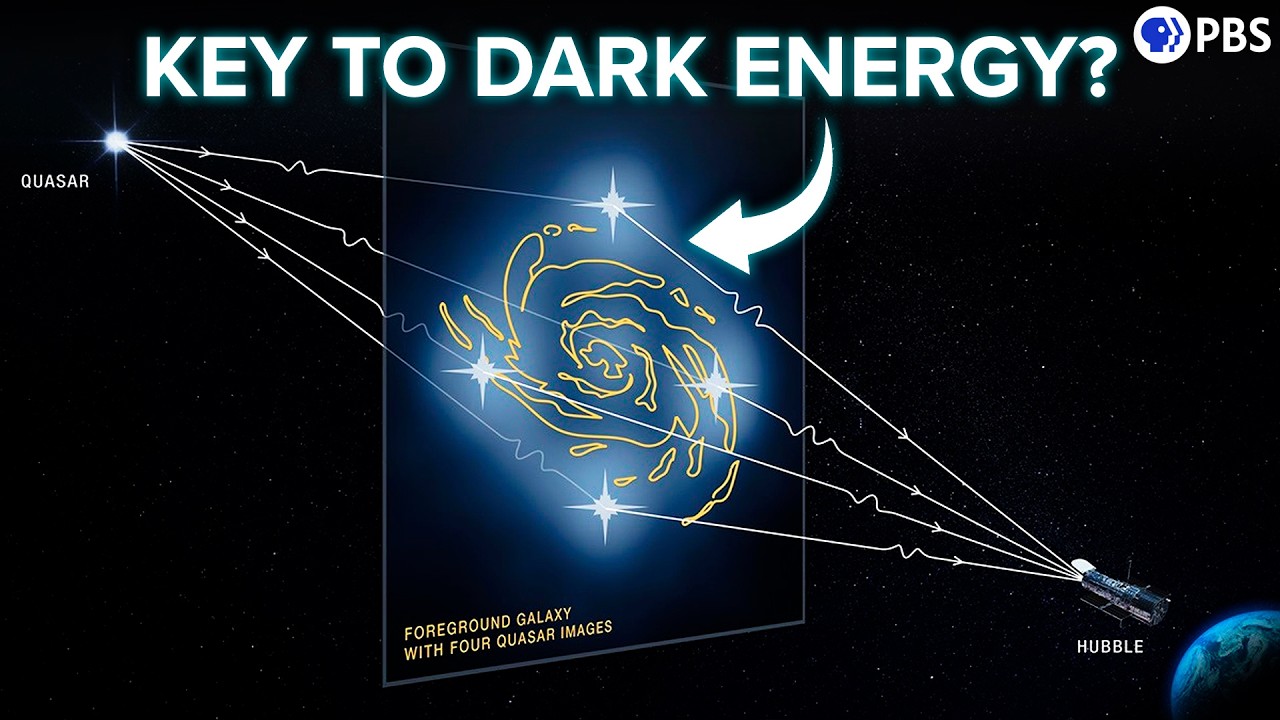
Einstein rings—spectacular gravitational lensing phenomena where background galaxies appear as perfect rings around foreground massive galaxies—can be harnessed for cosmological measurements by analyzing line-of-sight perturbations that distort these rings. Unlike traditional weak lensing which relies on statistical correlations of many galaxy shapes, Einstein rings provide high-signal measurements of cosmic shear with reduced systematic biases. This approach combines the strong lensing magnification and geometric precision of Einstein rings with the statistical power of weak lensing, enabling new cosmological constraints on parameters like matter density and structure formation.
Einstein Rings and Gravitational Lensing: A Cosmological Tool
Added:Einstein's General Theory of Relativity, specifically how mass curves spacetime and deflects the path of light.
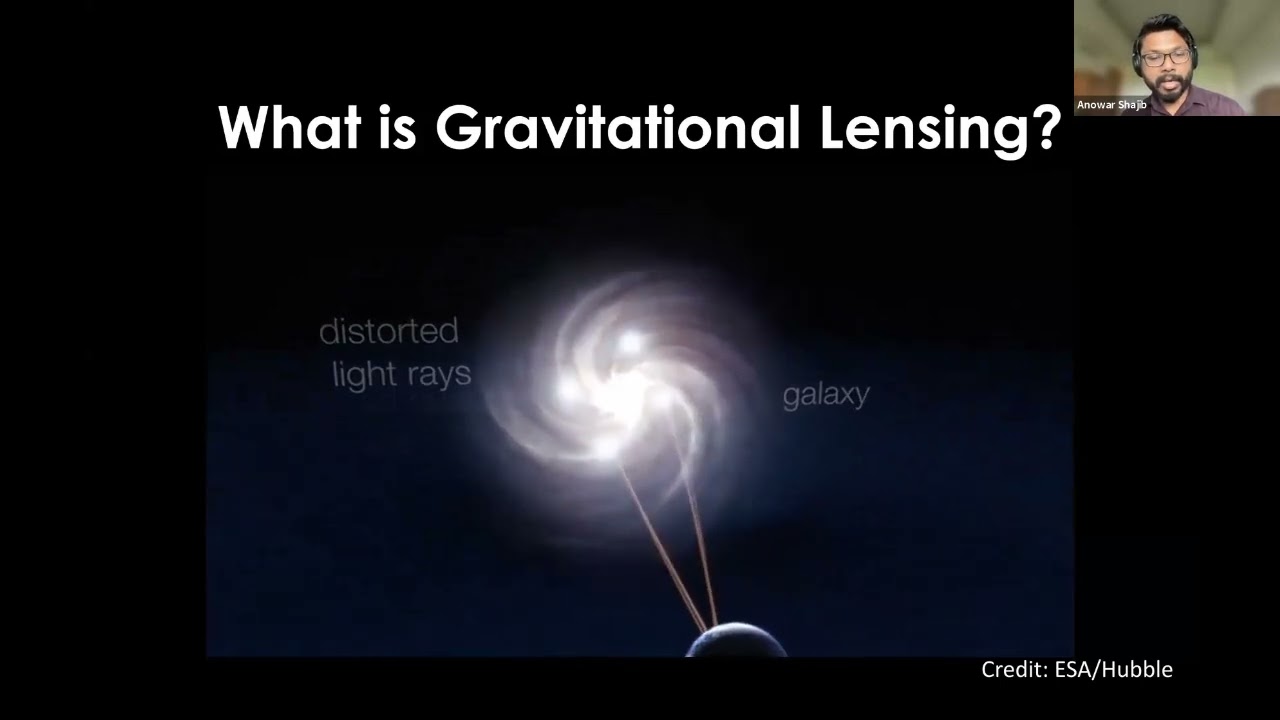
The basic classification of gravitational lensing, including the qualitative differences between strong lensing, weak lensing, and microlensing.
The fundamental concept of dark matter, its gravitational influence on visible matter, and why it cannot be observed directly via electromagnetic radiation.
Basic cosmological principles, including the expansion of the universe, cosmological redshift, and how light travels across astronomical distances.
Weak gravitational lensing and cosmic shear analysis to map the large-scale distribution of dark matter across the cosmic web.
Time-delay cosmography, which uses the time delay between multiple images in a lensed system to measure the Hubble constant (H0).
Investigating dark matter subhalos and constraining dark matter models (such as cold vs. warm dark matter) using fine-scale perturbations in Einstein rings.
The capabilities and objectives of next-generation observatories, such as the Euclid space telescope and the Nancy Grace Roman Space Telescope, in conducting large-scale weak lensing surveys.
749 views0likes1:10:41Original Release: 2023-11-03
pleasure to welcome [Music] okay it's a pleasure to welcome Pier flurry today for our seminar so most of you know Pierre because he has been uh studying at The Institute for his PhD during three years and you defended your phds in 1915 on topics Rel [Music] of the [Music] Rel 20 2015 15 sorry and then you went on series of pod in Cape Town Geneva and Madrid and we were HED at CS in the section in theoretical physics in in in 2021 and now you are sharing your time between epht inle and M where you spend a lot of time and so Pi has been working mostly on on weak lensing strong lensing so lensing in General trying to reconcile weak and strong lensing he has been also doing a lot of work on relativistic cosmology and uh some work on modified gravity and the propagation of gravity waves in in in this theories and he has been referring for very theoretical topics to more and more topics related to observation and now you are part of the UK and and Lisa Consortium so today I know you will talk about your your work on on strong and and weak lensing I also wanted to to mention that Pier has been teaching quite a lot he's a very good teacher he has written this this small book on gravitation from Newton toon that you can find it's on the archive I think the text don't buy it yes don't buy it it's a very nice introduction at the Master Level and P has been doing that because what 20 2018 I think uh you went to Cameroon to to teach for one month cosmology in in the as network of African Institute for mathematical Sciences I think you went twice to to to Cameron to to teach that and and then you you you wrote this this small textbook introductionary texbook so thank you for being here we listen to you thank you very much pH thank you for the nice introduction and uh thank you all for coming so so many to this colloquium It's actually an an honor for me to uh to give the colloquium F AP because as you said I was a PhD student here so you know 10 years ago I was I was sitting here and listening to colloquia and thinking well maybe one day anyway so uh so really yeah thank you for coming so this is um this is a colloquium so my goal is really to do something to to give a presentation that is as pedagogical and introductory as possible so I really hope that it's not going to be too easy uh but uh yes the that's the goal please interrupt me at any time if there is something that's not clear and with this uh well let's go so we're going to talk about as the name indicates about gravitational lensing and in particular about uh Einstein rings and the way we could use lensing and Einstein rings in particular to do cosmology uh the first thing I wanted to ask you is actually so who knows what an Einstein ring is is sure that then know what an Einstein ring is no who knows what an Einstein ring is yes one in Cosmos huh find one yes well not not just well not just one but there are quite well so okay so let's start with the easy stuff and again it's a colloquium so I will I will start with beautiful pictures because this is more to catch your attention I suppose before diving a bit more into the details so this is the most beautiful example what that we have of an einin ring so an Einstein ring is an is the most spectacular example of the strong gravitational lensing regime so what you see here is a so in the full ground it's a luminous red Galaxy so elliptical galaxy that is I think at Red shift about 0.5 and what you see around it is the image of a back ground Galaxy so blue Galaxy that is located behind this one because of the gravitational lensing effect so namely the fact that light falls the light can go around that foreground Galaxy and therefore you see it as as a ring like this so um this is really the most beautiful manifestation of the equivalence principle in a sense which is uh maybe the big difference that you would have between the Newtonian description of gravitation and the relativistic description of gravitation the fact that it's not just masses that are the source of gravitation and that experience computation but all but anything that has energy including light so this is an example of of an Einstein ring so if we put it into context this one has been observed by the Hubble Space Telescope if we put it in the in the in the in the field where it was seen so you see that to give you an idea of the orders of magnitude this one is one one of the biggest that is that's ever been seen it's about 10 Arc second in diameter 10 seconds of Arc so as a comparison it's about the apparent size of mass so it's bit a big object in a sense uh this this Einstein ring but of course it's much fainter so that's why we needed the Hubble Space Telescope to see it so well um so these objects are not that rare uh even with the telescopes that we have today it's a few tens more than than 100 that have been observed already this is a well-known catalog of of Einstein rings that has been observed by the SLO uh SLO lens act ACS the slack sample so of the of the SLO telescope uh so you have here about 84 84 examples of lenses they are a bit more um what did I want to say about it yes and uh so we have a few tents at the moment but we expect to multiply these numbers by about a thousand with the um current gen next future generation surveys like ID or Reuben telescopes um what can I say about something more about rings so sometimes uh you see objects like this so this is known as an Einstein cross rather than an Einstein ring what you see here is uh so same kind of context you have a foreground Galaxy this one a background one but this turns out to be quaza so an act an active Galactic nucleus that's extremely bright that's a like a point source at the center of the source Galaxy and that is imaged four times uh and that you see the four Images here so these objects are very interesting in cosmology we're going to come back to it because you can actually measure the time delay of the reception of the light uh or corresponding to the three the four different images here and we're going to come back back to hello you can sit if you want don't worry right so so far I've shown examples of strong gravitational lensing where the lens the deflector object is a galaxy of course some very beautiful images that you might have seen involve other deflectors that are Galaxy clusters instead and so you have probably all seen this picture which was the first picture that was released of the James web space telescope so where you can see here a cluster of galaxies so these are basically the bunch of um of white stuff here and you see a lot of images here that are arcs so they are background galaxies galaxies that are not that do not belong to the cluster but that are be behind it and that that are multiply imaged and extremely distorted so this is a very beautiful example as well of gravitational lensing that is really ubiquitous in this kind of pictures so when you have Galaxy so I talked about lenses being Galaxy clusters or galaxies sometimes you have both at the same time and again I keep showing interesting images just to discuss the phenomenology of gravitational lensing and particularly like this system so again you have here a gravitation uh sorry a um a Galaxy cluster that is also that is producing strong lensing so you can see here uh this galaxy that is imaged three times this is one image you have another one here and another one here so these are three images of the same galaxy and here you have a zoom on one of those images and what you see the bright spot here that corresponds to this is not does not belong to the source Galaxy but it is another galaxy that belongs to the Galaxy cluster and that is acting as a lens on top of the effect of of the lensing effect of the cluster so in other words this image here of of this galaxy that actually that you see here is experiences the gravitational field of the Galaxy cluster and on top of it the effect of a galaxy that turned out to be on the way of the light corresponding to that image and that so that leads to a double effect of gravitational lensing and that revealed a fantastic effect these four points that you see here are four images of a supernova that exploded in that Source Galaxy when people noticed that so this is the uh one of the two only examples that we know of strongly lensed multiply imaged Supernova it was predicted because this belongs to one of three images of the same galaxy that the we should see the Supernova exploding a bit later on another image and indeed about a year after so this was in 2014 in 2015 or 16 there was another explosion of a supernova that appeared here that was just the same Supernova but that appeared a bit later in another image and actually when people died into the um into the archival HST data they noticed that there was also an explosion here in the '90s so this is an interesting anology of things that can happen with gravitational lensing multiple images strong distortions time delays between events that happen at the level of the source maybe as a last example there's this one that I really like and also because it connects with with the title of my talk so um lensing because it is uh focusing light it allows you it it creates a magnification effect so it allows you to see things that you wouldn't see in the absence of lensing just like when you put a lens or or a microscope to see things a bit better what so in particular here what we see is so this is again a Galaxy cluster this is this Arc here that is zoomed in here is the very distorted image of a background Galaxy and what you see here this little spot here that was was baptized arell is a star it's one star at Red shift 6.2 so this is the farthest individual stars that that have that has ever been observed and this was possible thanks to gravitational lensing due to the cumulate cumulative effect of the strong lensing produced by this galaxy cluster and to some micr lensing effect that turned out to be a compact object on the way that magnified very strongly that object on top of the strong lensing so with lensing you can also see individual Stars at cosmological distances so it's been called Arendelle because this is an Old English word that means um Morning Star rising star and there is also of course a lord of the ring reference um that was intended according to the authors the other dots are also Stars I don't know it's a good question I think this this might be also so they could be uh clusters of stars like Global clusters I don't know I only know that this one is a star that was recognized to be a star because of its Spectrum than Spectrum yeah so if you want more information about it cor well actually so this is the jwst image it has been observed with hstd first uh it was maybe a year ago uh and so there was a followup with jwst where it appears so the jca image is really much more beautiful than the than the hs1 that's why I showed it but has been discovered by by HS okay so this was about the phenomenology of strong lensing just to again catch your attention now I'm going to discuss a bit more uh the two regimes of the two main regimes of gravitational lensing that you might have heard of this all these were examples of strong gravitational lensing there is another side of lensing Which is less spectacular but nonetheless very useful which is called we cleansing and so I'm going to discuss the differences between those uh those regimes and then we're going to talk about how they they are used in in cosmology so if you have no further question let's discuss the strong and the weak so long you know uh spoiler alert the weak has to stay away from the ring right that's that will be the main difference so strong and weak lensing so let me start from the very Basics the formalism of gravitational lensing that is known as the lens equation so here is how it works um you have suppose that you have a point source uh that you would observe in the absence of lensing in a certain direction beta with respect to an arbitrary um you know reference that would be incarnated by this line the line of sight okay and suppose that you have an object on the way like a massive red Galaxy an tical Galaxy um so the first thing that we do is that because in general this is true for uh for all the Practical systems that we study the distance between The Observer and the deflector and the diff the distance between the deflector and the sourcer is usually much larger than the typical scale of the deflector you can usually consider that everything is happening on the plane so in a sense that in this in the sense that you can project the density of matter corresponding to the deflector on a plane that you call the deflector plane and then you work in two dimensions in in this uh in this plane so then suppose that you have a uh well when you cons when you consider the way light is emitted and what's the trajectory of light in the absence of any other perturbation the light emitted by The Source goes in straight line until it reaches the deflector plane where it is suddenly deflected again we consider everything is happening in one plane is suddenly deflected by a quantity that we call the deflection angle that I denote with an alpha hatut that you can connect very easily to the distribution of matter so this is is the uh surface density of matter that you have within this deflector plane and so of course it depends on where you hit XIs here the pl the point of the plane where it light is hitting the plane So Def depends on where you hit it because it depends on the local gravitational field that you experience so for uh purely geometrical reasons this um this uh deflection angle is not exactly the same as the difference between the direction Theta in which you see the image and the um Direction beta in which you would see it without the lens actually they are proportional what we call the displacement angle so really the difference between Theta and beta displacement on the sky that you would have of this object is proportional to the deflection angle with a ratio of those angular diameter distances so there are angular diameter distances if you if you're wondering why there are angular diameter distances not Luminosity distances or moving distances or whatever you can ask me at the end and we can discuss that so this then leads by definition because again this Alpha I Define it as the difference between Theta and beta this leads to uh one of the simplest equations that you can think of we call it the lens equation so this is just the therefore the equation that relates the image position to the source position and this is therefore the equation that you want to solve if for Theta if you want to know what are the possible images of a single um single source that would be in the direction um what else can I say about this yes um because everything is happening in a single plane and when you look a little bit into look a little bit the expression of these quantity you can see that you could express it as a gradient just like the gravitational acceleration can be expressed as the gradient of gravitational potential so in that sense it would the alpha here would be the can be written as the gradient of a projected gravitational potential that we uh call the FMA potential so everywhere when I have this Alpha Theta I could replace it with the gradient of of a quantity the FMA potential we call it the FMA potential because as you will see a bit later it is connected to the time it takes for light to go from the the source to The Observer and this will be essential when we discuss time delays okay so far so good it's not very complicated math so let me show you an example so here I made a little uh simulation for you so what we see here is uh what we would see on the sky right so uh this is a certain Source uh uh light source this is the deflector that I modeled as a singular isothermal ellipsoid so it's really like a singular isothermal sphere the thing that we use to describe Global clusters for example or eliptical galaxies I gave it a certain ellipticity and so what I'm going to do now is I'm going to look at different situations where the source so you see the source is quite offset with respect to the deflector at that moment they're far away on the sky I'm going to move it so that it goes behind the deflector and this is how it looks see it gets closer a second image appears a fourth three four image appear as well right and then they disappear so again uh I'm going to show this um this again it's interesting to see that actually the what we call the ring is the merger of four images in this case so in this little simulation you can actually already visualize the two regimes that we call weak lensing and strong lensing so clearly when you have a situation like this which is a ring of four images One image that is very uh very distorted you are in the regime of uh of strong lensing when you're at the end here when the uh the source is quite far from the deflector there is no way that you can really tell whether this experience lensing or not and actually I lied to you I said this is the I said that this is the um the source but actually the source that I've taken was circular so here it's distorted into a little ellipse but you have but you were not shocked about it right when you saw it I tell I told you that was a source you were not particularly shocked particular surprised about it you would accept it very very easily so this is uh the definition of of what what we censing is we cleansing is just uh when you have lensing but you can you cannot really tell it by eye and so uh the formalism is a little bit different in this case is that clear or is just I'm spending too much time on on simple things it's no it's okay goad okay it's okay okay so I go ahead so um how does that work so when you are in the situation where a source is quite far quite offset with respect to the deflector as I say you have this kind of of situation so you have weak distortions and on top of it well if suppose that you call theta0 the direction in which you see the center of uh of this image well you can tell that the various points that compose this image they are quite close with they are quite close next to each other the distance the typical distance that you have between two points that compose this image is typically small compared to the typical Evolution scale of this quantity of the the deflecting potential so in we cleansing what is typically done is that you expand this quantity if you tailor expand it at first order in the difference Delta Theta between so the center of the image and any point that compos the image so when you do that of course you get this this uh first order expansion of gradient that is the second derivative of s you can call this beta not which is the uh position The Source position corresponding to uh this um image position to the center and this is the way it's usually written so this quantity here this Matrix a is called the Distortion Matrix it is defined by this quantity so one minus the second derivative of the Therma potential and it's usually parameterized with two numbers so first of all realize that because this is a second derivative The Matrix corresponding to it it's a hesan matri matrix it is symmetric so you can you can split it into a trace part which is which is represented by this Capa quantity that we call the convergence and so the convergence imagine that suppose that you have only that quantity and that this other quantity gamma is zero if you have only Kappa this Matrix is just proportional to the identity Matrix so when you apply it to a certain image or a certain Source you just multiply every all the the vectors by a certain number so you just make it bigger or smaller so this is what convergence is about convergence is creating a zooming in if it's positive or zooming out if it's uh negative and physically speaking it is due to the matter that is encountered By the Light Beam that goes from the source to uh to the to the Observer and then you would tell me yes but this is weird you're talking about matter that that is intercepted but clearly when I'm in a situation like that there is no way that uh that light encounters any matter because clearly it's out of this don't forget that there is dark matter and dark matter Halos are very extended so typic when you see an image like this this the light goes through some matter anyway and there all the matter that you don't see so you have convergence the second effect that is encoded into the trace free part of that Distortion Matrix is called the shear and so as the name indicat what it does is that it shears the um it shears the um the image so if you are starting from a um circular Source it will look elliptical just like that exactly as we see in this example so it is usually represented by a complex number uh so you take this quantity and you add I gamma to so nothing very complicated but I'm giving these details because these quantities are uh basically the the key quantities that you will encounter if you read any paper about weak gravitational lensing weak gravitational lensing is just all about convergence and uh above all Shear physically speaking this Shear is due to the tidal forces that are produced by the deflector just like um well the moon or the sun are creating tides on the earth that are distorting the shape of the oceans and of the earth as well well a light beam experiences tidal forces when it grazes a mass concentration that uh is making it look like this so so because I I can see that some of you are are are getting a bit tired I'm going to propose you a little riddle so the sheer that you see here is creating and you have seen that in all the images that I've shown you it's creating an elongation that is tangential to the uh to the mass concentrations right so here the elongation is really in that direction but the title forces they're supposed to act in the opposite direction right in principle when you're coming next to an object like this it should be elongated in the uh radial Direction and contracted in the other direction so how is that so you think about that and we talk about it afterwards well the thing is that you call it tital Force but it's not really a force it's a tital Firma potential gradient it is it is the V part of the reman tensor which is tital forces right it is it is it is really tidal forces the tile forces is affecting in the case of the Moon Earth system is affecting the Earth yes but there there it looks like it's affecting the Moon I mean it's not affecting the lens it's affecting the image of the mo it's AFF no but I'm talking about the the the so if you represent if you represent the beam as something as an the light beam as an extended physical um object when it when it comes next to the deflector it will experience tidal forces it's the beam that's it's it's light that experiences the tidal forces here again that is the big addition of general relativity with respect to neonian physics it's not just physical massive object massive object that experience gravity and therefore spatial and therefore sorry uh SpaceTime curvature but any type of entity that has energy so light included so the part of the beam that is closer to the to the lens is a TR attracted yes it's it's that you can phrase it this way light is more deflected here than here so you have to okay all right so this was uh weak lensing what else do we have oh yes I lied to you uh because I said that weak lensing is just about convergence and Shear so this is a little remark of something we've done with John Philip in a few years ago in fact fact weak lensing is supposed to be when the deflection is small so it's supposed to be when this Alpha quantity is small but that doesn't mean in principle that you can make a tailor expansion of it consider a situation like this where you have you would have a lot of diffuse Halos of of matter dark matter whatever you want and that you have a source that has a size that's comparable to the typical uh scale of or typical distance between those halos all those deflectors are producing small deflections but it would be really wrong to write to expand the total effect of them as uh as this first Auto tailor expansion right when you have a function that does this you don't do a tailor expansion to go from here to here okay it's a bit of a theoretical curiosity to be honest with you because when you uh do the actual calculations of how that works and you look at whether this affects Uh current surveys or the Anis of we cleansing that we usually do it is not relevant in any practical situation but it's something maybe to keep in mind it's the the picture of we cleansing being a first order tailor expansion creating this Kappa and this gamma is a bit of simplification another thing we can say about weak laning is that it is cumulative um and in a very simple in a very simple way so weak cleansing as I said is something that happens when you have when the deflectors are far away when the effect of lensing is small but so when you have a situation like this when you have a deflector that's causing a in on the sky you know you have a Galaxy you consider that there is another galaxy far away that distorts the shape of the source Galaxy well of course it will not be the only one right the logic here is that if you have one weak censing effect you will have many of them everything that is in the universe around your line of sight is going to create a weak lensing effect on what you look at so uh typically it's really wrong to consider that everything happens in a single plane when you have weak lensing weak lensing is really a cumulative effect of all the qu all the uh matter in homogeneities that will be uh reasonably close to the line of SES and the good thing is that because you can linearize everything the way that you that you distort a source like this is extremely simple you can consider that everything happens on the line of side that is not changed this is called the born approximation and you can just add up the effect of all those lens planes uh to get the net convergence or the net Shear so in summarizing when you see a distortion of a certain Galaxy it is due to the weak lensing effect of all what happens along the line of side between the Observer and the source okay so yes summary between the strong and the weak so strong lensing produces multiple images strong distortions like giant arcs strong magnifications it's due to typically due to one single isolated compact lump of matter uh while weak lensing is producing only one image you will not have a second image in the case of weak lensing and it's due to many diffused lump on the line of sight or from uh compact lumps but that are far away from the line of s and in terms of modeling uh you need a fully nonlinear modeling of of your uh system when you do strong lensing meaning that you need to model accurately this quantity if you want to explain a certain observation and you have to solve this equation which is not always a trivial thing to do while weak lensing from a theoretical perspective is extremely simple you obtain you go from image to Source just by multiplying by a certain Matrix which is which contains this convergence and this year and so this is why I was saying that the weak has to stay away from the ring right so because the Einstein ring that would be created uh from a certain compact lump has to be far away if you want the effect to before a joke do we have questions about that I think I'm still on time okay so I presented those two regimes of gravitational lensing the we and strong now let's see what we can do uh with them in cosmology so I'm still in this phase where I'm doing a bit of review of the general context of where these these things are happening I will go to um more recent work in after this section so uh let me give you the example that you have probably heard the most about especially if you're a cosmologist which is called time delay cosmography so we strong gravitational lensing can be used to measure the expansion rate of the universe how does that work suppose that you have a system like this which again represents um a quaza an AG that is multiply imaged here we have four Images called AB CD quazar have the advantage of not being very stable objects they have fluctuations they have flares they have eruptions they plenty of things that we don't really understand that are happening in in quazar that are making them brighter or fainter with time you can record you can um monitor the Luminosity of those various images and what you get is a plot that looks like this uh this plot here it's the monitoring has been happening over a lot of time this starting in 2003 for this object and stopped in 2016 so we have uh more than a decade of of observation here and you can't really see it but there is a well I mean there is a slight shift between those four uh those four um Luminosity functions they're a little bit offset with respect to each other which again corresponds to the fact that light takes a different time depending on which path it takes to go to go from The Observer from the source to The Observer typically when you go closer to the to the lens it takes you more time it's as if light were slown down when it when it experiences strong gravitational fields so monitoring these uh these light curves you can actually measure to a pretty good level of precision the time delay that you have between those uh between those images why is that interesting because when you write down the theoretical expression of this time delay between two different images let's say between A and B it takes that uh well the expression is the following so this is the time delay between A and B here you have a ratio of angular diameter distances so between the observe and the deflector between the observe and the source and the deflector and the source Alpha you remember is the displacement angle so right so this would be Alpha is the difference between the source position and the image position for a this is the same for B and remember this p is the FMA potential okay so when you have an observation like this what you can see directly of course is this quantity you measure the time delay from the those time series and you have the position of of the images and then you don't have only those four positions I don't know if you can see it but you also have the ring around it and the ring contains a lot of information about about the lens because different lenses are producing different Einstein rings so with this using all the rest of the photometric information here you can model what what your lens is about so you can model these quantities Alpha and S from the observation of the ring so you know that you know all the rest that means that you have access to that quantity with photometric end time delay differences so this thing we call time delay graphy is actually a distance measurement it gives you access to a ratio of angular diameter distances and so here the cosmologist know where I'm going when you have distances and because you can also measure the red shifts of these quantities you have access to the expansion rate distance red shift relation this is the good old Hubble idea if you write down a bit more accurately what it is so the the distance between this a and between o AB being ODS you have something that depends that is inversely proportional to the hobble expansion rate H not and you have here a quantity that depends on the other cosmological parameters like the quantity of matter the cosmological constant Spa spatial curvature if you have it these parameters we have modeled them pretty well we measure them pretty accurately with Supernova Baran acostic oscillations Cosmic microwave background so we have access to H this is how it works you have questions how precise this measurement can be ah so yes I will explain this I will exp no no no I will explain this so uh this is there is a history about this right so in 2008 19 there was the Holly cow collaboration that is doing that that published a paper saying a 1.4% measurement I think it was like that or 2% measurement of H not using six uh of six uh systems like this this is one of the systems that they used turns out that this Precision is highly overestimated because they had not accounted for one effect which is well a theoretical point that was made long time ago the mass sheet the Generac so yes I was thinking maybe I will skip that slide and come back but you asked the question so I will explain so uh here is the problem with the the method that I have just described it heavily relies on Imaging data so it it relies on observing the ring to determine what is the FMA potential and what is the deflection angle that you have to plug it into the time delay formula problem is there is no uh Unicity in the models that work uh to explain a certain certain image and here is the very simple um three lines of calculation to explain why suppose that you have a certain model Alpha so again everything is contained in alpha or in s right so this is a certain model that works let's say you have found a model of lens that works to describe this object that you see suppose that now you multiply this equation by a certain quantity Lambda a number between zero and one so here I've done nothing right if Theta and Theta is a solution of of that it's also a solution of that now I'm rearranging a little bit right instead of having this thet I wanted to put to put this expression in the same form as this one so I'm adding Theta and I'm taking out Theta I'm regrouping the terms and I'm defining beta Prime as Lambda beta an effective Source I don't care I don't observe the source nobody knows where the source is and another model Alpha Prime which is just this combination between Theta Lambda and Alpha so we have here two models that are different right because the alpha is not the same two lens models that are the same and that provide an equally good fit of the data problem is they don't predict the same time delays right if you so again three lines of calculations I'm not writing them but if you plug the uh this model Alpha in the formula that I gave you before you can show that that the prediction of the time delay between let's say images one and two is Lambda times uh the the model you started from when you when you work with the the primed uh quantity so that means that you have two equivalent models that predict different values for that quantity You observe this one you model this one but you have this uncertainty so the only way to have those match is to change that quantity to change the ratio of distance and therefore you change H not so that's why you have that the H not that you measure with this model is Lambda times the H not that you would measure with this model that's pretty bad right so that's called the mass sheet degeneracy because this model here is equivalent to taking from the initial model a part of the mass that was contained in this and spreading out as a homogeneous Mass sheet because this term is actually the deflection that would be produced by a continuous sheet of mass it doesn't look very physical to do that but on the other hand you could imagine a very shallow Dark Matter Halo that would would have a mostly homogeneous density of matter that could produce a similar effect so that's why it's called the math sheet de generation so that's a problem the only way to mitigate it is to have uh is to have an extra measurement a non lensing measurement that would give you information about this Alpha to make the difference between Alpha and Alpha Prime you need information about the mass distribution of your lens and this is done by spectroscopy by looking at the dispersion velocity dispersion of the Stars within the lens and this is what can give you more information about it the only thing is that it's a bit difficult and the data is not very good at the moment we expect it we expect this method to still reach a 1% predic uh precision in the coming 5 to 10 years but we're not there yet the current status is this one so these are the measurements accounting properly for this math sheet de genery uh with different assumptions I will not go into the details so these are different measurements of H knot by using this time delay cosmography method with seven time delay lenses you can't read I'm reading it for you um and so if you compare with the Hubble tension that we have today so between the measurement of H knot using the cosmic microwave background the the plank measurement or the one that you do directly with the distance ladder so supern no and SE to calibrate the numinosity of supernova you get uh something that is basically in agreement with both so for the moment uh for the moment the the H of tension cannot is not solved is not addressed by time delay cosmography it will be in the near future yes what's the red shift of these two because very strange is that one is consistent with the supern and one with CMB so yeah it's different so it's different assumptions so um this is uh this this measurement in this one mostly this one is when you do not use any further information about the lenses so you have your seven lenses and they are at Red shift between so the lens is typically around 0.5 and the source is typically one so when you observe that and you use no information about velocity dispersion so no further information no non- lensing information you get that with a big Arrow bar you can try to mitigate it a little bit by using velocity dispersion data but the problem is that the lenses that were used by the TD Cosmo team they didn't have measurements for those lenses of the Velocity dispersion so so they took another set of lenses the slack sample that I showed at the beginning these 84 lenses they used measurements of velocity dispersion in those um in those data and they assumed that the properties of the lenses were similar that's a big leap right so and this so This are these are the two measurements those two measurements are assuming that the slack lenses for which we have a velocity dispersion measurement are representative of the TD Cosmo lenses that were used to measure heat not okay um there is another thing that I want to mention about how to do cosmology with strong lenses just because it's cute and because Rafael gav is not here anymore because he's the one who observed this so uh when you have you have situations called the jackpot lenses jackpot because it's really rare you have an alignment between a deflector and two SES and this makes two rings concentric this this one and this one as you can see this is absolutely magnificent uh very lucky and so when you do that you can look at the ratio between the angles between the the radi and this these depend on the red shifts but also on the cosal parameters and this has been used to make forecast for a cosmological [Music] this okay okay so I will do I will go quickly so okay weak lenses so weak lensing so this is important because this is where I want to go so weak lensing is less spectacular it just less uh less beautiful images but it is very useful in cosmology so what the way it's done is the following suppose that you observe a lot of a lot of galaxies because the universe is not homogeneous you have all the foreground matter that is causing distortions of those uh of those galaxies so that actually you should see them a bit like this because of this here effect you would see the shape of those galaxies the electicity of those galaxies tangent ially aligned with the over densities of matter so basically the apparent ellipticity can write it as the intrinsic ellipticity plus this Shear quantity problem is uh the effect of Shear is weak lensing is weak right so the effect is extremely small we're talking about a 1% effect so you should see that but you actually see that so you can't do it by ey right you can't measure directly this sheere from the shape of the apparent shapes of galaxy you need to rely on statistics the way you do it is you take the apparent electicity of pairs of galaxies let's say you take pairs separated by the same amount or by the same order of magnitude for the angle and you sum this quantity that's making the twoo correlation function of the apparent electicity of galaxies when you plug in this expression into uh this what you get is 3 terms of course this is the correlation of the apparent ellipticities the correlation between apparent ticity sorry of intrinsic elti between intrinsic ellipticities and sheia and the two porn correlation function of sheia but this guy is random in principle the orientation of galaxies is not something that is supposed to be correlated so these two terms vanish and you left with uh the two point correlation function directly of the sheia which is related to the distribution of matter in the universe again the idea being that if you have a universe which is more homogeneous you have this effect is stronger and they have more correlations between two neighboring galaxies their shapes will be more correlated when you work out the math you realize that this twoo correlation function is proportional to two key parameters of cosmology the density of matter and this quantity called Sigma 8 who knows what Sigma eight is so for those of you who don't know Sigma eight8 is a quantity that uh is an indication of the degree of inhomogenity of the universe if you're taking BS of eight Mega parex of size and within those bows you average the density of matter that you have and you do that a lot everywhere and you look at the variance of this uh averaged mass density so it gives you something that fluctuates the variance of this quantity or standard deviation of this quantity is what we call Sigma so you have more homogeneous the universe the larger Sigma um the current status of that is the following so these quantities have been measured with with uh different surveys the dark energy survey the kilode survey DS and K recently there was a joint analysis of their data and you can see that it is more less in agreement well it is in reasonably good agreement with observations that were made by uh with this um Cosmic microwave background so the cosmic microwave background is in blue and the lensing measurements are the other colors I showed here two planes right there is the the plane Omega M Sigma 8 there is also this quantity the uh s 8 which is Sigma times something proportional toare root of Omega M the quantity that I gave you before so this is supposed to be the quantity that is best constrained by lensing and you see indeed that this reduces the uh the genery that you have so this seems to be fantastic but this is actually a very difficult measurement weak lensing is very difficult if I'm writing down again the assumption that I made here which is that when you look at the apparent uh the look at the twoo correlation function of the apparent electicity of galaxies I wrote those three terms and I assumed that these were zero well first of all this one is super hard to do measuring the apparent ticity of galaxies is not the trivial thing at all you have plenty of observational biases that can that can enter into the game there are PL there are pH entire PhD thesis that were dedicated to that and then I assume that those things were Vanishing why they vanish because there are supposed to be a sum of a lot of random numbers so you need a lot of galaxies to do that right so you need a lot of data if you want to be able to neglect those things with respect to that remember that gamma is a very small quantity so you need this this thing to go to zero uh very fast well it doesn't go to zero very fast you need a lot of data something else is that galaxies can be intrinsically aligned because of other gravitational effects there are people in this institute that worked on that very hard they're not in the room oh maybe clti CL work a bit of this yes but she was not paying attention okay anyway uh so this was just to say that uh you have weak lensing is a difficult thing and you have plenty of biases of systematic biases that can enter into the game so this leads me to is there another way can we do weak lensing in another way and so the problem again is that weak lensing is weak so if I apply Shear to this you don't you have no way to to know whether this was uh what is the source what is the image you have no way to to measure the uh the shear directly from a single Galaxy it would be possible if we had some kind of standard shape something that we could we would know the intrinsic shape of that you could or that you could calibrate so that you would see directly if there is a sheer effect and so the idea is is that well maybe Einstein Rings could play that role maybe we could use Einstein rings as standard shapes do you have questions before I go to this no sure side I have five minutes but five I think five minutes we'll do don't have questions keep going don't have questions okay thanks so this is uh when the strong lensing has the weak lensing so you know in the I can't carry for you for you but I can carry you so um I'm coming back to uh this how so my idea is to use um strong strong lenses as weak lensing probes so I need to study the weak lensing of strong lensing how does weak lensing perb string lens I have to put the these these two things together so I reminded you here uh the lens equation that we have when we have a single planer right now suppose that I add perturbations to this so weak lenses on the way we call that line of side perturbations I have a different picture right light is not being propagated straight line from The Observer to the deflector and from the deflector to the source and so when you work out the uh modified lens equation that you have in this case it becomes like this a bit more complicated you have in this new lens equation the addition of three new three additional Distortion matrices is AOS ads aod you remember the Distortion Matrix is what qualifies weak lensing so this is really how weak lensing is affecting strong lensing measurements for you to understand why there are three of them and what they represents just to give you a flavor of it for example this one you see a o d so this represents the distortions that are happening between the Observer and the deflector and you see that they appear here in in the argument of the quantity that represents the strong uh the sorry the uh the deflection so this point actually so this this perturbation sorry encodes the deviation from the born approximation what happens is that because light is deflected weakly deflected between the Observer and the deflector it reaches a point in the main lens plane that is not the same as the one that it would have reached in the absence of those perturbations so you need to account for this to evaluate the deflection in the main lens plane at the right Point when's the presence of this guy in this uh in this argument and you can play this can make a similar reasoning about uh the other one so this one accounts for the fact that the initial opening here does not reach the same difference here than in the absence of um of perturbations and I will not discuss this one but you got the idea right you have three uh new Distortion matrices that encode in different ways the weak lensing perturbations to strong lensing so that looks very complicated because we have a lot of additional parameters in our modeling in principle turns out that they are not all necessary so I will go very quickly to uh this take this I'm playing the same game as I did for the uh for the mass sheet de genery I use the fact that I don't know where the source is I can transform it the way I want so I multiply this equation by a certain Matrix this one that allows me to put the lens equation into a very elegant form where I have only one Distortion Matrix here that I call AOS which is this multiplication of the three that I had at the beginning and why did I do that because actually when I'm doing this I'm making this quantity as a per as a total derivative so I cast this term into an effective potential that contains the Full ground perturbations and so this model is absolutely equivalent to the previous one but it has less degrees of freedom because you have only one thing an effective quantity describing the main lens and you have a single perturbation weak lensing perturbation here so I call it because it has less parameters the minimal model for line of side perturbations and in particular it features a kind of effective Shear the shear that would be contained in this quantity if you linearize that is just this the sum of the shears with certain sides right you have OS plus o minus DS okay where is he going with this well I'm I'm telling you here that I managed to uh cast all the perb ations of a strong lens into a single Shear parameter remember that I want what I want to do is to do cosmic Shear with strong lenses so the question is can we actually measure this guy from strong lenses so we did that uh we made a proof of concept of the measurement that I the project has been led by Natalie Hawk who's a post do working with me uh at iphd but also now at in Monier we used a software called lens astronomy that's been developed by Simon ver few years ago so we simulated mock images uh of strong lensing that were perturbed and then we tried to fit them to see whether we can simply uh recover that quantity uh that line of s sheare that we're looking for so I'm passing the details of how we do the thing this is the sample that we generated so with L tronomy you can see that some lenses are very beautiful some of them are a bit more pixelated some of them looks more like Einstein crosses so this is to tell you that the sample that we generated is pretty representative of the diversity of actual observations and this is the final result so what you see here is the comparison between the input line of s here that we have put for in these uh in these mock data the y axis is the one that is obtained the output of the uh of the mcmc's basically of the fitting procedure um you have the first component and the second component that's why we have uh two panels and the Arab bars of course represent the uncertainty that we have in the recovery of those parameters and so you see that the correlation between the input and the output is pretty good there is a dispersion right of course we have an average uncertainty on those uh on those line of side line side shears that is about zero about 1% which is the order of magnitude of what we are trying to measure but this is a good indication that it seems that yes this line of sight here can be uh extracted from observations independently of the pro properties of the lens so this leads me to my last slide why uh why are we doing that so it's to try to do for Cosmic sheare with Einstein Rings the idea would be that in a survey like uid we'll have galaxies Galaxy shapes but also strong lenses and so we can do the two point correlation function of this line of sight here we can correlate it with the apparent electicity of galaxies and with the apparent positions of galaxies we are adding a lot of data that doesn't suffer from the same systematics as uh as standard weak lensing so this is the project actually the LR project this is very serious right it's for Einstein lensing rings to observe the nonic matter distribution it's been from by the so I think it's it's a serious project so the idea is that to forecast the cosmological advantage of this line of s here assuming that we can measure it so this is what we are doing at the moment confirm the me measurability of the lere on real data so we are going to use uh jwst data to start with and explore some line of sight perturbations Beyond here such as flexion you can ask me about it if you want we are hiring next autn if you're looking for a post do and you like lensing talk to me and so this I leave you with my conclusion I thank you very much I'm sorry for going over [Applause] time so do we have questions for pier Pier very interest can you just explain qualitatively I mean you've got shapes for a billion galaxies in ukl and tell me how you're going to do better with 10,000 strong l anwers 100,000 but the whole point is that you you wouldn't have so it's the question of statistics versus accuracy right signal to noise versus statistics the whole point of cosmic share is that you have a lot of data and you use the fact that those numbers to kill a terrible signal to noise terrible you have a signal toise which is 0 0.01 basically here we would have a signal to noise that is group F larger than one the other thing is that you so the hope is also that well the hope this measurement wouldn't be affected by intrinsic alignments okay so you mitigate intrinsic alignments with [Music] it we have more questions at some point you said you would explain why the tidal effect operates counter intuitively I said it was a riddle I think I think you should think about it but I didn't it okay so it's it's all because no the whole point is that we uh it's because it goes it's because of um we think from source to Observer rather than thinking from Observer to Source right so the idea is that when you want a certain beam to match this a certain uh morphology for for a source and that it is distorted in a certain effect let's say you have an effect that is creating that or have gravitational effect that's causing that on your on your beam so the beam does this why have to compensate for it at the level of the Observer for it to match what you should reach at the level of the source you see what I mean so instead you have instead of having straight lines I should draw but you know instead of having straight lines you have something that should be bigger if it's converged or it should be smaller if it's if it diverges I should make a drawing that's the whole point just go make sure which is the Observer yes exactly so suppose that you have something here that is causing a convergence so it's creating it's an attractive effect right the light beams they doing this well you see that you see it bigger because had to start with a larger angle for it to because of the deflection for it to match here and so this you no you don't see what I mean no compared to if it had propagated straight line so whenever you have a gravitational effect that goes in a certain direction the observation goes in the other so it's the case for convergence it's the case for Shear as well I have a time delay to understand it but I other questions yes in um everyday Optics there is this FMA principle that light chooses the path in the shortest time how does it relate to the geodesic principle in this gravitational context that's super good question when you when you're studying gr usually so you usually see the definition of geodesics as uh as the shorter shortest path right so this works very well when you have Tim likee geodesics or space like geodic or time like geodic right word lines so you go from the actual trajectory is the one that has the shortest U um proper time to go from a certain point to another so it works pretty well with with that it works very well with the space light geodesics time like with a light light geodesics the problem that all the distances are zero right but there is a way around and there is a FMA theorem in in gr that tells you that when you [Music] have so suppose that you have a certain uh an observer that has a certain word line so this would be an observer uh you have an a point that's emitting light so a Source Point the photon is emitted now and so you're wondering what is going to be the actual trajectory of light that would be the actual trajectory it's observed at a certain point so this is the source well if you're looking at all the possible null curves so all the curves of of something that's propagating at the speed of light uh but and that are reaching this uh this word Line This one is the one that extrem is the time of arrival right so that's a way to formulate the FMA principle in general relativity so they and it gives you have an equivalence between the physic equation so I made it maximal it can be maximal or minimal I never remember which what which one is the probably actually it should be the other way around probably the Observer should be here but but you got the idea there is a this is the way to phrase the FMA the equivalence between the FMA principle and uh in theic equation when you have no [Music] curves okay well it's a bit late but fine um so um I was thinking of recent work about field level inference Natalia por period in particular who showed that with weak lensing if you analyze the full field you can break the genery between Sigma and omeg that you have in the two-point function so here you're proposing a new way to get a point measurement of shei which is very interesting so my question was just basically why would you then limit yourself to the twoo function to go back to cosmology uh why would I because I'm because I'm bad with Statistics and so I'm doing what people what's known you know but yeah I mean of course if you have a if anyone is proposing yeah let's do let's use some higher order statistics on that I would be super happy I just uh it's my lack of knowledge of of these things that at the moment makes it yes I'm starting with the easy stuff but but yeah you're right so one naive question um for the time delay um could you there's more information than just the uh the positions there's also the the relative magnitudes due to different amplifications can that be used it's so it's not used much in practice you're right it's it's a very good remark because you think it would okay um no well I can explain that without slides anyway so the the the issue is that the magnitude of a point the of a point image is is is a lot subject to micro lensing so when you have you have these different Paths of um I understand and so yes you would have in the Halo sometimes a star sometime a cluster sometime maybe Primal black holes who knows you know and uh and these are actually changing the the magnitude the apparent uh the amplification and this is causing a lot of trouble it's much more the amplitude than the position yeah so actually it well yes oh yes micr lensing changes the amplitude question yes questions just maybe one to finish because you in your first slide you to the fact that you have higher moments be beyond the shear of flection and sound in your simulation can you measure them and can you learn something from from them so we have a PhD student working on that uh in in mellier his name is the Duos he's working with jul Arena and so this was uh the first part of his PhD that was to try to phrase those things for flexion so can you measure flexion with uh Einstein rings and uh so yes the is working on it he derived already the equivalent of the line of s here for flexion and he's doing at the moment simulations to see whether it can be measured it's harder okay it's harder at the moment we have not succeeded yet I mean he but uh we have hope thank you so if we don't have more questions it's okay then we can thank here [Music] again yeah we didn't give
Up Next

3:00
Dark Matter in the Bullet Cluster: Evidence Explained
@howfarawayisit
951 views•2025-12-06

12:53
21cm Hyperfine Transition in Neutral Hydrogen: Radio Astronomy Basics
@AaronRobertParsons
12.4K views•2011-10-13

32:32
NMR Spin Physics I: Zeeman Effect, Resonance Condition & Larmor Frequency
@nptel-indianinstituteofsci8064
2.3K views•2024-01-17

27:14
Entropy and the Second Law of Thermodynamics Explained
@veritasium
27.5M views•2023-07-01
Related Study Plans & Knowledge Roadmaps
Structured learning paths in Physics
physics
Nuclear Physics (Decay, Fission & Reactors)
01Atomic Structure and the Binding Force
02Radioactive Decay and Half-Life
03Nuclear Fission Mechanics and Chain Reactions
+ 2 more learning modules
12h5 modules
Explore Roadmap
physics
Soft Matter (Polymers, Colloids & Rheology)
01Foundations of Soft Matter & Thermal Forces
02Polymer Physics and Macromolecules
03Colloids, Surfactants, and Self-Assembly
+ 2 more learning modules
38h5 modules
Explore Roadmap
physics
Analytical Mechanics: Lagrangian & Hamiltonian
01Mathematical Foundations: Calculus of Variations
02From Newtonian Mechanics to Constraint Dynamics
03The Principle of Least Action & Lagrangian Mechanics
+ 3 more learning modules
28h6 modules
Explore Roadmap
physics
General Relativity (Spacetime & Cosmology)
01Foundations of Relativity: Special Relativity
02The Geometry of Spacetime: Equivalence Principle & Curvature
03Einstein's Field Equations: The Mathematics of Gravity
+ 2 more learning modules
55h5 modules
Explore Roadmap