




















This video teaches the systematic approach to interpreting proton NMR spectra by demonstrating how to predict and analyze signals through three key parameters: chemical shift (indicating proton environment and electron-withdrawing group proximity), integration (revealing the number of equivalent protons), and multiplicity (determined by the n+1 rule showing adjacent proton count). The instructor guides viewers through worked examples where they predict spectra from molecular structures and then extract information from actual spectra to determine molecular composition, emphasizing that organizing data into tables with labeled signals (from downfield to upfield) enables accurate compound identification.
1H NMR Spectra Interpretation: Part I Examples
Added:Understanding chemical equivalence: How to identify chemically identical versus distinct hydrogen atoms (protons) in an organic molecule.
The concept of chemical shift (ppm): How shielding and deshielding effects of electronegative atoms influence the position of NMR signals.
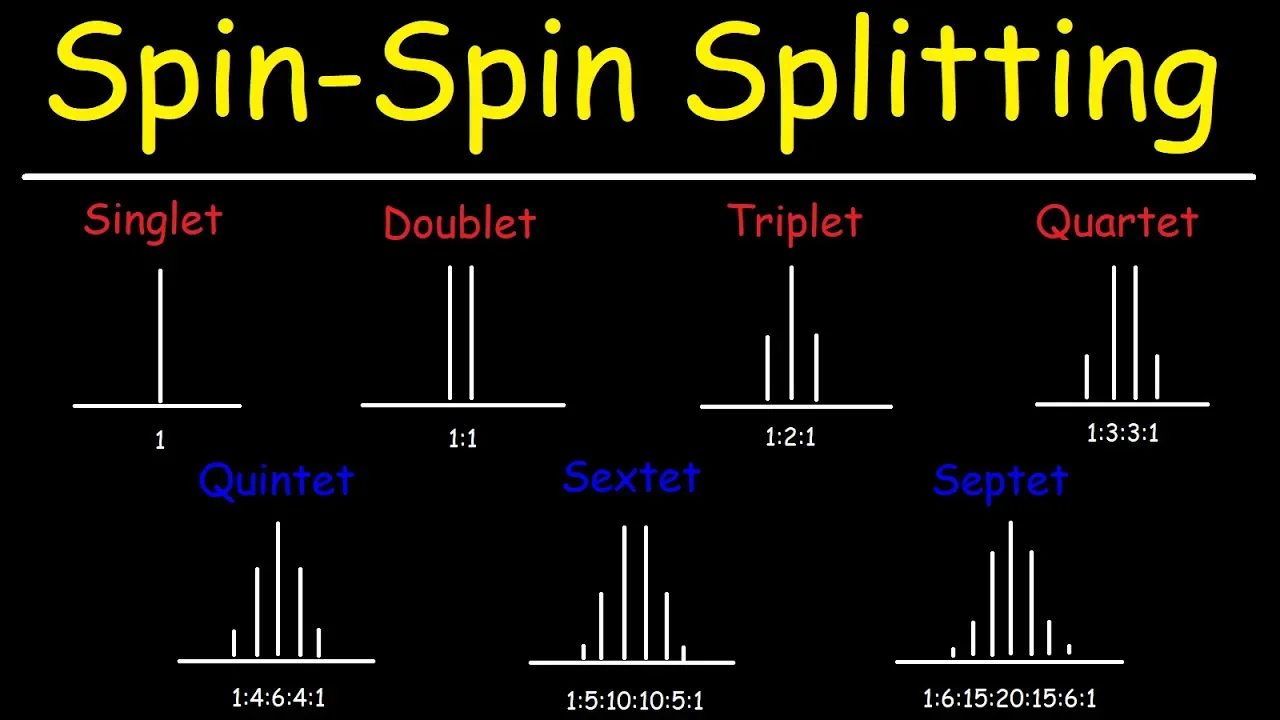
The fundamentals of spin-spin splitting (multiplicity): The theoretical basis of the n+1 rule and how neighboring protons couple with each other.
NMR integration: Knowing how the area under a peak relates to the relative number of protons contributing to that signal.
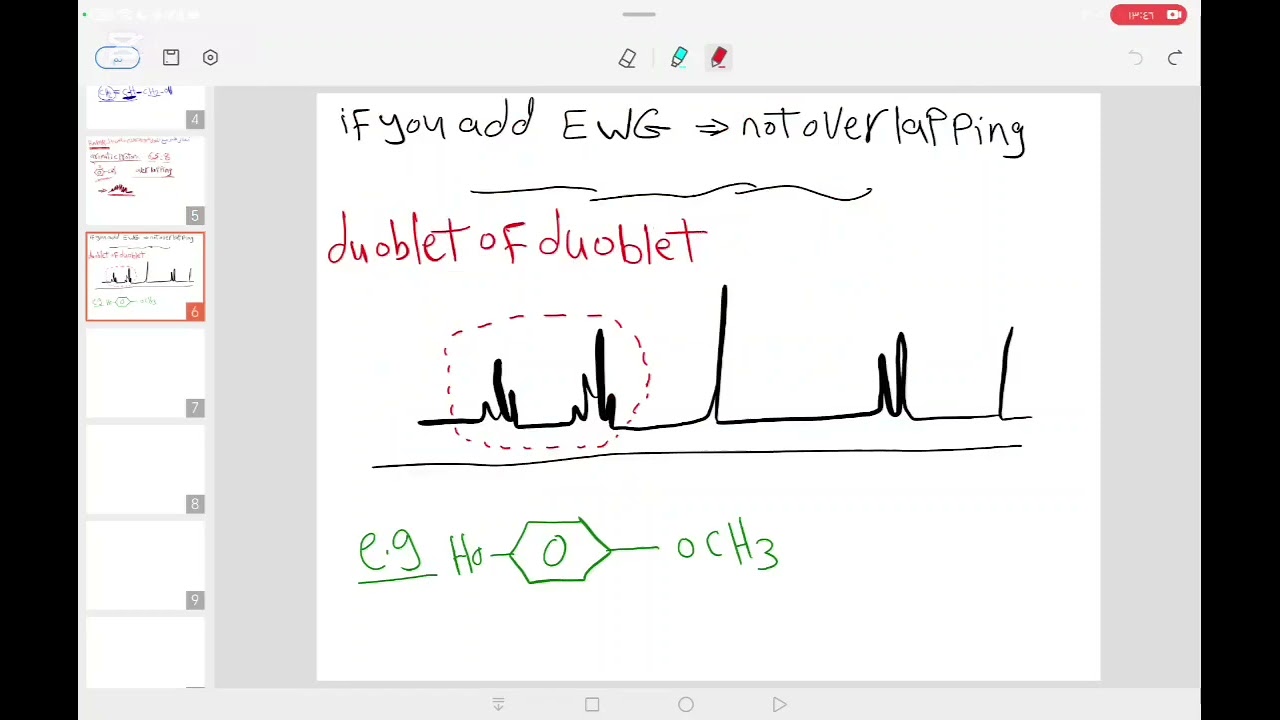
Advanced coupling patterns: Analyzing complex splitting (such as doublets of doublets) and non-first-order (second-order) NMR spectra.
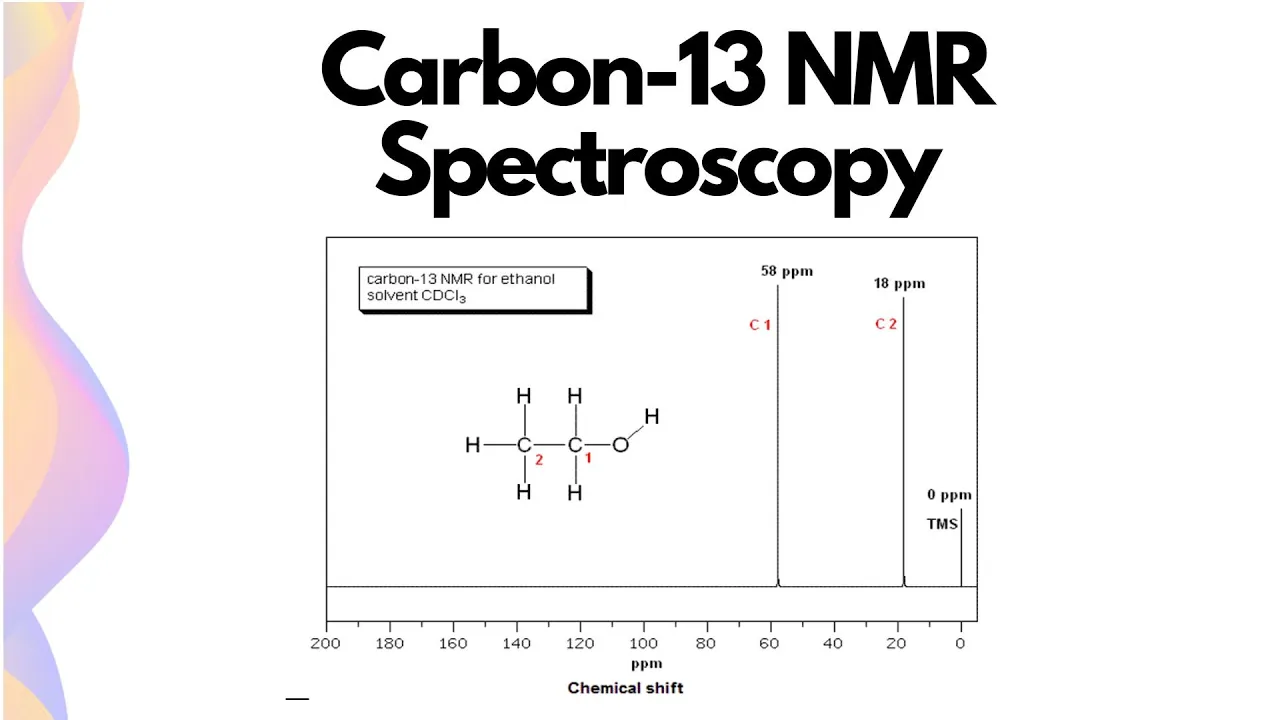
Carbon-13 (13C) NMR Spectroscopy: Learning to interpret carbon-13 spectra, DEPT, and understanding how they complement proton NMR.
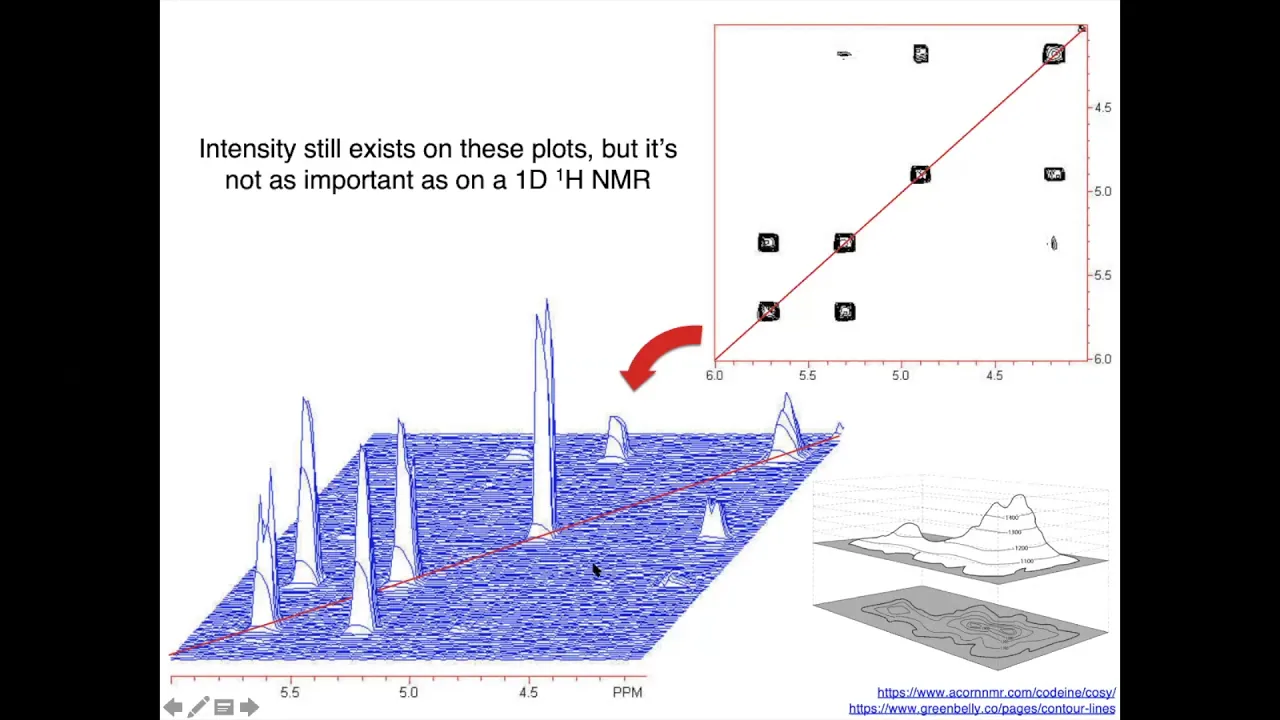
Multi-dimensional NMR (2D NMR): Exploring advanced techniques like COSY, HSQC, and HMBC to determine connectivity in complex organic molecules.
Joint structure elucidation: Combining 1H NMR, 13C NMR, Infrared (IR) Spectroscopy, and Mass Spectrometry (MS) to solve complex, unknown chemical structures.
79.4K views733likes10:18Original Release: 2015-08-27
compound characterization proton nucle magnetic resonance interpretation part one examples in this webcast we will go through a few examples to reinforce what you learned concerning interpreting NMR Spectra in the previous webcast consider this molecule on the left tell me how many signals you expect to see and what are the multiplicities of those signals pause the video take some time and decide because this is a warmup I included some helpful labels for you the protons labeled ha are equivalent and the protons labeled HB are also equivalent I should also remember that the proton that is part of the alcohol would also give its own signal but because it is laile I may or may not see it what about multiplicities for the ha protons I would expect to see a triplet which I will shorten to just t because there are only two neighbors to the ha protons for the HB protons I would expect to see a quartet which I will short into just Q because the HB protons have three neighbors remember low protons do not cause any splitting let's look at the actual NMR Spectra and see how we did look at that I see three signals one 2 3 one of which is a triplet like expected and one of which is a quartet like expected excellent do the chemical shifts make sense should the quartet be further downfield than the triplet remember the quartet belongs to the HB protons the HB protons are very close to this electron with drawing alcohol therefore the HB protons should be more D shielded than the farther away ha protons therefore the HB protons should be more downfield and that matches what we see similar exercise here looking at this chemical structure how many signals do you expect what is your predicted multiplicity for each signal and now try and predict the chemical shift for each set as well pause the video take some time and then we'll see how you did welcome back I expect to see three signals the meth on the left should produce a it own signal the methylene in the middle should produce its own signal and the methyl on the right should produce its own signal what about multiplicities the purple protons have no adjacent hydrogens therefore they should show up as a singlet which I shall abbreviate using the letter s the methylene protons have three neighbors therefore they should show up as a quartet and the blue protons have two neighbors therefore they should show up as a triplet what about chemical shifts what do we predict for those the purple protons are adjacent to a carbonal that carbonal is electron withdrawing but it's not very electron withdrawing I predict those protons will appear at roughly 2.5 PPM that's downfield but not very downfield similarly the red protons being adjacent to the same carbonal should be in roughly that same area in contrast the blue protons are pretty far away from that carbonal therefore they should still be pretty shielded I predict they will appear at roughly 1.0 PPM your values may not match mine exactly that's okay so long as your values are in the same vicinity you're thinking about this the right way now let's see how our predictions match reality the purple proton should appear as a singlet at roughly 2.5 PPM is there such a signal in that area yes there is I have a singet at roughly 2.1 PPM my prediction was pretty close my red protons should be a quartet at roughly 2.5 PPM how did we do there pretty good actually there's a quartet at almost exactly 2.5 PPM what about the blue protons I should see a triplet at 1.0 PPM excellent I see a triplet at just above 1.0 PPM my predictions were pretty accurate why were my chemical shift predictions so accurate this is because different types of protons appear in characteristic locations protons not near electron mod drawing groups tend to be at roughly 1.0 PPM sometimes a little more sometimes a little less but somewhere in that area protons near electron with Drawing Group such as carbonal will appear downfield of that because carbonal are weak electron with drawing groups they should be at roughly 2.5 again sometimes a little more sometimes a little less but somewhere in that areaa the first two exercises asks you to take a structure and predict what the Spectrum would look like in most cases however we don't know what the compound looks like instead we try to use the Spectrum to tell us what the compound looks like to do this we have to look at a proton NMR Spectrum such as this one and be able to pull out all of the useful information we usually organize that information using tables in this course when labeling signals in a spectrum we are going to use letters where we start with a with the signal farthest downfield and then go down the alphabet as we go to the right like so what I would like you to do is pull out all the important information in this NMR Spectra that means I want you to tell me the integration of each signal the chemical shift of each signal which actually does in it using the Greek letter Delta and the multiplicity of each signal spend some time and fill out this table and then come back and check your work okay let's see how you did to find the integration of a I look at this number below the signal this says a value of two therefore A's integration is two I continue down the line filling in the values if I don't have an integer I simply round to the nearest whole number and there we go I filled in the First Column of my table now let's look at chemical shifts when it comes to recording chemical shifts it doesn't have to be exact for example for Signal a I'm not going to record 3413 there's no way I can get that exact I'm just going to Simply write okay that looks to be about 3.4 parts per million for B that looks to be about 2.1 C is about I might say 1.75 for that again it's not an exact value but it's a best estimate just based on what I see and then signal D is about 0.9 there we go that's another column of very useful information recorded in our data table now multiplicity a has two peaks therefore that's a doublet which I shall designate with lowercase D B is a singlet C has Seven Peaks therefore that's a sep T which I shall shorten to just SE and then D is another doublet excellent that's the entire table of information that you can pull out of an NMR Spectra based on what we've discussed so far one more exercise before we go however using the multiplicity tell me the number of adjacent protons pause the video tell me how many protons are next door to each of these signals let's see how you did a is a doublet remember the n + one rule where n is the number of adjacent protons for a n + 1 has to equal 2 therefore n equals 1 there is one adjacent proton to Signal a if you look at B that's a singlet so that's zero if you look at C that's a septet it's got to be six Seven Peaks 7 minus one is six and D is another dlet therefore that two has only one adjacent proton there we go we now know how many equivalent sets of hydrogen there are 1 2 3 4 we now know how many protons belong in each set based B on the integration we have a rough idea of what kinds of protons these are based on the chemical shift signal a is further downfield therefore it must be near a strong electron withd Drawing Group in contrast signal D is very far up field therefore it must not be near any electron with Drawing Group we also know something about the neighborhood of all of these signals we know that the protons in Signal a have only one neighbor but the protons in Signal C have six neighbors this NMR spectrum is a partial NMR Spectrum it is only showing some of the proton signals for this molecule as a result we cannot identify this particular molecule however if we did have a full spectrum and you had a full table of information all you would need to begin figuring out what the compound is would be the molecular formula that brings us to the end of this webcast to recap the most important thing you can do when inter in NMR Spectra is to organize your data this process begins by working through a spectrum one aspect at a time label your signals in the NMR Spectra and then identify their chemical shift their integration and their multiplicity with that information in hand and organized it will be easier to see how all the different pieces fit together
Up Next

12:22
Spin-Spin Splitting in Proton NMR Spectroscopy Explained
@readysetorgo
356.5K views•2014-07-26
83:56
Biocatalysis and Catalysis in Islatravir Synthesis | Merck Webinar
@SCIwheresciencemeetsbusiness
675 views•2020-10-08
10:06
1H NMR: Determining Number of Peaks from Structure
@MSJChem
59.2K views•2017-04-06

17:31
Edible Water Bottles: A DIY Guide to Sodium Alginate Spherification
@ryan
10.5M views•2019-06-21
Related Study Plans & Knowledge Roadmaps
Structured learning paths in Chemistry
chemistry
Nuclear Chemistry: Decay, Meds & Fuel Cycle
01Introduction to Nuclear Structure and Radioactivity
02Decay Dynamics and Kinetics
03Radiation Interaction and Detection
+ 2 more learning modules
24h5 modules
Explore Roadmap
chemistry
Supramolecular Chemistry: Forces & Machines
01Foundations of Chemical Bonding and Intermolecular Forces
02Introduction to Host-Guest Chemistry
03Thermodynamics and Dynamics of Self-Assembly
+ 2 more learning modules
16h5 modules
Explore Roadmap
chemistry
Photochemistry: Excited States & Reactions
01Foundations of Light-Matter Interactions
02Molecular Orbitals and Electronic States
03Photophysical Processes and Jablonski Diagrams
+ 2 more learning modules
18h5 modules
Explore Roadmap
chemistry
Coordination Chemistry: Bonding & Properties
01Introduction to Transition Metals and Ligands
02Crystal Field Theory (CFT) and Geometry
03Magnetic Behavior and Spin States
+ 2 more learning modules
14h5 modules
Explore Roadmap