












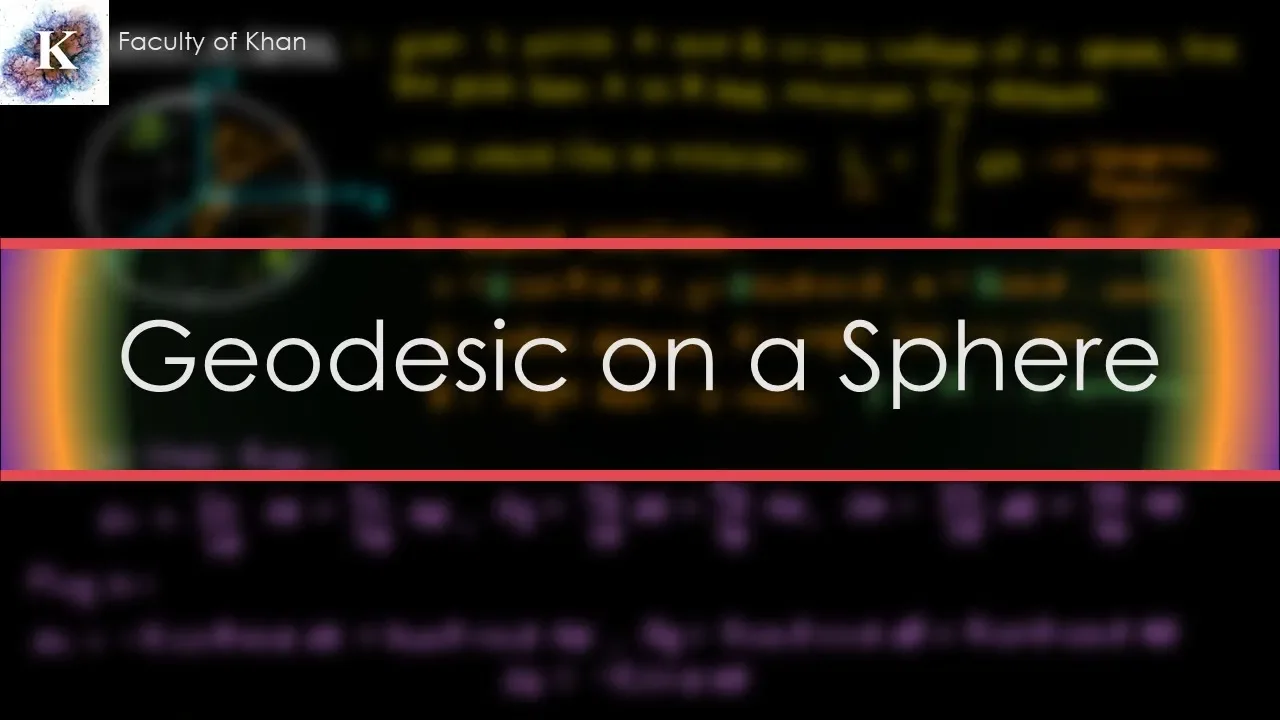






A curve on a surface is defined as a geodesic if its geodesic curvature is zero, which occurs when the curve's second derivative lies entirely in the direction of the surface's normal vector; this definition is mathematically equivalent to the geodesic equations, which are a system of two second-order nonlinear differential equations that locally minimize distance between points on the surface.
Geodesics Defined: Zero Curvature & Deriving Geodesic Equations
Added:Basic Differential Geometry of Curves: Familiarity with parameterized curves, tangent vectors, and arc-length parameterization.
Concept of Curvature on Surfaces: Understanding how a curve on a surface bends, specifically the decomposition of the acceleration vector into normal and geodesic curvature components.
Multivariable Calculus: Mastery of partial derivatives, the chain rule, and vector-valued functions in multiple dimensions.
The First Fundamental Form: Knowledge of how the metric tensor is used to calculate arc length and define intrinsic geometry on a surface.
Solving Geodesic Equations: Applying the derived system of differential equations to find explicit geodesic paths on specific surfaces like spheres, cylinders, and tori.
The Variational Formulation of Geodesics: Deriving geodesics as local distance-minimizing paths using the calculus of variations and the Euler-Lagrange equations.
Riemannian Geometry and Christoffel Symbols: Generalizing geodesics to higher-dimensional smooth manifolds using connection coefficients and covariant derivatives.
Physical Applications in General Relativity: Exploring how the geodesic equation dictates the motion of matter and light in curved spacetime under the influence of gravity.
501 views15likes10:57Original Release: 2025-01-25
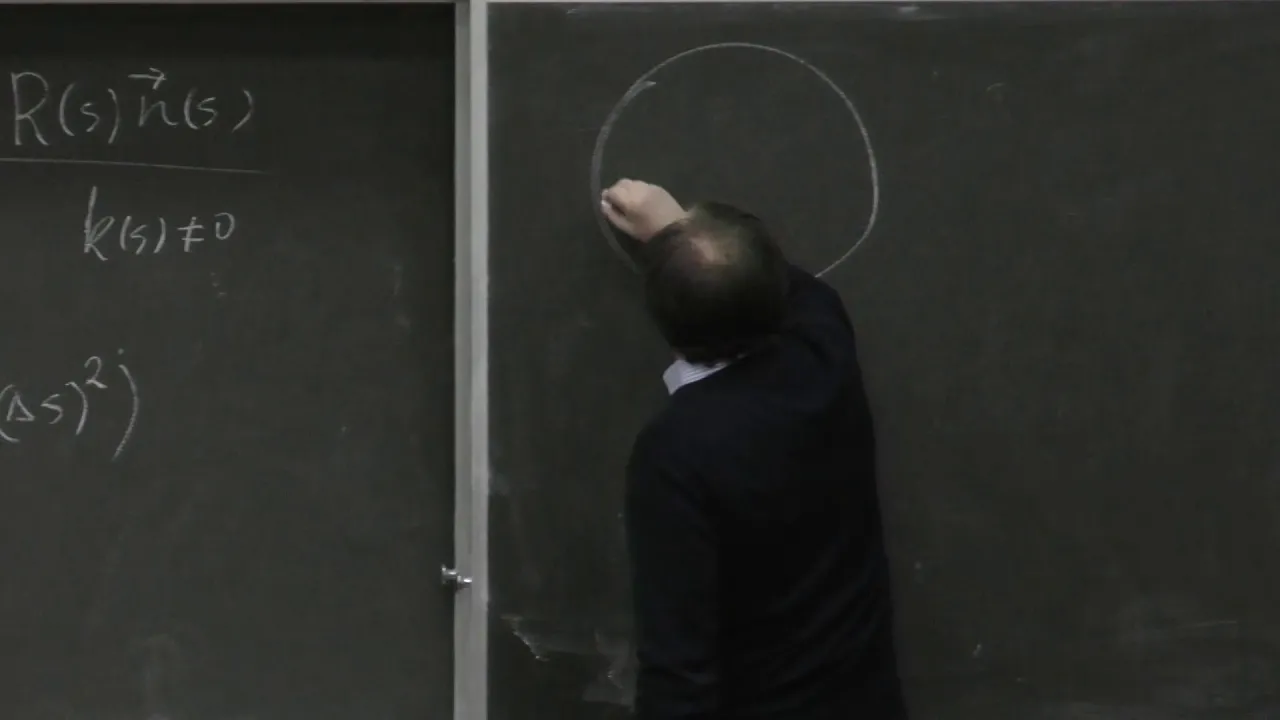
hello students in this video we'll discuss gec curvature in the gesk equations let's recall if we're given a curve on a Surface what we're can do is we can form the B bis get a DOT we can assume of course an arc length perimeter right Arc Length perimeter gamma dots andit normal Vector to the surface and then and Hat Cross getma do right at the basis of three dimensional space on the surface the first Sur this configuration we have this idea that here's our surface right here's a curve okay there's my curve gamma I can mute the gamma dot I Canute the normal Vector over here n hat and then I cross those two things I do n Hat Cross gamma dot right and that's going to go over this direction over here right and hit that GMA gamma dot right that's right and so I do this look like that and then the whole idea now is that the second derivative lies in this plane over here right second derivative is somewhere over here right gamma double dots right and so we know that gamma double dots gamma double dots is equal to the normal curvature in the direction of n hat plus the GS curvature the direction of and at Ross yeah that okay that's our background information this and so now we're going to make definition we're going to say definition gamma is a gesc if either gamma double dot is equal to zero straight line basic or gamma double dot is parallel to nhh right okay that's what it means in other words if it's par and no KD right so an immediate consequence of this proposition proposition G if and only if this gesc curvature is equal to zero right well from this equation if perature is equal to zero then you're definitely proportional to an hat and then if you're gesic right then you're parallel and hat well then you're I know that gamma dot gamma dot is a unit unit Vector right and so gamma dot gamma dot is is perpendicular and you're also perpendicular the gamma dot so you have to be the direction of AD right right next position we have is the following so this F4 GS and speed PR right so we say so G must be new in speed parameterization right so if we do derivative GX Conant speed okay so for what we're going to do so follow some calculation I know that gamma dot. gamma double dot that's plot well gamma double dot is in the direction of the normal Vector is equal to zero right we look at the overall that's that's the fundamental idea because this is a Tang Vector that's a normal Vector now of course what do we do if I do the derivative with respects to T or respect to S doesn't matter of gamma dot do product gamma Dot what will that be that's going to be twice gamma dot gamma double dot which is zero rise constant here other words this implies that the length of gamma dot squared is a constant okay theity so generality so far still Mo Bo that's the m in spe great what I want to do is I want to show this definition of gasc definition that you're either parallel to normal vector or a straight line so you're a straight line or you're parallel to normal Vector if only G equal to zero let's write down equations for these things to what happens okay so we really have is the following note that if you going to be parallel to the um to curve par to the L so I can say that the derivative the curve the curve is going to be what is going to be a u do Ru plus v. RV because we're on a Surface right if I do product this with for example Ru that has to be equal to zero right that's Wonder we go same with um the same condition with a second right now I'm going to a clever trick with this the idea what I'm going to say this is true if and only if um d by DT of U dot then Ru I'll do the ru do R I'll bring the dot product down the inside which I'm not allowed to do right plus v do F that's what happens if I brought the in do on the inside so have to subtract off what by the product subtract off the what theum here that's G to be minus minus What minus u.r U plus v.r v derivative Ru Ru going to be the derivative of Ru is going to be what going to be a Ru ruu dot what do U hat do U dot plus ruv UVB do okay great and this zero wind it over here look up two expressions over here so this tells me this is if and only if what if and only if d by DT d by DT of u. e plus v do f is equal to what the minus of course minus u u u squ ru. ruu is the same as the e d of e with respect to U but half of them right so every one half that's let one half out in front of everything I'm going to have an e subu and then U do square right I'm using the fact here that e so recall what am I doing here I'm saying that e for example is R u. Ru and so if I did an EU for example that'd be R u. R uu times two right by the product rule and so what that would tell me that would tell me that one half of EU is just going to be this expression for was are you. Ru that me a e with a 1/2 good what's the next term we're going to get over here well I have two of these things right I RV ruu r uv. r um UV right so those terms are going to have U are going to have two U derivatives and one B derivatives that's going to be a what that's going to be a u derivative of the component over here so I'm going have a plus two of them right so plus two plus two and then plus two right so we have this term over here yeah so these terms over here and then these terms over here are both going to give me what so for example if we have F which is ru. RV if I need a u derivative of f f sub U would be R uu. RV and then plus plus what plus r u r u v right and then by the symmetry of the dot proct I can pass those things onto the other one over here so each of these Expressions over here are going to be F sub U2 right two f subu u do V Dot and then finally plus if I have a r UV R UV that's the 1 half the U derivative G right this will be a g u v do squ so that's my Approach zero right if I execute the analogous trees we going up the following I'm going to have d by DT d by DT what you if I replace this U here so let's do it like this so let's like this if I replace this U over here was if I do this RV I'm going to get the same exact relationship is equal to Z but what F modification all the UDS are going turn to be right so this is d by DT of U dot f+ v.g I'm cting them over minus 12 e v u do^ 2 plus 2 f v u do V Dot plus g v v do^ 2 is equal to zero and these two equations over here are a system of second equations is these PS equations and we've previously shown the GS equation are the ones that locally minimize the between two points on the surface I'm us going to locally minimize some trajectories these trajectories locally minimize of course they're nonlinear OD right locally minimize distance on the surface okay and so that basically ties down together this idea of we've already driven the Gus equations from the oil or grung equations in the previous video right so that derivation with oil or grung gives us a syst system of nonlinear system of two second order differential equations and that's exactly the same uh form we have over here so by taking that proof and feeding up into this juncture feeding it back up to this juncture shows that you're geodesic that you're locally minimizing distan on F if and only if your geodesic curvature is equal to zero thank you very much
Up Next
12:30
Gauss-Bonnet Theorem for Simple Smooth Curves | Differential Geometry
@mikethemathematician
735 views•2025-02-13

8:17
JEE Maths | Circles: Pole & Polar Explained with Equations
@TargetPublications
14.4K views•2019-02-23
10:44
Fourier Series Introduction: The Big Idea Explained
@DrTrefor
387K views•2021-05-03

6:00
The Mathematical Impossibility of Accurate World Maps
@Vox
23.3M views•2016-12-02
Related Study Plans & Knowledge Roadmaps
Structured learning paths in Mathematics
mathematics
Projective Geometry: Coordinates & Conics
01From Euclidean to Projective Space
02Homogeneous Coordinates
03Duality and Projective Transformations
+ 2 more learning modules
14h5 modules
Explore Roadmap
mathematics
Tensor Calculus: Vectors to Riemann Curvature
01Mathematical Foundations: Linear Algebra & Calculus
02Covectors, Dual Spaces, and Tensor Basics
03The Metric Tensor and Index Gymnastics
+ 2 more learning modules
40h5 modules
Explore Roadmap
mathematics
Gödel's Incompleteness: Logic, Proofs & Limits
01Introduction to Formal Systems & Hilbert's Dream
02Set Theory, Cardinality, and Cantor's Diagonal Argument
03Arithmetization and Gödel Numbering
+ 2 more learning modules
14h5 modules
Explore Roadmap
mathematics
Galois Theory: Fields, Groups & Solvability
01Foundations of Abstract Algebra: Groups & Fields
02Polynomials & Field Extensions
03Splitting Fields & Symmetries
+ 2 more learning modules
24h5 modules
Explore Roadmap