The double slit experiment demonstrates that quantum particles like electrons exhibit wave-like behavior, creating interference patterns when passing through two slits, even when fired one at a time; however, when observed or measured, they revert to particle-like behavior, illustrating the fundamental principle that quantum systems exist in superposition of multiple states until measured.
Double Slit Experiment Explained: Quantum Physics Animation
Added:Deep Dive
The physics of classical waves, including the concepts of diffraction, wave interference, and constructive/destructive patterns.
12. Sınıf Fizik 1. Dönem 2. Yazılı | Full Genel Tekrar Yazılı Hazırlık Soruları
50.1K
This section covers wave interference and diffraction patterns. Diffraction requires wavelength comparable to or larger than the opening size; to increase diffraction, decrease slit width or increase wavelength. In interference patterns, constructive interference occurs where path difference equals integer multiples of wavelength (nλ), while destructive interference occurs at half-integer multiples ((n + ½)λ). For the second dark fringe, path difference is 1.5λ. In single-slit diffraction, fringe spacing is Δx = Lλ/ω. To move the first dark fringe to where the first bright fringe was, increase wavelength or decrease slit width. Light intensity affects brightness but not fringe positions.
Click to watch →

الفيزياء 12 ف 2 || مبدأ تراكب الموجات (7-1) و حيود الموجات (7-2) || أ. سعود الحضرمي
70.5K
This comprehensive segment covers fundamental wave physics concepts. The teacher emphasizes that taking notes is crucial for physics learning. The lesson distinguishes wave properties (wavelength, interference, diffraction) from particle properties (mass, collisions). The Principle of Superposition states that when waves meet, the resultant displacement is the algebraic sum of individual displacements. After superposition, waves return to their original state without change. The teacher demonstrates constructive interference (same-direction displacements add up) and destructive interference (opposite-direction displacements cancel out). The segment covers diffraction as the bending or spreading of waves when passing through openings, with the critical relationship between slit width and wavelength determining diffraction behavior. Sound diffraction is easier to observe than light diffraction because sound wavelengths are much larger.
Click to watch →
Physics All Formula & Concept Revision in one video Class 12 Physics CBSE Boards 2022
48.7K
Interference occurs when coherent light waves superpose. The intensity at any point is I = I₁ + I₂ + 2√(I₁I₂)cos(φ), where φ is phase difference. Constructive interference (bright fringes) occurs when path difference is nλ. Destructive interference (dark fringes) occurs when path difference is (2n-1)λ/2. Young's double slit experiment demonstrates wave nature of light. Fringe width is β = λD/d, with bright fringes at x = nλD/d and dark fringes at x = (n+1/2)λD/d. Diffraction is the bending of light around obstacles. Single slit diffraction produces a central maximum twice as wide as secondary maxima. Diffraction grating equation is d sin(θ) = nλ.
Click to watch →

Tom Campbell: The Key to Understanding Our Reality (from Spokane)
122.8K
When waves pass through two slits, they create circular waves from each slit that interfere with each other. When the path difference between waves from the two slits equals an integer multiple of the wavelength, the waves are in phase and reinforce each other, creating bright spots (constructive interference). When the path difference equals an odd multiple of half-wavelengths, the waves cancel each other out, creating dark spots (destructive interference). This creates a characteristic diffraction pattern with alternating bright and dark bands.
Click to watch →

فيزياء السادس علمي || جميع اختيارات الكتاب || سلسلة ال10 درجات في الوزاري
335.6K
For diffraction to occur in a single slit, the slit width must be comparable to the wavelength of light (a ≈ λ). The condition for the first minimum is a sinθ = λ. Young's double slit experiment demonstrates wave nature through interference: the first barrier produces diffraction, allowing light to spread, while the second barrier with two slits produces interference between diffracted waves. The central maximum is brightest and widest, with secondary maxima of decreasing intensity on either side.
Click to watch →
Deep Dive
Classical particle behavior, specifically how macroscopic objects behave when passing through physical barriers with slits.
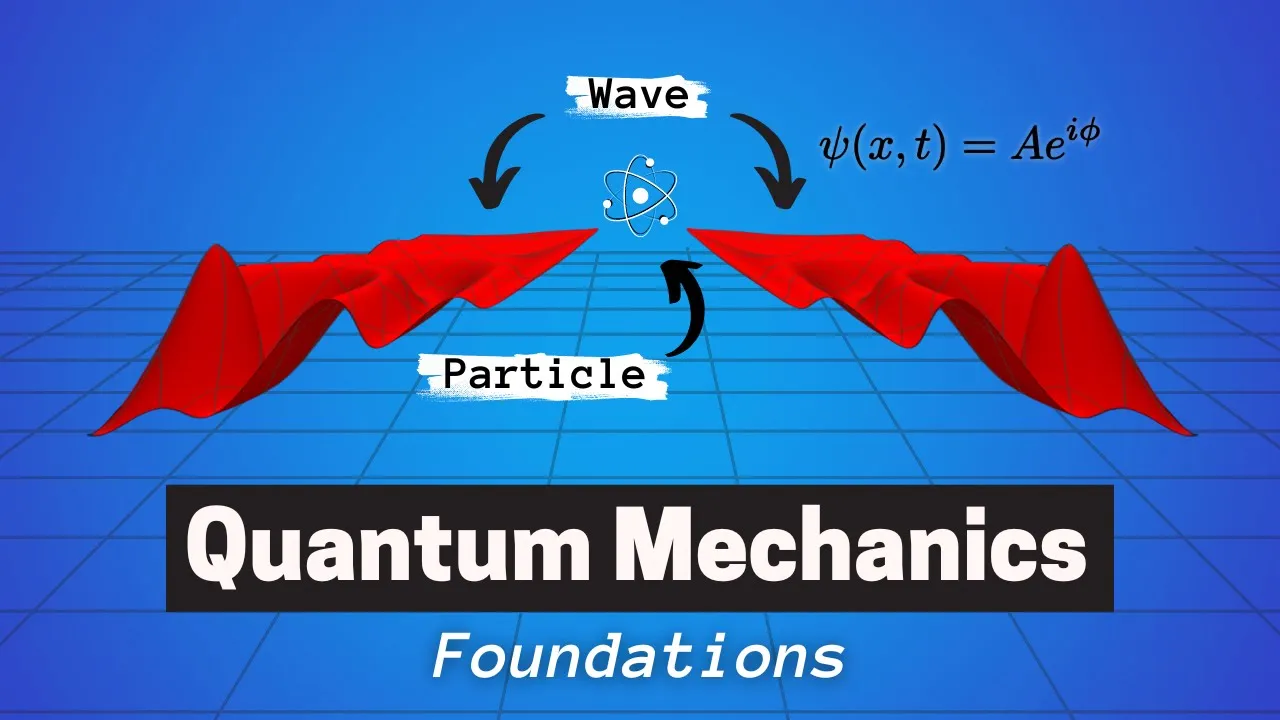
But why wavefunctions? A practical approach to quantum mechanics
225.8K
The double-slit experiment produces dramatically different results depending on whether we send classical particles or classical waves through the barrier. With BB gun pellets (classical particles), each pellet goes through one hole or the other, producing a simple distribution that is the sum of individual hole distributions. With laser light (classical waves), the waves from each slit interfere with each other, creating an alternating pattern of bright and dark fringes. Bright spots arise from constructive interference (waves adding together), while dark spots result from destructive interference (waves canceling each other). This interference pattern cannot be explained by simply adding intensities from each hole individually.
Click to watch →

The Double-Slit Experiment
1.1M
The double-slit experiment demonstrates that both light and matter exhibit wave-particle duality, where particles like electrons create interference patterns when passing through two slits, showing wave-like behavior; however, massive objects like humans do not show observable diffraction because their wavelengths are extremely small (around 10^-36 meters), making classical physics sufficient for everyday objects while quantum mechanics describes fundamental reality.
Click to watch →

Why don't quantum effects occur in large objects? double slit experiment with tennis balls
692.6K
Large objects like tennis balls cannot exhibit quantum wave-like behavior because they are practically impossible to isolate informationally from the universe. Any photon or air molecule bouncing off the object records its path, causing wave function collapse. Objects above absolute zero emit photons via blackbody radiation, carrying positional information. Even gravitational effects on nearby atoms can reveal an object's path. Mathematically, the de Broglie wavelength λ = h/(mv) becomes extremely small for massive objects, making interference patterns undetectable. Thus, macroscopic objects converge to classical behavior. This explains why Schrödinger's cat is not simultaneously dead and alive—quantum superposition only applies to sufficiently isolated quantum systems.
Click to watch →
Эмиль Ахмедов: "Парадоксы квантовой теории"
99.8K
The action (S) of a system determines whether quantum or classical behavior dominates. When S >> ℏ, quantum effects are negligible and classical mechanics applies. When S ~ ℏ or S < ℏ, quantum effects dominate. For the double-slit experiment, action is approximately the product of slit width and wave number. This criterion explains why macroscopic objects follow classical trajectories while microscopic particles exhibit quantum behavior. All physical theories have limits of applicability: Newtonian mechanics applies to macroscopic objects at low speeds, special relativity to objects moving at speeds comparable to light, and quantum mechanics to microscopic objects.
Click to watch →
Are Photons & Electrons Particles or Waves? Make up your mind god!
384.5K
All matter exhibits wave-like properties described by de Broglie's λ = h/(mv). For electrons in atoms, wavelengths match atomic sizes, explaining quantum behavior. For macroscopic objects like grains of sand, wavelengths become 10⁻²⁵ meters—billions of times smaller than protons. Since wavelength scales inversely with mass, heavier objects have increasingly negligible wave-like behavior. When wavelengths become extremely small, quantum effects average out, making objects appear continuous and classical. Modern physics suggests particles are excitations in quantum fields, not fundamental discrete entities.
Click to watch →
Deep Dive
The historical context of Thomas Young's original double-slit experiment which proved the wave-like nature of light.
El experimento más bonito de la física: Doble rendija de Young, los misterios de la física cuántica
189.4K
Thomas Young conducted the first double-slit experiment between 1801-1803 using sunlight entering his house through a curtain. He created two slits by crossing two cards and observed alternating bright and dark bands on a wall - interference fringes. This demonstrated that light behaves as a wave, as waves from each slit interfere constructively (reinforce) at some points and destructively (cancel) at others. This contradicted Newton's corpuscular theory and supported Huygens' wave theory, resolving a century-long scientific debate.
Click to watch →

Thomas Young'ın Çift Yarık Deneyi (Fizik) (MIT+K12 / STEM)
590.1K
Young's double slit experiment demonstrates that light behaves as a wave rather than a particle. In the 18th century, Newton's particle theory dominated due to his scientific authority. Thomas Young challenged this by showing that light passing through two slits creates an interference pattern where waves reinforce and cancel each other. This pattern depends on slit width and slit separation, confirming wave propagation. The experiment requires spatial coherence—light must originate from a single point source to produce interference. This discovery resolved the historical debate about light's fundamental nature.
Click to watch →

Le module de Young
122.4K
Thomas Young's 1801 double-slit experiment demonstrated that light exhibits wave-like properties through interference patterns, where light passing through two slits creates alternating bright and dark bands on a screen due to constructive and destructive interference of wavefronts, definitively resolving the 18th-century debate between particle and wave theories of light in favor of the wave theory.
Click to watch →
Mi TOP 10 Experimentos Más Locos y Bellos de la Ciencia… ¡TE VOLARÁN LA CABEZA!
845.1K
This section details Thomas Young's 1801 experiment that demonstrated light behaves as waves. Young was inspired by a phenomenon in Vietnam where tides canceled each other out, demonstrating wave interference. He proposed that light should exhibit the same interference pattern as water waves. In 1807, he presented his experiment at the Royal Institution, using light as the source. Instead of the two spots predicted by Newton's particle theory, the screen showed an interference pattern identical to that produced by water waves. This proved that light behaves as waves, contradicting Newton's authority and establishing the wave theory of light.
Click to watch →

Yalansız Sihir
226.4K
Thomas Young, who deciphered Egyptian hieroglyphs and created the first family tree of Indo-European languages, designed a simple experiment using three pieces of cardboard with colored filters. A green-tinted glass only allows green light to pass through, meaning only one color (frequency) of light passes through the slits. Young predicted that when multiple colors of light overlap, they would create an interference pattern. When he passed single-color light through two separate slits, he did not see two distinct light bands as would be expected if light were particles. Instead, he observed an interference pattern where light waves overlap and create alternating bright and dark bands. This discovery proved that light behaves as a wave, contradicting Newton's particle theory and establishing the wave nature of light.
Click to watch →
Deep Dive
The basic concept of subatomic particles, specifically the electron, and its discovery as a fundamental constituent of matter.

Discovery of Subatomic Particles - Atomic Structure Class 11 Chemistry Concept | NEET 2024 Exam
47.5K
J.J. Thomson and his team identified the electron as a fundamental particle in 1897 through experiments with cathode rays. This discovery revolutionized the understanding of atomic structure by revealing that atoms contain smaller subatomic particles. The electron was the first subatomic particle to be discovered, leading to the development of modern atomic theory.
Click to watch →

Part-1, अध्याय-2, परमाणु की संरचना | One Shot Revision | Class-11 Chemistry | कक्षा-11 रसायन विज्ञान
110.4K
The discovery of cathode rays and their properties led to the conclusion that electrons are fundamental subatomic particles that can be emitted from atoms. This finding challenged the ancient Greek idea that atoms are indivisible. The electron was found to be a universal component of all atoms, regardless of the element, suggesting that all atoms share common subatomic particles. This discovery opened the door to understanding the internal structure of atoms.
Click to watch →
L-1, इलेक्ट्रॉन ? Introduction | अध्याय-2, परमाणु की संरचना (STRUCTURE OF ATOM) 11th Chemistry
201.2K
The discovery of cathode rays established that electrons are fundamental constituents of atoms. Thomson concluded that atoms contain electrons, which are negatively charged particles. This discovery was crucial because it showed that atoms have internal structure and are not indivisible. The electrons are found in all atoms and are essential for understanding atomic structure. This marked the beginning of modern atomic physics.
Click to watch →

applied chemistry 1st semester polytechnic | chapter #1 Atomic Structure | raceva semeseter
105.5K
This section covers the discovery of the electron. In 1859, Julius Plücker used a discharge tube to observe particles traveling from cathode to anode. J.J. Thomson systematically studied these cathode rays and found they travel in straight lines, cast shadows, rotate paddle wheels, and are deflected by electric fields toward the positive plate. Thomson measured the charge-to-mass ratio (e/m) as 1.7 × 10^11 C/kg for all gases, proving these particles are fundamental constituents of all atoms. He named them 'electrons' and recognized them as the first subatomic particles discovered.
Click to watch →
Structure of the Atom - Complete Chapter Revision | Class 9 Chemistry Chapter 4 (2022-23)
218.1K
Electrons are subatomic particles that carry negative charge. They were discovered by J.J. Thomson in 1897 through his study of cathode rays. Electrons are extremely small compared to atoms and have negligible mass. The discovery of electrons proved that atoms are not indivisible but have internal structure, with electrons being one of the fundamental subatomic particles.
Click to watch →
Prerequisite Knowledge
- Concept 01The physics of classical waves, including the concepts of diffraction, wave interference, and constructive/destructive patterns.
- Concept 02Classical particle behavior, specifically how macroscopic objects behave when passing through physical barriers with slits.
- Concept 03The historical context of Thomas Young's original double-slit experiment which proved the wave-like nature of light.
- Concept 04The basic concept of subatomic particles, specifically the electron, and its discovery as a fundamental constituent of matter.
Subsequent Learning
- Step 01The De Broglie hypothesis and the concept of matter waves, which mathematically relates a particle's momentum to its quantum wavelength.
- Step 02The Copenhagen Interpretation of quantum mechanics, specifically focusing on the mathematical formulation of wave function collapse.
- Step 03Schrödinger's Cat thought experiment, which scales the concept of quantum superposition to macroscopic objects.
- Step 04Quantum Entanglement and Bell's Theorem, exploring how measurement of one particle instantaneously affects another, regardless of distance.
- Step 05Practical applications of quantum superposition and the observer effect, such as Quantum Computing, Quantum Cryptography, and Electron Microscopy.
Wave-Particle Duality
Quantum Interference
Observer Effect
Wave-Particle Duality
0:01Playing Section
- 1
Classical objects create two bands through double slits.
- 2
Waves produce an interference pattern of many bright lines.
De Broglie-Bohm Theory (Pilot Wave Theory)
While the standard Copenhagen interpretation of the double-slit experiment suggests particles exist in a state of probability (superposition) and are collapsed by an observer, the De Broglie-Bohm (or Pilot Wave) theory offers a deterministic alternative. According to this view, particles like electrons always have a definite, real position and trajectory, even when not observed. Instead of behaving as waves themselves, they are guided by a physical 'pilot wave.' This wave passes through both slits and creates the interference pattern, while the actual particle only passes through a single slit. This interpretation explains the experimental results without requiring wavefunction collapse, superposition, or a mysterious 'observer effect,' presenting a realist alternative to standard quantum mechanics.
Deep Dive
The De Broglie hypothesis and the concept of matter waves, which mathematically relates a particle's momentum to its quantum wavelength.

الفصل السادس || الفيزياء الحديثة || محاضرة (7)
87.7K
This section introduces Louis de Broglie's 1924 hypothesis that all matter exhibits wave-particle duality. The instructor explains that in every mechanical system, there must be waves that accompany the motion of material particles. These are called matter waves - they are neither mechanical waves nor electromagnetic waves, but a new type of wave. The instructor defines a wave packet as a group of waves with limited spatial extent that represents a particle. The De Broglie wavelength equation λ = h/(mv) is presented as the mathematical relationship between a particle's momentum and its associated wavelength.
Click to watch →
![De Broglie Hipotezi-1 [Temel Kavramlar]](https://i.ytimg.com/vi_webp/hrBD7qwiltI/maxresdefault.webp)
De Broglie Hipotezi-1 [Temel Kavramlar]
171.6K
De Broglie derived the fundamental relationship λ = h/p, connecting a particle's momentum to its associated wavelength. For photons, this becomes λ = hc/E. This formula unified wave and particle properties, showing that light's momentum and wavelength are mathematically linked. De Broglie then extended this hypothesis to all matter, proposing that any particle with mass and momentum has an associated wavelength. This 'matter waves' concept revolutionized physics by suggesting wave-particle duality is universal, not limited to light. The formula applies to electrons, atoms, and even macroscopic objects, though the wavelengths for larger objects are typically too small to observe.
Click to watch →

فيزياء سادس علمي | الفصل السادس | الفيزياء الحديثة | مخطط ذهبي للكلاميات ٢٠٢٥
147.7K
Louis de Broglie proposed that all matter exhibits wave-like properties, not just light. He hypothesized that every moving particle has an associated wave called a matter wave. The wavelength of this matter wave is given by λ = h/p, where h is Planck's constant and p is the momentum of the particle. This hypothesis extends wave-particle duality from light to all matter, suggesting that electrons, atoms, and even macroscopic objects have associated wavelengths. Matter waves are neither mechanical waves nor electromagnetic waves, but a fundamental property of all matter.
Click to watch →

فيزياء السادس العلمي || 3- المراجعة المركزة || الفصل السادس
533.9K
Louis de Broglie proposed that all matter exhibits wave-like properties. By equating Planck's equation (E = hf) with Einstein's equation (E = mc²), and using the relationship between energy and momentum, de Broglie derived that any moving particle has an associated wavelength given by λ = h/(mv). This equation shows that wavelength is inversely proportional to momentum. The left side of the equation represents wave behavior, while the right side represents particle behavior. This hypothesis was revolutionary as it extended wave-particle duality from light to all matter, from the smallest electrons to the largest planets.
Click to watch →
Dual Nature of Radiation and Matter Revision in 30 Mins | Class 12th Physics Chapter-11 | CBSE 2025
128.1K
Louis de Broglie proposed that matter exhibits wave properties, just as light exhibits particle properties. The de Broglie wavelength is λ = h/p, where p is momentum. For a particle of mass m and velocity v, λ = h/(mv). In terms of kinetic energy K, λ = h/√(2mK). For electrons accelerated through potential V, λ = h/√(2meV). The ratio of wavelengths for particles with same kinetic energy is λ₁/λ₂ = √(m₂/m₁). This hypothesis was experimentally confirmed and forms the basis of wave mechanics.
Click to watch →
Deep Dive
The Copenhagen Interpretation of quantum mechanics, specifically focusing on the mathematical formulation of wave function collapse.

David J. Griffiths | Lectures | Techfest 2012, IIT Bombay
108K
The Copenhagen interpretation, associated with Niels Bohr and the Copenhagen school, asserts that quantum particles do not have definite positions until they are measured. The act of measurement forces the particle to adopt a specific position, and simultaneously causes the wave function to collapse from its spread-out form into a sharp spike at the measured position. This collapse ensures that an immediately repeated measurement will yield the same result. The interpretation has two bizarre features: (1) measurement forces a particle to take a stand where it had no position before, and (2) the wave function collapses instantaneously to ensure measurement consistency.
Click to watch →

Dlaczego fizyka kwantowa działa? - dr Tomasz Miller - BS3S
707.4K
The wave function is a mathematical object that describes the quantum state of a system. It contains all the information about the system, including probabilities for different measurement outcomes. The wave function evolves according to the Schrödinger equation, which describes how quantum systems change over time. The measurement problem is a fundamental challenge in quantum mechanics: how does the wave function collapse to produce definite measurement outcomes? The mathematics of quantum mechanics describes systems as existing in superpositions of multiple states, but measurements always produce definite results. The Copenhagen interpretation is the most traditional interpretation of quantum mechanics. It holds that the wave function is merely a mathematical tool for calculating probabilities, and that it does not represent a real physical state. According to this interpretation, the wave function 'collapses' upon measurement, producing definite outcomes.
Click to watch →

【シュレーディンガーの猫】多くの天才物理学者を悩ませた未解決パラドックス
390.6K
The Copenhagen interpretation, proposed by Niels Bohr and colleagues at the Bohr Institute in Copenhagen, is the mainstream interpretation of quantum mechanics. It states that quantum systems can exist in multiple states simultaneously (superposition), and only when observed do they collapse into a single definite state. This process is called wave function collapse. Before observation, a quantum system exists in a superposition of all possible states with associated probabilities, and measurement randomly selects one state according to these probabilities.
Click to watch →
Something Deeply Hidden | Sean Carroll | Talks at Google
646K
The Copenhagen interpretation distinguishes between two regimes: when unobserved, quantum systems obey the Schrödinger equation with wave functions spreading out; when measured, wave functions collapse unpredictably to localized states. Probability enters via the Born rule (probability equals wave function squared). However, this interpretation faces two fundamental problems: the reality problem (what exactly is the wave function?) and the measurement problem (what constitutes a measurement?). Einstein argued this was incomplete, while Bohr's camp won public relations battles despite these unresolved issues.
Click to watch →

قطة شرودنغر ومبدأ التراكب الكمي .. نحن موجودون وغير موجودين في نفس الوقت
7.9K
The Copenhagen interpretation, developed by Bohr, Heisenberg, Born, and Compton in the 1920s-1930s, became the dominant framework for understanding quantum mechanics. It states that observation fundamentally affects quantum systems—measurement causes wave function collapse, where superposition resolves into a single definite state. Schrödinger's wave function mathematically describes quantum states and their probabilistic evolution. This interpretation led to the measurement problem: how and why does collapse occur? Einstein famously rejected this probabilistic view, arguing 'God does not play dice.' He proposed the EPR experiment to challenge quantum mechanics' completeness, believing particles have definite properties regardless of measurement.
Click to watch →
Deep Dive
Schrödinger's Cat thought experiment, which scales the concept of quantum superposition to macroscopic objects.
The Biggest Ideas in the Universe | 8. Entanglement
316.4K
Schrödinger's cat amplifies quantum superposition to macroscopic scale: a cat in a box with a radioactive atom that may release poison. According to Copenhagen interpretation, the cat exists in a superposition of alive and dead until observed. Schrödinger intended this to show absurdity of Copenhagen's observer-dependent reality, arguing that obviously cats are never observed in superpositions. The paradox highlights the measurement problem and the boundary between quantum and classical worlds.
Click to watch →

Квантовый мир.
2.2M
Schrödinger's cat is a thought experiment illustrating the paradox of quantum superposition applied to macroscopic objects. A cat is placed in a sealed box with a quantum device that has a 50% chance of releasing poison. According to quantum mechanics, until the box is opened, the cat exists in a superposition of being both alive and dead simultaneously. This thought experiment highlights the apparent absurdity of applying quantum rules to everyday objects and raises questions about when and how quantum superposition ends.
Click to watch →

شطحات فكرية | الحلقة 4 : جنون ميكانيكا الكم | Shata7at Fekreya
153.3K
Schrödinger's Cat is a thought experiment illustrating the paradox of quantum superposition applied to macroscopic objects. A cat is placed in a sealed box with a radioactive atom, a Geiger counter, and a vial of poison. If the atom decays, the counter detects it and breaks the vial, killing the cat. If the atom does not decay, the cat remains alive. According to quantum mechanics, until observed, the cat exists in a superposition of being both alive and dead simultaneously. Radioactive decay is a random process where unstable atomic nuclei lose energy by emitting radiation. Half-life is the time required for half of the radioactive atoms in a sample to decay, but it is impossible to predict which specific atom will decay.
Click to watch →

A mecânica quântica através de exemplos simples
165.6K
The lecturer describes Schrödinger's cat paradox: a cat is placed in a box with a quantum trigger that may or may not release poison. If the quantum object is in a superposition of being sonorous (blue) and silent (red), then the cat is simultaneously in a superposition of being alive (if silent) and dead (if sonorous). According to quantum mechanics, until observed, the cat is both alive and dead at the same time. This thought experiment illustrates the strange implications of quantum superposition when applied to macroscopic objects, highlighting the boundary between quantum and classical behavior.
Click to watch →
Квантовое бессмертие | Почему вы уже умирали сотни раз, но не помните? | Документальный фильм
380.4K
In 1935, Erwin Schrödinger created this famous thought experiment to illustrate the absurdity of the Copenhagen interpretation. A cat is placed in a sealed box with a radioactive atom, a Geiger counter, and a vial of poison. If the atom decays, the counter triggers and kills the cat; if not, the cat lives. According to quantum mechanics, until observed, the atom exists in superposition (both decayed and not decayed), meaning the cat is simultaneously alive and dead. This paradox highlights the strange implications of quantum theory when applied to macroscopic objects.
Click to watch →
Deep Dive
Quantum Entanglement and Bell's Theorem, exploring how measurement of one particle instantaneously affects another, regardless of distance.
Understanding Quantum Entanglement - with Philip Ball
753.6K
Quantum entanglement is a phenomenon where two particles become correlated such that their quantum states are interdependent; when one particle is measured, the other's state is instantly determined regardless of distance. This challenges Einstein's view of 'hidden variables' that predetermined particle properties before measurement. John Bell's 1964 theorem provided a way to test this by showing that classical systems can only achieve 75% correlation in certain scenarios, while quantum mechanics allows approximately 85% correlation through quantum nonlocality. Experiments since the 1970s have confirmed quantum mechanics' predictions, demonstrating that entangled particles remain connected as a single quantum entity even across vast distances, without violating relativity.
Click to watch →
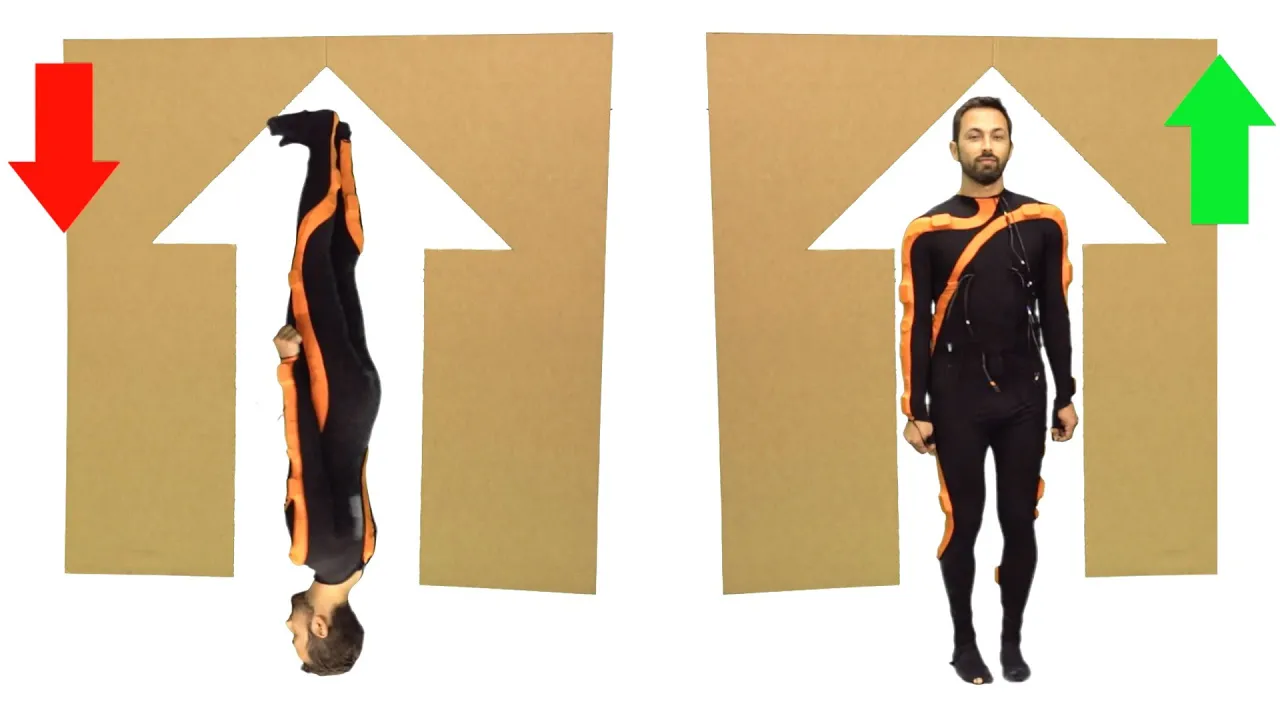
Quantum Entanglement Explained: Spooky Action at a Distance
4.5M
Quantum entanglement creates pairs of particles whose spins are correlated such that measuring one instantly determines the other's state, regardless of distance, but this phenomenon does not allow faster-than-light communication because measurement outcomes remain fundamentally random; John Bell's inequality experiments rigorously tested whether particles contain hidden information about their spins, and the results showing only 50% correlation (rather than the 5/9 predicted by hidden variable theories) confirmed that quantum mechanics correctly describes reality without local hidden variables.
Click to watch →

Доказательства виртуальности нашего мира
15.5M
Quantum entanglement creates correlations between particles so strong that measuring one instantly determines the state of its partner, regardless of distance. Einstein called this 'spooky action at a distance.' Bell's theorem proved particles don't have predetermined properties but exist in genuine superposition until measured. Swiss experiments in 2008 showed entangled particles communicate at least 100,000 times faster than light, possibly instantaneously. This nonlocality defies classical physics but makes perfect sense in a simulated reality where programs can instantly coordinate across vast distances.
Click to watch →

El Experimento que refutó a Einstein | El Borrador Cuántico
147.9K
John Stewart Bell conceived an experiment to determine whether entangled particles have predetermined properties (hidden variables) or generate properties upon measurement. The experiment measures entangled particles' spins in different directions. Classical physics predicts that when measuring with different detectors, opposite results occur one-third of the time (55% matching probability). Quantum mechanics predicts 50% probability for both matching and differing results. Experimental results consistently matched quantum predictions, proving that entangled particles do not have predetermined properties but generate outcomes upon measurement. This demonstrates that information about one particle's measurement appears to travel instantaneously to the other, faster than light.
Click to watch →

Квантовые парадоксы / Александр Львовский в Рубке ПостНауки
90.2K
Quantum entanglement creates correlations where measuring one particle instantly determines another's state, regardless of distance. The EPR paradox challenged quantum mechanics by arguing this implied 'spooky action at a distance' or incomplete theory. Einstein, Podolsky, and Rosen proposed hidden variables could restore locality. However, Bell's theorem later showed local hidden variable theories cannot reproduce quantum predictions, confirming quantum nonlocality as fundamental.
Click to watch →
Deep Dive
Practical applications of quantum superposition and the observer effect, such as Quantum Computing, Quantum Cryptography, and Electron Microscopy.

【総集編】宇宙の全てがここに!「量子力学、シミュレーション仮説、人間原理、仏教、人類の起源、宇宙の起源」(女声版)
686.6K
Quantum superposition describes how particles exist in multiple states simultaneously until observed. An unobserved electron can be in multiple locations and spin states at once. The observer effect reveals that observation itself collapses wave functions to definite states. This phenomenon challenges the fundamental scientific assumption that objective properties remain unchanged regardless of human observation. In the quantum realm, human observation can fundamentally alter the state of matter, suggesting that reality may be fundamentally different from our everyday experience.
Click to watch →
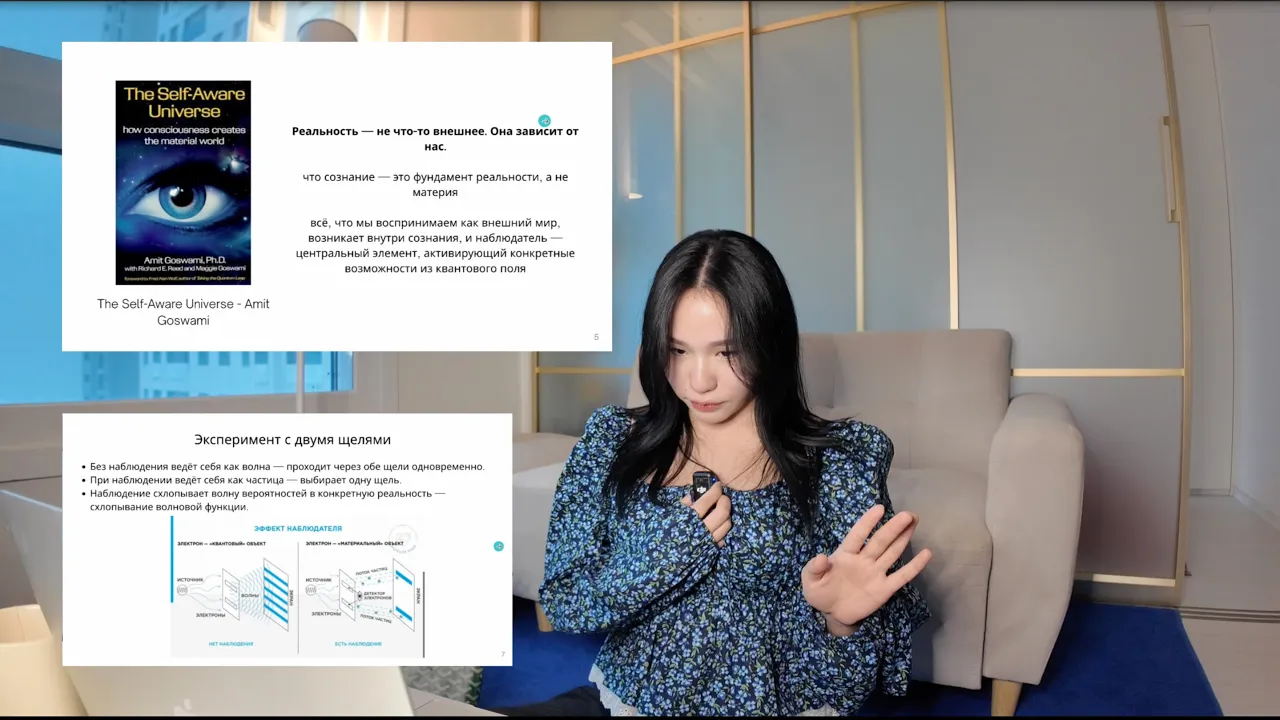
презентация: почему квантовой физики не достаточно чтобы объяснить механику манифестации
69.4K
In quantum mechanics, particles exist in superposition where all possible states exist simultaneously until observed. The double-slit experiment demonstrates that without observation, electrons behave as waves passing through both slits, but when observed, they behave as particles choosing one slit. Observation collapses probability waves into definite reality. The observer is not passive but a creative act that brings reality into existence. The coin toss analogy illustrates that until observed, outcomes exist as both possibilities simultaneously.
Click to watch →

Can we make quantum technology work? | Leo Kouwenhoven | TEDxAmsterdam
727K
Quantum mechanics allows particles like electrons to exist in superpositions—being in multiple states simultaneously—which enables quantum computers to perform massive parallel calculations exponentially faster than classical computers, potentially revolutionizing fields like drug development, material science, and climate modeling.
Click to watch →
![Quantum Mechanics for the Magus [Esoteric Saturdays]](https://i.ytimg.com/vi/20ru6E3cuqc/maxresdefault.jpg)
Quantum Mechanics for the Magus [Esoteric Saturdays]
107.2K
When electrons are fired one at a time through two slits, they still create a wave pattern, demonstrating wave-particle duality. However, when a sensor observes which slit each electron passes through, the pattern changes to particle behavior. This reveals that quantum particles exist in superposition—multiple states simultaneously—until observed. The act of observation collapses this superposition, forcing the particle into a single definite state. This phenomenon challenges classical notions of reality and suggests that observation plays a fundamental role in determining quantum outcomes.
Click to watch →
Most Mysterious Experiment in Whole Physics Explained | Rajan15x
19.3K
Quantum computers leverage quantum mechanical phenomena like superposition and entanglement to process information differently from classical computers. They can generate truly random numbers by harnessing quantum randomness, solving problems intractable for classical computers. The observer effect and uncertainty principle enable quantum key distribution, providing theoretically unbreakable encryption for secure communications.
Click to watch →
Wave-Particle Duality
Quantum Interference
Observer Effect
Wave-Particle Duality
0:01- 1
Classical objects create two bands through double slits.
- 2
Waves produce an interference pattern of many bright lines.
De Broglie-Bohm Theory (Pilot Wave Theory)
While the standard Copenhagen interpretation of the double-slit experiment suggests particles exist in a state of probability (superposition) and are collapsed by an observer, the De Broglie-Bohm (or Pilot Wave) theory offers a deterministic alternative. According to this view, particles like electrons always have a definite, real position and trajectory, even when not observed. Instead of behaving as waves themselves, they are guided by a physical 'pilot wave.' This wave passes through both slits and creates the interference pattern, while the actual particle only passes through a single slit. This interpretation explains the experimental results without requiring wavefunction collapse, superposition, or a mysterious 'observer effect,' presenting a realist alternative to standard quantum mechanics.
The physics of classical waves, including the concepts of diffraction, wave interference, and constructive/destructive patterns.
Classical particle behavior, specifically how macroscopic objects behave when passing through physical barriers with slits.
The historical context of Thomas Young's original double-slit experiment which proved the wave-like nature of light.
The basic concept of subatomic particles, specifically the electron, and its discovery as a fundamental constituent of matter.
The De Broglie hypothesis and the concept of matter waves, which mathematically relates a particle's momentum to its quantum wavelength.
The Copenhagen Interpretation of quantum mechanics, specifically focusing on the mathematical formulation of wave function collapse.
Schrödinger's Cat thought experiment, which scales the concept of quantum superposition to macroscopic objects.
Quantum Entanglement and Bell's Theorem, exploring how measurement of one particle instantaneously affects another, regardless of distance.
Practical applications of quantum superposition and the observer effect, such as Quantum Computing, Quantum Cryptography, and Electron Microscopy.
85.1K views268likes4:41@ExtraOrdinaryWAVEOriginal Release: 2008-01-25
and here we are the granddaddy of all Quantum weirdness the infamous double slip experiment to understand this experiment we first need to see how particles or little balls of matter act if we randomly shoot a small object say a marble at the screen we see a pattern on the back wall where they went through the slit and hit now if we add a second slit we would expect to see a second band duplicated to the right now let's look at waves the waves hit the slit and radiate out striking the back wall with the most intensity directly in line with the slit the line of brightness on the back screen shows that intensity this is similar to the line the marbles make but when we add the second slit something different happens if the top of one wave meets the bottom of another wave they cancel each other out so now there is an interference pattern on the back wall places where the two tops meet are the highest intensity the bright lines and where they cancel there is nothing so when we throw things that is matter through two slits we get this two bands of hits and with waves we get an interference pattern of many bands good so far now let's go Quantum an electron is a tiny tiny bit of matter like a tiny marble let's fire a stream through one slit it behaves just like the marble a single band so if we shoot these tiny bits through two slits we should get like the marbles two bands what an interference pattern we fired electrons tiny bits of matter through but we get a pattern like waves not like little marbles how how could pieces of matter create an interference pattern like a wave it doesn't make sense but physicists are clever they thought maybe those little balls are bouncing off each other and creating that pattern so they decide to shoot electrons through one at a time there is no way they could interfere with each other but after an hour of this the same interference pattern is seen to emerge the conclusion is inescapable the single electron leaves as a particle becomes a wave of potentials goes through both slits and interferes with itself to hit the wall like a particle but mathematically it's even stranger it goes through both slits and it goes through neither and it goes through just one and it goes through just the other all of these possibilities are in super position with each other but physicists were completely baffled by this so they decided to Peak and see which slit it actually goes through they put a measuring device by one slit to see which one it went through and let it fly but the quantum world is far more mysterious than than they could have imagined when they observed the electron went back to behaving like a little marble It produced a pattern of two bands not an interference pattern of many the very Act of measuring or observing which slit it went through meant it only went through one not both the electron decided to act differently as though it was aware it was being watched and it was here that physicists stepped forever into the strange never
Up Next

17:48
Black Body Radiation Explained: Why Hot Objects Glow
@Mahesh_Shenoy
244.2K views•2024-09-06

12:53
21cm Hyperfine Transition in Neutral Hydrogen: Radio Astronomy Basics
@AaronRobertParsons
12.4K views•2011-10-13

32:32
NMR Spin Physics I: Zeeman Effect, Resonance Condition & Larmor Frequency
@nptel-indianinstituteofsci8064
2.3K views•2024-01-17

27:14
Entropy and the Second Law of Thermodynamics Explained
@veritasium
27.5M views•2023-07-01
Related Study Plans & Knowledge Roadmaps
Structured learning paths in Physics
physics
Nuclear Physics (Decay, Fission & Reactors)
01Atomic Structure and the Binding Force
02Radioactive Decay and Half-Life
03Nuclear Fission Mechanics and Chain Reactions
+ 2 more learning modules
12h5 modules
Explore Roadmap
physics
Soft Matter (Polymers, Colloids & Rheology)
01Foundations of Soft Matter & Thermal Forces
02Polymer Physics and Macromolecules
03Colloids, Surfactants, and Self-Assembly
+ 2 more learning modules
38h5 modules
Explore Roadmap
physics
Analytical Mechanics: Lagrangian & Hamiltonian
01Mathematical Foundations: Calculus of Variations
02From Newtonian Mechanics to Constraint Dynamics
03The Principle of Least Action & Lagrangian Mechanics
+ 3 more learning modules
28h6 modules
Explore Roadmap
physics
General Relativity (Spacetime & Cosmology)
01Foundations of Relativity: Special Relativity
02The Geometry of Spacetime: Equivalence Principle & Curvature
03Einstein's Field Equations: The Mathematics of Gravity
+ 2 more learning modules
55h5 modules
Explore Roadmap