










![Topology, Chapter-02 [ Topological Space ] Tutorial - 15 ( Class-33 ) ***NUH- 2017](https://i.ytimg.com/vi/m_X1Ad-CVOg/maxresdefault.jpg)






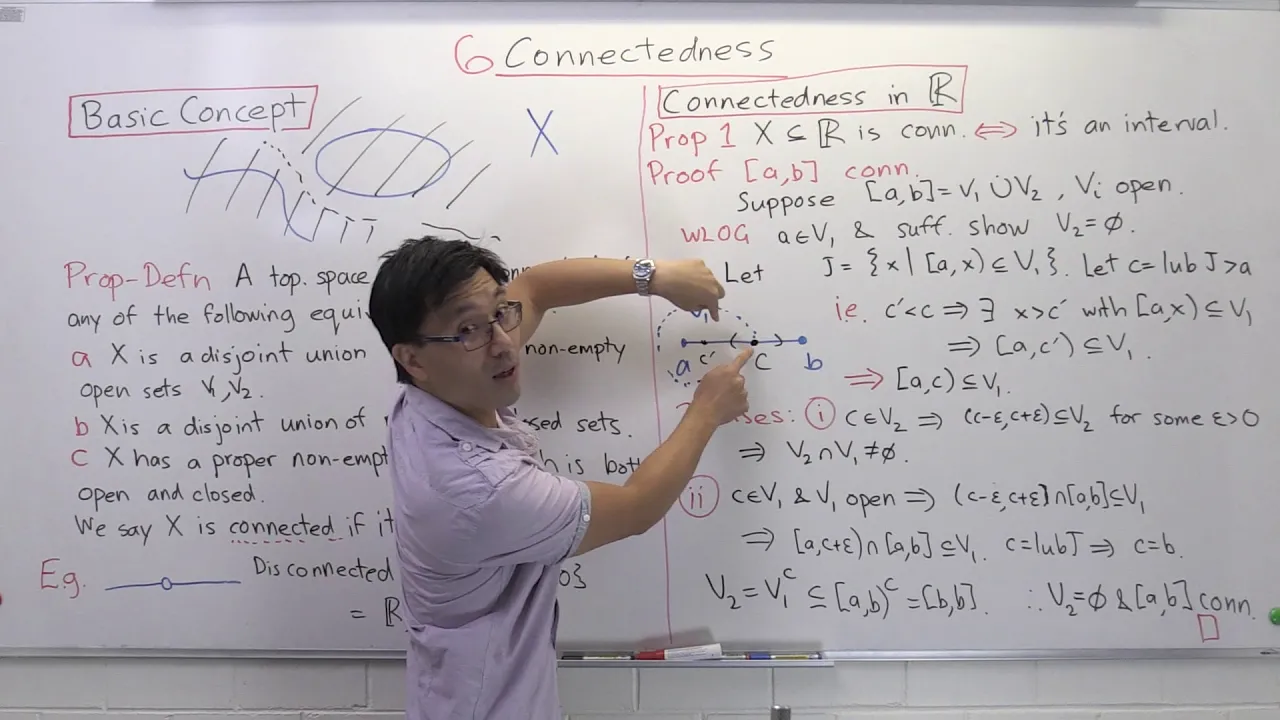

![[기초부터 대학원 수학까지 시리즈 서브-스터디 3기] metric에서 일반 위상으로 추상화할 때 미적분학이 어디까지 될까?](https://i.ytimg.com/vi/YRrmeGUVeA0/maxresdefault.jpg)

![[s1 | 2025] Математический анализ, К. П. Кохась, лекция 6](https://i.ytimg.com/vi/iz7uggIta_M/maxresdefault.jpg)


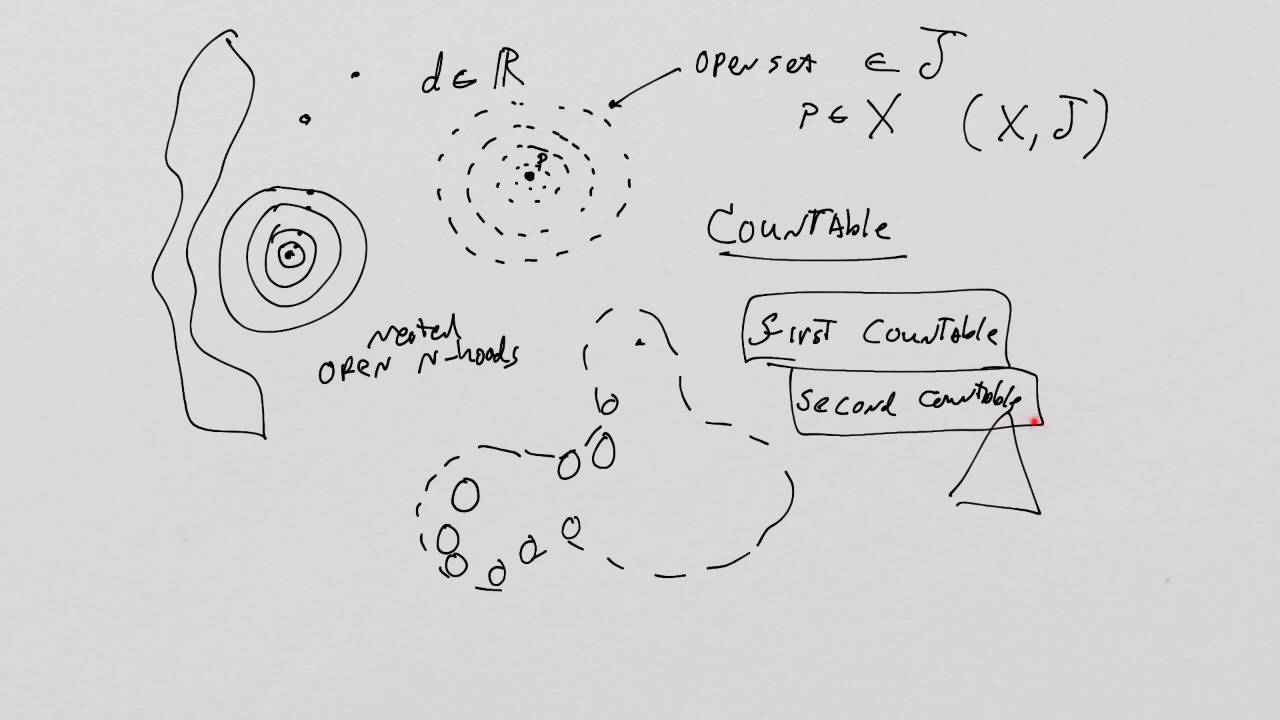



A subset of real numbers is open if for every point in the set, there exists an epsilon neighborhood entirely contained within the set; a set is closed if it contains all its limit points. Open sets are closed under arbitrary unions and finite intersections, while closed sets are closed under arbitrary intersections and finite unions. The real numbers and empty set are both open and closed (clopen), while sets like the rationals are neither open nor closed.
Open and Closed Sets | Real Analysis Limits and Topology
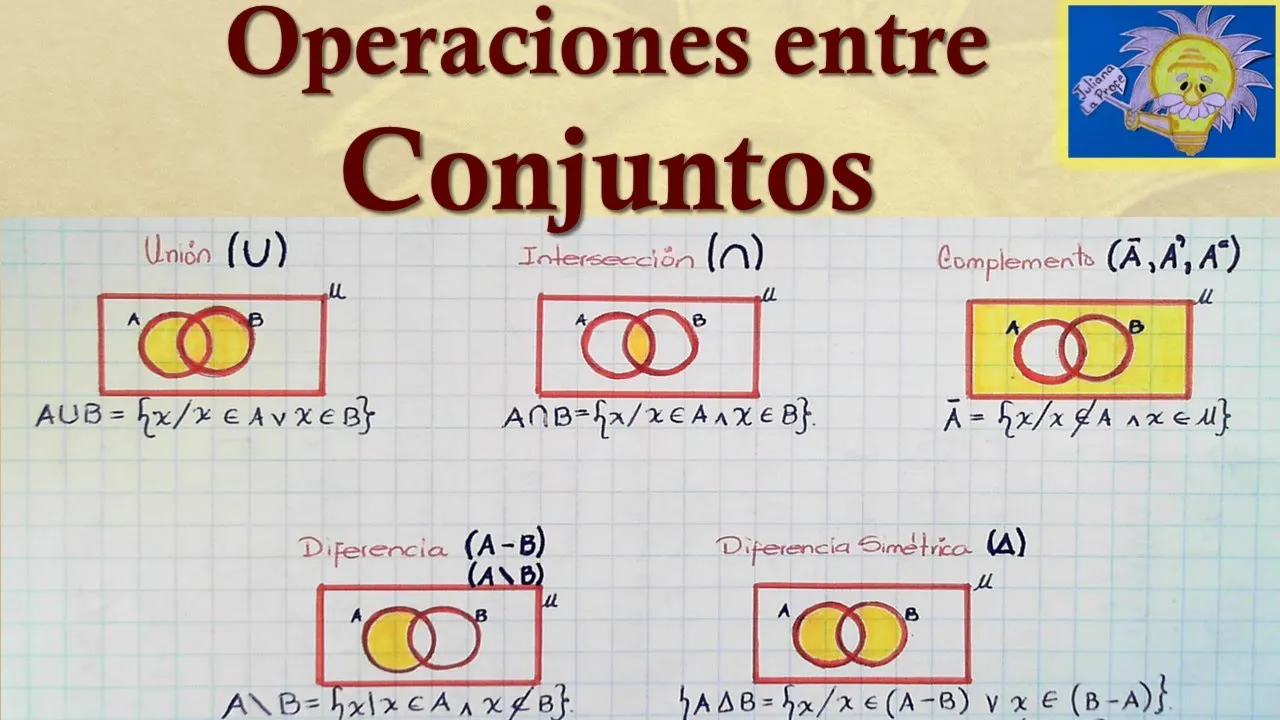
Added:Basic set theory notation and operations, including subsets, unions, intersections, and complements.
The structure of the real number system, particularly the absolute value function and its role in measuring distance.
Fundamental mathematical logic, specifically understanding quantifiers (for all, there exists) and how to construct direct and indirect proofs.
The concepts of supremum (least upper bound) and infimum (greatest lower bound) under the completeness axiom of real numbers.
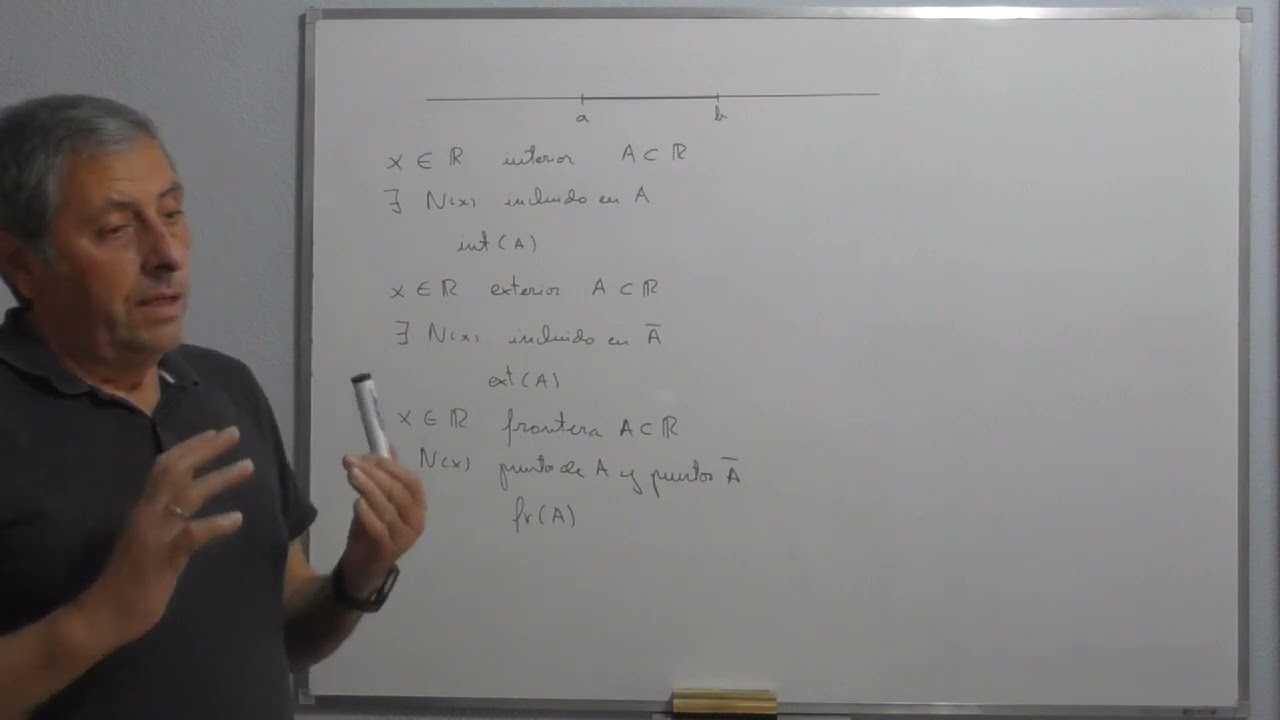
Concepts of interior, closure, boundary, and exterior points of a set in real analysis.
The definition and properties of compact sets, including sequential compactness and the Heine-Borel Theorem.
Connectedness on the real line and its implications for the Intermediate Value Theorem.
Generalization of these concepts to metric spaces and general topological spaces.
The topological definition of continuous functions, defined via the preimages of open sets.
264 views9likes16:40Original Release: 2026-02-04
Let's generalize our notions of open and closed. Currently, we only talk about open intervals or closed intervals. But let's consider what open would mean or what closed would mean for any subset of the real numbers. Given a real number a and an epsilon greater than zero, we could define the epsilon neighborhood around a to be the set of all real numbers within epsilon of a. In other words, the absolute value of x - a is less than epsilon. Or equivalently, this would just be the open interval from a minus epsilon to a plus epsilon. We could then define that a subset x of the real numbers is open if for all real numbers a in x there exists an epsilon neighborhood of a that lives entirely within x that is a subset of x. This definition is supposed to generalize the notion of open interval. So we should verify that the open interval say a to b not including the end points a and b is in fact open by this new definition. If we let x be an arbitrary point in that interval, then since x is not equal to a and not equal to b, x - a and b minus x must both be positive quantities. So we could say let epsilon be the minimum of the two of them. And then if we put a window of that size epsilon around in this picture here, I've drawn epsilon to be equal to x - a. And we're guaranteed that that epsilon window or epsilon neighborhood lives entirely within our open interval a to b. And since x was arbitrary, that means this interval is in fact an open set. What's another example of an open set? The real numbers themselves are an open set. We can take any arbitrary real number. And for this, we could even just take any arbitrary size of a neighborhood. We could choose epsilon equal to 1 and look at the interval x -1 to x + one. And notice that that's entirely contained within the real numbers. So it definitely has to be an open set. What's another example of an open set that's not just the entire real line and not just an open interval? Well, we could take the union of two open intervals and you could argue that that will still be an open set. If those intervals were disjoint, then any element that lived in that set would live in one of those intervals. And we've already shown that you can put an epsilon neighborhood around any point in an open interval that's entirely contained in that interval. And so it would be contained in our overall set. And if the two open intervals weren't disjoint, then their union would be an open interval, which we've already shown to be open. But the result for unions is much stronger than that. Not only are finite unions and countable unions of open sets still open, even uncountable unions of open sets remain open. So we'll say that arbitrary unions of open sets are open.
To prove this, we need a way of denoting this arbitrary union and we can't just use an index say n= 1 to infinity cuz that would imply that the union is countable. So we'll take some index set.
We'll let capital lambda represent a set of indices. And then we'll let O sublambda be an open set for each index lambda in the set capital lambda. So capital lambda here could be the set of the naturals in which case this would be a typical countable union. Capital lambda could be a finite set in which this would be a finite union or capital lambda could be some sort of uncountable set like the real numbers. Our proof makes no assumption about the nature of this index set. Let's let O with no subscript represent the arbitrary union of all of these sets and we can write down this notation to denote that union.
The definition of open is a for all statement. So we should take an arbitrary element of the reals and then show that an epsilon neighborhood around that element is entirely contained in O.
So let A be an element of O. By the definition of our set O as this arbitrary union, there exists at least one specific index call it lambda prime such that A is contained in O sub lambda prime. And we know this O sub lambda prime to be an open set. And so by that definition of open, there exists an epsilon neighborhood of A that is contained in O lambda prime. But that's a subset of O. So that epsilon neighborhood of A is contained in O demonstrating that O is in fact open.
What if we take the intersection of two open sets? Is the result open? What about countable intersections of open sets or arbitrary intersections of open sets? If we allow infinite intersections of open sets, we can actually form sets that are no longer open. How can we come up with infinitely many open sets whose intersection is not an open set? There's a variety of ways to do this, but it can be done using open intervals. Let's say I define the open interval O subn to be equal to the interval from 1 /n to 1 /n for each n. Then my open intervals would form the sequence 1 to 1, - 1/2 to 1/2, 1/3 to 1/3. And if I take their infinite intersection, there will only be a single element that remains 0. So the infinite intersection of these open intervals is the set containing zero. It can't contain any other real numbers because if it contains any say positive real number for a large enough n will be smaller than that real number and so we'll be able to find specific intervals of the formative 1/n to 1 /n in which it does not live contradicting it being in the infinite intersection and you could make a similar argument on the negative side. So this infinite intersection is just a singleton set containing zero.
But that's not open because I can take the element zero and then no matter what epsilon neighborhood I place around it, it's not contained in the set. So we've engineered a counter example to the claim that infinite intersections of open sets remain open. But finite intersections of open sets will still be open. Let's prove this. Let O1 through O N be a finite collection of open sets.
Let O be the intersection of these n sets. To show that O is in fact open, we'll take an arbitrary real number. So let A be in O. Then by the definition of intersection, A belongs to O K for each K from 1 to N. For each K, since OK is open, there exists some epsilon subk such that the epsilon K neighborhood of A is contained in OK. Let epsilon represent the minimum of epsilon 1 through epsilon n. Then the epsilon neighborhood around a is contained in the epsilon k neighborhood around a which lives in okay for each k. Since our epsilon neighborhood around a lives in each of the okay, it must live in their intersection. So it must live in O demonstrating that O is open. Now we'll turn our attention to closed sets. A point X is a limit point of a set A if every epsilon neighborhood of X intersects the set A at some point other than X. And the use of the word limit here makes us think of sequences. And that's because we'll have an equivalent definition where this will be the limit of a sequence. Let's state that as a theorem. A point X is a limit point of a set A if and only if X is the limit of some sequence A subn such that A subn is entirely contained within A and none of the A end are equal to X. Since this is an if and only if statement, let's take its proof one direction at a time. So for the forward direction, we'll assume that X is a limit point of some set A and we'll now need to construct this sequence. We can use the definition of limit point with an epsilon as small as we want. So for each index n, we could consider the neighborhood of radius 1 / n around our point x. And we're guaranteed to have some point in that neighborhood other than x that's also contained in a. Let's call this a subn.
The sequence that results from selecting a n in that way for each n must converge to x. Because for any epsilon greater than zero, we can let big n be an integer greater than 1 / epsilon. And then for any n greater than or equal to big n, the absolute value of the difference between x and a n is less than 1 / n which is less than epsilon.
For the reverse direction of our if and only if we first assume that we have a sequence a n that converges to x and such that each a n is not equal to x. We then have to argue that x is in fact a limit point for any epsilon greater than zero. The definition of convergence guarantees that there will exist some big n beyond which the terms of the sequence are within epsilon of x. But we could just say specifically it guarantees that the absolute value of x minus a sub big n will be less than epsilon which is precisely what it means for a sub big n to live in the epsilon neighborhood around x satisfying the requirement for the definition of x being a limit point. The purpose of requiring that the terms of the sequence or the thing that lives within the epsilon neighborhood of X are different than X is so that we use the phrase limit point to describe points that lie unlike the boundary of the set or on the inside of the set but not just out on their own. If you had the singleton set containing just the number five, you could argue that a sequence of just repeated fives would live within that set and it would converge to five. And yet we still won't call five a limit point. Instead, we'll call it an isolated point. And more generally, we define any element of a set A that's not a limit point of A to be an isolated point of A. We can finally define that a set X of real numbers is closed if it contains all of its limit points. And while they're certainly quite different qualities, being open and being closed aren't exactly opposites of one another.
There's actually two sets that are both.
Sometimes we'd call these two clin sets.
In other settings beyond the real numbers like you might explore in a topology course, the notions of open and closed can take on different meanings and you could have more than just two cloen sets. So what are these special sets? It's less cool sounding once we know the answer. But the two sets are everything and nothing. The set of all real numbers and the empty set are both closed and open. We've already talked about the set of all real numbers being open and they're also closed because given any sequence of real numbers, it has to converge to some other real number. So the set of all real numbers contains all of its limit points. And the empty set is kind of trivially open because the definition of open begins with a statement for all elements of the set. And when the set is the empty set, it doesn't matter what follows. That's going to be true. Like you can make really bizarre sounding statements like for all x in the empty set x is equal to 3. And you might instinctively say no that's not the case. Three is not in there. But this is a true statement. For all x in the empty set x is equal to 3.
It's just true by default. The empty set ends up also being somewhat trivially closed. But for every other set we'll end up being able to show that being open means it's not closed and vice versa. You can however have sets that are neither. Like say consider some interval from A to B that contains A but doesn't contain B. Well, this is not open because no epsilon neighborhood around A would be contained within this interval. But this is not closed because B is a limit point and yet it's not contained in this interval. Now to actually show that this is a generalization of our use of the phrase closed interval, we should prove that the interval from A to B that contains both end points is actually a closed set. So we need to show that this interval contains all of its limit points. Let's let x be an arbitrary limit point of the interval a to b. Then there exists a sequence x subn converging to x with each xn in the interval. We need to show that the limit of the sequence x actually lives in the interval as well. And since a is less than or equal to xn is less than or equal to b for each n by either the order limit theorem or the squeeze theorem, a is less than or equal to x is less than or equal to b. Thus, the interval from a to b is closed. What are some other examples of closed sets? We could take a look at various sets that we know and decide whether they're open, closed, or neither. Say, what about the natural numbers?
Is this set open, closed, or neither?
Well, it's definitely not open because we could take any specific natural number, say 1. And no matter how small we take epsilon, the epsilon window around one will not be contained in the naturals.
To decide if it's closed, we need to decide if it contains all of its limit points. But it actually has no limit points. The only sequence of natural numbers converging to a natural number would have an infinite tail just repeating that number. For example, the sequence 5 4 3 3 does converge to three.
But in order to consider three a limit point, we required there to be a sequence of elements of the set that aren't equal to that limit three. So since the naturals have no limit points, they form a closed set by default. The same holds for say any singleton sets or any finite unions of singleton sets. But it is possible to come up with say a countable union of singleton sets that's not closed.
What about the set of rationals? Is that open, closed, or neither?
It can't [music] be open because the irrationals are dense in the reals.
Meaning between any two distinct real numbers, you can find an irrational number. So there's no way we'll be able to fit an epsilon neighborhood around a rational number entirely contained within the rationals.
But the rationals also aren't closed because they don't contain all of their limit points. [music] For example, consider the sequence 1 1.4 1.41 1.414 1.4142 etc. just formed by truncating a decimal expansion for the square root of 2 to an increasing number of decimal places.
Each term of the sequence is rational and yet the limit is square<unk> of two which means that square<unk> of two is a limit point of the rationals but it's not a rational itself. So the rationals are not closed so they are neither.
What about each of these two sets open closed or neither?
Despite them looking deceptively similar we'll have different results. In the first case, the elements of this set are precisely the partial sums of the series 1 / n^2, which we know converges.
And so whatever it converges to is a limit point of this set. But that sum isn't contained in this set because any specific partial sum of the series 1 over n^2 is less than the total infinite sum that they converge to. So this set is not closed and it's definitely not open because it contains isolated points. Take for example the number one that's contained in the set for an n value of one.
In the second example, however, we could try to apply a similar argument and say that the elements of the set are exactly the partial sums of the series 1 / n, the harmonic series, which we know diverges. because it diverges, there's no limit. There's nothing to be the limit point. And you might think, well, what if there's another sequence we could form from these terms that's convergent. But the sequence of partial sums for the harmonic series is a strictly increasing sequence. So any subsequence of it would also diverge.
And yes, we could even rearrange things to try to form some other sequence.
We're not restricted in the order in which we use these terms, but we can in general demonstrate that no real number can serve as a limit for a sequence whose terms come from this set. Let's say that L was a limit of a sequence whose terms came from this set. Then let n specifically represent the index of the first term that's greater than L. So then if we look at the prior term it would be less than L and we could write this inequality choosing an epsilon to be less than the difference between L and the nth partial sum here and also less than the difference between L and this n minus 1st partial sum. We could fit in this epsilon window around the supposed limit that contains no elements of this set.
And yet if we had sequence convergence to L, it would be supposed to contain [music] infinitely many elements from the set. So we definitely have a contradiction in this case.
So this set has no limit points and thus it's closed.
In the next video, we'll continue this conversation about open and closed sets.
will define the closure of a set and will prove that a set is open if and only if its complement is closed.
Up Next

13:50
Real Analysis: Definition of Supremum and Infimum of a Set
@WrathofMath
173.6K views•2020-11-02
4:43
Elliptic Curve Cryptography Explained: ECC, ECDSA, ECDH
@PracticalNetworking
28.5K views•2024-10-21
10:44
Fourier Series Introduction: The Big Idea Explained
@DrTrefor
387K views•2021-05-03

6:00
The Mathematical Impossibility of Accurate World Maps
@Vox
23.3M views•2016-12-02
Related Study Plans & Knowledge Roadmaps
Structured learning paths in Mathematics
mathematics
Tensor Calculus: Vectors to Riemann Curvature
01Mathematical Foundations: Linear Algebra & Calculus
02Covectors, Dual Spaces, and Tensor Basics
03The Metric Tensor and Index Gymnastics
+ 2 more learning modules
40h5 modules
Explore Roadmap
mathematics
Gödel's Incompleteness: Logic, Proofs & Limits
01Introduction to Formal Systems & Hilbert's Dream
02Set Theory, Cardinality, and Cantor's Diagonal Argument
03Arithmetization and Gödel Numbering
+ 2 more learning modules
14h5 modules
Explore Roadmap
mathematics
Galois Theory: Fields, Groups & Solvability
01Foundations of Abstract Algebra: Groups & Fields
02Polynomials & Field Extensions
03Splitting Fields & Symmetries
+ 2 more learning modules
24h5 modules
Explore Roadmap
mathematics
Non-Euclidean Geometry: Models & Geodesics
01Euclid's Fifth Postulate and the Birth of New Geometries
02Hyperbolic Space and the Poincaré Disk Model
03Geodesics: Defining Straight Lines in Curved Spaces
+ 2 more learning modules
15h5 modules
Explore Roadmap