








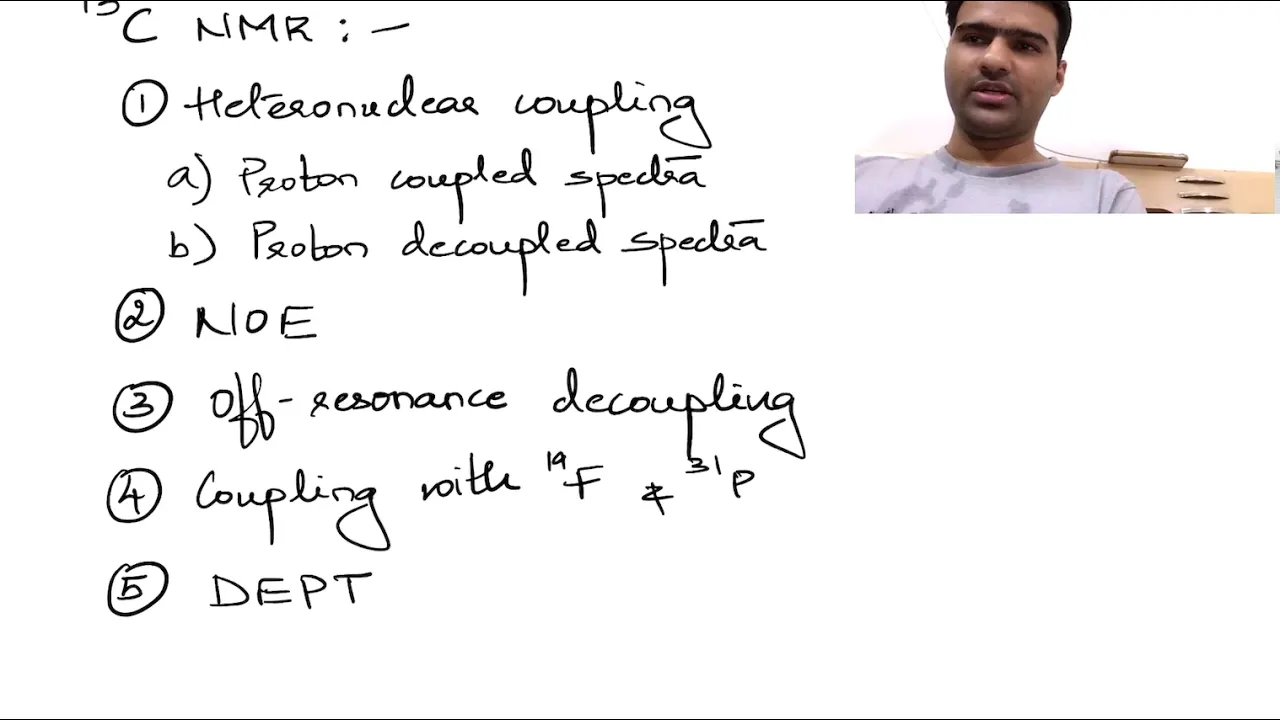







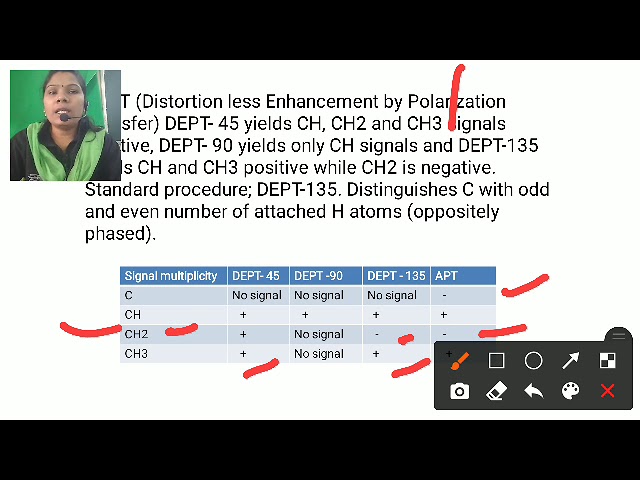



DEPT (Distortionless Enhancement by Polarization Transfer) NMR spectroscopy is a specialized carbon NMR technique that reveals the number of hydrogen atoms attached to each carbon atom in a compound, allowing chemists to distinguish between CH3, CH2, CH, and carbons with no hydrogens; the 45-degree spectrum shows all carbons with hydrogens, the CH spectrum shows only carbons with one hydrogen, and the 135-degree spectrum shows CH/CH3 carbons pointing up (odd hydrogens) and CH2 carbons pointing down (even hydrogens), enabling complete molecular structure determination when combined with regular carbon NMR and hydrogen NMR data.
Understanding DEPT NMR: Identify Carbon Types via 13C Spectroscopy
Added:Fundamental principles of Nuclear Magnetic Resonance (NMR) spectroscopy, including nuclear spin, resonance, and chemical shifts.
Basic understanding of 13C NMR spectroscopy, specifically why 13C signals are typically proton-decoupled to yield single peaks.
Classification of carbon atoms in organic molecules, distinguishing between methyl (CH3), methylene (CH2), methine (CH), and quaternary (C) carbons.
The concept of spin-spin coupling (J-coupling), specifically heteronuclear coupling between 13C and 1H nuclei.
Interpretation of DEPT-45, DEPT-90, and DEPT-135 sub-spectra to systematically assign carbon identities in complex molecules.
Introduction to 2D NMR spectroscopy correlation techniques, such as HSQC (Heteronuclear Single Quantum Coherence) and HMBC (Heteronuclear Multiple Bond Correlation).
Comparing DEPT with other carbon-editing NMR experiments, such as the Attached Proton Test (APT).
Application of combined 1H, 13C, and DEPT NMR data to solve and elucidate the structures of unknown organic compounds or natural products.
1.1K views41likes7:19Original Release: 2023-01-19
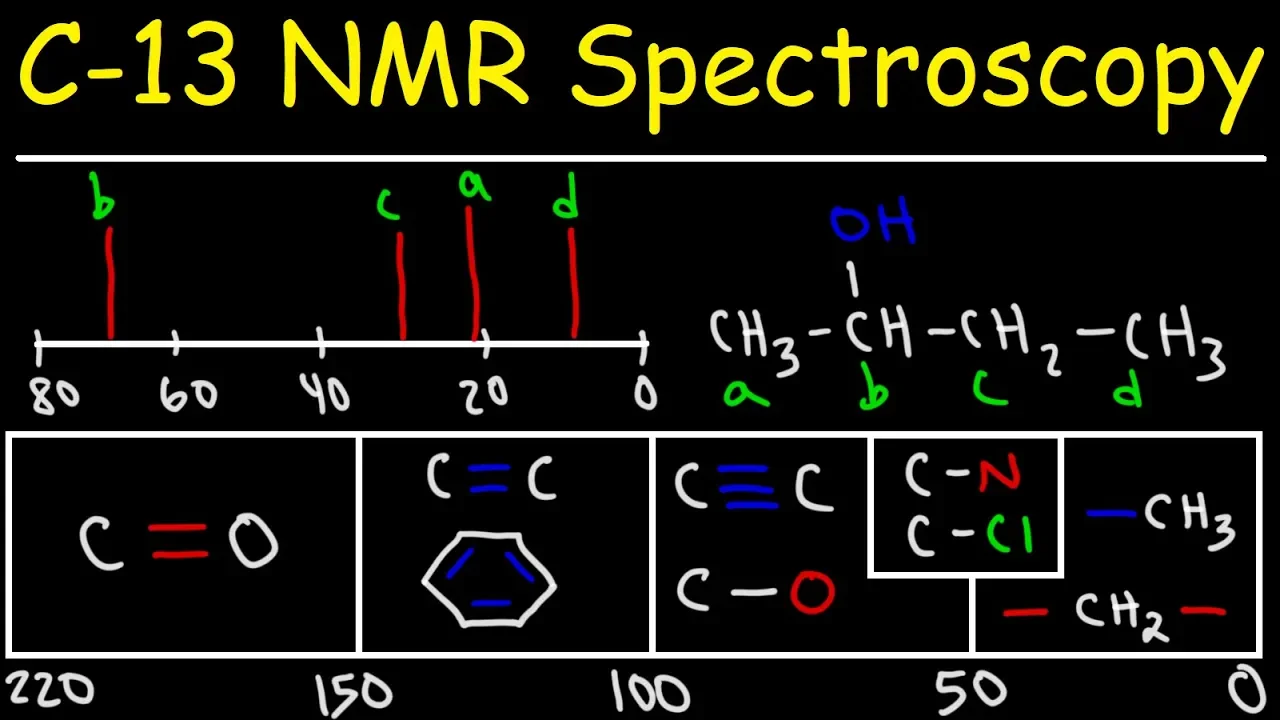
have I got a trick for you now that we've seen in the carbon NMR it's telling us how many types of carbons we have there's a trick we can do with a carbon NMR is called a running Adept spectrum d-e-p-t and that allows us to see on every carbon atom how many hydrogens are there is it a ch3 or a ch2 or CH or a carbon with no hydrogens that's going to be huge for us to figure out what our molecule is let's take a look in that last video we looked at this compound right here there were five different carbon atoms in them in this compound one of the carbons labeled C is a carbonyl between 150 and 200 two of them were double bonded carbons between 100 and 150 and two of them were regular carbons between 0 and 50.
that's a regular carbon 13 NMR that's what it looks like sometimes called the zero degree carbon NMR think about looking at it straight on now you can also run What's called the depth Spectra Dept d-e-p-t it's a special kind of NMR carbon NMR we run it three more times in in effect we're looking at it at different angles and starting to look at our peripheral vision of the detector and you see these Peaks a little bit differently at these different angles sort of that's what's going on that's good enough for our case today what I want you to know is for these different locations they tell us something about the carbons that we saw on the regular carbon NMR in this spectrum the 45 degree one which is usually at the bottom of these three this one shows us all carbons with hydrogens on it every carbon that has a hydrogen this one is only those with one hydrogen only on it only ch's carbons with one hydrogen and the 135 degree a peak points up if it has a ch3 or CH an odd number of hydrogens and it points down if it has a ch2 okay even but only ch2s carbons with no hydrogens don't show up at any of these so let's take a look at each of these Spectra okay now the bottom one only carbon atoms with hydrogen show up so you end up getting a spectrum that looks like this this one shows up this one shows up this one shows up and this one shows up so e shows up again D shows up so e ch3 has hydrogens D ch2 has hydrogens a ch2 has hydrogens B CH has hydrogens C carbonyl with no hydrogens it does not show up ah so we're saying these have hydrogens but this one does not so this one being out around 200 is probably a carbonyl and it has no hydrogens on it it's not an aldehyde all right so that tells us which carbons don't have hydrogens and which ones do this one are only those with one hydrogen show up so a with a ch2 it won't show up because that's two not one B with the CH yes it shows up and all these are in the same location hopefully I can line them up but that's a CH it shows up C no hydrogens on it it's not a CH it does not show up D ch2 that's not a CH there's too many hydrogens on it it does not show up e ch3 it won't show up so B is the only Peak I see in this one ah I know that B has one hydrogen on it and some other thing oh and it's a double bond it's in my double bond region okay now sometimes don't get fooled that sometimes you might see a little tiny Peak for some of these others where if it was a strong Peaks originally you could still see a little bit out of your peripheral vision but not a lot so it would be very strong as big as it is always was if you're going to see it since I don't see very much of it don't worry about little tiny things out there b would be the only thing I see here right now this one again my carbonyl doesn't show up in any of these because it doesn't have any hydrogens B with a CH it points up a with a ch2 it actually points down below the Spectrum so that's a key indicator if it points down below the Spectrum that's a ch2 c doesn't show up no hydrogens D ch2 which way do you think it points down below that's right and E ch3 odd number of hydrogens it points up all right so let's see what that tells me A and D ah those are ch2s easy and this one's in the double bond region it's got a double bond on it and D is a ch2 but a regular kind of ch2 no double bond how about e so I know what each of these are how many hydrogens are on them e here's how I would have interpreted that one let's see it's got hydrogens on it it's either an odd number of hydrogens because it points up it's a CH or ch3 but it does not show up here with the chsr ah it must be a ch3 so we have a methyl for e now I know every carbon atom I know how many hydrogens are on it I know if it's a carbonyl if it's a double bond or a regular one now I can go to the hydrogen NMR and make sure this methyl and this ethyl or this ch2 and ch3 are together by being a triplet quartet pattern I can make sure these double bond ones are attached to each other which of course we know they have to be one's got a double bond the other one's got a double bond what else can it do but stick together right there like that so I can start to piece together what's next to what and figure out what my compound looks like that's what the debt tells me so I can get a regular carbon NMR see how many types of carbons I have I can get Adept which tells me how many hydrogens on each of those carbons and then I can go to the hydrogen tomorrow and put the whole thing together one of those you just got to memorize the bottom one the 45 all of them with hydrogens then just the CHS then up CH or ch3 odd numbers or Downs or ch2s and if they get them mixed up look for the one that might have some down ones in it you remember those are ch2s and everything else will start to fall into place hey I hope these videos are helpful for you if it's helpful for you to learn this organic chemistry watch another one of my videos and I hope uh to see you in another video
Up Next
4:43
Carbon-13 DEPT NMR: Determining Substitution Patterns
@mevansthechemist
52.8K views•2017-12-15
83:56
Biocatalysis and Catalysis in Islatravir Synthesis | Merck Webinar
@SCIwheresciencemeetsbusiness
675 views•2020-10-08
10:06
1H NMR: Determining Number of Peaks from Structure
@MSJChem
59.2K views•2017-04-06

17:31
Edible Water Bottles: A DIY Guide to Sodium Alginate Spherification
@ryan
10.5M views•2019-06-21
Related Study Plans & Knowledge Roadmaps
Structured learning paths in Chemistry
chemistry
Nuclear Chemistry: Decay, Meds & Fuel Cycle
01Introduction to Nuclear Structure and Radioactivity
02Decay Dynamics and Kinetics
03Radiation Interaction and Detection
+ 2 more learning modules
24h5 modules
Explore Roadmap
chemistry
Supramolecular Chemistry: Forces & Machines
01Foundations of Chemical Bonding and Intermolecular Forces
02Introduction to Host-Guest Chemistry
03Thermodynamics and Dynamics of Self-Assembly
+ 2 more learning modules
16h5 modules
Explore Roadmap
chemistry
Photochemistry: Excited States & Reactions
01Foundations of Light-Matter Interactions
02Molecular Orbitals and Electronic States
03Photophysical Processes and Jablonski Diagrams
+ 2 more learning modules
18h5 modules
Explore Roadmap
chemistry
Coordination Chemistry: Bonding & Properties
01Introduction to Transition Metals and Ligands
02Crystal Field Theory (CFT) and Geometry
03Magnetic Behavior and Spin States
+ 2 more learning modules
14h5 modules
Explore Roadmap