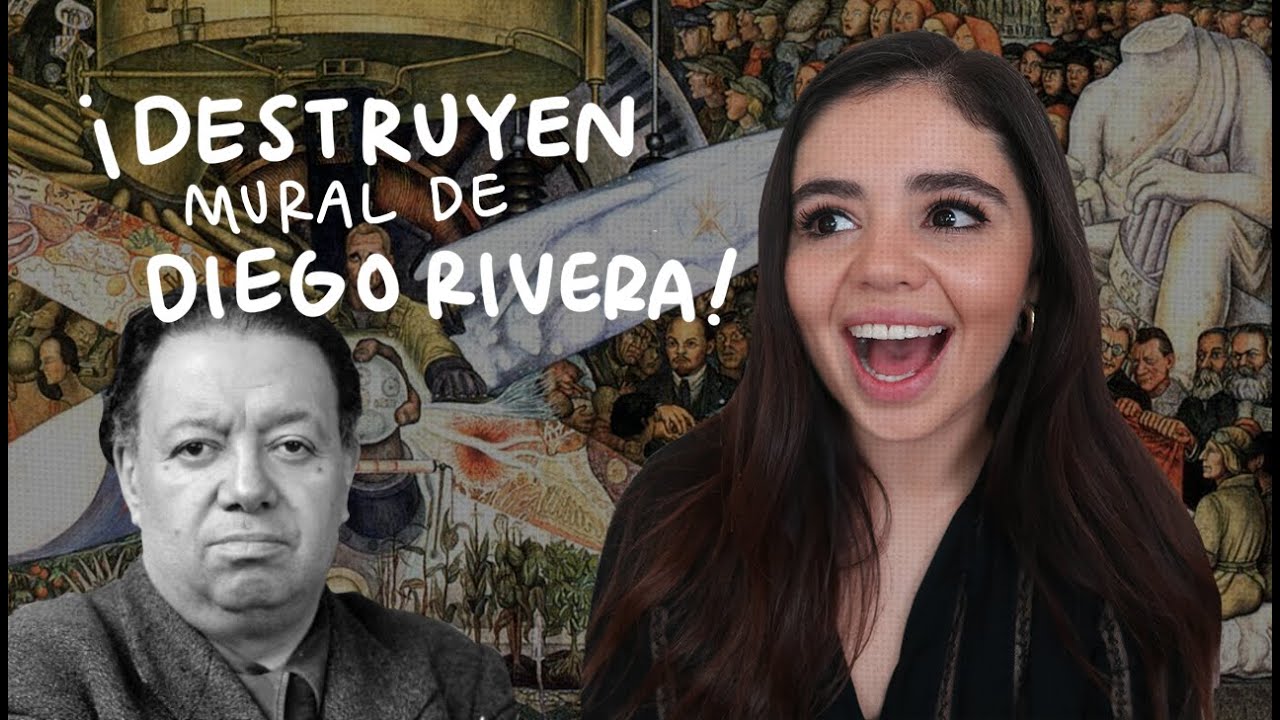
























Diego Rivera's 1934 fresco 'Man Controller of the Universe' at the Palacio de Bellas Artes in Mexico City represents a pivotal moment in Mexican muralism, where Rivera transformed his controversial Rockefeller Center mural into a powerful statement about humanity's technological capabilities and the critical choices facing society at the crossroads of the 1930s. The painting depicts a central human figure operating a giant machine, symbolizing humanity's control over both the cosmos and microscopic worlds through scientific advancement, while simultaneously presenting stark contrasts between war and peace, capitalism and communism, and the old classical order versus emerging ideologies. Rivera's placement of portraits—including Lenin, Trotsky, Darwin, and John D. Rockefeller Jr.—reflects his political sympathies and critiques of economic systems, while the broken classical sculptures on either side suggest the decline of traditional Western civilization. This artwork exemplifies how public mural painting serves as a vehicle for social commentary, raising enduring questions about whether technology will lead to greater equality or increased inequality, and whether humanity can wisely wield the immense power it has gained through scientific progress.
Diego Rivera's Man, Controller of the Universe: Mural Analysis
Added:(piano music) - [Voiceover] We're in The Palace of Fine Arts in Mexico City, surrounded by enormous murals by some of the most important mural painters in Mexico, including Orozco, Siqueiros and Diego Rivera.
- [Voiceover] And the idea behind the mural painters in Mexico in the 1920s and 30s was to create a truly public art in the public spaces of Mexico City and other cities in Mexico.
- [Voiceover] Mural painting can't be moved.
Unlike oil on canvas, it can't be bought and sold and put in a private home.
And so this is really for the people.
- [Voiceover] This is shortly after the Mexican Revolution, so this idea of establishing a new republic for Mexico that would distance it from its dictatorial and colonial past.
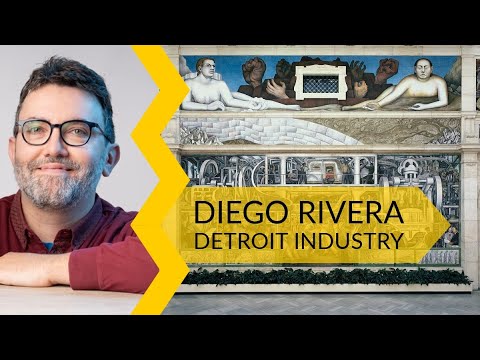
And this particular painting that we're looking at, "Man, Controller of the Universe," is a true fresco, that is it's painted directly on the wall with wet plaster.
- [Voiceover] What's really fascinating is that this is not the first iteration of this painting.
The first painting was commissioned by John D. Rockefeller Jr. for 30 Rock.
That is the jewel of Rockefeller Center.
John D. Rockefeller Jr. was one of the heirs to the great standard oil fortune and undertook major real estate investments like Rockefeller Center in the middle of Manhattan in New York City.
Now, Rivera was in the United States.
He had just received a large, one-man exhibition at the Museum of Modern Art.
And it's important to remember that John D. Rockefeller's wife, Abby Rockefeller, was one of the founders of the Museum of Modern Art.
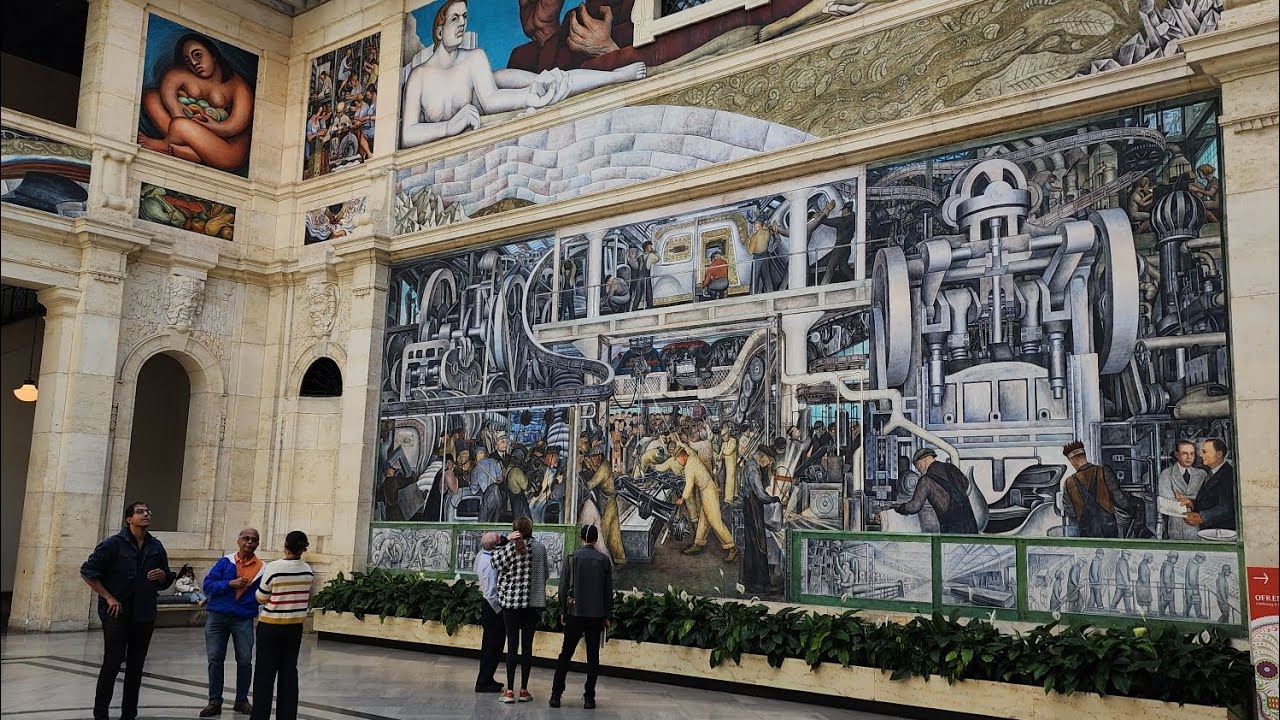
- [Voiceover] And Rivera had already painted murals in San Francisco, he had painted murals in Detroit.
And so here he is in New York City, in Rockefeller Center.
But that mural doesn't survive.
- [Voiceover] Rivera ran into problems because he included in the fresco images of Communist figures.
But, needless to say, Rockefeller was not thrilled with having Lenin in the lobby of his centerpiece, Rockefeller Center.
- [Voiceover] No, he's a capitalist.
He's the enemy of Communism.
- [Voiceover] And so he asked Rivera to remove the figures.
Rivera refuses, they come to a stand-off.
- [Voiceover] So the mural was destroyed.
This involved chipping away at the wall itself.
- [Voiceover] Rivera was paid everything that he was owed and he was locked out.
And then he gets the opportunity to repaint it here in Mexico City.
- [Voiceover] The original fresco is called "Man at the Crossroads."
Here in Mexico City, the redone version is "Man Controller of the Universe."
And I have to say I like that title better.
We have an enormous figure at the center who looks as though he's operating a giant machine and he appears in control of the universe.
But this is also the crossroads.
It's clearly a composition which is divided in two and this idea of which way will the future go in the early 1930s when this was painted, that was very much open question.
- [Voiceover] The 1930s was a time of tremendous strife.
You have Fascism rising in Europe, economic depression around the world, tremendous unemployment, deprivation and people looked at capitalism as the cause.
There had been speculation on Wall Street, there had been the stock market crash, and people were starving.
- [Voiceover] Could capitalism be replaced by a system that was more fair, that didn't just seemingly to the Communist benefit an elite.
- [Voiceover] And Rivera was very sympathetic to these ideas and we see this in this mural.
Let's take a close look at it.
The centerpiece, as you said, is man controller of the universe.
And look at that hand that's holding up this little orb that reflects in it a control panel.
The man is in the center of a large X that is constructed out of attenuated ellipses and in one we see the cosmos, we see the universe.
In the other, we see the microcosm, we see bacteria.
And, in fact, there are two huge lenses that frame the figure on either side.
Presumably, this is man's ability now to look at the great reaches of space and to look at the smallest life.
- [Voiceover] The great things that science has brought us, our ability to understand the stars and the planets and the galaxies and our place within that.
And the other great thing science brings us is that understanding of the microscopic world, which allows us to cure diseases.
The early 20th century is this moment of coming to terms with the amazing fruits of the Industrial Revolution and the Scientific Revolution.
- [Voiceover] At the top left, we clearly see war, we see soldiers in gas masks, we see a sky filled with planes and violence and fire.
- [Voiceover] And tanks in the distance.
- [Voiceover] On the right, we see Moscow, we see Red Square, we see the Communist workers of the world united.
And then on both left and right, we see these huge classical figures.
- [Voiceover] Sculptures that seem broken on the left, perhaps Zeus, who seems to be wielding a thunderbolt.
He wears a cross around his neck, perhaps suggesting that Christianity is just as false as ancient pagan religions.
And on the right, the broken sculpture has the symbol of the Nazis.
But there's this suggestion that of the old order fading away, the old classical structures that underpinned Western civilization no longer functioning.
- [Voiceover] And then we have a whole series of portraits.
On the right side, we see Lenin, we see Trotsky.
On the left, we see Darwin, and then, we see a group of the wealthy, completely unaware or uncaring of the suffering of the poor.
And, in fact, if you look very closely, you can see a portrait of John D. Rockefeller Jr.
Diego Rivera places him here in his anger at the destruction of his earlier artwork.
And it's been pointed out by some art historians that John D. Rockefeller's head is just at the bottom of some of the images of the microscopic world.
And some have suggested that the image just above his head is syphilis.
- [Voiceover] It's interesting to me is that on both sides we seem to have the promise of peoples of different ethnic backgrounds coming together.
If you look at the lower left, we see figures of different ethnic backgrounds being educated.
And on the right, we see Lenin, who's grasping the hands of people of different colors.
- [Voiceover] When I look at this painting, what I'm seeing is a man who's looking at all the chaos of the modern world, all of the advances, all of the tremendous goods, and all of the tremendous evils.
And he's trying to systematize it.
He's trying to understand it, he's trying to organize it in a way that makes sense in a world that must have felt to so many people like a top that was wobbling and was about to spin out of control.
- [Voiceover] We're still very much at these crossroads.
Technology is ever more important in our lives.
What will technology bring us?
A more egalitarian society, a world where everyone can be educated?
Or will it bring greater inequality?
These are still things debated today.
- [Voiceover] We are still grappling with the increasing power of the tools that we have built, the power that technology has given us, and the choices that we make in terms of how we wield that power.
(piano music)
Up Next

Diego Rivera's Epic History of Mexico Mural Explained
@ProfessorEstradaPhD
8.8K views•2023-07-25

Christian Iconography: History, Theology, and Meaning | Fr. Panayiotis Papageorgiou
@Trisagionfilms
58.8K views•2020-02-21

Redgrave's The Sempstress: Victorian Social Realism, 1846
@smarthistory-art-history
3.2K views•2011-10-22

Earliest Depictions of Jesus in Art: 10 Ancient Images Explained
@UsefulCharts
5.9M views•2022-06-03
Related Study Plans & Knowledge Roadmaps
Structured learning paths in Art History