





















Social media posts can constitute defamation when they make false statements that harm someone's reputation, and such posts can result in significant legal liability, as demonstrated by a North Carolina case where a woman was sued for $500,000 after posting on Facebook that another woman 'didn't get drunk and kill my kid,' implying the other woman was responsible for her son's death; defamation cases are difficult to win because the accused must prove the statements were false, and truth is always a valid defense.
Defamation Law and Social Media: A Case Study on Facebook Posting
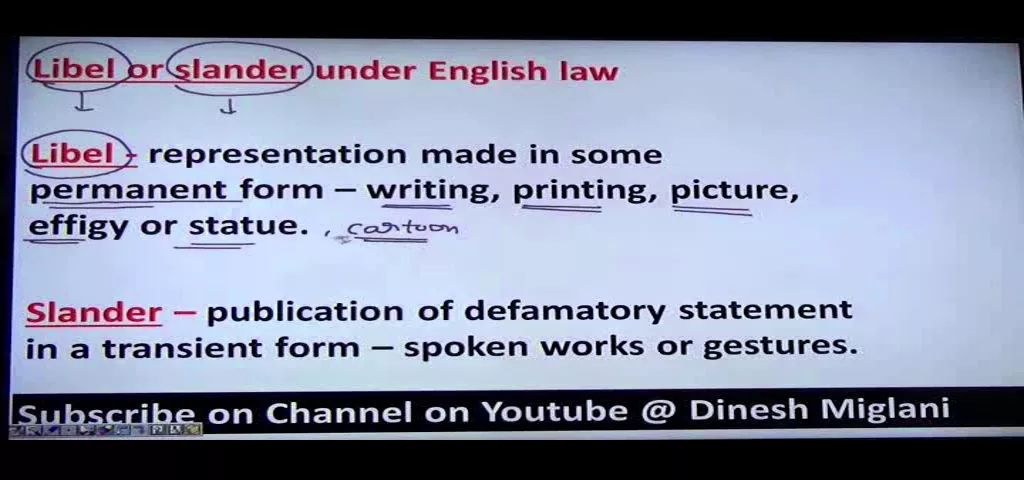
Added:The legal definition of defamation, including the distinction between libel (written) and slander (spoken).
The standard elements required to prove a defamation claim in a civil court (falsity, publication, fault, and harm).
The difference in standards of proof for public figures (actual malice) versus private individuals (negligence).
An understanding of how civil settlements function as an alternative to a full court trial.
The application of Section 230 of the Communications Decency Act and why internet service providers/platforms are generally immune from liability for user content.
The role and variation of Anti-SLAPP (Strategic Lawsuits Against Public Participation) laws across different state jurisdictions.
How courts calculate compensatory and punitive damages in online defamation cases.
Legal mechanisms for unmasking anonymous online posters, such as 'John Doe' subpoenas.
579 views9likes5:02Original Release: 2017-04-18
social medium hey how many times have I told you in these presentations to be careful about what you post on social media well if you needed another lesson here it is comes from a real case arising in North Carolina two women once upon a time they were vying for control of a radio station they knew each other once had been friends they had a falling-out long story short gal by the name last name Hammond and she made some comments regarding another woman who was a radio station general manager gain control of the radio station low wattage radio station North Carolina her last name was dial well Ms Hammond said at one point in time in a Facebook posting at least I didn't get drunk and kill my son well miss dial had an 11 year old son that years ago had died in a shooting incident involving another child there was no indication that she had been in any way involved nonetheless this comment by Miss Hammond certainly gave some indication that she Hammond thought that maybe dial was responsible for her own son's death well dial brought suit against Hammond for defamation saying that her reputation was horribly damaged as a result of this Facebook posting well the case went forward the case went forward and as it unwound well the gals finally decided to settle it have it over and done with but that happened only when miss Hammond agreed to pay 1/2 million dollars that's $500,000 to misdial in order to bring an end to this lawsuit substantial amount of money that was paid as a result of a Facebook posting well first of all let me also observe that that is a relatively unheard of amount of money to be paid in a defamation case period in a defamation case normally you don't see that kind of money being paid but that's because you have to look the history of defamation in the United States once upon a time well how did we get information now we got information out mainly through newspapers newspapers had a small geographic circulation then we had news getting out through radio broadcast then through television but very rarely in the history of mankind has one individual had the ability to get information out to the whole world on the worldwide web that's what happens when postings are made to social media in this instance we saw that this individual was very inflamed as a result of the comments that were made about her on Facebook sued and as a result a payment of half million dollars was made now generally in the United States defamation cases are very difficult and difficult for a variety of reasons let's say that Sally Jones says hey Jim Smith is a horrible father and a lousy husband well Jim Smith doesn't like that sues Sally Jones going forward on a defamation case truth is always the ultimate defense if you can prove that the statements that were made by the person being accused of defamation were actually true then there is no case there's no libel there's no defamation well in this case where we have Jim Smith saying hey I am a good father what does he have to do he has to jump up and offer proof I'm a good father I am a good husband Sally has to prove that she has information evidence that shows he is a lousy husband and a poor father case goes to trial and what do you have you have evidence being presented on both behalf and both basically are trying to produce evidence that says he is either a good guy or a bad guy he has to produce evidence saying I'm a good guy the person that made the statement says oh no he's really a bad guy and at the end of the day that kind of evidence is sometimes very difficult to obtain and many times the credibility of it is very much questioned at the end most people find pragmatically the defamation suits in the United States really are a no-win situation for the majority of people maybe we're starting to see change in that as a result of the social media and the ability to post things on the World Wide Web as I've said pay attention to what you post we bring you this case so we bring cases every week so you understand how the law works I'm David Allen you
Up Next

15:07
Alex Berenson's Twitter Ban Lawsuit: Section 230 and Free Speech Explained
@joerogan
1.2M views•2022-08-26

4:27
US Secondary Sanctions Impact on EU Businesses and Blocking Legislation
@Bureauvandijk
1.6K views•2019-03-20

5:27
Forensic Phonetics: Speaker Identification in Legal Cases
@nptel-nociitm9240
539 views•2025-03-19

24:42
Police Interrogation Tactics: False Confessions & Legal Reform
@LastWeekTonight
7M views•2022-04-18
Related Study Plans & Knowledge Roadmaps
Structured learning paths in Law
law
Self-Defense Law: Imminence & Castle Doctrine
01Foundations of Self-Defense Law
02Imminent Threat & Reasonable Belief
03The Principle of Proportionality
+ 3 more learning modules
12h6 modules
Explore Roadmap
law
Defamation Law: First Amendment & Actual Malice
01Introduction to civil torts and the First Amendment
02Elements of Defamation: Libel and Slander
03Public Figures vs. Private Individuals
+ 2 more learning modules
8h5 modules
Explore Roadmap
law
Hearsay Rule: Trial Evidence & Exceptions
01Introduction to Trial Evidence & Courtroom Basics
02Demystifying Hearsay: The Core Definition
03Non-Hearsay: Exclusions Under FRE 801(d)
+ 3 more learning modules
14h6 modules
Explore Roadmap
law
Medical Malpractice: Law, Liability & Care
01Foundations of Tort Law and Civil Liability
02The Four Elements of Medical Malpractice
03Defining and Proving the Standard of Care
+ 2 more learning modules
12h5 modules
Explore Roadmap