




















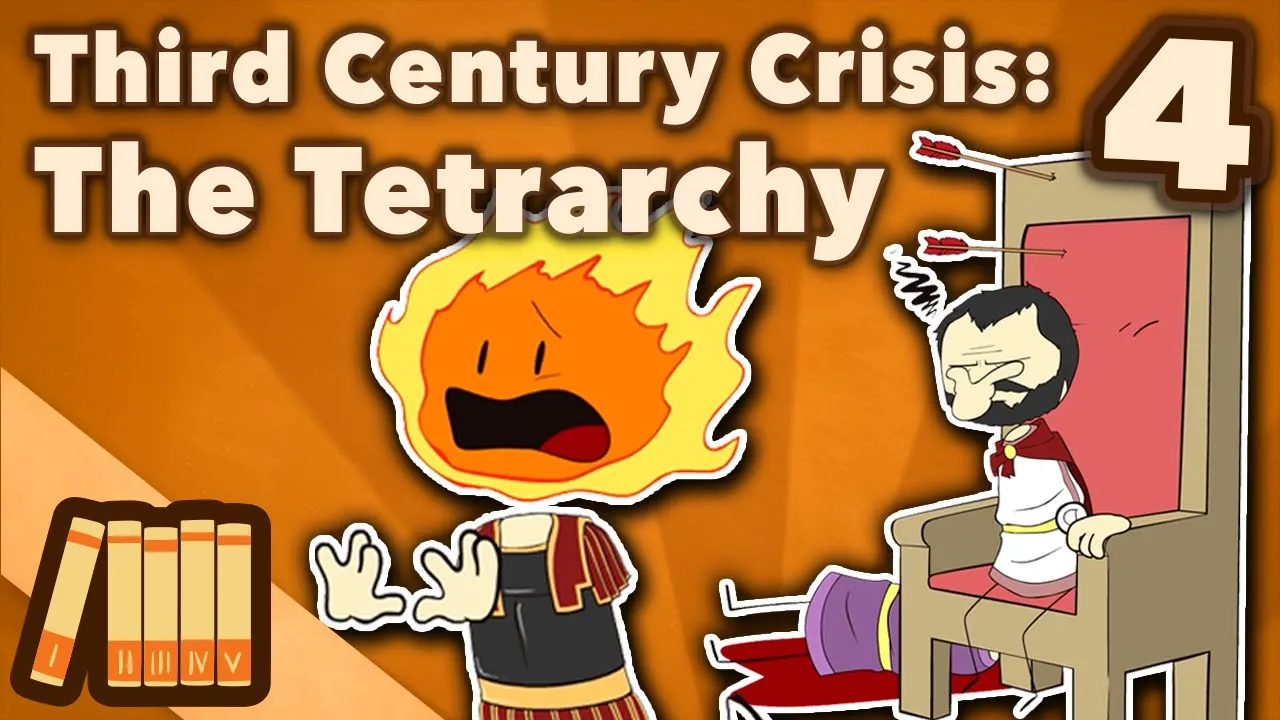



The Roman Empire faced a severe crisis from 235-284 CE characterized by invasions from Persia and Germanic tribes, political instability with over 30 emperors ruling briefly, and economic chaos through monetary debasement causing hyperinflation; Emperor Diocletian (r. 284-305) responded by implementing the Tetrarchy (a system of four rulers dividing the Empire into East and West), reforming taxation through bureaucratic assessment of productive units, and militarizing society, which successfully stabilized the Empire for approximately 100 years and established administrative and military frameworks that persisted in the Byzantine Empire until 1453 CE.
Crisis of the Third Century & Diocletian's Reforms (HIST 210) | Yale Courses
Added:The political structure of the early Roman Empire (the Principate) established by Augustus, including the traditional mechanisms of imperial succession.
The concept of the Pax Romana and the territorial boundaries (limes) of the Roman Empire during its peak in the 1st and 2nd centuries AD.
The role of the Roman military in provincial administration and its relationship with the Emperor, including the power of the Praetorian Guard.
Basic Roman economic foundations, particularly the system of coinage and the early practices of currency debasement.
The rise of Constantine the Great, the collapse of the Tetrarchy, and the civil wars that led to his sole imperial rule.
The legal recognition and eventual dominance of Christianity within the Empire, beginning with Constantine's Edict of Milan.
The founding of Constantinople (New Rome) and the formal, permanent division of the Roman Empire into Western and Eastern administrative halves.
The long-term efficacy of Diocletian's administrative reforms on the eventual collapse of the Western Roman Empire in the 5th century and the survival of the Byzantine Empire.
791.6K views0likes48:37Original Release: 2012-04-05
PAUL FREEDMAN: But the advantage of talking to you, even on an inconvenient day, is Diocletian.
We don't use terms in the professional world of history like awesome very much.
But the guy certainly deserves that.
He rescued the Roman Empire, and we'll begin by saying what he rescued it from.
As a preliminary, the sections are meeting this week.
If you're wait-listed for a section, just go to it.
We will have enough sections for however many people take this course, right?
So there are currently four.
The additional ones that were added since last week are Wednesday at 2:30 and Thursday at 7:00.
And again, if you're wait-listed, just go.
We'll figure this out.
There will be enough sections for everybody.
So I referred last time to the third century crisis.
A crisis of the Roman Empire that preceded the accession of Diocletian, from 235 to 284.
And we mentioned several interrelated weaknesses of the Empire that might be seen as long-term causes of this crisis.
The size of the Empire.
It's sheer, massive size.
The problem the succession.
That is, it was never quite clear, and we'll talk about this in more detail, how one emperor succeeded another.
The urban-rural imbalance.
This was an empire built on cities.
And to some extent, although heavily debated among historians to what extent, but to some extent, the cities may be said to have drained off the energy, or been parasites to the productivity of the countryside.
It was an empire that was, according to one point of view, more cosmopolitan than it had been, according to another point of view, more barbarian.
In other words, this was an empire whose Roman population was less dominant, partly through its own success in co-opting other peoples.
Some of the peoples that it co-opted we're not actually originally inhabitants of the Empire.
Particularly, this is visible in the armies, which tended to be staffed by so-called barbarian tribes.
So called by the Romans, who referred to them as barbarians.
Another problem is the East-West imbalance, where the East tends to do better economically and demographically than the West, demographically meaning population.
We live in a world where one of the great threats is over-population.
It is therefore not self-evident, although true, that for most of the time, historically, most places have trouble reproducing their population.
And indeed, we are starting to enter into a period of great demographic decline.
The infant mortality, the low life expectancy, the death of women in childbirth, the prevalence of disease, and to some extent, military threats of invasion, or if not threats, the reality, made it hard for one generation to produce children to replace itself.
And this is true up until the dawn of modernity.
So these are fundamental problems of the Roman Empire.
The real question is why do they explode in the third century?
And this is a question, as I think I said last week, with any great empire.
It's easy to point to the flaws in a complicated system.
Often size is one of them.
Often bureaucracy.
Often overspending on the military.
But some of these go on for a very long time, more or less success of successfully, despite the flaws.
And the Roman Empire went on longer than most, as we said.
The immediate problems that explode in the third century are invasions and succession.
Invasions by, first of all, Persia.
Persia is the old enemy of the Roman Empire.
Indeed, as many of you know, the old enemy of the Greek city-states that precede the Roman Empire as far back as the first historian of the Western tradition, Herodotus-- first week of directed studies, for those of you who are nostalgic for that experience-- Persia is the enemy.
Now we never study Persia.
It's kind of like offstage all the time.
And that's the great benefit of the Department of Near Eastern Languages and Cultures.
If you want to learn about Persia really from within, instead of oh, my god, the Persians.
And it's oh, my god, the Persians in 370 BC, [correction:470] and it's going to come to an end.
It is going to come to an end in the seventh century.
But that's because of Islam, just to anticipate.
But in the third century, Persia becomes resurgent.
Having been rather passive, it has this frontier with the Roman Empire in the East. More or less, buffer states are Mesopotamia, present-day Iraq, and Armenia.
It's not exactly the same as the present-day state of Armenia, but more like eastern Turkey.
The dynasty that controls Persia, and that is more aggressive than its predecessor are the Sassanids, and this appears in your reading.
The Sassanid Dynasty, the rulers of Persia, just more aggressive and more adventurous.
Beginning in 224, they start to probe that frontier along the Armenian and Mesopotamian border, and eventually cross it and start to wreak havoc in some of the eastern provinces of the Roman Empire.
The climax of this is the Emperor Valerian was captured by the Persians in 260.
Valerian actually one of the longer-reigning Emperor's of this chaotic period, 253 to 260.
They kept him for a little while.
Displayed him in chains, maybe flayed him.
Anyway, he died in captivity.
They did a kind of a job on him.
I think maybe he was flayed after he died, just not to be too gruesome, but I think they displayed the skin.
As I said, I'm not a Persian specialist.
But the second invasion is across the Danube-Rhine frontier.
The Danube and the Rhine form what the Romans thought of as a natural frontier with the barbarian states.
That didn't mean that they didn't cross them.
In fact, many of their great fortresses and establishments were on the eastern side of the Rhine.
But they considered those as bulwarks against a dramatic invasion across the Rhine.
The Rhine and the Danube almost meet-- the Rhine going from modern Netherlands down to Switzerland, and the Danube going also from Germany eventually Austria, Hungary, into the Black Sea.
As we'll see, Charlemagne, in the early ninth century, tried to build a canal between the two of them.
And there are actually traces of this immense and completely unsuccessful project.
And there now is a canal between them.
So this is sort of the frontier of the Roman Empire, and this is the line above which wine grapes are grown, [correction: wine grapes become scarce] no olive oil is pressed.
And it's got to be protected, but not worth conquering.
So we have pressure on the Rhine-Danube frontiers in the third century, and another Emperor, Decius, died fighting the Goths in 251, Decius.
And Valerian dies in 260.
So the Emperors are certainly out there as leaders, but that actually has to do with the fact that they're military guys.
And that is part of the problem.
The major problem besides the invasions was succession.
It depends on how you count-- is someone a real Emperor, or is he merely a pretender?-- there are at least 30 Emperors between 235 and 285.
Many of them ruling for months, most of them being killed.
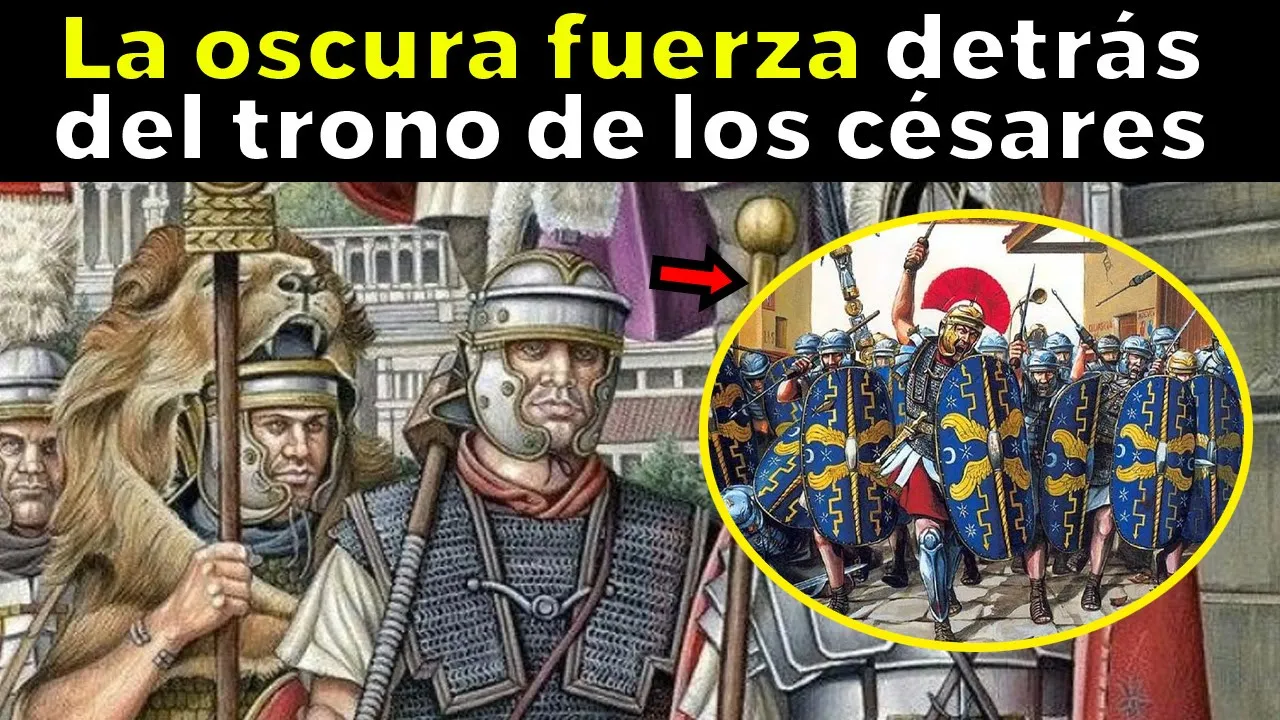
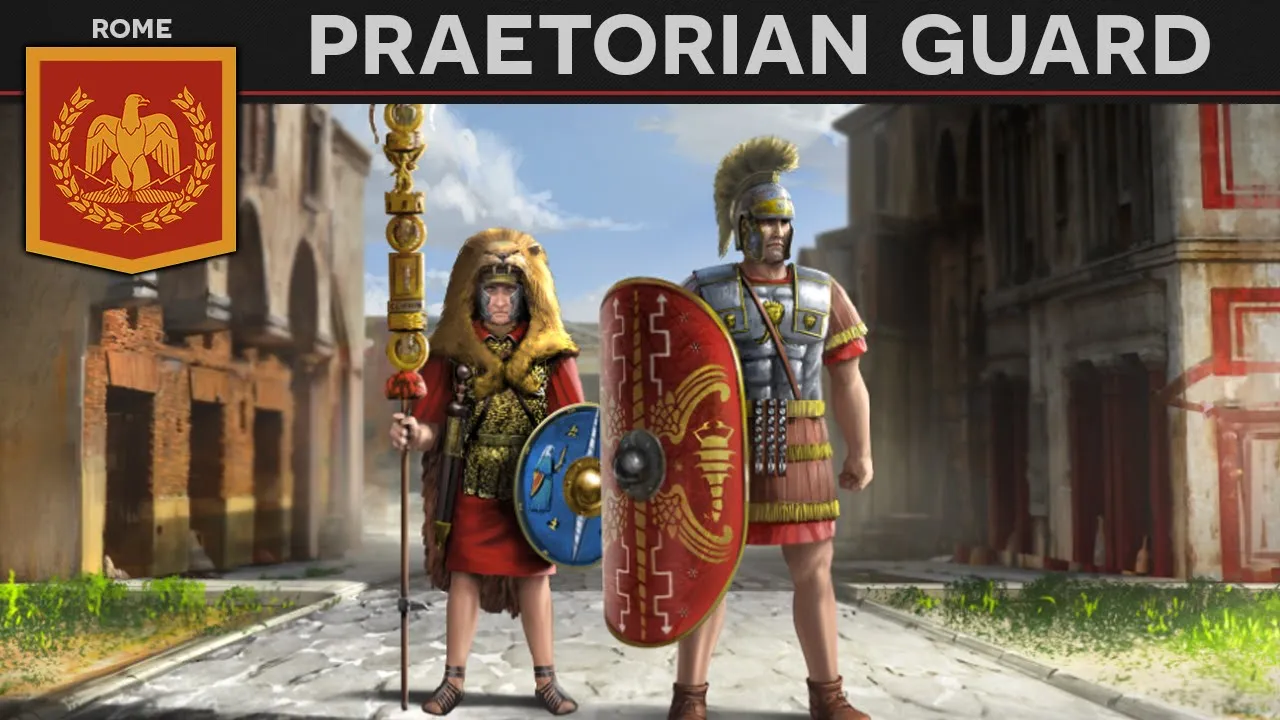
They're assassinated by the Praetorian Guard, that is, by their own troops.
They're killed in battle against foreign enemies, like Decius and Valerian.
They're killed in battle against other people claiming to be Emperors.
But the most common thing is they're assassinated by their own troops.
How had Roman Emperors succeeded each other?
There were several ways.
One is what you would expect, and that is dynastic.
But that's not all that common.
Dynastic, in other words, families rule.
And the family is recognized as a ruling family, and therefore it goes from father to son, or if there's no son, father to person daughter marries, or father to nephew, something like that.
But that was not actually so common.
Sometimes the next Emperor was chosen by his predecessor.
This is characteristic of the second century AD, the era of the so-called good Emperors.
In theory, this is a great system.
You have no family prejudice.
You simply, as a good Emperor, pick someone who looks to you like he's going to be a good Emperor.
So that is another possibility.
Another possibility is some guy is powerful, and uses his troops to take over.
And that's what we see in the third century.
We see not only the militarization of the Empire, but the interference of the army in raising successors, in raising new Emperors.
The army was able to make and unmake Emperors.
Just as in some countries with unstable political structures, the military is able to make and unmake rulers.
What is interesting about the third century is that they're able to do it far from Rome.
Some of these armies are in North Africa.
Some of them are on the frontier fighting the Persians.
Rome is becoming less and less relevant as the dominant city of the Empire.
And I mentioned that now, because we'll see on Wednesday the result of this is will be the establishment of another capital, a second capital in the East, in what would be called Constantinople, modern Istanbul.
Rome is fortified for the first time.
There is a wall that you can still see in many parts of Rome, built by the Emperor Aurelian in 271.
And this is a significant thing, because until 271 for centuries, Rome had not been walled, because it was not threatened.
And fortification in 271 starts to indicate things to come, or at least things that we know are to come.
Namely, barbarian invasions, just as the marginalization of Rome begins at this time.
Rome in the third century is ruled, if one can call it that, by a succession of generals.
Not members of an upper class elite, but men who have come from the provinces.
Men who are not particularly well-educated, who would have trouble recognizing a tag from Horace, there being no internet just to look these quotes up.
They hold the traditional Roman elite in contempt.
The Senate of Rome is the embodiment of that elite.
The Roman Senate is a collection of extremely wealthy people, from good families, extensive property, and very, very fine education.
The people leading in the third century now are generals raised by their troops.
One of the reasons that the troops both raised up generals, and then killed them, was that they tended to get a kind of reward from the new Emperor-- a thing called a donative.
A donative is money that you get when there's a new Emperor.
A bad idea from the point of view of the Emperors, because it encourages double-dipping, or triple-dipping.
OK, now we've gotten our money from this guy, let's kill him and get money from another guy.
I don't think that's too cynical to say that that is some of what is going on.
Now of all the crises of the third century, this is the one that leaves the most visible impression.
There's absolutely no doubt that there are all of these different Emperors, and that the top of the government is unstable.
The question is how much does that carry over into the lives of ordinary people?
One measure of the effectiveness of a civilization is that is survives, and even people don't comment very much on political instability.
In a way, we are testing that now.
For many people, the fact that the government is polarized doesn't really matter, in terms of their everyday life.
How long can that go on?
That's partly because all sorts of institutions are functioning perfectly fine.
Here we are.
We are meeting.
There's no problem of the supply of water suddenly, or scarce provisioning, or barbarians massed outside, and we have to sort of protect against during our class.
It hasn't come to that.
Yet.
But if you look at the lives of ordinary people in the third century, they are not saying not another Emperor, I can't take it anymore.
The philosopher Plotinus, for example, one of the great intellectual figures of this time.
Now it's true, he has a very otherworldly way of thinking about things.
He is a follower of Plato, he's the leading so-called neo-Platonist philosopher, flourishes during the third century, travels a bit.
But we never hear of any difficulty, any kind of problems raised by these unstable conditions.
The one that might have affected more people than the instability is inflation.
Roman coinage was silver and bronze, and based on ratios of these metals to gold.
The ultimate standard of value was gold, but bronze and silver had attributed values in relation to gold.
The need to reward the army with those donatives, and the dislocations of the invasions led to tremendous government expenditures.
And this was a society that did not have debt financing.
There are no bonds.
There are no ways of the government anticipating future revenues and borrowing money against them.
That is actually an invention of the Middle Ages.
This is an example of something that the Romans didn't have that Medieval cities in Italy pioneered, debt financing.
I don't have to tell you what that is.
And it's a great advantage, up to a point.
Great advantage, because it gives you leverage, allows you to do things now.
So how does a government deal with problems like this if it can't borrow money?
It does what is called debasing the coinage.
To debase, that is degrade, the coinage means that you just don't put in as much silver or bronze, let alone gold, and try to get people to accept it for its value anyway.
So up until the 1970s, the American currency was based on gold, and dollar bills were called silver certificates.
They said that you could hand this bill in for a dollar's worth of silver.
It was, technically speaking, not currency.
It was merely a representative of currency, which you could trade in.
And before that, of course, the coins were metal.
Dollars were both silver and paper, with the silver one being, in some sense, the more real.
It is in the nature of modern government financing that, at some point, the government could just say forget about it.
And even long before the 1970s, of course the government didn't have enough silver for everyone to trade them in, just as it doesn't have enough gold in Fort Knox to float the entire world's currency.
It has a lot.
And that's important that there be some real kind of value, or bullion, or bottom line kind of gold bars.
But the fact that it's not enough is not intrinsically a problem.
But here, so let's say the government receives, in the form of taxes and stuff, a thousand gold units.
And it issues two thousand units using that gold.
The coins say they're worth a unit, but they're actually, in terms of precious metal value, worth a half.
So it pays its expenses that way.
It pays the army.
It gets people to accept this money.
But when most people go to buy stuff, they are going to find that the stuff is 50% more expensive, because their coins are not actually very good.
The governments tend to do this gradually, hoping the people don't notice in the first place, or that if the inflation is say, 10%, it's not so bad.
But once having embarked on the debasement of the coinage, this tends to get out of control because of the famous Gresham's law-- an 18th century economist-- that bad money drives out good.
If I have good sestertia, or Roman currency, with the full measure of silver that they say they have, one full unit, and I've got other coins that say one full unit, but only have half, I'm going to try to get rid of the bad ones and hoard the good ones.
And only spend the good ones if I absolutely have to, or demand a premium on them.
So therefore, there are all these crappy coins circulating like mad, and the good ones retreat into peoples' wealth-- they don't really have mattresses then-- but into their store boxes, or under their beds, creating in itself more and more inflation.
So you have a fierce inflation.
Prices go up.
People don't know the value of things.
They start bartering.
And the Roman economy is very, very adversely affected, as hyperinflation tends to.
And a final problem is the ruin of the local elite, partly because of this economic chaos, but partly from deeper causes.
The importance of this is something that I alluded to last time, and that is that the Empire could not be held together, really, by the government, however big the government was.
It required the cooperation of wealthy people with ties to their native city.
It was these people who sponsored games, civic improvements, maintained the temples, and kept a kind of local order.
The third century crisis undermines this elite.
This elite is undermined by the militarization of society.
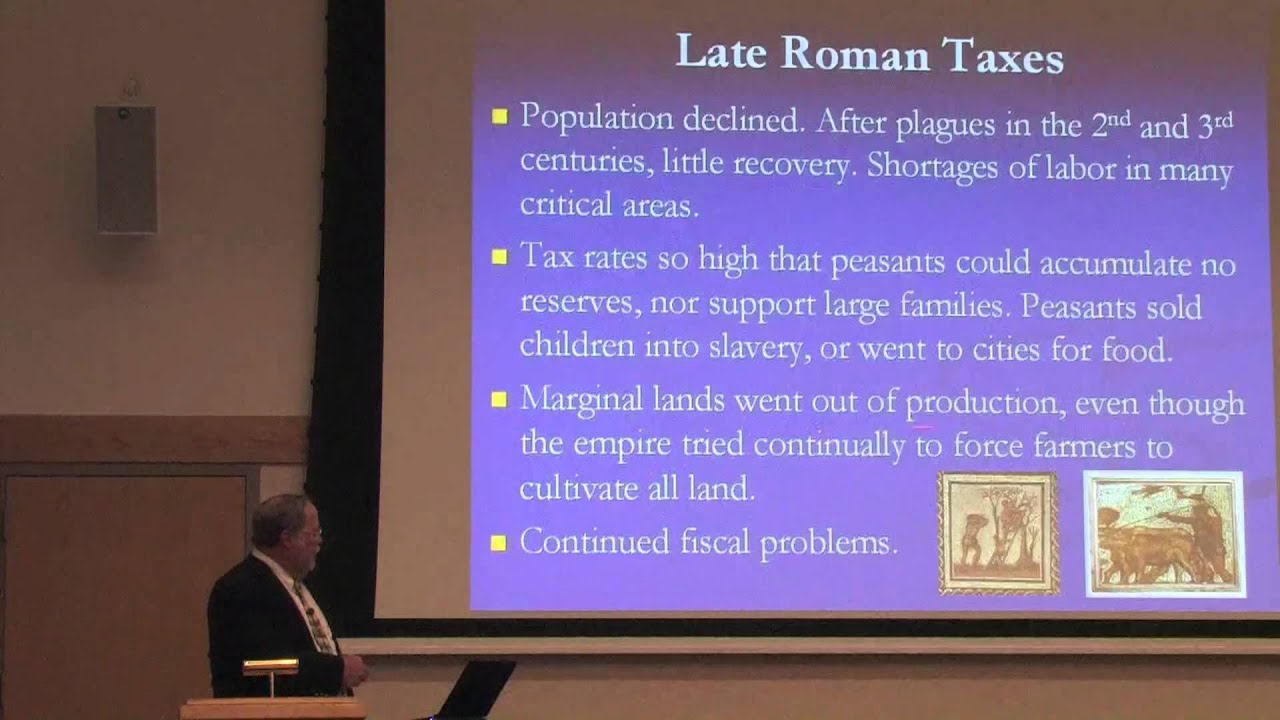
They are, to some extent, ruined by taxation and increased taxation.
They're just powerful enough to be well-off, but not powerful enough to evade taxation.
But they also tend to be undermined by an Empire that's more cosmopolitan, where local elites don't matter as much.
Where, for example, military people who move around a lot, are more important.
And I emphasize this, not only because of these elites themselves and their role in holding the Empire together, but we're going to talk about this when we talk about Christianity.
Because when the local elites are ruined, so is local religion.
And local religion means polytheism.
If I am of a grand family of, let's say the city of Sardis in Asia Minor, in modern Turkey, and I feel that my ancestors have always been involved in the worship of the goddess Cybele and I am a votary, or an officer, or like a member of the governing board of the club, or society that runs the cult of Cybele, I'm going to feel very loyal to that local deity.
But if I come from North Africa, and I'm in Sardis because that's where my army is, I'm not going to don't care about some local.
No more than you might care about a club that's important at Yale, if you went to the University of Illinois.
No more important than you might feel about pizza in New Haven, if you came from somewhere else and didn't like pizza.
It's just like this local cult, and you don't understand it, and you don't care.
So the kind of things you will care about, we'll see, religiously.
But they will tend to be religions that cross borders, like Christianity.
Religions that are not identified with one place and one god, in the sense of local god, local temple, my people.
So into this mess Diocletian-- because Diocletian defeats his predecessor, Carinus in battle in 284.
Diocletian is a general.
In 284, it would have seemed like more of the same.
But Diocletian rules until 305 and he abdicates.
He passes the power to someone else.
He is, however, very typical of the military class of the Empire.
He came from nowhere, socially.
He was the son of an ex-slave from Dalmatia, modern coastal Croatia.
You can still see his palace in the Croatian city of Split on the Adriatic.
His retirement palace, actually.
Under his severe guidance, the Empire was reformed.
And the way it was reformed was that it was, in effect, militarized.
Diocletian was not a great general, but he was a brilliant manager.
And he was a brilliant bureaucratic organizer.
I used the term bureaucracy, not to mean inefficient, useless administration, but administration.
Administration officers of the state, who are capable of doing their jobs, or maybe not capable of doing their jobs.
But who are nevertheless-- I'm not making a value judgment with the term bureaucracy-- I simply mean the proliferation of government and government offices.
Diocletian is responsible for the militarization of society.
That is, building society around the army in order to protect it.
And he is responsible for a more efficient, and ultimately, burdensome form of taxation.
The two are enlinked because, as we know, you have to pay to have a large and effective military.
Diocletian did not set out to be a revolutionary.
His aims were conservative.
He wanted to save, preserve, restore, the Roman Empire of the pre-235 era.
His methods were radical.
He was willing to undertake radical measures.
And the debate among historians, now somewhat muted.
Many historians at one time felt that he had basically destroyed the Empire.
By making it so bureaucratic, so militarized, so heavy-handed, in terms of government, it no longer was the Roman Empire.
It was something else.
Now the reason this is no longer exactly considered to be a big problem, or a big controversy, you'll see when we come to read Wickham.
The Empire has an impress on society.
There is what he calls the Burden of Empire, but it is, at the same time, not a totalitarian empire that controls everything.
Society has an identity that's different from the government.
So he has three goals.
One, solving this problem of the imperial succession.
Two, stabilizing the economy.
Three, protecting the frontiers.
Of these three, he's actually only really successful in the third, protecting the frontiers.
He devises a system, that we're going to talk about in a moment, of succession, but it does not really outlast him very long.
The economy does get fixed but, not exactly because of his policies.
What he's really successful at, and what changes most dramatically, is what rulership means.
That includes the figure of the Emperor, who becomes more sacred and more powerful, in terms of imagery, as well as administration.
Changes in the administration, of taxes in particular, and then that goal of his to change and grow the military.
The size of the army grew, probably doubled.
Maybe, just as a ballpark figure, from 200,000 troops to 400,000 troops.
This is a major, major increase that had to be paid for.
And it had to be paid for by taxation, and from a population not particularly eager to volunteer to pay more.
Ultimately, it looks as if Diocletian didn't so much increase taxation, as increase the efficiency of its collection.
In order to increase the efficiency of his collection, he had to increase the bureaucracy charged with monitoring the taxes.
And that means first making an inventory of taxable resources.
There is no income tax in this society because it's an economy based more on land than on salaries.
An income tax is easy because you can keep records of what people are earning.
The government, to this day, finds it much easier to take a portion of your wages, because it knows from your company what you're being paid.
If you're being paid in some other form, like you're a waiter, and a lot of your money is in tips, that's harder for the government.
If your wealth is in property, it's hard to put a value on that.
You own estates.
You have people who are free tenants, who rent land from you, and pay you in money, or produce, or labor.
You have some slaves.
You have a water mill.
How do you pay taxes on all of this stuff.
The opportunities for evasion are greater.
So the first bureaucratic tasks was just to have a lot of people could value things, who could come into a territory and say OK, this farm is worth so much, and it has these many people.
They develop a system to evaluate productive units of things like land, and population, and to tax them according to a formula.
So I have a lot of land, but it's not very good land.
I don't have a lot of people making a living off it.
I will be taxed at a lower rate than someone was maybe half that land, but twice the people, better soil, more clearance of forest, whatever the reason.
It changes.
So every 15 years, the government changes its estimation.
A second means, once you have this taxation system in place, of bringing the Empire together and dominating it more, is to have the army really have first call on the resources of the state.
We now start to have a state supply system for the army alone.
This allows the state to avoid dealing with that debased currency.
So for example, the state just goes in and takes wheat and gives it to the army, without taking money, buying wheat, giving that to the army.
Diocletian binds the Empire together, also very effectively, by a postal system.
Post in this case meaning a system of riders, horses, communications, that allows the Emperor to go faster than anyone else, to have news quicker than anyone else, to send orders quicker than anyone else.
And also, more punishment for things like tax evasion.
It's not just that people get killed for not paying their taxes, or imprisoned, or tortured, but that groups are responsible.
Not only that if I don't pay my taxes, I get punished, but if you and I live in the same village, and you don't pay your taxes, I get punished.
Or at the very least, taxed for the part that you evaded.
But the most important change in government is the establishment of what's called the Tetrarchy.
The Tetrarchy is the rule of four.
Four rulers Diocletian divides the Empire, first in two-- East, West. A very significant move that will have consequences for the next 1,200 years.
He then appoints a co-Emporer to rule in the West, while he rules in the East. And they each appoint a helper, number three and number four.
The two Emperors are called Augusti, Emperors, and the two helpers are Caesars.
So they're subordinate to their respective Augusti, and they're supposed to help them.
Why this system?
This is really to overcome the problems of size, communication, administration.
It's a statement that the Empire is too big for one man to rule.
But the chief Emperors are also exalted now.
There's no longer a pretense that they're just first citizens.
or princes.
They are clothed in purple.
They don't move a lot in public audiences.
We're familiar with this kind of dichotomy between the political figure as distant authority, versus the political figure at least pretending to be just like you and me.
We're in the era of the latter.
The Diocletianic period ushers in a period when the Emperor is distant, glimpsed, product of ceremonies, wearing a lot of very funny-looking, but fancy clothes.
He doesn't appear a lot in public.
He's a god.
You don't go up to him and shake hands, or say hi.
You throw yourself at his feet, and don't look at him until he tells you to.
So the tetrarchy, great idea, it really doesn't work.
Because, first of all, the Emperors don't necessarily cooperate.
The Caesars don't necessarily cooperate with the Emperors.
And so in 285 Diocletian nominates a Caesar, and then makes him, in 286, a co-Augustus.
And this man is named Maximian.
In 293, Diocletian and Maximian appoint two Caesars.
I think I'm not going to burden you with the personnel.
I will hand out something on Wednesday that gives you some of this information.
Diocletian and Maximian appoint Galerius in the East and Constantius in the Western-- you don't have to remember who these are-- and each of them marries a daughter of their respective Augusti.
This looks like a great system.
In 305, Diocletian and Maximian abdicate and then two people become Augusti.
The two Caesars rise up to be Augusti and they appoint their own new Caesars.
It breaks down beginning in 306.
One of the sons of one of these Augusti is not appointed, and he's mad, and he revolts.
And then the Augusti don't get along.
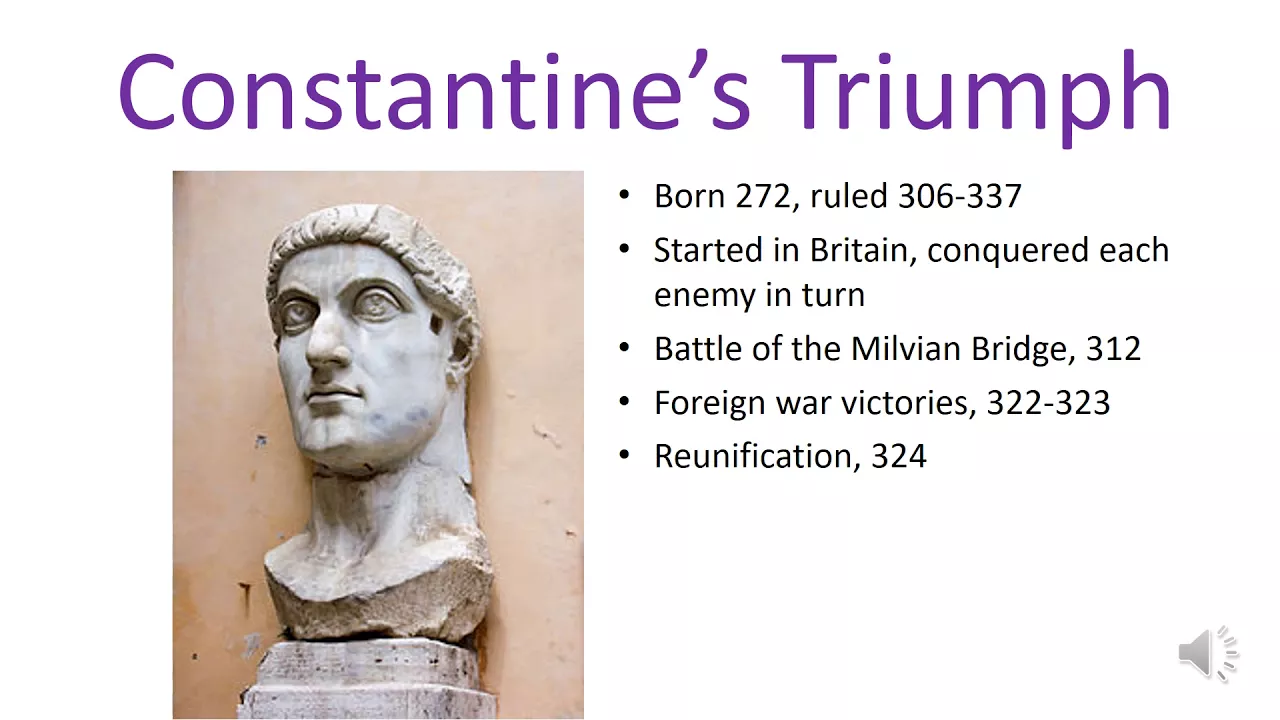
Out of this chaos between 306 and 312 emerges one Emperor.
And that is Constantine.
And we'll be talking about Constantine on Wednesday.
So the Tetrarchy fails.
Diocletian's second big initiative was over this question of the economy, and ways of combating inflation.
Diocletian issued a so-called edict on prices.
The edict on prices attempted to set a fixed price for goods.
And if you sold them for more than that, you were to be severely punished.
This is the kind of classic example of the state trying to combat inflation by dictating prices.
Most of you are not familiar with inflation, because we have lived in an era of very low interest and fairly stable prices.
But if you think of those commodities whose inflation you are familiar with, like petroleum, it is very dislocating.
It starts to create panics, and the panics then feed into the inflation.
Just as, if people keep on getting gas because they think that it's going to go up in price, then there's a greater demand for gasoline, and it goes up further in price.
Eventually, if the thing is really just speculative, it deflates again.
And that's what's happened with products that we're familiar with in recent times.
But there is also a kind of structural, longer-term inflation such as America experienced, for example, in the '70s.
And in theory, if you have resource crises and things that are becoming scarcer, then you ought to have more and more experience with inflation.
The government in the 1970s in the United States tried also to have an edict on prices.
Under President Ford, there was a kind of administration of maximum prices.
The problem with this is that it creates a temptation for black markets, creates a version of what we were just talking about with Gresham's law of coinage.
If you say that tomatoes can only be sold for a dollar a pound, then those tomatoes that are being sold for a dollar a pound in a climate of severe inflation will be terrible, will be rotten.
If you want to pay $2.00 a pound in secret, we have some nice tomatoes for you.
And if you want to pay $5.00 a pound, we have some really nice, locally-grown tomatoes for you.
All of which may be illegal, but the legal market is empty.
And this is what happened in response to the edict of prices.
This doesn't mean that the government cannot-- I mean it still remains debatable, obviously, the degree to which government can or cannot intervene in such things-- but certainly, in the case of the Roman Empire, this failed.
What did bring back a measure of economic stability is the reform of the taxation.
The fact that the state simply started getting in more resources, that less was being withheld by private people, and so the state could actually pay for its administrative and military costs.
So Diocletian succeeded in abdicating peacefully, spent his retirement in Split in his palace, and lived to see the breakdown, or the partial breakdown of the Tetrarchy.
And in certain respects, his policies clearly failed.
The edict on prices had to be abandoned, the Tetrarchy did not work, and Diocletian failed in trying to suppress Christianity.
We'll talk about this some more, but Diocletian, in the late part of his reign, a couple animals were split open to see what the future would be.
Right?
Isn't that what we all do if you want to figure out what's going to happen?
You slaughter an animal and check out its liver.
Maybe its kidneys and spleen, too.
But the liver is really what you want to look at.
And I don't exactly know what the animal was, what the organs were, and why they didn't splay out right, but the liver told Diocletian that the Christians were responsible for this, and that he'd better go after them.
So there is this big persecution of Christians in the first part of the fourth century.
And he certainly didn't succeed in that.
Not only did the Christians not crumble, but of course Diocletian's most effective successor, six years after he abdicated, would convert to Christianity.
But Diocletian is extremely important, and in many respects, extremely successful.
He did more than prop up a tottering Empire.
He did more than just transform a tottering Empire into a kind of tottering tyranny.
He saved the Roman Empire.
He saved the Roman Empire for 100 years.
When you take a course like this that goes for 700, 800 years, you start to hurl centuries around and get confused among them.
But any polity that exists for 100 years is fairly impressive.
Or a polity that looks like it's about to collapse, and then is restored for 100 years.
The Roman Empire, conventionally speaking, is thought to have collapsed in the West in the late fifth century.
In the East however, arguably, Diocletian's reforms last for more on the order of 1,200 years.
The Eastern Empire, the Byzantine Empire would fall in 1453.
And to its last day, it was modeled on Diocletianic administrative and military forms.
People at the time clearly thought that they'd been saved from disaster.
If you look at fourth century artifacts, things like mosaics on the floors of dining rooms, people often put mottos there.
And their mottos are things like "Joyful times everywhere." or "A world restored." The fourth century is interpretable as an era of increasing gloom, because we know that in the fifth century things are going to collapse.
But people in the fourth century are not saying to each other, I'm so glad I'm alive in the fourth century, because I don't want to see what's going to happen in the fifth.
They are just happy that the barbarians are back across the Danube and the Rhine, the Persians are more or less controlled along the frontier.
Yes, taxes are high.
Yes, the elite is some sort of riff-raff, and not as well educated, and they're military people.
But basically, things are working, prosperity is restored to the people who had been prosperous before, the local elites have declined, but it's not so visible as it had been.
But there are some changes.
Changes that we can, with the proverbial benefit of hindsight, see.
Changes in the center of gravity.
The dominant places are now places that are military bases.
They are great cities, with all the amenities of Rome.
That is, stadiums, gateways.
One of the best-preserved of these to this day is Trier in Germany.
Trier, on the Moselle behind [correction: west of] the Rhine, has a wonderful collection of Roman ruins.
A gateway, the Porta Nigra, a theater, a sports arena, a basilica, a law court turned into a church.
The reason trier was great was because of the frontier.
It was one of the most important cities in the Empire because of the military, because of its strategic importance.
And there are other cities that are like.
Milan, for example, becomes more important than Rome.
Because Milan is further north, it's a good place to get to the Danube and to the Rhine quickly, whereas Rome is buried in the Mediterranean.
So we're in a new world.
We'll discuss more of the new world on Wednesday.
And we will see that Constantine, in some cases, completely revolutionizes things.
And in other cases, continues Diocletian's work.
Up Next
44:42
John Law and the Mississippi Bubble: History of Paper Money
@PBoyle
487.3K views•2020-12-16

33:02
The Great Schism of 1054: Causes and Consequences
@SacredCathedrals
113.5K views•2026-02-19

46:32
Dutch and British Exceptionalism: Why They Rejected Absolutism | European Civilization (HIST 202) (56 chars)
@YaleCourses
183.7K views•2009-09-02
17:05
Understanding the Cold War: Superpower Conflicts and the Road to Détente
@OverSimplified
46.1M views•2019-01-24
Related Study Plans & Knowledge Roadmaps
Structured learning paths in History
history
Byzantine Iconoclasm: Theology, Art & Politics
01Foundations of Byzantium and Early Christian Images
02The First Iconoclasm: Leo III and the Crisis of Images
03Empress Irene, Nicaea II, and the Second Iconoclasm
+ 2 more learning modules
9h5 modules
Explore Roadmap
history
Iranian Revolution (Causes, Events & Legacy)
01The Pahlavi Dynasty and the Roots of Discontent
02The Spark of Rebellion and the Rise of Khomeini
031979: The Fall of the Shah and the Climax of the Revolution
+ 2 more learning modules
8h5 modules
Explore Roadmap
history
Mali Empire: Mansa Musa, Trade & Timbuktu
01Foundations of the Mali Empire
02The Trans-Saharan Gold and Salt Trade
03The Reign and Pilgrimage of Mansa Musa
+ 1 more learning modules
6h4 modules
Explore Roadmap
history
1947 Partition: Politics, Borders & Legacies
01Foundations of British India and the Divide
02The Political Negotiations and the Mountbatten Plan
03Drawing the Boundary: The Radcliffe Line
+ 2 more learning modules
8h5 modules
Explore Roadmap