


















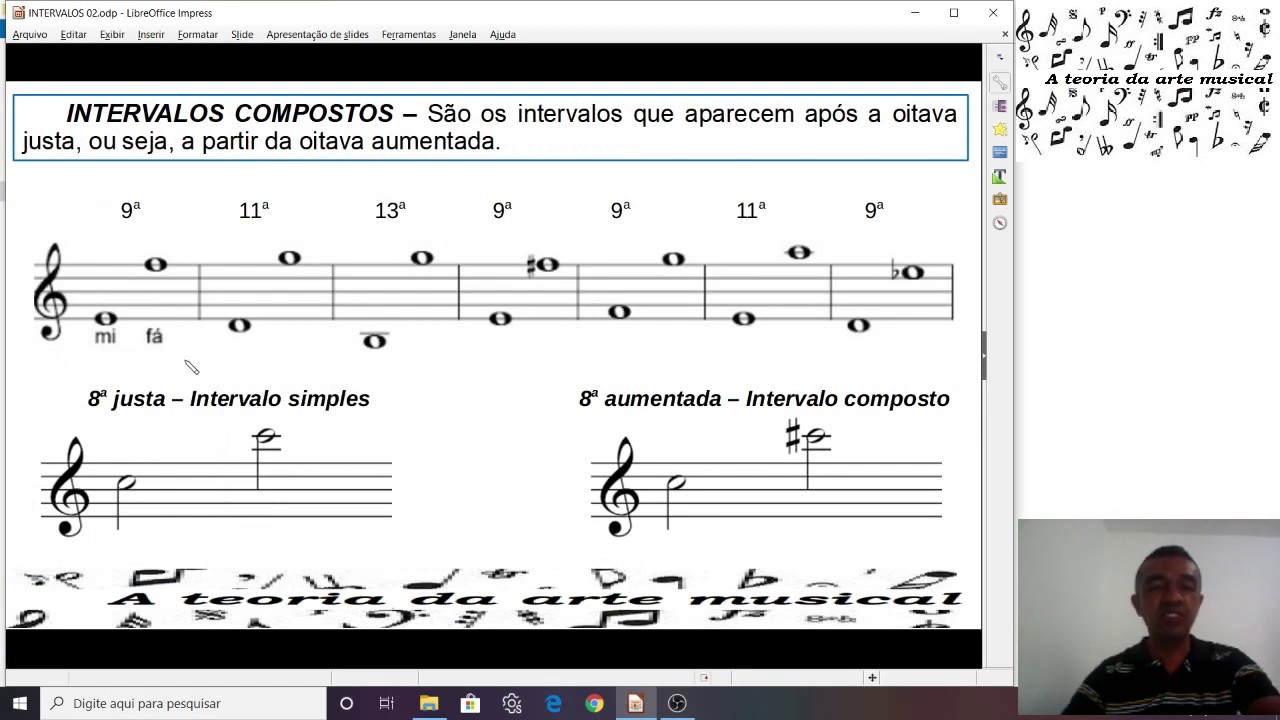




In music theory, intervals are the relationship between two notes, consisting of two parts: the distance (counted by counting lines and spaces on the staff, including the starting note) and the type (major, minor, perfect, augmented, or diminished). In a major scale, unisons, 4ths, 5ths, and octaves are perfect, while 2nds, 3rds, 6ths, and 7ths are major; in a minor scale, the 3rd, 6th, and 7th become minor (one half-step smaller), while the 2nd remains major. Augmented intervals are one half-step larger than major/perfect, and diminished intervals are one half-step smaller than minor/perfect.
Understanding Musical Intervals: A Music Theory Guide
Added:Understanding the musical alphabet (A through G) and how notes are represented on a staff.
The concept of half steps (semitones) and whole steps (whole tones) as the basic units of musical distance.
Familiarity with accidentals, specifically how sharps, flats, and naturals alter pitch.
A basic understanding of the major scale structure and how scale degrees are numbered.
Building and identifying triads (major, minor, diminished, and augmented chords) using combined intervals.
Understanding interval inversions and the rules for how intervals change when their pitch order is flipped.
Developing ear-training skills to aurally identify different interval qualities in musical context.
Exploring voice leading and how intervals resolve in classical and modern harmony.
742.9K views18.8Klikes6:03Original Release: 2017-12-13
This video builds on what we've learned so far in the Reading Music, Key Signature, and Building Scales videos.
So if you haven't seen those yet, please watch them first. Links are in the description.
In music, intervals are the relationship between any two notes.
[ding] [buzzer] The name of the interval has two parts. First, the type of the interval, and second, the distance the two notes are from each other.
To find the distance two notes are from each other count the lines and spaces on the staff separating the two notes including the line or space the first note is on.
For example, if we have this F and C on the treble clef, we will count the F space as one, the G line as two, the A space as three, the B line as four, and the C space as five. So the distance these two notes are from each other is a 5th.
Let's do another example in bass clef this time. If we have this B and D we will count the B line as one, the C space as two, and the D line as three.
So the distance these two notes are from each other is a 3rd.
Practice on your own finding the distances between two notes by counting the lines and spaces between them to get more comfortable with the process.
When first learning about intervals some teachers only want the distance of the interval and not the type, so definitely practice learning how to find the distance of an interval first before moving on to the type of intervals.
Now for the second part of any interval name: the type.
The type of an interval can be described with a number of different names, including: major, minor, perfect, augmented, and diminished.
Notice that all of these names also have a shorthand. Major is a capital "M," minor is a lowercase "m."
Perfect is a capital "P," Augmented is a capital "A," or a "+" sign, and diminished is shortened to "dim" or a small circle. [°] Let's take this C Major scale as an example to find the distances of the intervals between the tonic and the rest of the scale degrees.
The first interval is from the tonic to the tonic. You might think we would call this distance a first, but it has a special name.
The distance between any two identical notes is called a unison.
This is a unison, this a unison, and all of these are unisons.
Next, the distance between C and D.
If we count the C line as one and the D space as two, this is a distance of a 2nd.
Next, the distance between C and E. C line is one, D space is two, and E line is three.
So this distance is a 3rd.
We can repeat this process all the way up through the seventh scale degree where the distance between C and B is: one, two, three, four, five, six, seven.
So we would call this distance a 7th.
The last interval, from low C to high C, also has a special name.
This distance is called an octave.
An octave is the distance from one note to that same note name either higher or lower on the staff.
This is an octave, this is an octave, and all of these are octaves.
Now that we know the distances, let's label the type for each of the intervals.
In any major scale, the unison 4th, 5th, and octave are Perfect, and the rest of the intervals are Major.
So we have a Perfect unison (PU), a Major 2nd (M2), a Major 3rd (M3), a Perfect 4th (P4), a Perfect 5th (P5), a Major 6th (M6), a Major 7th (M7), and a Perfect octave (P8).
These intervals will be the same in any major scale.
Now let's look at a minor scale.
If you notice the distances stay the same. You can double-check by counting the lines and spaces.
However, some of the types of the intervals will change.
The unison, 4th, 5th, and octave remain perfect, but the 3rd, 6th, and 7th are now minor because a minor interval is one half-step smaller than a major interval.
This leaves the 2nd.
It stays a major second because the number of half-steps in the interval didn't change from the major scale to the minor scale.
So we have a Perfect unison (PU), a Major 2nd (M2), a minor 3rd (m3), a Perfect 4th (P4), a Perfect 5th (P5), a minor 6th (m6), a minor 7th (m7), and a Perfect octave (p8).
These intervals will be the same in any natural minor scale.
If we compare the intervals of the major and minor scales, we can see that the third sixth and seventh are the only intervals that change type from Major to minor.
The rest of the intervals stay the same.
So what about Augmented and diminished intervals?
Well, remember that minor intervals are one half-step smaller than Major intervals, and if we make a minor interval one half-step smaller it becomes diminished.
If we go back to the original Major interval and make it one half-step larger it becomes Augmented.
For Perfect intervals, it's a little different.
There is no minor version of a perfect interval.
If we make the perfect interval one half-step smaller it becomes diminished, And if we make the perfect interval one half-step larger it becomes Augmented.
I know there was a lot to unpack this episode, but if you start by practicing finding the distances of intervals before moving on to identifying the types, that should make it easier than trying to learn everything at once.
If you have any questions about today's video, or if you have any ideas for future music theory videos, please let me know in the comments below.
Thank you for watching. If you like the video, please give it a thumbs up and hit that subscribe button if you haven't already.
Click here if you want to watch more music theory videos, And if you would like to support the channel, please check out the Patreon link as well.
Thank you.
Up Next
14:41
Interval Numbers Made Simple: Music Theory Explained
@GracieTerzian
269.7K views•2021-04-12

10:20
Mozart's Musical Dice Game Explained: History, Rules, & Fun
@webpianoacademy
5K views•2023-03-13

47:36
Understanding Diatonic 7th Chords in Major Keys | Music Theory Tutorial
@GracieTerzian
54.7K views•2022-03-02
10:49
Understanding John Coltrane's Giant Steps: A Music Theory Analysis
@Vox
10.4M views•2018-11-12
Related Study Plans & Knowledge Roadmaps
Structured learning paths in Music Theory
music-theory
Composing Galant Music: Partimento & Schemata
01Foundations of Figured Bass and Keyboard Harmony
02The Rule of the Octave (Regola dell'Ottava)
03Galant Schemata: The Building Blocks of Form
+ 2 more learning modules
30h5 modules
Explore Roadmap
music-theory
Decoding Overtone Series: Tuning & Drone Music
01Acoustic Foundations: The Physics of the Overtone Series
02Tuning Systems: Equal Temperament vs. Just Intonation
03Microtonality and Spectralism: Beyond Standard Pitches
+ 2 more learning modules
24h5 modules
Explore Roadmap
music-theory
Impressionist Harmony: Scales, Planing & RPGs
01Foundational Music Theory: Keys, Intervals, and Seventh Chords
02Impressionist Color: Chord Planing and Parallel Harmony
03Whimsical Textures: Pentatonic Cascades and Whole-Tone Scales
+ 1 more learning modules
14h4 modules
Explore Roadmap
music-theory
Negative Harmony: Axis Reflection in Indie Pop
01Music Theory Foundations: Scales, Intervals, and Triads
02Functional Harmony and the Circle of Fifths
03Demystifying the Negative Harmony Axis Reflection
+ 2 more learning modules
16h5 modules
Explore Roadmap